ICU · Toxicology
NSAID, Opioid & Sedative-Hypnotic Overdose
Also known as Opioid overdose · Benzodiazepine overdose · Naloxone · Flumazenil · Sedative-hypnotic toxicity · NSAID overdose · Fentanyl toxicity · Z-drug overdose · Barbiturate overdose · Miosis coma differential
The overdose of the NSAIDs, the opioids and the sedative-hypnotics (the benzodiazepines, the barbiturates, the Z-drugs). The opioid toxidrome (the coma, the miosis, the respiratory depression, the hypotension) and the naloxone (the competitive mu-antagonist, the titrated-to-respiratory-effort, the half-life mismatch with the long-acting opioids and the relapse and the infusion). The benzodiazepine and the sedative-hypnotic overdose (the CNS depression, the flumazenil and the seizure caution). The NSAID overdose (the usually-mild, the seizures and the renal injury in the large).
On this page & tools
Your progress
Saved locally on this device.
Target exams
Overview & definition
The NSAIDs, the opioids and the sedative-hypnotics (the benzodiazepines, the barbiturates, the Z-drugs) are among the commonest overdose agents. The opioid overdose is the life-threatening (the respiratory depression) and the naloxone-reversible; the benzodiazepine overdose is the usually-benign and the flumazenil is the cautious; the NSAID overdose is the usually-mild.[1][1]
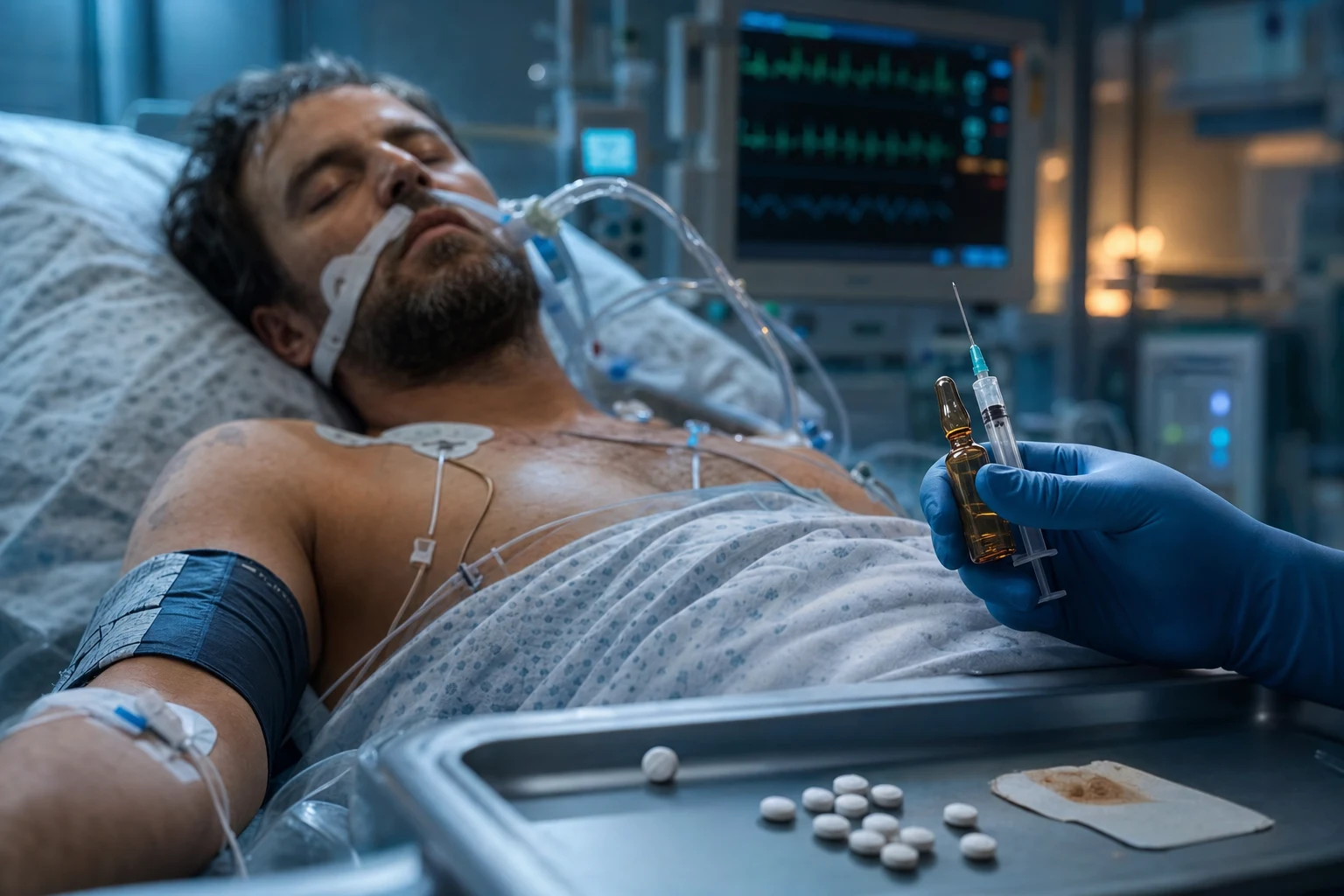
Pathophysiology by class — three receptors, three toxidromes
The three drug families in this topic act on three completely different molecular targets, and recognising which receptor is involved is the entire diagnostic and therapeutic exercise.[1][1]
-
Opioids → mu (μ) opioid G-protein-coupled receptor in the CNS. Agonism at mu receptors in the medullary respiratory centre abolishes the CO₂-driven ventilatory drive (the lethal effect) and at the Edinger-Westphal nucleus produces miosis (the diagnostic effect). Sedation, analgesia, euphoria, cough suppression, GI hypomotility and urinary retention complete the picture. There are three classical receptor subtypes — mu (analgesia, respiratory, miosis, euphoria), kappa (spinal analgesia, dysphoria) and delta — but in clinical overdose nearly everything of importance is mu-mediated, which is why a pure mu-antagonist (naloxone) reverses the syndrome completely. [1]
-
Benzodiazepines, Z-drugs, barbiturates → the GABA-A chloride channel — the major inhibitory receptor of the brain. Benzodiazepines are allosteric positive modulators (they increase the frequency of chloride channel opening only in the presence of GABA — which is why, alone, they have a ceiling and are rarely fatal). Barbiturates directly agonise the channel (they increase the duration of opening and work even without GABA — which is why they are genuinely dangerous, causing direct cardiovascular and respiratory depression). Z-drugs bind the same benzodiazepine-recognition site as benzodiazepines (selectively at alpha-1 subunits) and behave almost identically in overdose. [1]
-
NSAIDs → cyclo-oxygenase (COX-1 and COX-2) inhibition abolishes prostaglandin and thromboxane synthesis. In overdose this is largely trivial, but at large doses the loss of renal prostaglandin (which normally vasodilates the afferent arteriole) causes renal ischaemia, and some agents (especially mefenamic acid) have a separate pro-convulsant action unrelated to COX. [1]
The three receptor targets and their toxidromes
| Drug class | Molecular target | Lethal effect | Hallmark sign | Antidote |
|---|---|---|---|---|
| Opioids | mu-opioid GPCR (medullary resp centre, Edinger-Westphal) | Respiratory depression (apnoea) | Miosis (pinpoint pupils) + bradypnoea | Naloxone (mu-antagonist) |
| Benzodiazepines / Z-drugs | GABA-A (allosteric, frequency ↑) | Rarely fatal alone; respiratory depression only with co-ingestant | CNS depression, ataxia, slurred speech | Flumazenil (cautious — seizure risk) |
| Barbiturates | GABA-A (direct, duration ↑) | Respiratory + cardiovascular depression | Coma, hypotension, hyporeflexia, hypothermia | None — supportive; charcoal / haemodialysis for phenobarbital |
| NSAIDs | COX-1 / COX-2 inhibition | Usually mild; seizures + renal injury in massive | GI upset, tinnitus; seizures (mefenamic acid) | None — supportive |
The opioid overdose
The opioid produces the classic toxidrome:[1][1]
- The central nervous system — the coma, the miosis (the pinpoint pupils) — the hallmark (though the co-ingestion of a sympathomimetic or the severe hypoxia may dilate the pupils).
- The respiratory — the respiratory depression (the reduced rate and the tidal volume, the bradypnoea) — the leading cause of the death. The hypoxia and the hypercapnia.
- The cardiovascular — the hypotension (the vasodilation, the histamine with the morphine), the bradycardia.
- The other — the hypothermia, the hypotonia, the hyporeflexia, the GI hypomotility, the urinary retention. [1]
The agents: the heroin, the morphine, the codeine, the oxycodone, the fentanyl (the potent, the transdermal), the methadone (the long half-life, the QT prolongation), the tramadol (the serotonergic, the seizure risk).[1]
The opioid agents — a comparison
The opioid agents and their distinguishing features in overdose
| Agent | Relative potency | Half-life | Special features in overdose |
|---|---|---|---|
| Heroin (diamorphine) | ~2× morphine | 2–3 h (active metabolite 6-MAM) | IV/IM/inhaled; rapid onset; "track marks"; pulmonary oedema |
| Morphine | Reference (1×) | 3–4 h | Histamine release → urticaria, hypotension; active M3G metabolite accumulates in renal failure |
| Codeine | ~0.1× morphine | 3 h | Prodrug — CYP2D6 dependent (poor / ultra-rapid metabolisers vary); usually mild, often paediatric |
| Oxycodone | ~1.5× morphine | 3–5 h; SR formulation 12 h | Sustained-release → prolonged toxicity; observe >6 h |
| Hydrocodone | ~1× morphine | 4–6 h | Often combined with paracetamol — always check paracetamol level |
| Fentanyl | ~100× morphine | 2–4 h IV; patch depot 13–22 h | Lipophilic — large tissue depot; patch ingestion → prolonged, relapsing toxicity; recrudescent coma |
| Methadone | ~1× morphine (analgesic) | 24–36 h (up to 60 h) | Long half-life → naloxone infusion + observe >24 h; QT prolongation → torsades |
| Tramadol | ~0.1× morphine | 6–7 h | SNRI → serotonin syndrome + seizures; lowers seizure threshold; naloxone may worsen seizures |
| Buprenorphine | Partial mu-agonist, high affinity | 8–28 h (sublingual) | High receptor affinity → higher naloxone doses; ceiling on respiratory depression |
| Dextromethorphan | Weak mu; NMDA antagonist | 4 h | Dissociative state, serotonin syndrome, especially with MAO-I |
A few agent-specific traps deserve emphasis. Fentanyl is so lipophilic that a single IV dose is redistributed into a large tissue depot and can re-emerge; transdermal patches worn (or, worse, chewed/ingested) continue to deliver drug from a cutaneous reservoir for many hours after exposure stops, producing the classic "re-narcotisation" after each naloxone bolus wears off. Methadone combines a very long half-life (24–36 h, occasionally 60 h) with QT prolongation from hERG blockade — obtain a 12-lead ECG in any methadone overdose and correct K⁺/Mg²⁺. Tramadol is the opioid that breaks the rule: it is also a serotonin–noradrenaline reuptake inhibitor, so overdose can produce seizures (often multiple, self-limiting) and serotonin syndrome, and naloxone — by unmasking the serotonergic component — can paradoxically precipitate seizures (give naloxone for apnoea, but be ready to treat seizures and serotonin toxicity).[1][1]
Naloxone
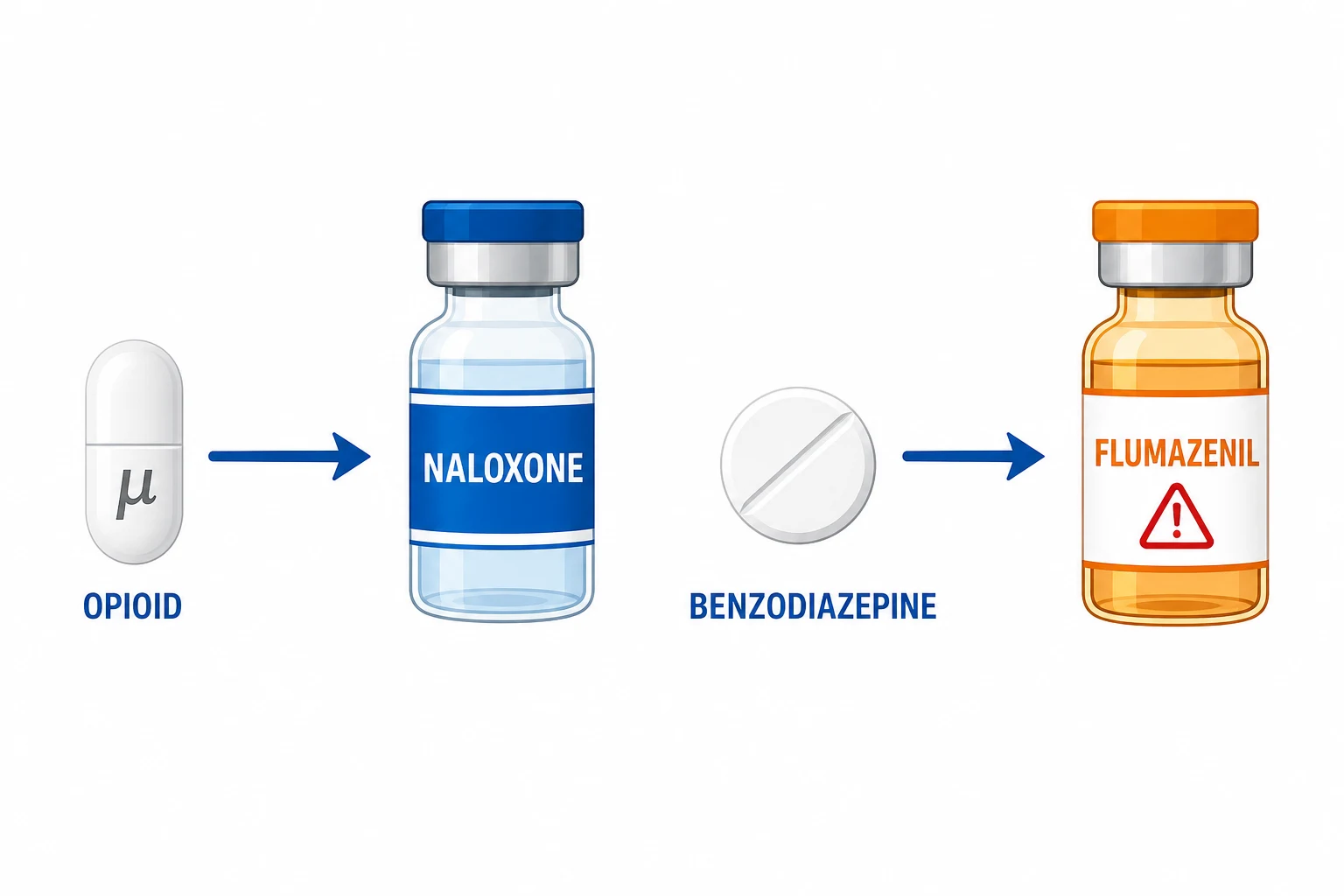
The naloxone is the competitive mu-opioid receptor antagonist — the specific antidote.[1][1]
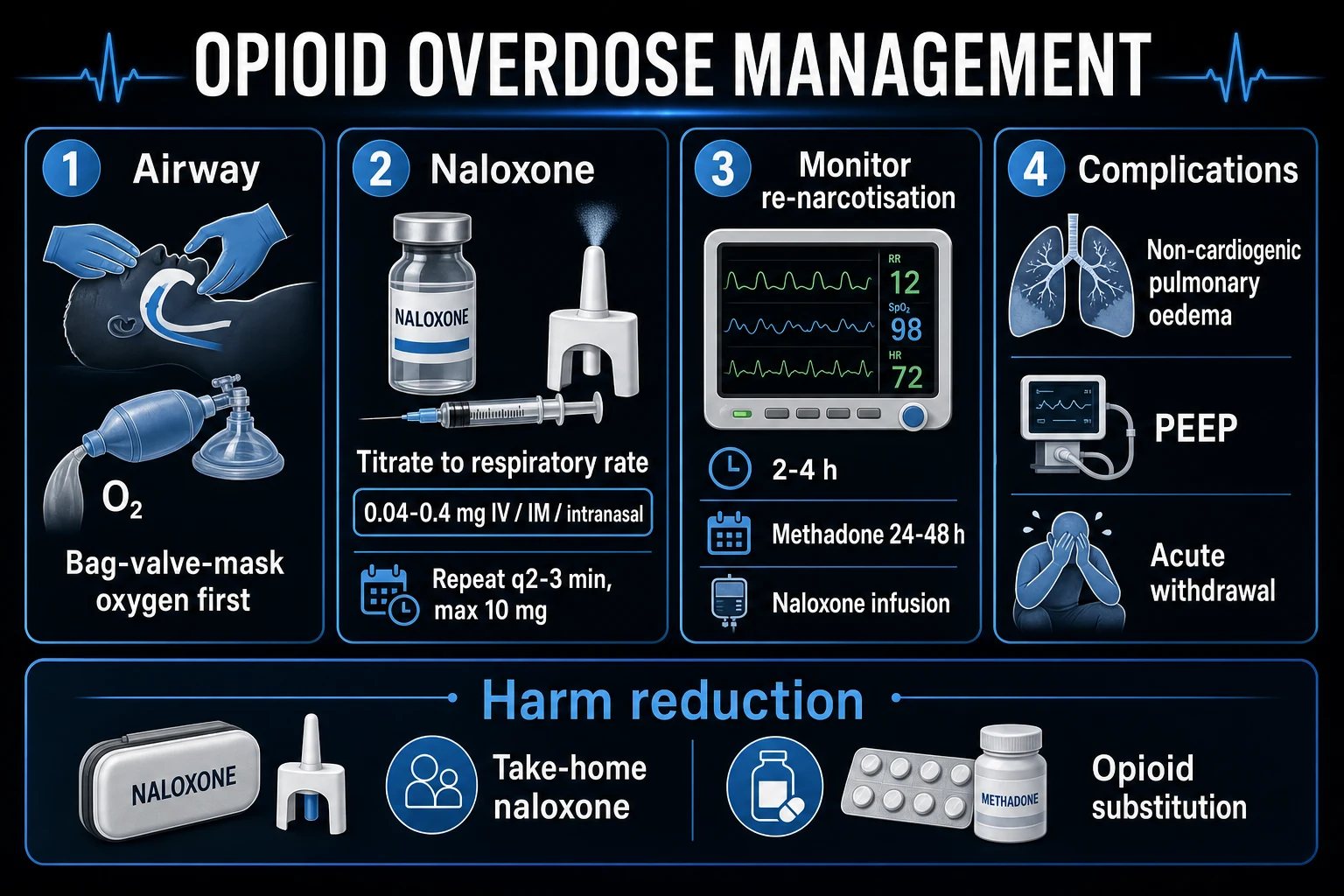
- The dose — the 0.04 to 0.4 mg IV (the IM or the intranasal in the community), the titrated to the respiratory effort (the not the full alertness — to avoid the precipitated acute withdrawal in the dependent). The onset within 1 to 2 minutes IV.
- The half-life mismatch — the naloxone half-life is 60 to 90 minutes, the SHORTER than the most opioids (the morphine 3 to 4 h, the methadone 24 to 36 h, the sustained-release oxycodone). The patient may the re-narcotise (the relapse) after the naloxone wears off — the observe for at least 4 to 6 hours (the long-acting opioids: the continuous naloxone infusion at two-thirds of the effective bolus per hour).
- The precipitated withdrawal — the agitation, the vomiting, the pulmonary oedema (the rare), the catecholamine surge. The avoid the over-reversal in the dependent. [1]
The titration principle — "narcotic overdose is a respiratory problem, not a consciousness problem" — is the single most important rule. The endpoint of naloxone is an adequate respiratory rate (above ~10–12/min) and an SaO₂ that is acceptable, not a fully awake, alert patient. Waking the patient up risks an explosive acute withdrawal (agitation, vomiting, aspiration, catecholamine surge, occasionally non-cardiogenic pulmonary oedema), and a patient who is comfortable at a rate of 12 with a saturation of 96% on room air does not need any more naloxone.[1][1]
The naloxone infusion protocol (for long-acting opioids)
For any ingestion expected to out-last the naloxone bolus — methadone, sustained-release oxycodone, fentanyl patch, sustained-release morphine — start a continuous infusion once the patient has been reversed.[1][1]
Naloxone infusion set-up
- Estimate the effective bolus — the total naloxone dose (in mg) that produced an adequate respiratory rate. e.g. if 0.4 mg IV reversed the patient, the effective bolus is 0.4 mg.
- Dilute — add two-thirds of the effective bolus, per hour, into 250 mL of 5% dextrose. For an effective bolus of 0.4 mg → infuse ~0.27 mg/h (≈ 0.27 mg in 250 mL at 250 mL/h is too dilute; practically, put 4 mg naloxone in 500 mL D5W = 8 µg/mL and titrate the rate to the respiratory rate).
- Practical recipe — 4 mg naloxone in 1 L of D5W (or normal saline) = 4 µg/mL. Start at two-thirds of the effective-bolus-per-hour. For a 0.4 mg effective bolus → start at ~270 µg/h ≈ ~65 mL/h.
- Titrate to the respiratory rate — target RR ≥ 12/min. Do NOT titrate to alertness. Re-narcotisation is the expected failure mode — increase the infusion rate, do not simply re-bolus.
- Re-bolus if needed — if the patient re-narcotises, give a bolus equal to half the effective bolus AND increase the infusion rate by 25–50%.
- Continue beyond the drug — keep the infusion running for at least 2–3 × the drug's half-life: typically 12–24 h for most opioids, 24–72 h for methadone and fentanyl patches.
- De-escalate — once the patient is breathing spontaneously at an adequate rate off stimulation for several hours, halve the infusion rate every 2–4 h and observe for re-narcotisation before stepping down.
Long-acting opioids and the fentanyl patch
Approach to the undifferentiated opioid overdose
Resuscitation of the suspected opioid overdose
- AIRWAY / BREATHING — bag-valve-mask ventilation with 100% O₂; the apnoeic patient reverses dramatically with naloxone. Do not delay ventilation for an antidote.
- CHECK GLUCOSE — every comatose patient gets a bedside glucose; hypoglycaemia mimics opioid coma and is missed at your peril. Give 50 mL of 50% dextrose IV (or 25 g) if low or if a level is unobtainable. Thiamine 100 mg IV if alcoholism/malnutrition suspected.
- NALOXONE TRIAL — 0.04 mg IV every 1–2 min, doubling each time (0.04 → 0.08 → 0.16 → 0.4 mg), titrated to respiratory rate. If no IV access: 0.4–0.8 mg IM or intranasal (4 mg IN commercially). Onset 1–2 min IV, 2–5 min IM/IN. If no response by a cumulative 10 mg, reconsider the diagnosis.
- EXAMINE THE PUPILS — but do not be falsely reassured. Miosis is the hallmark but is lost with severe hypoxia, anoxia, or co-ingested sympathomimetics.
- EXAMINE FOR PULMONARY OEDEMA — opioid-induced non-cardiogenic pulmonary oedema occurs in ~2% of heroin overdoses; treat with O₂, PEEP, and avoid naloxone over-reversal (catecholamine surge worsens it).
- OBTAIN AN ECG — methadone and oxycodone prolong the QT; check for torsades.
- DECONTAMINATION — activated charcoal 50 g PO/NG only after the airway is protected (the opioid patient re-narcotises and aspirates). For body-packer/stuffer: whole-bowel irrigation with polyethylene glycol and surgical consultation for bowel obstruction/perforation.
- OBSERVE / INFUSE — short-acting opioid with full recovery: observe 4 h. Long-acting opioid (methadone, SR oxycodone, fentanyl patch, sustained-release morphine): admit and start a naloxone infusion.
- LOOK FOR THE SOURCE — find the fentanyl patch (back, buccal, rectal, ingested); count tablets; check the medication chart (iatrogenic opioid accumulation in renal failure, postoperative PCA, palliative care).
The sedative-hypnotic overdose
The benzodiazepines (the diazepam, the lorazepam, the midazolam, the temazepam) act on the GABA-A receptor (the allosteric enhancement). The overdose produces the CNS depression, the ataxia, the dysarthria, the slurred speech, the sedation — but the relatively mild respiratory depression (the benzodiazepine alone is rarely the fatal). The co-ingestion (the alcohol, the opioid) potentiates the respiratory depression.[2][1]
The barbiturates (the phenobarbital, the thiopental) are the more dangerous — the direct GABA-A agonism, the severe CNS and the cardiovascular depression, the hypotension, the respiratory depression. The phenobarbital is the long-acting, the charcoal-and-the-haemodialysis-removable.[1]
The Z-drugs (the zopiclone, the zolpidem) — the benzodiazepine-receptor agonists, the similar-to-the-benzodiazepine profile.[1]
Benzodiazepines — the agent comparison
The benzodiazepine agents in overdose
| Agent | Onset | Half-life (parent + active metabolite) | Notes |
|---|---|---|---|
| Diazepam | Fast (IV 1–5 min) | 20–100 h (desmethyldiazepam) | Long-acting; accumulates in elderly/renal failure |
| Lorazepam | Intermediate (5–15 min) | 10–20 h | No active metabolite; preferred in alcohol withdrawal |
| Midazolam | Very fast (IV 1–3 min) | 1.5–3 h | Short-acting; the typical iatrogenic overdose (procedural sedation) |
| Temazepam | Slow (30–60 min PO) | 8–20 h | Common hypnotic; usually benign |
| Oxazepam | Slow | 4–15 h | No active metabolite; safe in liver disease |
| Clonazepam | Intermediate | 20–50 h | Anticonvulsant; long half-life |
| Alprazolam | Fast | 6–27 h (with metabolites) | High-potency; more withdrawal/seizures on cessation |
| Chlordiazepoxide | Slow | 24–100 h | Alcohol withdrawal protocol |
The benzodiazepine-only overdose is, in the great majority of cases, a watch-and-wait problem: support the airway, observe, and the patient will wake up. Death from a benzodiazepine alone is so unusual that it should prompt a search for a co-ingestant (alcohol, opioid, TCA) or a complication (aspiration, anoxia).[2][1]
Barbiturates — the dangerous GABA-ergic
Barbiturates act directly at the GABA-A channel (increasing the duration of chloride channel opening, and acting even in the absence of GABA), which is why they produce both profound CNS depression and direct cardiovascular toxicity (negative inotropy and venodilation). The classic severe barbiturate overdose produces the triad of coma, hypotension, and hypothermia with bulbar areflexia (loss of corneal, gag and deep-tendon reflexes) that can mimic brain death.[1][1]
- Phenobarbital — long-acting (half-life 2–6 days), weakly acidic (pKa 7.4) and therefore amenable to urinary alkalinisation (NaHCO₃ to keep urine pH ≥ 7.5) and haemodialysis (consider for severe toxicity, level >100 mg/L, or refractory shock). Multi-dose activated charcoal (50 g q4–6h) interrupts enterohepatic recirculation and shortens the half-life substantially.
- Thiopental / pentobarbital — ultra-short-acting induction agents; overdose produces rapid-onset apnoea and hypotension that resolves over hours as the drug redistributes. No role for dialysis (large Vd).
- Butalbital / butobarbital — intermediate; found in combination analgesics, often with caffeine and paracetamol — check the paracetamol level. [1]
Benzodiazepine vs barbiturate vs Z-drug in overdose
| Feature | Benzodiazepines | Barbiturates | Z-drugs (zolpidem, zopiclone) |
|---|---|---|---|
| GABA-A mechanism | Allosteric ↑ frequency | Direct ↑ duration (works without GABA) | Allosteric (alpha-1 selective) |
| Respiratory depression (alone) | Mild — rarely fatal | Severe — apnoea | Mild — similar to BZD |
| Cardiovascular depression | Minimal | Severe — hypotension, negative inotropy | Minimal |
| Antidote reversal | Flumazenil (cautious) | None | Flumazenil (cautious; usually not needed) |
| Enhanced elimination | No | Multi-dose charcoal, urinary alkalinisation, haemodialysis (phenobarbital) | No |
| Hallmark | Ataxia, slurred speech, somnolence | Coma + hypotension + hypothermia + areflexia (mimics brain death) | Sleep behaviour, parasomnias (zolpidem) |
Z-drugs — the hypnotic "Z"s
The Z-drugs — zolpidem, zopiclone, zaleplon — are non-benzodiazepine agonists of the benzodiazepine recognition site, selective for the alpha-1 subunit of the GABA-A receptor (responsible for sedation). In overdose they behave almost identically to a short-acting benzodiazepine: somnolence, ataxia, slurred speech, mild respiratory depression, and (rarely, with co-ingestants) coma requiring intubation. Two Z-drug-specific features are worth remembering:[1]
- Zopiclone — produces a characteristic bitter/metallic taste ("cinchonism") even at therapeutic doses, a useful diagnostic clue in the undifferentiated comatose patient. A mildly prolonged QT has been reported.
- Zolpidem — famous for complex parasomnias (sleep-walking, sleep-eating, sleep-driving) at therapeutic doses; in overdose, paradoxical agitation and a small risk of hallucinations occur. Reversal with flumazenil is effective but rarely required. [1]
Management of a Z-drug overdose is supportive — the patient will wake up. Flumazenil is reserved for the rare isolated iatrogenic/procedural over-sedation, exactly as for benzodiazepines.[1][1]
Flumazenil
The flumazenil is the competitive benzodiazepine-receptor antagonist. It reverses the benzodiazepine CNS depression, BUT it is the used with the caution (the NOT the empirical) because of the seizure risk:[2]
- The seizure is precipitated in the chronic benzodiazepine users (the receptor-dependent, the withdrawal), the co-ingestion of the pro-convulsant (the tricyclic, the theophylline), and the seizure history.
- The flumazenil is reserved for the isolated iatrogenic or the pure benzodiazepine overdose (the procedural over-sedation), the titrated carefully. The NOT given in the undifferentiated overdose.[2][1]
Flumazenil — when it is reasonable vs when it is dangerous
| Reasonable to use (rare) | Dangerous / contraindicated (the usual case) |
|---|---|
| Isolated iatrogenic over-sedation (e.g. post-MRI / post-procedural midazolam) | Undifferentiated overdose (unknown ingestion history) |
| Known benzodiazepine-naïve patient with pure BZD ingestion | Chronic benzodiazepine user (dependence → withdrawal seizure) |
| Reversal needed for an airway manoeuvre in a known pure BZD ingestion | Co-ingestion of a pro-convulsant (TCA, theophylline, bupropion) — BZD may be protecting against that seizure |
| Seizure history / epilepsy | |
| Mixed overdose where the BZD may be the only anti-convulsant on board | |
| Suspected body-packer / stuff-and-run (unknown content) |
If flumazenil is given and a seizure occurs, it is not reversed by further benzodiazepines (the receptor is occupied) — the seizure must be managed with barbiturate, propofol, or levetiracetam. This is the core of the caution. The half-life of flumazenil (40–80 min) is also shorter than most benzodiazepines, so re-sedation is expected.[2][1]
Approach to the undifferentiated sedative-hypnotic overdose
Resuscitation of the suspected sedative-hypnotic overdose
- AIRWAY / BREATHING — most BZD/Z-drug overdoses need only positioning, supplemental O₂, and observation. Intubate for GCS <8, loss of airway reflexes, or refractory hypoxia.
- CHECK GLUCOSE, PARACETAMOL, SALICYLATE, ECG — the "coma cocktail" in every undifferentiated overdose. A "sedative overdose" frequently turns out to be a paracetamol or TCA co-ingestion.
- DO NOT EMPIRICALLY GIVE FLUMAZENIL — in the undifferentiated overdose the benzodiazepine may be the only anti-convulsant on board, and an unmasking seizure is a catastrophe.
- ACTIVATED CHARCOAL 50 g PO/NG if airway protected and within 1–2 h of ingestion. Multi-dose charcoal (50 g q4–6h) for phenobarbital.
- HAEMODYNAMICS — IV crystalloid for hypotension; noradrenaline for refractory vasoplegia (especially barbiturates — the alpha-tone is lost). Warming for hypothermia.
- CONSIDER ENHANCED ELIMINATION for phenobarbital: urinary alkalinisation (NaHCO₃, target urine pH ≥ 7.5) and haemodialysis if severe (level >100 mg/L, refractory shock, prolonged coma).
- IDENTIFY THE AGENT — history, pill bottles, "patient pack", prescription records, family. A "hypnotic overdose" is often more than a hypnotic.
- OBSERVE FOR RE-SEDATION after any flumazenil — re-sedation is the rule (flumazenil t½ 40–80 min < most BZDs).
- PSYCHIATRIC / SOCIAL ASSESSMENT once awake.
The NSAID overdose
The NSAID (the ibuprofen, the naproxen, the diclofenac, the mefenamic acid, the indomethacin) overdose is the usually mild:[3][1]
- The gastrointestinal — the nausea, the vomiting, the abdominal pain, the gastritis (the prostaglandin inhibition). The mild GI bleed (the significant bleed if the anticolagulated).
- The central nervous system — the mild; the tinnitus, the headache at the high dose. The seizures in the large ingestion (the mefenamic acid, the massive).
- The renal — the renal injury (the prostaglandin-inhibition, the afferent arteriolar vasoconstriction) in the large, the dehydrated, the elderly, the chronic-kidney-disease.[3]
- The metabolic — the metabolic acidosis (the large), the hyperkalaemia.
The management is the supportive — the charcoal if the early, the fluids, the renal monitoring, the seizure control (the benzodiazepine), the PPI for the GI. The rarely the severe.[3][1]
The NSAID agents — a comparison
The NSAID agents and their overdose-specific features
| Agent | Typical toxic dose | Characteristic severe feature | Note |
|---|---|---|---|
| Ibuprofen | >400 mg/kg severe | Usually mild; seizures/acidosis only at massive doses | The benign outlier — most patients are observed briefly and discharged |
| Naproxen | >500 mg/kg severe | Seizures, renal injury, AKA | Moderate risk |
| Diclofenac | Variable | Hepatotoxicity (delayed, 24–72 h, like paracetamol) | Check LFTs; watch for delayed peak |
| Mefenamic acid | >25 mg/kg severe | Seizures (the classic cause) — self-limiting but dramatic | The most neurotoxic NSAID; the exam answer |
| Indomethacin | Variable | Headache, GI bleed, renal | Strong CNS effects even at therapeutic doses |
| Ketorolac | Variable | Renal injury, GI bleed (high dose) | Often parenteral — iatrogenic overdose |
| Aspirin (note) | >150 mg/kg | Salicylate toxicity — separate topic | NOT managed as a generic NSAID — see salicylate topic |
| Celecoxib (COX-2) | Variable | Sulphonamide cross-reactivity; renal | Less GI toxicity |
Two NSAID-specific syndromes deserve to be highlighted: [1]
- Mefenamic-acid seizures are the single most characteristic NSAID overdose feature. They are typically generalised, brief, self-limiting, and respond to benzodiazepines — but they are the reason mefenamic acid has a worse reputation than other NSAIDs. The seizure does not indicate ongoing ingestion and does not, by itself, mandate ICU; treat the seizure and observe.[3][1]
- NSAID-induced high-anion-gap metabolic acidosis and ketoacidosis — at large doses, some NSAIDs (notably ibuprofen in massive overdose) produce a lactic-ketotic mixed acidosis sometimes called "ibuprofen-induced ketoacidosis" (AKA), with an elevated anion gap and ketonaemia without hypoglycaemia or diabetes. It is managed supportively (fluids, glucose if needed, treat the underlying toxicity); it is self-limiting as the drug is metabolised.[3]
Differential diagnosis of the coma with miosis
Miosis in an unconscious patient is a powerful but not absolute sign. The "pinpoint pupil" differential is one of the most frequently examined in toxicology, because it narrows the field to a small number of receptor targets.[1][1]
Differential diagnosis of coma with miosis (pinpoint pupils)
| Cause | Mechanism | Distinguishing features |
|---|---|---|
| Opioid | mu-agonism at Edinger-Westphal | Bradypnoea, hypotonia, IV drug use; reverses with naloxone |
| Pontine haemorrhage / stroke | Direct brainstem damage | Sudden onset, hypertension, hyperthermia (not hypo),Cheyne-Stokes; does NOT reverse with naloxone |
| Organophosphate / nerve agent / carbamate | Cholinesterase inhibition → cholinergic crisis | Also salivation, lacrimation, urination, defecation, GI cramps, emesis (SLUDGE/MUDPILES); bradycardia, fasciculations; reverse with atropine + pralidoxime |
| Clonidine / imidazoline (alpha-2 agonist) | Central alpha-2 agonism (mimics opioid) | Hypertension then hypotension, bradycardia; children; partial response to naloxone |
| Phenothiazine / antipsychotic (some) | Alpha-1 blockade + anticholinergic (variable pupils) | Extrapyramidal signs, QT prolongation, hypotension |
| Pilocarpine / cholinergic eye drops | Direct muscarinic agonist | Local effect — pupil is miotic but patient is alert |
| Pontine lesion from herniation | Same as pontine haemorrhage | One pupil only; Cushing reflex; clearly unwell |
The practical point: a miotic, comatose, bradypnoeic patient should receive a naloxone trial regardless of the history — it is both diagnostic (reversal) and therapeutic, and it has no role (but is harmless) in the cholinergic or pontine differential. Failure to reverse does not exclude opioid overdose if the patient is severely hypoxic or co-intoxicated.[1]
SAQ — Opioid overdose from a fentanyl transdermal patch
10 minutes · 10 marks
A 68-year-old man with chronic cancer pain on a 100 μg/hr fentanyl patch is found unconscious at home by his daughter. In ED he is cyanotic, GCS 6, RR 6/min shallow, SpO₂ 84% on room air, pinpoint pupils, HR 60, BP 100/60. Two empty opioid tablet bottles are also at the bedside. The patch is still on his chest.
SAQ — Benzodiazepine overdose — flumazenil use and its hazards
10 minutes · 10 marks
A 24-year-old woman is brought to ED after ingesting 30 tablets of diazepam 5 mg with an unknown quantity of alcohol. GCS 11, RR 14, BP 100/60, SpO₂ 95% on room air, no focal neurology. ECG normal. Family history reveals a long-standing depression and an unknown possible co-ingestion of her flatmate’s antidepressant.
Clinical pearls
Prognosis
The opioid overdose is the survivable with the timely naloxone and the airway support; the poor-prognostic features are the hypoxic brain injury (the delayed presentation), the pulmonary oedema, the aspiration. The benzodiazepine overdose is the usually benign (the alone). The NSAID overdose is the usually mild.[1][1]
Outcomes by drug class
| Drug class | Mortality (modern ICU) | Poor-prognostic features |
|---|---|---|
| Opioid | Low IF reversed early | Delayed presentation → hypoxic brain injury, anoxia; aspiration; non-cardiogenic pulmonary oedema; rhabdomyolysis/compartment syndrome from prolonged immobility |
| Benzodiazepine (alone) | Very low — usually benign | Almost always a co-ingestant or a complication — search for it |
| Barbiturate | Moderate with severe ingestion | Refractory vasoplegia, hypothermia, prolonged coma → complications (DVT, pressure injury, VAP) |
| Z-drug | Very low | Re-sedation after flumazenil; parasomnias; co-ingestion |
| NSAID | Very low | Massive mefenamic acid → status epilepticus, AKI; massive ibuprofen → acidosis |
Red flags
Key trials and evidence
Hadland 2026 — Naloxone and buprenorphine for adolescent opioid overdose (PMID 41661628)
Source
JAMA Pediatrics — contemporary review of adolescent opioid poisoning
Key principle 1
Naloxone is the specific antidote for opioid respiratory depression; titrate to respiratory rate, not alertness
Key principle 2
Buprenorphine (partial mu-agonist, high receptor affinity) overdose may require higher naloxone doses; long observation period
Key principle 3
Co-prescribing of naloxone (take-home) reduces opioid-overdose mortality — public-health as well as ICU relevance
Clinical bottom line
Confirms naloxone titration to respiratory effort and prolonged observation for partial-agonist/long-acting opioids
Veiraiah 2016 — Flumazenil adverse events in benzodiazepine overdose (PMID 26096314)
Source
Basic & Clinical Pharmacology & Toxicology — systematic review of flumazenil harm
Key principle 1
Flumazenil precipitates seizures most often in chronic benzodiazepine users, mixed ingestions (TCA, theophylline), and those with a seizure history
Key principle 2
Seizures after flumazenil are difficult to control (benzodiazepines are receptor-blocked) — barbiturate, propofol or levetiracetam may be required
Key principle 3
The risk-benefit favours flumazenil only for isolated iatrogenic / benzodiazepine-naïve pure overdoses; NOT empirical in the undifferentiated overdose
Clinical bottom line
The evidence that flumazenil is the cautious antidote — the cornerstone of why we almost never give it
Bhala 2023 — NSAIDs: current insight into toxicity (PMID 36608735)
Source
Food and Chemical Toxicology — contemporary review of NSAID adverse effects
Key principle 1
NSAID overdose is usually mild — GI upset, tinnitus; severe features (seizures, AKI, acidosis) only at large doses
Key principle 2
Mefenamic acid is the NSAID most associated with seizures; ibuprofen is the most benign
Key principle 3
Renal injury (afferent arteriolar vasoconstriction from loss of prostaglandin) is a risk in the elderly, dehydrated and CKD patient
Clinical bottom line
Justifies the supportive, watch-and-wait approach to most NSAID overdoses, with vigilance for the mefenamic-acid seizure
Boyer 2012 — Management of opioid analgesic overdose (NEJM)
Source
New England Journal of Medicine — definitive clinical review
Key principle 1
Naloxone is titrated to respiratory effort; the endpoint is an adequate RR, not full alertness
Key principle 2
Long-acting opioids (methadone, sustained-release oxycodone, fentanyl patch) require a naloxone infusion (two-thirds of the effective bolus per hour) and prolonged observation
Key principle 3
Non-cardiogenic pulmonary oedema occurs in ~2% of heroin overdoses and can be worsened by over-reversal
Clinical bottom line
The modern naloxone-infusion protocol and the respiratory-rate endpoint come from this review
Spiller 2023 — Tramadol: adverse events and seizures
Source
Annals of Pharmacotherapy — post-marketing surveillance of tramadol toxicity
Key principle 1
Tramadol is a serotonin–noradrenaline reuptake inhibitor as well as a weak mu-agonist
Key principle 2
Overdose produces seizures (often multiple) and serotonin syndrome; naloxone can unmask the serotonergic component
Key principle 3
Seizure risk is dose-related and enhanced by co-ingestion of antidepressants
Clinical bottom line
Tramadol is the opioid that breaks the rules — be ready to treat seizures and serotonin syndrome, not just respiratory depression
Lheureux 2017 — Barbiturates in acute poisoning; enhanced elimination
Source
Clinical Toxicology — expert consensus on barbiturate management
Key principle 1
Phenobarbital is amenable to multi-dose activated charcoal, urinary alkalinisation and haemodialysis (long half-life, small Vd, weak acid pKa 7.4)
Key principle 2
Severe barbiturate overdose produces coma + hypotension + hypothermia + bulbar areflexia mimicking brain death — exclude before pronouncing
Key principle 3
Other barbiturates (thiopental) are NOT dialysable — large Vd, redistribution governs recovery
Clinical bottom line
The rationale for dialysing phenobarbital and the brain-death-mimic warning
Gunja 2019 — Z-drugs (zolpidem, zopiclone, zaleplon) toxicity
Source
Emergency Medicine Australasia — contemporary z-drug case series
Key principle 1
Z-drugs bind the benzodiazepine recognition site (alpha-1 selective) and behave like short-acting benzodiazepines in overdose
Key principle 2
Zopiclone produces a bitter/metallic taste (cinchonism); zolpidem is associated with complex parasomnias (sleep-walking, sleep-eating)
Key principle 3
Reversal with flumazenil is effective but rarely required — supportive care suffices
Clinical bottom line
The Z-drug overdose is a benzodiazepine-like, usually benign event — flumazenil only for isolated iatrogenic over-sedation
Dowling 2020 — Mefenamic acid overdose: seizures, acidosis, renal injury
Source
Journal of Medical Toxicology — case series of mefenamic acid toxicity
Key principle 1
Mefenamic acid is the NSAID most associated with seizures in overdose — typically generalised, brief, self-limiting
Key principle 2
Massive ingestion also causes metabolic acidosis and AKI (afferent arteriolar vasoconstriction)
Key principle 3
Supportive care — IV fluids, benzodiazepines for seizures, alkalinisation for severe acidosis
Clinical bottom line
The mefenamic-acid-seizure association — the classic exam NSAID
CDC/MMWR 2021 — Counterfeit pills and transdermal fentanyl
Source
MMWR Morbidity and Mortality Weekly Report — public-health surveillance
Key principle 1
Fentanyl is highly lipophilic; transdermal patches act as depots that continue to deliver drug for many hours after the patch is removed
Key principle 2
Patch ingestion/chewing releases the entire drug load → prolonged, relapsing toxicity requiring a naloxone infusion and prolonged (>24 h) observation
Key principle 3
Counterfeit pills containing fentanyl/fentanyl analogues are a leading cause of overdose death — naloxone is the antidote but may need higher/more frequent dosing for high-potency analogues
Clinical bottom line
Justifies the 'find and remove ALL patches' and the prolonged-observation protocols for fentanyl
Nelson & Howland — Antidotes in Depth: Naloxone and Flumazenil (Goldfrank's)
Source
Goldfrank's Toxicologic Emergencies, 11th edition — definitive antidote reference
Key principle 1
Naloxone 0.04–0.4 mg IV titrated to respiratory rate; infusion at two-thirds of effective bolus per hour for long-acting opioids
Key principle 2
Flumazenil is contraindicated in chronic benzodiazepine users, mixed ingestions, and seizure history; reserved for isolated iatrogenic / pure benzodiazepine-naïve overdose
Key principle 3
The two antidotes are asymmetric: naloxone is safe and freely used; flumazenil is cautious and rarely used — the asymmetry is the central teaching point of this topic
Clinical bottom line
The reference for naloxone-infusion and flumazenil-contraindication dosing
References
- [1]Hadland SE, et al. Naloxone and Buprenorphine Treatment for Adolescent Opioid Overdose and Opioid Use Disorder: A Review JAMA Pediatr, 2026.PMID 41661628
- [2]Veiraiah A, et al. Adverse Events Associated with Flumazenil Treatment for the Management of Suspected Benzodiazepine Intoxication--A Systematic Review with Meta-Analyses of Randomised Trials Basic Clin Pharmacol Toxicol, 2016.PMID 26096314
- [3]Bhala N, et al. Non-steroidal anti-inflammatory drugs (NSAIDs): A current insight into its molecular mechanism eliciting organ toxicities Food Chem Toxicol, 2023.PMID 36608735