ICU · Toxicology
Recreational & Novel Psychoactive Substances
Also known as Novel psychoactive substances · GHB · Gamma-hydroxybutyrate · Synthetic cannabinoids · Spice · Synthetic cathinones · Bath salts · Nitazenes · MDMA · Ecstasy · Molly · Ketamine · Mephedrone · NBOMe · PMA · PMMA
The recreational and the novel psychoactive substances (the NPS — the 'legal highs', the 'designer drugs') — the MDMA/ecstasy (the serotonin syndrome, the SIADH/hyponatraemia from the excessive the water intake, the hyperthermia/the rhabdomyolysis), the GHB/GBL (the rapid-resolving the coma), the synthetic cannabinoids (the Spice/K2 — the seizures and the psychosis and the AKI), the synthetic cathinones (the 'bath salts' — the sympathomimetic), the novel benzodiazepines, the novel synthetic opioids (the nitazenes — the very potent, the naloxone-resistant), the ketamine (the dissociative, the emergence phenomenon), the NBOMe and the novel psychedelics. The unreliable history; the supportive + the benzodiazepine-based management; the naloxone for the opioid features; the active the cooling for the hyperthermia; the fluid the restriction (the not the free the saline) for the MDMA-SIADH-hyponatraemia.
On this page & tools
Your progress
Saved locally on this device.
Target exams
Overview & definition
The recreational and the novel psychoactive substances (the NPS — the "legal highs", the "designer drugs", the "research chemicals") are the evolving, the unpredictable, the often-adulterated drugs. The history the unreliable (the user the does not the know the contents; the street the names the deceptive). The management the supportive + the benzodiazepine-based + the naloxone for the opioid features.[2][1]
The two the defining the principles.[2][14] (1) The treat the toxidrome, the not the assumed the agent — the contents the unknown, the adulterants the common (the MDMA the tablet the commonly the not the MDMA), the rapid the evolution the outstrips the laboratory. (2) The benzodiazepine the first-line the for the agitation, the hyperthermia, the sympathomimetic, the serotonergic — the no the role the for the antipsychotic (the lowers the seizure the threshold, the impairs the thermoregulation, the QT the prolongation) the unless the specific the indication.
The NPS the several the broad the pharmacological the families:[14]
- The sedatives — the GHB/GBL/1,4-BD, the novel the benzodiazepines (the etizolam, the phenazepam).
- The stimulants — the MDMA/ecstasy, the cathinones/the 'bath salts' (the mephedrone, the MDPV), the methamphetamine-the analogues.
- The cannabinoids — the synthetic the cannabinoids (the Spice, the K2) — the full the CB1 the agonists.
- The dissociatives — the ketamine, the methoxetamine, the PCP-the analogues.
- The opioids — the fentanyl the analogues, the nitazenes (the etonitazene).
- The psychedelics — the NBOMe, the 2C family, the tryptamines. [1]
The GHB / GBL / 1,4-butanediol
The gamma-hydroxybutyrate (the GHB) and the prodrugs (the gamma-butyrolactone / the GBL, the 1,4-butanediol / the 1,4-BD) act on the GABA-B receptor and the specific GHB receptor. The "the date-rape drug", the bodybuilding, the recreational.[1][1]
The clinical. The rapid-onset, the deep coma (the 15 to 30 min), the bradycardia, the hypothermia, the myoclonus (the seizure-like the movements — the not the true the seizures), the vomiting (the aspiration risk — the position, the airway). The co-ingestion (the alcohol) the potentiates. The characteristic: the coma that the resolves the rapidly (the 2 to 6 h) — the patient the deep-comatose the one the hour, the awake-and-the-alert the next — "the sudden the awakening".[1]
The treatment. The supportive — the airway (the recovery position, the intubation if the coma the deep or the airway the unprotected), the oxygen, the ventilation if the bradypnoea. The NO the antidote (the naloxone the ineffective). The observation (the rapid the recovery).[1][1]
The GHB — the high-yield the exam the detail
- The GHB the endogenous — the natural the neuromodulator (the GABA-B the metabolite); the pharmaceutical the sodium oxybate (the narcolepsy-the cataplexy; the tightly-regulated).
- The GBL the 1,4-BD the prodrugs — the rapidly the metabolised the to the GHB (the GBL the present the in the industrial the solvents — the alloy-the cleaner; the 1,4-BD the industrial). The equimolar the potency the higher (the prodrug the conversion the efficient).
- The dose-dependent the coma — the small the dose (the euphoria, the disinhibition); the larger (the deep the coma); the massive (the bradypnoea the requiring the ventilation).
- The chronic the dependence the and the withdrawal — the daily the user; the withdrawal the severe (the tremor, the delirium, the hypertension, the tachycardia, the paranoia — the benzodiazepine-the resistant; the baclofen the sometimes; the barbiturate the for the refractory). The onset the within the hours; the duration the 5 to 14 days. The distinct the from the alcohol-the withdrawal.
- The re-presentation the / the relapse — the rapid the recovery the then the re-sedation the if the co-ingestant (the alcohol) the delayed-the-absorption; the observe the at least the 6 h.[1][1]
The MDMA / ecstasy (the methylenedioxymethamphetamine)
The 3,4-methylenedioxymethamphetamine (the MDMA, the "ecstasy", the "Molly", the "E") is the entactogen — the amphetamine the derivative (the methylenedioxy the ring) with the serotonin (the 5-HT) the release and the reuptake the inhibition, the dopamine and the noradrenaline the release. The psychedelic-the empathogenic-the entactogenic. The 8 to 12 million the users the worldwide; the commonest the nightclub/rave/festival the drug.[4][5]
The pharmacokinetics. The onset the 20 to 60 min, the peak the 90 to 120 min, the duration the 3 to 6 h. The half-life the 7 to 9 h. The CYP2D6 the metabolism (the autoinhibition — the second the dose the disproportionate; the non-linear the kinetics). The taken the orally (the tablet), the snorted, the plugged, the injected. The peak the MDMA the level the 4 to 8 h.[5]
The clinical — the three the life-threatening the syndromes
The MDMA the ICU the presentation the dominated the by the three the syndromes (the may the overlap — the treat the all):[4][6][7]
1. The hyperthermia (the serotonin-mediated + the muscle the activity)
The core the temperature the 40 to 43 °C (the malignant-the-hyperthermia-like — the rave, the dancing, the hot the enclosed the environment, the dehydration). The multi-the-organ the failure — the rhabdomyolysis (the CK the tens-of-the-thousands), the disseminated the intravascular the coagulation (the DIC), the acute the kidney the injury (the pigmented-the-cast + the hypovolaemia), the hepatocellular the necrosis (the fulminant the hepatic the failure), the seizures, the cardiovascular the collapse. The MDMA-the-hyperthermia the mortality the up to the 50 % (the worst the single the prognostic the feature). The underlying the muscle the activation (the dancing) + the serotonin the thermogenesis + the anticholinergic the features (the dry the mouth the masks the dehydration).[6][7]
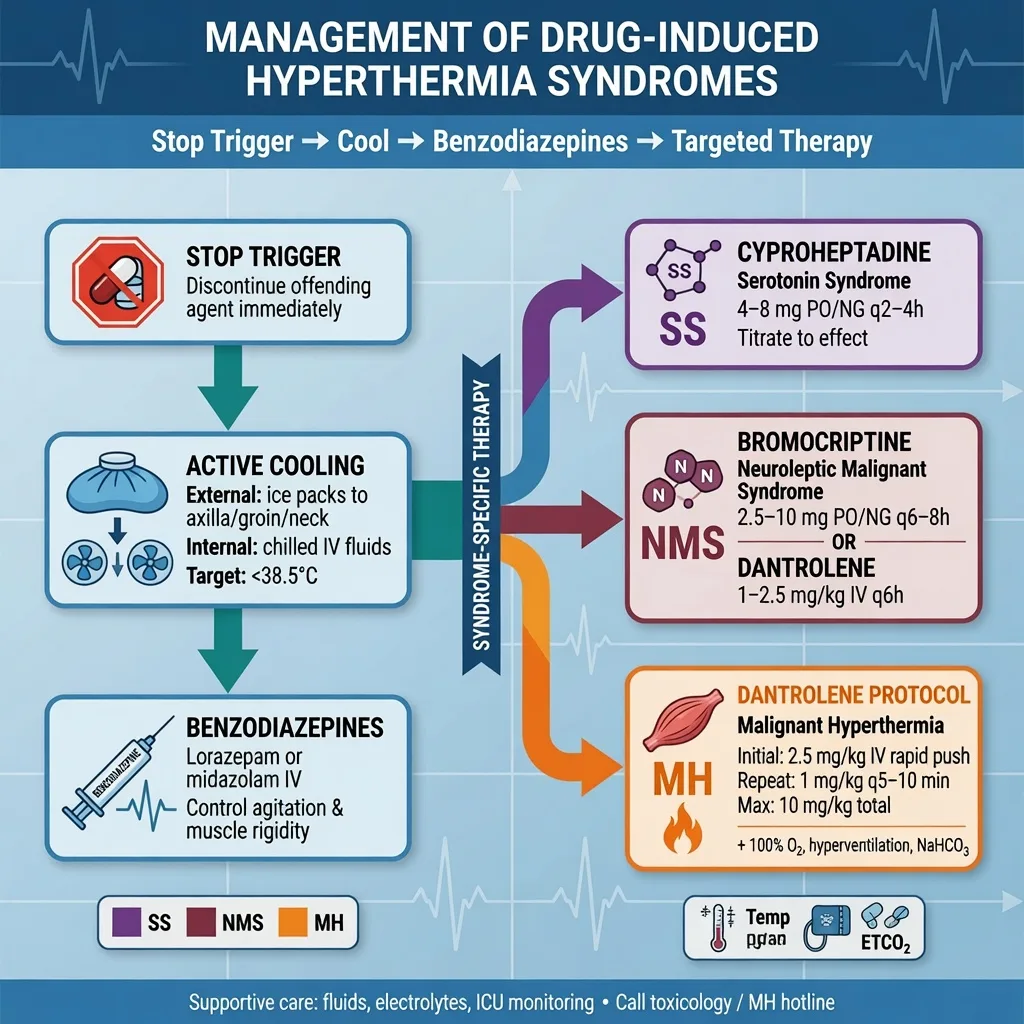
The the drugs-the-induced the hyperthermia the syndromes — the differential (the MDMA the hyperthermia, the serotonin the syndrome, the neuroleptic the malignant the syndrome, the malignant the hyperthermia, the anticholinergic the toxicity, the heat the stroke) — the MDMA the hyperthermia the overlaps the serotonin the syndrome; the treat the for the both.[6]
2. The hyponatraemia (the SIADH + the excessive the water)
The MDMA the triggers the marked the ADH the release (the syndrome of the inappropriate the antidiuretic the hormone — the SIADH). The combined the with the massive the water the intake (the rave — the "drink the plenty of the water" the advice; the user the drinks the litres). The result the severe the dilutional the hyponatraemia — the cerebral the oedema, the seizures, the coma, the herniation, the death. The classically the young the female, the first the hour the after the ingestion, the Na the 110 to 120 mmol/L. The NOT the simple the dehydration — the opposite (the euvolaemic / the slightly the volume-overloaded).[4][8]
The pathophysiology. The MDMA the → the marked the ADH the surge (the 5-HT + the noradrenaline the → the pituitary) + the thirsty (the dry the mouth — the anticholinergic) → the water the intake → the dilutional the hyponatraemia → the cerebral the oedema. The female the sex-the-hormone the potentiates (the oestrogen the sensitises the brain the to the hyponatraemia).[8]
3. The serotonin syndrome
The MDMA the serotonergic — the triad of the clonus (the spontaneous, the inducible, the ocular), the hyperreflexia (the lower-the-limb the prominent), the hyperthermia, the agitation, the autonomic the instability, the mydriasis, the diaphoresis, the tremor, the rigidity (the late — the lower-the-limb). The severity the spectrum — the mild (the tremor, the diaphoresis) the to the severe (the rigidity, the hyperthermia > 41 °C, the seizures, the death). The differential — the neuroleptic the malignant the syndrome (the NMS) (the bradyreflexic, the lead-pipe the rigidity, the antipsychotic-the-exposure, the slower the onset, the lower the creatine-the-kinase-the-temperature the ratio).[9][10]
The MDMA — the cardiovascular and the hepatic
The cardiovascular (the sympathomimetic). The tachycardia, the hypertension (the systolic the spike), the vasoconstriction (the coronary, the cerebral), the arrhythmia (the SVT, the VT, the VF), the myocardial the ischaemia (the spasm + the thrombosis), the stroke (the haemorrhagic — the BP the spike; the ischaemic — the vasoconstriction), the aortic the dissection.[5]
The hepatic (the idiosyncratic). The delayed the hepatic the necrosis (the days the after the ingestion — the zone-3 the necrosis; the fulminant the hepatic the failure; the transplant the consideration). The distinct the from the immediate the hyperthermia-the-related the injury.[5]
The MDMA — the management
The supportive + the benzodiazepine + the active the cooling + the specific the for the syndrome.[6][7][9]
- The airway (the GCS < 8, the seizures, the aspiration) — the intubation (the RSI; the avoid the ketamine — the sympathetic; the propofol the cautious; the suxamethonium the avoid in the established the rhabdomyolysis the hyperkalaemia).
- The benzodiazepine the first-line — the diazepam 5 to 10 mg IV the titrated, the lorazepam 2 to 4 mg, the midazolam (the infusions for the severe). The reduces the muscle the activity, the agitation, the sympathetic the outflow, the serotonin-the-syndrome the rigidity — the lowers the temperature. The high the doses the often the required (the total the 50 to 100 mg the diazepam the equivalents the not the uncommon in the severe).
- The active the cooling (the hyperthermia the 40 °C or the above) — the evaporative (the mist + the fan), the ice-the-bath, the cooling the blankets, the cold IV the fluids (the 4 °C the saline). The target the core the 38.5 °C. The dantrolene the considered (the unproven the evidence — the case-the-reports the support; the malignant-the-hyperthermia-like the mechanism; the 1 mg/kg the IV the repeat the up to the 10 mg/kg). The NOT the antipyretics (the paracetamol the ineffective — the central the serotonergic the not the prostaglandin the cause).
- The hyponatraemia — the fluid the restriction (the NOT the free the normal the saline — the worsens; the euvolaemic the SIADH), the hypertonic the saline the 3 % if the seizures/the coma (the 100 mL the boluses the over the 10 min, the target the Na the 120 to 125, the no the more than the 8 to 10 mmol/L the per the 24 h — the osmotic the demyelination the syndrome the risk). The conivaptan / the tolvaptan the avoid (the SIADH — but the risk the overcorrection the and the volume the depletion). The seizures the often the resolve the once the Na the > 120.[4][8]
- The serotonin the syndrome — the benzodiazepine, the active the cooling; the cyproheptadine (the 5-HT2A the antagonist; the 12 mg the PO/NG the initial, the 2 mg the q2h the up to the 32 mg the per the day) the for the moderate-to-the-severe. The chlorpromazine (the 50 to 100 mg the IM; the caution — the hypotension, the seizure-the-threshold).[9]
- The rhabdomyolysis — the IV the fluids (the target the urine the 200 to 300 mL/h; the urine the alkalinisation the considered — the sodium the bicarbonate), the CK the monitoring (the q6-12h), the renal the support (the CRRT if the failure). The mannitol the debated.
- The NO the beta-blocker the monotherapy (the MDMA the unopposed the alpha — the hypertension the worse, the coronary the spasm). The beta-the-blocker + the alpha (the labetalol, the carvedilol) the safe. The nitrate (the GTN) the for the coronary the spasm/the ischaemia. The benzodiazepine the first.[5]
The MDMA — the adulterants
The "ecstasy" the tablet the often the NOT the MDMA — the PMA (the paramethoxyamphetamine) / the PMMA (the far the more the toxic — the hyperthermia, the death; the delayed the onset — the user the re-doses; the serotonin the very the potent), the mCPP, the caffeine, the ketamine, the methamphetamine, the NBOMe, the cathinones. The history the unreliable; the treat the toxidrome.[2][5]
The synthetic cannabinoids (the Spice, the K2)
The synthetic cannabinoids (the "Spice", the "K2", the "Black Mamba") are the full CB1-receptor the agonists (the more the potent the than the THC — the partial the agonist). The sprayed the on the plant the material; the smoked (the joint, the e-the-cigarette).[2][3][12]
The clinical. The more the severe the than the natural the cannabis:[3][12]
- The psychiatric — the agitation, the psychosis (the paranoia, the hallucinations — the new-the-onset; the persistent the even the after the single the use), the anxiety, the suicidality.
- The neurological — the seizures (the generalised-the-tonic-clonic; the status — the more the common the than the natural the cannabis), the syncope, the stroke (the vasoconstriction — the reversible-the-cerebral-the-vasoconstriction-the-syndrome / the RCVS; the ischaemic — the posterior the circulation), the headache, the akathisia.
- The cardiovascular — the tachycardia, the hypertension, the myocardial the ischaemia / the infarction (the young the otherwise-the-well; the coronary the spasm), the arrhythmia (the QT the prolongation; the torsades; the bradycardia — the high-dose-the-BRASH).
- The metabolic / the renal — the acute the kidney the injury (the unknown the mechanism — the direct the nephrotoxicity the from the adulterants the such the as the brodifacoum; the rhabdomyolysis-the-related; the electrolyte the derangement — the hyper-/the hypokalaemia).
- The other — the hyperthermia, the serotonin the syndrome (the with the other the serotonergics), the cannabinoid the hyperemesis (the intractable the vomiting — the cyclical; the hot-the-shower the relief; the cutaneous the burning — the capsaicin-the-receptor), the pneumonitis (the inhalation-the-induced; the histiocytic), the coagulopathy (the long-the-acting the anticoagulant — the brodifacoum the adulterant — the INR the supratherapeutic; the vitamin-the-K-the-dependent the factors the depleted).[3][12]
The treatment. The benzodiazepine (the agitation, the seizures, the psychosis, the hyperthermia — the diazepam, the lorazepam), the supportive (the airway, the cardiovascular), the active the cooling (the hyperthermia), the renal the support (the AKI — the fluids, the CRRT if the severe), the coagulopathy (the vitamin the K the IV, the prothrombin-the-complex-the-concentrate if the bleeding — the brodifacoum the long-the half-life; the weeks-to-the-months of the vitamin the K).[3][12]
The synthetic cannabinoids — the high-yield the exam the detail
- The full-the-agonist the vs the partial-the-agonist — the THC the partial (the ceiling-the-effect; the mild); the synthetic the full (the no the ceiling; the severe — the seizures, the psychosis, the AKI the at the high the doses).[12]
- The persistence — the synthetic the cannabinoids the highly the lipophilic (the stored the in the adipose; the long the half-life; the chronic the use the cumulative) — the psychosis the persist the weeks-to-the-months the after the cessation.[3]
- The variable the potency — the batch-the-to-the-batch the variation the extreme — the same the brand the may the produce the different the effects the at the different the times.[12]
- The brodifacoum the coagulopathy (the "the long-the-acting the anticoagulant" — the rodenticide the adulterant; the 2018 the Illinois-the-outbreak) — the NO the empiric the fresh-the-frozen-the-plasma; the vitamin the K1 the (the phylloquinone) the high-dose (the 50 to 100 mg the IV the daily — the weeks); the 4-the-factor the PCC the if the bleeding. The warfarin-the-resistant. The do the NOT the confuse the with the liver-the-failure-the-coagulopathy (the INR the elevated the but the liver the normal — the vitamin-the-K-the-dependent).[12]
The synthetic cathinones (the "bath salts")
The synthetic cathinones (the mephedrone, the MDPV / the methylenedioxypyrovalerone, the methylone, the alpha-PVP / the "flakka") are the stimulants (the catecholamine the releasers the and the reuptake the blockers — the cocaine-like; the dopamine-the-transporter + the noradrenaline-the-transporter the blockade; the MDMA-like the serotonin the release the in the some). The similar the to the amphetamines and the cocaine — but the longer-the-duration and the more the severe.[2][13]
The clinical (the sympathomimetic + the serotonergic + the excited the delirium).[2][13]
- The sympathomimetic — the tachycardia, the hypertension (the severe; the hypertensive-the-emergency), the hyperthermia (the severe — the 40 to 42 °C), the excited the delirium (the agitated-the-paranoid-the-hallucinatory-the-aggressive; the superhuman-the-strength; the pain-the-insensitive — the restraint-the-related the death; the "the excited the delirium the syndrome"), the mydriasis, the diaphoresis.
- The psychiatric — the paranoia, the psychosis (the severe; the persistent — the days-to-the-weeks; the delusions-the-of-the-parasitosis — the "the coke-the-bugs"), the self-the-harm, the suicidality (the "the crash" the after — the serotonin the depletion).
- The neurological — the seizures (the generalised; the status), the stroke (the ischaemic — the vasospasm; the haemorrhagic — the hypertension), the serotonin the syndrome (the triad), the dystonia.
- The cardiovascular — the myocardial the ischaemia / the infarction, the arrhythmia (the VT, the VF — the catecholamine-the-surge; the QT the prolongation the in the some), the aortic the dissection, the cardiomyopathy (the takotsubo — the catecholamine-the-induced; the chronic — the dilated).
- The metabolic / the renal — the rhabdomyolysis (the severe — the agitation + the hyperthermia + the restraint; the CK the extreme), the AKI (the pigmented-the-cast + the hypovolaemia), the DIC, the hepatic the necrosis, the hyperkalaemia, the acidosis (the lactic). [1]
The treatment. The benzodiazepine the first-line (the high-the-doses — the reduces the sympathetic the outflow, the seizures, the hyperthermia, the serotonin-the-syndrome). The AVOID the pure the beta-blocker (the unopposed the alpha — the hypertension the worse, the coronary the spasm — the propranolol-the-associated the death the reported). The supportive — the active the cooling (the evaporative; the cold IV the fluids; the dantrolene the considered), the cardiovascular (the labetalol/the carvedilol the if the severe the hypertension; the nitrate the for the ischaemia; the avoid the alpha-the-agonist-the-monotherapy), the rhabdomyolysis the fluids, the renal the support. The airway (the intubation — the propofol the sedation; the ketamine the AVOID — the sympathetic). The physical the restraint the minimise (the restraint-the-asphyxia; the rapid the chemical-the-sedation the instead).[1][13]
The cathinones — the excited delirium and the restraint
The excited the delirium (the EXDS) — the acute-the-onset the agitated-the-delirium (the paranoia, the aggression, the pain-the-insensitive, the hyperthermia, the superhuman-the-strength) — the medical-the-emergency; the high the mortality (the sudden-the-cardiac; the asphyxia-the-restraint-the-related; the hyperthermia-the-multi-the-organ). The the management (the AHA / the ACEP / the ACNP the framework):[13]
- The de-escalation — the minimise the physical the restraint (the prone-the-restraint the avoid — the positional-the-asphyxia; the supine — the airway-the-monitor); the rapid the chemical-the-sedation the preferred.
- The sedation — the benzodiazepine (the midazolam the 10 mg the IM — the repeatable; the diazepam the 10 mg the IV; the high-the-doses the often the required — the total the 50 to 100 mg the diazepam-the-equivalents); the ketamine (the 4 to 5 mg/kg the IM — the dissociative; the airway-the-preserved; the caveat — the sympathetic; the preferred the in the pre-the-hospital-the-setting), the droperidol/the haloperidol (the antipsychotic — the QT; the caution; the adjunct the not the first).
- The airway + the cooling — the airway-the-monitor (the hyperthermia-the-induced the rapid-the-sequence); the active the cooling; the IV the fluids.
- The treat the hyperthermia + the rhabdomyolysis + the DIC + the AKI (the severe-the-EXDS the the multi-the-organ-the-failure — the ICU). [1]
The novel benzodiazepines
The "designer benzodiazepines" (the etizolam, the flualprazolam, the clonazolam, the phenazepam, the flubromazolam, the diclazepam) — the CNS the depression, the ataxia, the respiratory the depression (the esp. the with the opioid — the synergistic; the fentanyl-the-fake-the-pill the contaminated), the long the half-life (the phenazepam the 50 to 100 h; the persistent-the-sedation-the-days), the amnesia. The flumazenil the cautious (the seizure-the-precipitation — the same the caveat the as the prescription-the-benzodiazepine).[1]
The novel synthetic opioids (the fentanyl analogues, the nitazenes)
The novel synthetic opioids (the fentanyl the analogues — the carfentanil; the nitazenes — the etonitazene, the isotonitazene, the protonitazene, the metonitazene) are the EXTREMELY potent (the nitazenes the up to the hundreds of times the morphine; the carfentanil the 10000 the times the morphine — the veterinary-the-elephant-the-tranquilliser).[1][1]
The clinical. The opioid the toxidrome (the coma, the miosis, the respiratory the depression) but the naloxone-the-resistant (the large the doses — the tens-of-the-milligrams; the multiple the boluses; the continuous the infusion; the prolonged). The relapse (the long the half-life — the nitazenes the 8 to 14 h; the etonitazene the longer). The chest-the-wall-the-rigidity (the "the wooden-the-chest" — the fentanyl-the-class — the naloxone-the-responsive; the early-the-ventilation-the-required).[1]
The treatment. The high-the-dose naloxone (the repeat — the 0.4 to 2 mg the IV the every the 2 to 3 min the up to the 10 to 20 mg the if the required; the infusion — the two-thirds the of the effective-the-bolus-the-total the per the hour), the airway (the early-the-intubation — the chest-the-wall-the-rigidity), the prolonged the observation (the at the least the 12 to 24 h — the relapse the common). The multiple the doses the often the required; the naloxone-the-shortage-the-era — the ventilate-the-if the naloxone-the-unavailable.[1]
The novel opioids — the carfentanil and the first-responder-the-safety
The carfentanil — the dermal-the-absorption + the inhalation-the-risk (the airborne-the-powder — the law-the-enforcement; the first-the-responders) — the personal-the-protective-the-equipment (the gloves; the N95 / the respirator; the avoid the mouth-the-contact), the naloxone-the-on-the-hand. The mass-the-casualty-the-potential (the weaponisation).[1]
The NBOMe and the novel psychedelics
The NBOMe (the 25I-NBOMe / the "N-Bomb", the 25C-NBOMe, the 25B-NBOMe) and the 2C family (the 2C-B, the 2C-I, the 2C-E) — the potent 5-HT2A the agonists (the more the potent the than the LSD). The severe — the serotonergic (the serotonin the syndrome), the sympathomimetic (the tachycardia, the hypertension, the vasoconstriction — the severe the peripheral-the-vasoconstriction — the limb-the-ischaemia; the digital-the-gangrene; the pulmonary), the seizures, the hyperthermia, the rhabdomyolysis, the renal, the psychosis. The sublingual/the buccal (the blotter-the-paper; the "the stamps"). The management — the benzodiazepine, the supportive, the active the cooling, the vasodilator (the nitrate/the alpha-blocker — the peripheral the vasoconstriction).[2][1]
The ketamine (the recreational) — expanded
The dissociative anaesthetic (the NMDA-the-receptor the antagonist; the opioid-the-receptor the interaction; the monoamine). The recreational — the "the K", the "the special K", the "the vitamin K", the "the cat-the-valium". The insufflated (the most the common), the injected (the IM, the IV), the oral (the less the common — the first-the-pass). The shorter the duration (the 30 to 60 min the insufflated; the 15 to 30 min the IM).[11][1]
The clinical.[11]
- The dissociative (the "K-hole" — the cataleptic-the-catalepsy, the depersonalisation, the derealisation, the floating-the-out-of-the-body — the near-death-the-experiences, the annihilation), the amnesia, the vivid the hallucinations, the analgesia (the profound; the somatic), the anaesthesia (the cataleptic-the-state — the eyes-the-open-the-nystagmus — the awake-the-looking).
- The emergence phenomenon (the on the recovery — the agitation, the vivid the imagery, the confusion, the nightmares, the flashback-the-episodes — the "the hallucinogen-the-persisting-the-perception-the-disorder"; the 10 to 30 % the recreational-the-users). The benzodiazepine-the-responsive; the worse the with the solitary the use; the less the with the social; the predictive — the high-the-dose-the-higher-the-risk.
- The sympathetic the stimulation — the tachycardia, the hypertension, the bronchodilation (the asthma-the-safe — the unique the anaesthetic), the increased the ICP (the controversial — the modern-the-evidence the modest; the maintain the normocapnia), the increased the intraocular the pressure, the increased the cerebral-the-blood-the-flow, the increased the CMR — the preserve the cerebral the autoregulation (the unique).
- The nystagmus (the horizontal, the vertical, the rotatory — the "the roving") — the characteristic; the almost the pathognomonic in the recreational-the-context.
- The hypersalivation (the airway-the-concern — the antisialogogue the considered).
- The ulcerative the cystitis (the chronic the ketamine the use — the voiding-the-pain, the frequency, the urgency, the haematuria, the incontinence; the destructive — the bladder-the-fibrosis-the-shrinkage; the bilateral-the-hydronephrosis — the obstructive-the-nephropathy; the hepatic — the biliary — the dilated-the-biliary-the-tree; the abdominal-the-pain — the mimic the obstruction). The urology-the-refer; the cessation-the-only-the-cure; the cystectomy-the-sometimes.
- The ulcerative-the-GI — the gastric-the-and-the-biliary-the-pain — the mimic the surgical.
- The cognitive (the chronic — the impairment-the-memory-the-attention-the-executive; the persistent — the months-the-after the cessation).[11]
The management. The supportive (the airway the usually the preserved — the unique the dissociative). The benzodiazepine for the emergence phenomenon, the agitation (the diazepam the 5 to 10 mg the IV; the lorazepam the 2 to 4 mg). The quiet-the-environment, the low-the-stimulation, the reassurance. The NO the naloxone (the ineffective). The fluids the for the rhabdomyolysis (the large-the-doses; the prolonged-the-immobility — the "the frozen" the position — the compartment-the-syndrome the risk). The chronic-the-use the cystitis — the urology; the cessation. The rhabdo/the AKI/the compartment — the supportive-the-surgical.[1][11]
The NPS — the toxidrome-based the approach (the pattern the recognition)
The NPS the history the unreliable — the treat the toxidrome (the cluster-the-of-the-signs-the-and-the-symptoms — the predicts the class; the guides the management).[2][14]
NPS toxidromes — pattern recognition at the ICU bedside
| Toxidrome | Classic NPS agents | Mental state | Pupils | Vitals | Skin / secretions | Hallmark |
|---|---|---|---|---|---|---|
| Sedative-hypnotic | GHB/GBL/1,4-BD, novel benzodiazepines (etizolam, phenazepam) | Deep, rapid-onset coma; rapid resolution (GHB 2–6 h) | Small or normal | Bradycardia, hypothermia, bradypnoea | Myoclonus; vomiting (aspiration) | "Coma that resolves before your eyes" |
| Opioid | Nitazenes (etonitazene, isotonitazene), fentanyl analogues (carfentanil) | Coma, slow | Miosis (pinpoint) | Bradypnoea, bradycardia, hypotension, hypothermia | Pulmonary oedema; chest-wall rigidity ("wooden chest") | Naloxone-resistant; relapse (long half-life) |
| Sympathomimetic / stimulant | MDMA, cathinones (mephedrone, MDPV, "bath salts"), methamphetamine analogues | Agitated, paranoid, "excited delirium" | Mydriasis | Tachycardia, hypertension, hyperthermia, tachypnoea | Diaphoresis, piloerection, tremor | Hyperthermia + agitation + tachycardia |
| Serotonergic | MDMA, NBOMe, cathinones (with serotonergic component) | Agitated, confused | Mydriasis | Tachycardia, hypertension, hyperthermia | Clonus (inducible/spontaneous/ocular), hyperreflexia (lower limb), diaphoresis, tremor | Clonus + hyperreflexia + hyperthermia |
| Dissociative | Ketamine, methoxetamine, PCP analogues | Dissociated, cataleptic, "K-hole" | Normal or dilated | Tachycardia, hypertension (mild); bronchodilation | Nystagmus (horizontal/vertical/rotatory), hypersalivation | Nystagmus + catalepsy + analgesia |
| Cannabinoid | Synthetic cannabinoids (Spice/K2) | Agitated, psychotic, paranoid | Injected conjunctiva | Tachycardia, hypertension, hyperthermia | Diaphoresis; coagulopathy (brodifacoum adulterant) | Psychosis + seizures + AKI (worse than THC) |
| Psychedelic | NBOMe, 2C family, tryptamines | Hallucinations, synaesthesia, "bad trip" | Mydriasis | Sympathomimetic ± serotonergic | Tremor, diaphoresis; peripheral vasoconstriction (digital ischaemia) | Hallucinations + 5-HT2A sympathomimetic |
MDMA vs cathinones vs cocaine — the stimulant / entactogen differential
| Feature | MDMA (ecstasy) | Cathinones ("bath salts") | Cocaine |
|---|---|---|---|
| Primary mechanism | Serotonin releaser + reuptake inhibitor (entactogen) | Catecholamine releaser + reuptake blocker (DAT/NET); some serotonin release | DAT/NET/SERT blocker; Na-channel blockade |
| Duration of effect | 3–6 h | 4–8 h (longer than cocaine) | 30–60 min |
| Cardinal ICU danger | Hyperthermia + hyponatraemia (SIADH) + serotonin syndrome | Excited delirium + sympathomimetic + hyperthermia | Na-channel blockade (wide QRS); ACS; aortic dissection |
| Psychiatric | Empathogenic; mild euphoria → crash | Severe paranoia, psychosis, "excited delirium" | Euphoria; paranoia; formication |
| Seizures | Common (hyponatraemia + serotonergic) | Common (status) | Common (Na-channel) |
| Serotonin syndrome | Classic cause | Possible (some serotonin release) | Rare |
| Hyponatraemia | Characteristic (SIADH + water) | Rare | Rare |
| First-line treatment | Benzodiazepine + active cooling + fluid restriction (hyponatraemia) + cyproheptadine | High-dose benzodiazepine + cooling; avoid pure beta-blocker | Benzodiazepine + sodium bicarbonate (wide QRS) |
| Antidote | None (cyproheptadine for serotonin syndrome) | None | None (NaHCO3 for cardiotoxicity) |
GHB vs opioid vs novel benzodiazepine — the sedative overdose differential
| Feature | GHB / GBL / 1,4-BD | Opioid (incl. nitazenes) | Novel benzodiazepines |
|---|---|---|---|
| Onset | Rapid (15–30 min) | Variable (minutes–hours) | Slow (1–4 h) |
| Coma depth | Deep | Deep (with miosis) | Moderate (usually) |
| Recovery | Rapid (2–6 h) — "sudden awakening" | Slow; relapse (naloxone wears off) | Slow; long half-life (phenazepam 50–100 h) |
| Pupils | Normal / small | Miosis (pinpoint) | Normal |
| Respiratory | Bradypnoea (mild) | Severe respiratory depression | Mild (unless co-opioid) |
| Other | Myoclonus, vomiting, bradycardia, hypothermia | Pulmonary oedema; chest-wall rigidity | Ataxia, dysarthria, amnesia |
| Antidote | None (naloxone ineffective) | Naloxone (high-dose; infusion) | Flumazenil (cautious — seizure risk) |
| Hallmark | Rapid-resolving coma, no antidote | Miosis + naloxone-responsive (usually) | CNS depression, flumazenil cautious |
Systematic approach to the undifferentiated NPS overdose
- RESUSCITATE (ABC) — assume mixed toxidrome and adulterated substance. (a) AIRWAY: GCS <8, deep coma, or unprotected → early RSI + intubation (assume full stomach — risk of aspiration). GHB: recovery position if maintaining airway; intubate only if prolonged (>6 h) or co-ingestant. (b) BREATHING: oxygenate; ventilate for bradypnoea; apply capnography (opioid + GHB). (c) CIRCULATION: IV access ×2, fluids for hypotension, vasopressors (noradrenaline) if refractory; ECG (QRS widening → Na-channel blockade; QT → look for torsades). (d) NEURO: glucose (hypoglycaemia — odd); empirical naloxone 0.04–0.4 mg titrated if miosis/bradypnoea (repeat up to 10–20 mg if nitazene suspected); treat seizures (benzodiazepine); check temperature early.
- RAPID TOXIDROME CLASSIFICATION (the diagnostic anchor — agent unknown, treat the syndrome). (a) SEDATIVE: deep coma + bradypnoea ± miosis → opioid (naloxone) / GHB (rapid recovery, no antidote) / benzo (flumazenil cautious). (b) SYMPATHOMIMETIC / SEROTONERGIC: agitation + mydriasis + tachycardia + hyperthermia + (clonus/hyperreflexia → serotonin) → MDMA / cathinones / NBOMe → benzodiazepine first-line + active cooling. (c) DISSOCIATIVE: catalepsy + nystagmus + analgesia + preserved airway → ketamine → supportive + benzodiazepine for emergence. (d) CANNABINOID: agitation + psychosis + seizures + AKI ± coagulopathy → Spice/K2 → benzodiazepine + supportive + check INR.
- PARALLEL INVESTIGATIONS. (a) VBG (acidosis — lactic in hyperthermia/cathinones; methanol/ethylene glycol gap — exclude). (b) ECG (Na-channel — QRS; QT; ischaemia). (c) Glucose, U&E (Na — MDMA hyponatraemia; K), LFT (hepatic necrosis — MDMA), CK (rhabdomyolysis), troponin (ACS — sympathomimetic), lipase, coagulation (INR — brodifacoum in Spice). (d) Paracetamol + salicylate + ethanol levels (co-ingestion). (e) Urine drug screen (often unhelpful — NPS not detected; guides chronic-use disclosure). (f) Temperature (core). (g) CT brain if coma persists or focal signs (exclude intracranial — MDMA stroke, NBOMe vasospasm, Spice RCVS).
- SYNDROME-SPECIFIC INTERVENTIONS (do not wait for laboratory). (a) HYPERTHERMIA (≥40 °C): active cooling (evaporative ± ice-bath ± cold IV fluids); benzodiazepine; dantrolene 1 mg/kg IV considered (up to 10 mg/kg) in MH-like; avoid antipyretics. (b) SEROTONIN SYNDROME: benzodiazepine + cooling + cyproheptadine 12 mg PO/NG (then 2 mg q2h up to 32 mg/day). (c) MDMA HYPONATRAEMIA (seizures/coma, Na <120): fluid restriction + 3% saline 100 mL boluses → Na 120–125 (≤8–10 mmol/L per 24 h). (d) RHABDOMYOLYSIS: IV fluids (target urine 200–300 mL/h); consider NaHCO3; CRRT if AKI. (e) COAGULOPATHY (brodifacoum): vitamin K1 50–100 mg IV; 4-factor PCC if bleeding. (f) EXCITED DELIRIUM: high-dose benzodiazepine ± ketamine IM; minimise physical restraint; airway + cooling.
- DECONTAMINATION (selected cases). Activated charcoal 50 g only if airway protected AND oral ingestion within 1–2 h (most NPS are smoked/insufflated — usually not applicable). No role for gastric lavage or ipecac. Whole-bowel irrigation rarely (body-packing — packets visible on CT).
- OBSERVATION + DISPOSITION. (a) GHB: observe 6 h (rapid recovery expected; if coma persists >6 h → co-ingestant / alternative diagnosis). (b) Opioid/nitazene: observe 12–24 h (relapse); infusion if long-acting. (c) MDMA: ICU if hyperthermia, hyponatraemia, serotonin syndrome, seizures, multi-organ failure; observe 12 h if asymptomatic (delayed hepatic). (d) Cathinones/excited delirium: ICU (multi-organ risk). (e) Synthetic cannabinoids: observe for seizures, AKI, coagulopathy. (f) All: psychiatric + social + addiction-medicine referral once medically stable. (g) Notify the regional poison centre / toxbase; consider public-health notification (novel/cluster).
Prognosis
The NPS overdose is the survivable with the supportive care; the mortality driven by the respiratory failure (the opioid, the GHB, the novel benzodiazepine + the opioid), the hyperthermia (the MDMA, the cathinones, the NBOMe — the mortality the up to the 50 % in the severe), the cardiac (the sympathomimetic — the ACS, the arrhythmia, the aortic-the-dissection), the renal (the MDMA-the-rhabdo, the Spice-the-AKI), the neurological (the stroke — the MDMA, the cathinones; the cerebral-the-oedema — the MDMA-hyponatraemia; the anoxic-the-injury — the opioid-the-apnoea-the-delayed-the-response). The history the unreliable — the treat the toxidrome, the not the assumed the agent.[1][1][1][4][13]
The MDMA-the-hyperthermia-the-mortality (the core the > 42 °C, the DIC, the multi-the-organ-the-failure) — the up to the 50 %; the MDMA-the-hyponatraemia-the-cerebral-the-oedema-the-herniation — the up to the 20 % the severe. The cathinone-the-excited-the-delirium — the sudden-the-cardiac; the restraint-the-asphyxia; the hyperthermia — the high-the-mortality. The GHB — the low-the-mortality the IF the airway-the-maintained (the death the from the aspiration — the position-the-matters).[4][7][13]
SAQ — MDMA toxicity with serotonin syndrome and hyperthermia
10 minutes · 10 marks
A 21-year-old woman collapses at a dance party 2 hours after taking two ‘ecstasy’ tablets. She is agitated, diaphoretic, confused, with sustained ankle clonus, hyperreflexia, jaw clenching (bruxism), mydriasis, HR 144, BP 175/100, temp 41.2°C, RR 32, SpO₂ 96%. CK 14,800 U/L, INR 2.4, creatinine 180 μmol/L, sodium 122 mmol/L.
SAQ — GHB/GBL overdose and synthetic cannabinoid (Spice) toxicity
10 minutes · 10 marks
Two patients arrive at ED after a nightclub collapse. Patient 1: a 24-year-old man who took ‘G’ (GHB); he is deeply unconscious (GCS 6) with bradycardia (HR 50), ataxic breathing, and profound miotic pupils, but his vital signs have begun improving over the 40 minutes since arrival. Patient 2: a 19-year-old woman who smoked ‘Spice’ (a synthetic cannabinoid); she is agitated, tachycardic (HR 130), hypertensive (170/100), with new-onset seizures.
Clinical pearls
Trial cards
Landmark evidence — MDMA, cathinones, synthetic cannabinoids, GHB, ketamine
Hall & Henry 2006 (MDMA acute toxicity, Br J Anaesth): defined the three life-threatening MDMA syndromes (hyperthermia, hyponatraemia/SIADH, hepatic failure) and the supportive + benzodiazepine + cooling management; mortality up to 50 % in severe hyperthermia. The exam-standard reference.[4] Green et al 2003 (MDMA pharmacology, Pharmacol Rev): established the serotonin-release mechanism, the rat model of MDMA-hyperthermia, and the dantrolene/cooling rationale; informed the "MDMA hyperthermia is malignant-hyperthermia-like" concept.[6] Boyer & Shannon 2005 (serotonin syndrome, NEJM): the classic triad (clonus, hyperreflexia, hyperthermia); cyproheptadine as the 5-HT2A antagonist; benzodiazepine + cooling first-line. The exam-standard.[9] Liechti 2012 (GHB clinical toxicology, Clin Toxicol): the rapid-onset (15–30 min), rapid-recovery (2–6 h) coma; no antidote (naloxone ineffective); supportive + airway management.[1] Schep et al 2014 (synthetic cannabinoids clinical toxicology): the full-CB1-agonist severity (seizures, psychosis, AKI, coagulopathy from brodifacoum adulterant); benzodiazepine + supportive; vitamin K1 for brodifacoum.[12] Thornton & Baum 2020 (synthetic cathinones, Emerg Med Clin): the excited delirium syndrome, high-dose benzodiazepine ± ketamine, minimise restraint, avoid pure beta-blockade; multi-organ failure in severe.[13] Miotto et al 2014 (ketamine abuse, CNS Drugs): the K-hole, emergence phenomenon (10–30 %), nystagmus, chronic ulcerative cystitis, cognitive impairment; supportive + benzodiazepine for emergence.[11]
Evidence synthesis — the NPS era and the toxidrome approach
Mowry et al 2014 (Emerging drugs of abuse, Emerg Med Clin): the framework — treat the toxidrome not the agent; the unreliable history; the benzodiazepine as first-line across the stimulant/serotonergic classes; the naloxone for opioid features.[2] Baumann et al 2018 (Bath salts, spice, designer drugs, J Neurosci): the pharmacology of the NPS families (stimulants, cannabinoids, sedatives, dissociatives, opioids); the full-vs-partial agonist principle; the rationale for the syndrome-based approach.[14] Orsolini et al 2026 (synthetic cannabinoid psychiatric consequences, Psychiatry Res): the persistent psychosis (weeks-months after a single use); the chronic neuropsychiatric sequelae; the psychiatric follow-up mandate.[3] Gillman 2010 (serotonin syndrome triptans/agonists review, Headache): the spectrum of serotonergic agents (incl. MDMA) and the dose-response; cyproheptadine dosing; the overlap with NMS and the differentiation (hyperreflexia/clonus vs lead-pipe rigidity).[10] Holden & Jackson 2002 (MDMA near-fatal hyponatraemic coma, J Accid Emerg Med): the SIADH + water-overload mechanism; the fluid-restriction + 3% saline approach; the female predominance; the classic case that informs the exam answer.[8]
Red flags
References
- [1]Liechti ME, et al. The clinical toxicology of γ-hydroxybutyrate, γ-butyrolactone and 1,4-butanediol Clin Toxicol (Phila), 2012.PMID 22746383
- [2]Mowry JB, et al. Emerging drugs of abuse Emerg Med Clin North Am, 2014.PMID 24275167
- [3]Orsolini L, et al. Acute and long-term psychiatric consequences of synthetic cannabinoids and related novel psychoactive substances: A systematic review Psychiatry Res, 2026.PMID 41793795
- [4]Hall AP, Henry JA More on pneumonia: treatment of MRSA in community acquired pneumonia BMJ, 2006.PMID 16740574
- [5]Liechti ME Arthrogryposis multiplex congenita with callosal agenesis and dentato-olivary dysplasia Brain Dev, 2006.PMID 16368213
- [6]Green AR, et al. LTP in cultured hippocampal-entorhinal cortex slices from young adult (P25-30) rats J Neurosci Methods, 2003.PMID 14583401
- [7]Dewan A, et al. [123 I-MIBG myocardial sympathetic innervation scintigraphy and Parkinson's disease. Preliminary results] Rev Esp Med Nucl, 2003.PMID 12846947
- [8]Holden R, Jackson MA Hypertonic saline solution resuscitation in hemorrhagic shock dogs Chin J Traumatol, 2002.PMID 12034084
- [9]Boyer EW, Shannon M Rawls' theory of justice: a naturalistic evaluation(1) J Med Philos, 2005.PMID 16282139
- [10]Gillman PK Novel mutations in scavenger receptor BI associated with high HDL cholesterol in humans Clin Genet, 2011.PMID 21480869
- [11]Miotto K, et al. Conservative management of intraoperative tracheal injury during cardiac operations Ann Thorac Surg, 2014.PMID 24694420
- [12]Schep LJ, et al. Vitamin D deficiency in community-acquired pneumonia: low levels of 1,25(OH)2 D are associated with disease severity Respir Res, 2014.PMID 24766747
- [13]Thornton SL, Baum CR [Torsade de pointes following repeated massive loperamide ingestions] Lakartidningen, 2020.PMID 32016923
- [14]Baumann MH, et al. Improved contrast microscopy: modification of bright field for urine sediment visualisation Diagnosis (Berl), 2018.PMID 29565789