ICU · Toxicology
Salicylate Poisoning
Also known as Aspirin overdose · Salicylate toxicity · Urinary alkalinisation · Ion trapping · Oil of wintergreen · EXTRIP salicylate
Salicylate (aspirin) poisoning — the uncoupling of the oxidative phosphorylation and the direct stimulation of the medullary respiratory centre producing the classic mixed respiratory alkalosis and the high-anion-gap metabolic acidosis. The clinical features (the tinnitus, the hyperpnoea, the hyperthermia, the pulmonary oedema, the seizures). The decontamination, the urinary alkalinisation (the sodium bicarbonate to a urine pH of 7.5 to 8.0 — the ion-trapping of the weak acid), and the haemodialysis for the severe (the EXTRIP criteria). The danger of the intubation without the maintenance of the hyperventilation.
On this page & tools
Your progress
Saved locally on this device.
Target exams
Overview & definition
Salicylate (aspirin) poisoning is a high-yield, the dangerous overdose that produces a characteristic mixed acid–base disorder (the respiratory alkalosis plus the high-anion-gap metabolic acidosis) and a constellation of the systemic and the neurological features. The mortality is driven by the severe acidosis, the pulmonary oedema, and the cerebral salicylate accumulation — the early urinary alkalinisation and the timely haemodialysis are the life-saving.[1][1]

Pathophysiology: the mixed acid–base disorder
The salicylate produces the two acid–base effects:[1][1]
- The respiratory alkalosis — the salicylate directly stimulates the medullary respiratory centre (the early and the dominant effect in the adult). The patient hyperventilates; the PaCO2 falls.
- The high-anion-gap metabolic acidosis — the salicylate uncouples the oxidative phosphorylation (the disruption of the electron transport and the ATP production), interferes with the Krebs cycle and the amino-acid and the fatty-acid metabolism, and produces the lactic acid and the ketoacid production. The renal bicarbonate loss contributes. [1]
The result is the mixed respiratory alkalosis + high-anion-gap metabolic acidosis — the classic salicylate blood gas. (A pure metabolic acidosis or the normalisation of the pH is the sign of the severe poisoning, the respiratory fatigue, or the child.)[1]
The salicylate also produces the fever (the uncoupling — the increased the metabolic rate and the heat), the hypoglycaemia (especially the children — and the paradoxically low CSF glucose causing the neuroglycopenia), and the pulmonary oedema (the non-cardiogenic, the direct capillary leak).[1]
Pharmacokinetics — saturable (zero-order) elimination and ion trapping
Understanding the disposition of salicylate is what separates protocol-following from genuine mastery, because three pharmacokinetic behaviours explain almost every clinical surprise: (1) the elimination shifts from first-order to zero-order (saturable) kinetics as the dose rises; (2) the drug is a weak acid that can be trapped by alkalinisation; and (3) the volume of distribution expands and tissue penetration deepens as the patient becomes acidotic.[4][1]
Absorption. Aspirin (acetylsalicylic acid) is rapidly hydrolysed in the gut wall and liver to salicylic acid. Plain tablets are largely absorbed within 1–2 h, but in overdose several factors delay and prolong absorption: delayed gastric emptying (a direct salicylate effect), pylorospasm, and the formation of pharmacobezoars / concretions of undissolved tablets (especially with enteric-coated and sustained-release formulations). The result is the well-described delayed peak and rising serial levels — a single level can NEVER be relied upon, and repeat levels every 2 h until a clear fall is documented is mandatory.[1][1]
Protein binding and volume of distribution. At therapeutic concentrations salicylate is ~80–90% protein-bound (to albumin), giving a small apparent volume of distribution (~0.2 L/kg). As the concentration rises protein binding saturates (the free fraction increases), and the acidosis of severe poisoning drives the un-ionised salicylic acid across membranes and into the brain, muscle, and CSF. The apparent Vd therefore expands markedly in toxicity — which is exactly why the serum level underestimates tissue/brain burden, and why a "falling" serum level can mask ongoing CNS toxicity. The brain:plasma ratio rises sharply as pH falls.[4]
Saturable (zero-order / Michaelis–Menten) elimination. At low (therapeutic) doses salicylate is eliminated by first-order kinetics (half-life ~2–4 h). As the dose and concentration rise, the metabolic enzymes (glycine conjugation to salicyluric acid is the rate-limiting, saturable pathway) become saturated and elimination shifts to zero-order kinetics — the half-life lengthens dramatically to 15–30 h (occasionally >30 h) and a constant amount (not a constant fraction) is removed per unit time. This is the crucial clinical point: doubling the dose more than doubles the toxicity and the duration, and urinary alkalinisation and haemodialysis — which act on the renally-cleared fraction — become disproportionately valuable precisely when hepatic metabolism is saturated.[4][3]
Renal handling and ion trapping. Salicylic acid is a weak acid with a pKa of ~3.0. In acidic urine most is in the membrane-permeant un-ionised (protonated) form and is passively reabsorbed in the distal nephron, so urinary clearance is low. In alkaline urine (pH 7.5–8.0) the drug is largely in the ionised (charged, salicylate anion) form, which is lipid-insoluble and "trapped" in the tubular lumen and excreted. Raising the urine pH from 6.0 to 8.0 increases renal salicylate clearance roughly five- to tenfold — this is the entire pharmacological basis of urinary alkalinisation. The same ion-trapping logic operates in reverse and dangerously across the blood–brain barrier: systemic acidosis protonates salicylate, letting it cross into the brain, where it ionises and accumulates — the mechanism of salicylate neurotoxicity.[3][4]
Salicylate pharmacokinetics — therapeutic vs toxic dose
| Parameter | Therapeutic dose | Toxic / overdose |
|---|---|---|
| Elimination kinetics | First-order (constant fraction/h) | Zero-order / saturable (Michaelis–Menten) — constant amount/h |
| Half-life | 2–4 h | 15–30 h (sometimes >30 h) |
| Protein binding | 80–90% (albumin) | Saturates → free fraction rises |
| Apparent Vd | ~0.2 L/kg | Expands — tissue & CNS penetration |
| Renal clearance | Modest | Low (reabsorbed in acid urine) — but multiplied 5–10× by alkalinisation |
| Dominant clearance route | Hepatic (glycine conjugation) | Hepatic saturated → renal + extracorporeal become decisive |
| Clinical implication | Predictable, linear | Small dose increments → large toxicity; serial levels mandatory; alkalinisation & dialysis pivotal |
The Done nomogram — and why it cannot be trusted in the ICU
The Done nomogram (1960) plots the serum salicylate level against the time since ingestion and divides patients into severity bands (mild / moderate / severe / very severe). It was derived from single acute ingestions of plain aspirin in non-acidotic patients and its use is now heavily restricted because it is wrong in precisely the patients ICU cares about.[1][1]
Limitations / when the Done nomogram FAILS: [1]
- Chronic (repeated-dose) toxicity — does NOT apply. Levels accumulate insidiously, the patient is often already acidotic, and a "moderate" level corresponds to severe illness.
- Sustained-release / enteric-coated formulations — delayed and erratic absorption means the time axis is unreliable; the nomogram must not be used.
- Oil of wintergreen / methyl salicylate ingestion — concentrated liquid, rapid absorption, the nomogram is unvalidated.
- Mixed / co-ingestions, renal failure, acidosis — all invalidate the assumptions.
- Use beyond ~6 h after ingestion — unreliable; late levels reflect tissue distribution, not the absorption curve.
- A single level is never enough — always check a repeat level at 2 h to detect ongoing absorption. [1]
Modern teaching: treat the PATIENT and the blood gas, not the nomogram. The severity is judged by the clinical state (CNS, pulmonary oedema, acidosis) and the trend of serial levels, not by where a point falls on a 60-year-old curve. The EXTRIP and modern toxicology approach has effectively retired the Done nomogram for ICU decision-making.[1][4]
The clinical features
- The central nervous system — the tinnitus (the early), the deafness, the vertigo, the agitation, the confusion, the delirium, the seizures, the coma (the sign of the severe, the cerebral penetration).
- The respiratory — the hyperventilation, the hyperpnoea, the tachypnoea (the respiratory alkalosis), the pulmonary oedema (the severe).
- The gastrointestinal — the nausea, the vomiting, the haematemesis (the gastric irritation).
- The metabolic — the hyperthermia, the diaphoresis, the dehydration (the insensible + the GI loss), the hypokalaemia, the hypoglycaemia (the children).
- The source — the aspirin tablets, the oil of the wintergreen (the methyl salicylate — the highly concentrated; the one teaspoon is the lethal in the child), the topical salicylates.[1]
The investigation
- The serum salicylate level — the toxic above about 2.2 mmol/L (30 mg/dL); the severe above 4.8 mmol/L (65 mg/dL); the very severe above 6.5 mmol/L (90 mg/dL). The level does NOT always correlate with the severity (the tissue distribution, the acidosis driving the salicylate into the cells and the brain) — the treat the patient, the not the number alone.
- The arterial blood gas — the mixed disorder; the worsening acidosis is the ominous.
- The electrolytes (the hypokalaemia, the hypoglycaemia), the renal function, the glucose, the lactate, the coagulation (the salicylate affects the vitamin-K-dependent factors — the prolonged PT).[1][1]
Treatment: the escalation
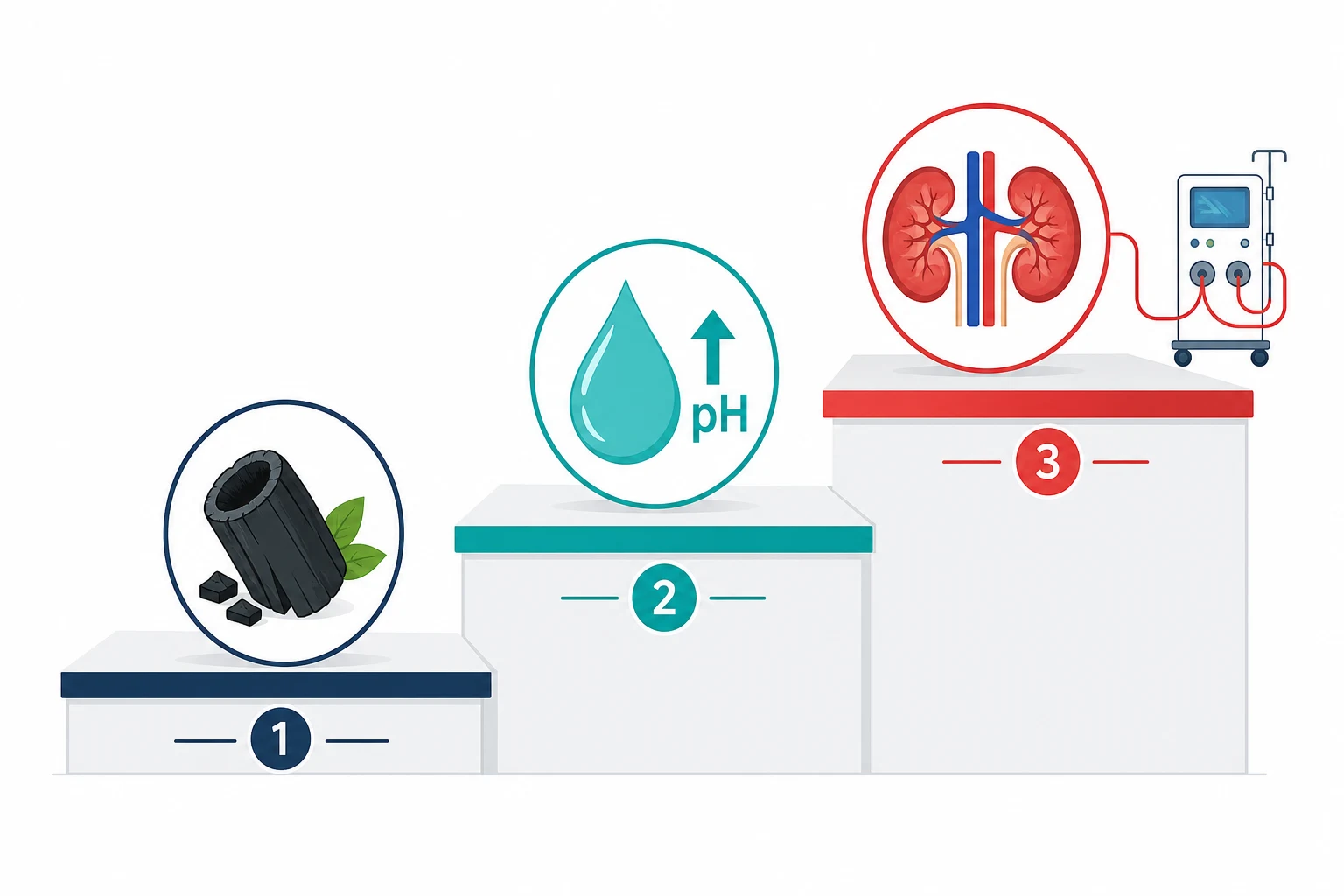
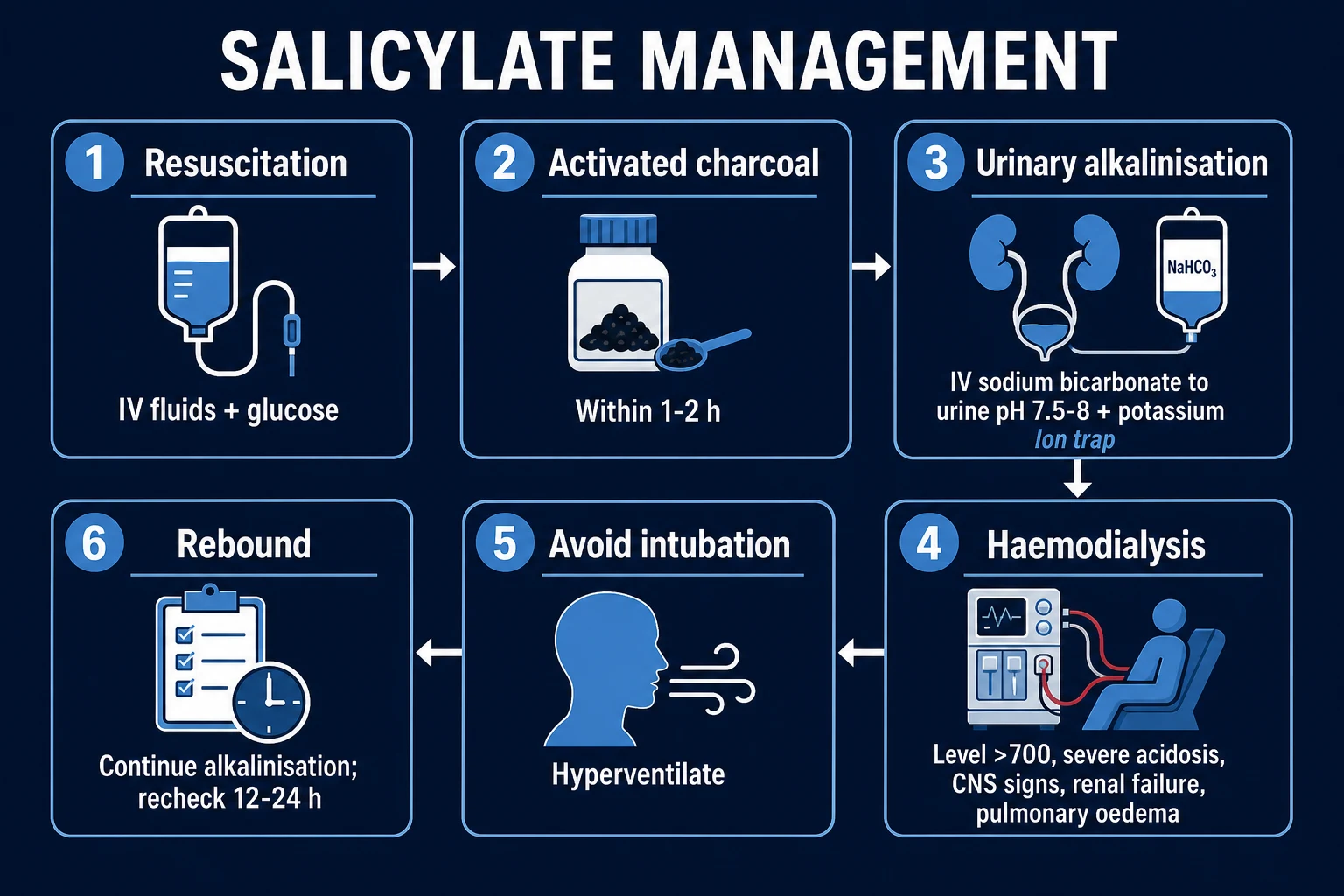
1. Decontamination. The activated charcoal (50 to 100 g) within 1 to 2 hours; the multi-dose charcoal (50 g every 4 h) for the sustained-release formulations, the massive ingestion, or the continued absorption (the salicylate forms the bezoars, the delayed absorption).[1]
2. Urinary alkalinisation. The sodium bicarbonate IV (the 1.26 per cent or the 8.4 per cent) to a urine pH of 7.5 to 8.0 — the ion-trapping. The salicylate is the weak acid; in the alkaline urine it is the ionised (the charged) and the trapped (the unable to reabsorb), the enhancing the elimination five- to tenfold. The potassium must be repleted — the hypokalaemia prevents the renal tubular alkalinisation (the Na-H exchange and the K reabsorption).[2][3][1]
3. Haemodialysis. The EXTRIP criteria for the extracorporeal treatment (the haemodialysis, the most efficient):[1]
- The salicylate level above 6.5 mmol/L (90 mg/dL), OR above 5 mmol/L with the end-organ damage (the CNS, the pulmonary oedema, the severe acidosis, the renal failure).
- The severe acidosis (the pH below 7.2 despite the bicarbonate), the pulmonary oedema refractory to the standard care, the renal impairment, the altered mental state or the seizures, the deterioration despite the optimal care.
The intubation danger
The intubation of the salicylate-poisoned patient is the high-risk: the loss of the spontaneous hyperventilation causes the rapid and the catastrophic rise of the PaCO2 and the acidosis, the driving of the salicylate into the brain (the ionised-fraction shift) and the cardiac arrest. If the intubation is the unavoidable (the coma, the severe exhaustion, the pulmonary oedema), the ventilation MUST match or exceed the pre-intubation minute volume (the permissive hyperpnoea — the low PaCO2), the pre-oxygenation is the maximal, and the dialysis is the ready.[1][1]
Prognosis
The salicylate poisoning is the survivable with the timely alkalinisation and the dialysis. The poor-prognostic features: the severe acidosis, the CNS depression, the pulmonary oedema, the hyperthermia, the late presentation. The oil-of-wintergreen and the sustained-release ingestions carry the higher mortality.[1][1]
Red flags
The acid–base fingerprint — reading the gas across severity
The salicylate blood gas evolves as toxicity deepens, and the pattern is the single most useful bedside marker after the level itself. Recognising the stage from the gas drives the decision to escalate to dialysis.[4][1]
The salicylate acid–base pattern evolves with severity
| Stage | pH | PaCO2 | HCO3 / BE | Anion gap | Interpretation | Action |
|---|---|---|---|---|---|---|
| Early / mild (adult) | Alkalaemia (↑↑) | Low (↓↓ — hyperventilation > acidosis) | Mildly low | Raised | Pure / dominant respiratory alkalosis | Charcoal, observe, serial levels |
| Moderate | Near-normal pH (the "normalisation" is deceptive) | Low | Lower | Raised | Mixed respiratory alkalosis + high-AG metabolic acidosis offsetting | Start urinary alkalinisation + K⁺ |
| Severe | Acidaemia (↓↓) | "Low" but inappropriately high for the acidosis | Low | Markedly raised | The metabolic acidosis now dominates; respiratory compensation failing/fatiguing | Escalate to haemodialysis |
| Pre-terminal | Severe acidaemia | Rising (fatigue) or rises abruptly with intubation | Very low | Very high | Pure metabolic acidosis / failure to compensate — CNS, pulmonary oedema | Emergency dialysis + matched hyperventilation |
| Child / chronic | Often metabolic acidosis dominant from the outset | — | Low | Raised | Children lack the dominant respiratory response; chronic toxicity is insidious | Treat aggressively, do not be reassured |
The trap of the "normal" pH. A normal-or-near-normal pH in a salicylate-toxic patient is NOT reassuring — it means the two opposing disorders (respiratory alkalosis + metabolic acidosis) are cancelling out, which is itself a marker of significant poisoning. The falling pH, the loss of the respiratory alkalosis, or a pure metabolic acidosis are all signs of deterioration and trigger dialysis.[1]
Management — the full ICU protocol
Salicylate poisoning — escalating ICU management
- RESUSCITATE & RISK-STRATIFY (ABC, but protect the hyperventilation): IV access ×2, continuous cardiac + SpO₂ monitoring, 12-lead ECG. Draw VBG/ABG (pH, PaCO2, lactate), salicylate level (baseline + repeat at 2 h), glucose, paracetamol level (frequent co-ingestion), EUC, LFTs, coagulation (PT often prolonged), β-HCG if relevant. Do NOT sedate or intubate electively — the patient's hyperventilation is their compensation; protect it. Determine the agent (plain vs enteric-coated vs oil of wintergreen), the time, and the dose.[1][1]
- DECONTAMINATION — activated charcoal: 50–100 g PO/NG if within 1 h of ingestion (extend to 2 h if delayed gastric emptying, sustained-release, or large ingestion) AND the airway is protected/gag reflex intact. MULTI-DOSE charcoal (25–50 g every 4 h, ~0.5 g/kg/h) is justified in salicylate poisoning — unlike most overdoses — because salicylate undergoes enterohepatic recirculation and forms bezoars/concretions that liberate drug for many hours. Charcoal directly binds salicylate in the gut lumen ("gut dialysis"). No role for gastric lavage routinely (aspiration risk); no role for syrup of ipecac (delayed, uncontrolled emesis).[5][1]
- FLUID & ELECTROLYTE RESUSCITATION: Replace dehydration (insensible + GI + hyperpnoeic losses are large). Use balanced crystalloid. Correct hypokalaemia aggressively — potassium MUST be >4.0 mmol/L for urinary alkalinisation to work (hypokalaemia triggers H⁺/Na⁺ exchange, acidifying the urine and defeating the bicarbonate). Check glucose — salicylate-induced hypoglycaemia (especially children) causes neuroglycopenia even with a "normal" meter glucose; give dextrose if symptomatic or CSF glucose is low.[4][1]
- URINARY ALKALINISATION — the core therapy: Give IV sodium bicarbonate to a urine pH target of 7.5–8.0 (NOT plasma pH — the endpoint is the URINE).[2][3]
- Loading: 1–2 mmol/kg of 8.4% NaHCO₃ (≈ 50–100 mmol adult) over 1–2 h (the 1.26% solution is less hyperosmolar for larger volumes; 8.4% for bolus). Some protocols: 150 mmol NaHCO₃ + 30 mmol KCl in 1 L of 5% dextrose, run at 1.5–2× maintenance.
- Maintenance: infusion titrated to keep urine pH 7.5–8.0, K⁺ >4.0, and haemodynamics stable. Check urine pH every 1–2 h (indwelling catheter — also allows accurate urine output).
- Why it works: salicylate is a weak acid (pKa ~3.0); at urine pH 8.0 it is >99.9% ionised → lipid-insoluble → "trapped" in the tubule → clearance rises 5–10-fold.
- Pitfalls: (a) hypokalaemia prevents alkalinisation — replete first; (b) overshoot alkalaemia and hypernatraemia — monitor; (c) fluid overload / pulmonary oedema — salicylate itself causes non-cardiogenic pulmonary oedema; add K⁺ and bicarbonate to a dextrose-containing (low-Na) fluid to limit sodium load; (d) rebound on stopping — continue alkalinisation for 12–24 h after the level falls, then wean and recheck.[7]
- HAEMODIALYSIS — for the severe / refractory (EXTRIP criteria). Salicylate is small, water-soluble, low Vd (in the plasma phase), low protein binding in overdose, and rapidly dialysable — dialysis removes it efficiently and is definitive for severe cases.[1][6]
- Definite indications (EXTRIP — grade 1D/2D): (a) salicylate level > 6.5 mmol/L (90 mg/dL); (b) level > 5.0 mmol/L (70 mg/dL) with end-organ damage (CNS depression/seizures, pulmonary oedema, severe acidosis pH <7.2, renal impairment); (c) refractory acidosis (pH <7.2) despite bicarbonate; (d) refractory hypotension / pulmonary oedema unresponsive to standard care; (e) renal failure impairing excretion; (f) clinical deterioration despite optimal alkalinisation.[1]
- Modality: intermittent haemodialysis (IHD) clears salicylate fastest and is preferred for haemodynamically stable patients; CRRT (CVVHD/CVVHDF) if shocked/unstable (slower clearance but tolerated); haemodialysis > haemofiltration for clearance efficiency. Modern high-efficiency IHD can lower the level by ~50% in 2–4 h.[6][13]
- Rebound: salicylate redistributes from tissue stores after dialysis — recheck the level 2–4 h post-dialysis; a second run or sustained CRRT is often needed.[7]
- IF INTUBATION IS UNAVOIDABLE — match the minute volume (see the intubation danger, below). Pre-oxygenate maximally; choose a ventilator setting that maintains a respiratory alkalosis (PaCO₂ 25–30 mmHg); give IV bicarbonate before/during induction; have dialysis immediately available; use short-acting agents. The most dangerous moment in salicylate poisoning is the intubation.[10][11][12]
- TREAT THE COMPLICATIONS: seizures — benzodiazepines (avoid those that depress ventilation excessively); pulmonary oedema — oxygen, PEEP, treat the cause (dialysis), diuretics are usually ineffective (non-cardiogenic); hyperthermia — active cooling (the fever is from uncoupling — paracetamol is useless); hypoglycaemia — IV dextrose; coagulopathy — vitamin K if significant (salicylate interferes with vitamin-K-dependent factors).[1]
- MONITORING & DE-ESCALATION: serial salicylate levels every 2 h until a sustained fall below toxic threshold AND clinical improvement; continuous ABG/VBG; urine pH hourly during alkalinisation; K⁺, Na⁺, glucose, lactate 2–4 h. Continue alkalinisation 12–24 h after the level normalises, then taper and recheck for rebound. Psychiatric assessment once recovered.[7]
Activated charcoal — when and how much
| Scenario | Recommendation | Rationale |
|---|---|---|
| Within 1 h of plain aspirin ingestion | Single dose 50 g (1 g/kg) | Most benefit; binds unabsorbed drug |
| 1–2 h, or delayed gastric emptying | Still give 50 g if airway safe | Salicylate delays gastric emptying → window extends |
| Sustained-release / enteric-coated / massive ingestion | Multi-dose charcoal 25–50 g q4h (or 0.5 g/kg/h) | Bezoar/concretion formation + enterohepatic recirculation → prolonged absorption; charcoal = "gut dialysis" |
| Oil of wintergreen (methyl salicylate) | Give charcoal — absorption is rapid but volume small | Concentrated liquid; do not delay decontamination |
| Obtunded / unprotected airway | Intubate first, then charcoal via NG | Aspiration risk — never charcoal an unprotected airway |
| Gastric lavage / ipecac | No routine role | Aspiration risk; lavage only within 1 h of life-threatening dose |
EXTRIP haemodialysis criteria for salicylate poisoning (Juurlink 2015)
| Criterion | Threshold | EXTRIP grading |
|---|---|---|
| Level alone | > 6.5 mmol/L (90 mg/dL) | Dialyse (1D) |
| Level + end-organ damage | > 5.0 mmol/L (70 mg/dL) with CNS signs, pulmonary oedema, severe acidosis, or renal failure | Dialyse (1D) |
| Refractory metabolic acidosis | pH < 7.2 despite bicarbonate | Dialyse (2D) |
| Renal impairment | AKI impairing salicylate excretion / inability to alkalinise urine | Dialyse (2D) |
| Clinical deterioration | Worsening despite optimal conservative care | Dialyse (2D) |
| Altered mental status / seizures | CNS toxicity | Dialyse (2D) |
| Pulmonary oedema refractory to standard care | Non-cardiogenic, severe | Dialyse (2D) |
| Standard/moderate toxicity | Level < 5 mmol/L, no end-organ damage | Do NOT dialyse — alkalinisation suffices |
Treatment modalities and their effect on salicylate clearance
| Modality | Mechanism | Effect on clearance / outcome | Notes |
|---|---|---|---|
| Activated charcoal (single) | Gut binding | Prevents absorption of residual drug | Within 1–2 h |
| Multi-dose charcoal | "Gut dialysis" + interrupts enterohepatic recirculation | Removes drug already in circulation across the gut wall | Sustained-release, bezoar, massive ingestion |
| Urinary alkalinisation (NaHCO₃) | Ion trapping in alkali urine | Increases renal clearance 5–10× | Core therapy; needs K⁺ >4.0, urine pH 7.5–8.0 |
| Forced diuresis alone (without alkalinisation) | ↑ urine flow | No added benefit, may cause pulmonary oedema | Abandoned — alkalinise, do not just force fluids |
| Intermittent haemodialysis (IHD) | Extracorporeal clearance | Fastest removal; definitive for severe | Preferred if haemodynamically stable |
| CRRT (CVVHDF) | Slower extracorporeal clearance | Tolerated if shocked; less efficient per hour | Useful for unstable patient + rebound prevention |
| Haemoperfusion | Adsorbent column | Effective but more clotting/platelet issues | Rarely used today; IHD preferred |
The intubation danger — the single most lethal intervention
The salicylate-toxic patient maintains a compensatory respiratory alkalosis by hyperventilating. The moment they are intubated and ventilated to "normal" targets (normocapnia, PaCO₂ 40 mmHg), three catastrophes occur simultaneously:[10][11][12]
- The PaCO₂ rises abruptly — the respiratory alkalosis is lost, the pH falls.
- The falling pH protonates salicylate → more un-ionised (lipid-soluble) drug → massive shift into the brain and CSF (ion trapping in reverse). Neurotoxicity (seizures, coma) can escalate within minutes.
- The fall in pH also drives salicylate into the myocardium and worsens the metabolic acidosis → cardiovascular collapse and cardiac arrest. [1]
Multiple case series document that intubated salicylate-poisoned patients have high mortality, and survival is strongly associated with concurrent haemodialysis — i.e. the institution that intubates a salicylate patient without immediately arranging dialysis is courting disaster. McCabe & Lu showed haemodialysis was associated with improved survival among intubated salicylate-poisoned patients.[11][12]
If intubation is unavoidable (coma, refractory pulmonary oedema, severe exhaustion):[1][1]
- Pre-oxygenate maximally (100% FiO₂).
- Give IV sodium bicarbonate 1–2 mmol/kg BEFORE induction (pre-empt the acidosis).
- Set the ventilator to match or EXCEED the pre-intubation minute volume — target a respiratory alkalosis (PaCO₂ 25–30 mmHg), i.e. permissive hyperpnoea, NOT normocapnia.
- Use short-acting sedation/paralysis so the patient can resume spontaneous effort as soon as feasible.
- Have haemodialysis IMMEDIATELY available — and strongly consider dialysing any intubated salicylate patient.
- Check a blood gas immediately post-intubation and titrate the ventilator to keep the pH alkalaemic. [1]
SAQ — Severe salicylate poisoning with mixed acid–base disorder
10 minutes · 10 marks
A 22-year-old woman (55 kg) is brought to ED 8 hours after ingesting 50 g of aspirin in a deliberate overdose. She is agitated, tachypnoeic (RR 36) with hyperpnoea, tinnitus, mild fever (38.4°C) and is sweating. Arterial blood gas: pH 7.46, PaCO₂ 22 mmHg, HCO₃⁻ 16 mmol/L, lactate 5.6 mmol/L, anion gap 24. Serum salicylate 720 mg/L (5.2 mmol/L). ECG sinus tachycardia.
SAQ — Chronic salicylism in an elderly patient
10 minutes · 10 marks
An 82-year-old woman on long-term enteric-coated aspirin 150 mg/day for stroke prevention is brought in with a 5-day history of progressive confusion, dehydration, tinnitus, fast breathing and one witnessed seizure. She has been taking extra over-the-counter “pain powders” for arthritic pain. Salicylate level 580 mg/L (4.2 mmol/L), pH 7.34, PaCO₂ 26, HCO₃⁻ 17, Na⁺ 134, K⁺ 3.0, lactate 4.2.
Clinical pearls
Additional red flags
Key trials and evidence
Juurlink 2015 — EXTRIP: Extracorporeal Treatment for Salicylate Poisoning (PMID 25986310)
Source
Annals of Emergency Medicine — EXTRIP Workgroup systematic review & recommendations
Key principle 1
Haemodialysis recommended for level >6.5 mmol/L (90 mg/dL), OR >5 mmol/L (70 mg/dL) with end-organ damage (CNS, pulmonary oedema, severe acidosis, renal failure)
Key principle 2
Intermittent haemodialysis preferred (fastest clearance); CRRT acceptable if haemodynamically unstable
Key principle 3
Salicylate is highly dialysable — small, water-soluble, low Vd, low protein binding in overdose
Clinical bottom line
The international consensus that governs dialysis decisions in salicylate poisoning — the criteria ICU referrals are based on
Palmer & Clegg 2020 — Salicylate Toxicity, NEJM (PMID 32579814)
Source
New England Journal of Medicine — definitive mechanistic & clinical review
Key principle 1
Two converging effects: direct medullary respiratory-centre stimulation (respiratory alkalosis) + uncoupling of oxidative phosphorylation and Krebs-cycle disruption (high-AG metabolic acidosis, fever)
Key principle 2
Elimination shifts to saturable (zero-order) kinetics in overdose — half-life lengthens to 15–30 h; small dose increments → large toxicity
Key principle 3
Acidosis drives salicylate into the brain (ion trapping in reverse) — level underestimates CNS burden; treat the patient and the gas, not the level
Clinical bottom line
The modern reference for pathophysiology and the rationale for urinary alkalinisation and dialysis
McCabe & Lu 2017 — Haemodialysis & survival in intubated salicylate-poisoned patients (PMID 28438446)
Source
American Journal of Emergency Medicine — retrospective association study
Key principle 1
Intubated salicylate-poisoned patients have high mortality, reflecting the danger of losing compensatory hyperventilation
Key principle 2
Haemodialysis was associated with improved survival among intubated salicylate-poisoned patients
Clinical bottom line
If you intubate a salicylate patient, arrange dialysis — intubation without dialysis is a high-mortality combination
McDonald 2024 — Tracheal Intubation & Mechanical Ventilation in Severe Salicylate Poisoning (PMID 39030088)
Source
Journal of Emergency Medicine — contemporary case series
Key principle 1
Re-examines the safety of intubation in severe salicylate poisoning; documents the acid-base deterioration that accompanies standard ventilation
Key principle 2
Underscores the need to match pre-intubation minute ventilation (permissive hyperpnoea, low PaCO₂) and have dialysis available
Clinical bottom line
Modern evidence reinforcing the intubation danger and the imperative to ventilate to a respiratory alkalosis
O'Keefe 2023 — Rebound salicylate toxicity after cessation of urine alkalinisation (PMID 37427892)
Source
Clinical Toxicology (Philadelphia) — observational study
Key principle 1
Rebound salicylate toxicity occurs after urinary alkalinisation is stopped — drug redistributes and reabsorbs
Key principle 2
Supports continuing alkalinisation for a period after the level appears to normalise, then tapering with recheck
Clinical bottom line
Explains the 'got better then got worse' phenomenon — taper alkalinisation and recheck levels
Hoegberg 2021 — Systematic review: activated charcoal for GI decontamination (PMID 34424785)
Source
Clinical Toxicology (Philadelphia) — POSITION/PRACTICE Guideline systematic review
Key principle 1
Single-dose activated charcoal within 1 h of ingestion reduces absorption; benefit may extend beyond 1 h for substances that delay gastric emptying (e.g. salicylates)
Key principle 2
Multi-dose charcoal has a role for substances that form concretions or undergo enterohepatic recirculation — salicylate is the archetype
Clinical bottom line
Evidence base for charcoal timing and multi-dose use in salicylate overdose
Lam 2024 — Serum salicylate trajectory after methyl salicylate (oil of wintergreen) ingestion (PMID 39387701)
Source
Clinical Toxicology (Philadelphia) — case series / pharmacokinetic study
Key principle 1
Oil of wintergreen (methyl salicylate) produces very high serum levels from small volumes — ~30× the concentration of aspirin tablets
Key principle 2
Characterises the prolonged, often delayed absorption and the long tail of toxicity requiring extended alkalinisation/dialysis
Clinical bottom line
Why oil-of-wintergreen ingestions are disproportionately dangerous and need aggressive, prolonged management
Mullins & Kraut 2022 — The Nephrologist in Poisoning, Core Curriculum (PMID 34895948)
Source
American Journal of Kidney Diseases — Core Curriculum 2022
Key principle 1
Operationalises dialysis decisions for dialysable poisons; salicylate is a flagship example (small, water-soluble, low Vd)
Key principle 2
Intermittent haemodialysis clears salicylate fastest; CRRT is the fallback for the haemodynamically unstable
Clinical bottom line
Practical nephrology reference for when and how to dialyse salicylate toxicity
Prescott 2003 — Does urine alkalinization increase salicylate elimination? (PMID 15181662)
Source
Toxicology Reviews — classic pharmacology review
Key principle 1
Alkalinising the urine to pH 7.5–8.0 increases renal salicylate clearance 5–10-fold by ion trapping
Key principle 2
Hypokalaemia prevents successful alkalinisation (Na⁺/H⁺ exchange acidifies the urine) — potassium repletion is prerequisite
Clinical bottom line
The mechanistic foundation of urinary alkalinisation and the reason potassium correction is non-negotiable
References
- [1]Juurlink DN, Gosselin S, Kielstein JT, et al.; EXTRIP Workgroup. Extracorporeal Treatment for Salicylate Poisoning: Systematic Review and Recommendations From the EXTRIP Workgroup Ann Emerg Med, 2015.PMID 25986310
- [2]Chen A, et al. Urinary Alkalinization for Salicylate Poisoning Is Infrequently Measured nor Achieved Am J Ther, 2025.PMID 40266330
- [3]Prescott LF, Balali-Mood M, Critchley JA, et al. Does urine alkalinization increase salicylate elimination? If so, why? Toxicol Rev, 2003.PMID 15181662
- [4]Palmer BF, Clegg DJ. Salicylate Toxicity N Engl J Med, 2020.PMID 32579814
- [5]Hoegberg LCG, Shepherd G, Wood DM, et al. Systematic review on the use of activated charcoal for gastrointestinal decontamination following acute oral overdose Clin Toxicol (Phila), 2021.PMID 34424785
- [6]Mullins ME, Kraut JA. The Role of the Nephrologist in Management of Poisoning and Intoxication: Core Curriculum 2022 Am J Kidney Dis, 2022.PMID 34895948
- [7]O'Keefe M, Stanton M, Feldman R. Incidence of rebound salicylate toxicity following cessation of urine alkalinization Clin Toxicol (Phila), 2023.PMID 37427892
- [8]Lam RPK, Chan CK, Tse ML. The trajectory of serum salicylate concentrations after ingestion of medicinal oil containing methyl salicylate Clin Toxicol (Phila), 2024.PMID 39387701
- [9]Berggren J, Jones C, Katz KD. Severe Salicylate Poisoning Due to Teaberry Flavoring Ingestion: A Case Report J Emerg Med, 2025.PMID 39952819
- [10]McDonald BA, Conlon M, Ulici A. Tracheal Intubation and Mechanical Ventilation in Adults with Severe Salicylate Poisoning J Emerg Med, 2024.PMID 39030088
- [11]McCabe DJ, Lu JJ. The association of hemodialysis and survival in intubated salicylate-poisoned patients Am J Emerg Med, 2017.PMID 28438446
- [12]Fernando SM, Charbonneau V, Rosenberg H. Hypercapnea and Acidemia despite Hyperventilation following Endotracheal Intubation in a Case of Unknown Severe Salicylate Poisoning Case Rep Crit Care, 2017.PMID 28465843
- [13]Wong A, Mac K, Aneman A. Modern Intermittent Haemodialysis (IHD) is an Effective Method of Removing Salicylate in Chronic Topical Salicylate Toxicity J Med Toxicol, 2016.PMID 26334327