ICU · Toxicology
Serotonin Syndrome & Neuroleptic Malignant Syndrome
Also known as Serotonin toxicity · Serotonin syndrome · Neuroleptic malignant syndrome · NMS · Malignant hyperthermia · Cyproheptadine · Dantrolene
The two drug-induced hyperthermic syndromes of the ICU — the serotonin syndrome (the excess serotonin — the clonus, the hyperreflexia, the rapid onset, the cyproheptadine) and the neuroleptic malignant syndrome (the dopamine antagonism — the lead-pipe rigidity, the slow onset, the dantrolene and the bromocriptine) — and their distinction from the malignant hyperthermia (the volatile-anaesthetic + the suxamethonium, the theatre, the dantrolene) and the anticholinergic syndrome (the dry, the hot, the blind, the red, the mad — the physostigmine).
On this page & tools
Your progress
Saved locally on this device.
Target exams
Overview & definition
The drug-induced hyperthermic syndromes — the serotonin syndrome (the excess serotonin), the neuroleptic malignant syndrome (the NMS) (the dopamine antagonism), and the malignant hyperthermia (the MH) (the volatile + the suxamethonium) — are the distinct, the dangerous, the potentially-lethal entities with the overlapping features (the hyperthermia, the rigidity, the altered mental state) and the different triggers and the different treatments. The accurate, the rapid distinction is the essential. The anticholinergic syndrome is the fourth member of the differential — the dry, the hot, the flushed, the mydriatic, the delirious — distinguished by the peripheral muscarinic blockade and treated by the physostigmine.[1][1][4]
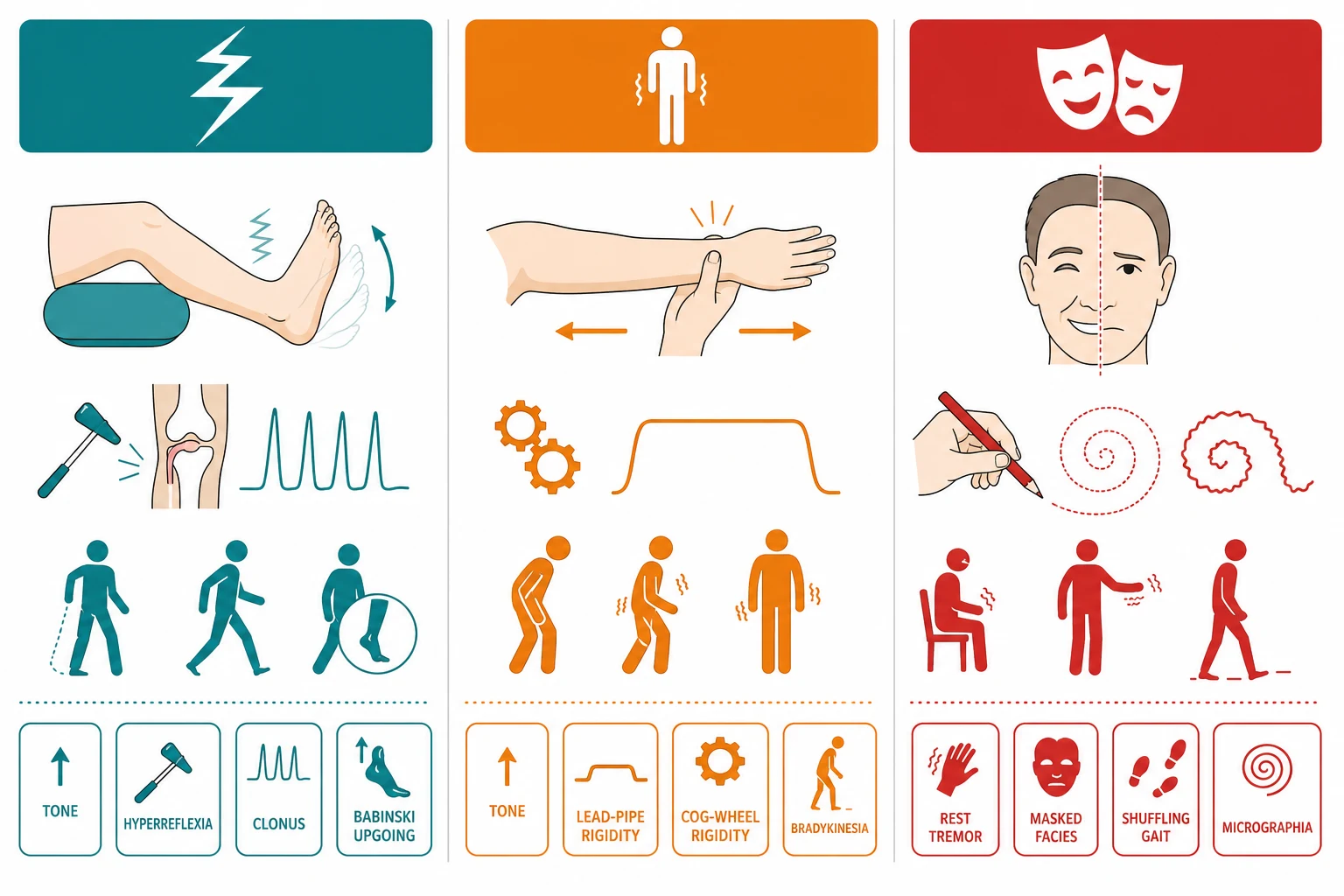
The Fellowship candidate must hold four facts simultaneously: (1) the onset is the discriminator — the minutes for the MH, the hours for the serotonin, the days for the NMS; (2) the neuromuscular sign is the discriminator — the clonus and the hyperreflexia for the serotonin, the lead-pipe rigidity and the bradyreflexia for the NMS, the masseter rigidity for the MH, the dry skin and the mydriasis for the anticholinergic; (3) the antipyretics are useless in all four — the heat is the muscle-generated, not the hypothalamic; (4) the specific antidote differs — the cyproheptadine for the serotonin, the dantrolene and the bromocriptine for the NMS, the dantrolene for the MH, the physostigmine for the anticholinergic.[1][4][9]
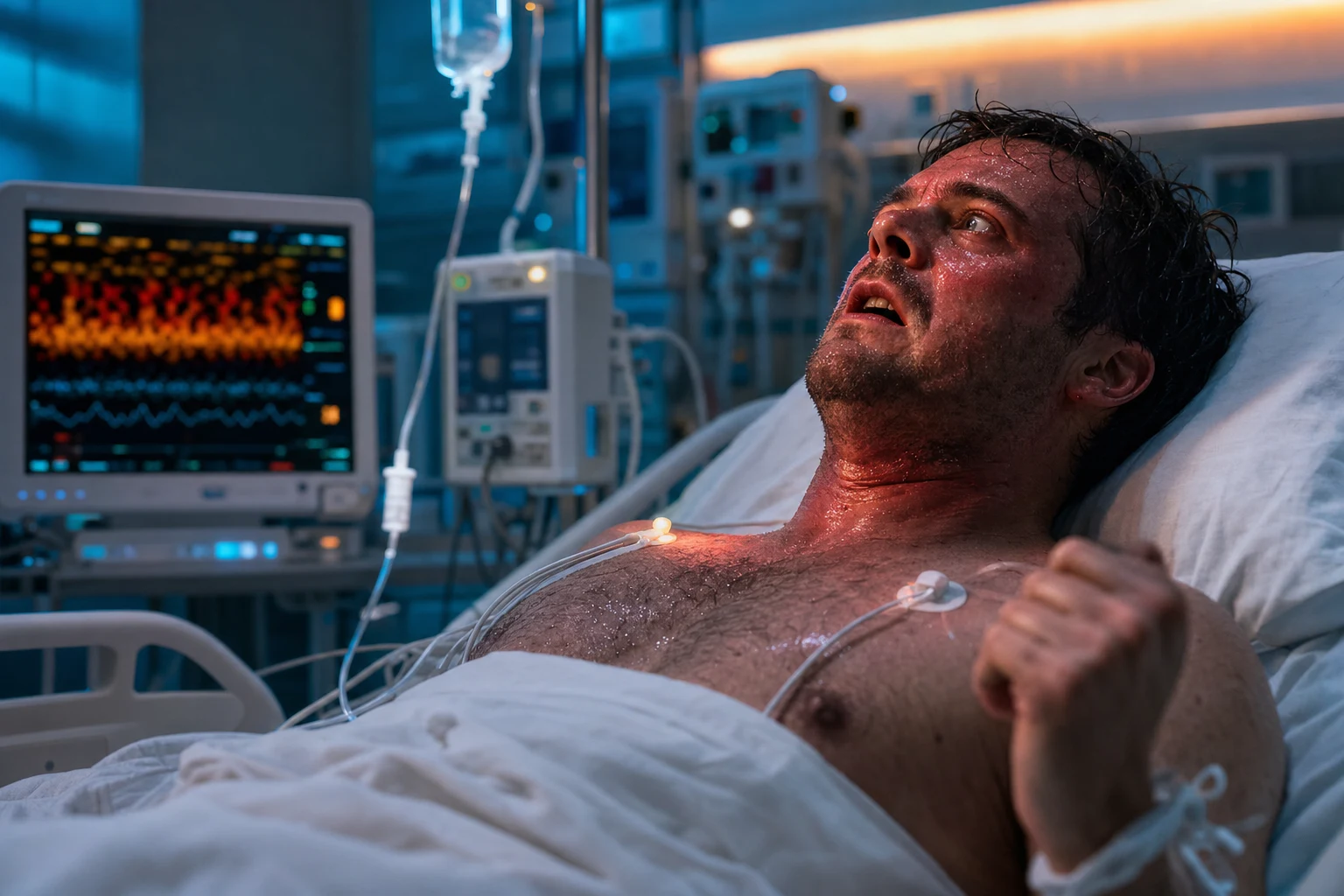
The pathophysiology — the receptor pharmacology
The four syndromes share the hyperthermia and the altered mental state but diverge at the receptor. The understanding of the receptor is the understanding of the trigger and the antidote. [1]
The serotonin syndrome is the central serotonergic excess at the 5-HT2A and the 5-HT1A receptors in the brainstem and the spinal cord. The serotonin is the product of the dietary tryptophan, the stored in the presynaptic vesicle by the vesicular monoamine transporter, the released into the synapse, the action terminated by the reuptake (the SERT transporter) and the degradation (the monoamine oxidase). The serotonergic drugs act at every step: the SSRIs and the SNRIs block the reuptake; the MAOIs block the degradation; the tramadol and the pethidine and the fentanyl displace the serotonin and the block the reuptake; the linezolid and the methylene blue are the reversible MAOIs; the MDMA forces the vesicular release. The combination of two drugs acting at the different steps is the lethal — the MAOI (the no degradation) plus the SSRI/tramadol (the no reuptake) produces the unchecked synaptic serotonin and the severe toxicity.[4][7][12]
The NMS is the central dopamine antagonism at the D2 receptors in the hypothalamus and the basal ganglia. The dopamine is the endogenous thermoregulator — the dopamine pathway from the hypothalamus to the peripheral vasculature mediates the heat dissipation, and the dopamine in the basal ganglia modulates the muscle tone. The D2 blockade (the antipsychotic, the antiemetic) removes both the heat dissipation and the muscle-tone modulation — the rigidity and the hyperthermia result. The dopamine-agonist withdrawal (the abrupt cessation of the levodopa or the amantadine in the Parkinson's disease) produces the identical picture by the same mechanism — the empty receptor rather than the blocked receptor.[3][9]
The malignant hyperthermia is the ryanodine receptor (the RyR1) defect in the skeletal muscle sarcoplasmic reticulum. The volatile anaesthetics and the suxamethonium open the defective RyR1 channel — the uncontrolled calcium release from the sarcoplasmic reticulum into the myoplasm, the sustained actin-myosin cross-bridge cycling, the ATP consumption, the heat production, the rigidity, the hyperkalaemia (the leak from the damaged muscle), the acidosis. The calcium is the unable to be re-sequestered — the cycle is the self-sustaining until the dantrolene (the RyR1 blocker) is given. The genetic basis is the autosomal dominant mutation in the RYR1 gene (the 70 to 80 per cent of the cases) or the CACNA1S gene (the 1 per cent).[1][11]
The anticholinergic syndrome is the muscarinic acetylcholine receptor blockade — the central (the delirium, the agitation) and the peripheral (the dry, the dilated, the flushed, the hot, the blind). The mnemonic — the dry as a bone, the red as a beet, the hot as a hare, the blind as a bat, the mad as a hatter — captures the peripheral antimuscarinic effects and the central delirium.[15]
The serotonin syndrome
The serotonin syndrome is the excess of the central serotonin, the produced by the serotonergic agents (the SSRIs, the SNRIs, the MAOIs, the tramadol, the pethidine, the fentanyl, the linezolid, the methylene blue, the MDMA, the triptans, the St John's wort) — the classically the combination (the MAOI + the SSRI/tramadol is the lethal). The onset is the rapid (the hours) after a dose increase or a new agent.[1][2]
The triad:[1]
- The neuromuscular hyperactivity — the clonus (the inducible and the spontaneous, the ocular — the hallmark), the hyperreflexia (the lower-limbs especially), the rigidity (the more the severe, the lower-body), the tremor, the myoclonus.
- The autonomic instability — the hyperthermia, the tachycardia, the hypertension, the mydriasis, the diaphoresis, the diarrhoea, the flushing.
- The altered mental state — the agitation, the confusion, the restlessness.
The clonus is the most specific sign — the inducible (the ankle or the patella) at the milder end, the spontaneous and the ocular (the horizontal) at the severe end. The ocular clonus is the virtually pathognomonic for the serotonergic aetiology. The hyperreflexia is the lower-limb and the exaggerated — the contrast with the bradyreflexia of the NMS is the key discriminator at the bedside. The Babinski may be present (the upper motor neuron).[4][5]
The Hunter criteria (the highly-sensitive-and-specific, the 84 per cent sensitive and the 97 per cent specific): the spontaneous clonus, OR the inducible clonus + the agitation + the diaphoresis, OR the ocular clonus + the agitation + the diaphoresis, OR the tremor + the hyperreflexia, in the context of the serotonergic agent.[5]
The Hunter criteria replaced the older Sternbach criteria, which required the presence in the serotonergic agent and (a) mental status change with (b) two of myoclonus, hyperreflexia, diaphoresis, shivering, tremor, diarrhoea, incoordination, or fever — but the Sternbach criteria missed the milder cases and over-diagnosed the febrile delirium. The Hunter criteria, built on the prospectively-observed Hunter Area Toxicology Service cohort, are the more accurate and the current standard.[4][5]
The severity spectrum of the serotonin syndrome — the Radomski classification
The mild — the tremor and the hyperreflexia, the mild tachycardia and the mydriasis, the diaphoresis, the restlessness; the temperature normal or the low-grade; the outpatient management in many cases, the agent stopped
The moderate — the clonus (the inducible), the hypertonia, the hyperthermia (up to 40 degrees C), the autonomic instability (the tachycardia, the hypertension or the hypotension, the mydriasis), the agitation; the hospital admission, the cyproheptadine, the benzodiazepine
The severe — the spontaneous clonus and the ocular clonus, the marked hyperthermia (over 40 degrees C), the muscle rigidity (the lower-body), the delirium, the seizures, the rhabdomyolysis, the renal failure, the disseminated intravascular coagulation, the death; the ICU, the intubation, the paralysis, the active cooling
The neuroleptic malignant syndrome (the NMS)
The NMS is the dopamine antagonism — the antipsychotics (the typical — the haloperidol; the atypical — the olanzapine, the risperidone, the clozapine), the antiemetics (the metoclopramide, the prochlorperazine), and the withdrawal of the dopamine agonist in the Parkinson's disease (the levodopa, the amantadine abruptly stopped). The onset is the slow (the 1 to 3 days).[3][1]
The tetrad:[3]
- The hyperthermia (the over the 38.5 degrees C, the frequently the over 40).
- The lead-pipe rigidity (the extrapyramidal, the generalized; the bradyreflexia — the contrast with the hyperreflexia of the serotonin syndrome); the cogwheeling may be present.
- The autonomic instability (the tachycardia, the labile blood pressure, the diaphoresis, the sialorrhoea — the especially with the clozapine).
- The altered mental state (the stupor, the mutism, the agitation, the coma).
The associated: the elevated creatine kinase (the rhabdomyolysis — the typically the over 1000, the often the over 10,000 units per litre), the transaminitis, the leukocytosis (the typically the 10,000 to 20,000), the renal impairment (the rhabdomyolysis-induced), the hypocalcaemia, the low serum iron (the characteristic but the not the diagnostic).[1][9]
The DSM-5 diagnostic criteria (the five): the muscle rigidity and the elevated temperature (the over 38.5 with no other cause) PLUS at least two of: the diaphoresis, the sialorrhoea, the incontinence, the altered consciousness, the mutism, the tachycardia, the labile or the elevated blood pressure, the leukocytosis, the elevated CK. The DSM-5 criteria are the more specific but the less sensitive than the clinical judgement — the NMS remains the clinical diagnosis.[9]
The incidence — the 0.02 to 0.3 per cent of the patients on the antipsychotics. The mortality — the 5 to 20 per cent (the down from the 25 per cent in the era before the recognition and the dantrolene). The predictors of the mortality (the Guinart pooled analysis) — the higher CK, the higher temperature, the older age, the renal failure, the cognitive impairment, the catatonic features. The NMS with the acute renal failure from the rhabdomyolysis carries the 50 per cent mortality.[9][13]
The malignant hyperthermia (the MH)
The MH is the ryanodine-receptor mutation (the calcium-handling) triggered by the volatile anaesthetics (the halothane, the sevoflurane, the isoflurane, the desflurane) and the suxamethonium — the massive intracellular calcium release, the sustained muscle contraction, the rigidity (the masseter especially — the "the jaw of steel"), the rapid hyperthermia, the hypercarbia, the acidosis, the hyperkalaemia. The onset is the in-the-theatre, the rapid after the trigger (the minutes, the within the first hour of the anaesthesia, the occasionally the delayed to the several hours).[1][11]
The clinical grading scale (the Larach) is the post-hoc research tool — the not the for the acute diagnosis. The acute diagnosis is the clinical: the unexplained hypercarbia (the rising end-tidal CO2 with the unchanged ventilation, the earliest sign), the tachycardia out of proportion, the masseter rigidity (the 50 per cent of the paediatric cases with the suxamethonium), the rapid temperature rise, the hyperkalaemia, the acidosis, the sinus tachycardia then the ventricular arrhythmia. The coffee-coloured urine (the myoglobinuria) is the late sign.[11]
The MH is the inherited (the autosomal dominant) but the sporadic in the 50 per cent (the new mutation or the unrecognised family history). The first presentation may be the third or the fourth anaesthetic — the prior uneventful anaesthetics do NOT exclude the susceptibility. The diagnosis is the in vitro contracture test (the IVCT) — the muscle biopsy (the vastus lateralis) and the exposure to the halothane and the caffeine; the gold standard for the confirmation and the family screening. The genetic testing (the RYR1 and the CACNA1S) is the increasingly used but the lower sensitivity than the IVCT.[1][11]
The anticholinergic syndrome — the fourth member
The anticholinergic syndrome is the muscarinic acetylcholine receptor blockade — the central and the peripheral — produced by the antihistamines (the diphenhydramine, the promethazine), the antispasmodics, the tricyclics (the anticholinergic plus the sodium-channel), the atropine, the hyoscine, the plant toxins (the deadly nightshade — the Atropa belladonna, the thornapple — the Datura stramonium), and the parkinsonian medications (the benztropine, the procyclidine).[15]
The clinical: the dry as a bone, the red as a beet, the hot as a hare, the blind as a bat, the mad as a hatter. The dry — the dry skin and the dry mucosae, the absent sweating, the urinary retention, the ileus. The red — the flushed face. The hot — the hyperthermia. The blind — the cycloplegia and the mydriasis (the loss of the accommodation, the blurred vision). The mad — the central delirium, the agitation, the hallucination (the visual and the auditory), the picking and the plucking (the characteristic movement), the seizures in the severe. The tachycardia is the universal.[15]
The discrimination from the serotonin syndrome — the serotonin syndrome has the clonus, the hyperreflexia, the diaphoresis (the WET skin), the mydriasis with the bowel sounds present; the anticholinergic has the dry skin, the absent bowel sounds, the urinary retention, the hyperreflexia absent. The skin moisture is the single best discriminator at the bedside.[4][15]
The physostigmine (the acetylcholinesterase inhibitor, the crosses the blood-brain barrier) is the specific antidote — the 1 to 2 mg IV in the adult, the slow (the 5 minutes), the onset in the minutes. The use is the controversial — the bradycardia, the bronchospasm, the seizures, the asystole are the reported; the contraindicated in the tricyclic with the QRS widening (the ventricular arrhythmia). The benzodiazepine is the safe alternative for the agitation.[15]
The triggering agents — the comprehensive list
The Fellowship candidate must know the full list — the trigger is the diagnostic, the trigger is the preventable. [1]
Serotonin syndrome — the serotonergic agents
the 5-HT excess
- The SSRIs (the sertraline, the fluoxetine, the citalopram, the paroxetine, the escitalopram) — the commonest, the chronic exposure
- The SNRIs (the venlafaxine, the duloxetine, the desvenlafaxine) — the venlafaxine the highest single-agent risk
- The MAOIs (the phenelzine, the tranylcypromine, the moclobemide, the selegiline) — the highest interaction risk
- The tramadol and the pethidine (the meperidine) — the weak reuptake inhibition plus the analgesic
- The fentanyl and the methadone — the reuptake inhibition
- The linezolid — the reversible MAOI; the classic antibiotic precipitant
- The methylene blue — the potent MAOI; the classic surgical precipitant (the parathyroidectomy, the vascular surgery)
- The MDMA (the ecstasy), the cocaine, the amphetamine — the forced vesicular release
- The triptans (the sumatriptan) — the 5-HT1B/1D agonist; the debated but the additive
- The St John wort (the hypericum) — the herbal; the MAOI plus the reuptake inhibition
- The dextromethorphan, the ondansetron, the granisetron, the metoclopramide — the mild serotonergic
- The L-tryptophan and the 5-hydroxytryptophan — the serotonin precursor; the dietary supplement
NMS — the dopamine antagonists
the D2 blockade
- The typical antipsychotics (the haloperidol, the chlorpromazine, the fluphenazine) — the haloperidol the classic
- The atypical antipsychotics (the olanzapine, the risperidone, the quetiapine, the clozapine, the aripiprazole, the ziprasidone) — the not the spared despite the lower D2 affinity
- The clozapine — the highest risk among the atypicals; the sialorrhoea and the ileus
- The antiemetics (the metoclopramide, the prochlorperazine, the promethazine, the droperidol) — the overlooked precipitants
- The dopamine-agonist withdrawal (the abrupt cessation of the levodopa, the amantadine, the bromocriptine, the pramipexole, the ropinirole in the Parkinson disease) — the identical mechanism
- The rapid-dose escalation, the depot (the long-acting) formulation, the high-potency agent
- The dehydration, the agitation, the iron deficiency, the organic brain disease — the patient factors
- The lithium — the additive; the serotonin syndrome more than the NMS but the both reported
Malignant hyperthermia — the triggers
the RyR1 opening
- The volatile anaesthetics (the halothane, the sevoflurane, the isoflurane, the desflurane, the enflurane) — the all
- The suxamethonium (the succinylcholine) — the alone or the with the volatile
- The rare and the disputed (the ketamine in the susceptible, the statins in the susceptible) — the not the classic
- The avoidance (the propofol, the opioids, the benzodiazepines, the etomidate, the ketamine, the local anaesthetics, the non-depolarising relaxants) — the safe agents for the MH-susceptible
Anticholinergic — the muscarinic blockers
the antimuscarinic
- The antihistamines (the diphenhydramine, the promethazine, the hydroxyzine, the doxylamine) — the over-the-counter; the commonest overdose
- The tricyclics (the amitriptyline, the nortriptyline, the dothiepin, the imipramine) — the anticholinergic plus the sodium-channel (the QRS widening)
- The atropine and the hyoscine (the scopolamine) — the ophthalmologic, the perioperative
- The antiparkinsonian (the benztropine, the procyclidine, the trihexyphenidyl, the orphenadrine)
- The antispasmodics (the hyoscine butylbromide, the dicyclomine), the bladder antimuscarinics (the oxybutynin, the tolterodine)
- The plants (the Atropa belladonna — the deadly nightshade, the Datura stramonium — the thornapple, the Hyoscyamus niger — the henbane) — the herbal and the recreational
- The mydriatics (the tropicamide, the cyclopentolate) — the topical but the systemic in the infant
The comparison
| Feature | Serotonin syndrome | NMS | Malignant hyperthermia | Anticholinergic |
|---|---|---|---|---|
| Mechanism | Excess serotonin (5-HT2A) | Dopamine antagonism (D2) | RyR1 calcium release | Muscarinic blockade |
| Trigger | Serotonergic agents | Antipsychotics / dopamine-agonist withdrawal | Volatiles + suxamethonium | Antihistamines, TCA, atropine, plants |
| Onset | Hours | Days (1–3) | Minutes (theatre) | Hours |
| Key neuromuscular sign | Clonus, hyperreflexia | Lead-pipe rigidity, bradyreflexia | Masseter rigidity, hypercarbia | None (dry skin, ileus) |
| Mental state | Agitated | Stupor, mutism | Coma (late) | Delirium, hallucination |
| Skin | Diaphoretic (WET) | Diaphoretic | Mottled, hot | Dry (DRY), flushed |
| Bowel sounds | Hyperactive, diarrhoea | Normal or ileus | Normal | Absent (ileus) |
| Pupils | Mydriasis | Normal | Normal | Mydriasis, cycloplegia |
| Creatine kinase | Normal or mildly raised | Markedly raised (rhabdomyolysis) | Markedly raised | Normal |
| Specific treatment | Cyproheptadine, benzodiazepine | Dantrolene, bromocriptine | Dantrolene, stop trigger | Physostigmine, benzodiazepine |
| Mortality (untreated) | Low (under 1 per cent mild) | 5 to 20 per cent | 70 per cent without dantrolene | Low (sedation risk) |
Serotonin syndrome
the WET, the fast, the clonus
- The clonus — the inducible, the spontaneous, the ocular (the pathognomonic)
- The hyperreflexia — the lower-limbs especially
- The hyperthermia + the diaphoresis (the WET skin)
- The onset in the hours; the serotonergic agent
- The cyproheptadine; the benzodiazepine
- The hyperactive bowel sounds, the diarrhoea
NMS
the rigid, the slow, the lead-pipe
- The lead-pipe rigidity — the generalized, the extrapyramidal
- The bradyreflexia — the contrast with the serotonin
- The hyperthermia + the diaphoresis
- The onset over the 1 to 3 days; the antipsychotic
- The elevated CK (the over 1000); the dantrolene, the bromocriptine
- The stupor, the mutism, the leukocytosis
Malignant hyperthermia
the theatre, the masseter, the dantrolene
- The masseter rigidity (the jaw of steel) — the 50 per cent with the suxamethonium
- The unexplained hypercarbia (the rising end-tidal CO2) — the earliest sign
- The onset in the minutes after the trigger; the theatre
- The hyperkalaemia, the acidosis, the rapid temperature rise
- The dantrolene 2.5 mg/kg; the stop the volatile
- The RYR1 mutation; the family history
Anticholinergic
the DRY, the hot, the mad
- The dry skin and the dry mucosae (the DRY — the key discriminator)
- The mydriasis and the cycloplegia (the blind)
- The flushed skin (the red); the hyperthermia (the hot)
- The delirium and the hallucination (the mad); the picking, the plucking
- The absent bowel sounds, the urinary retention
- The physostigmine; the benzodiazepine (avoid the antipsychotic that worsens)
Investigations
The diagnosis is the clinical — the no specific confirmatory test. The investigations are the for the severity grading, the complication detection, and the differential exclusion.[1][9]
The laboratory: the creatine kinase (the rhabdomyolysis — the serial, the every 6 to 12 hours), the renal function and the urine output (the AKI from the myoglobin), the liver function (the transaminitis), the full blood count (the leukocytosis in the NMS), the coagulation (the DIC), the electrolytes (the hyperkalaemia in the MH, the hypocalcaemia in the NMS), the serum iron (the low in the NMS — the characteristic), the lactate (the tissue hypoperfusion and the muscle injury), the troponin (the demand ischaemia and the direct injury), the creatinine (the AKI), the arterial or the venous blood gas (the acidosis, the hypercarbia in the MH, the hypoxia in the severe).[1]
The urine — the myoglobin (the red-brown, the positive dipstick for the blood without the red cells, the "the tea-coloured urine"). The toxicology screen — the confirmation of the serotonergic or the antipsychotic exposure (the not the immediate, the for the documentation and the medico-legal). The CT brain — the exclude the structural cause (the intracranial haemorrhage, the meningitis, the encephalitis) in the altered-mental-state patient. The lumbar puncture — the exclude the meningitis and the encephalitis when the fever and the altered mental state coexist. The ECG — the arrhythmia, the QTc prolongation (the antipsychotic), the QRS widening (the TCA).[1][1]
The invasive monitoring in the severe — the arterial line (the beat-to-beat, the labile blood pressure), the central venous line (the inotrope and the vasopressor), the urinary catheter (the urine output, the core temperature), the continuous core temperature (the oesophageal, the bladder, the rectal). The continuous EEG if the seizure suspected or the paralysed patient for the non-convulsive status.[1]
Treatment
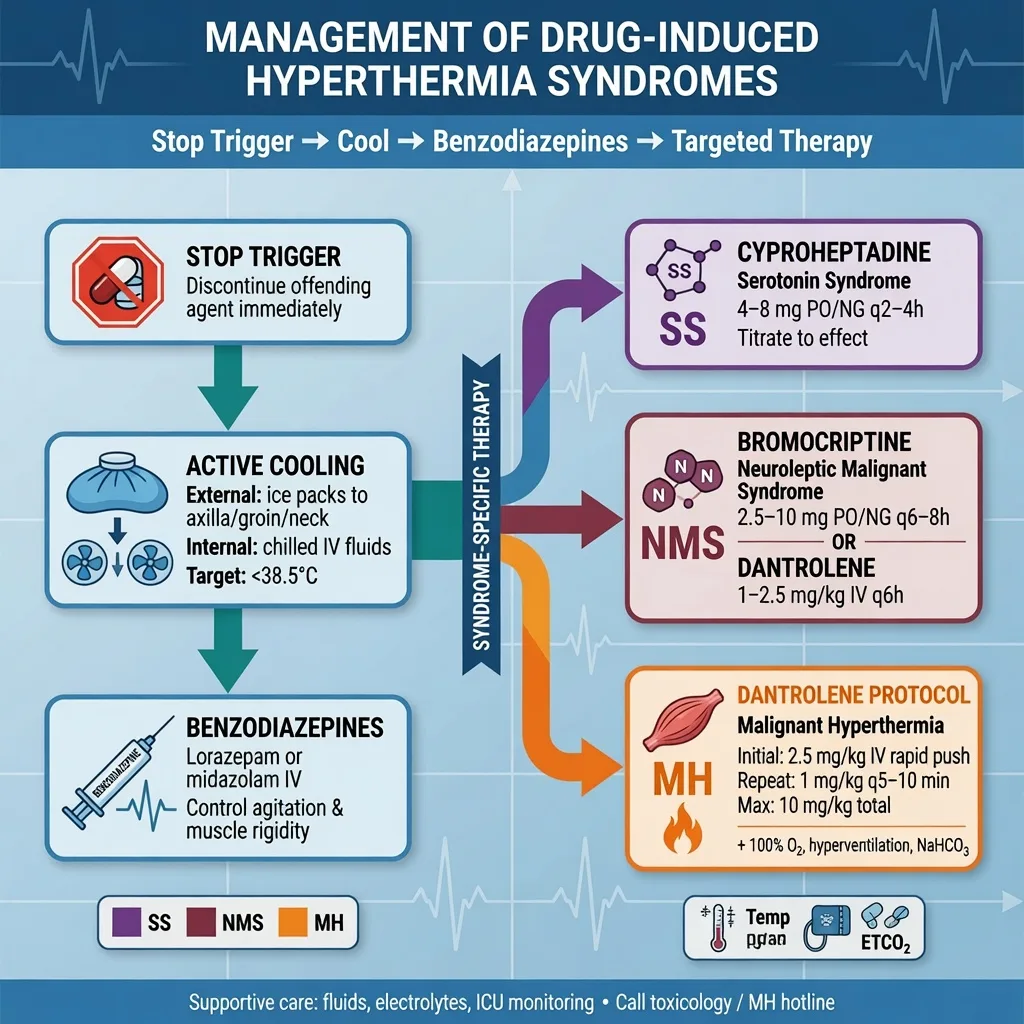
- Stop the serotonergic agent — the first and the essential.
- The benzodiazepine (the diazepam, the lorazepam) — the sedation, the muscle relaxation, the reduces the heat generation and the injury. The core therapy. The titrate to the calm (the not the apnoea).
- The cyproheptadine (the 5-HT2A antagonist) — the specific antidote (the oral/NG; the 12 mg loading, then the 2 mg every 2 h to the 32 mg/day; the maintenance the 8 mg every 8 h for the 2 to 4 weeks). The onset in the hours. The no parenteral formulation — the limitation in the intubated patient (the via the NG).
- The active cooling (the ice, the blankets, the cold IV fluids, the evaporative, the gastric and the bladder lavage, the intravascular catheter in the severe) — the hyperthermia is the MUSCLE-generated (the not the central fever) — the antipyretics (the paracetamol, the NSAID) are the INEFFECTIVE.
- The severe — the intubation, the non-depolarising paralysis (the vecuronium, the rocuronium — the AVOID the suxamethonium: the rhabdomyolysis and the hyperkalaemia), the deep sedation (the propofol infusion), the consider the early haemofiltration (the no strong evidence but the used in the refractory).
- Stop the antipsychotic (or the restore the dopamine agonist in the withdrawal). The depot formulation — the longer the risk (the weeks for the decanoate).
- The supportive — the cooling, the benzodiazepine, the fluids (the rhabdomyolysis — the urine output the 1 to 2 mL/kg/h, the target the alkalinisation of the urine), the renal support (the renal replacement therapy for the AKI), the thromboprophylaxis (the immobility), the pressure-area care.
- The dantrolene (the 1 to 2.5 mg/kg IV, the repeat to the 10 mg/kg, then the infusion) — the ryanodine-receptor, the reduces the muscle rigidity and the heat. The no strong evidence for the mortality reduction but the clinically effective; the consider in the severe hyperthermia and the rigidity.
- The bromocriptine (the 2.5 to 5 mg oral/NG, the up to the 45 mg/day in the divided doses) or the amantadine (the 100 mg twice daily) — the dopamine agonists. The onset in the 1 to 2 days. The caution in the hypotension and the psychosis. The continue for the 1 to 2 weeks after the resolution; the abrupt cessation causes the relapse.
- The renal (the AKI from the rhabdomyolysis), the CK monitoring (the serial, the trend the fall), the ECG (the QTc).
The malignant hyperthermia.[1]
- Stop the trigger (the volatile off, the switch to the TIVA — the propofol; the flush the circuit with the 100 per cent oxygen at the high flow, the change the circuit and the soda lime if the time allows).
- The dantrolene (the 2.5 mg/kg IV, the repeat every 5 to 10 minutes to the 10 mg/kg, then the infusion of the 0.25 mg/kg/h for the 24 to 48 hours) — the specific. The onset in the minutes. The new formulation (the Ryanodex) reconstitutes in the seconds; the older (the Dantrium) in the minutes and the multiple vials (the 36 vials for the 70-kg adult at the 10 mg/kg).
- The cooling, the treat the hyperkalaemia (the insulin-dextrose, the calcium chloride 10 mmol, the salbutamol, the bicarbonate), the acidosis (the bicarbonate, the hyperventilation), the arrhythmia (the lidocaine, the amiodarone — the avoid the calcium-channel blockers with the dantrolene: the severe hyperkalaemia and the cardiovascular collapse).
- The monitoring for the 48 to 72 hours — the recurrence in the 25 per cent (the recrudescence); the dantrolene infusion continued.
- The referral for the family screening — the IVCT or the genetic testing; the MedicAlert bracelet; the safe-anaesthesia plan for the future.
The anticholinergic syndrome.[15]
- Stop the anticholinergic agent.
- The benzodiazepine (the diazepam, the lorazepam, the midazolam) for the agitation — the safe, the first-line. The AVOID the antipsychotic (the haloperidol, the olanzapine) — the additional anticholinergic and the QTc; the chlorpromazine and the promethazine are the explicitly anticholinergic.
- The physostigmine (the 1 to 2 mg IV slow over the 5 minutes, the repeat in the 30 minutes to the 2 hours) — the specific antidote. The reserved for the severe delirium with the tachycardia and the agitation resistant to the benzodiazepine; the CONTRAINDICATED in the TCA overdose (the QRS widening — the ventricular arrhythmia and the asystole), the asthma, the intestinal obstruction, the bladder obstruction. The atropine at the bedside for the bradycardia.
- The supportive — the cooling, the fluids, the cardiac monitoring (the tachyarrhythmia, the QRS), the catheterisation (the urinary retention), the eye care (the corneal abrasion from the dry and the loss of the blink).
The first 60 minutes of the suspected hyperthermic syndrome — the parallel resuscitation and the diagnostic sequence
0 to 5 minutes — the ABCDE and the trigger identification
The airway and the breathing (the oxygen, the intubation for the GCS under 8 or the loss of the airway reflexes); the circulation (the IV access, the fluid if the hypotensive); the disability (the GCS, the glucose, the pupils); the exposure (the temperature, the skin moisture, the rigidity, the clonus). The IMMEDIATE drug history: the SSRI, the MAOI, the antipsychotic, the recent anaesthetic. The trigger points to the syndrome.
5 to 15 minutes — the bedside neuromuscular exam
Check for the clonus (the inducible at the ankle and the knee, the spontaneous, the ocular); the reflexes (the hyperreflexia versus the bradyreflexia); the muscle tone (the lead-pipe rigidity); the bowel sounds (the present versus the absent); the skin moisture (the wet versus the dry). The WET + the clonus + the serotonergic = the serotonin syndrome. The rigid + the bradyreflexia + the antipsychotic = the NMS. The dry + the absent bowel sounds + the antihistamine = the anticholinergic.
15 to 30 minutes — the bloods and the monitoring
The venous gas (the lactate, the pH), the creatine kinase (the baseline, the serial), the electrolytes (the potassium, the calcium), the renal function, the liver function, the coagulation, the troponin, the FBC. The ECG (the QTc, the QRS). The arterial line and the central line for the severe. The urinary catheter (the urine output, the myoglobin, the core temperature).
30 to 60 minutes — the specific therapy
The benzodiazepine (the diazepam 5 to 10 mg IV, the titrate) for the agitation in all four. The cyproheptadine 12 mg NG (the serotonin). The dantrolene 1 to 2.5 mg/kg IV (the NMS, the MH). The bromocriptine 2.5 mg NG (the NMS). The physostigmine 1 to 2 mg IV (the anticholinergic, the not the TCA). The active cooling (the ice, the cold fluids, the evaporative, the gastric lavage, the intravascular in the refractory). The non-depolarising paralysis (the rocuronium, the vecuronium) for the uncontrolled rigidity.
60 minutes and beyond — the ICU and the ongoing care
The ICU admission for the moderate-to-severe. The continuous monitoring (the arterial, the core temperature, the urine output, the EEG if the paralysed). The serial CK every 6 to 12 hours. The fluid and the alkalinisation for the rhabdomyolysis (the urine pH over 6.5, the urine output 1 to 2 mL/kg/h). The renal replacement therapy for the AKI. The thromboprophylaxis. The psychiatric liaison once the resolution (the antipsychotic re-challenge in the NMS — the wait 2 weeks, the lower-potency, the cross-class).
Complications
The complications are the common and the lethal in the untreated or the delayed. The Fellowship candidate must anticipate and the prevent.[1][3][11]
The rhabdomyolysis is the near-universal in the severe NMS and the MH, the common in the severe serotonin syndrome. The CK the over 5000, the myoglobinuria, the acute kidney injury (the pigment nephropathy), the compartment syndrome (the less common but the catastrophic). The treatment — the aggressive fluid, the alkalinisation of the urine, the mannitol in the selected, the renal replacement therapy for the established AKI.[1]
The acute kidney injury — the pigment nephropathy from the myoglobin (the direct tubular toxicity plus the cast formation plus the renal vasoconstriction), the volume depletion, the hypotension. The prevention — the early and the aggressive fluid, the urine output the 1 to 2 mL/kg/h, the target the urine pH over 6.5. The established AKI — the renal replacement therapy.[1]
The disseminated intravascular coagulation — the tissue-factor release from the damaged muscle and the endothelium; the thrombosis and the bleeding. The treatment — the underlying cause, the factor replacement per the viscoelastic or the laboratory, the heparin in the thrombotic phase.[1]
The seizures — the hyperthermia, the electrolyte disturbance (the hyponatraemia, the hypocalcaemia), the direct drug toxicity. The benzodiazepine first-line; the levetiracetam or the phenytoin for the refractory.[1]
The hepatic failure — the direct injury (the transaminitis), the heat stroke picture (the centrilobular necrosis), the drug-induced (the valproate, the statin). The supportive; the N-acetylcysteine if the paracetamol co-ingestion suspected.[1]
The cardiac arrest — the arrhythmia (the hyperkalaemia, the QTc, the QRS), the profound hypotension, the refractory hyperthermia. The periarrest — the immediate dantrolene in the MH, the aggressive cooling, the correction of the potassium and the acidosis.[1]
The aspiration pneumonia — the reduced consciousness, the ileus in the NMS and the anticholinergic. The prevention — the intubation for the GCS under 8, the NG tube on the free drainage, the head-up position.[1]
The deep vein thrombosis and the pulmonary embolism — the immobility, the rigidity, the DIC. The thromboprophylaxis (the enoxaparin 40 mg daily unless the bleeding; the mechanical if the contraindicated).[1]
Prognosis
The mild-to-moderate serotonin syndrome resolves over the 24 to 72 hours with the supportive care and the cyproheptadine. The NMS resolves over the 1 to 2 weeks (the longer than the serotonin syndrome — the drug clearance, the depot the weeks). The mortality is the low with the early recognition and the treatment; the high (the 10 to 20 per cent) in the untreated severe; the 50 per cent in the NMS with the acute renal failure. The MH is the lethal (the 70 per cent) without the dantrolene; the low (the under 5 per cent) with the early dantrolene. The anticholinergic syndrome is the rarely fatal in the adult; the more dangerous in the elderly and the child.[1][3][1][13]
The sequelae of the NMS — the residual cognitive impairment, the parkinsonism (the especially if the dopamine agonist withdrawn), the muscle wasting, the contractures. The sequelae of the MH — the muscle pain, the weakness for the weeks, the renal recovery, the anxiety for the future anaesthetic. The recurrence of the NMS on the antipsychotic re-challenge — the 30 per cent; the wait 2 weeks, the lower-potency, the cross-class, the low dose, the slow titration. The recurrence of the MH — the 25 per cent recrudescence within the 24 to 48 hours; the lifelong avoidance of the volatiles and the suxamethonium; the family screening.[9][11]
SAQ — The four hyperthermic toxidromes — discriminating features and therapy
10 minutes · 10 marks
An ICU registrar presents a 40-year-old man (GCS 12, temp 41.5°C, HR 130, BP 180/100 then 80/40, widespread rigidity, CK 18,000, lactate 7.2, INR 2.1) admitted overnight. Three candidate diagnoses are debated: serotonin syndrome (recent linezolid added to an SSRI), neuroleptic malignant syndrome (recent haloperidol depot), and malignant hyperthermia (recent anaesthetic with sevoflurane and succinylcholine for an unrelated procedure 4 hours earlier).
SAQ — Anticholinergic toxidrome from jimsonweed ingestion
10 minutes · 10 marks
A 19-year-old man is brought to ED agitated and hallucinating after drinking tea made from jimsonweed (Datura stramonium). He is hot and flushed (38.6°C), with dry axillae and mouth, mydriasis (8 mm), tachycardia (HR 138), urinary retention, and reduced bowel sounds. He is picking at the bed sheets and does not recognise his mother. ECG: sinus tachycardia with QRS 110 ms.
Clinical pearls
Trial cards
Dunkley et al, QJM 2003 — the Hunter Serotonin Toxicity Criteria
QJM
PMID 12925718
Key finding
The development and the validation of the Hunter Serotonin Toxicity Criteria from the prospectively-observed 2222 overdoses (the 472 with the serotonergic agent) at the Hunter Area Toxicology Service. The criteria — the spontaneous clonus, or the inducible clonus + the agitation + the diaphoresis, or the ocular clonus + the agitation + the diaphoresis, or the tremor + the hyperreflexia — were the 84 per cent sensitive and the 97 per cent specific, the outperforming the Sternbach criteria.
Practice change
The Hunter criteria replaced the Sternbach criteria as the diagnostic standard for the serotonin toxicity and the are the requirement for the Fellowship candidate to the recite.
Boyer & Shannon, NEJM 2005 — the definitive serotonin syndrome review
New England Journal of Medicine
PMID 15784664
Key finding
The landmark review establishing the serotonin syndrome as the clinical diagnosis (the Hunter criteria), the pathophysiology (the 5-HT2A and the 5-HT1A), the precipitants (the SSRI, the MAOI, the tramadol, the linezolid, the methylene blue), the severity spectrum, and the management (the stop the agent, the benzodiazepine, the cyproheptadine, the active cooling, the paralysis in the severe).
Practice change
The reference review for the Fellowship examination; the single most-cited source on the serotonin syndrome.
Graudins et al, J Emerg Med 1998 — cyproheptadine for the serotonin syndrome
Journal of Emergency Medicine
PMID 9696181
Key finding
The retrospective case series and the dose-finding review of the cyproheptadine for the serotonin syndrome. The initial the 12 mg loading, then the 2 mg every 2 hours to the clinical response (the maximum 32 mg per day), then the 8 mg three times daily for the maintenance. The clinical improvement in the hours; the no severe adverse effects.
Practice change
The source of the cyproheptadine dosing regimen used in the contemporary practice and the Fellowship examination.
Graudins et al, MJA 1998 — serotonin syndrome from the drug interactions
Medical Journal of Australia
PMID 9861909
Key finding
The case series and the pharmacological analysis establishing that the serotonin syndrome is the overwhelmingly the drug-INTERACTION phenomenon (the MAOI plus the serotonergic) rather than the single-agent overdose. The Hunter group demonstrated that the severe toxicity required the combination of the two drugs acting at the different steps of the serotonin handling.
Practice change
The conceptual basis for the 2-week MAOI washout and the high-vigilance for the serotonergic drug combinations.
Strawn et al, Am J Psychiatry 2007 — the NMS review
American Journal of Psychiatry
PMID 17541044
Key finding
The comprehensive review of the NMS — the pathophysiology (the D2 blockade), the clinical features (the tetrad of the hyperthermia, the rigidity, the autonomic instability, the altered mental state), the DSM-IV criteria, the precipitants (the typical and the atypical antipsychotics, the antiemetics, the dopamine-agonist withdrawal), the incidence (the 0.02 to 0.3 per cent), the mortality (the 5 to 20 per cent), and the management (the stop, the dantrolene, the bromocriptine).
Practice change
The contemporary review that the Fellowship candidate uses for the NMS — the pathophysiology, the criteria, and the management.
Rosenberg & Green, Arch Intern Med 1989 — the NMS response-to-therapy review
Archives of Internal Medicine
PMID 2673115
Key finding
The literature review of the 107 cases of the NMS treated with the dantrolene, the bromocriptine, or the amantadine. The dantrolene and the bromocriptine were the associated with the more rapid resolution and the lower mortality than the supportive care alone — the observational (the no controlled trial).
Practice change
The early evidence (the observational) for the dantrolene and the bromocriptine in the NMS; the no randomised trial has the followed, and the use remains the empiric.
Guinart et al, Acta Psychiatr Scand 2021 — the predictors of mortality in the NMS
Acta Psychiatrica Scandinavica
PMID 34358327
Key finding
The systematic review and the pooled patient-level analysis of the 391 NMS cases (the from the published case series and the case reports). The mortality was the 10.4 per cent overall. The predictors of the mortality (the multivariable) — the elevated CK (the OR the 1.4 per the 1000-unit rise), the higher peak temperature, the older age, the cognitive impairment, the catatonic features, the renal failure. The treatment with the dantrolene or the bromocriptine was the not the significantly associated with the reduced mortality (the confounding by the indication — the sicker patients received them).
Practice change
The largest pooled analysis of the NMS mortality predictors; the quantifies the high-risk features for the Fellowship candidate to the identify and the escalate.
Larach et al, Anesth Analg 2010 — the North American MH registry
Anesthesia & Analgesia
PMID 20081135
Key finding
The analysis of the 286 confirmed MH events from the North American Malignant Hyperthermia Registry. The mortality was the 1.4 per cent (the down from the 70 per cent historically) — the attributed to the increased dantrolene availability and the earlier recognition. The clinical presentation — the unexplained hypercarbia in the 92 per cent, the tachycardia in the 73 per cent, the masseter rigidity in the 24 per cent (the higher in the children). The complications — the cardiac arrest in the 4 per cent, the compartment syndrome in the 5 per cent, the disability in the 18 per cent.
Practice change
The definitive contemporary registry of the MH — the clinical presentation, the mortality, the complications; the basis for the Fellowship examination answer.
Gillman, J Psychopharmacol 2011 — the methylene blue MAOI review
Journal of Psychopharmacology
PMID 20142303
Key finding
The pharmacological review establishing the methylene blue as the potent reversible MAOI (the potency comparable to the moclobemide) and the exemplar of the drug interaction that the precipitates the serotonin toxicity. The review collated the published cases of the serotonin syndrome after the methylene blue in the patients on the SSRI or the SNRI — the high rate of the severe toxicity.
Practice change
The mechanistic and the clinical basis for the contraindication of the methylene blue in the patient on the serotonergic antidepressant.
Stübner et al, Ann Pharmacother 2016 — the NMS systematic review
Annals of Pharmacotherapy
PMID 27423483
Key finding
The systematic review of the NMS — the incidence, the clinical features, the precipitants, the management, and the outcomes. The atypical antipsychotics (the olanzapine, the risperidone, the clozapine) carry the lower but the not-zero risk; the clozapine the highest among the atypicals. The depot formulations the longer the duration. The mortality the 5 to 20 per cent; the renal failure the strongest predictor.
Practice change
The contemporary systematic review for the NMS — the evidence base for the management.
Birmes et al, CMAJ 2003 — the brief serotonin syndrome review
CMAJ
PMID 12771076
Key finding
The concise review of the serotonin syndrome for the generalist — the pathophysiology, the clinical triad, the Hunter criteria (the then the new), the precipitants, and the management. The review the emphasised the drug-interaction mechanism and the need for the vigilance in the combination therapy.
Practice change
The accessible review for the Fellowship candidate; the complements the Boyer-Shannon NEJM review.
Red flags
Special populations
The elderly — the higher-risk for the NMS (the increased D2-receptor sensitivity, the polypharmacy, the dehydration, the cognitive impairment) and the anticholinergic (the anticholinergic burden of the polypharmacy, the reduced cholinergic reserve). The lower threshold for the benzodiazepine, the cautious physostigmine (the bradycardia), the aggressive hydration.[9][15]
The paediatric — the masseter rigidity after the suxamethonium is the more common (the 50 per cent in the children with the strabismus surgery, the less in the adults). The MH presents the earlier (the first anaesthetic). The dantrolene dose the weight-based (the 2.5 mg/kg). The anticholinergic from the topical mydriatic in the infant (the cyclopentolate, the tropicamide) — the systemic absorption; the diazepam and the cooling.[11]
The pregnant — the serotonin syndrome treated the same (the benzodiazepine, the cyproheptadine — the no strong teratogenicity data, the used in the severe). The NMS the same (the dantrolene — the no strong teratogenicity, the used). The physostigmine the avoided in the pregnancy (the limited data). The delivery the for the obstetric indication, the not the toxicological.[2]
The Parkinson patient — the NMS from the dopamine-agonist withdrawal is the common and the overlooked. The restore the levodopa or the dopamine agonist is the first (the not the bromocriptine alone — the patient is the already on the dopamine agonist). The antipsychotic the avoided in the Parkinson patient; the pimavanserin (the 5-HT2A inverse agonist, the not the D2 blocker) or the quetiapine or the clozapine (the lower D2 affinity) the preferred if the antipsychotic is the necessary.[3][9]
The renal failure — the dantrolene (the hepatic metabolism, the no adjustment) and the bromocriptine (the hepatic, the no adjustment) are the safe. The cyproheptadine (the hepatic, the no adjustment). The physostigmine (the hepatic and the renal, the cautious). The volume management the challenging — the fluid for the rhabdomyolysis balanced against the oliguria; the early renal replacement therapy.[1]
Drug doses — the bedside reference
Cyproheptadine (the serotonin)
the 5-HT2A antagonist
- The 12 mg loading PO/NG, then the 2 mg every 2 h to the 32 mg/day, then the 8 mg every 8 h for the 2 to 4 weeks
- The oral/NG only (the no IV); the first-generation antihistamine with the 5-HT2A antagonism
- The onset in the hours; the response the clinical
- The sedation, the anticholinergic (the mild) — the monitor
Dantrolene (the MH, the NMS)
the RyR1 blocker
- The MH: the 2.5 mg/kg IV, the repeat every 5 to 10 min to the 10 mg/kg, then the 0.25 mg/kg/h infusion for the 24 to 48 h
- The NMS: the 1 to 2.5 mg/kg IV, the repeat to the 10 mg/kg; the no infusion the routine
- The Ryanodex reconstitutes in the seconds (the less diluent); the Dantrium in the minutes (the multiple vials)
- The hepatic metabolism; the AVOID the calcium-channel blocker (the severe hyperkalaemia)
Bromocriptine (the NMS)
the D2 agonist
- The 2.5 mg PO/NG twice daily, the titrate to the 5 mg three times daily, the up to the 45 mg/day in the divided doses
- The onset in the 1 to 2 days; the continue for the 1 to 2 weeks after the resolution (the 2 to 4 weeks for the depot)
- The hypotension, the psychosis (the caution); the abrupt cessation the relapse
- The not for the serotonin or the anticholinergic
Amantadine (the NMS)
the NMDA + the dopamine
- The 100 mg PO/NG twice daily; the alternative to the bromocriptine
- The weaker dopamine agonist; the also the NMDA antagonism
- The fewer side effects than the bromocriptine; the less the studied
Physostigmine (the anticholinergic)
the AChE inhibitor
- The 1 to 2 mg IV slow over the 5 min; the repeat in the 30 min to the 2 h; the onset in the minutes
- The crosses the BBB (the tertiary amine); the specific for the central anticholinergic delirium
- The CONTRAINDICATED in the TCA (the QRS widening, the asystole), the asthma, the obstruction
- The atropine at the bedside for the bradycardia; the benzodiazepine the safe alternative
Benzodiazepine (the all)
the sedation, the muscle relaxation
- The diazepam 5 to 10 mg IV (the repeat); the lorazepam 1 to 2 mg IV (the repeat); the midazolam 0.05 to 0.1 mg/kg IV (the infusion for the severe)
- The titrate to the calm (the not the apnoea); the reduces the muscle activity and the heat generation
- The first-line for the agitation in all four syndromes
- The flumazenil the available but the rarely needed (the risk the seizure)
References
- [1]Ahmad SR, et al. Serotonin syndrome-A focused review Basic Clin Pharmacol Toxicol, 2023.PMID 37309284
- [2]McCarthy R, et al. Management of serotonin syndrome (toxicity) Br J Clin Pharmacol, 2025.PMID 38926083
- [3]Stübner S, et al. Neuroleptic Malignant Syndrome Ann Pharmacother, 2016.PMID 27423483
- [4]Boyer EW, Shannon M The serotonin syndrome N Engl J Med, 2005.PMID 15784664
- [5]Dunkley EJ, Isbister GK, Sibbritt D, Dawson AH, Whyte IM The Hunter Serotonin Toxicity Criteria: simple and accurate diagnostic decision rules for serotonin toxicity QJM, 2003.PMID 12925718
- [6]Graudins A, Stearman A, Chan B Treatment of the serotonin syndrome with cyproheptadine J Emerg Med, 1998.PMID 9696181
- [7]Graudins A, Dawson AH, Whyte IM Serotonin syndrome resulting from drug interactions Med J Aust, 1998.PMID 9861909
- [8]Birmes P, Coppin D, Schmitt L, Lauque D Serotonin syndrome: a brief review CMAJ, 2003.PMID 12771076
- [9]Strawn JR, Keck PE, Caroff SN Neuroleptic malignant syndrome Am J Psychiatry, 2007.PMID 17541044
- [10]Rosenberg MR, Green M Neuroleptic malignant syndrome. Review of response to therapy Arch Intern Med, 1989.PMID 2673115
- [11]Larach MG, Brandom BW, Allen GC, Gronert GA, Lehman EB Clinical presentation, treatment, and complications of malignant hyperthermia in North America from 1987 to 2006 Anesth Analg, 2010.PMID 20081135
- [12]Gillman PK CNS toxicity involving methylene blue: the exemplar for understanding and predicting drug interactions that precipitate serotonin toxicity J Psychopharmacol, 2011.PMID 20142303
- [13]Guinart D, Misawa F, Rubio JM, Pereira J, Correll CU A systematic review and pooled, patient-level analysis of predictors of mortality in neuroleptic malignant syndrome Acta Psychiatr Scand, 2021.PMID 34358327
- [14]Isbister GK Selective Serotonin Reuptake Inhibitor Toxicity 2026.PMID 30521236
- [15]Culbreath K, et al. Diphenhydramine Overdose: A Case Report and Topic Review of Prehospital Diagnosis and Treatment Cureus, 2024.PMID 39493145