ICU · Toxicology
Sympathomimetic Poisoning — Cocaine & Amphetamines
Also known as Cocaine toxicity · Amphetamine overdose · Methamphetamine · MDMA · Sympathomimetic toxidrome · Cocaine chest pain · Unopposed alpha
The sympathomimetic poisoning — the cocaine (the reuptake blockade of the dopamine, the noradrenaline and the serotonin; the sodium-channel blockade) and the amphetamines/methamphetamine/MDMA (the catecholamine release). The toxidrome (the mydriasis, the diaphoresis, the tachycardia, the hypertension, the hyperthermia, the agitation). The complications (the cocaine chest pain / the coronary vasospasm, the intracerebral haemorrhage, the seizures, the rhabdomyolysis, the MDMA hyponatraemia). The benzodiazepine first-line, the active cooling, and the avoidance of the pure beta-blocker (the unopposed-alpha problem).
On this page & tools
Your progress
Saved locally on this device.
Target exams
Overview & definition
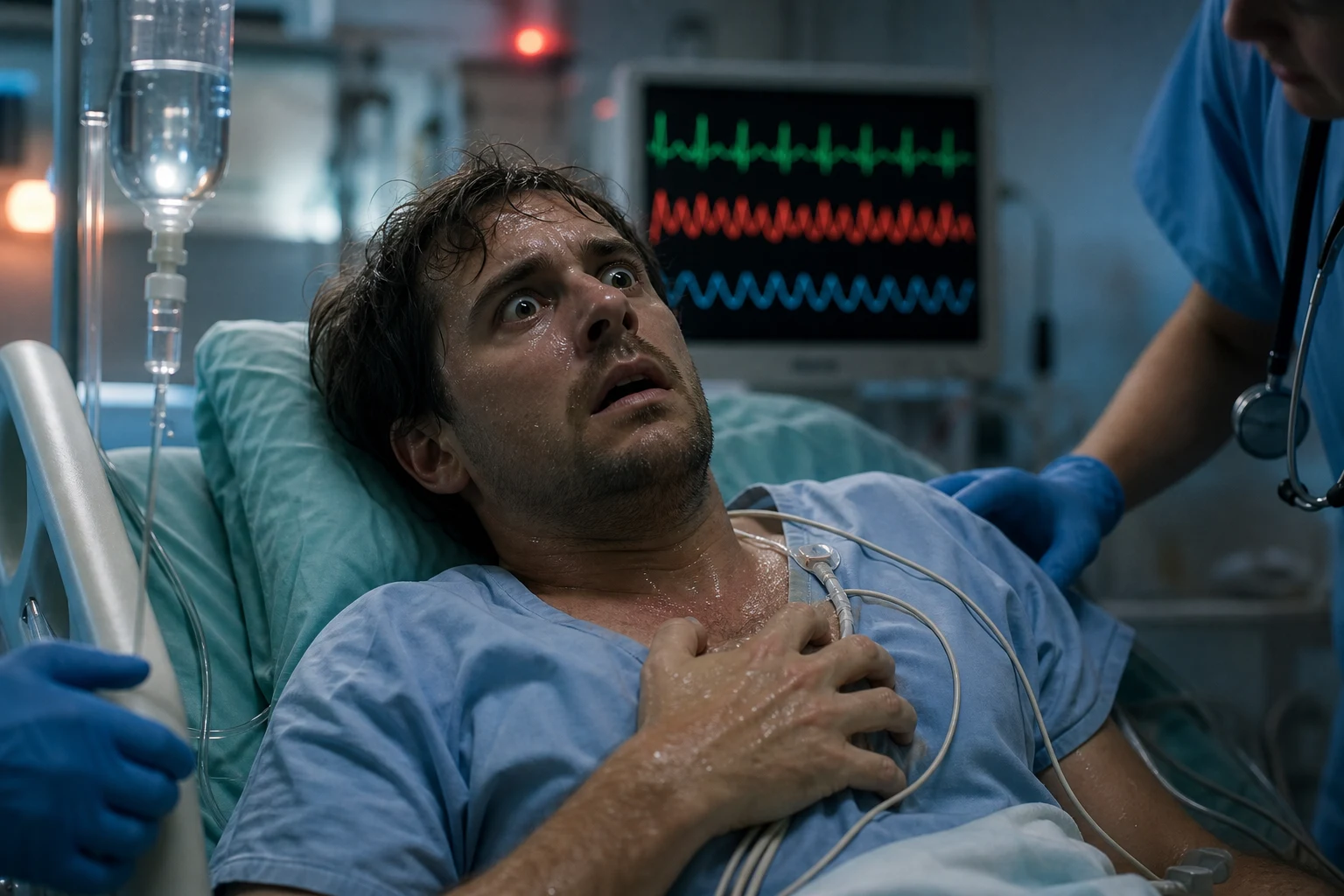
The sympathomimetic poisoning (the cocaine, the amphetamines, the methamphetamine, the MDMA) produces the sympathomimetic toxidrome — the adrenergic excess — and the dangerous complications (the cocaine chest pain and the coronary vasospasm, the intracerebral haemorrhage, the seizures, the hyperthermia, the rhabdomyolysis). The benzodiazepine is the first-line (the reduces the central sympathetic outflow, the sedation, the muscle relaxation, the anticonvulsant), and the pure beta-blocker is the avoided (the unopposed-alpha problem).[1][1]
The pharmacology
- The cocaine — the blocks the reuptake of the dopamine, the noradrenaline and the serotonin (the synaptic excess), AND the local-anaesthetic fast-sodium-channel blockade (the QRS widening and the arrhythmia at the high dose). The short half-life (the 60 to 90 min).
- The amphetamines / the methamphetamine — the stimulate the catecholamine RELEASE (the reverse the transport into the synapse), the longer-acting (the many hours). The MDMA additionally the serotonergic (the serotonin-syndrome features and the SIADH / the hyponatraemia from the excess water + the ADH).[2]
The toxidrome and the complications
The sympathomimetic toxidrome:[1][1]
- The mydriasis, the diaphoresis, the piloerection ("the gooseflesh").
- The tachycardia, the hypertension, the hyperthermia, the tachypnoea.
- The agitation, the psychosis, the paranoia, the hyperreflexia.
The complications:[1]
- The cocaine chest pain — the coronary vasospasm + the thrombosis + the increased demand — the myocardial infarction (the young patient, the normal coronaries). The aortic dissection (the rare).
- The intracerebral haemorrhage — the hypertensive surge.
- The seizures — the focal or the generalised.
- The hyperthermia — the severe, the muscle-generated (the rhabdomyolysis).
- The renal failure — the rhabdomyolysis, the hypertensive, the dehydration.
- The MDMA hyponatraemia — the SIADH + the excess water intake → the cerebral oedema and the seizures.
Treatment
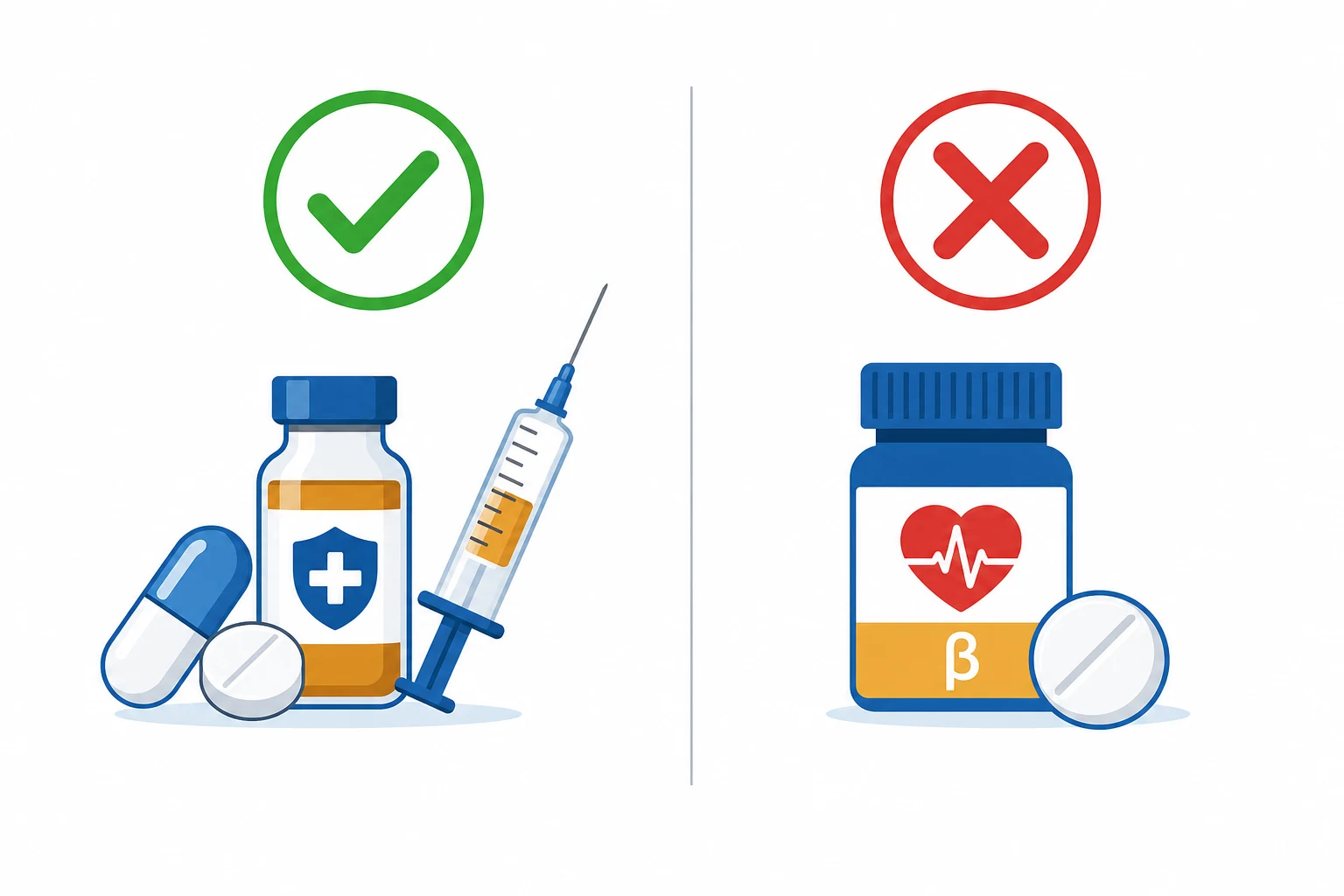
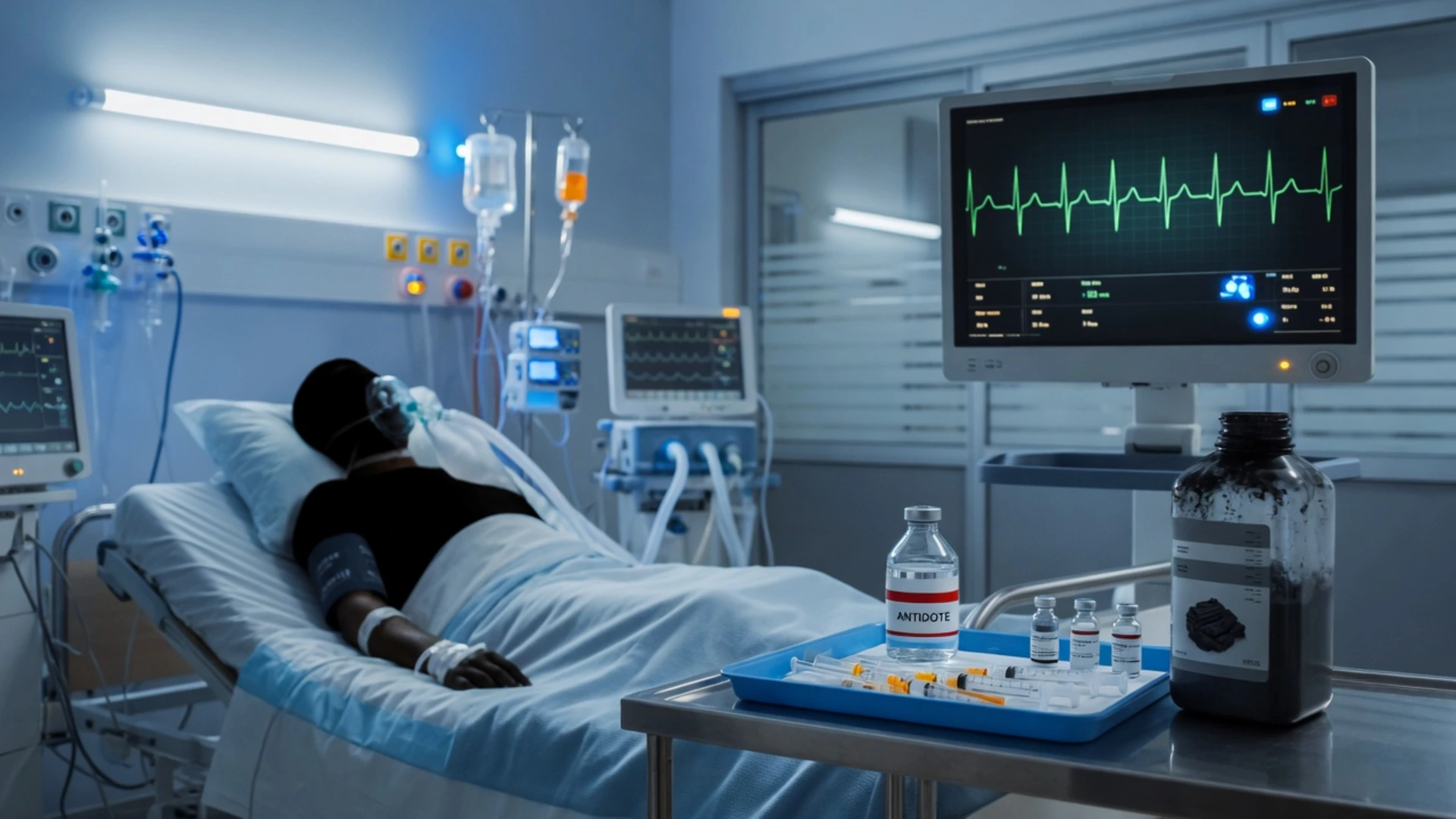
1. The benzodiazepine — the first-line. The diazepam or the lorazepam IV, the titrate to the sedation. The reduces the central sympathetic outflow — the lowers the heart rate, the blood pressure, the temperature AND the muscle activity (the hyperthermia and the rhabdomyolysis). The first drug for the agitation, the chest pain, the hypertension, the hyperthermia, the seizure.[1][3][1]
2. The cocaine chest pain / the ACS.[1][3]
- The benzodiazepine (the first — the reduces the sympathetic drive and the vasospasm).
- The nitrates (the glyceryl trinitrate — the coronary vasodilator, the reverses the spasm).
- The aspirin + the heparin (the thrombus).
- The calcium-channel blocker (the nicardipine, the diltiazem) for the refractory spasm or the hypertension.
- The morphine (the analgesia).
- The avoid the pure beta-blocker in the acute phase (the unopposed alpha — see below).
3. The hypertension / the hypertensive crisis. The benzodiazepine first; then the labetalol (the combined alpha- and beta-blocker — the avoids the unopposed-alpha) OR the nitroprusside / the phentolamine (the direct vasodilator / the alpha-blocker) for the refractory. AVOID the pure beta-blocker (the propranolol, the metoprolol).[3]
4. The hyperthermia. The benzodiazepine + the active cooling (the muscle heat — the antipyretics ineffective). The severe — the intubation and the non-depolarising paralysis.[1]
5. The seizures. The benzodiazepine; then the phenytoin / the levetiracetam / the barbiturate for the refractory.[1]
6. The rhabdomyolysis. The IV fluids (the target the urine output, the alkalinisation), the CK monitoring, the renal support.[1]
7. The MDMA hyponatraemia. The fluid restriction, the hypertonic saline for the severe (the seizures, the cerebral oedema).[2]
The unopposed-alpha problem
The cocaine (and the amphetamines) cause the hypertension via the alpha-1 vasoconstriction AND the beta-1 tachycardia. The pure beta-blocker (the propranolol, the metoprolol) blocks the beta (the vasodilatory, the compensatory) but leaves the alpha unopposed — the WORSENED vasoconstriction, the blood pressure, and the coronary spasm. The evidence is the debated (the some studies the safe), but the conservative, the examinable teaching is to avoid the pure beta-blocker in the acute cocaine / sympathomimetic toxicity and the use the benzodiazepine first, the labetalol (the alpha+beta) or the direct vasodilator (the nitrate, the nitroprusside, the phentolamine).[3][1]
Prognosis
The sympathomimetic poisoning is the survivable with the benzodiazepine-based, the supportive care. The poor-prognostic features: the severe hyperthermia (the brain injury), the MI, the intracerebral haemorrhage, the rhabdomyolysis with the renal failure, the late presentation.[1][1]
Cocaine — the deep pharmacology and the routes of use
The cocaine (the benzoylmethylecgonine — the naturally-occurring alkaloid of the Erythroxylum coca leaf) is the prototype of the sympathomimetic class. The two pharmacological actions are the (a) the blockade of the monoamine reuptake transporters (the dopamine, the noradrenaline, the serotonin) at the presynaptic nerve terminal — the synaptic accumulation and the adrenergic/serotonergic excess — and the (b) the local-anaesthetic fast-sodium-channel blockade (the type-Ia antiarrhythmic effect — the QRS widening, the PR prolongation, the negative inotropy, and the pro-arrhythmia at the high dose). The latter is the reason the cocaine is still used (rarely) as a topical mucosal anaesthetic (the TAC — the tetracaine-adrenaline-cocaine — for the ENT and the paediatric wound repair).[1][1]
The cocaine is the rapidly hydrolysed by the plasma and the hepatic cholinesterases (and by the spontaneous non-enzymatic hydrolysis at the alkaline pH) — the short half-life (the 60 to 90 min) and the correspondingly short duration of the psychoactive effect (the 30 to 60 min for the intranasal, the shorter for the intravenous, the longer for the smoked). The liver also generates the active metabolites the norcocaine (the hepatotoxic, the vasoconstrictor) and the ecgonine methyl ester. The cocaine and the ethanol together generate the cocaethylene — the transesterification product with the LONGER half-life (the up to 4 h) and the HIGHER cardiotoxicity than the cocaine itself; this is the basis for the clinical observation that the cocaine binge with the alcohol is the more dangerous than the cocaine alone.[1][1]
Cocaine routes — onset, duration and the relative risk
| Route | Onset | Peak | Duration | Relative intensity |
|---|---|---|---|---|
| Intravenous | Seconds | 3-5 min | 20-30 min | Highest peak; the highest sudden-death risk |
| Smoked (crack/freebase) | 6-10 sec | 5-10 min | 15-30 min | Very high; the rapid re-dosing; the compulsive pattern |
| Intranasal (snorted) | 1-5 min | 20-60 min | 45-90 min | Slower peak; the septal perforation, the chronic rhinitis |
| Oral (chewed leaf / body-packer) | 10-30 min | 60-90 min | 2-4 h | Slowest; the packet leakage in the body-packer is the catastrophic |
Cocaine-induced acute coronary syndrome — the "cocaine chest pain"
The cocaine chest pain is the COMMON life-threatening presentation — the cocaine is the most common illicit-drug cause of the emergency-department chest-pain presentation. The pathophysiology is the FOUR convergent mechanisms:[1][3]
- The coronary vasospasm — the alpha-1-mediated vasoconstriction of the epicardial coronaries (and the microvasculature), the blood-flow reduction even in the normal coronaries. The cocaine also potentiates the thromboxane and the endothelin and reduces the nitric-oxide availability — the vasoconstriction is the multifactorial.
- The thrombosis — the cocaine activates the platelets, increases the platelet aggregation and the alpha-granule release, increases the fibrinogen and the PAI-1, and the endothelial dysfunction — the PROTHROMBOTIC state. The coronary thrombus forms on the top of the spasm (and on the pre-existing atheromatous plaque).
- The increased demand — the tachycardia, the hypertension, the increased contractility → the doubled rate-pressure product → the demand-supply mismatch.
- The premature atherosclerosis — the chronic cocaine use accelerates the atheroma formation; the young patient with the cocaine chest pain can have the genuine atheromatous plaque rupture (the type-1 MI) and not just the spasm. [1]
The cocaine MI is the YOUNG-PATIENT disease — the median age in the 30s, the male predominance, the frequent absence of the classic risk factors. The ECG may be the initially normal (the 6-12% of the cocaine chest pain have the eventual MI; the ~40% have the non-specific changes). The troponin is the more reliable than the CK-MB (the cocaine itself can elevate the CK and the CK-MB from the rhabdomyolysis — the troponin is the preferred cardiac biomarker).[1][1]
Cocaine chest pain vs the classic atheromatous ACS
| Feature | Cocaine ACS | Atheromatous ACS |
|---|---|---|
| Age | 20-40 years | >50 years (typical) |
| Mechanism | Vasospasm + thrombosis + demand + premature atheroma | Plaque rupture + thrombosis |
| Coronaries at angiography | Often NORMAL or the isolated spasm | The obstructive atheroma |
| The FIRST drug | Benzodiazepine (reduces the sympathetic drive AND the spasm) | Aspirin + nitrate |
| Beta-blocker (acute) | AVOID — the unopposed alpha | First-line (early) |
| Nitrate | YES — the coronary vasodilator | YES |
| Aspirin + heparin | YES | YES |
| CCB for refractory spasm | YES (the nicardipine, the diltiazem, the verapamil) | Limited role |
| STEMI / the PCI | YES — the primary PCI for the confirmed STEMI | YES |
| Phentolamine for refractory | YES (the alpha-blocker, the reverses the spasm) | No |
Cocaine chest pain / ACS — the ICU resuscitation sequence
- ABC, IV access, monitoring: the 12-lead ECG (the repeat — the dynamic ST changes common), the continuous cardiac monitoring, the SpO2, the BP, the temperature. The IV access for the benzodiazepine and the nitrate titration.
- DIAZEPAM or LORAZEPAM IV first (the 5-10 mg diazepam, the repeat q5-10 min until the calm, the titrate to the mild sedation). This is the FIRST drug — the reduces the central sympathetic outflow, the tachycardia, the BP, the vasospasm AND the muscle activity (the temperature, the rhabdo). The benzo alone often resolves the chest pain, the ST changes and the BP together.
- GLYCERYL TRINITRATE (GTN) SL or infusion — the coronary vasodilator, the reverses the spasm. The infusion titrated to the chest-pain relief and the BP. (Watch for the reflex tachycardia — the benzo first mitigates this.)
- ASPIRIN 300 mg PO (the platelet inhibition) + HEPARIN (the LMWH or the unfractionated — the anticoagulation for the thrombus). The dual antiplatelet if the stent is anticipated.
- MORPHINE 2.5-5 mg IV (the analgesia, the anxiolysis, the venodilator) — but the benzo is the preferred first-line; the morphine is the adjunct.
- CALCIUM-CHANNEL BLOCKER for the refractory — the nicardipine infusion (the titratable, the BP control AND the spasm), the diltiazem, the verapamil. Especially if the BP remains elevated or the chest pain / the ST-elevation persists.
- PHENTOLAMINE for the refractory vasospasm — the alpha-1-blocker (the 1-5 mg IV, the repeat), the directly reverses the alpha-mediated coronary and the systemic vasoconstriction. The drug of the last resort for the refractory cocaine coronary spasm.
- TROPONIN (the baseline, the 3 h, the 6 h) — the troponin (NOT the CK-MB) is the preferred (the cocaine itself elevates the CK from the rhabdo).
- AVOID the PURE BETA-BLOCKER (the propranolol, the metoprolol) in the acute phase — the unopposed alpha. The early use of the beta-blocker (the labetalol — the alpha+beta) is the more controversial; the conservative and the examinable teaching is to AVOID the pure beta-blocker for the first 24 h and the use the labetalol if the beta-blockade is needed.
- PRIMARY PCI for the confirmed STEMI — the same door-to-balloon as the atheromatous STEMI. The thrombolysis if the PCI unavailable (the cocaine is NOT a contraindication to the thrombolysis, but the uncontrolled hypertension / the intracranial haemorrhage must be excluded first — the CT brain if any neurological deficit).
- OBSERVATION (the serial troponin, the serial ECG, the telemetry for the arrhythmia). The cocaine MI can progress to the arrhythmia (the VT/VF from the Na-channel blockade) — the have the bicarbonate and the lipid-emulsion ready for the wide-complex arrhythmia.
- SEARCH for the other cocaine complications — the aortic dissection (the CT-chest-angiogram if the back pain or the pulse deficit), the intracerebral haemorrhage (the CT brain if any neurology), the rhabdomyolysis (the CK, the urine myoglobin).
Cocaine-induced hypertensive emergency, the aortic dissection and the intracerebral haemorrhage
The cocaine causes the hypertensive crisis via the alpha-1-mediated vasoconstriction PLUS the tachycardia-driven cardiac-output surge. The three catastrophic consequences of the cocaine hypertensive crisis are the (a) the aortic dissection (the intimal tear from the sudden pressure surge), the (b) the intracerebral haemorrhage (the hypertensive bleed PLUS the cocaine-induced cerebral vasculitis), and the (c) the hypertensive encephalopathy. The cocaine user with the severe headache, the chest pain radiating to the back, the neurological deficit or the altered mental state needs the IMMEDIATE imaging (the CT brain, the CT-chest-angiogram) — do NOT attribute the symptoms to "the cocaine intoxication" alone.[1][3]
The cocaine-associated intracerebral haemorrhage is the well-described — the hypertensive surge + the cocaine-induced cerebral vasculitis (the necrotising angiitis resembling the polyarteritis nodosa) + the potential for the ruptured aneurysm (the cocaine use is associated with the berry aneurysms). The young cocaine user with the sudden severe headache and the neurological deficit has the intracerebral haemorrhage until proven otherwise — the immediate CT brain (no contrast first, then the CTA if a bleed is found). The BP control is the same as the other hypertensive ICH (the SBP <140 mmHg with the labetalol, the nicardipine, the clevidipine), the neurosurgical referral for the evacuation or the EVD. [1]
Antihypertensive agents in the cocaine / sympathomimetic crisis
| Agent | Mechanism | The role in cocaine crisis | The caveat |
|---|---|---|---|
| Benzodiazepine (diazepam, lorazepam, midazolam) | The central sympathetic outflow reduction | THE FIRST-LINE for ALL the cocaine-induced hypertension | The titrate to the mild sedation; the large doses sometimes required |
| Labetalol | The combined alpha-1 + beta-blocker (the ~1:7 ratio) | The second-line; avoids the unopposed-alpha | Still has the some beta-predominance — the conservative teaching is the benzo first |
| Nicardipine / clevidipine infusion | The dihydropyridine CCB — the arteriolar vasodilator | The excellent titratable BP control AND the coronary spasm relief | The reflex tachycardia (mitigated by the benzo) |
| Nitroprusside | The NO donor — the arteriolar + venous | The refractory; the rapid titration | The cyanide toxicity with the prolonged high-dose infusion; the coronary steal theoretically |
| Phentolamine | The non-selective alpha-blocker | The refractory vasospasm (the coronary AND the systemic) | The reflex tachycardia; the short duration |
| GTN infusion | The venous + arteriolar + the coronary vasodilator | The chest pain + the BP | The methaemoglobinaemia with the prolonged high-dose |
| AVOID — Propranolol, metoprolol, atenolol | The pure beta-blocker | THE AVOIDED — the unopposed-alpha | The WORSENED BP and the coronary spasm |
| AVOID — Hydralazine | The direct arteriolar vasodilator | The unpredictable, the long-acting, the reflex tachycardia | The poor titratability |
Cocaine body-packers vs body-stuffers — a critical distinction
The cocaine is the most common illicit-drug body-concealment. The two patterns are the clinically distinct and the management is the different.[1][1]
Cocaine body-packer vs body-stuffer
| Body-packer ("mule") | Body-stuffer | |
|---|---|---|
| The scenario | The international drug-smuggling — the deliberate swallowing of the large number of the factory-sealed packets for the transport | The swallowing (or the rectal/vaginal concealment) of the small amount of the drug AT or JUST BEFORE the arrest to avoid detection |
| The packet | The well-sealed (the condoms, the latex, the layered wrapping) — the high-purity, the large quantity (the 30-100 packets, the up to 1-2 kg total) | The poorly-sealed (the loose wrapping, the baggie) — the lower-purity, the smaller quantity |
| The leakage risk | LOW (the well-sealed) — but the catastrophic if the leakage (the massive acute cocaine toxicity, the often fatal) | HIGH (the poorly-sealed) — the acute cocaine toxicity from the absorption of the small amount |
| The presentation | Often asymptomatic; the discovered at the airport, the prison intake, or the routine screening | The symptomatic (the sympathomimetic toxidrome) within the hours of the ingestion |
| The imaging | The plain abdominal X-ray (the packets visible as the radio-opaque / the "double-condom sign"); the CT abdomen more sensitive | The imaging if symptomatic |
| The management | The OBSERVATION (the telemetry, the ICU if the packet leakage suspected); the whole-bowel irrigation with the polyethylene glycol; the surgery if the obstruction, the perforation, OR the packet NOT passing; AVOID the activated charcoal (the insufficient for the wrapped packets) | The TREAT the cocaine toxicity (the benzo, the cooling, the supportive); the whole-bowel irrigation; the surgical removal if the obstruction |
| The surgery | Indicated for the obstruction, the perforation, the packet-FAILURE-to-progress, OR the haemodynamic instability (the packet leakage with the refractory cocaine toxicity) | Rarely needed (the small amount usually passes) |
Amphetamine and methamphetamine toxicity
The amphetamines (the dextroamphetamine, the mixed amphetamine salts, the methylphenidate-related) and the methamphetamine (the N-methyl analogue — the more lipophilic, the more CNS penetration, the longer half-life of the 9-12 h, the more potent) act by the RELEASING the monoamines (the reverse transport through the dopamine and the noradrenaline transporters) AND the weak MAO inhibition — the synaptic catecholamine accumulation. Unlike the cocaine (the short-acting, the reuptake blocker), the methamphetamine is the LONG-ACTING — the duration of the 8-24 h, the half-life of the 9-12 h; the slower onset of the methamphetamine means the patient may present 6-12 h after the use with the persistent agitation and the tachycardia.[2]
The clinical picture of the methamphetamine toxicity is the SEVERE agitation, the paranoia, the psychosis (the formication — the "meth mites" — the patient picks at the skin), the tachycardia, the hypertension, the hyperthermia, the seizures, the rhabdomyolysis and the acute kidney injury. The methamphetamine user is the DANGEROUS — the severe agitation and the paranoia require the LARGE doses of the benzodiazepine (the 10-20 mg diazepam, the sometimes 100 mg or more total) for the adequate sedation. The propofol or the ketamine infusion (with the intubation) is the often required for the refractory agitation.[2]
The methamphetamine-specific chronic complications include the neurotoxicity (the dopaminergic and the serotonergic terminal degeneration — the long-term cognitive impairment, the Parkinsonism), the meth mouth (the severe dental caries from the bruxism, the xerostomia, the poor hygiene and the sugary drinks), the skin-picking sores (the formication), and the cardiomyopathy (the chronic catecholamine-induced dilated cardiomyopathy, the accelerated atherosclerosis, the methamphetamine-associated pulmonary arterial hypertension).[2]
Methamphetamine vs cocaine — the key differences
| Feature | Methamphetamine | Cocaine |
|---|---|---|
| The mechanism | The monoamine RELEASE + the weak MAO inhibition | The monoamine REUPTAKE blockade + the Na-channel blockade |
| The half-life | 9-12 h | 60-90 min |
| The duration of effect | 8-24 h | 30-90 min |
| The presentation | The persistent agitation, the paranoia, the psychosis; the LONG duration | The acute sympathomimetic; the SHORT duration |
| The cardiovascular | The cardiomyopathy (the chronic), the accelerated atheroma | The coronary vasospasm, the MI, the aortic dissection |
| The Na-channel blockade | Minimal | The QRS widening, the type-Ia effect |
| The dental | The "meth mouth" | The septal perforation (the intranasal) |
| The body-packer risk | Less common | The well-described |
| The duration of the ICU stay | Long (the persistent agitation, the large-dose benzos) | Short (the cocaine clears in the 1-2 h) |
| The renal failure from the rhabdo | Common (the severe hyperthermia, the prolonged agitation) | Less common |
Methamphetamine toxicity — the agitation/hyperthermia/rhabdo pathway
- SECURE the safety — the methamphetamine-agitated patient is the strong, the paranoid, the combative. The adequate security/Police presence, the chemical sedation BEFORE the verbal de-escalation fails. The dedicated sitter.
- DIAZEPAM or the midazolam IV/IM (the 10 mg diazepam or the 10 mg midazolam, the repeat q10 min until the calm — the LARGE cumulative doses the often required, the 50-100 mg diazepam is NOT unusual). The ketamine (the 4 mg/kg IM) is the option for the refractory agitation (but the ketamine is the sympathomimetic — the monitor for the hypertension, the tachycardia, the emergence reaction).
- COOLING — the active external (the cold IV fluids, the ice packs, the cooling blanket, the evaporative cooling). The methamphetamine hyperthermia is the MUSCLE-GENERATED (the agitation and the rigidity) — the antipyretics INEFFECTIVE. The paracetamol is the useless here.
- IV FLUIDS (the 1-2 L of the crystalloid, the titrate to the euvolaemia, the urine output >1 mL/kg/h — for the rhabdomyolysis washout).
- CHECK the CK (the rhabdomyolysis is the near-universal in the severe methamphetamine hyperthermia — the CK can be the >10,000, the AKI is the common). The serial CK q6h.
- THE SEVERE / refractory — intubate + the non-depolarising paralysis (the rocuronium or the vecuronium). The paralysis STOPS the muscle heat generation AND the rhabdomyolysis. The continuous EEG (the paralysed patient cannot seize visibly) — the methamphetamine lowers the seizure threshold.
- TREAT the hypertension (the benzo is the first; the labetalol, the nicardipine for the refractory — the AVOID the pure beta-blocker as for the cocaine).
- TREAT the seizures (the benzo; the levetiracetam, the phenytoin, the barbiturate for the refractory).
- TREAT the rhabdomyolysis (the IV fluids to the urine output >1-2 mL/kg/h, the urinary alkalinisation with the bicarbonate if the CK very high, the renal replacement therapy for the refractory AKI).
- SEARCH for the complications — the intracerebral haemorrhage (the CT brain if any neurology), the MI (the troponin, the ECG), the methamphetamine cardiomyopathy (the echo), the aspiration (the CXR).
- PROLONGED observation — the methamphetamine is the long-acting; the patient can the re-surge as the drug redistributes; the ICU observation for the 12-24 h after the apparent control.
- PSYCHIATRY and the addiction-medicine referral when the patient is the medically stable.
MDMA — a separate entity from the sympathomimetic class
The MDMA (the 3,4-methylenedioxymethamphetamine — the "ecstasy", the "Molly") is the PHARMACOLOGICALLY DISTINCT from the cocaine and the amphetamines. The MDMA is the substituted amphetamine (the ring-methylenedioxy group) with the THREE actions: the (a) the massive serotonergic release (the 5-HT transporter reversal — the MDMA is the MOST potent serotonergic of the substituted amphetamines), the (b) the weaker catecholamine release (the dopamine, the noradrenaline — less than the methamphetamine), and the (c) the direct ADH (vasopressin) release from the posterior pituitary. The MDMA is therefore the SEROTONIN SYNDROME and the SIADH drug — NOT the simple sympathomimetic.[1][4]
The MDMA user presents the THREE distinct clinical syndromes (the may overlap): [1]
- The sympathomimetic syndrome — the tachycardia, the hypertension, the mydriasis, the diaphoresis, the agitation, the hyperthermia, the jaw clenching (the bruxism), the piloerection. (The shared with the cocaine and the methamphetamine.)
- The serotonin syndrome — the clonus (especially the INDUCIBLE clonus, the OCULAR clonus, the LOWER-LIMB clonus), the hyperreflexia (the lower limbs > the upper), the agitation, the autonomic instability, the rigidity (the lower-limb-predominant). The HALLMARK is the clonus (the spontaneous or the inducible) — NOT the lead-pipe rigidity of the NMS.
- The hyponatraemia — the SIADH (the direct ADH release) PLUS the patient the OVER-DRINKS water (the MDMA culture of the "drink plenty of water to avoid the heat stroke"). The severe hyponatraemia (the Na <125) with the cerebral oedema, the seizures, the coma. The MDMA-hyponatraemia death is the well-described — the young, the previously well, the after a single tablet. [1]
The MDMA also causes the hepatic necrosis (the idiosyncratic hepatitis — the MDMA is the metabolised to the reactive quinone, the centrilobular necrosis; the patient may present weeks later with the jaundice and the fulminant hepatic failure), the DIC (the hyperthermia-triggered), the malignant-hyperthermia-like syndrome (the rare — the ryanodine-receptor variant), and the arrhythmia (the catecholamine-driven).[4][1]
MDMA vs cocaine vs methamphetamine — the clinical distinction
| Feature | MDMA ("ecstasy") | Cocaine | Methamphetamine |
|---|---|---|---|
| The principal neurotransmitter | Serotonin > catecholamines | Catecholamines (reuptake block) | Catecholamines (release) |
| The duration | 3-6 h | 30-90 min | 8-24 h |
| The distinctive toxidrome | The serotonin syndrome + the SIADH hyponatraemia | The coronary vasospasm + the MI | The prolonged agitation + the cardiomyopathy |
| The clonus | The hallmark (inducible, ocular, lower-limb) | Absent | Absent |
| The hyperthermia mechanism | The serotonin syndrome + the muscle + the MH-like | The muscle-generated | The muscle-generated |
| The hyponatraemia | The CLASSIC (the ADH release + the water over-drinking) | Rare | Rare |
| The hepatic injury | The idiosyncratic necrosis | The rare | The chronic (the hepatitis C co-infection) |
| The rhabdomyolysis | The common (the hyperthermia, the SIADH) | The moderate | The severe (the prolonged agitation) |
| The first-line treatment | The benzo + the cyproheptadine + the active cooling + the fluid restriction (the hyponatraemia) | The benzo + the nitrate + the CCB | The benzo + the cooling + the fluids + the paralysis |
| The body-packer risk | Less common | The well-described | The well-described |
Serotonin syndrome from MDMA and the serotonergic agents
The serotonin syndrome is the LIFE-THREATENING consequence of the excessive central and the peripheral serotonergic activity — the MDMA is the prototype recreational cause (the other common causes in the ICU are the SSRI + the MAOI, the linezolid + the SSRI, the tramadol + the SSRI, the fentanyl + the SSRI). The MDMA alone can cause the serotonin syndrome; the MDMA PLUS the SSRI (the patient on the chronic antidepressant) is the highest risk.[4]
The classic STERNBACH diagnostic triad (the now superseded by the more specific HUNTER serotonin toxicity criteria) is: the (1) the recent serotonergic agent, the (2) the mental status change (the agitation, the confusion, the coma), the (3) the autonomic instability (the hyperthermia, the tachycardia, the diaphoresis, the hypertension), AND the (4) the neuromuscular hyperactivity (the clonus, the hyperreflexia, the rigidity, the tremor).[4]
The HUNTER criteria (the Isbister/Gillman refinement — the more specific, the requires ANY ONE of): the (a) the spontaneous clonus, the (b) the inducible clonus PLUS the agitation AND the diaphoresis, the (c) the ocular clonus PLUS the agitation AND the diaphoresis, the (d) the tremor PLUS the hyperreflexia, the (e) the hypertonia PLUS the temperature >38 PLUS the ocular clonus OR the inducible clonus. The HALLMARK is the CLONUS — the inducible, the ocular, the lower-limb-predominant. (The Hunter criteria have the 84% sensitivity and the 97% specificity for the serotonin toxicity.)[4]
Serotonin syndrome vs NMS vs malignant hyperthermia vs anticholinergic vs sympathomimetic
| Feature | Serotonin syndrome | NMS | Malignant hyperthermia | Anticholinergic | Sympathomimetic (cocaine) |
|---|---|---|---|---|---|
| The trigger | The serotonergic agent (the MDMA, the SSRI+MAOI) | The neuroleptic (the dopamine blockade) | The volatile anaesthetic / the succinylcholine | The anticholinergic (the atropine, the antihistamine, the plant) | The cocaine / the methamphetamine |
| The onset | RAPID (the hours — within 6 h of the new agent) | SLOW (the days-weeks of the neuroleptic) | MINUTES (the anaesthesia) | The hours | The minutes-hours |
| The mucous membranes | The DIAPHORESIS (the WET) | Variable | The diaphoresis (late) | The DRY (the dry mouth, the dry skin) | The diaphoresis (the WET) |
| The bowel sounds | The normal / the increased | The decreased / the ileus | The normal | The DECREASED / absent | The normal |
| The pupils | The normal or the dilated (the reactive) | The normal | The normal | The widely DILATED (the unresponsive) | The DILATED (the reactive) |
| The skin | The diaphoresis (the wet) | The pallor, the diaphoresis | The mottled, the hot | The DRY, the flushed ("red as a beet") | The diaphoresis, the piloerection |
| The muscle tone | The LOWER-LIMB hyperreflexia and the clonus; the tremor | The LEAD-PIPE rigidity (the generalised) | The MASSETER rigidity, the generalised rigidity | The normal | The tremor, the bruxism (the MDMA) |
| The temperature | The elevated (the severe >38.5) | The elevated (>38) | The very HIGH (>39-40) | The elevated (the mild) | The elevated (the severe in the meth) |
| The clonus | The HALLMARK (the inducible, the ocular) | Absent | Absent | Absent | Absent |
| The reflexes | The hyperreflexia (the lower > upper) | The hyporeflexia (the late) | Variable | The normal | The hyperreflexia (the mild) |
| The treatment | The cyproheptadine + the benzo + the cooling | The dantrolene + the bromocriptine + the cooling + the withdrawal | The dantrolene + the cooling + the cessation of the trigger | The physostigmine (the severe) + the benzo | The benzo + the nitrate + the cooling |
The TREATMENT of the MDMA serotonin syndrome is: the (1) the cessation of the MDMA and the other serotonergic agents, the (2) the benzodiazepine (the diazepam, the lorazepam — for the agitation, the muscle relaxation, the temperature reduction), the (3) the active cooling (the muscle heat — the antipyretics ineffective), the (4) the cyproheptadine (the 12 mg PO/NG initially, then the 2 mg q2h until the response or the 32 mg/day — the serotonin-receptor antagonist, the 5-HT2A), the (5) the severe — the intubation and the non-depolarising paralysis (the paralysis stops the muscle heat and the rigidity), the (6) the AVOIDANCE of the pure beta-blocker (the unopposed-alpha, the same as the cocaine). The dantrolene is NOT indicated in the serotonin syndrome (the pathophysiology is the 5-HT2A, not the ryanodine receptor) — UNLESS the malignant hyperthermia cannot be excluded.[4]
MDMA-associated hyponatraemia — the SIADH mechanism
The MDMA is the UNUSUAL among the sympathomimetics in that it causes the SEVERE hyponatraemia — by the TWO convergent mechanisms: the (a) the MDMA directly stimulates the ADH (vasopressin) release from the posterior pituitary (the MDMA is a direct secretagogue — the elevated ADH even at the modest doses), and the (b) the patient the OVER-DRINKS water (the "drink plenty of water" advice of the harm-reduction literature, the dilutional hyponatraemia). The result is the SIADH-pattern hyponatraemia with the INAPPROPRIATELY CONCENTRATED urine (the high urine osmolality, the high urine sodium), the severe dilutional hyponatraemia (the Na often <125, the sometimes <120), and the cerebral oedema with the seizures and the coma.[1]
The MDMA-hyponatraemia death is the well-described — the young woman (the women more susceptible — the lower body mass, the estrogen effect on the ADH) after a single tablet, the collapsing at the dance party, the fatal cerebral oedema. The MDMA-hyponatraemia is the MEDICAL EMERGENCY — the immediate sodium, the CT brain (the cerebral oedema, the tonsillar herniation), and the hypertonic saline for the severe.[1]
MDMA hyponatraemia vs the other ICU hyponatraemias
| MDMA hyponatraemia | The other SIADH (the tumour, the SSRI, the pneumonia) | The hypovolaemic (the dehydration, the diuretic) | The cerebral salt wasting (the SAH, the TBI) | |
|---|---|---|---|---|
| The trigger | The MDMA + the water over-drinking | The SIADH cause | The hypovolaemia | The CNS injury |
| The volume status | Euvolaemic (the SIADH pattern) | Euvolaemic | HYPOVOLAEMIC | HYPOVOLAEMIC |
| The urine osmolality | HIGH (the inappropriately concentrated — the ADH present) | High | High | High |
| The urine sodium | HIGH (>40) | High (>40) | LOW (<20) | High (>40) |
| The treatment | The fluid RESTRICTION; the hypertonic saline for the severe | The fluid restriction; the demeclocycline; the tolvaptan | The NORMAL SALINE (the volume repletion) | The NORMAL SALINE (the volume repletion); the fludrocortisone |
| The risk of the rapid correction | The osmotic demyelination (the pontine) if the over-corrected | Same | Lower (the brain adapted to the low volume) | Lower |
MDMA hyponatraemia — the ICU management sequence
- ABC, the IV access, the glucose, the sodium, the ABG. The CT brain if any neurology (the seizures, the coma, the focal deficit).
- DETERMINE the severity: the mild-moderate (the Na 120-130, the asymptomatic) — the fluid restriction + the observation. The SEVERE (the Na <120, OR the seizures, OR the coma) — the HYPERTONIC SALINE.
- THE SEVERE — 3% NaCl 100 mL IV bolus (the repeat q5-10 min until the seizure stops AND the Na rises by 4-6 mmol/L). The goal is the SYMPTOM control (the seizure, the coma) — NOT the rapid normalisation.
- TARGET the Na correction <8-10 mmol/L per 24 h (the avoid the osmotic demyelination / the central pontine myelinolysis). The check the Na q2-4 h during the active correction.
- FLUID RESTRICTION (the 800-1000 mL/day) once the acute phase controlled — the SIADH pattern.
- AVOID the normal saline as the sole fluid (the worsens the hyponatraemia — the sodium is excreted in the concentrated urine, the free water retained — the urine osmolality > serum → the net free-water GAIN with the isotonic saline).
- THE CONVULSIONS — the benzo (the lorazepam 4 mg IV) PLUS the hypertonic saline (the seizure is from the cerebral oedema, NOT the simple cocaine-seizure — the benzo alone is the insufficient).
- THE CT BRAIN — if any neurology; the cerebral oedema, the tonsillar herniation. The neurosurgical referral.
- THE MONITORING — the serial Na q2-4 h, the urine output, the urine osmolality, the urine sodium, the fluid balance, the continuous EEG if the paralysed.
- SEARCH for the other MDMA complications — the serotonin syndrome (the clonus), the hyperthermia, the rhabdomyolysis, the hepatic necrosis, the DIC.
Sympathomimetic vs anticholinergic — "the sweats vs the dry"
The CRITICAL exam point (and the frequent bedside confusion) is the sympathomimetic vs the anticholinergic toxidrome — both the tachycardic, the hypertensive, the agitated, the hyperthermic, the mydriatic. The TWO discriminating features are the (1) the SWEATS vs the DRY (the sympathomimetic is the DIAPHORETIC — the wet skin; the anticholinergic is the ANHYDROTIC — the dry skin, the dry mucous membranes — "the dry as a bone"), and the (2) the BOWEL SOUNDS (the sympathomimetic — the normal or the hyperactive bowel sounds; the anticholinergic — the DECREASED or the ABSENT bowel sounds, the urinary retention).[1]
Sympathomimetic vs anticholinergic toxidrome — the bedside differentiation
| Feature | Sympathomimetic (the cocaine, the meth) | Anticholinergic (the atropine, the antihistamine, the plant) |
|---|---|---|
| The skin | The DIAPHORESIS — the WET, the flushed | The DRY — the anhidrosis, the flushed ("the red as a beet, the dry as a bone") |
| The mucous membranes | The moist | The DRY (the dry mouth) |
| The bowel sounds | The normal / the hyperactive | The DECREASED / absent (the ileus) |
| The bladder | The normal | The URINARY RETENTION (the palpable bladder) |
| The pupils | The DILATED (the reactive) | The DILATED (the unresponsive — the cycloplegia) |
| The temperature | The elevated (the muscle-generated) | The elevated (the anhidrosis) |
| The mental state | The agitation, the paranoia, the psychosis, the hyperreflexia | The agitation, the CONFUSION, the DELIRIUM ("the mad as a hatter"), the mumbling, the picking; the HALLUCINATIONS (the visual > the auditory) |
| The classic mnemonic | "the fight-or-flight" | "the mad as a hatter, the blind as a bat, the red as a beet, the hot as a hare, the dry as a bone, the full as a flask" |
| The drugs | The cocaine, the methamphetamine, the MDMA, the ephedrine, the pseudoephedrine | The atropine, the hyoscine, the antihistamines (the diphenhydramine, the promethazine), the tricyclics (the anticholinergic component), the plants (the deadly nightshade, the jimsonweed, the angel's trumpet) |
| The treatment | The benzo + the cooling + the nitrate/CCB for the cocaine | The benzo + the physostigmine (the severe — the centrally-acting cholinesterase inhibitor) |
| The diagnostic test | The response to the benzo (the diagnostic AND the therapeutic) | The response to the physostigmine (the diagnostic AND the therapeutic — the reversal of the delirium) |
The CLINICAL RULE: the WET + the dilated-pupil + the agitated = the SYMPATHOMIMETIC (give the benzo). The DRY + the dilated-pupil + the delirious = the ANTICHOLINERGIC (give the benzo AND the consider the physostigmine). The MIXED picture (the diphenhydramine — the anticholinergic AND the Na-channel blockade; the tricyclic — the anticholinergic AND the Na-channel AND the alpha-blockade) requires the careful dissection.[1]
The agitated hyperthermic patient — a structured approach
The agitated, the hyperthermic ICU patient is the DIAGNOSTIC and the THERAPEUTIC EMERGENCY — the every minute of the severe hyperthermia (>40°C) is the brain injury and the rhabdomyolysis. The structured approach is the SAME regardless of the aetiology (the cocaine, the meth, the MDMA, the NMS, the MH, the anticholinergic, the serotonin syndrome, the heat stroke):[1][1]
The agitated hyperthermic patient — the first 30 minutes
- ABC + the IV access + the glucose + the temperature + the ECG + the ABG. The exclude the hypoglycaemia (the common cause of the agitation). The continuous monitoring.
- THE DIAZEPAM or the LORAZEPAM IV (the 5-10 mg, the repeat q5-10 min until the calm). The benzo is the FIRST drug for the agitation REGARDLESS of the cause (the cocaine, the meth, the MDMA, the serotonin, the NMS, the anticholinergic — all respond to the benzo to the some extent). The large doses the often required.
- THE ACTIVE COOLING — the cold IV fluids (the 1-2 L of the cold crystalloid), the ice packs (the axillae, the groin, the neck), the cooling blanket, the evaporative cooling (the mist + the fan). The TARGET the temperature <38.5°C within 30-60 min. The antipyretics are the INEFFECTIVE (the hyperthermia is NOT the hypothalamic — the muscle-generated or the central serotonergic).
- THE IV FLUIDS — the 1-2 L crystalloid, the titrate to the euvolaemia, the urine output >1 mL/kg/h (the rhabdomyolysis washout). The check the CK, the urine myoglobin.
- THE DIAGNOSIS — the history (the witness, the drugs, the medications, the psychiatric history, the anaesthetic exposure), the examination (the CLONUS — the serotonin; the LEAD-PIPE rigidity — the NMS; the DRY skin — the anticholinergic; the DIAPHORESIS — the sympathomimetic; the hot environment — the heat stroke), the investigations (the CK, the troponin, the LFTs, the coagulation, the sodium, the ECG, the CT brain).
- THE SEVERE / refractory hyperthermia (>40°C despite the benzo and the cooling) — INTUBATE + the NON-DEPOLARISING PARALYSIS (the rocuronium 1 mg/kg or the vecuronium). The paralysis STOPS the muscle heat generation AND the rigidity AND the rhabdomyolysis. The continuous EEG (the paralysed patient cannot seize visibly — the methamphetamine and the MDMA lower the seizure threshold).
- THE SPECIFIC THERAPY once the diagnosis established: the cocaine → the nitrate + the CCB; the MDMA serotonin → the cyproheptadine; the NMS → the dantrolene + the bromocriptine; the MH → the dantrolene (the 2.5 mg/kg); the anticholinergic → the physostigmine; the heat stroke → the rapid cooling (the cold-water immersion if the conscious).
- THE AVOIDANCE of the pure beta-blocker in the cocaine / the methamphetamine / the MDMA (the unopposed alpha). The benzo first; the labetalol if the beta-blockade needed.
- THE SEARCH for the complications — the rhabdomyolysis (the CK, the AKI), the DIC (the coagulation), the hepatic necrosis (the LFTs), the MI (the troponin), the intracerebral haemorrhage (the CT brain), the aspiration (the CXR), the compartment syndrome (the limbs).
- THE OBSERVATION in the ICU for the 12-24 h — the methamphetamine and the MDMA are the long-acting; the patient can the re-surge.
Rhabdomyolysis in the sympathomimetic poisoning
The rhabdomyolysis is the NEAR-UNIVERSAL in the severe sympathomimetic poisoning — the cocaine, the methamphetamine and the MDMA all cause the muscle injury by the (a) the direct agitation and the muscle activity, the (b) the hyperthermia (the thermal muscle injury), the (c) the vasoconstriction (the muscle ischaemia), the (d) the prolonged immobilisation (the compartment syndrome), and the (e) the MDMA-associated SIADH (the cerebral oedema → the seizures → the muscle injury). The CK can rise to the >10,000-100,000; the AKI is the common; the compartment syndrome is the feared (the monitor the limbs).[2][1]
The management is the IV fluids (the target the urine output >1-2 mL/kg/h, the sometimes the 500-1000 mL/h of the crystalloid for the first 6-12 h), the urinary alkalinisation with the bicarbonate (the urine pH >6.5 — the prevents the myoglobin precipitation in the tubule), the monitoring of the CK (the q6h), the potassium (the hyperkalaemia from the muscle release — the life-threatening), the calcium (the early hypocalcaemia is common; the AVOID the routine calcium — it will the precipitate when the muscle recovers), the renal replacement therapy for the refractory AKI, and the fasciotomy for the compartment syndrome.[1]
Worked clinical scenario — cocaine chest pain in a young adult
Presentation: The 32-year-old man, the 70 kg, the brought to the ED 30 min after the intranasal cocaine use, the central crushing chest pain, the diaphoretic, the agitated, the HR 130, the BP 200/115, the T 38.5, the RR 28, the SpO2 96%. [1]
Step 1 — the syndromic diagnosis: The cocaine chest pain (the sympathomimetic toxidrome + the central chest pain). The MI is the presumed until excluded. [1]
Step 2 — the ECG: The sinus tachycardia, the 2 mm ST-elevation in the anterior leads (the V2-V4). The reciprocal depression in the II/III/aVF. [1]
Step 3 — the FIRST drug — the DIAZEPAM 10 mg IV (the repeat at 5 min — the 20 mg total). The HR drops to 110, the BP to 165/95, the agitation resolves, the chest pain partially improves. (The benzo reduces the central sympathetic outflow AND the coronary vasospasm.) [1]
Step 4 — the GTN infusion (the titrate to the chest pain and the BP — start at 10 mcg/min). The BP drops to 145/85, the chest pain improves further. [1]
Step 5 — the ASPIRIN 300 mg PO + the HEPARIN (the LMWH). The MORPHINE 5 mg IV for the residual pain. [1]
Step 6 — the troponin (the baseline, the 3 h, the 6 h). The troponin (NOT the CK-MB — the cocaine elevates the CK from the rhabdo). [1]
Step 7 — the AVOID the pure beta-blocker. The labetalol (the alpha+beta) is the considered for the persistent hypertension but the benzo + the GTN usually the sufficient. [1]
Step 8 — the primary PCI — the cardiology activated (the ST-elevation, the chest pain, the haemodynamic stability). The angiography reveals the SEVERE anterolateral wall-motion abnormality, the coronary spasm of the LAD (the NO atheroma) — the intracoronary nitrate + the verapamil → the spasm resolves, the ST segments normalise. (The cocaine MI can have the NORMAL coronaries at the angiography.) [1]
Step 9 — the search for the other cocaine complications: the CK (the rhabdo), the CT brain (the headache — exclude the intracerebral haemorrhage), the CT-chest-angiogram if the back pain (the aortic dissection). [1]
Step 10 — the observation — the ICU for the 12-24 h (the cocaine is the short-acting but the complications — the arrhythmia, the re-bleed, the late rhabdo — can evolve). [1]
Worked clinical scenario — MDMA collapse at a dance party
Presentation: The 19-year-old woman, the 55 kg, the brought to the ED 4 h after the 1.5 tablets of the MDMA at the dance party. The GCS 8 (the E2 V2 M4), the HR 125, the BP 145/90, the T 39.5, the RR 22, the SpO2 98%. The witness reports the seizure at the scene. The friend says the patient "drank lots of water to stay hydrated." [1]
Step 1 — the syndromic diagnosis: The MDMA overdose with the (a) the serotonin syndrome features, the (b) the SIADH hyponatraemia, the (c) the hyperthermia. The THREE convergent syndromes. [1]
Step 2 — the examination: The MYDRIASIS, the DIAPHORESIS, the INDUCIBLE CLONUS in the lower limbs (+), the OCULAR clonus (+), the hyperreflexia (the lower > upper), the jaw clenching (the bruxism), the rigidity of the lower limbs. (The Hunter serotonin toxicity criteria — the POSITIVE.) [1]
Step 3 — the investigations: The Na 119 (the SEVERE hyponatraemia), the CK 8500 (the rhabdomyolysis), the glucose 6.5, the ABG pH 7.32 (the mild metabolic acidosis from the hyperthermia and the rhabdo), the troponin 0.04 (the borderline), the LFTs normal (the early — the MDMA hepatic necrosis can the develop days later), the coagulation normal (the early — the DIC can the follow the hyperthermia). [1]
Step 4 — the CT brain: The cerebral oedema (the loss of the sulci, the effaced ventricles), the NO bleed. [1]
Step 5 — the FIRST intervention — the DIAZEPAM 10 mg IV + the 3% NaCl 100 mL bolus (the seizure has stopped at the scene but the cerebral oedema is the severe). The repeat the 3% NaCl bolus at 10 min (the Na rises to 122). The fluid RESTRICTION (the SIADH). [1]
Step 6 — the active cooling — the cold IV fluids, the ice packs (the axillae, the groin, the neck), the cooling blanket. The TARGET the temperature <38.5 within 30 min. [1]
Step 7 — the cyproheptadine 12 mg NG (the first dose), then the 2 mg q2h (the serotonin-receptor antagonist). [1]
Step 8 — the AVOID the pure beta-blocker — the labetalol if the BP requires the beta-blockade (the alpha+beta). [1]
Step 9 — the IV fluids — the cautious (the SIADH — the fluid restriction, BUT the rhabdomyolysis needs the urine output). The TARGET the urine output 0.5-1 mL/kg/h (the balance between the fluid overload / the cerebral oedema AND the rhabdo washout). [1]
Step 10 — the sodium correction — the TARGET the Na rise <8-10 mmol/L per 24 h (the avoid the osmotic demyelination). The serial Na q2-4 h. [1]
Step 11 — the intubation + the non-depolarising paralysis if the temperature remains >39.5 despite the cooling (the paralysis stops the muscle heat generation). The continuous EEG (the paralysed patient cannot seize visibly). [1]
Step 12 — the observation in the ICU for the 24-48 h — the MDMA is the long-acting; the patient can the re-surge; the hepatic necrosis can the develop days later; the psychiatric follow-up. [1]
SAQ — Cocaine-induced acute coronary syndrome
10 minutes · 10 marks
A 38-year-old man is brought to ED 90 minutes after smoking crack cocaine with severe crushing central chest pain, diaphoresis and dyspnoea. ECG shows 2 mm ST-elevation in leads II, III, aVF with reciprocal depression in I, aVL. HR 134, BP 196/120, RR 28, SpO₂ 94% on room air, troponin pending. He is agitated and tremulous.
SAQ — Methamphetamine toxicity and excited delirium
10 minutes · 10 marks
A 33-year-old man is brought in by police, acutely agitated, paranoid, and combative after smoking methamphetamine. He is diaphoretic, tachycardic (HR 152), hypertensive (BP 210/120), hyperthermic (40.8°C), with rigid extremities, and is being physically restrained by four police officers. CK 12,000, K⁺ 6.2, creatinine 190 μmol/L, INR 2.1.
Clinical pearls
Key trials and evidence
Lange & Hillis 2001 — Cardiovascular complications of cocaine use (NEJM)
Source
New England Journal of Medicine — the definitive cocaine-cardiovascular review
Key principle 1
The cocaine causes the coronary vasospasm + the thrombosis + the increased demand + the premature atherosclerosis
Key principle 2
The young cocaine user with the chest pain has the cocaine MI until proven otherwise — even with the NORMAL coronaries
Key principle 3
The benzodiazepine is the FIRST drug (the reduces the sympathetic drive AND the vasospasm); the AVOID the pure beta-blocker (the unopposed alpha)
Key principle 4
The cocaine + the ethanol → the cocaethylene (the longer half-life, the higher cardiotoxicity)
Clinical bottom line
The definitive cocaine-cardiology reference — the benzo first, the nitrate, the aspirin, the CCB; the AVOID the pure beta-blocker
Richards 2016 — Treatment of cocaine cardiovascular toxicity (PMID 26919414)
Source
Clinical Toxicology (Philadelphia) — the systematic review of the cocaine-cardiovascular treatment
Population
The cocaine-associated chest pain, the MI, the arrhythmia, the hypertension
Key finding 1
The benzodiazepine is the FIRST-LINE for the cocaine chest pain / hypertension / agitation — the reduces the sympathetic drive AND the vasospasm
Key finding 2
The evidence on the beta-blocker is the DEBATED — the conservative and the examinable teaching is the AVOID the pure beta-blocker in the acute cocaine toxicity
Key finding 3
The nitrate and the calcium-channel blocker are the effective for the cocaine coronary vasospasm
Key finding 4
The phentolamine is the effective for the refractory cocaine-induced vasospasm
Clinical bottom line
The benzo + the nitrate + the aspirin + the CCB; the AVOID the pure beta-blocker; the labetalol (the alpha+beta) or the phentolamine for the refractory
Richards 2023 — Methamphetamine toxicity management (PMID 37877728)
Source
Emergency Medicine Practice — the methamphetamine toxicity review
Population
The methamphetamine-associated agitation, hyperthermia, rhabdomyolysis, cardiomyopathy
Key finding 1
The methamphetamine is the LONG-ACTING (the half-life 9-12 h) — the prolonged ICU observation the required
Key finding 2
The LARGE-dose benzodiazepine (the 50-100 mg diazepam) is the often required for the severe agitation
Key finding 3
The ketamine (the 4 mg/kg IM) is the option for the refractory agitation — the monitor for the hypertension
Key finding 4
The rhabdomyolysis is the near-universal in the severe methamphetamine hyperthermia — the CK, the fluids, the renal replacement therapy
Clinical bottom line
The methamphetamine toxicity — the large-dose benzo, the active cooling, the IV fluids, the prolonged observation; the AVOID the pure beta-blocker
Dunkley 2003 — Hunter Serotonin Toxicity Criteria (PMID 12695083)
Source
Quarterly Journal of Medicine — the diagnostic-criteria refinement (the 2222 cases)
Population
The 2222 patients with the suspected serotonergic overdose
Key finding 1
The CLONUS (the spontaneous, the inducible, the ocular) is the MOST SPECIFIC sign of the severe serotonin toxicity
Key finding 2
The Hunter criteria (the ANY-ONE-of-the-clonus-patterns) — the 84% sensitivity, the 97% specificity
Key finding 3
The hyperreflexia and the clonus are the LOWER-LIMB-PREDOMINANT
Clinical bottom line
The CLONUS is the pathognomonic — the look for the inducible and the ocular clonus in ANY MDMA / serotonergic patient
Hall & Henry 2006 — Ecstasy (MDMA) and the acute medical complications
Source
British Journal of Anaesthesia — the MDMA acute medical complications review
Key principle 1
The MDMA is the SEROTONIN and the SIADH drug (the direct ADH release from the posterior pituitary)
Key principle 2
The MDMA-associated hyponatraemia — the SIADH + the water over-drinking → the cerebral oedema, the seizures
Key principle 3
The MDMA hyperthermia — the serotonin syndrome + the muscle activity + the MH-like syndrome
Key principle 4
The MDMA hepatic necrosis — the idiosyncratic, the centrilobular, the can the develop days later
Clinical bottom line
The MDMA is the pharmacologically DISTINCT — the serotonin syndrome, the SIADH, the hyperthermia, the hepatic necrosis — NOT the simple sympathomimetic
Hoffman & Goldfrank — Goldfrank's Toxicologic Emergencies (the textbook)
Source
Goldfrank's Toxicologic Emergencies — the definitive toxicology reference
Key principle 1
The sympathomimetic vs the anticholinergic — the WET vs the DRY (the diaphoresis, the bowel sounds, the urinary retention)
Key principle 2
The benzodiazepine is the universal first-line for the agitation, the hypertension, the hyperthermia, the seizures — REGARDLESS of the aetiology
Key principle 3
The pure beta-blocker is the avoided in the cocaine / sympathomimetic — the unopposed-alpha vasoconstriction
Key principle 4
The body-packer vs the body-stuffer — the distinct management
Clinical bottom line
The definitive toxicology reference — the benzo first, the cooling, the avoid the pure beta-blocker
Red flags
References
- [1]Singh A, et al. Acute Cardiovascular Toxicity of Cocaine Can J Cardiol, 2022.PMID 35697321
- [2]Richards JR, et al. Emergency department management of methamphetamine toxicity Emerg Med Pract, 2023.PMID 37877728
- [3]Ríchards JR, et al. Treatment of cocaine cardiovascular toxicity: a systematic review Clin Toxicol (Phila), 2016.PMID 26919414
- [4]Dunkley EJ, Isbister GK, Sibbritt D, Dawson AH, Whyte IM Conflicting phylogenies of Larix (Pinaceae) based on cytoplasmic and nuclear DNA Mol Phylogenet Evol, 2003.PMID 12695083