ICU · Toxicology
Tricyclic Antidepressant (TCA) Poisoning
Also known as TCA overdose · Amitriptyline poisoning · Sodium-channel blockade · Sodium bicarbonate TCA · QRS widening · Lipid emulsion
The tricyclic antidepressant (TCA) poisoning — the dangerous overdose defined by the cardiotoxicity (the fast-sodium-channel blockade producing the QRS widening, the VT and the VF, the hypotension via the alpha-1 blockade) and the anticholinergic and the CNS effects (the coma, the seizures). The five pharmacological actions. The ECG as the prognostic (the QRS above 100 ms, the terminal R wave in the aVR). The sodium bicarbonate (the overcomes the sodium-channel blockade), the avoidance of the class-Ia/Ic antiarrhythmics and the phenytoin, and the lipid emulsion for the refractory.
On this page & tools
Your progress
Saved locally on this device.
Target exams
Overview & definition
The tricyclic antidepressant (TCA) poisoning (the amitriptyline, the nortriptyline, the dothiepin, the imipramine) is the dangerous, the potentially-lethal overdose defined by the cardiotoxicity (the fast-sodium-channel blockade). The mortality is driven by the arrhythmia and the refractory hypotension — the timely sodium bicarbonate is the life-saving, and the avoidance of the sodium-channel-blocking antiarrhythmics (the class Ia and Ic, the phenytoin) is the essential.[1][1]
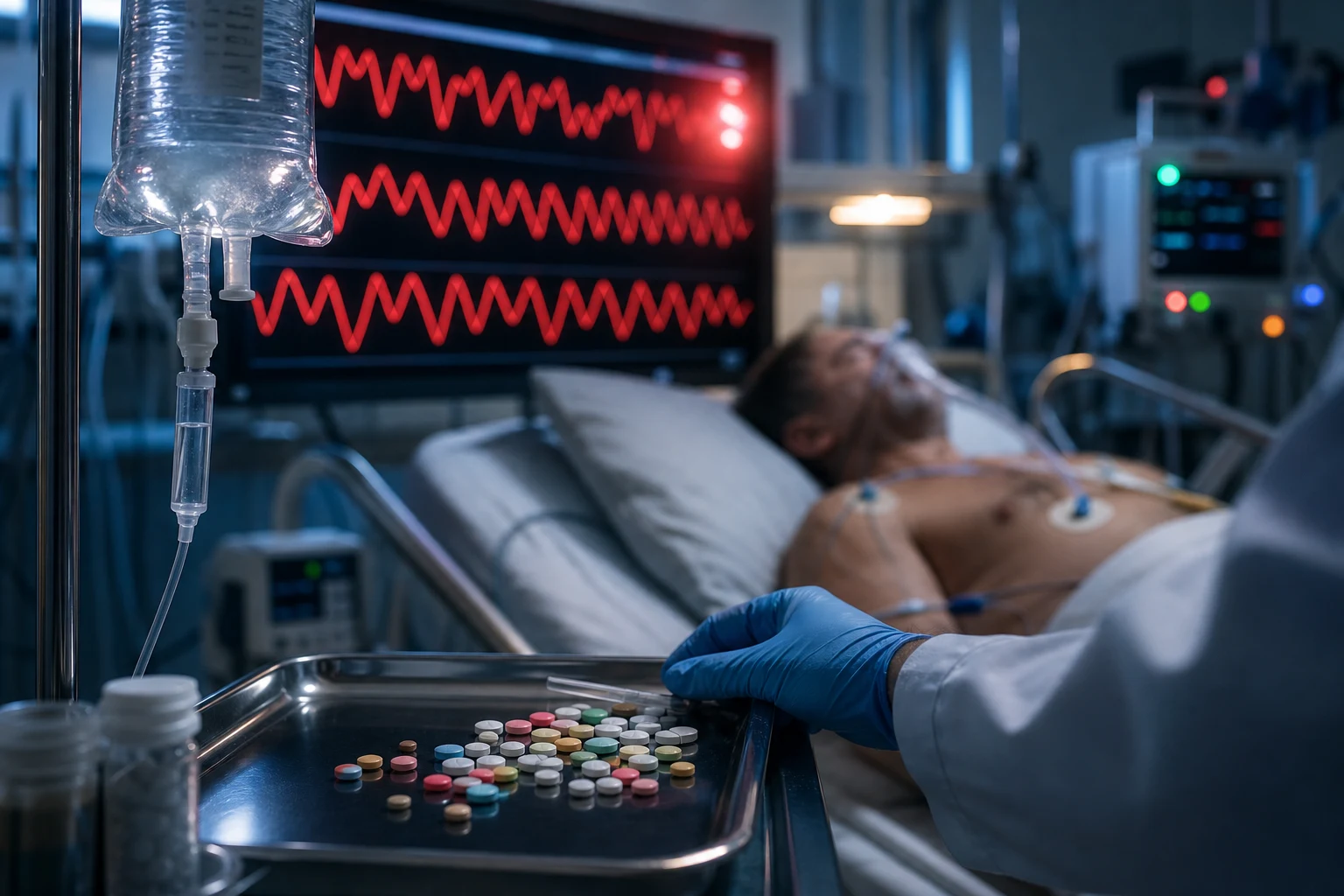
The five pharmacological actions
The TCA has five pharmacological actions, each producing a clinical effect:[1][1]
- The fast-sodium-channel blockade — the cardiotoxicity (the QRS widening, the conduction delay, the arrhythmia). The leading cause of the death.
- The alpha-1 adrenergic blockade — the vasodilation and the hypotension (the refractory).
- The muscarinic (anticholinergic) blockade — the anticholinergic toxidrome (the tachycardia, the dry, the flushed, the mydriasis, the ileus, the urinary retention).
- The histamine (H1) blockade — the sedation, the coma.
- The noradrenaline and the serotonin reuptake inhibition — the (the therapeutic effect, the minor in the overdose). [1]
The cardiotoxicity
The cardiotoxicity is the dominant, the lethal effect:[1][1]
- The QRS widening — the fast-sodium-channel blockade slows the ventricular depolarisation. The QRS above 100 ms indicates the cardiotoxicity; the QRS above 160 ms the high risk of the seizure and the arrhythmia.
- The rightward-axis terminal R wave in the aVR (the R wave above 3 mm) — the sensitive, the specific ECG marker of the TCA cardiotoxicity.
- The QT prolongation, the tachycardia (the anticholinergic + the reuptake), the conduction blocks.
- The ventricular arrhythmia — the VT (often the monomorphic, the Brugada-like), the VF, the torsades. The cardiac arrest.
- The hypotension — the alpha-1 blockade (the vasodilation) plus the negative inotropy (the sodium-channel effect). The refractory. [1]
The CNS effects
- The coma — the rapid onset (the H1 and the sodium-channel effects).
- The seizures — the generalised, the often-early; the more common with the amoxapine and the maprotiline. The seizure worsens the acidosis and the cardiotoxicity.
- The anticholinergic signs — the "the red as a beet, the dry as a bone, the blind as a bat, the mad as a hatter" (the flushed, the dry, the mydriasis, the delirium).[1]
The investigation
- The ECG — the central, the prognostic. The QRS width (the 100 ms the threshold), the aVR terminal R wave, the QT, the arrhythmia. The serial ECG (the every 1 to 2 hours until the narrowing).
- The electrolytes, the glucose, the ABG (the acidosis worsens the cardiotoxicity — the target the pH the normal-to-alkalinaemic).
- The TCA drug level — the NOT useful for the management (the poor correlation); the clinical and the ECG the guide.[1]
Treatment: the sodium bicarbonate and the escalation
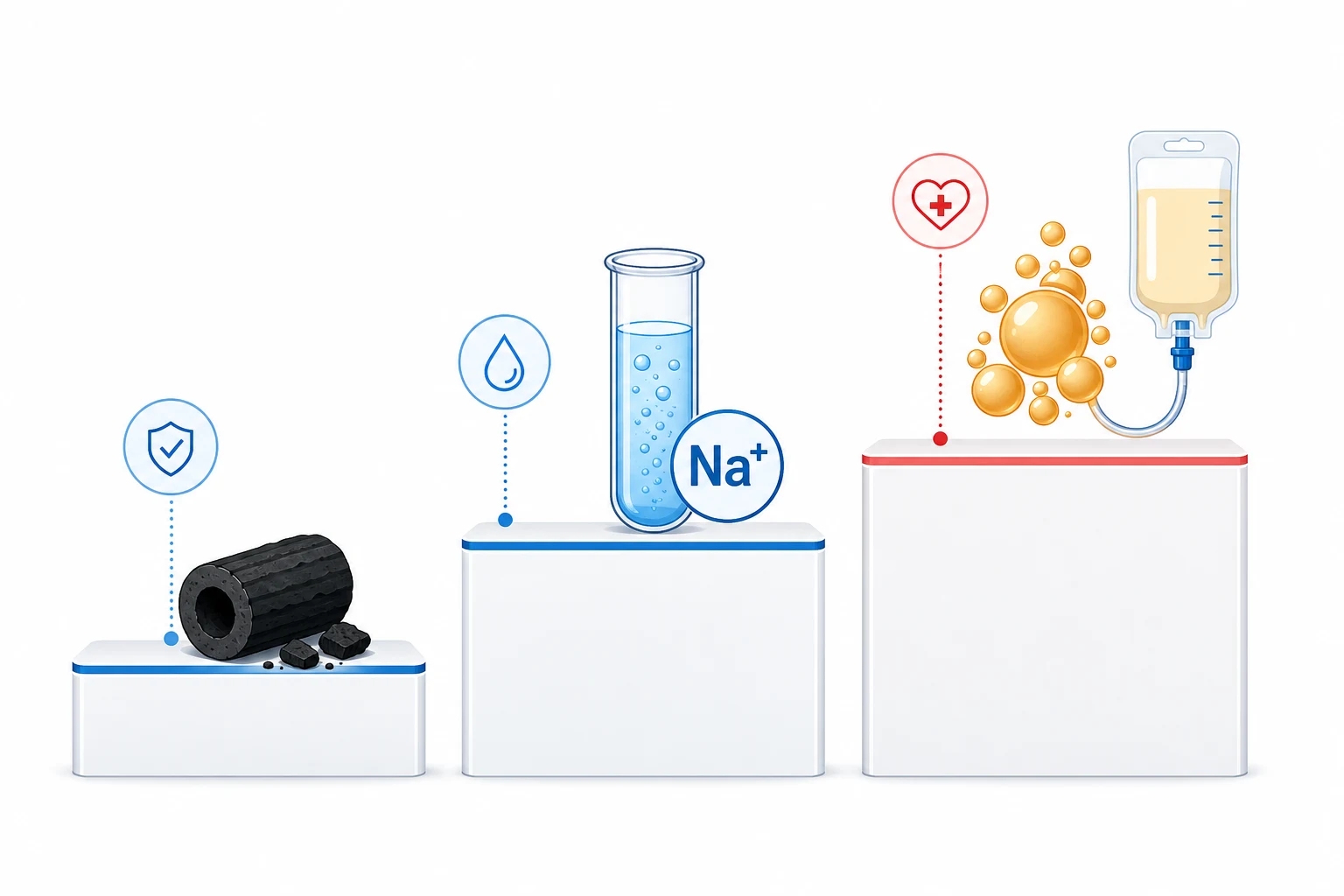
1. Resuscitation + decontamination. The ABCDE; the activated charcoal if the early (within 1 to 2 h) AND the airway protected (the TCA coma + the charcoal-aspiration risk). The intubation for the coma or the seizure.[1]
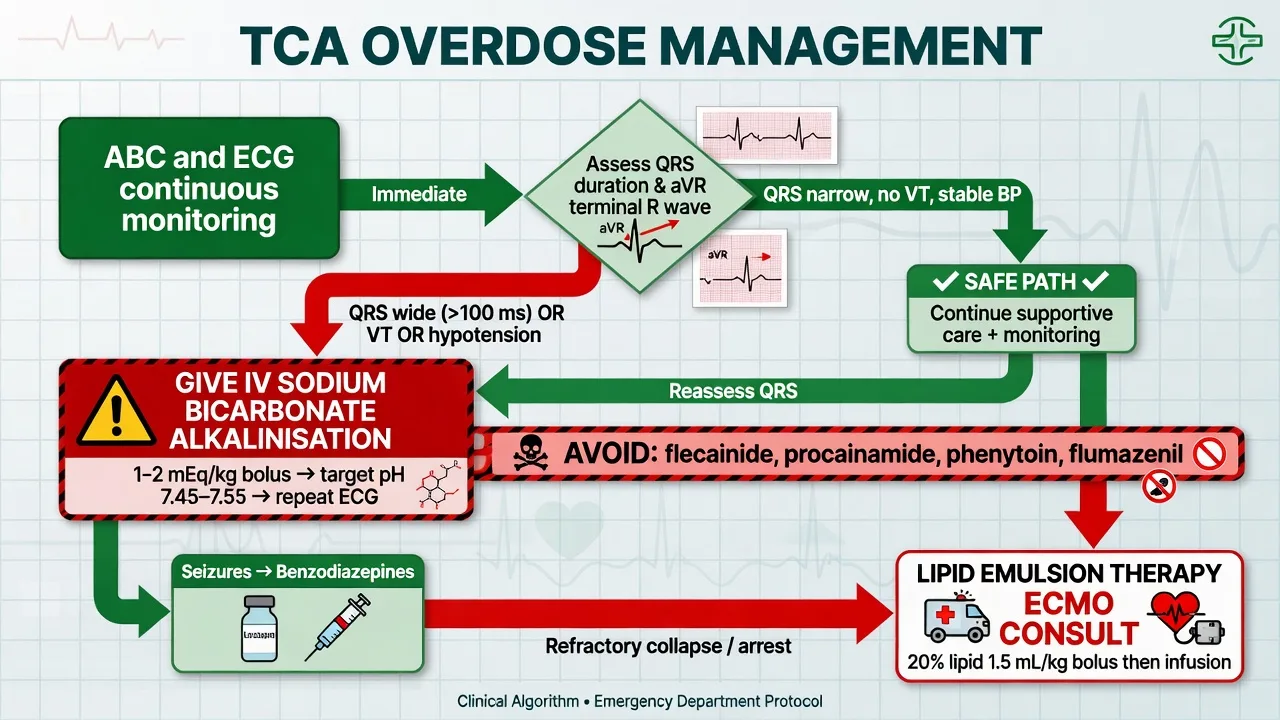
2. The sodium bicarbonate. The specific therapy for the cardiotoxicity (the QRS widening, the VT, the hypotension).[1]
- The 1 to 2 mmol/kg IV bolus, repeat to a serum pH of 7.45 to 7.55 and the QRS narrowing. Then the infusion (the 150 mL of the 8.4 per cent in 850 mL of the 5-per-cent dextrose, at 2 to 3 mL/kg/h).
- The mechanism: the sodium load (the overcomes the channel blockade — the mass action) AND the alkalosis (the increases the protein binding, the reduces the free fraction, the favours the channel recovery). The hyperventilation to the same target pH is the adjunct.
- The potassium monitoring (the bicarbonate drives the potassium into the cells).[1][1]
3. The hypotension. The IV fluids, the norepinephrine (the direct alpha-1 agonist — the bypasses the blocked alpha-1 receptor; the preferred over the dopamine, which is the less effective and the possibly pro-arrhythmic).[1]
4. The seizures. The benzodiazepine (the diazepam, the lorazepam). AVOID the phenytoin (the sodium-channel blocker — the worsens the cardiotoxicity).[2]
5. The arrhythmia. The bicarbonate, the magnesium, the correction of the acidosis and the potassium. AVOID the class-Ia (the procainamide, the quinidine, the disopyramide) and the class-Ic (the flecainide) antiarrhythmics — the sodium-channel blockers, the worsen the TCA toxicity. The lidocaine (the class-Ib) is the debated, the possible for the refractory (the does not worsen the blockade as much).[2]
6. The lipid emulsion. The 20-per-cent lipid emulsion (the 1.5 mL/kg bolus, then the infusion) for the refractory cardiotoxicity, the cardiac arrest unresponsive to the bicarbonate and the CPR — the "the lipid sink" sequesters the lipophilic TCA. The NOT the first-line.[1][9]
AVOID the flumazenil (the benzodiazepine-antagonist precipitates the seizure in the TCA).[1]
Prognosis
The patient who survives the first 24 hours (the cardiotoxicity and the seizure the peak in the first 12 hours) usually the recovers completely — the TCA is the eliminated, the no chronic damage. The poor-prognostic features: the wide QRS, the ventricular arrhythmia, the refractory hypotension, the seizure, the severe acidosis.[1][1]
Red flags
The four converging mechanisms of TCA cardiotoxicity
The cardiotoxicity of a TCA is not a single action — it is the summation of four distinct electrophysiological and pharmacological insults that converge on the myocardium and the peripheral vasculature. Understanding each one is the key to understanding why the therapy is what it is.[4][5]
1. Fast-sodium-channel blockade (the dominant lethal mechanism). TCAs bind the open state of the cardiac voltage-gated sodium channel (Naᵥ1.5) and delay its recovery to the resting state. The pharmacological signature is use-dependence (frequency-dependence) — the faster the heart rate, the more channels are in the open state, and the more the channel is blocked. The clinical consequence is slowed phase-0 depolarisation of the ventricular myocyte, manifest as QRS widening. The wider the QRS, the more sodium channels are blocked, and the higher the risk of re-entrant ventricular arrhythmia (monomorphic VT), electromechanical dissociation, and asystole. This is the mechanism that kills, and it is the mechanism that sodium bicarbonate specifically reverses.[4][7]
2. Alpha-1 adrenergic receptor blockade (the refractory hypotension). TCAs competitively antagonise the peripheral alpha-1 receptor on vascular smooth muscle, producing vasodilation and distributive shock. This is compounded by negative inotropy (from the sodium-channel effect) and by depletion of noradrenaline stores (from the reuptake inhibition). The net result is a hypotension that is refractory to indirect-acting catecholamines (dopamine, adrenaline) — these agents act partly via the alpha-1 receptor that is blocked, and partly via release of endogenous catecholamines that have been depleted by the reuptake blockade. Norepinephrine (a direct alpha-1 agonist that bypasses the blocked receptor) is the preferred vasopressor.[1]
3. Anticholinergic (muscarinic) blockade (the toxidrome and the tachycardia). Antagonism of central and peripheral muscarinic receptors produces the classic anticholinergic syndrome: tachycardia, mydriasis, dry mucosae, flushed dry skin, ileus, urinary retention, and delirium ("red as a beet, dry as a bone, blind as a bat, mad as a hatter"). The tachycardia is haemodynamically important because it worsens use-dependent sodium-channel blockade (more channels in the open state per unit time) — a vicious cycle that pushes the myocardium toward VT/VF. This is the pharmacological reason that the sinus tachycardia of TCA poisoning should NOT be reflexively treated with a beta-blocker — slowing the rate can paradoxically narrow the QRS (less use-dependence) but more importantly a beta-blocker worsens hypotension and is contraindicated.[5]
4. Potassium-channel (hERG / Iᴋʀ) blockade (the QT prolongation and the torsades risk). TCAs block the rapid component of the delayed-rectifier potassium current (Iᴋʀ), carried by the hERG channel. This produces QT prolongation and a risk of torsades de pointes — distinct from the monomorphic VT of sodium-channel blockade. The QT effect is more prominent with some agents (amitriptyline, dothiepin) than others. Magnesium sulphate (2–4 g IV) is the specific therapy for torsades, regardless of cause.[5][13]
The fifth classical action — histamine H1 blockade — produces sedation and contributes to coma but is not cardiotoxic; the sixth, monoamine (noradrenaline and serotonin) reuptake inhibition, is the therapeutic antidepressant action and is clinically minor in overdose.[1]
The ECG as the bedside prognostic instrument
In TCA poisoning the 12-lead ECG is the single most useful investigation — more useful than the drug level, more useful than the electrolytes, more useful than the arterial blood gas. Every ECG variable you need is on the strip: the QRS width, the QT interval, the axis, the lead-aVR terminal R wave, and the rhythm. The severity of the overdose is read from the ECG.[3][6]
QRS duration — the master vital sign
The QRS width is the direct electrophysiological readout of how many fast-sodium channels are blocked. The thresholds that every intensivist must know:[3][6]
| QRS duration | Interpretation | Action |
|---|---|---|
| < 100 ms | No significant Na-channel blockade | Standard observation, serial ECG |
| 100–160 ms | Significant cardiotoxicity — risk of seizure and arrhythmia rising | IV sodium bicarbonate 1–2 mmol/kg, repeat to narrow QRS < 100 ms |
| > 160 ms | Severe cardiotoxicity — high risk of ventricular arrhythmia | Bicarbonate bolus, ICU admission, prepare for lipid emulsion and escalation |
| Widening acutely | Drug still absorbing — deteriorating | Repeat bicarbonate, secure airway, prepare for arrest |
Measure the QRS in the limb lead where it is widest, not just lead II. The convention is to use the longest QRS in any limb lead. Re-measure every 15–30 minutes until it has narrowed and remained stable; continue until the QRS is < 100 ms for at least 6–12 hours after the last widening.[6]
The terminal R wave in lead aVR — the "missing piece" ECG sign
Lead aVR has been historically neglected, but in TCA poisoning it is the most specific single ECG marker. The TCA sodium-channel effect produces a rightward shift of the terminal QRS vector, manifest in lead aVR as a terminal R wave (an R' deflection). Two thresholds are quoted:[6]
- R wave in aVR > 3 mm — sensitive marker of significant TCA cardiotoxicity.
- R/S ratio in aVR > 0.7 — the more specific threshold, with a high positive predictive value for seizure and arrhythmia. [1]
If the QRS is borderline and you are unsure whether to give bicarbonate, the lead-aVR terminal R wave settles it: a tall terminal R in aVR with a broad QRS is TCA cardiotoxicity until proven otherwise. [1]
The right-axis deviation — the "S1R3" pattern
A more recently described sign is right-axis deviation of the terminal 40-ms QRS vector, which produces the characteristic S wave in lead I with an R wave in lead aVR (the so-called S1R3 pattern — a deep S in I and a dominant R in aVR). This is essentially the same electrophysiological phenomenon as the terminal R in aVR expressed across two leads, and it is the basis of the Naᵥ1.5 overload ECG pattern that mimics a Brugada-type morphology in the right precordial leads (V1–V3). A Brugada-pattern ECG in a comatose patient is TCA (or another sodium-channel blocker) until proven otherwise.[5]
QT prolongation and torsades risk
The hERG/K-channel blockade prolongs the QT interval. Correct the QT for heart rate (QTc) — the anticholinergic tachycardia partially conceals this, so a QTc > 440 ms in a tachycardic TCA patient is a genuine red flag for torsades. Maintain potassium > 4.0 mmol/L and magnesium > 1.0 mmol/L; both shorten the action potential and reduce torsades risk.[13]
Rhythm disturbances
- Sinus tachycardia — universal from the anticholinergic effect; benign in isolation, do NOT treat with a beta-blocker.
- Monomorphic VT — re-entrant arrhythmia from QRS widening; treat with bicarbonate and correction of acidosis/potassium.
- Torsades de pointes — from QT prolongation; treat with IV magnesium 2–4 g.
- Brugada-pattern ECG — coved ST elevation in V1–V3; sodium-channel effect, NOT a primary arrhythmic syndrome here; treat with bicarbonate.
- Ventricular fibrillation / asystole — pre-terminal; bicarbonate bolus + CPR + lipid emulsion + ECMO consideration.[3][14]
Sodium bicarbonate — the specific antidote, in detail
Sodium bicarbonate is the single most important drug in TCA poisoning. It is the only therapy with robust mechanistic and clinical support for the reversal of the sodium-channel blockade that kills.[4][7]
Indications (any one)
- QRS > 100 ms in any limb lead
- QRS widening on serial ECG
- Ventricular arrhythmia (VT, VF, torsades) suspected due to TCA
- Hypotension refractory to fluids in the context of known/suspected TCA
- Na-channel-blockade-pattern ECG (terminal R in aVR > 3 mm; Brugada pattern) [1]
Dose
- Bolus: 1–2 mmol/kg IV (typically 100 mL of 8.4% NaHCO₃ = 100 mmol for a 70 kg adult; or 2 mL/kg of 8.4% solution).
- Repeat every 5–15 minutes until the QRS narrows to < 100 ms AND the haemodynamics stabilise. Most patients need 1–3 boluses.
- Infusion: 150 mL of 8.4% NaHCO₃ in 850 mL of 5% dextrose, run at 2–3 mL/kg/h to maintain QRS < 100 ms and pH 7.45–7.55.
- Target: QRS < 100 ms (the QRS, not the pH, is the titration endpoint — a patient can have a "normal" pH and still need bicarbonate).[3][4]
The two mechanisms of action — both matter
-
The sodium load (mass action). The bicarbonate bolus delivers a large extracellular sodium concentration (~1000 mmol/L in 8.4% solution). The raised [Na⁺]ᵢₒ drives the sodium-gradient and overcomes the channel blockade by mass action — more substrate competes for the partially blocked channel. This is why hypertonic saline (3% NaCl) also narrows the QRS in TCA models, and why bicarbonate is more effective than hyperventilation alone (hyperventilation raises pH but delivers no sodium).[4][12]
-
The alkalosis (protein binding). Raising the blood pH to 7.45–7.55 increases the protein binding of the TCA, reducing its free (unbound) fraction at the myocardial sodium channel. TCAs are weak bases; at alkaline pH a greater proportion is in the non-ionised, protein-bound form. The alkalosis also directly favours channel recovery (the Vmax of phase-0 depolarisation is pH-dependent).[4][7]
Both mechanisms are necessary and synergistic — which is why hyperventilation alone is insufficient (no sodium load) and hypertonic saline is less effective than bicarbonate (no alkalosis). Sodium bicarbonate delivers both.[12]
Adjunctive hyperventilation
In an intubated patient, target a PaCO₂ of 30–35 mmHg (pH 7.45–7.55). This delivers the alkalosis component of the bicarbonate mechanism and is the recommended adjunct in the 2023 AHA focused update on poisoning-induced cardiac arrest.[14]
Monitoring and pitfalls of bicarbonate therapy
- Hypokalaemia — alkalaemia drives potassium into cells; check K⁺ every 1–2 h and supplement to keep K⁺ > 4.0 mmol/L (also reduces torsades risk).
- Hypocalcaemia / tetany — alkalosis reduces ionised calcium; monitor for paraesthesia, carpopedal spasm.
- Hypernatraemia — usually acceptable; monitor, but do not let it exceed ~155 mmol/L.
- Volume overload — the bicarbonate infusion carries a substantial sodium and water load; watch for pulmonary oedema in the elderly or those with cardiac disease.
- Cerebral fluid shift — large boluses can transiently reduce cerebral perfusion; acceptable in the context of life-threatening cardiotoxicity.
- Local extravasation — 8.4% NaHCO₃ is extremely alkaline and vesicant; use a central line if possible, or a securely-cannulated large peripheral vein.[1]
Intravenous lipid emulsion therapy — for refractory cardiotoxicity
The 20% intravenous lipid emulsion (ILE) is the second-line rescue therapy for TCA cardiotoxicity that is refractory to maximal bicarbonate, or for cardiac arrest unresponsive to standard ALS plus bicarbonate. The mechanism is the "lipid sink": the lipid emulsion creates an intravascular lipid phase that sequesters lipophilic drugs (TCAs are highly lipophilic, log P ~5), reducing the free drug concentration at the myocardium and other target tissues.[9][8][10]
Indications
- Refractory ventricular arrhythmia unresponsive to bicarbonate and correction of acidosis/potassium
- Cardiac arrest (TCA-induced) unresponsive to standard ALS + bicarbonate + CPR /- Intractable hypotension unresponsive to fluids, bicarbonate, and vasopressors (controversial — earlier use increasingly advocated)[10]
Dose (the standard AAGBI/ACMT regimen)
- Bolus: 20% lipid emulsion 1.5 mL/kg IV over 1 minute (≈ 100 mL for a 70 kg adult).
- Infusion: 0.25 mL/kg/min for 30–60 minutes (≈ 1000 mL over 30 min for 70 kg).
- Repeat bolus 1.5 mL/kg if recurrent arrest or persistent cardiovascular collapse.
- Maximum cumulative dose: ~12 mL/kg.[10]
Pitfalls and adverse effects of lipid emulsion
- Laboratory interference — lipaemia invalidates most spectrophotometric assays and the visual haemolysis/icteria/lipaemia assessment; send bloods BEFORE giving lipid.
- Pancreatitis — hypertriglyceridaemia can trigger acute pancreatitis; check lipase at baseline and at 24 h.
- Acute kidney injury / ARDS / fat embolism — reported; the benefit-risk balance in arrest favours use.
- Infection — lipid is a growth medium; strict asepsis, use within 24 h of spiking.
- Does NOT replace bicarbonate — give bicarbonate first; lipid is added on top, not substituted.[9]
Vasopressor strategy in TCA-induced shock
The hypotension of TCA poisoning has three mechanisms — alpha-1 blockade (vasodilation), negative inotropy (Na-channel effect), and depletion of noradrenaline stores (reuptake inhibition). The vasopressor strategy must respect all three.[1]
First-line: norepinephrine (noradrenaline)
Norepinephrine is the preferred first-line vasopressor. It is a direct alpha-1 agonist — it binds and activates the alpha-1 receptor itself, bypassing the competitive blockade. It also has beta-1 agonist activity, providing modest positive inotropy. Start at 0.05–0.1 mcg/kg/min and titrate to MAP > 65 mmHg.[1]
Avoid indirect-acting catecholamines
Dopamine and adrenaline are less effective in TCA shock. Dopamine acts partly via the alpha-1 receptor (blocked) and partly via release of endogenous noradrenaline (depleted). Adrenaline similarly depends on the alpha-1 receptor and on indirect mechanisms. Both are more arrhythmogenic and less effective than noradrenaline in this setting.[1]
Add-on vasopressors
- Vasopressin — for refractory vasodilatory shock; acts on V1 receptors, independent of alpha-1. Fixed dose 0.03–0.04 U/min.
- Adrenaline (epinephrine) — as a second agent if norepinephrine is insufficient; provides inotropy and chronotropy.
- Phenylephrine — pure alpha-1 agonist, theoretically ideal, but pure vasoconstrictor with no inotropy; less commonly used.[13]
SAQ — Amitriptyline overdose with sodium-channel cardiotoxicity
10 minutes · 10 marks
A 25-year-old woman (60 kg) is brought to ED 2 hours after ingesting 4.5 g of amitriptyline (90 tablets of 50 mg) with alcohol. She is unconscious (GCS 6), HR 132, BP 76/40, RR 16 shallow. ECG shows sinus tachycardia with QRS 160 ms, terminal R wave in aVR (R/S ratio > 0.7), QTc 520 ms.
SAQ — TCA poisoning — sodium bicarbonate and QRS guidance
10 minutes · 10 marks
A 16-year-old girl is brought to ED after a deliberate overdose of unknown quantity of her mother’s dothiepin. On arrival she is drowsy (GCS 11), HR 122, BP 100/60, RR 18, mydriasis, dry mouth. ECG: sinus tachycardia with QRS 124 ms and a terminal R wave in aVR. She has had one brief generalised seizure in the ambulance.
The clinical pearls — 18 high-yield points for the exam
The complete management protocol
TCA poisoning — the complete stepwise ICU management protocol
-
RESUSCITATE (ABCDE): high-flow oxygen; secure TWO large-bore IV cannulae; continuous cardiac monitoring from the moment of arrival; 12-lead ECG (measure QRS in the widest limb lead, inspect lead aVR for a terminal R wave, look at V1–V3 for Brugada pattern). Intubate early if GCS < 8, recurrent seizures, or anticipated loss of airway. Check: glucose (rule out hypoglycaemia), paracetamol and salicylate levels (co-ingestion), U&E, VBG/ABG (pH, lactate), troponin, beta-HCG in women of reproductive age. Do NOT wait for a TCA level — it does not guide therapy.[3][1]
-
DECONTAMINATION — activated charcoal: 50 g PO/NG if within 1–2 h of ingestion (the anticholinergic delay extends the window) AND the airway is protected. Intubate BEFORE charcoal if GCS < 8 or airway reflexes impaired. NO multi-dose charcoal (TCAs do not undergo enterohepatic recirculation). NO gastric lavage routinely (aspiration risk in the anticholinergic, seizing patient). NO whole-bowel irrigation. NO ipecac.[3]
-
THE ANTIDOTE — SODIUM BICARBONATE 1–2 mmol/kg IV bolus (100 mL of 8.4% for a 70 kg adult) for ANY of: QRS > 100 ms; ventricular arrhythmia; hypotension refractory to fluids; Na-channel-pattern ECG (terminal R in aVR > 3 mm; Brugada pattern). Repeat every 5–15 min until QRS < 100 ms. Start an infusion (150 mL 8.4% NaHCO₃ in 850 mL 5% dextrose at 2–3 mL/kg/h).[3][4]
-
HYPERVENTILATE to pH 7.45–7.55 (PaCO₂ 30–35 mmHg) if intubated. This is the alkalosis arm of the bicarbonate mechanism and an AHA-recommended adjunct. Do not exceed the target range.[14]
-
CORRECT POTASSIUM AND MAGNESIUM: keep K⁺ > 4.0 mmol/L (bicarbonate drives K⁺ into cells) and Mg²⁺ > 1.0 mmol/L (reduces torsades). Give MgSO₄ 2–4 g IV for torsades or a long QT.[13]
-
VASOPRESSORS for refractory hypotension: norepinephrine first-line (direct alpha-1 agonist, bypasses the blockade), starting 0.05–0.1 mcg/kg/min, titrate to MAP > 65. Add vasopressin 0.03–0.04 U/min for refractory vasodilation. Add adrenaline for inotropic support if needed. AVOID dopamine (less effective, more arrhythmogenic).[1]
-
SEIZURES — benzodiazepine (diazepam 5–10 mg IV, lorazepam 4 mg IV, midazolam 5 mg IV); repeat and escalate to infusion if recurrent. Intubate if recurrent. AVOID phenytoin (Na-channel blocker — worsens cardiotoxicity). AVOID propofol infusion in large doses for ongoing seizure control (cardiodepression); barbiturate (thiopental) is acceptable.[2]
-
VENTRICULAR ARRHYTHMIA — sodium bicarbonate bolus (above) + magnesium 2–4 g + correction of K⁺/acidosis. If refractory, lidocaine 1–1.5 mg/kg IV (the only class-I agent that does not worsen the blockade). AVOID amiodarone, procainamide, quinidine, disopyramide, flecainide, sotalol — all Na-channel or K-channel blockers that worsen TCA toxicity. Synchronised cardioversion/defibrillation at standard energies for unstable VT/VF.[2][3]
-
LIPID EMULSION 20% for refractory cardiotoxicity or arrest: 1.5 mL/kg bolus IV over 1 min, then 0.25 mL/kg/min for 30–60 min. Repeat bolus 1.5 mL/kg for recurrent arrest. Maximum ~12 mL/kg. Send bloods BEFORE lipid (lipaemia invalidates assays).[8][10]
-
CARDIAC ARREST (TCA-induced) — modified ALS: standard CPR + early and aggressive sodium bicarbonate (1–2 mmol/kg bolus, repeat q5–10 min — there is no upper limit in arrest) + hyperventilation to PaCO₂ 30–35 + lipid emulsion (above) + continue CPR for at least 1 hour (prolonged CPR is justified — the drug redistributes and the patient can recover neurologically intact). Consider VA-ECMO for refractory arrest if available. Do NOT use amiodarone, procainamide, or lidocaine routinely in TCA arrest — bicarbonate is the antidote.[1][14]
-
NEVER GIVE flumazenil (seizure), class Ia/Ic antiarrhythmics (Na-channel blockade), phenytoin (Na-channel blockade), beta-blockers (worsen hypotension), physostigmine (case reports of asystole — generally avoided, though historically advocated for pure anticholinergic toxicity; the risk in TCA cardiotoxicity outweighs benefit).[1][3]
-
OBSERVATION: ICU admission for a minimum of 12–24 h after the QRS has been < 100 ms for at least 6 h. Serial ECG every 1–2 h until stable. Discharge criteria: asymptomatic, QRS < 100 ms for > 12 h, normal mental state, normal electrolytes, psychiatric assessment completed.[3]
The five pharmacological actions — clinical translation table
The five TCA pharmacological actions and their clinical translation
| Pharmacological action | Receptor / channel | Clinical effect | Specific therapy |
|---|---|---|---|
| Fast Na-channel blockade | Naᵥ1.5 (use-dependent) | QRS widening, VT/VF, asystole — the lethal mechanism | Sodium bicarbonate 1–2 mmol/kg; hypertonic saline; lipid emulsion (refractory) |
| Alpha-1 blockade | α₁ adrenergic (vascular smooth muscle) | Vasodilation, refractory hypotension | Norepinephrine (direct α₁ agonist); vasopressin; IV fluids |
| Anticholinergic (muscarinic) blockade | M₁–M₅ | Tachycardia, mydriasis, dry/flushed skin, ileus, urinary retention, delirium | Supportive; AVOID physostigmine in cardiotoxicity |
| H1 blockade | Histamine H1 | Sedation, coma | Supportive; airway protection |
| K-channel (hERG / Iᴋʀ) blockade | hERG | QT prolongation, torsades de pointes | Magnesium 2–4 g IV; K⁺ correction |
| (Monoamine reuptake inhibition) | NET, SERT | (Therapeutic antidepressant action; minor in overdose) | None specific |
The five TCAs — agent-specific comparison
The five commonly-encountered TCAs in overdose — agent-specific features
| Agent | Cardiotoxicity | Seizure risk | Notes |
|---|---|---|---|
| Amitriptyline | High | Moderate | Most commonly ingested in fatal overdose; very lipophilic — best lipid-emulsion responder |
| Nortriptyline | Moderate | Moderate | Active metabolite of amitriptyline; slightly less cardiotoxic |
| Dothiepin (dosulepin) | Highest | Moderate | Most lethal TCA per tablet — restrict on this basis in many formularies |
| Imipramine | High | Moderate | Classic reference TCA in toxicology literature |
| Clomipramine | High | Moderate | Most lipophilic — strong lipid-emulsion responder |
| Amoxapine | Moderate | Highest | Seizure-predominant; cardiotoxicity less prominent |
| Maprotiline | Moderate | High | Tetracyclic; seizure-predominant, long half-life |
Sodium-channel-blocker overdose — the broader differential
The sodium-channel-blocker overdose differential — TCA vs other agents
| Agent class | Examples | QRS widening | aVR terminal R | Hypotension mechanism | Specific therapy |
|---|---|---|---|---|---|
| TCAs | Amitriptyline, nortriptyline, dothiepin | Yes (often > 100 ms) | Yes (R > 3 mm) | α₁ blockade + cardiodepression | Sodium bicarbonate; norepinephrine; lipid |
| Class Ia antiarrhythmics | Quinidine, procainamide, disopyramide | Yes | Yes | Cardiodepression + vasodilation | Sodium bicarbonate; AVOID these agents as therapy |
| Class Ic antiarrhythmics | Flecainide, propafenone | Yes (often severe) | Variable | Cardiodepression | Sodium bicarbonate; AVOID as therapy |
| Local anaesthetics (massive dose) | Bupivacaine, lidocaine | Yes (bupivacaine) | Variable | Cardiodepression | Lipid emulsion first-line (not bicarbonate) |
| Cocaine | — | Yes | Variable | Na-channel + α₁ (paradoxical) + catecholamine surge | Benzodiazepine first-line; nitrate/hypertensives; AVOID beta-blockers |
| Carbamazepine | — | Yes | Variable | Less prominent | Sodium bicarbonate; multi-dose charcoal; MARS dialysis |
| Diphenhydramine | — | Yes (large dose) | Variable | Less prominent | Sodium bicarbonate; supportive |
The contraindicated drugs in TCA poisoning
Drugs that WORSEN TCA toxicity and MUST be avoided
| Drug | Reason it is dangerous | Mechanism |
|---|---|---|
| Class Ia antiarrhythmics (quinidine, procainamide, disopyramide) | Widen QRS, precipitate VF | Fast-sodium-channel blockade — additive to the TCA |
| Class Ic antiarrhythmics (flecainide, propafenone) | Widen QRS, precipitate VF | Fast-sodium-channel blockade — additive |
| Amiodarone | Widen QRS, hypotension | Class-III + class-I activity; Na-channel blockade |
| Phenytoin / fosphenytoin | Widen QRS, worsen cardiotoxicity | Fast-sodium-channel blockade — additive |
| Sotalol | QT prolongation, torsades | K-channel blockade (class III) — additive to TCA hERG blockade |
| Flumazenil | Refractory seizures | Lowers seizure threshold; reverses protective benzodiazepine effect |
| Beta-blockers (incl. sotalol) | Worsen hypotension, paradoxically widen QRS | Loss of β-1 inotropy; unmasking of Na-channel effect |
| Physostigmine | Asystole, bradycardia (case reports) | Cholinesterase inhibition — risk in cardiotoxic patient |
| Calcium channel blockers | Worsen hypotension, bradycardia | Negative inotropy/chronotropy — additive |
| Hypnotic-dose propofol infusion | Cardiodepression | Negative inotropy at high dose |
Sodium bicarbonate vs lipid emulsion — when to use which
Sodium bicarbonate vs intravenous lipid emulsion in TCA cardiotoxicity
| Feature | Sodium bicarbonate | Intravenous lipid emulsion (20%) |
|---|---|---|
| Position in algorithm | First-line specific antidote | Second-line rescue / refractory |
| Indication | QRS > 100 ms; VT; hypotension; Na-channel-pattern ECG | Refractory cardiotoxicity; arrest unresponsive to bicarbonate + CPR |
| Mechanism | Na⁺ mass action + alkalosis (protein binding) | Lipid sink — sequesters lipophilic TCA |
| Dose | 1–2 mmol/kg bolus, repeat to QRS < 100 ms | 1.5 mL/kg bolus, then 0.25 mL/kg/min × 30–60 min |
| Onset | Seconds to minutes | Minutes |
| Titration endpoint | QRS < 100 ms | ROSC / haemodynamic stability |
| Key adverse effects | Hypokalaemia, hypernatraemia, alkalosis, volume overload, extravasation | Lipaemia (assay interference), pancreatitis, AKI, ARDS, fat embolism |
| Evidence base | Robust (mechanism + clinical) | Animal models + case reports + consensus guideline (Gosselin 2016) |
| Cost / availability | Cheap, universal | Expensive, may be supply-constrained |
| Laboratory caveat | None major | Send all bloods BEFORE giving lipid — lipaemia invalidates assays |
Hypotensive TCA patient — vasopressor selection
Vasopressor selection in TCA-induced shock
| Vasopressor | Mechanism | Efficacy in TCA shock | Recommendation |
|---|---|---|---|
| Norepinephrine | Direct α₁ agonist + β₁ agonist | High — bypasses α₁ blockade; provides vasoconstriction + inotropy | FIRST-LINE; start 0.05–0.1 mcg/kg/min |
| Vasopressin | V₁ receptor (independent of α₁) | Moderate–high; useful for refractory vasodilation | ADD-ON; 0.03–0.04 U/min fixed |
| Adrenaline | α₁ + β₁ + β₂ agonist | Moderate; useful for inotropic support; more arrhythmogenic | ADD-ON if inotropy needed |
| Phenylephrine | Pure α₁ agonist | Theoretically ideal; pure vasoconstriction, no inotropy | SECOND-LINE option |
| Dopamine | α₁ + β₁ + dopaminergic; partly indirect | LOW — α₁ receptor blocked, indirect stores depleted | AVOID |
| Metaraminol | α₁ (direct + indirect) | Moderate; partly indirect | Acceptable alternative if noradrenaline unavailable |
| Milrinone | PDE-3 inhibitor | Low; causes vasodilation (worsens hypotension) | AVOID |
The landmark trials and guidelines
Body 2011 — GEMNet guideline for management of TCA overdose (PMID 21436332)
Source
Emerg Med J — UK national evidence-based guideline (GEMNet)
Design
Structured evidence-based guideline
Key principle 1
Sodium bicarbonate 1–2 mmol/kg is first-line for QRS > 100 ms / ventricular arrhythmia / hypotension
Key principle 2
Activated charcoal within 1 h if airway protected; no role for multi-dose charcoal in TCA
Key principle 3
AVOID class Ia/Ic antiarrhythmics and amiodarone; lidocaine (class Ib) is the only acceptable class-I agent for refractory VT
Key principle 4
Lipid emulsion is a rescue therapy for refractory cardiotoxicity or arrest; norepinephrine preferred for hypotension
Exam relevance
THE definitive UK guideline — the single most citable reference for TCA management in the CICM/FFICM exam
Bradberry 2005 — Sodium bicarbonate for the cardiovascular complications of TCA poisoning (PMID 16390221)
Source
Toxicological Reviews — definitive mechanism review
Design
Comprehensive narrative review
Key principle 1
Bicarbonate works by two mechanisms: sodium loading (mass action — overcomes Na-channel blockade) AND alkalosis (increases protein binding → less free TCA at the channel)
Key principle 2
NaHCO₃ > NaCl > hyperventilation alone — the bicarbonate bolus delivers both effects
Key principle 3
Recommended for QRS > 100 ms, ventricular arrhythmia, and hypotension — titrate to QRS < 100 ms
Exam relevance
The 'two mechanisms' answer — quote this paper when asked HOW bicarbonate works
Pentel & Benowitz 1984 — Mechanism of sodium bicarbonate in desipramine toxicity (PMID 6086872)
Source
J Pharmacol Exp Ther — foundational animal mechanistic study
Design
Controlled rat model of desipramine (TCA) cardiotoxicity
Key principle 1
Bicarbonate reversed cardiotoxicity; the effect was driven by BOTH extracellular sodium concentration AND pH
Key principle 2
Hypertonic saline alone was partially effective (sodium mechanism); alkalosis alone was partially effective (binding mechanism)
Key principle 3
Established the dual mass-action + protein-binding mechanism that underpins all clinical bicarbonate therapy for Na-channel-blocker overdose
Exam relevance
The foundational mechanistic paper — cite for the 'two mechanisms of bicarbonate' answer
Liebelt 1995 — ECG lead aVR vs QRS interval in predicting TCA toxicity (PMID 9733258)
Source
Ann Emerg Med — classic ECG prognostication study
Design
Prospective cohort of acute TCA-poisoned patients
Key principle 1
Terminal R wave in lead aVR > 3 mm predicts seizures and arrhythmias
Key principle 2
R/S ratio in aVR > 0.7 has high specificity for significant cardiotoxicity
Key principle 3
Severity is read from the ECG (QRS + aVR), NOT the drug level
Exam relevance
The 'aVR terminal R wave' answer — cite when asked which ECG sign predicts TCA severity beyond QRS width
Harvey & Cave 2006 — Intralipid vs sodium bicarbonate in clomipramine toxicity (PMID 17098328)
Source
Ann Emerg Med — landmark animal model of lipid rescue in TCA
Design
Randomised rabbit model of clomipramine (TCA) cardiotoxicity
Key principle 1
Intravenous lipid emulsion OUTPERFORMED sodium bicarbonate alone for return of spontaneous circulation in this model
Key principle 2
Supports the 'lipid sink' hypothesis — lipid phase sequesters lipophilic TCA, reducing free drug at the myocardium
Key principle 3
Did NOT establish lipid as first-line (bicarbonate remains first-line in humans); supports lipid as rescue therapy
Exam relevance
The 'lipid sink' paper — cite when asked about the mechanism and evidence for lipid emulsion in TCA
Gosselin 2016 — Evidence-based recommendations on intravenous lipid emulsion in poisoning (PMID 27608281)
Source
Clin Toxicol — international consensus (ACMT/EAPCCT) position paper
Design
Structured expert consensus with GRADE
Key principle 1
Lipid emulsion is recommended as part of the standardised protocol for TCA-induced refractory cardiotoxicity or arrest
Key principle 2
Standard regimen: 1.5 mL/kg bolus then 0.25 mL/kg/min; maximum ~12 mL/kg
Key principle 3
Send bloods BEFORE lipid — lipaemia invalidates most assays
Key principle 4
Watch for pancreatitis, hypertriglyceridaemia, AKI, ARDS
Exam relevance
The definitive dosing protocol — cite for the 'how do you give lipid emulsion' answer
Lavonas 2023 — AHA Focused Update on poisoning-induced cardiac arrest (PMID 37721023)
Source
Circulation — American Heart Association focused update
Design
Evidence-based guideline update
Key principle 1
For TCA-induced cardiac arrest: high-quality CPR + early aggressive sodium bicarbonate + hyperventilation to PaCO₂ 30–35 + IV lipid emulsion
Key principle 2
Prolonged CPR (> 1 h) is justified — the patient can recover neurologically intact
Key principle 3
Consider VA-ECMO for refractory arrest if available
Key principle 4
AVOID amiodarone, class Ia/Ic agents, and calcium channel blockers as standard antiarrhythmics in this setting
Exam relevance
The current standard-of-care reference for poisoning-induced arrest — cite for the 'modified ALS in TCA arrest' answer
Lou 2026 — Survival after multiple in-hospital arrests due to severe amitriptyline poisoning (PMID 41484815)
Source
Int J Emerg Med — case report
Design
Case report of prolonged CPR + bicarbonate + lipid + ECMO in massive amitriptyline overdose
Key principle 1
Survival with intact neurology is possible after multiple in-hospital arrests in severe TCA poisoning — do not be nihilistic
Key principle 2
The successful strategy combined prolonged CPR, aggressive bicarbonate, lipid emulsion, and ECMO
Exam relevance
The 'never give up on a TCA arrest' paper — cite when justifying prolonged CPR and multimodal rescue
Additional red flags
Viva pitfalls and high-yield exam questions
Viva: the seven questions examiners ask about TCA poisoning
| Question | The pass answer | The distinction answer |
|---|---|---|
| What is the lethal mechanism of TCA overdose? | Fast-sodium-channel blockade producing QRS widening, VT/VF, and asystole | Add the four converging mechanisms: Na-channel (lethal), α₁-blockade (hypotension), anticholinergic (tachycardia worsens use-dependence), hERG/K-blockade (QT, torsades) |
| How does sodium bicarbonate work? | Sodium load + alkalosis | Mass-action Na⁺ competition at the channel AND alkalosis-driven increase in protein binding (reduces free TCA); established by Pentel & Benowitz 1984 |
| What ECG sign predicts TCA severity? | QRS > 100 ms | Add the aVR terminal R > 3 mm, R/S ratio in aVR > 0.7, right-axis (S1R3) pattern, Brugada pattern, QT prolongation |
| Which vasopressor? | Norepinephrine | Direct α₁ agonist bypasses the blocked receptor; dopamine/adrenaline are inferior (indirect, partly via blocked α₁); add vasopressin for refractory |
| Which drugs must you AVOID? | Class Ia/Ic, phenytoin, flumazenil | Add amiodarone, sotalol, beta-blockers, physostigmine, calcium channel blockers — explain WHY each is dangerous |
| When do you give lipid emulsion? | Refractory cardiotoxicity or arrest | 1.5 mL/kg bolus then 0.25 mL/kg/min; lipid sink mechanism; send bloods before lipid; watch pancreatitis/AKI/ARDS |
| What is the prognosis? | Survival of first 24 h is usually complete recovery | Add the never-nihilistic principle — prolonged CPR + multimodal rescue can recover the arrested patient neurologically intact (Lou 2026) |
The myths — busted
Five myths about TCA poisoning that examiners love to test
| Myth | Reality |
|---|---|
| "Give amiodarone for the VT" | WRONG. Amiodarone is a Na-channel blocker (class I + III). The VT of TCA is a Na-channel-blockade arrhythmia; the antidote is sodium bicarbonate, NOT another Na-channel blocker. Amiodarone widens the QRS and precipitates VF. |
| "The TCA level guides therapy" | WRONG. The TCA level has poor correlation with severity (large Vd, active metabolites). Therapy is guided by the ECG (QRS, aVR) and the clinical state. Do NOT wait for a level. |
| "Hyperventilate to pH 7.6" | OVER-correct. Target pH 7.45–7.55 (PaCO₂ 30–35). Beyond this there is no further benefit and cerebral vasoconstriction is harmful. |
| "Give activated charcoal regardless of timing" | WRONG. Charcoal only within 1–2 h AND airway protected. Beyond 2 h there is no benefit (TCA does not undergo enterohepatic recirculation), and aspiration risk is high in the anticholinergic patient. |
| "A normal QRS means no TCA ingestion" | WRONG. The QRS can be normal early (drug still absorbing) or in mild ingestion. The anticholinergic toxidrome and history establish the diagnosis; the ECG quantifies the cardiotoxicity. Serial ECG is mandatory. |
The ICU consultant's one-paragraph answer
Mnemonics for the exam
The two mnemonics that earn marks in the TCA viva
| Mnemonic | Decodes to | Use |
|---|---|---|
| TRI-CYCLIC (the five actions) | Tachycardia (anticholinergic), Refractory hypotension (α₁), Impaired conduction (Na-channel — QRS), Coma (H1), Yellow/red flags (ECG), Channel-blockade QT (hERG) | The five-to-six pharmacological actions |
| "Bicarb, Blow, Burn fat" | Bicarb (sodium bicarbonate 1–2 mmol/kg), Blow (hyperventilate to PaCO₂ 30–35), Burn fat (lipid emulsion 1.5 mL/kg for refractory) | The escalation of TCA cardiotoxicity therapy |
Key equations and numbers to memorise
The numbers an intensivist must know for TCA poisoning
| Parameter | Value | Application |
|---|---|---|
| QRS cardiotoxicity threshold | 100 ms | Give sodium bicarbonate |
| QRS high-risk threshold | 160 ms | High risk of VT/VF; prepare for escalation |
| aVR terminal R wave threshold | 3 mm | Sensitive marker of cardiotoxicity |
| aVR R/S ratio threshold | 0.7 | Specific marker of cardiotoxicity |
| Sodium bicarbonate bolus | 1–2 mmol/kg IV (≈ 100 mL 8.4% for 70 kg) | Repeat every 5–15 min to QRS < 100 ms |
| Sodium bicarbonate infusion | 150 mL 8.4% in 850 mL 5% dextrose at 2–3 mL/kg/h | Maintenance |
| Target pH | 7.45–7.55 (PaCO₂ 30–35) | Alkalosis arm of the mechanism |
| Lipid emulsion bolus | 1.5 mL/kg 20% over 1 min (≈ 100 mL for 70 kg) | Refractory cardiotoxicity / arrest |
| Lipid emulsion infusion | 0.25 mL/kg/min for 30–60 min (≈ 1000 mL over 30 min) | After bolus |
| Lipid emulsion max dose | ~12 mL/kg | Cumulative |
| Activated charcoal window | 1–2 h (extended by anticholinergic delay) | AND airway protected |
| TCA half-life | 10–30 h | Justifies prolonged monitoring |
| Norepinephrine starting dose | 0.05–0.1 mcg/kg/min | Titrate to MAP > 65 |
| Magnesium for torsades | 2–4 g IV | QT-prolongation arrhythmia |
| Minimum CPR duration in TCA arrest | At least 1 hour (no upper limit) | The drug redistributes; recovery possible |
Decontamination, dialysis, and the things that do NOT work
Therapies that do NOT work (or are harmful) in TCA poisoning
| Therapy | Status | Reason |
|---|---|---|
| Multi-dose activated charcoal | NOT indicated | TCA does not undergo clinically significant enterohepatic recirculation (unlike salicylate, carbamazepine, theophylline) |
| Gastric lavage | NOT indicated routinely | Aspiration risk in the anticholinergic, seizing, obtunded patient; no outcome benefit |
| Whole-bowel irrigation | NOT indicated | TCA tablets are rapidly absorbed; no bezoar formation |
| Ipecac | CONTRAINDICATED | Delayed onset, aspiration risk, confounds subsequent charcoal |
| Haemodialysis / haemoperfusion | NOT effective | Large Vd (5–10 L/kg), high protein binding; negligible drug removal |
| Urinary alkalinisation | NOT effective (alone) | The bicarbonate effect is on the channel, not on renal elimination; TCA is hepatically metabolised |
| Forced diuresis | NOT effective | Same reason; risk of fluid overload |
| Fomepizole / ethanol | IRRELEVANT | TCA is not an alcohol; no role for ADH inhibition |
| Naloxone | NOT effective (unless co-ingested opioid) | TCA is not an opioid |
| Hypertonic saline (3%) | Possible adjunct | Provides the sodium-load mechanism but NOT the alkalosis; inferior to bicarbonate; reserve for bicarbonate-unavailable settings |
The post-resuscitation phase and disposition
Once the QRS has narrowed to < 100 ms and remained stable, the patient enters a phase of supportive care and observation. The TCA half-life is 10–30 h; ongoing absorption from a large ingestion can prolong toxicity. Serial ECG every 1–2 hours until stable for at least 6 h; ICU observation for 12–24 h after the last QRS widening. Discharge criteria: asymptomatic, QRS < 100 ms for > 12 h, normal mental state, normal electrolytes, psychiatric assessment completed (the overdose is, in most cases, deliberate self-harm).[3][1]
The patient who survives the first 24 hours usually recovers completely — there is no chronic end-organ damage from a single TCA overdose. The exceptions are anoxic brain injury from a prolonged arrest, and rhabdomyolysis/compartment syndrome from prolonged immobility or seizure (check creatine kinase, manage the hyperkalaemia and the renal failure). A psychiatric and social-work assessment must be completed before discharge.[1]
The bottom line
The TCA poisoning is a sodium-channel-blockade overdose. The ECG (QRS > 100 ms, aVR terminal R, right-axis S1R3) is the master prognostic. Sodium bicarbonate (1–2 mmol/kg, titrate to QRS < 100 ms, by mass-action sodium loading and alkalosis-driven protein binding) is the specific antidote. Norepinephrine is the vasopressor. Benzodiazepine is the anticonvulsant. Lipid emulsion is the refractory-cardiotoxicity rescue. NEVER give class Ia/Ic antiarrhythmics, amiodarone, phenytoin, flumazenil, beta-blockers, or physostigmine. The patient who survives 24 hours usually recovers completely — never be nihilistic, even in prolonged arrest.[1][3][4]
References
- [1]Lou J, et al. Survival after multiple in-hospital cardiac arrests due to severe amitriptyline poisoning- a case report Int J Emerg Med, 2026.PMID 41484815
- [2]Bosse GM, et al. What is the role of lidocaine or phenytoin in tricyclic antidepressant-induced cardiotoxicity? Clin Toxicol (Phila), 2010.PMID 20507243
- [3]Body R, et al. Guidelines in Emergency Medicine Network (GEMNet): guideline for the management of tricyclic antidepressant overdose Emerg Med J, 2011.PMID 21436332
- [4]Bradberry SM, Thanacoody HK, Watt BE, Thomas SH, Vale JA Management of the cardiovascular complications of tricyclic antidepressant poisoning : role of sodium bicarbonate Toxicol Rev, 2005.PMID 16390221
- [5]Kerr GW, McGuffie AC, Wilkie S Tricyclic antidepressant overdose: a review Emerg Med J, 2001.PMID 11435353
- [6]Liebelt EL, Francis PD, Woolf AD Targeted management strategies for cardiovascular toxicity from tricyclic antidepressant overdose: the pivotal role for alkalinization and sodium loading Pediatr Emerg Care, 1998.PMID 9733258
- [7]Pentel P, Benowitz N Efficacy and mechanism of action of sodium bicarbonate in the treatment of desipramine toxicity in rats J Pharmacol Exp Ther, 1984.PMID 6086872
- [8]Harvey M, Cave G Intralipid outperforms sodium bicarbonate in a rabbit model of clomipramine toxicity Ann Emerg Med, 2007.PMID 17098328
- [9]Cao D, et al. Intravenous lipid emulsion for the treatment of drug toxicity J Intensive Care Med, 2014.PMID 22733724
- [10]Gosselin S, Hoegberg LC, Hoffman RS, Graudins A, et al. Evidence-based recommendations on the use of intravenous lipid emulsion therapy in poisoning() Clin Toxicol (Phila), 2016.PMID 27608281
- [11]Engebretsen KM, Kaczmarek KM, Morgan J, Holger JS. High-dose insulin therapy in beta-blocker and calcium channel-blocker poisoning Clin Toxicol (Phila), 2011.PMID 21563902
- [12]Heard K, Cain BS, Dart RC, Bogdan GM, Choules MP, O'Malley GF, Brower JE, Stermitz FR. Characterization of a new methylated beta-cyclodextrin with a low degree of substitution by matrix-assisted laser desorption/ionization mass spectrometry and liquid chromatography using evaporative light scattering detection J Chromatogr A, 2005.PMID 16078695
- [13]Graudins A, Lee HM, Druda D. Calcium channel antagonist and beta-blocker overdose: antidotes and adjunct therapies Br J Clin Pharmacol, 2016.PMID 26344579
- [14]Lavonas EJ, Akpunonu PD, Arens AM, et al. 2023 American Heart Association Focused Update on the Management of Patients With Cardiac Arrest or Life-Threatening Toxicity Due to Poisoning: An Update to the American Heart Association Guidelines for Cardiopulmonary Resuscitation and Emergency Cardiovascular Care Circulation, 2023.PMID 37721023