ICU · Transplant / organ donation
Donation After Circulatory Death (DCD) & Recipient Logistics
Also known as Donation after circulatory death · DCD · Donation after brain death · DBD · Organ donation · Warm ischaemia time · Cold ischaemia time · Normothermic regional perfusion · NRP · Organ retrieval
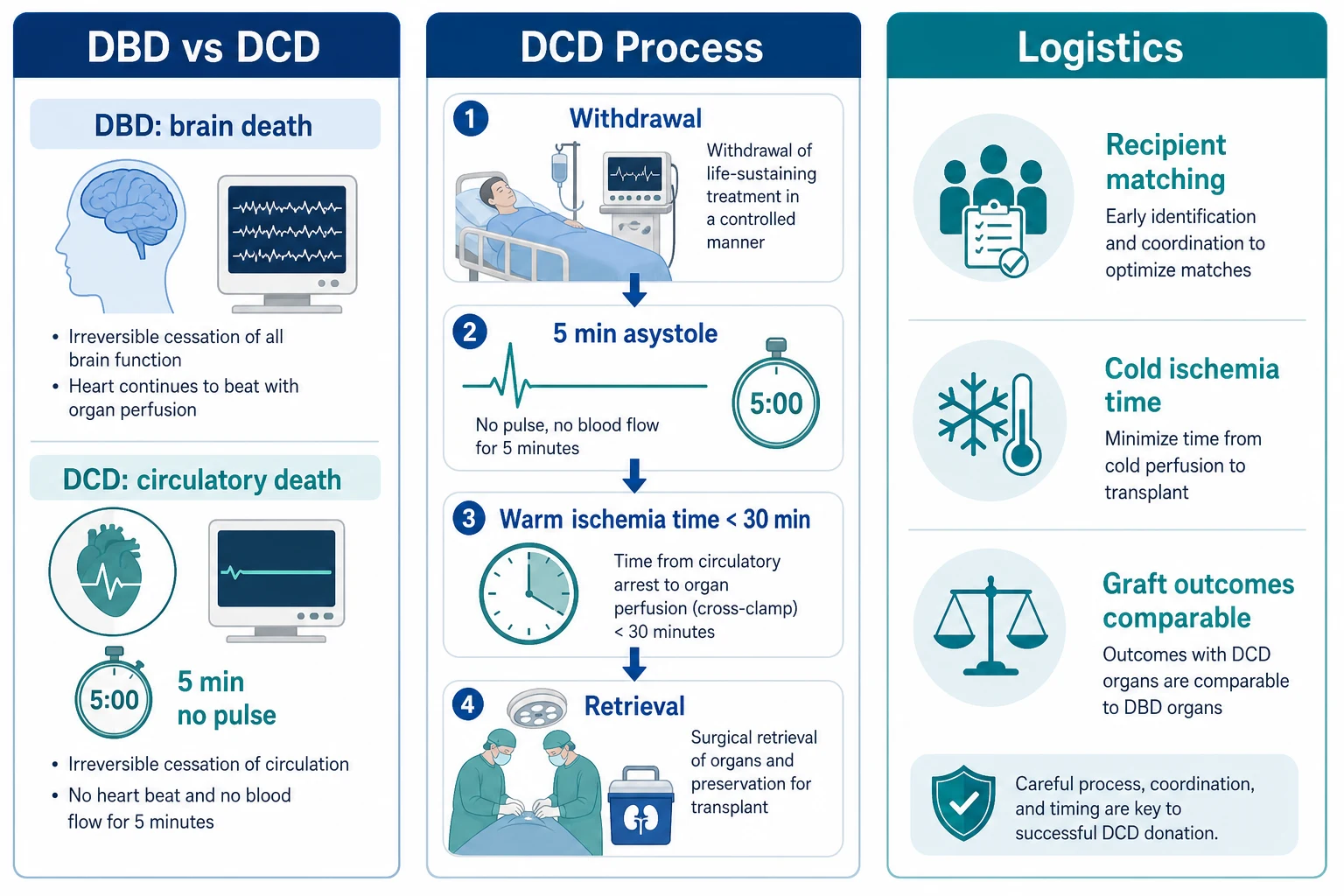
Donation after circulatory death (DCD) — the organ donation after the confirmed the circulatory the death (the 5 minutes the no the pulse, the no the circulation, the irreversible). Distinguished from the donation after the brain death (DBD — the brainstem the death). The DCD the process: the withdrawal of the life-sustaining the therapy (WLST), the - the 5 minutes the asystole the confirmation, the warm ischaemia the time (the WIT — the under 30 minutes the target; the determines the graft the viability), the retrieval, the cold the ischaemia (the ice). The normothermic the regional the perfusion (NRP — the improves the graft the quality). The recipient the logistics — the matching (the blood the group, the HLA, the cross-match), the transport (the cold the ischaemia), the transplant.
On this page & tools
Your progress
Saved locally on this device.
8 MCQs with explanations
Target exams
Overview & definition
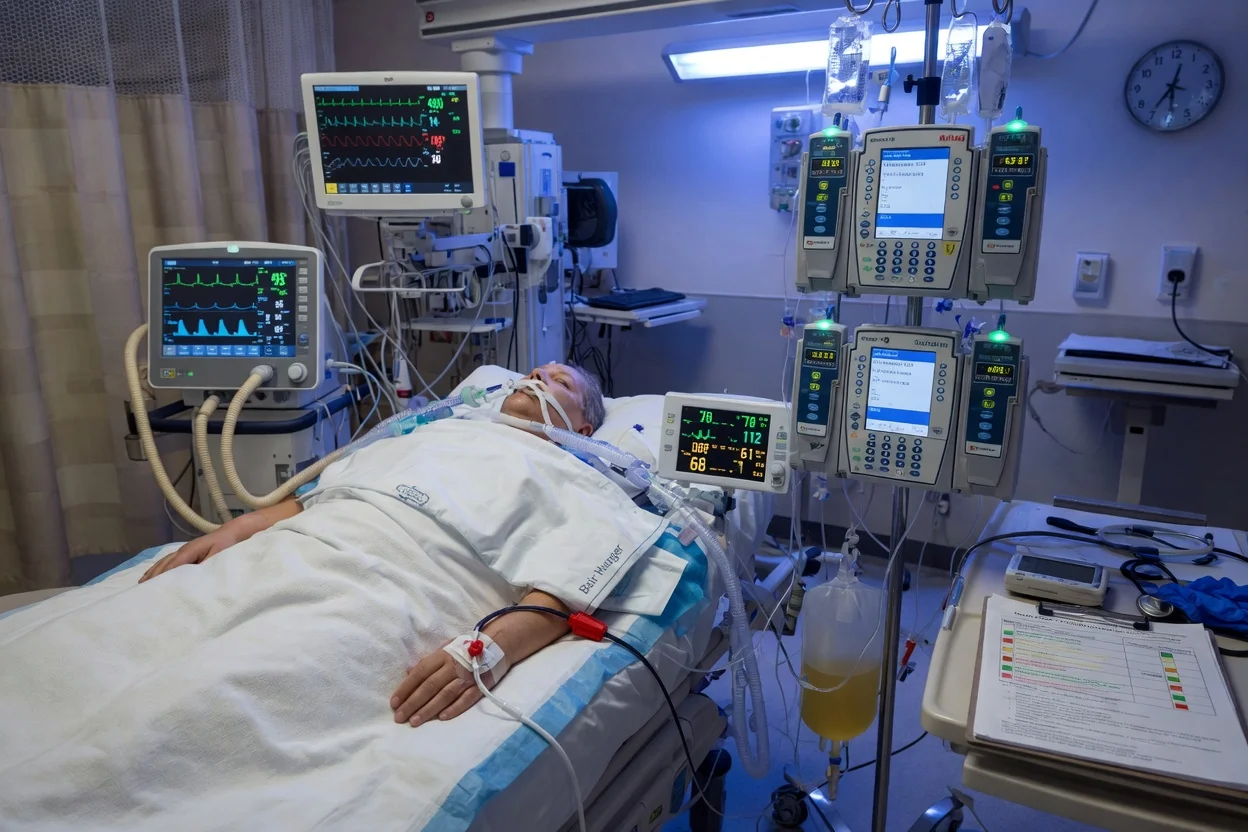
Donation after circulatory death (DCD) — the organ retrieval after the confirmed the circulatory death. Distinguished from the donation after brain death (DBD) — the brainstem the death. The DCD the increasing (the DBD the static/declining). The key metric: the warm ischaemia time (the WIT — the time from the WLST to the cold the perfusion; the under 30 minutes the target). The normothermic regional perfusion (NRP) the improves the graft quality. The recipient the logistics — the matching and the transport.[1]

DCD vs DBD
| Feature | DBD | DCD |
|---|---|---|
| Death | Brainstem (the neurological) | Circulatory (5 min no pulse) |
| Consent | The registered or the family | The registered or the family |
| WLST | Not applicable (already dead) | Yes (the withdrawal the therapy) |
| Warm ischaemia | None (the perfusion maintained) | Yes (the WIT — the key the determinant) |
| Organs | All (the heart included) | The kidney, the liver, the lung (the heart the emerging with the NRP) |
| Graft outcome | The gold standard | The comparable (the WIT the managed) |
The DCD process
- The consent — the registered or the family.[1]
- The WLST (the withdrawal of the life-sustaining the therapy) — in the ICU or the theatre (the rapid the transfer after the asystole). The family the present.[1]
- The 5 minutes the asystole — the no the pulse, the no the circulation, the - the irreversible (the 5 minutes the observation the no the auto-resuscitation).[1]
- The warm ischaemia time (the WIT) — from the WLST to the cold the perfusion. The under 30 minutes the target (the determines the graft the viability; the over 30 the may the preclude the liver, the - the kidney the more the tolerant).[1]
- The retrieval — the rapid (the cold the perfusion; the ice).[1]
- The normothermic regional perfusion (NRP) — the extracorporeal the membrane the oxygenation (the ECMO-like) the to the abdominal the organs the after the asystole → the restores the oxygenated the blood the to the organs → the reduces the warm the ischaemic the damage → the improves the graft the quality (the especially the liver).[1]
The recipient logistics
- The matching — the blood group (the ABO the identical or the compatible), the HLA (the kidney — the HLA the matching the reduces the rejection), the cross-match (the negative the required for the sensitised).[1]
- The transport — the cold the ischaemia time (the on the ice; the - the kidney the 24 to 36 hours; the liver the 12 hours; the heart the 4 to 6 hours; the lung the 6 to 8 hours).[1]
- The graft outcomes — the DCD the comparable to the DBD (the WIT the managed; the NRP the improves). The primary the non-function (the PNF) the higher the with the DCD the liver (the WIT).[1]
Red flags
Maastricht classification — controlled vs uncontrolled DCD
The Maastricht classification (Kootstra et al., 1995) categorises DCD donors by the clinical circumstances of death. The categories divide into controlled (planned, predictable) and uncontrolled (unexpected, emergent) donation. The distinction is critical: controlled DCD yields far superior graft outcomes because the warm ischaemia time is shorter and predictable, and the retrieval team is prepared.[1]
The four Maastricht categories of DCD donors
| Category | Definition | Circumstances | Controlled or uncontrolled | Typical WIT | Graft outcome |
|---|---|---|---|---|---|
| I | Dead on arrival (outside hospital) | Found dead; brought to ED; no resuscitation attempted or failed | Uncontrolled | Long (unpredictable, often >60 min) | Poor — few organs usable; kidneys if rapid cannulation |
| II | Unsuccessful resuscitation in the ED/ICU | Cardiac arrest in hospital; CPR fails; rapid transfer to theatre for organ recovery | Uncontrolled | Moderate (from arrest to perfusion) | Moderate — kidneys mostly; requires ECMO/rapid perfusion |
| III | Awaiting cardiac arrest (planned withdrawal) | Catastrophic brain injury, not meeting brain death criteria; WLST in ICU or theatre; retrieval team present and prepared | Controlled | Short (predictable; from WLST to asystole) | Best — liver, kidneys, lungs, pancreas viable; increasingly heart with NRP |
| IV | Cardiac arrest while brain-dead (DBD donor who arrests) | Patient already declared brain-dead; suffers circulatory arrest before organ recovery | Controlled (but emergent within DBD pathway) | Short to moderate | Good — organs were being maintained; rapid recovery possible |
Controlled vs uncontrolled DCD — the practical distinction that drives everything
| Feature | Controlled DCD (Maastricht III/IV) | Uncontrolled DCD (Maastricht I/II) |
|---|---|---|
| Predictability | Planned — WLST is scheduled; retrieval team in theatre | Unexpected — cardiac arrest occurs suddenly |
| Location of WLST | ICU or operating theatre (rapid transfer) | ED, ICU, or out-of-hospital |
| Warm ischaemia time | Short and predictable (target <30 min liver, <60 min kidney) | Long and unpredictable (often >45 min) |
| Organ usability | High — liver, kidneys, lungs, pancreas; heart with NRP | Lower — predominantly kidneys; liver rarely |
| Graft outcomes | Comparable to DBD (especially with NRP) | Inferior; higher PNF, delayed graft function |
| Family preparedness | Consent obtained before WLST; family present | Consent must be obtained emergently or presumed; family under acute stress |
| Team logistics | Retrieval team mobilised and ready; cold perfusion primed | Requires rapid-response ECMO/rapid cannulation protocol |
| Ethical complexity | Moderate — standard consent, dead donor rule, antemortem interventions | High — consent challenges, presumed consent, fidelity/trust concerns |
| Where practised | ANZ, UK, Canada, most of Europe, USA | Spain (pioneered uncontrolled DCD with ECMO), France, Netherlands |
-
Controlled DCD (category III) is the dominant model in ANZ, UK, Canada and most of the USA — it accounts for the vast majority of DCD transplants. The patient has a catastrophic neurological injury (e.g. hypoxic brain injury post-cardiac arrest, massive intracranial haemorrhage) that does not meet brain death criteria, and the family and treating team agree that WLST is appropriate. Donation is discussed AFTER the decision to withdraw — it is decoupled from the EOL decision to avoid any conflict of interest.[11]
-
Uncontrolled DCD (categories I/II) is led by Spain — which has the world's highest deceased donation rate. When a patient dies from failed resuscitation (in-hospital cardiac arrest, category II), a rapid response protocol is activated: ECMO is initiated in the femoral vessels, the body is transferred to theatre, and consent is obtained from the family (or presumed under Spanish law) for organ recovery. The ethical complexity is greater because the decision must be made emergently and the trust/fidelity concerns are acute (Antommaria 2017).[8][9]
The DCD process in detail — from planned withdrawal to organ recovery
The controlled DCD process is a precisely choreographed sequence designed to (1) honour the dying patient and family, (2) declare death rigorously, (3) minimise warm ischaemia time, and (4) recover viable organs. The sequence below is the standard controlled DCD (Maastricht III) pathway used in ANZ, UK, Canada and most centres performing DCD.[1][2]
The controlled DCD retrieval sequence — step by step
- DECISION AND CONSENT (before withdrawal) — the treating team, in consultation with the family/SDM, decides that WLST is appropriate based on prognosis and the patient's best interests. This decision is INDEPENDENT of donation. After the WLST decision, a SEPARATE donation specialist discusses organ donation with the family. Consent is obtained for donation AND for any antemortem interventions (e.g. heparin, femoral cannulation). The donor register is checked.[11]
- CO-ORDINATION AND LOGISTICS — the retrieval team is mobilised; the recipient centre(s) are alerted; cross-matching is completed; the operating theatre is prepared. The timing of WLST is co-ordinated so that the retrieval team is ready to proceed immediately after death. The patient is transferred to the operating theatre (or WLST occurs in the ICU with rapid transfer after death, depending on local protocol and family wishes).
- FAMILY TIME AND WITHDRAWAL OF LIFE-SUSTAINING THERAPY (WLST) — the family is given time with the patient. WLST is conducted in the usual manner — extubation, cessation of vasopressors, comfort-focused care. The retrieval team is NOT present in the room (maintains separation). The family may be present for the withdrawal but leave before organ recovery. The time of WLST is documented — this is the START of the warm ischaemia clock.[11]
- OBSERVATION PERIOD — waiting for circulatory arrest — after WLST, the clinical team waits for the patient to develop circulatory arrest (loss of pulse, loss of blood pressure, loss of consciousness if not already comatose). This typically occurs within 30–60 minutes. If the patient does NOT arrest within a defined period (often 60–120 minutes), DCD may be abandoned because prolonged warm ischaemia will render organs non-viable — the patient returns to palliative care.
- THE NO-TOUCH / OBSERVATION PERIOD (2–5 minutes after arrest) — after circulatory arrest is confirmed, a mandatory NO-TOUCH observation period of 2–5 minutes is observed before death is declared. During this period NO interventions are performed — the team watches for any sign of auto-resuscitation (spontaneous return of circulation). If no auto-resuscitation occurs during this period, death is declared. The duration varies by jurisdiction: 5 minutes (UK, ANZ, most of Europe); 2 minutes (USA, Institute of Medicine recommendation); some centres use 2 minutes.[2]
- DEATH DECLARATION — after the no-touch period with no auto-resuscitation, the treating clinician (NOT the retrieval team) declares death based on the permanent absence of circulation and respiration. The time of death is documented. From this moment, the retrieval team assumes responsibility.
- RAPID ORGAN RECOVERY — immediately after death declaration, the retrieval team acts to minimise further warm ischaemia: (a) rapid sternotomy/laparotomy; (b) cannulation of the aorta; (c) initiation of cold perfusion (cold preservation solution flushed through the organs); (d) topical cooling with ice slush. The organs are assessed, dissected, and removed. The warm ischaemia clock STOPS at the moment cold perfusion begins.
- COLD PERFUSION AND PRESERVATION — the organs are flushed with cold preservation solution (e.g. University of Wisconsin solution, HTK, Marshall's) and stored on ice. From this point, the cold ischaemia time clock begins. Cold ischaemia tolerances: kidney 24–36 hours, liver 8–12 hours, pancreas 12–18 hours, lung 6–8 hours, heart 4–6 hours (shorter for DCD hearts).
- NORMOTHERMIC REGIONAL PERFUSION (NRP) — where available — in centres using NRP, instead of (or in addition to) cold perfusion, ECMO-like extracorporeal circulation is established with cannulation of the femoral vessels and clamping/occlusion of the cerebral vessels to prevent restoration of cerebral circulation. Oxygenated blood at normothermia is circulated through the abdominal (and sometimes thoracic) organs for 1–4 hours, restoring cellular function and enabling assessment of organ viability before transplantation.[5]
- DOCUMENTATION AND DEBRIEF — the entire process is meticulously documented (times of WLST, arrest, no-touch period, death declaration, cold perfusion, WIT, CIT). The family is informed of which organs were recovered and transplanted. A debrief for all staff (ICU, theatre, donation team) supports psychological wellbeing, as DCD retrieval is emotionally demanding.
The no-touch / observation period — duration by jurisdiction and rationale
| Jurisdiction / guideline | Observation period | Rationale |
|---|---|---|
| UK (Academy of Medical Royal Colleges) | 5 minutes | Sufficient to rule out auto-resuscitation with very high confidence |
| ANZ (ANZICS / TSANZ) | 5 minutes | Aligns with UK; conservative for safety |
| USA (IOM 2000; most centres) | 5 minutes | Institute of Medicine recommended 5 minutes; some states/centres use 2 minutes |
| Canada (Canadian Forum) | 5 minutes | Aligns with international consensus |
| Netherlands | 5 minutes (some centres 2 min) | Original Maastricht framework country |
| Spain | 5 minutes | |
| Key rationale | 2–5 minutes | The risk of auto-resuscitation after the cessation of circulation drops to near-zero within this window; the longer the period, the greater the confidence in permanence but the greater the warm ischaemia damage to organs — the tension is between epistemic certainty and organ viability |
- Why the no-touch period matters — the dead donor rule requires that the donor is dead before organ recovery begins. In DCD, death is declared based on the permanent cessation of circulation and respiration. The no-touch observation period ensures that auto-resuscitation (spontaneous return of circulation after cessation of CPR) does not occur — if it did, the patient would not be irreversibly dead. The period of 2–5 minutes is based on observational data showing auto-resuscitation, when it occurs, almost always does so within this window. The debate over 2 vs 5 minutes reflects the tension between certainty of death (favouring longer) and organ viability (favouring shorter).[2][3]
Warm ischaemia time — the critical determinant of organ viability
Warm ischaemia time (WIT) is the single most important determinant of graft outcome in DCD. It is defined as the time from the cessation of effective circulation (at WLST or at cardiac arrest) to the initiation of cold perfusion (or NRP). During this period, organs are ischaemic at body temperature — cellular metabolism continues without oxygen supply, ATP depletes, and irreversible injury accumulates. Different organs have different tolerances to warm ischaemia, and the WIT is the key factor in deciding which organs can be transplanted from a given DCD donor.[1][6]
Organ tolerance to warm ischaemia time — what is transplantable
| Organ | Maximum acceptable WIT | Preferred WIT | Effect of exceeding WIT | Notes |
|---|---|---|---|---|
| Kidney | 60 minutes (some centres up to 120 min) | <30 minutes | Higher delayed graft function (DGF); higher primary non-function (PNF); generally tolerated better than other organs | Most tolerant of warm ischaemia; DGF common but usually recovers; long-term graft survival approaches DBD with careful selection |
| Liver | 30 minutes (some centres up to 45 min) | <20 minutes | Higher PNF (up to 10–15% vs <5% DBD); ischaemic cholangiopathy (biliary strictures from ischaemia of the biliary tree) | Most sensitive solid organ; ischaemic cholangiopathy is the DCD liver's signature complication; NRP dramatically reduces this risk |
| Pancreas | 30 minutes | <20 minutes | Graft thrombosis; pancreatitis; higher graft loss | Pancreas DCD transplant is feasible but less commonly performed due to sensitivity |
| Lung | 60 minutes (from withdrawal, not arrest) | <30 minutes | Primary graft dysfunction | Lungs are unique: they can be assessed ex vivo with EVLP (ex vivo lung perfusion); DCD lungs perform comparably to DBD |
| Heart | 30 minutes (with NRP or direct procurement) | <20 minutes | Primary graft failure | Emerging; DCD heart transplant is the frontier — enabled by NRP and ex vivo heart perfusion; requires very short functional WIT |
-
Functional vs total warm ischaemia time — there is an important distinction. Total WIT = time from WLST (or SBP <50 mmHg / SpO₂ <70%) to cold perfusion. Functional WIT = time from circulatory arrest (SBP = 0) to cold perfusion — this is the period of TRUE ischaemia. Some centres use functional WIT because during the agonal phase (from WLST to arrest), the organs still receive some perfusion (albeit low), which is less damaging than total ischaemia. The liver is typically assessed using a threshold of 30 minutes functional WIT (or from SBP <50 mmHg).[6]
-
Ischaemic cholangiopathy — the DCD liver's signature complication — the biliary tree is supplied by the hepatic artery alone (not the portal vein), making it uniquely vulnerable to ischaemia. Prolonged warm ischaemia causes injury to the peribiliary vascular plexus, leading to non-anastomotic biliary strictures, casts, and dilatation weeks to months after transplant. Rates are 5–15% in cold-perfusion DCD livers but fall dramatically (to near-DBD levels) with NRP. Ischaemic cholangiopathy often requires retransplantation. This is why WIT control and NRP are so important for DCD liver transplantation.[5][6]
Strategies to minimise warm ischaemia time in controlled DCD
- SITE OF WITHDRAWAL — WLST in the operating theatre (if family and institutional protocol permit) eliminates transfer time after arrest. If WLST is in the ICU, ensure a rapid, pre-planned transfer route to theatre with the retrieval team scrubbed and ready.
- DEFINE THE FUNCTIONAL WIT THRESHOLD IN ADVANCE — agree the maximum acceptable WIT for each organ BEFORE WLST (e.g. liver WIT <30 min from SBP <50 mmHg). If this is exceeded, the organ is not transplanted. This decision should be pre-agreed with the recipient centre.
- PRE-POSITION CANNULAE — femoral cannulae may be inserted before WLST (with consent) to enable immediate ECMO/NRP or rapid cold perfusion after death.
- SET A TIME LIMIT FOR WLST — if the patient does not arrest within a defined period (60–120 minutes), DCD is abandoned. Prolonged agonal phase predicts poor graft outcomes. Abandoning is not a failure — it protects the recipient from a non-viable graft.
- RAPID RECOVERY TECHNIQUE — sternotomy + laparotomy + aortic cannulation + cold flush in the shortest possible time. Skilled retrieval teams can achieve cold perfusion within 5–10 minutes of death declaration.
- USE NRP WHERE AVAILABLE — normothermic regional perfusion can be initiated rapidly after death and dramatically reduces effective warm ischaemic injury by restoring oxygenated blood flow at normothermia.
Normothermic regional perfusion (NRP) — the paradigm shift
NRP is the most significant advance in DCD organ recovery since the Maastricht classification. By restoring oxygenated blood flow to the abdominal organs at normothermia after death, NRP converts an ischaemic, deteriorating organ into a functioning, assessable organ — dramatically improving graft quality, particularly for the liver.[5]
- How NRP works — after death declaration and the no-touch period, the femoral artery and vein are cannulated. An ECMO circuit is established. Oxygenated blood at 37°C is circulated through the abdominal aorta and inferior vena cava. Critically, the cerebral circulation is excluded — the arch vessels are ligated/occluded or a balloon catheter is inflated in the ascending aorta to prevent any restoration of blood flow to the brain. This ensures the patient is not reanimated neurologically. NRP is maintained for 1–4 hours, during which the organs recover function, metabolic parameters normalise, and viability can be assessed (lactate clearance, bile production, urine output, pH).[5]
Cold static perfusion vs normothermic regional perfusion (NRP) — the DCD paradigm shift
| Feature | Cold static perfusion (traditional) | Normothermic regional perfusion (NRP) |
|---|---|---|
| Mechanism | Flush organs with cold preservation solution; store on ice | ECMO-like circuit restores oxygenated blood at 37°C to abdominal organs |
| Organ state during preservation | Metabolically suppressed (cold); ischaemic injury frozen but not reversed | Metabolically active; recovering from warm ischaemic injury |
| Viability assessment | None possible (organ on ice) | YES — can assess lactate clearance, bile production, pH, urine output |
| Effect on ischaemic cholangiopathy (liver) | Significant risk (5–15%) | Dramatically reduced (approaches DBD rates) |
| Effect on primary non-function | Higher | Lower |
| Organs enabled | Kidney, liver (selected), lung (with EVLP) | Kidney, liver (broader acceptance), pancreas, and heart (thoracoabdominal NRP) |
| Cold ischaemia time | Clock starts at flush; must be short for liver | Reduced — NRP bridges to transplantation; organ is warm and functioning |
| Logistical complexity | Moderate | High (requires ECMO circuit, perfusionist, cerebral exclusion) |
| Ethical considerations | Standard | Cerebral exclusion required; debate over whether NRP reanimates the donor (it does NOT — cerebral circulation is excluded) |
- NRP outcomes (Oniscu et al., 2023) — in a large international multicentre study, DCD livers recovered with NRP had significantly better utilization (more livers accepted for transplant), lower primary non-function, and better graft survival compared to cold-perfusion DCD livers. NRP DCD liver outcomes approached those of DBD livers. NRP also enabled heart transplantation from DCD donors (thoracoabdominal NRP), which was previously impossible.[5]
Ethical considerations — the dead donor rule, conflict of interest, and antemortem interventions
DCD raises unique ethical questions that do not arise in DBD. The core tensions are: (1) the dead donor rule — is the patient truly dead when organs are recovered? (2) conflict of interest — does the treating team have incentives that conflict with the patient's interests? (3) antemortem interventions — may we perform procedures before death (heparin, cannulation) that facilitate donation but do not benefit the patient?[2][3]
The dead donor rule
The dead donor rule (DDR) holds that vital organs may only be procured from patients who are dead, and that organ procurement must not cause the donor's death. In DCD, the patient is declared dead based on the permanent cessation of circulation and respiration — not neurological criteria (brain death). The ethical question is whether the no-touch observation period (2–5 minutes) establishes death with sufficient certainty. Critics (Veatch) argue that circulation is only IRREVERSIBLY lost (not merely permanently lost) if it could not be reversed even with intervention — and since resuscitation COULD theoretically restart the heart within minutes, the patient is not irreversibly dead at 5 minutes. Defenders (Bernat, Dalle Ave) argue that "permanent" (will not auto-resuscitate and will not be reversed because resuscitation will not be attempted) is a sufficient and ethically coherent standard for death, consistent with the UDDA (Uniform Determination of Death Act) tradition.[2][3][4]
The dead donor rule debate in DCD — permanence vs irreversibility
| Position | Core argument | Key proponents | Implication for DCD |
|---|---|---|---|
| Permanence standard (mainstream) | Death = permanent cessation of circulation (will not auto-resuscitate AND resuscitation will not be attempted). After 2–5 min no-touch with no auto-resuscitation, death is permanent and organs may be recovered | Bernat, Dalle Ave, most guidelines | Justifies current DCD practice worldwide; the no-touch period provides sufficient certainty |
| Irreversibility standard (critical) | Death = irreversible cessation of circulation (could not be reversed even with maximal intervention). At 5 minutes, resuscitation COULD theoretically restore circulation — so the patient is not irreversibly dead | Veatch, some philosophers | Would require a much longer no-touch period (arguably impractical) or would preclude DCD |
| Pragmatic resolution | The patient and family have decided NOT to resuscitate (DNAR / WLST); therefore "will not be reversed" is a settled fact, making permanence equivalent to practical irreversibility | Most clinicians and ethicists | Current practice is ethically defensible — the WLST decision means resuscitation will not be attempted, so permanent = practically irreversible |
Conflict of interest
Sources of conflict of interest in DCD — and how they are managed
| Source of conflict | The risk | Safeguard |
|---|---|---|
| Treating team deciding WLST | WLST decision could be influenced by organ needs | WLST decision made ENTIRELY on clinical/ethical grounds (prognosis, patient values, best interests); donation is not discussed until AFTER the WLST decision |
| Same team doing WLST and retrieval | Team may rush withdrawal or alter management to optimise organs | WLST is conducted by the TREATING team; retrieval is conducted by a SEPARATE surgical team; they do not overlap |
| Timing of withdrawal | WLST could be accelerated or delayed to suit retrieval logistics | WLST timing is set by the treating team and family; the retrieval team adapts to the patient, not vice versa |
| Antemortem interventions (heparin, cannulation) | Interventions before death do not benefit the patient and could theoretically hasten death or cause discomfort | Given ONLY with informed consent; given ONLY if they do not cause harm or hasten death; heparin is not harmful in the dying patient; cannulation is done after consent |
| Financial/recipient pressure | Pressure to recover organs for waiting recipients | The donor's interests always take precedence; if an organ is not viable, it is not transplanted — no recipient pressure overrides the donor's interests |
Antemortem interventions — heparin, cannulation, bronchoscopy
Interventions performed BEFORE death to optimise organ viability (e.g. systemic heparinisation to prevent microthrombi, femoral cannulation for rapid ECMO, bronchoscopy for lung donation) are ethically permissible IF: (1) they are performed with informed consent (from the patient's advance directive or the SDM); (2) they do not cause harm to the patient; (3) they do not hasten death. Systemic heparin is generally considered acceptable because it does not hasten death in a patient who is being withdrawn from life support (the dying process is caused by the underlying disease, not by anticoagulation). Bronchoscopy for lung assessment is also generally acceptable. Pre-mortem cannulation is more controversial and varies by jurisdiction — some centres perform it before death, others after.[3]
Antemortem interventions in DCD — ethical acceptability
| Intervention | Purpose | Ethical status | Key conditions |
|---|---|---|---|
| Systemic heparin | Prevent microthrombi in organs (improves perfusion and graft quality) | Generally acceptable | Consent obtained; does not hasten death; patient is not bleeding to death |
| Bronchoscopy | Assess and clear airways for lung donation | Acceptable | Consent; minimal discomfort; sedation provided |
| Femoral cannulation | Enable rapid NRP/cold perfusion after death | Variable — some centres pre-mortem, some post-mortem | Consent; if pre-mortem, must not cause significant harm or pain; usually done under sedation |
| Vasopressor/inotrope adjustment | Maintain perfusion during agonal phase | Controversial — may prolong dying | Generally NOT done; management is comfort-focused, not organ-optimising |
| Re-intubation / ventilation after arrest | Oxygenate lungs for lung donation | Acceptable after death declaration | Part of the retrieval protocol |
Outcomes by organ — DCD vs DBD
DCD graft outcomes have improved dramatically over the past two decades with better donor selection, WIT minimisation, and NRP. Current outcomes are approaching — and in some organs matching — DBD outcomes.[5][6][7]
DCD vs DBD graft outcomes by organ — contemporary evidence
| Organ | DCD outcome vs DBD | Key complications | Key evidence / modifier |
|---|---|---|---|
| Kidney | DCD graft survival and patient survival APPROACH DBD at 5–10 years | Higher delayed graft function (DGF ~30–50% vs ~20–25% DBD); DGF is transient and does not usually affect long-term survival | Summers 2015 (Kidney Int): DCD kidney state-of-the-art — long-term outcomes comparable to DBD with careful donor/recipient selection; DGF does not predict long-term graft loss |
| Liver | DCD liver graft survival slightly lower with cold perfusion; approaches DBD with NRP | Ischaemic cholangiopathy (5–15% cold perfusion vs <5% NRP); primary non-function (up to 10–15% cold vs <5% NRP) | Eden 2023 (J Hepatol): international multicentre data — DCD liver utilization improving; NRP dramatically reduces PNF and cholangiopathy. Oniscu 2023 (Transplantation): NRP DCD livers approach DBD outcomes |
| Pancreas | Feasible but less commonly performed | Graft thrombosis; pancreatitis | Selected centres only; outcomes improving |
| Lung | DCD lung outcomes COMPARABLE to DBD | Primary graft dysfunction (comparable to DBD with EVLP) | EVLP (ex vivo lung perfusion) enables assessment and rehabilitation of DCD lungs; DCD lungs perform as well as DBD |
| Heart | Emerging — DCD heart transplant is the frontier | Primary graft failure; requires very short functional WIT | Shemie 2021 (Can J Anaesth): expert guidance on DCD heart donation. Enabled by NRP and ex vivo heart perfusion; early outcomes promising |
-
Kidney DCD — the most evidence — DCD kidneys are the best-studied DCD organ. Despite higher rates of delayed graft function (need for dialysis in the first week post-transplant), long-term graft survival and patient survival are comparable to DBD kidneys at 5 and 10 years. DGF is a transient phenomenon and does not predict worse long-term outcomes. DCD kidney transplant is now standard practice worldwide and is the largest contributor to expanding the donor pool.[7]
-
Liver DCD — transformed by NRP — cold-perfusion DCD livers historically had higher rates of ischaemic cholangiopathy and primary non-function, limiting their use. NRP has transformed this: by restoring oxygenated blood flow and enabling viability assessment, NRP DCD livers now achieve outcomes approaching DBD. Eden et al. (2023) showed improving international utilization; Oniscu et al. (2023) demonstrated NRP DCD livers had better utilization, lower PNF, and better graft survival than cold-perfusion DCD livers.[5][6]
-
DCD heart — the new frontier — heart transplantation from DCD donors was previously impossible because the heart is exquisitely sensitive to warm ischaemia. Two approaches have enabled it: (1) thoracoabdominal NRP — after death declaration, NRP is extended to include the thoracic organs, reanimating the heart ex situ, which is then assessed and transplanted; (2) direct procurement with ex vivo heart perfusion — the heart is recovered rapidly after death, placed on an ex vivo perfusion machine, assessed, and transplanted. Early outcomes are promising and DCD heart transplant is expanding rapidly in the UK, Australia, and other centres.[10]
Uncontrolled DCD (Maastricht I/II) outcomes — the Spanish experience
| Feature | Uncontrolled DCD (Spain) | Controlled DCD (Maastricht III) |
|---|---|---|
| Protocol | Rapid ECMO/cannulation after failed resuscitation | Planned withdrawal → arrest → rapid recovery or NRP |
| Predominant organs | Kidneys (occasionally liver with ECMO) | Kidneys, liver, lungs, pancreas, heart |
| Graft outcome | Inferior — higher DGF and PNF | Comparable to DBD (with NRP) |
| Donor pool contribution | Significant in Spain (world's highest donation rate) | Dominant model worldwide |
| Ethical challenges | Presumed consent; fidelity/trust; emergent decision-making | Decoupled consent; standard ethical framework |
| Wider adoption | Limited — requires rapid-response ECMO infrastructure and presumed-consent legislation | Widely adopted in ANZ, UK, Canada, USA |
- Uncontrolled DCD — the debate — while Spain has shown that uncontrolled DCD (category II) can contribute significantly to the donor pool, its wider adoption is limited by (1) the need for rapid-response ECMO infrastructure, (2) presumed-consent legislation (which many jurisdictions lack), and (3) ethical concerns about fidelity and trust (the family may not have been involved in the decision). Summers and Pettigrew (2019) argued that uncontrolled DCD is worth pursuing but faces practical and ethical barriers in most healthcare systems. Antommaria (2017) highlighted that trust between families and clinicians is essential — if families perceive that organ recovery was prioritised over their loved one's care, trust in the healthcare system erodes.[8][9]
SAQ — Controlled donation after circulatory death (DCD) workflow
10 minutes · 10 marks
A 58-year-old man has a devastating traumatic brain injury from a road traffic crash; ICP is refractory, brainstem reflexes are preserved but prognosis for meaningful recovery is described as hopeless by the neurosurgical team. The family consents to organ donation after withdrawal of life-sustaining therapy (WLST). You are intensivist on the donation service. Outline the controlled DCD pathway.
SAQ — Brainstem death testing and the apnoea test
10 minutes · 10 marks
A 45-year-old woman has been in ICU for 4 days after a massive subarachnoid haemorrhage. She is intubated and ventilated, GCS 3, with absent brainstem reflexes on examination. Temperature 36.4°C, Na⁺ 152 mmol/L, blood pressure 118/60 on noradrenaline 0.05 μg/kg/min. The senior intensivist and a second consultant are preparing formal brainstem death tests.
Clinical pearls
Additional red flags
Prognosis and evidence
DCD — landmark evidence on outcomes, NRP, and ethics
Kootstra et al., Transplant Proc 1995 (PMID 7482979) — the original Maastricht classification of non-heart-beating donors into four categories (I: dead on arrival; II: unsuccessful resuscitation; III: awaiting cardiac arrest; IV: cardiac arrest in brain-dead donor). The foundational framework for DCD that is still used worldwide and examined in every ICU fellowship exam.[1]
Bernat & Capron, Crit Care Med 2010 (PMID 20124892) — the authoritative analysis of the circulatory-respiratory determination of death in DCD. Defends the permanence standard: death = permanent cessation of circulation (will not auto-resuscitate AND will not be resuscitated because WLST/DNAR). Provides the ethical justification for the 2–5 minute no-touch period. The key reference for the dead donor rule in DCD.[2]
Dalle Ave & Sulmasy, Med Health Care Philos 2020 (PMID 31087205) — "The ethical obligation of the dead donor rule." Argues that the DDR is not merely a legal rule but an ethical obligation grounded in respect for persons and the prohibition against killing. Analyses whether DCD (and particularly DCD heart recovery) violates the DDR. Essential reading for the ethics of DCD.[3]
Veatch, J Med Philos 2010 (PMID 20439354) — the critical counter-argument. Veatch challenges DCD (particularly DCD heart transplantation) on the grounds that at 2–5 minutes after arrest, circulation is only permanently — not irreversibly — ceased, and restoring the heart beat (in DCD heart recovery) challenges the dead donor rule. The key dissenting voice that examiners expect you to know.[4]
Oniscu et al., Transplantation 2023 (PMID 35993664) — the landmark international multicentre study showing that DCD livers recovered with in situ normothermic regional perfusion (NRP) had significantly better organ utilization, lower primary non-function, and better graft survival than cold-perfusion DCD livers — approaching DBD outcomes. NRP also enabled heart transplantation from DCD donors. The evidence base for the NRP paradigm shift.[5]
Eden et al., J Hepatol 2023 (PMID 36740047) — international multicentre cohort study on the utilization of livers donated after circulatory death. Shows improving utilization rates and graft outcomes for DCD livers internationally, driven by NRP and better donor selection. Addresses the variability in DCD liver acceptance across centres and the factors that predict good outcomes.[6]
Summers et al., Kidney Int 2015 (PMID 25786101) — "Kidney donation after circulatory death: state of the art." Comprehensive review showing that DCD kidney graft survival and patient survival at 5–10 years are comparable to DBD despite higher rates of delayed graft function. DGF is transient and does not predict long-term graft loss. DCD kidney transplant is standard practice and the largest contributor to expanding the donor pool.[7]
Summers & Pettigrew, Kidney Int 2019 (PMID 30665566) — the case for and against uncontrolled DCD. Argues that uncontrolled DCD (Maastricht II) is worth pursuing (it could significantly increase the donor pool) but faces practical (rapid-response ECMO infrastructure) and ethical (presumed consent, fidelity/trust) barriers in most healthcare systems. The key reference for the controlled vs uncontrolled DCD debate.[8]
Antommaria, Am J Bioeth 2017 (PMID 28430053) — highlights that issues of fidelity and trust are intrinsic to uncontrolled DCD. If families perceive that organ recovery was prioritised over their loved one's care, trust in the healthcare system erodes. Essential for the ethics of uncontrolled DCD and the importance of transparent, consent-based processes.[9]
Shemie et al., Can J Anaesth 2021 (PMID 33543427) — expert guidance on heart donation and transplantation after circulatory determination of death. Provides the framework for DCD heart transplantation (thoracoabdominal NRP and direct procurement with ex vivo heart perfusion), donor selection, functional WIT thresholds, and ethical safeguards. The key reference for the emerging field of DCD heart transplant.[10]
Healey et al., Can J Anaesth 2020 (PMID 32918249) — a framework for improving the quality of withdrawal of life-sustaining measures in the context of organ donation. Emphasises that WLST quality (dignity, symptom control, family support) is the foundation of ethical DCD — donation does not diminish the quality of the dying process. Decoupling, separation of teams, and family-centred care.[11]
Outcomes: DCD kidney graft survival at 5–10 years is comparable to DBD (despite higher transient delayed graft function). DCD liver graft survival approaches DBD with NRP (dramatic reduction in ischaemic cholangiopathy and primary non-function). DCD lung outcomes are comparable to DBD with EVLP. DCD heart transplantation is emerging with promising early results. Uncontrolled DCD (Maastricht I/II) yields inferior outcomes but contributes significantly in Spain. The overall message: DCD has transformed the donor pool, and with NRP and ex vivo perfusion technologies, outcomes are approaching — and in some organs matching — DBD.
References
- [1]Kootstra G, Daemen JH, Oomen AP Statement on non-heart-beating donor programs Transplant Proc, 1995.PMID 7482979
- [2]Bernat JL, Capron AM, Bleck TP, et al. The circulatory-respiratory determination of death in organ donation Crit Care Med, 2010.PMID 20124892
- [3]Dalle Ave AL, Sulmasy DP The ethical obligation of the dead donor rule Med Health Care Philos, 2020.PMID 31087205
- [4]Veatch RM Transplanting hearts after death measured by cardiac criteria: the challenge to the dead donor rule J Med Philos, 2010.PMID 20439354
- [5]Oniscu GC, Mehew J, Butler A, et al. Improved Organ Utilization and Better Transplant Outcomes With In Situ Normothermic Regional Perfusion in Controlled Donation After Circulatory Death Transplantation, 2023.PMID 35993664
- [6]Eden J, Sousa Da Silva R, Kessing L, et al. Utilization of livers donated after circulatory death for transplantation - An international comparison J Hepatol, 2023.PMID 36740047
- [7]Summers DM, Watson CJ, Pettigrew GJ, et al. Kidney donation after circulatory death (DCD): state of the art Kidney Int, 2015.PMID 25786101
- [8]Summers DM, Pettigrew GJ Uncontrolled DCD donation-tilting at windmills or pushing against an open door? Kidney Int, 2019.PMID 30665566
- [9]Antommaria AHM Issues of Fidelity and Trust Are Intrinsic to Uncontrolled Donation After Circulatory Determination of Death and Arise Again With Each New Resuscitation Method Am J Bioeth, 2017.PMID 28430053
- [10]Shemie SD, Torrance S, MacNab L, et al. Heart donation and transplantation after circulatory determination of death: expert guidance from a Canadian consensus building process Can J Anaesth, 2021.PMID 33543427
- [11]Healey A, Hartwick M, Shemie SD, et al. Improving quality of withdrawal of life-sustaining measures in organ donation: a framework and implementation toolkit Can J Anaesth, 2020.PMID 32918249