Paeds · child-safety-and-social-paediatrics
Caregiver-fabricated or induced illness
Also known as Fabricated or induced illness · FII · Munchausen syndrome by proxy · Medical child abuse · Illness induction syndrome · Paediatric condition falsification
Fellowship guide to caregiver-fabricated or induced illness (FII): the modern child-centred definition that replaced Munchausen syndrome by proxy, the three caregiver behaviours of fabrication falsification and induction, the three mechanisms of harm through direct injury iatrogenic burden and developmental distortion, the RCPCH alerting features, the separation from perplexing presentations and genuine rare disease, the multi-agency safeguarding response that never confronts the suspected caregiver alone, and a closed-loop long-term plan with sibling protection across ANZ UK US and Canada.
On this page & tools
Your progress
Saved locally on this device.
Practise this topic
Target exams
Red flags
Life stages
Care settings
Clinical exam formats
Board mappings
Overview & Definition
A two-year-old is admitted for the fourth time this year with unexplained apnoea that nobody on the ward has witnessed, and his mother — calm, knowledgeable, and sleeping by his side — is pressing for a central line. The question an examiner wants you to hold is not "what rare disease does this child have?" but "is the caregiver's behaviour harming this child?" That question is the doorway into fabricated or induced illness, one of the most dangerous and most missed forms of child abuse. [1] [3]
The working definition is child-centred, not perpetrator-centred: FII is a situation in which a child is, or is very likely to be, harmed because of a caregiver's behaviour and actions directed towards fulfilling the caregiver's own needs. The harm may flow from direct induction, from the medical response to a fabricated story, or from the psychological and developmental consequences of the enforced sick role. What makes it abuse is the harm to the child, not the label or the motivation of the adult. [6] [1]
The terminology has evolved precisely because the old label failed children. "Munchausen syndrome by proxy" centred on the perpetrator's psychopathology and asked clinicians to diagnose a mental disorder in the parent; "fabricated or induced illness" and the AAP's "medical child abuse" centre on the child's welfare and ask only whether the caregiver's behaviour is causing harm. Glaser's reframing — from "Munchausen by proxy" to child and family-oriented action — is the conceptual hinge a fellowship candidate must defend. [6] [2]
This leaf owns the recognition, multi-agency assessment, and safeguarding-led management of FII. The overarching maltreatment framework lives on the child-maltreatment leaf, jurisdictional reporting on the mandatory-reporting leaf, the uncertainty-before-suspicion work on the perplexing-presentations leaf, and the mechanism of inflicted physical injury on the abusive-head-trauma and inflicted-burns leaves. [1] [2]
Classification
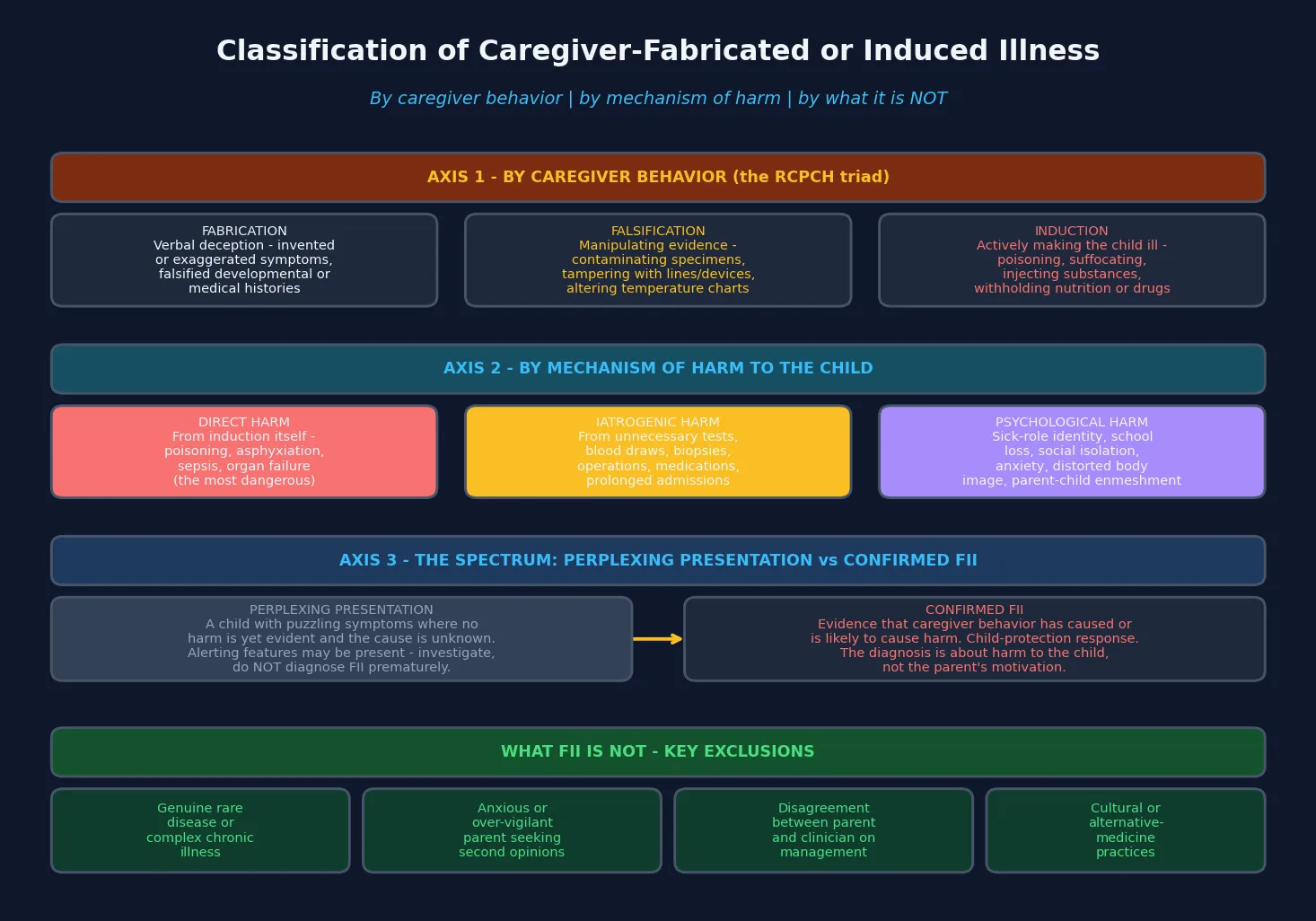
Classify every suspected case along three axes before you name the plan: which caregiver behaviour is operating, which mechanism is harming the child, and what it is not. The same bizarre story means something different in a child with a proven metabolic disease than in a previously well toddler whose mother is seeking a feeding tube. [1] [6]
By caregiver behaviour
| Behaviour | What the caregiver does | Presenting clue |
|---|---|---|
| Fabrication | Invents or exaggerates symptoms; gives false histories; falsifies developmental or medical records | Symptoms reported but never witnessed; incongruent histories across clinicians |
| Falsification | Manipulates evidence: contaminates specimens, tampers with lines and devices, alters temperature or symptom charts | Contaminated blood cultures; tampered central lines; chart entries that do not match witnessed observations |
| Induction | Actively makes the child ill: poisoning, suffocating, injecting substances, withholding nutrition or medication | Unexplained hypernatraemia, hypoglycaemia, recurrent apnoea, or sepsis that resolves with separation |
Perplexing presentation versus confirmed FII
- Puzzling symptoms where the cause is unknown
- No harm yet evident to the child
- Alerting features may be present
- Investigate and hold the uncertainty — do NOT diagnose FII prematurely
- Evidence that caregiver behaviour has caused or is likely to cause harm
- Child-protection response required
- The diagnosis is about harm to the child, not the parent's motivation
- Convene a strategy meeting and separate for observation
By mechanism of harm and by what it is not
The mechanism of harm is rarely a single channel. Direct injury from induction causes the acute collapse — poisoning, asphyxia, sepsis. Iatrogenic injury from unnecessary investigations and treatments accumulates over months of blood draws, anaesthetics, and operations driven by the fabricated story. Psychological and developmental harm distorts the child's identity, schooling, and relationships. The exclusions examiners probe are a genuine rare or complex disease, an anxious or over-vigilant parent seeking second opinions, a clinician-parent disagreement about management, and a cultural or alternative-medicine practice — each of which changes the response from child protection to subspecialty referral or family support. [1] [6]
Epidemiology & Risk Factors
FII is uncommon relative to other forms of maltreatment, yet it carries a high morbidity and mortality, and induction through suffocation and poisoning is the most dangerous subtype. Rosenberg's 1987 "Web of deceit" literature review established the clinical syndrome, and Gray and Bentovim's 1996 Great Ormond Street series of 41 children from 37 families defined the illness-induction pattern that remains the prototype today. [3] [8]
Who harms, and who is harmed? The suspected perpetrator is most often the mother, who frequently has healthcare knowledge or training, appears devoted and attentive at the bedside, and may herself carry somatisation, factitious disorder, personality disorder, or depression — the Bass and Jones 2011 case series and the Yates and Bass 2017 systematic review of 796 cases are the named perpetrator evidence. The child at greatest risk is the one whose symptoms are easy to manipulate: infants who cannot disclose, children with genuine complex medical needs, and those with feeding tubes or indwelling lines. [4] [5]
Risk concentrates where caregiver capacity is overwhelmed by unresolved loss, trauma, or social isolation, and where the child's complexity provides cover for fabrication. Protective forces are the same as for all safeguarding: a functioning multi-agency network that holds the longitudinal record across hospitals, an alert clinician who notices the gap between reported and witnessed signs early, and a medical home that prevents the fragmentation FII exploits. [1] [9]
Pathophysiology
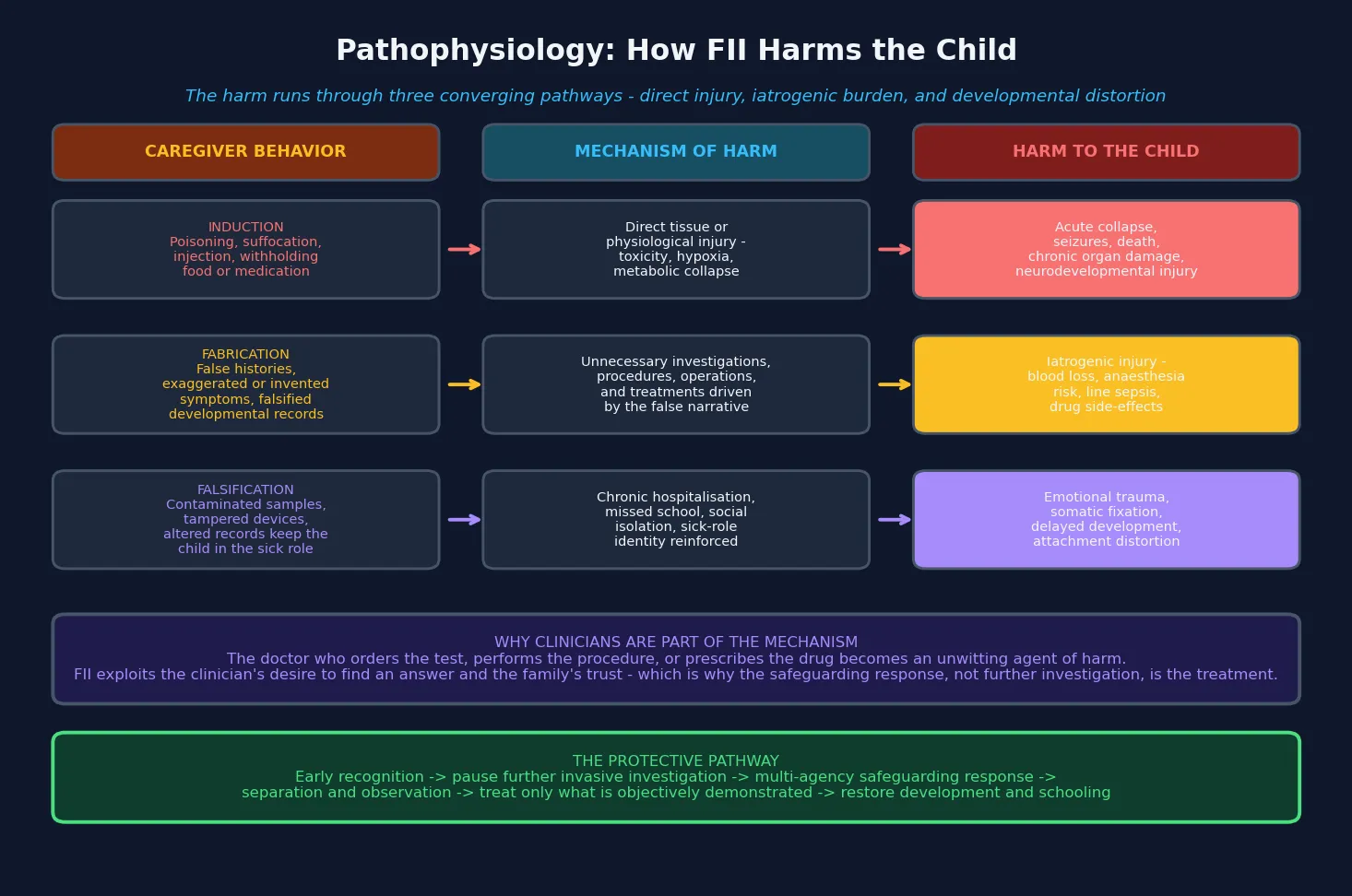
FII harms the child through three converging pathways, and the clinician who does not understand all three will underestimate the injury. Direct harm flows from the induction itself — salt poisoning produces hypernatraemic brain injury, suffocation produces hypoxic-ischaemic injury, insulin administration produces hypoglycaemic brain injury, and withholding food produces faltering growth. [1] [8]
The second pathway is the one that surprises candidates: iatrogenic harm from the medical response. The doctor who orders the test, performs the operation, or prescribes the drug becomes an unwitting agent of the abuse, because the unnecessary intervention is driven by the caregiver's false narrative. This is why Bass and Glaser insist that the safeguarding response — not further investigation — is the treatment: every additional invasive test ordered in pursuit of a fabricated symptom is itself a mechanism of harm. [1] [9]
The third pathway is psychological and developmental. The child who has been kept in the sick role for months or years loses schooling, social development, and a coherent sense of self; some older children internalise the fabricated illness so deeply that they resist separation or perpetuate the symptoms themselves — a recognised consequence of chronic abuse, not a sign that the diagnosis was wrong. The hopeful corollary is that iatrogenic and developmental harm may be partially reversible once the fabricated narrative is stopped and the child returns to normal function. [6] [7]
Clinical Presentation
A caregiver rarely leads with "I am harming my child." They bring a child with a dramatic, unexplained, or bizarre illness, and they are often the most engaged, knowledgeable, and cooperative parent on the ward. The pattern that should alert you is the gap between what is reported and what is witnessed. [1] [10]
The RCPCH alerting features are the framework to hold. Symptoms and signs that are reported by the caregiver but not observed by staff, that resolve when the caregiver is absent, that do not fit any recognised disease pattern, that are bizarre or incongruent, and that are associated with an inexplicably poor response to standard treatment — each of these is a signal, and several together are a pattern. Add the caregiver who is unusually willing to consent to invasive investigations, who moves between hospitals or clinicians, and whose documented objective findings are consistently normal between their reports. [11] [1]
The child may present through any system: apnoea or seizures from induction by suffocation or poisoning, faltering growth from withholding food, unexplained electrolyte disturbance from salt or insulin, recurrent sepsis from contaminated lines, or a bizarre multisystem illness that defies diagnosis across subspecialties. The ENT-setting systematic review of Rees and colleagues is the named evidence that FII presents through every specialty and that specialty teams must hold safeguarding vigilance. Always look beyond the index presentation, because the child may already carry accumulated iatrogenic harm. [10] [2]
Differential Diagnosis
Build the differential in layers: the things FII is not, the things that mimic its signs, and the coexisting genuine disease that travels with it. The single most examined distinction is FII versus a genuine rare disease, and getting it wrong in either direction harms the child. [1] [6]
| Pattern | Favours | Against / distinguish |
|---|---|---|
| Invented symptoms, objective findings normal | FII (fabrication) | Anxious parent exaggerates but symptoms are real when witnessed |
| Unexplained hypernatraemia, hypoglycaemia, recurrent sepsis | FII (induction or falsification) | Genuine metabolic, endocrine, or immunological disease — exclude with subspecialty review |
| Bizarre multisystem illness defying diagnosis | FII or perplexing presentation | Rare metabolic, mitochondrial, or autoimmune disease — never close without expert opinion |
| Over-vigilant parent seeking many opinions | Anxious parent, not FII | FII requires evidence of harm, not just parental distress |
The two mirror-image errors examiners love are labelling a genuinely ill child as FII — which stops the investigation of a treatable disease and devastates the family — and chasing a fabricated symptom through yet another subspecialty because the story is so compelling. When the objective findings and the caregiver's reports tell different stories, return to the multi-agency record review, involve the designated safeguarding lead, and hold the uncertainty of a perplexing presentation before concluding. FII and genuine disease can coexist in the same child, which makes the assessment harder, not easier. [7] [9]
Clinical & Bedside Assessment
The assessment is led by the paediatrician with the designated safeguarding lead from the moment FII is suspected, and it is multi-agency from the first step. A single clinician working alone is the classic error that endangers the child and compromises the case — the record review, the observation plan, and the confrontation must each be coordinated. [1] [11]
FII-informed assessment sequence
Escalate to the safeguarding lead
The moment FII is suspected, involve the designated safeguarding lead; never investigate alone or in isolation.
Document the gap precisely
Record what is objectively observed by staff versus what is only reported by the caregiver — contemporaneously, factually, and without accusation.
Review the entire record cross-setting
Obtain every hospital, GP, specialist, pharmacy, and school record; FII exploits fragmentation, and the pattern emerges only when the records are brought together.
Assess present versus absent
Compare the child's presentation when the suspected caregiver is present versus absent; consider admission for observation and separation.
Examine and assess siblings
Siblings are at elevated risk and may already be harmed; assess them as part of the initial response, not as an afterthought.
Formulate and plan the strategy meeting
Decide whether this is a perplexing presentation or confirmed FII; plan separation, observation, or forensic testing with the multi-agency team.
Examine the child head to toe and plot growth, but the core assessment here is documentary rather than physical. The most important investigation is the cross-hospital record review that surfaces the pattern a single admission cannot show. Document precisely, factually, and without accusation, because the contemporaneous record of the gap between reported and witnessed signs is the evidence on which the safeguarding response and any subsequent legal action will rest. [6] [2]
Assess siblings kindly but directly, because harm to siblings is well documented and may be occurring concurrently. An infant sibling of a child with suspected induction by suffocation is at immediate risk, and the sibling assessment is mandatory, not optional, once FII is suspected in the index child. [2] [5]
Investigations
FII is a diagnosis of safeguarding pattern, not of a single laboratory test, and the commonest investigation error is the shotgun panel ordered for a fabricated symptom — which deepens the iatrogenic harm and delays the safeguarding response. Once the pattern is recognised, pause non-essential investigation. [1] [6]
Investigate only what is objectively demonstrated or clinically necessary. Treat the genuine, staff-witnessed finding on its own merits, and keep the child safe rather than pursuing the caregiver's reported symptom. This is counterintuitive for clinicians trained to chase every lead, and it is exactly why the safeguarding lead must be involved before the next test is ordered. [1] [7]
When induction is suspected, targeted forensic specimens may be needed — blood for electrolytes, glucose, insulin, C-peptide, toxicology, and drug levels — collected with a strict chain of custody, split samples, and documented handling. The results may be needed for both clinical and legal purposes, and a break in the chain of custody can destroy a case. The most important investigation remains the multi-agency information-gathering: cross-hospital record review, pharmacy dispensing data, and school attendance, gathered under safeguarding authority. [1] [11]
Management — Resuscitation
"Resuscitation" in FII means immediate safety, medical stabilisation, and the end of any present danger — and the first principle is to stop the harm you are causing. If the child is acutely unwell from induction, resuscitate and stabilise as for any critically ill child, while ensuring the suspected caregiver does not have unsupervised access. [1] [8]
Make a same-day safety plan: who supervises the child now, where they stay, who has access, and how the ward staff are briefed. If induction is suspected and the child cannot be kept safe on the ward, an emergency-protection order or police protection may be required without delay. Recognise that no medication resuscitates FII — safety, separation, and the stopping of iatrogenic harm are the resuscitation. [1] [2]
Management — Definitive & Stepwise
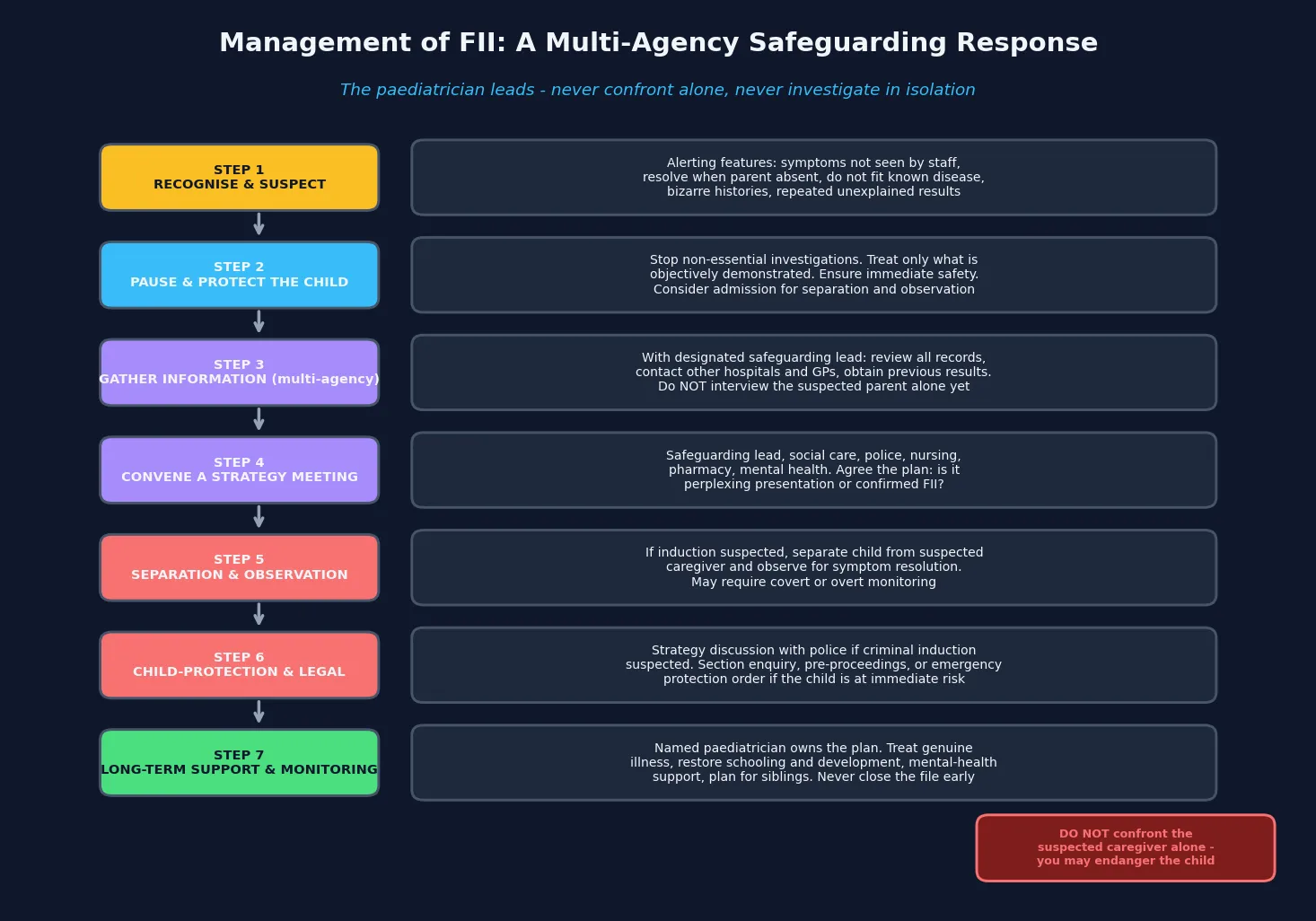
Stepped, multi-agency safeguarding care is the frame, and the order matters: recognise, pause and protect, gather information, convene a strategy meeting, separate and observe, engage child protection and legal, then support long-term. The paediatrician leads throughout, but never alone. [1] [6]
Step 1 — Recognise and suspect
Identify the alerting features, document the gap between reported and witnessed signs, and escalate to the designated safeguarding lead immediately. The recognition is clinical and documentary, and the moment of suspicion is the moment to involve the safeguarding lead, not the moment to order another test. [11] [1]
Step 2 — Pause and protect
Stop non-essential investigations, treat only what is objectively demonstrated, and admit the child for separation and observation if induction is a concern. Ending the iatrogenic harm is itself treatment, because every unnecessary test driven by the fabricated narrative is a mechanism of abuse. [1] [9]
Step 3 — Gather information multi-agency
Review all records across hospitals, GPs, pharmacy, and school; contact other clinicians the child has seen; and never interview the suspected caregiver alone before the strategy meeting. The pattern emerges only when the fragmented records are brought together, and FII exploits fragmentation by design. [6] [11]
Step 4 — Convene a strategy meeting
Bring the safeguarding lead, social care, police, nursing, pharmacy, and mental health to one table. Decide whether this is a perplexing presentation or confirmed FII, and plan any separation, observation, or forensic testing. The strategy meeting is where the safeguarding response is owned and coordinated. [1] [11]
Step 5 — Separation and observation
If induction is suspected, separate the child from the suspected caregiver and observe for symptom resolution. Monitoring may be overt or, in rare and tightly governed circumstances with police involvement, covert — the principle is that separation with resolution of symptoms is both diagnostic and protective. [1] [8]
Step 6 — Child-protection and legal
Engage social care and police if criminal induction is suspected, and consider a section enquiry, pre-proceedings, or an emergency-protection order if the child is at immediate risk. The paediatrician's role is recognition and the medical assessment of harm — forensic criminal investigation belongs to the police and child-protection agencies. [2] [6]
Step 7 — Long-term support and monitoring
The named paediatrician owns the plan: treat any genuine illness, restore schooling and development, provide mental-health support, assess and protect siblings, and never close the file early. Recurrence and harm to siblings are well documented, so a single intervention that closes the file fails the child. [1] [5]
Specific Subtypes & Scenarios
Induction by poisoning (salt, insulin, medications). The most dangerous subtype; presents with hypernatraemia, hypoglycaemia, or unexplained drug toxicity; requires forensic sampling with chain of custody and immediate police and child-protection involvement. [1] [8]
Induction by suffocation. Presents with recurrent apnoea, apparent life-threatening events, or seizures that resolve when the caregiver is absent; historically detected through covert video surveillance and carrying a high mortality if missed. [8] [9]
Fabrication with iatrogenic harm. The child accumulates unnecessary investigations, blood draws, anaesthetics, and treatments driven by the caregiver's false narrative — the harm is done by the medical system, and the treatment is to stop the harm and start the safeguarding response. [1] [9]
Falsification of specimens and devices. Contaminated blood cultures, tampered central lines, and altered temperature or symptom charts; the pattern emerges from meticulous cross-checking of laboratory and device data against witnessed observations. [6] [11]
The child with a genuine complex illness who is also being fabricated upon. The most challenging scenario — treat the real disease on its merits while addressing the fabricated overlay, because FII and genuine disease can coexist, and the child is harmed by both. [1] [7]
Older child who has internalised or colludes with the fabricated illness. A recognised consequence of chronic FII; the child may resist separation or perpetuate symptoms, and long-term psychological and developmental support is essential and may extend well beyond removal. [6] [4]
Child with a feeding tube or indwelling line. More vulnerable because the device is easy to manipulate and the baseline complexity masks fabrication; treat the genuine need while maintaining safeguarding vigilance and reviewing device and pharmacy records. [1] [10]
Complications & Pitfalls
- Missing a genuine rare disease by prematurely labelling the child as FII — devastating for the child and family; always seek subspecialty opinion. [1] [7]
- Confronting the suspected caregiver alone or prematurely — may trigger escalation, flight, evidence destruction, or further harm to the child. [1] [11]
- Continuing to investigate the fabricated symptom — deepens iatrogenic harm; the treatment is to pause the investigation. [1] [6]
- Failing to assess and protect siblings — siblings are at elevated risk and may already be harmed. [2] [5]
- Closing the file too early — recurrence and harm to siblings are well documented; the named paediatrician owns a long-term plan. [1] [5]
- Accepting the caregiver's calm, cooperative, and knowledgeable demeanour as reassurance — it is the typical presentation, not evidence against FII. [4] [9]
Prognosis & Disposition
Morbidity and mortality in FII are substantial, with induction through suffocation and poisoning carrying the highest risk of death or permanent neurodevelopmental injury. The outcome depends on early recognition and a swift, coordinated safeguarding response — every day of delay is a day of ongoing direct or iatrogenic harm. [1] [8]
Iatrogenic and developmental harm may be partially reversible once the fabricated narrative is stopped and the child returns to normal schooling and social function. Some children carry permanent physical sequelae from induction or unnecessary procedures, and many carry long-term psychological consequences from the enforced sick role and the disruption of separation. [6] [7]
Disposition after safety confirmed: a named paediatrician owns a long-term plan of developmental monitoring, mental-health support, genuine-illness treatment, sibling protection, and scheduled re-evaluation; never a single intervention. [1] [6] Disposition when induction is suspected: the acute safeguarding pathway with separation, observation, forensic sampling, and police and child-protection involvement before any routine work; the child's immediate safety is the non-negotiable priority. [1] [8]
Markers of response are the resolution of fabricated symptoms with separation, the cessation of unnecessary investigations, the child's return to schooling and social function, and the safety of siblings — because FII is measured in the child's recovery and the family's long-term safety, not in a single discharge. [6] [5]
Special Populations
Children with complex chronic illness, feeding tubes, or indwelling lines are the most vulnerable group, because their symptoms are easy to manipulate and their baseline complexity masks fabrication. Treat the genuine disease on its merits while maintaining safeguarding vigilance, because FII and genuine disease coexist in this group more than in any other. [1] [10]
Infants and pre-verbal children cannot disclose; they present entirely through the caregiver's report, so the gap between reported and witnessed signs is the only clinical signal, and a low threshold for admission, separation, and observation is justified. Children in out-of-home care who previously experienced FII carry accumulated developmental and psychological morbidity from the enforced sick role and need a comprehensive health assessment that addresses the legacy. [6] [8]
Adolescents may have internalised the fabricated illness, collude with the caregiver, or resist separation; long-term mental-health and identity-support work is essential and may extend beyond removal. Siblings of the index child are at elevated risk and must be assessed as part of the initial response, not as an afterthought, because harm to siblings may be occurring concurrently and is well documented. [2] [5]
Rural and remote families should be offered telehealth-linked multi-agency coordination rather than told to wait, because FII exploits fragmented care and distance is a barrier to the cross-hospital record review that surfaces the pattern. Families living in socioeconomic hardship need a response that distinguishes the deprivation of displacement from genuine fabrication, and the safeguarding assessment must never confuse an overwhelmed family with a fabricating caregiver. [1] [11]
Evidence, Guidelines & Regional Differences
Key evidence anchors for exam defence: [1] [6]
- Rosenberg 1987 Child Abuse Negl — "Web of deceit," the foundational literature review that established the clinical syndrome of Munchausen syndrome by proxy. [3]
- Gray and Bentovim 1996 Child Abuse Negl — the Great Ormond Street series of 41 children from 37 families that defined the illness-induction pattern. [8]
- Sheridan 2003 Child Abuse Negl — "The deceit continues," the updated literature review that traced the field's evolution. [12]
- Bass and Jones 2011 Br J Psychiatry — the psychopathology case series of perpetrators; the named perpetrator evidence. [4]
- Flaherty and Macmillan 2013 Pediatrics — the AAP clinical report defining caregiver-fabricated illness as a manifestation of child maltreatment. [2]
- Bass and Glaser 2014 Lancet — the modern evidence anchor for early recognition and management; the single most cited review. [1]
- Yates and Bass 2017 Child Abuse Negl — the systematic review of 796 perpetrator cases; the largest perpetrator dataset. [5]
- Glaser and Davis 2019 Arch Dis Child — the perplexing-presentation spectrum and management framework. [7]
- Glaser 2020 Child Abuse Negl — the child-centred reframing from "Munchausen by proxy" to child and family-oriented action; the conceptual hinge. [6]
- Wear and Li 2022 Arch Dis Child Educ Pract Ed — the guideline review of the RCPCH 2021 perplexing presentations and FII guidance. [11]
Child protection legislation in every Australian state and territory (New Zealand has no mandatory reporting duty for health professionals — reporting is voluntary with good-faith protection) makes paediatricians mandatory reporters, and the threshold is a reasonable belief that a child has suffered or is at risk of significant harm — FII meets that threshold once the alerting features and the gap between reported and witnessed signs are documented. Multi-agency coordination through the state or territory child-protection authority and police is the pathway when induction is suspected, and Aboriginal Community Controlled Health Services and culturally safe pathways are central for Aboriginal and Torres Strait Islander and Māori children. [1] [2]
Controversies: covert video surveillance is effective for detection but ethically and legally fraught; the terminology shift and its forensic implications are debated; and the balance between investigating a genuine rare disease and recognising FII without harming either child or family remains the hardest clinical judgement in the field. [1] [7]
Exam Pearls
INDUCED
- The child-centred shift from "Munchausen syndrome by proxy" to "fabricated or induced illness" is the single most testable concept. [6] [1]
- The three caregiver behaviours are fabrication, falsification, and induction; the three mechanisms of harm are direct, iatrogenic, and psychological. [6] [11]
- The clinician is part of the mechanism of harm — every unnecessary test ordered in pursuit of a fabricated symptom is itself abuse. [1] [9]
- The core clinical finding is the gap between symptoms reported by the caregiver and signs witnessed by staff. [1] [10]
References
- [1]Bass C, Glaser D Early recognition and management of fabricated or induced illness in children Lancet, 2014.PMID 24612863
- [2]Flaherty EG, Macmillan HL, Committee on Child Abuse and Neglect Caregiver-fabricated illness in a child: a manifestation of child maltreatment Pediatrics, 2013.PMID 23979088
- [3]Rosenberg DA Web of deceit: a literature review of Munchausen syndrome by proxy Child Abuse Negl, 1987.PMID 3322516
- [4]Bass C, Jones D Psychopathology of perpetrators of fabricated or induced illness in children: case series Br J Psychiatry, 2011.PMID 21804147
- [5]Yates G, Bass C The perpetrators of medical child abuse (Munchausen Syndrome by Proxy) - A systematic review of 796 cases Child Abuse Negl, 2017.PMID 28750264
- [6]Glaser D Fabricated or induced illness: From Munchausen by proxy to child and family-oriented action Child Abuse Negl, 2020.PMID 32805620
- [7]Glaser D, Davis P For debate: Forty years of fabricated or induced illness (FII): where next for paediatricians? Paper 2: Management of perplexing presentations including FII Arch Dis Child, 2019.PMID 29618483
- [8]Gray J, Bentovim A Illness induction syndrome: paper I--a series of 41 children from 37 families identified at The Great Ormond Street Hospital for Children NHS Trust Child Abuse Negl, 1996.PMID 8866113
- [9]Feldman MD, Light MJ, Lasher LJ, Sheridan MS Beyond Munchausen syndrome by proxy Pediatrics, 2007.PMID 17974755
- [10]Rees P, Al-Hussaini A, Maguire S Child abuse and fabricated or induced illness in the ENT setting: a systematic review Clin Otolaryngol, 2017.PMID 27148702
- [11]Wear KR, Li S Guideline review: RCPCH perplexing presentations, fabricated or induced illness in children guidance 2021 Arch Dis Child Educ Pract Ed, 2022.PMID 34728544
- [12]Sheridan MS The deceit continues: an updated literature review of Munchausen Syndrome by Proxy Child Abuse Negl, 2003.PMID 12686328