Paeds · clinical-assessment-and-reasoning
Failure to thrive and faltering growth: diagnostic approach
Also known as Failure to thrive · FTT · Faltering growth · Weight faltering · Growth faltering
Fellowship diagnostic approach to paediatric failure to thrive and faltering growth: confirm measurements, mechanism-based differential, threat-first stabilisation, nutrition and safeguarding plans, and exam-ready communication.
On this page & tools
Your progress
Saved locally on this device.
Practise this topic
Target exams
Red flags
Life stages
Care settings
Clinical exam formats
Board mappings
You will hear two labels. Failure to thrive (FTT) is still common in US and older exam stems. Faltering growth is the preferred UK NICE language. They describe the same clinical problem: a child whose weight gain, and sometimes length or overall growth, is not following an expected trajectory. Neither label is a final diagnosis. Both are a prompt to find mechanism and threat. [1] [3] [5]
Measurement technique, chart choice and z-score maths live on the sister page Growth measurement, charting and interpretation. This page assumes you can re-measure and re-plot. It focuses on what the plot means and what you do next. [10] [11]
C.A.L.O.R.I.E.
Overview & Definition
A caregiver brings a nine-month-old because “clothes are still huge” and the health visitor is worried. The weight sits on the 2nd centile. That single point is not yet a diagnosis. You need prior points, correct age on the chart, and a sense of velocity. A child who has always tracked the 2nd centile with a healthy feed and exam is different from a child who fell from the 50th to the 2nd over three months. [1] [4] [5]
Olsen’s review makes the uncomfortable point clearly: FTT has never had one universal definition. Clinics use weight-for-age cut-offs, weight-for-length or BMI thresholds, and downward centile crossing. Different rules catch different children. In practice, fellowship answers should name the pattern you see, not hide behind a single magic percentile. [5]
NICE-aligned teaching uses faltering growth for children whose weight gain is slower than expected. Practical primary-care guides still use FTT for the same clinical task: recognise inadequate growth, find cause, support nutrition, and protect the child. [1] [2] [3]
Classification
Think in two layers at once: severity and mechanism. [1] [7]
Severity answers: how urgent is today? A stable toddler with mild centile drift needs a structured outpatient plan. An infant with severe wasting, reduced interaction, hypothermia or dehydration is an acute care problem first. WHO severe acute malnutrition language is a severity framework used in many global and hospital contexts; clinic FTT language is broader and includes milder community presentations. Do not force every mild faltering child into a SAM protocol, and do not under-call true medical risk. [1] [4] [10]
Mechanism answers: why is energy balance wrong? The four common buckets are inadequate intake (not enough calories or protein reaching the gut), increased losses (vomiting, diarrhoea, malabsorption), increased needs (cardiac, respiratory, infection, inflammation), and ineffective utilisation (endocrine, metabolic, chronic inflammation). [1] [2] [7] Most community cases involve inadequate intake, often mixed with social strain. Organic disease is less common but must not be missed when red flags appear. [1] [2] [7]
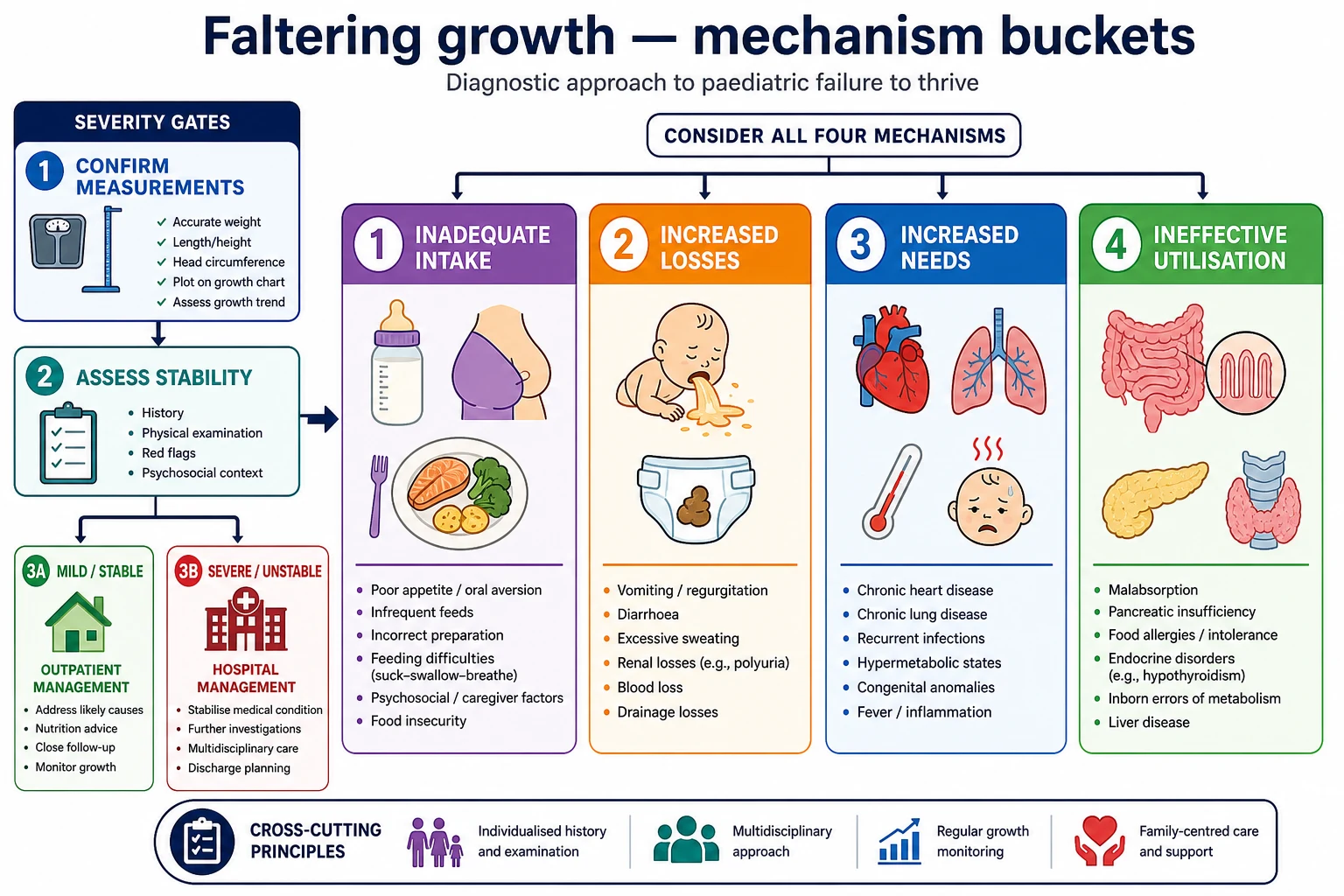
Older teaching split “organic” versus “non-organic” FTT. That split is too blunt for exams now. Many children have mixed contributors. Prefer mechanism language plus social context. [1] [7] [8]
Epidemiology & Risk Factors
Weight faltering is common enough that every general paediatrician will manage it repeatedly. Peak concern sits in infancy and early childhood, when growth is fastest and feeding is fully dependent on caregivers. [4]
Risk rises with poverty, food insecurity, caregiver depression or isolation, and chaotic routines. Wright’s birth-cohort work linked maternal socioeconomic and emotional factors with infant weight faltering. That does not mean “blame mother.” It means the feeding environment is part of the pathophysiology. [6]
Perinatal risk includes prematurity, small-for-gestational-age birth, and neonatal illness. Chronic disease, disability and medical complexity raise needs and complicate feeds. Out-of-home care and family violence raise safeguarding stakes when growth fails. Migrant and refugee families may have interrupted records, infection risk and language barriers that hide true trajectories. [7] [8] [13] [17]
False epidemiology is real. Wrong chart, uncorrected prematurity, clothes-on weights and missing serial data create “outbreaks” of FTT that vanish on re-measurement. Cross-check technique before you order tests. [10] [11]
Pathophysiology
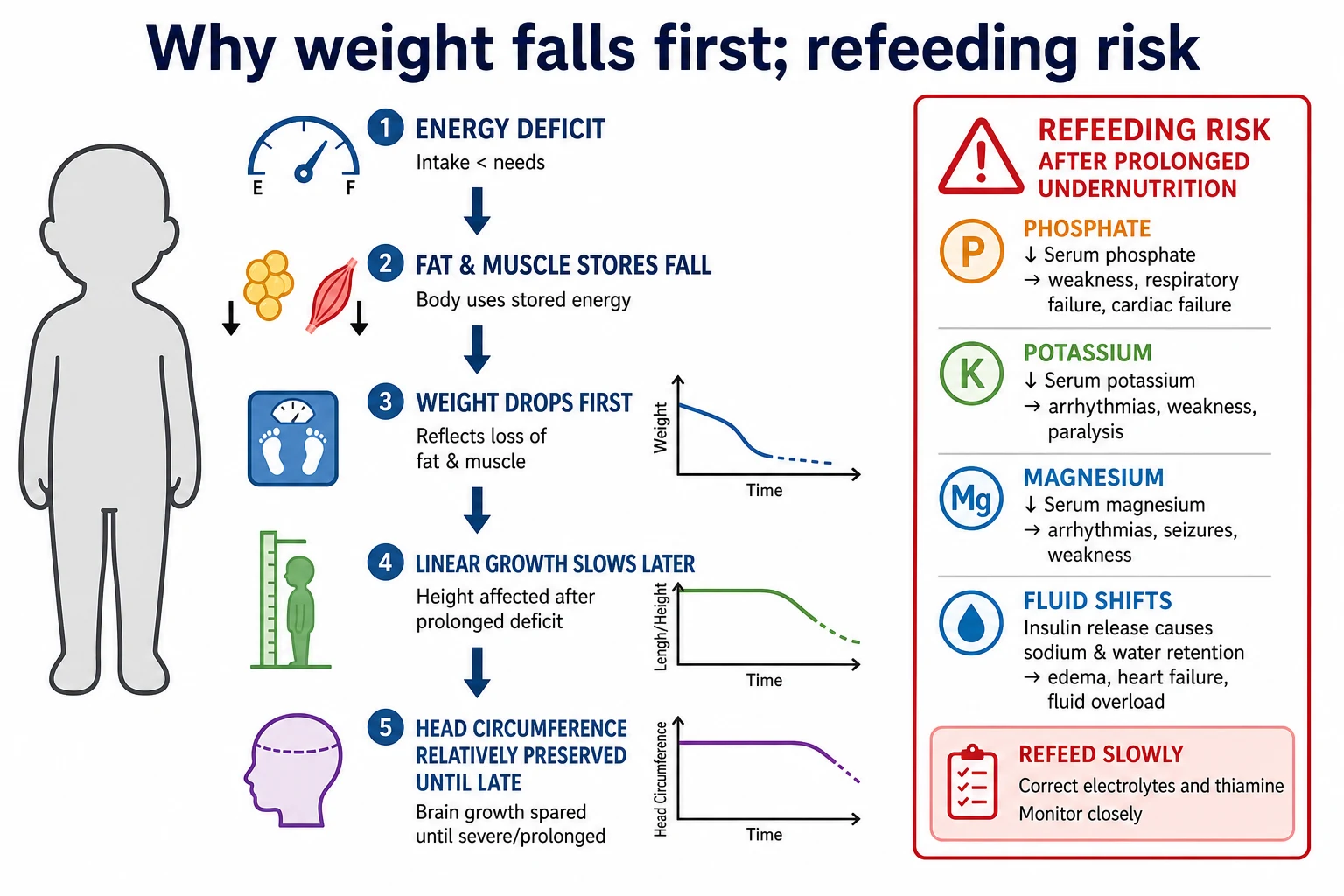
Growth is an energy story written on a chart. When intake falls short of need, fat and muscle stores are used first. Weight drops before length slows. Head circumference is often preserved until late, because brain growth is protected. If you see the reverse pattern — length falling hard while weight is relatively preserved, or head circumference behaving oddly — rethink endocrine disease, genetic short stature, measurement error or intracranial issues rather than pure underfeeding. [1] [7]
Inadequate milk transfer in a young infant is a classic intake problem. The parent may report “feeding all the time.” Long feeds can mean poor transfer, not abundance. Sparse wet nappies, early fatigue at the breast or bottle, and falling weight velocity tell the truth better than a single diary line. [1] [4]
Chronic cardiorespiratory disease raises work of breathing and energy need. Malabsorption wastes nutrients after they are swallowed. Inflammation and some endocrine states blunt growth-factor signalling. Psychosocial deprivation can reduce offered feeds, disrupt routines, and suppress appetite without a single organ lesion. [6] [7] [8]
After prolonged undernutrition, sudden large calorie loads can trigger refeeding syndrome. Insulin rises, electrolytes shift intracellularly, and phosphate, potassium and magnesium can fall. Fluid balance can swing. ASPEN consensus frames refeeding as a recognisable risk state needing monitored reintroduction of nutrition, not a free-for-all “just feed more.” Do not invent local electrolyte recipes in a viva if you cannot cite them; state the risk, monitor, and use local nutrition pathways. [9]
Clinical Presentation
Some families arrive worried. Others are surprised when a nurse plots the book. Presentation styles you must recognise include silent clothing lag, a “picky eater” label that hides juice excess, an infant always on the breast with poor transfer, a post-illness slide that never recovers velocity, a chronic disease child whose baseline is falling further, and a social red-flag package of missed appointments, inconsistent stories or delayed care-seeking. [1] [4] [8]
Caregiver concern that the child is deteriorating is data. Mills and colleagues showed caregiver concern associates with critical illness in hospital-presenting children. In growth clinic the stakes differ, but the principle stands: do not talk a worried parent out of a real change you have not measured. [15]
Atypical and subtle patterns matter in exams. An older child with coeliac disease may have abdominal symptoms and progressive weight issues after gluten exposure. A child with congenital heart disease may eat slowly and tire mid-feed. An adolescent with restrictive eating may present as “healthy lifestyle” until the trajectory collapses. [1] [7]
Differential Diagnosis
Start with the common and the dangerous at the same time. [1] [7]
Common and often mixed: inadequate calories from feeding technique, formula errors, food insecurity, restrictive toddler diets, and caregiver capacity limits. [1] [2] [6]
Increased losses or malabsorption: recurrent vomiting, chronic diarrhoea, coeliac disease, cow’s milk protein allergy, cystic fibrosis, inflammatory bowel disease in older children. [1] [7]
Increased needs: congenital heart disease, chronic lung disease, recurrent infection, hyperthyroidism, convalescence. [7]
Endocrine and genetic: hypothyroidism, growth hormone deficiency, cortisol excess, syndromes with short stature — patterns often differ from pure nutritional FTT (length/height and velocity clues). Cross-link stature evaluation when linear growth dominates. [1] [7]
Safeguarding-related neglect: multi-parameter faltering, developmental delay, poor hygiene, fearful behaviour, or history that does not match findings. Harper’s review places FTT within neglect frameworks without claiming every low weight is abuse. Hold both truths: most FTT is not intentional harm, and some is. [8] [12]
Not true faltering: measurement error, wrong chart, uncorrected prematurity, constitutional low channel with normal velocity. [5] [10] [11]
Age shifts the list. Neonates: milk transfer, congenital disease, infection. Infants: feeding technique, reflux with secondary intake failure, cow’s milk protein allergy, heart disease. Toddlers: diet quality, juice, oral aversion. School-age: chronic disease, coeliac, social determinants. Adolescents: eating disorders enter early in the differential for weight loss. [1] [4] [7]
Clinical & Bedside Assessment
1. Stability first. Look at the child before the chart. Work of breathing, colour, interaction, hydration, temperature and glucose risk outrank percentile debate. Reduced interaction or a caregiver who says “this is not my child” raises urgency. [15]
2. Confirm the data. Re-weigh. Re-measure length or height. Check age, sex chart and prematurity correction. Plot velocity. If the crisis disappears on re-measurement, you just prevented an unnecessary work-up. Detailed technique lives on the growth-measurement page — borrow the skill, do not re-write the chapter here. [10] [11]
3. Take a feeding history that could change management. What is offered, what is taken, how long feeds last, night feeds, formula scoop-to-water ratio, juice and snack pattern, mealtime battles, who feeds the child, and food security at home. Ask about vomiting, stools, cough, sweatiness with feeds, polyuria and infections. [1] [2] [20]
4. Observe a feed when safe. Watching transfer, latch, bottle flow, pacing and caregiver–child interaction often beats another questionnaire. Document what you see without humiliating the family. [1] [4]
5. Examine for nutrition and disease. Fat stores, muscle bulk, oedema, hair and skin changes, thrush, respiratory signs, heart findings, abdomen, organomegaly, neurological tone, dysmorphism and pubertal stage when relevant. Note hygiene and interaction carefully and factually. [1] [7]
6. Screen development. Growth and development travel together in many serious pathways. Use surveillance principles and escalate when milestones plateau or regress. [16]
7. Social history without blame. Mental health, substance use, housing, money for food, domestic violence, number of caregivers, and prior child-protection involvement. Trauma-informed posture keeps the child safe and the family engaged. [6] [8] [12]
Use a professional interpreter when language discordance exists. Diet detail is easy to lose in ad-hoc translation. [13]
Investigations
Labs do not replace calories, and normal labs do not exclude inadequate intake or neglect. [1] [8]
Often no immediate panel is needed when faltering is mild, examination is normal, feeding issues are clear, and close follow-up is assured. Start nutrition support and review early. [1] [3]
Reasonable first-line tests when faltering is progressive, unexplained, or accompanied by symptoms: full blood count, iron studies as indicated, electrolytes and renal function, glucose if unwell, coeliac serology in children who have taken gluten, thyroid function when linear growth or other clues exist, and urinalysis. Add targeted tests for diarrhoea, respiratory disease or cardiac findings. [1] [2] [7]
Second-line and specialist tests (sweat test, stool studies, imaging, genetic tests, endocrine stimulation) follow hypothesis, not a fixed mega-panel. Hospital observation of intake and weight can be more informative than a third page of bloods. [1] [7]
Avoid radiation and invasive tests that will not change near-term management. Avoid “shotgun” endocrine panels for a child with clear underfeeding and normal length velocity without other clues. [1]
Management — Resuscitation
If the child is unstable, the chart becomes background. Protect airway and breathing if effort is poor. Support circulation and correct dehydration carefully in the severely wasted child. Check and treat hypoglycaemia risk. Warm the hypothermic infant. Consider sepsis when infection is possible. Involve senior help and local critical-care pathways early. [1] [9]
For severe undernutrition, think refeeding risk before celebrating a huge first feed. Monitor clinical state and electrolytes according to local nutrition and ASPEN-informed principles. Escalate intake in a supervised way rather than an uncontrolled binge of concentrated calories. Exact replacement protocols are local — state the principle and use your hospital guideline. [9]
If safeguarding risk is high, protect the child in parallel with medical care. That may mean admission, supervised feeding, and urgent statutory referral according to local law. Document facts, not insults. [8] [12]
Technology-dependent children may decompensate when pumps, formulas or carer systems fail. Treat the device and social system as part of the resuscitation, not an afterthought. [17]
Structured handoffs matter when multiple teams share a fragile nutrition plan. [19]
Management — Definitive & Stepwise
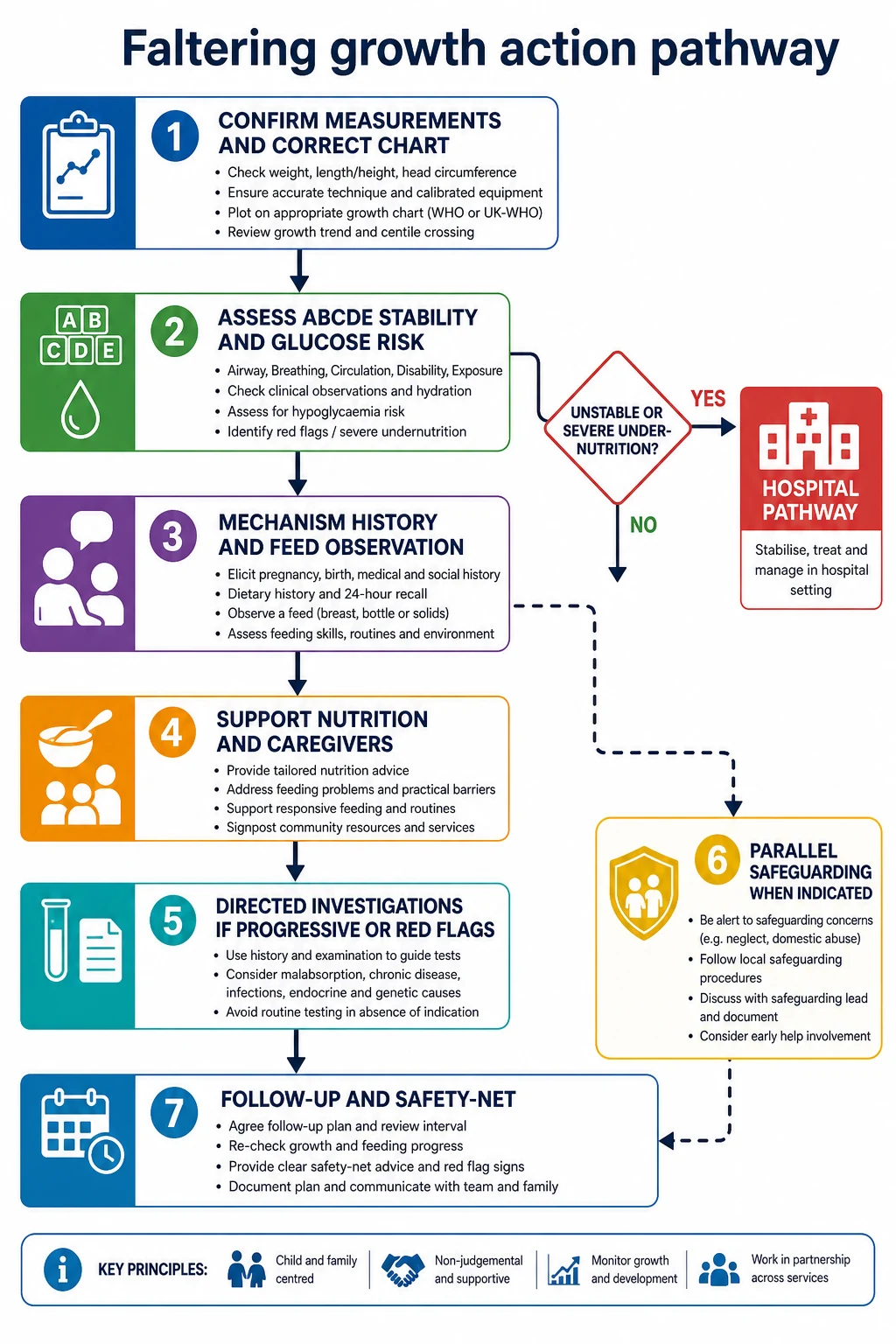
Step 1 — Name the problem representation.
Example: “Four-month-old with falling weight velocity from 50th to 5th centile, sparse wet nappies, long inefficient breastfeeds, normal exam otherwise — likely inadequate transfer until proven otherwise.” [1] [20]
Step 2 — Fix what is fixable today.
Lactation support, feed observation, correct formula mixing, increase energy density of the diet with dietetic advice, scheduled meals rather than endless grazing, and practical food-security help. Catch-up needs more than maintenance calories; dietitians translate that into a plan families can run. Do not invent product scoops or modular recipes without a cited local pathway. [1] [3]
Step 3 — Multidisciplinary support.
Dietetics, lactation, speech and language therapy for oral-motor problems, psychology for mealtime aversion, social work, and primary care. Medical complexity needs a coordinated medical home. [3] [17]
Step 4 — Decide location of care.
Outpatient care suits stable children with clear plans and reliable follow-up. Admit for severe wasting, failed outpatient progress, unsafe home environment, need for supervised feeds, or investigations that require hospital. [1] [3] [8]
Step 5 — Set review intervals and expected response.
Young infants need tight loops — days to a couple of weeks depending on severity. Older children with mild drift can be reviewed over longer intervals if safety-net advice is clear. If weight velocity does not improve after a genuine intake intervention, escalate the organic work-up. [1] [3] [14]
Step 6 — Communicate and consent.
Explain the chart in plain language. Agree goals with caregivers. Use teach-back. Share uncertainty honestly when tests are deferred. Shared decisions still apply in paediatrics. [18]
Step 7 — Safety-net.
Tell families when to return: ongoing weight loss, vomiting, lethargy, fewer wet nappies, breathing difficulty, or a sense that the child is worse. Written and verbal safety-netting helps. [14]
Specific Subtypes & Scenarios
Breastfed infant with poor transfer. Observe a feed. Fix latch and transfer with skilled support. Protect breastfeeding while restoring intake; supplementation plans should be intentional, temporary when possible, and reviewed. [1] [4]
Formula mixing errors. Too much water dilutes energy. Too little water risks hypernatraemia. Ask people to show you how they mix. [1]
Toddler juice and snack pattern. Energy looks “busy” but protein and density are poor. Rebuild meal structure. [1] [2]
Ex-preterm false faltering. Uncorrected age on a term chart creates panic. Correct when indicated, then judge velocity. Cross-link the measurement topic. [10] [11]
Coeliac pathway. Progressive faltering after gluten exposure with gastrointestinal or extraintestinal clues — test appropriately before gluten is removed. [1] [7]
Cardiorespiratory high needs. High-calorie plans plus disease treatment; tiring mid-feed is a clue. [7]
Suspected neglect. Parallel medical care and safeguarding. Supervised feeding response can be diagnostically helpful and protective. [8] [12]
Medical complexity / tube feeds. Verify recipe, rate, free-water, tolerance and carer training. Growth failure may signal system failure. [17]
Refugee child. Rebuild the growth story, treat infection risk thoughtfully, use interpreters, and avoid racialised assumptions about “small families.” [13]
Adolescent restriction. Confidential history, urgent safety assessment for medical instability, and eating-disorder pathway linkage. [1]
Complications & Pitfalls
- Labelling a single low centile as FTT without trend. [5]
- Missing measurement or plotting error. [10] [11]
- Over-investigating while under-feeding support. [1]
- Blaming breastfeeding or caregivers without observing a feed. [4] [6]
- Using “non-organic” as a conversation ender. [7]
- Missing safeguarding when multi-domain risk is obvious. [8]
- Unsafe aggressive refeeding after prolonged undernutrition. [9]
- Ignoring caregiver concern. [15]
- Language discordance without an interpreter. [13]
- Fragmented handoffs that drop the nutrition plan. [19]
Prognosis & Disposition
Many children recover velocity once intake and stressors improve. Early correction protects later growth potential. Prolonged early undernutrition associates with developmental risk, which is one reason surveillance runs beside nutrition care. [4] [6] [16]
Good disposition means more than “GP follow-up.” Name the review date, the expected weight response, who to call, and community supports for food and caregiving. If social determinants remain unsolved, medical clearance alone is fragile. [3] [14]
Discharge after inpatient supervised feeding is safer when weight is rising, electrolytes are stable if refeeding risk was present, caregivers can demonstrate the plan, and safeguarding is addressed. [9] [8]
Special Populations
Neonates and preterm graduates need corrected-age thinking, lactation or fortification pathways, and tight early review. [10]
Breastfed infants deserve skilled support, not automatic formula conversion as the first and only move. [1] [4]
Disability and technology dependence need equipment that can weigh the child, realistic targets, and carer-respite awareness. [17]
Indigenous families need culturally safe care without racialised chart myths. Ask about food access and supports with respect. [12]
Migrant and refugee families need interpreters, catch-up context and infection–nutrition dual awareness. [13]
Out-of-home care treats growth as a welfare vital sign with meticulous documentation. [8]
Adolescents need confidential space for eating-disorder questions and body-image harm. [1]
Evidence, Guidelines & Regional Differences
Homan’s practical AFP guide and Cole’s earlier update remain high-yield for structured clinic evaluation and management priorities. [1] [2]
Shields’ BMJ review summarises weight faltering epidemiology and approach in early childhood. [4]
Gonzalez-Viana and colleagues summarise NICE faltering-growth guidance for recognition and management — essential UK exam language. [3]
Olsen explains why definition debates persist; Wright links social and emotional context to weight faltering risk. [5] [6]
WHO standards define how children should grow under favourable conditions; US recommendations describe when to use WHO versus CDC charts in young children. Use them to support trajectory judgement, not as a substitute for clinical reasoning. [10] [11]
ASPEN refeeding consensus informs risk recognition when nutrition restarts after significant deprivation. [9]
Australian primary-care framing (Bergman) aligns with a practical local approach: systematic history, examination and staged management. [20]
Personal health records and local growth resources often operationalise WHO early-childhood standards. Pair growth concern with culturally safe family support and local safeguarding statutes. [10] [20]
Prefer faltering growth language and NICE-aligned multidisciplinary pathways. UK-WHO chart plotting is standard in child health records. [3]
FTT language remains common in teaching and coding. Practical AFP guides structure outpatient care; chart policy often uses WHO under 24 months and CDC charts thereafter. [1] [2] [11]
Growth monitoring statements align with WHO early-years standards; follow provincial pathways for admission and child protection. [10]
Exam Pearls
- Trend beats a single point; re-measure before you label. [1] [5]
- Say mechanism, not only “organic versus non-organic.” [7]
- Weight before length before head in nutritional deficit. [1]
- Observe a feed when safe. [4]
- Labs normal ≠ safe home or adequate calories. [8]
- NICE says faltering growth; US stems may say FTT — define terms. [3] [1]
- Refeeding risk is phosphate, potassium, magnesium and fluid shifts after prolonged undernutrition. [9]
- Caregiver concern is data. [15]
- Safety-net every plan. [14]
- Cross-link measurement technique; do not clone that chapter in your answer. [10] [11]
High-yield anchors
References
- [1]Homan GJ Failure to Thrive: A Practical Guide Am Fam Physician, 2016.PMID 27548594
- [2]Cole SZ Failure to thrive: an update Am Fam Physician, 2011.PMID 21524049
- [3]Gonzalez-Viana E Faltering growth in children: summary of NICE guidance BMJ, 2017.PMID 28963099
- [4]Shields B Weight faltering and failure to thrive in infancy and early childhood BMJ, 2012.PMID 23014901
- [5]Olsen EM Failure to thrive: still a problem of definition Clin Pediatr (Phila), 2006.PMID 16429209
- [6]Wright CM The influence of maternal socioeconomic and emotional factors on infant weight gain and weight faltering (failure to thrive): data from a prospective birth cohort Arch Dis Child, 2006.PMID 16397011
- [7]Larson-Nath C Clinical Review of Failure to Thrive in Pediatric Patients Pediatr Ann, 2016.PMID 26878182
- [8]Harper NS Neglect: failure to thrive and obesity Pediatr Clin North Am, 2014.PMID 25242707
- [9]da Silva JSV ASPEN Consensus Recommendations for Refeeding Syndrome Nutr Clin Pract, 2020.PMID 32115791
- [10]WHO Multicentre Growth Reference Study Group WHO Child Growth Standards based on length/height, weight and age Acta Paediatr Suppl, 2006.PMID 16817681
- [11]Grummer-Strawn LM Use of World Health Organization and CDC growth charts for children aged 0-59 months in the United States MMWR Recomm Rep, 2010.PMID 20829749
- [12]Forkey H Trauma-Informed Care Pediatrics, 2021.PMID 34312292
- [13]Boylen S Impact of professional interpreters on outcomes for hospitalized children from migrant and refugee families with limited English proficiency: a systematic review JBI Evid Synth, 2020.PMID 32813387
- [14]Burvenich R Effectiveness of safety-netting approaches for acutely ill children: a network meta-analysis Br J Gen Pract, 2025.PMID 39117428
- [15]Mills E Association between caregiver concern for clinical deterioration and critical illness in children presenting to hospital: a prospective cohort study Lancet Child Adolesc Health, 2025.PMID 40451224
- [16]Lipkin PH Promoting Optimal Development: Identifying Infants and Young Children With Developmental Disorders Through Developmental Surveillance and Screening Pediatrics, 2020.PMID 31843861
- [17]Kuo DZ Recognition and Management of Medical Complexity Pediatrics, 2016.PMID 27940731
- [18]Katz AL Informed Consent in Decision-Making in Pediatric Practice Pediatrics, 2016.PMID 27456510
- [19]Starmer AJ Changes in medical errors after implementation of a handoff program N Engl J Med, 2014.PMID 25372088
- [20]Bergman P An approach to failure to thrive Aust Fam Physician, 2005.PMID 16184203