Paeds · clinical-assessment-and-reasoning
Telehealth assessment and remote examination of children
Also known as Paediatric telehealth · Pediatric telemedicine · Remote paediatric examination · Virtual paediatric visit · Webside manner
A fellowship approach to paediatric telehealth: modality selection, remote first impression, caregiver-assisted examination, webside manner, stewardship, equity, privacy, escalation to EMS or in-person care, and safe disposition across age bands and settings.
On this page & tools
Your progress
Saved locally on this device.
Practise this topic
Target exams
Red flags
Life stages
Care settings
Clinical exam formats
Board mappings
Medical-home integration is a quality design choice, not a brand preference. Ray and colleagues linked paediatric direct-to-consumer telemedicine visits with higher antibiotic prescribing, and later work comparing primary-care versus direct-to-consumer telemedicine pathways continues to show stewardship differences. [6] [7] [11]
Overview & Definition
Imagine a parent rings because a toddler has fever and is “not right.” You cannot put a stethoscope on the chest. You cannot feel the abdomen. You can still do dangerous harm in two opposite ways: you can reassure too early, or you can treat uncertainty with an unnecessary antibiotic and no follow-up. Paediatric telehealth is the craft of deciding which problems can be assessed remotely, how to examine at a distance, and when to stop being virtual. [1] [3] [17]
Telehealth is the broader term for care delivered with telecommunications. Telemedicine often refers to clinician–patient clinical encounters. Remote patient monitoring is ongoing capture of patient- or family-generated data such as oxygen saturations, glucose or symptom scores. Store-and-forward means images or recordings are reviewed later. Telephone-only advice is still common and still limited. Name the modality you used in the notes. Do not write “full exam” when you only observed a video. [2] [16] [30]
AAP clinical reports after the pandemic expansion frame telehealth as a tool to improve access, quality and cost when it is designed well, and as a source of inequity and quality gaps when it is not. The fellowship task is not “can we do video?” It is “should we, for this child, and what is the conversion plan if we cannot finish safely?” [3] [4] [5] [20]
This page owns modality selection, remote assessment technique, webside manner, stewardship, equity, privacy and disposition after virtual care. It does not replace dedicated pages on the Paediatric Assessment Triangle, full physical examination, history technique, vital-sign norms or disease-specific treatment. [3] [17]
Classification
Classify the visit by purpose first. Acute triage, primary-care follow-up, specialty consult, behavioural health, care coordination for medical complexity, education and post-discharge review need different depth and different safety bars. A wraparound virtual programme for children with medical complexity is not the same workflow as a one-off ear-pain video visit. [11] [18] [30]
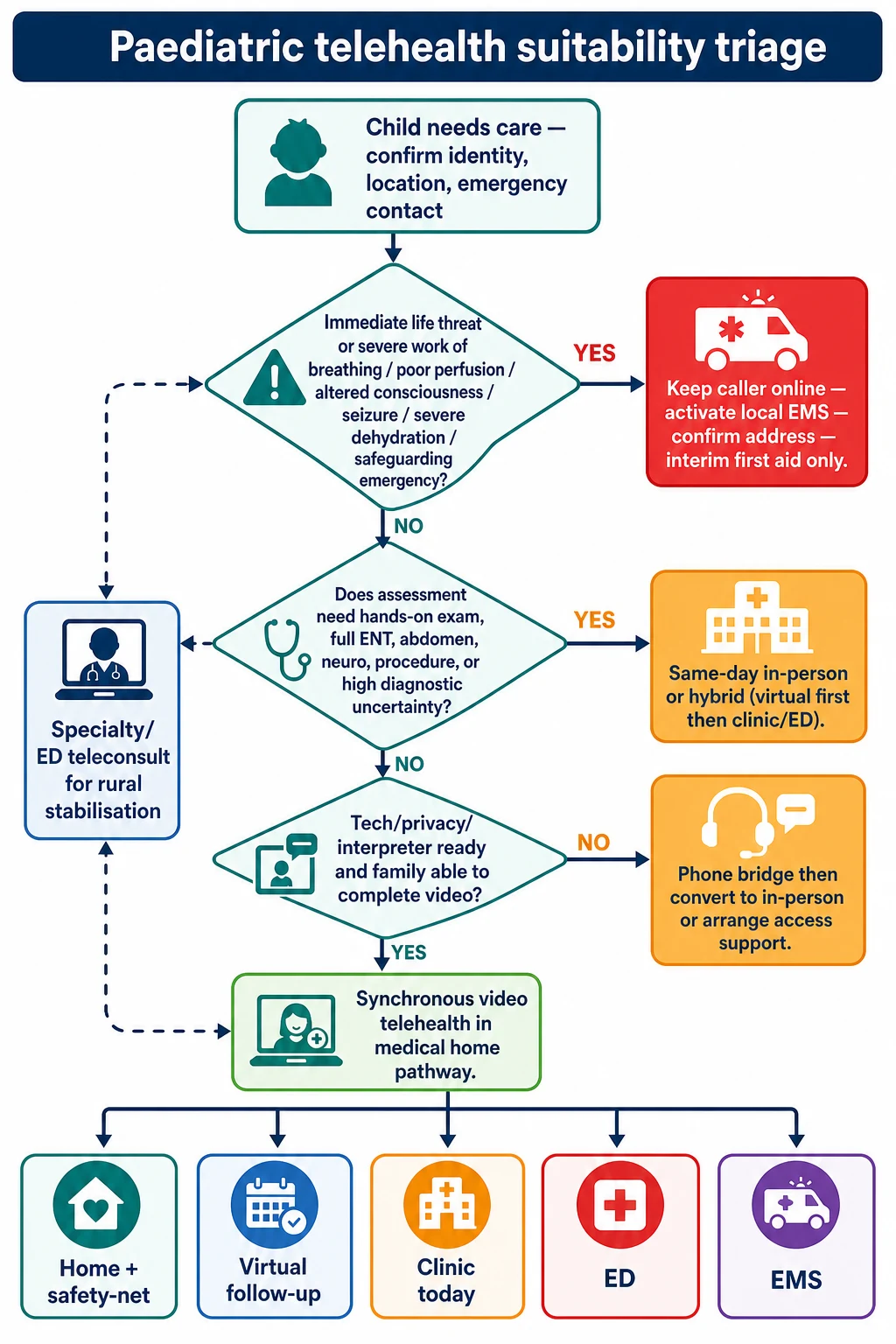
Classify the channel next: synchronous video, audio-only, asynchronous messaging, remote monitoring alert, or hybrid (virtual first, in-person same day). Video is usually preferred when appearance and work of breathing matter. Audio may be a bridge when video fails, not a destination for an unwell child. [9] [19] [22]
Classify clinical appropriateness separately from technical readiness. A family may have perfect broadband and still need hands-on abdominal examination. Another family may have the right clinical problem for video and no private device. Both need a different plan. Suitability is the intersection of acuity, required exam manoeuvres, caregiver capacity, language access, privacy and local escalation options. [3] [17] [21]
Classify the remote examination itself. Observation-first means you watch appearance, breathing and interaction. Caregiver-assisted means you coach hands-on steps the adult can do safely. Device-augmented means thermometer, pulse oximeter, blood-pressure cuff, peak flow, glucose meter or parent smartphone otoscopy add data. Not feasible means you stop and convert. Parent otoscopy can help in selected follow-up settings, but reliability in untrained hands is limited and must not be treated as theatre-grade otoscopy. [12] [13] [29]
Direct-to-consumer platforms and medical-home telehealth are different quality environments. Continuity, record access and stewardship culture change prescribing and follow-up even when the camera looks the same. [6] [7] [11]
Epidemiology & Risk Factors
Paediatric telehealth expanded rapidly during COVID-19 and then settled into hybrid models. Access gains were real for some rural families, immunocompromised children and medical-complexity programmes. Access losses were also real when broadband, devices, data cost, disability design and language support were missing. Digital exclusion is a clinical risk factor, not an IT footnote. [3] [4] [20] [22]
Antibiotic overuse is a measured telehealth harm pathway. In paediatric direct-to-consumer telemedicine visits, antibiotic prescribing for common infections was higher than in comparator settings in Ray 2019. Wittman 2024 again found antibiotic-receipt differences between primary-care telemedicine and direct-to-consumer vendor pathways. Stewardship belongs in every acute virtual respiratory or ear visit. [6] [7]
Rural and community emergency departments use paediatric tele-emergency consultation to support stabilisation and transfer decisions. Cluster-randomised work by Marcin and colleagues examined tele-emergency effects on interfacility transfers, and related trials compared telemedicine with telephone for medication-prescribing errors among referring physicians. Video quality advantages matter most when the child is sick and the local team wants paediatric eyes on the room. [8] [9] [10] [19]
Children with medical complexity use telehealth for coordination, remote monitoring and reduced travel burden when programmes are wraparound rather than one-off. Clinician training gaps, fragmented vendor platforms and unactioned remote-monitoring alerts are programme-level risk factors. [16] [18] [28]
Pathophysiology
Remote care removes touch and full auscultation. That is not a minor inconvenience. It changes how sure you can be about perfusion, chest findings, abdominal guarding and subtle neurological signs. Your brain still wants a complete story, so it fills gaps with optimism or with overtreatment. Both are predictable failure modes. [1] [17]
Camera physics matter. Poor lighting hides pallor and mottling. Compression and white-balance distort rash colour. A narrow field misses work of breathing at the neck and abdomen. A smiling toddler can still be hypoxic if no saturation is measured and the camera never shows quiet tachypnoea. Off-camera deterioration is a real mechanism: the child looks all right for thirty seconds of performance, then slumps when the call ends. [10] [14]
Caregiver technique varies. Respiratory rates counted too briefly, capillary refill taught badly, and ear views obtained at the wrong angle all inject noise. Device data help only when the device is appropriate and the response pathway is defined. Foster and colleagues frame remote monitoring of family-generated health data as useful when thresholds, responsibility and escalation are explicit; otherwise alerts create noise without safety. [12] [16]
Cognitive load rises when you troubleshoot audio while thinking about sepsis. That load steals working memory from red-flag screening. Webside manner is partly a cognitive intervention: reduce friction so clinical reasoning can run. Privacy threat is also physiological for adolescents. A shared bedroom or a parent holding the phone changes what will be disclosed about self-harm, assault or substance use. [14] [15] [27]
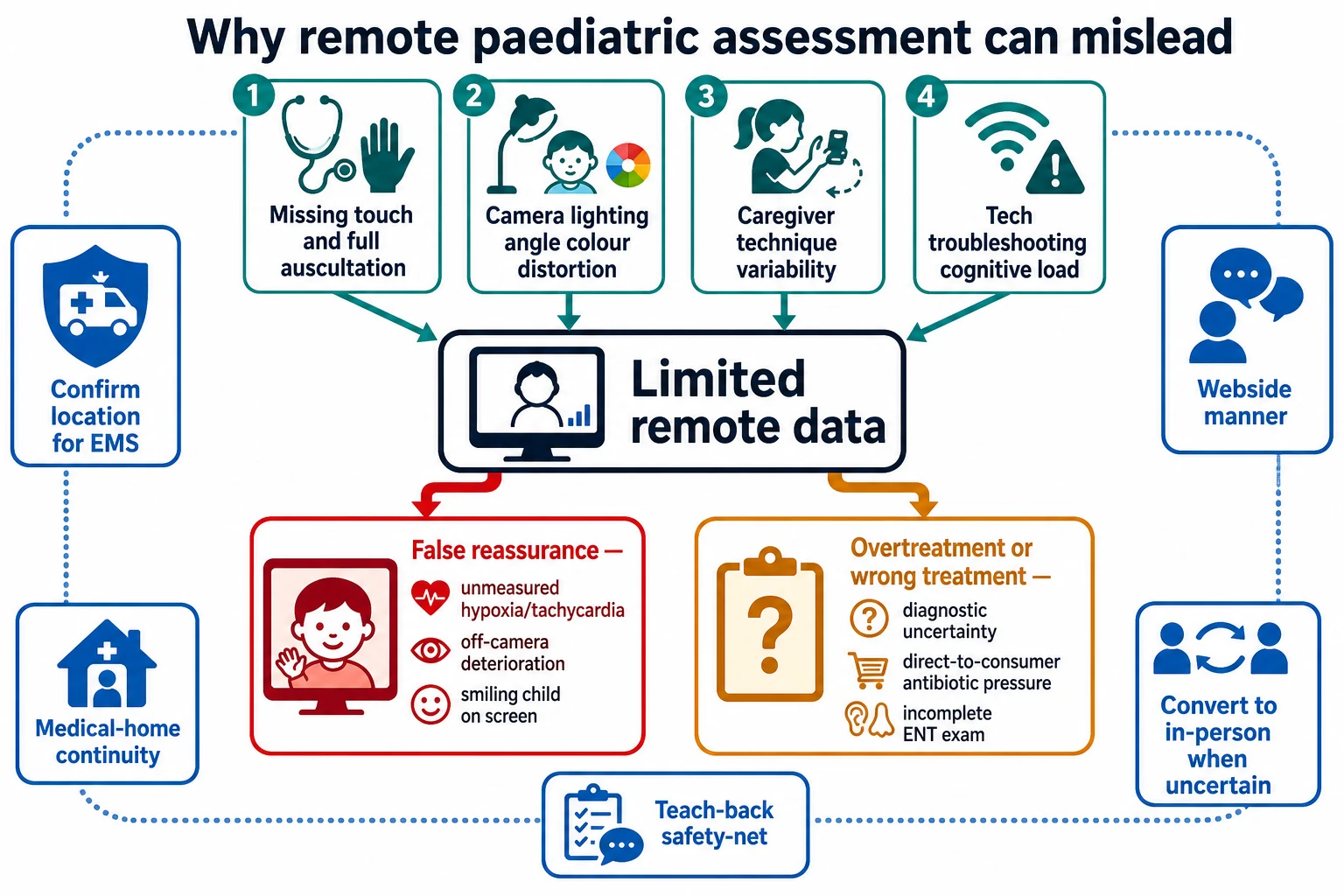
Antibiotic pressure is a social and workflow mechanism as much as a microbiological one. Incomplete ENT examination plus parental expectation plus a short direct-to-consumer slot produces a prescription that feels decisive and is often wrong. Continuity reduces that pressure because follow-up and reputation live in the same medical home. [6] [7] [15]
Clinical Presentation
From the first seconds of video, ask what you would ask at a doorway. Is the child looking at you? Is breathing quiet or laboured? What colour is the skin you can see? Is the infant floppy on the caregiver’s lap or vigorous and resisting? Remote first impression is still first impression. [10] [14]
Neonates and young infants present remote risk quickly. Feeding refusal, few wet nappies, colour change, fever in early infancy, abnormal tone and “not waking for feeds” are hard to clear without in-person assessment. Toddlers often perform for the camera or melt down completely. Neither state is a full exam. School-age children can show rashes, demonstrate peak flows and describe pain location. Adolescents may look fine while hiding a mental-health emergency until private virtual space exists. [3] [11] [27]
Caregiver concern that the child is different remains high-value data when vitals are unmeasured. Medical-complexity presentations need the caregiver’s baseline: what is normal for this child’s colour, secretions, seizure pattern or ventilator settings? Language-discordant families may present first as an access problem — no interpreter on the platform — before any symptom is heard. Technology failure is itself a presentation of risk when the child is unwell. [18] [23] [21]
Differential Diagnosis
After remote history, sort by threat and by feasibility. The first differential is not “viral versus bacterial.” It is “remote-safe versus same-day in-person versus emergency services now.” Technical limitation is not clinical reassurance. “I cannot see the eardrum well” is a reason to examine in person, not a reason to assume the ear is fine or to default to an antibiotic. [6] [13]
Respiratory differentials need work-of-breathing trajectory, hydration and saturation when available. Circulatory concern needs colour, capillary refill if reliably coached, urine output and behaviour. Neurological concern needs interaction, tone, seizure description and glucose pathway planning. Behavioural and psychosocial differentials need private space and clear safety questions. Safeguarding concerns change modality: if the remote environment is controlled by a possible perpetrator, remote care may be unsafe even when the rash looks minor. [10] [26]
Frame “unable to exclude” as an action. Unable to exclude severe dehydration means fluids assessment in person. Unable to exclude acute abdomen means same-day physical exam. Unable to exclude serious bacterial infection in a young infant means urgent in-person pathways, not overnight video watchful waiting. [3] [11]
Clinical & Bedside Assessment
Start before the camera opens. Confirm who you are speaking with, who has parental responsibility, where the child is, a call-back number and local emergency access. Check privacy: who else is in the room, and is this a safe space to talk? Book a professional interpreter on the platform when language does not match. Never use a child as interpreter for clinical content. [14] [23] [26]
Use webside manner deliberately. Look at the camera when you greet the child. Reduce side-screen multitasking. Speak in short sentences. Engage the child with play or questions matched to age. Name uncertainty out loud: “I can see your chest moving, but I cannot listen with a stethoscope from here.” Families tolerate limits better when you state them early. [14] [15] [28]
Run a remote first impression equivalent to a doorway PAT-style view: appearance and interaction, work of breathing, colour and visible perfusion. Then take an age-adapted history with the same domains you would use in person, compressed to what changes decisions today. For adolescents, open confidential virtual time and state limits of confidentiality before HEADSS or SSHADESS-type questions. Shared devices need explicit planning so privacy is real, not theatrical. [10] [27]
Coach caregiver-assisted examination with one instruction at a time: [12] [14]
- Count respiratory rate for a full window while the child is quiet if possible.
- Show the chest and abdomen; look for recession, nasal flaring and grunting.
- Assess colour of lips and skin in good light; expose carefully for rash mapping.
- Check capillary refill only if you can teach the site and timing clearly.
- Offer fluid or observe a breastfeed when hydration is the question and it is safe.
- Walk the child on camera for gait; watch rising from the floor when relevant.
- Use a torch for mouth and throat if the child cooperates; do not force.
- For ears, parent smartphone otoscopy is adjunctive in selected pathways only; treat uncertain views as uncertain. [12] [13] [29]
Integrate home device data with humility. A home pulse oximeter can help trajectory in chronic respiratory disease when the device is known and motion artefact is considered. It does not clear a toxic infant. Thermometer readings help; the wrong site or an unwell neonate still needs in-person care. Document what was examined, what was not, and your confidence. [16] [21]
REMOTE-SAFE start
Investigations
Remote findings drive whether and where to test, not a virtual shotgun panel. Red flags end the remote pathway and start emergency care. For non-emergency uncertainty, arrange same-day vitals and hands-on exam rather than guessing. Store-and-forward rash or wound photos can triage urgency if quality is adequate and colour is interpreted cautiously. [3] [10]
Parent-performed smartphone otoscopy may support tube surveillance or selected ear pathways in research and pilot settings, but it is not a universal replacement for clinician otoscopy. Remote monitoring programmes need defined thresholds, who responds, and what happens after hours. Unmonitored dashboards are decoration. [12] [16] [29]
Avoid investigations or prescriptions that pretend certainty you did not earn. An antibiotic for “possible otitis” on a black ear image is not thoroughness. It is guessing with side effects. When adolescent sexual or substance history changes testing needs, handle consent and privacy by local law and platform safety. [6] [26]
Management — Resuscitation
If the child looks critically unwell on video, you are in a resuscitation communication role. Stay on the line. Confirm the exact address and nearest access point. Activate local emergency services early. Give simple interim guidance only: recovery position if unconscious and breathing, seizure protection from injury, prescribed intramuscular adrenaline if this is known anaphylaxis and the device is available, keep the airway open. Do not run complex procedures over a fading phone signal. [8] [10]
Hand over using closed-loop language to EMS or the receiving emergency department: age, location, main problem, what you saw, what you could not assess, allergies and medications if known, and caregiver contact. If the video drops, switch to phone immediately using the call-back number you collected at the start. If both fail, use the emergency contact pathway you documented. [9] [14]
Paediatric tele-emergency programmes can support rural teams during stabilisation and transfer decisions. Video is preferred over telephone when visual assessment changes treatment or transport. Marcin trial programmes and Haynes video-versus-telephone quality work support investing in video for sick children rather than assuming audio is enough. [8] [9] [19]
Remote disclosure of suicidal intent or assault is an emergency communication event. Do not promise secrecy you cannot keep. Secure immediate safety, involve senior and local crisis pathways, and do not end the call until a safety plan or handover exists. [26] [27]
Management — Definitive & Stepwise
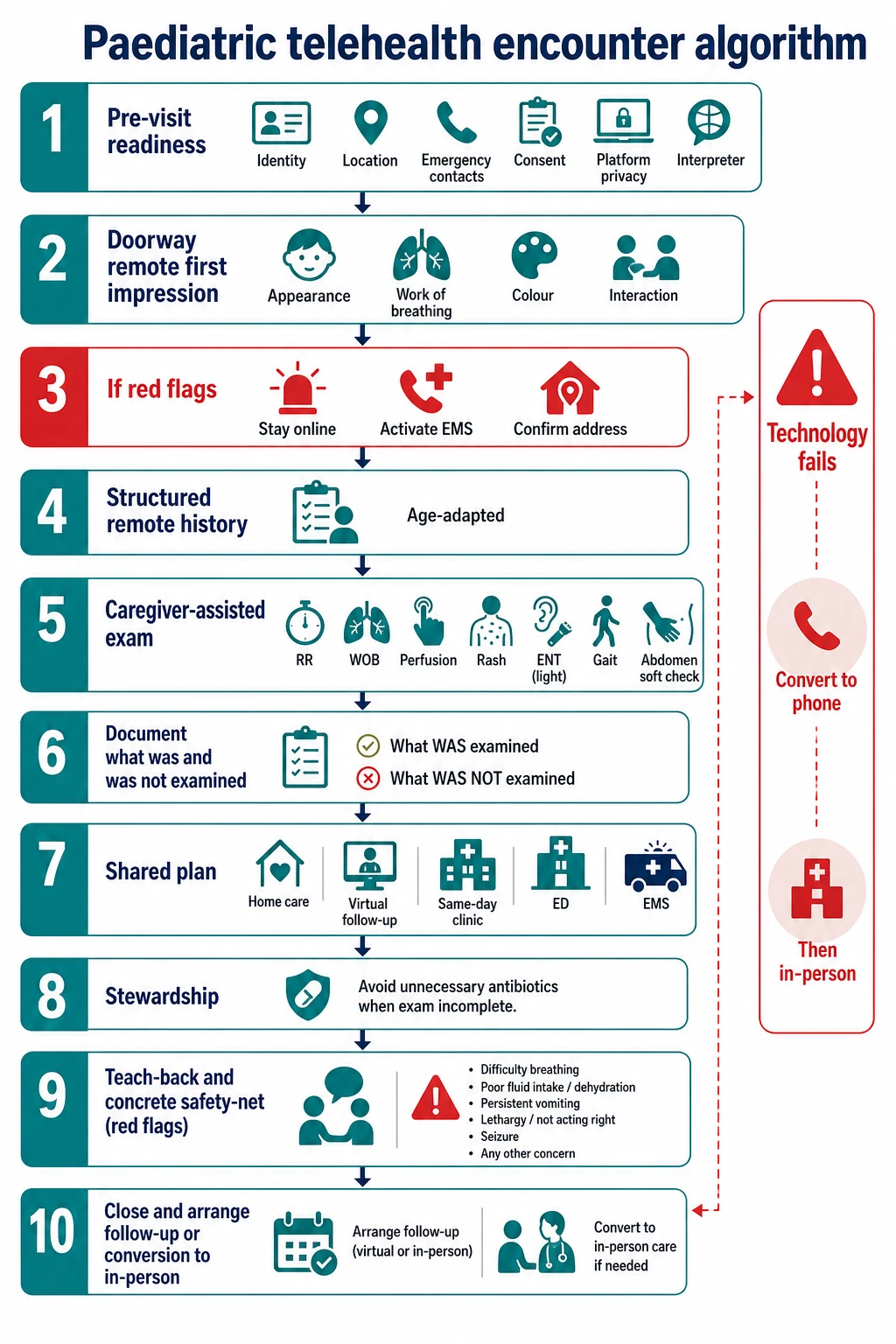
For non-critical encounters, move in a fixed order so you do not invent a new workflow under pressure. [3] [14]
- Confirm identity, location, contacts, consent and privacy.
- Form remote first impression.
- Interrupt to EMS if red flags appear.
- Complete structured remote history.
- Coach caregiver-assisted exam and capture device data.
- State a problem representation that includes uncertainty.
- Choose disposition: home care, virtual follow-up, same-day clinic, ED or EMS.
- Prescribe only when indication and exam adequacy support it; check allergy and weight-based dosing from a reliable source.
- Use teach-back; correct gaps.
- Safety-net with specific red flags, time windows and how to access care.
- Document modality, limitations and plan.
- Arrange interpreter-supported follow-up when needed. [14] [24] [25]
Stewardship is part of definitive care. If you cannot support a bacterial diagnosis, explain symptomatic care and follow-up rather than trading an antibiotic for visit closure. Medical-home pathways make that conversation easier because the family is not lost to a vendor queue. [6] [7] [11]
Hybrid care is often the right definitive plan: virtual first for history and triage, then same-day nurse or clinic observations, or planned in-person complete exam within a defined window. For children with medical complexity, wraparound virtual care works when escalation thresholds and a real clinician responder exist. [5] [18]
Specific Subtypes & Scenarios
Febrile toddler triage. Watch interaction and breathing. Ask about wet nappies, rash, intake and vaccine status. Mild cases with good appearance may trial home care with tight safety-net. Young infants and toxic appearances convert immediately. [11] [25]
Mild respiratory illness. Count respiratory rate, view chest wall, ask about feeding and sleep. Any severe work of breathing or saturation concern when a reliable oximeter is available and abnormal ends remote-only care. [10] [16]
Rash. Map distribution with good light and multiple angles. Petechiae or purpura with illness is emergency care, not photo follow-up. [3]
Adolescent confidential visit. Headphones, private room, limits of confidentiality, then psychosocial scaffold. Convert to urgent in-person mental-health pathways when safety is uncertain. [27]
Medical complexity. Use caregiver expertise, emergency plans and device baselines. Virtual coordination reduces travel but does not replace hands-on assessment of new decompensation. [18]
Rural ED teleconsult. Prefer video. Support airway, breathing, circulation decisions and transfer timing with paediatric eyes on the room. [8] [19]
Parent otoscopy pathways. Adjunctive for selected surveillance; uncertain images mean in-person exam, not automatic antibiotics. [12] [29]
Language discordance. Professional remote interpreter first; reschedule with interpreter rather than using a sibling. [23]
Technology failure. Phone bridge if the child is stable enough; in-person conversion if not fully assessed. [21]
Complications & Pitfalls
The classic pitfall is false reassurance from a brief cute video. The second is antibiotic-by-default in direct-to-consumer models. The third is missing safeguarding because the home environment is curated. The fourth is documentation that implies a complete exam. The fifth is ignoring equity: offering “video only” pathways that exclude the families who already face the highest access barriers. The sixth is unowned remote-monitoring alerts. The seventh is failing to confirm location before a crash. Train for these explicitly. [6] [7] [16] [28]
Prognosis & Disposition
Good telehealth programmes improve access and can reduce unnecessary travel when conversion rules are clear. Tele-emergency support can change transfer decisions and prescribing safety compared with weaker audio pathways. Disposition after every virtual acute visit should answer four questions: what is the working diagnosis, what remains uncertain, what exact red flags force return, and when is planned review? Burvenich network meta-analysis work supports structured safety-netting approaches for acutely ill children; use specific, actionable advice rather than vague “come back if worried” alone. [8] [9] [19] [25]
Home care is appropriate only when appearance is reassuring, exam adequacy matches the decision, caregivers understand the plan, and access to escalate exists. Same-day clinic or ED is the correct “prognosis” for incomplete assessment. Programme prognosis depends on training, equity design and medical-home integration more than on camera resolution. [4] [5] [28]
Special Populations
Neonates and young infants have low tolerance for remote diagnostic uncertainty. Children with medical complexity gain from wraparound virtual care and lose if remote monitoring has no responder. Disability and neurodiversity may make video either easier (home regulation) or harder (sensory load, platform design). Indigenous, rural and remote families may gain access and still face connectivity limits — offer hybrid options, not a single brittle pathway. Migrant and refugee families need professional interpreting on the same link. Out-of-home care and youth justice raise consent and privacy complexity. Adolescents need real confidential space. Socioeconomic disadvantage requires data-light options, phone bridges and funded transport to in-person care when video is impossible. Possible maltreatment may make remote assessment inadequate or unsafe. [18] [20] [23] [4]
Evidence, Guidelines & Regional Differences
AAP clinical reports by Curfman, Olson and colleagues provide the core paediatric telehealth framing for access, quality and post-pandemic strategy. Primary-care and emergency paediatric telehealth reviews by Milne Wenderlich and Schinasi translate that into setting-specific practice. Antibiotic stewardship evidence from Ray and Wittman should change how you design acute virtual pathways. Marcin cluster-randomised programmes and Haynes video-versus-telephone work inform emergency and rural consult standards. Parent otoscopy studies define adjunctive use, not carte blanche. Foster 2022 guides remote monitoring governance. [2] [3] [4] [5] [6] [7] [8] [9] [16]
Regionally, ANZ practice sits inside local health-service telehealth policies, professional registration and privacy principles — state the principle and follow local procedure rather than inventing statute numbers in the viva. UK practice references NHS remote consultation and safeguarding-in-virtual-settings policies. US practice references AAP guidance, privacy rules and state licensure constraints. Canadian practice follows provincial programmes and college standards. Across regions the clinical constants remain: location confirmation, red-flag conversion, stewardship, equity and documentation of limits. [3] [20] [30]
Exam Pearls
- Lead with modality decision and conversion plan, not gadget enthusiasm. [1]
- Location, identity and emergency contacts before deep history. [1]
- Remote first impression: appearance, work of breathing, colour. [1]
- Document what you did not examine. [1]
- DTC antibiotic pressure is a tested trap; defend medical-home stewardship. [1]
- Video over telephone for sick-child teleconsult when available. [1]
- Parent otoscopy is adjunctive; uncertain image means in-person exam. [1]
- Adolescents need real privacy and stated confidentiality limits. [1]
- Teach-back plus specific safety-net closes the visit. [1]
- Equity and interpreter access are safety issues, not optional extras. [6] [14] [19] [25]
References
- [1]Burke BL Jr Telemedicine: Pediatric Applications Pediatrics, 2015.PMID 26122813
- [2]Olson CA The Current Pediatric Telehealth Landscape Pediatrics, 2018.PMID 29487164
- [3]Curfman A Pediatric Telehealth in the COVID-19 Pandemic Era and Beyond Pediatrics, 2021.PMID 34215677
- [4]Curfman AL Telehealth: Improving Access to and Quality of Pediatric Health Care Pediatrics, 2021.PMID 34462339
- [5]Curfman A Telehealth: Opportunities to Improve Access, Quality, and Cost in Pediatric Care Pediatrics, 2022.PMID 35224638
- [6]Ray KN Antibiotic Prescribing During Pediatric Direct-to-Consumer Telemedicine Visits Pediatrics, 2019.PMID 30962253
- [7]Wittman SR Antibiotic Receipt for Pediatric Telemedicine Visits With Primary Care vs Direct-to-Consumer Vendors JAMA Netw Open, 2024.PMID 38483387
- [8]Marcin JP Impact of Tele-Emergency Consultations on Pediatric Interfacility Transfers: A Cluster-Randomized Crossover Trial JAMA Netw Open, 2023.PMID 36780158
- [9]Marcin JP Telemedicine vs Telephone Consultations and Medication Prescribing Errors Among Referring Physicians: A Cluster Randomized Crossover Trial JAMA Netw Open, 2024.PMID 38421649
- [10]Schinasi DA Telehealth in pediatric emergency medicine Curr Probl Pediatr Adolesc Health Care, 2021.PMID 33551336
- [11]Milne Wenderlich A Telehealth in pediatric primary care Curr Probl Pediatr Adolesc Health Care, 2021.PMID 33547004
- [12]Erkkola-Anttinen N Smartphone Otoscopy Performed by Parents Telemed J E Health, 2019.PMID 30040525
- [13]Shah MU iPhone otoscopes: Currently available, but reliable for tele-otoscopy in the hands of parents? Int J Pediatr Otorhinolaryngol, 2018.PMID 29447893
- [14]Elliott T Conducting a Professional Telemedicine Visit Using High-Quality Webside Manner Curr Allergy Asthma Rep, 2022.PMID 35072928
- [15]McConnochie KM Webside Manner: A Key to High-Quality Primary Care Telemedicine for All Telemed J E Health, 2019.PMID 30648924
- [16]Foster C Remote Monitoring of Patient- and Family-Generated Health Data in Pediatrics Pediatrics, 2022.PMID 35102417
- [17]Utidjian L Pediatric Telehealth: Opportunities and Challenges Pediatr Clin North Am, 2016.PMID 27017042
- [18]Curfman AL Implementation and Evaluation of a Wraparound Virtual Care Program for Children with Medical Complexity Telemed J E Health, 2023.PMID 36355064
- [19]Haynes SC Video vs Telephone Consultations for Pediatric Quality of Care in Emergency Departments Pediatrics, 2026.PMID 42409386
- [20]Haynes SC Pediatric Telemedicine: Lessons Learned During the Coronavirus Disease 2019 Pandemic and Opportunities for Growth Adv Pediatr, 2022.PMID 35985702
- [21]Finkelstein JB Pediatric Clinicians' Use of Telemedicine: Qualitative Interview Study JMIR Hum Factors, 2021.PMID 34860669
- [22]Badawy SM Digital Approaches to Remote Pediatric Health Care Delivery During the COVID-19 Pandemic: Existing Evidence and a Call for Further Research JMIR Pediatr Parent, 2020.PMID 32540841
- [23]Boylen S Impact of professional interpreters on outcomes for hospitalized children from migrant and refugee families with limited English proficiency: a systematic review JBI Evid Synth, 2020.PMID 32813387
- [24]Samuels-Kalow M Like a dialogue: Teach-back in the emergency department Patient Educ Couns, 2016.PMID 26597382
- [25]Burvenich R Effectiveness of safety-netting approaches for acutely ill children: a network meta-analysis Br J Gen Pract, 2025.PMID 39117428
- [26]Katz AL Informed Consent in Decision-Making in Pediatric Practice Pediatrics, 2016.PMID 27456510
- [27]Coble C Teaching SSHADESS Versus HEADSS to Medical Students: An Association With Improved Communication Skills and Increased Psychosocial Factor Assessments Acad Pediatr, 2023.PMID 36130691
- [28]Schinasi DA One-Size-Fits All: A Scalable Solution to Formal Telemedicine Provider Training to Support the COVID-19 Pandemic Response Front Pediatr, 2021.PMID 33859970
- [29]Don DM Prospective Evaluation of a Smartphone Otoscope for Home Tympanostomy Tube Surveillance: A Pilot Study Ann Otol Rhinol Laryngol, 2021.PMID 32627572
- [30]Buchi AB Use of Telehealth in Pediatrics Prim Care, 2022.PMID 36357063