Paeds · clinical-pharmacology-and-therapeutics
Procedural sedation medicines
Also known as Paediatric procedural sedation and analgesia · Ketamine sedation in children · Nitrous oxide for procedures · ED procedural sedation medicines · Dissociative sedation
Fellowship guide to the medicines used for procedural sedation and analgesia in children: matching the agent and the depth to the procedure (ketamine, nitrous oxide, midazolam with an opioid, dexmedetomidine, propofol), the pharmacology that decides each choice, how to set up safely (an independent sedationist, ASA depth, capnography, suction and reversal), the preprocedural fasting question and why fasting should not delay emergency sedation, and how to manage the complications that matter (laryngospasm, hypoventilation, emergence agitation, oversedation), with ANZ, UK, US and Canada guidance.
On this page & tools
Your progress
Saved locally on this device.
Practise this topic
Target exams
Red flags
Life stages
Care settings
Clinical exam formats
Board mappings
SOAP-ME — the pre-sedation setup the examiner rewards
Overview & Definition
A six-year-old lands in the emergency department with an angulated forearm fracture that needs reduction, and the question is not whether to sedate her but which drug, at what depth, watched by whom, and with what ready in case her airway is lost. Procedural sedation and analgesia is the controlled, drug-induced depression of consciousness that lets a child tolerate a painful or anxiety-provoking diagnostic or therapeutic procedure while spontaneous ventilation, protective airway reflexes, and cardiovascular stability are preserved. Done well it converts a frightened, restrained child into one who is safe, still, and unharmed; done badly it is one of the commonest sources of serious, preventable airway harm in children. [1] [2]
The discipline rests on a few principles that hold across every agent. The sedationist and the proceduralist are different people, because the person doing the procedure cannot also watch the drug, the airway, and the monitor. The depth of sedation is chosen for the stimulus, not chosen first with a drug bolted on, and the agent's pharmacology is matched to that depth. Monitoring is continuous and includes capnography, which detects the rising carbon dioxide of hypoventilation long before the oxygen saturation falls. And rescue is planned before the first dose is given, with suction, airway equipment, oxygen, reversal agents, and a clinician skilled in advanced airway management all immediately available. [3] [11]
Procedural sedation medicines are the focus of this page, and they divide cleanly by what they do to the brain. Ketamine and the opioids are analgesics that quiet the noxious stimulus; nitrous oxide gives light sedation with analgesia and a rapid recovery; the benzodiazepines, propofol, and dexmedetomidine are chiefly sedatives that calm awareness and produce amnesia. The choice is a matching exercise between the procedure, the desired depth, the child's physiology, and the recovery time the setting allows. [5] [12]
Classification
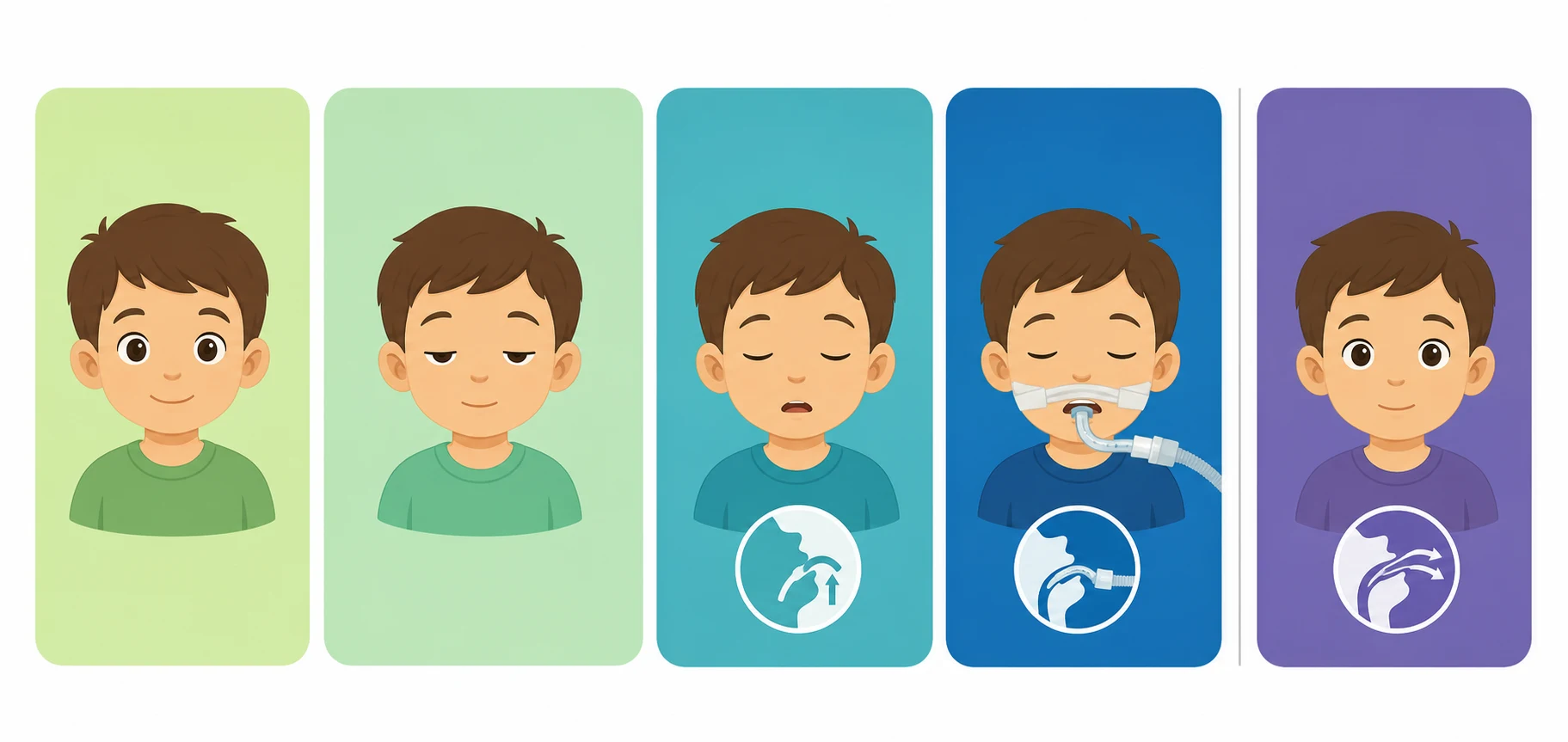
Classify a sedation episode by the depth of consciousness you intend to reach, because depth dictates who must do it, what monitoring is mandatory, and how likely the airway is to need help. The American Society of Anesthesiologists continuum runs from minimal sedation, through moderate and deep sedation, to general anaesthesia, with dissociative sedation held as a separate state unique to ketamine. [3] [4]
Minimal sedation, or anxiolysis, leaves the child responding normally to voice; ventilation and cardiovascular function are unaffected, and nitrous oxide at sub-dissociative concentrations and oral midazolam often land here. It suits imaging or minor, painless procedures in an anxious child. [5]
Moderate, or conscious, sedation gives a depressed consciousness from which the child responds purposefully to voice or light touch; airway reflexes and spontaneous ventilation are preserved, and cardiovascular function stays stable. Many ketamine and midazolam-fentanyl emergency sedations aim for this band. [1] [2]
Deep sedation reaches a state where the child responds only to repeated or painful stimulus, the airway may need support, and spontaneous ventilation can become inadequate; propofol sedation lives here, and with it the obligation of an anaesthesia-capable rescuer. [4]
Dissociative sedation, produced by ketamine, is a cataleptic state in which the eyes remain open, the airway reflexes and muscle tone are maintained, and cardiovascular stability is preserved, even though the child is unresponsive to the procedure. It is pharmacologically distinct from the continuum and is the reason ketamine is so useful for painful procedures outside the operating theatre. [3]
Epidemiology & Risk Factors
Procedural sedation in children is common, and it is safe in trained hands, but the rare serious events are almost all airway events. Across the emergency and procedural settings, ketamine dominates practice for painful reduction and repair, and surveys of Australasian and European paediatric emergency departments show a strongly standardised approach built around it. [1] [2]
The serious complications are few and predictable. In a very large international analysis of ketamine emergency department sedation, critical and high-risk adverse events such as apnoea, hypoxia, and laryngospasm were uncommon, and the predictors that mattered were high intravenous dose, very young age, and underlying airway or neurological abnormality. A separate analysis of more than a quarter of a million paediatric sedation episodes found laryngospasm itself to be rare but clustered in the youngest children, those with upper airway infection, and those sedated for airway and head-and-neck procedures. [3] [4]
What shapes risk in paediatric procedural sedation
The risk factors an examiner expects you to name are the ones that tilt a sedation from safe to dangerous: age under two to three years, an active upper respiratory infection or snoring, obesity and obstructive sleep-disordered breathing, American Society of Anesthesiologists physical status of three or higher, neuromuscular or airway abnormality, and the planned use of more than one sedative class, especially an opioid with a benzodiazepine. Each is a flag to reassess the depth, the agent, or whether the child belongs in an operating theatre instead. [3] [4]
Pathophysiology
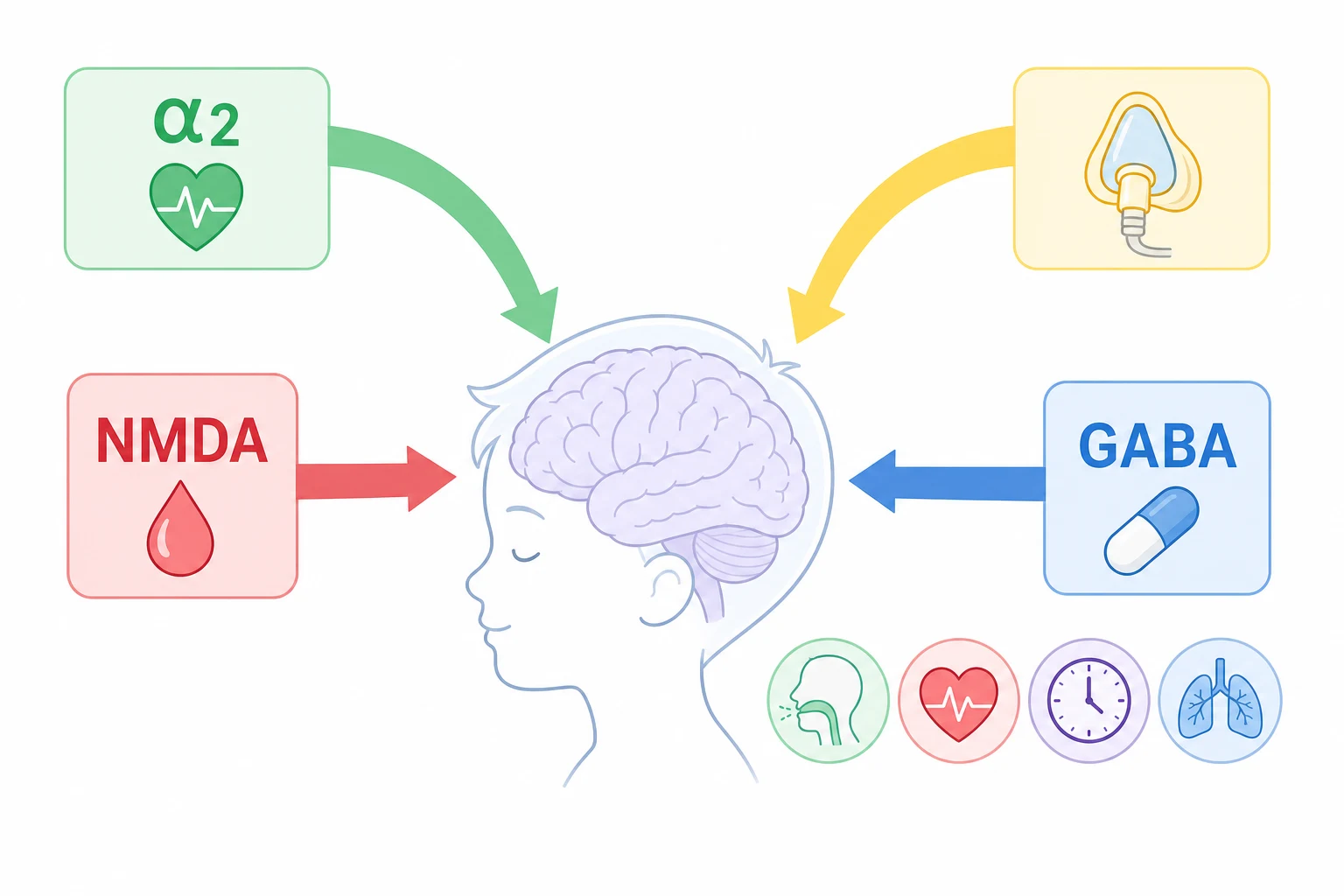
Each agent class works on a different receptor, and the receptor decides the depth, the airway behaviour, the haemodynamics, and the recovery. Naming the pharmacology is the step that turns a list of drugs into a set of reasoned choices. [3] [12]
Ketamine is a non-competitive NMDA receptor antagonist that produces dissociative sedation and genuine analgesia. It stimulates the sympathetic nervous system, so heart rate and blood pressure rise or hold steady, and it preserves airway reflexes and muscle tone, which is why it is tolerated outside the operating theatre. Its costs are hypersalivation, nausea and vomiting, nystagmus, and the emergence phenomena of recovery agitation or vivid dreams, and the rare but feared events of laryngospasm and transient apnoea. [3] [4]
Nitrous oxide is an inhaled agent giving minimal to moderate sedation with analgesia at sub-dissociative concentrations. It has a rapid onset and an equally rapid recovery because it is insoluble and washes in and out quickly, and it has minimal haemodynamic effect. Its weakness is inadequate sedation for intensely painful procedures, and it is contraindicated where gas expansion matters, including pneumothorax, bowel obstruction, and middle-ear disease, and in vitamin B12 or folate deficiency because it inhibits methionine synthase. [5]
Midazolam and propofol work on the GABA-A receptor. Midazolam gives anxiolysis, amnesia, and sedation with no analgesia, and it is the benzodiazepine of choice for its rapid onset and short half-life; propofol gives deep sedation with a brisk onset and rapid wake-up but a narrow margin to apnoea and hypotension. Both are reversed or overridden only by airway support, since no pharmacological reversal exists for propofol. [4] [2]
Dexmedetomidine is a selective alpha-2 adrenoceptor agonist that produces a sedation resembling natural, rousable sleep with minimal respiratory depression, making it attractive where airway reserve is precious. Its characteristic adverse effects are bradycardia and hypotension from the sympatholysis that is also its mechanism, and it has slower onset and longer recovery than the GABA agents, which limits its role in rapid emergency sedation. [9] [12]
Clinical Presentation
The clinical presentation of procedural sedation is not the child but the procedure, and matching the two is the first decision. A handful of scenarios dominate paediatric practice, and each suggests a different depth and a different agent. [1] [2]
The painful emergency procedure is the commonest: fracture or joint reduction, complex wound repair, abscess drainage, burns dressing change, or lumbar puncture in an uncooperative child. These demand dissociative or deep sedation with real analgesia, which is the territory of ketamine given intravenously or intramuscularly, with dexmedetomidine as a respiratory-sparing alternative in selected children. [3] [10]
The brief, moderately painful procedure, such as intravenous cannulation or venepuncture in an anxious child or a minor laceration repair, may need only nitrous oxide or intranasol analgesia-sedation, with a rapid return to baseline. The gain here is speed of recovery and a preserved airway, and the loss is inadequate depth if the stimulus proves stronger than expected. [5]
The painless but frightening procedure, such as computed tomography or magnetic resonance imaging, needs immobility and anxiolysis more than analgesia, and oral midazolam, dexmedetomidine, or propofol sedation fits. The trap is the child who moves during the scan and is then re-dosed to a deeper level than the airway was prepared for. [12] [9]
The special-needs or technology-dependent child presents both the highest need for sedation, because cooperation is hard, and the highest risk, because airway tone, secretion handling, and drug clearance may be abnormal. These children often warrant anaesthetic involvement rather than emergency department sedation, and the decision is made before, not during, the procedure. [4]
Differential Diagnosis
When a child behaves unexpectedly during or after sedation, the differential is the drug, the procedure, or the child, and separating them changes the management. [3] [11]
| You see | Most likely cause | Distinguishing feature | Trap |
|---|---|---|---|
| Tachycardia, hypertension during the procedure | Inadequate analgesia or stimulus break-through | Coincides with the painful step; ketamine levels are subtherapeutic | Treating it as drug toxicity and deepening sedation, when analgesia is what was missing |
| Desaturation and falling end-tidal carbon dioxide | Hypoventilation from oversedation | Capnography shows shallow or slow breaths first | Trusting oximetry, which lags when supplemental oxygen is given |
| Stridor, crowing, or paradox during the procedure | Laryngospasm, usually stimulus-driven | Ketamine or deep sedation in a young child with an upper airway infection | Treating with more sedative instead of oxygen, jaw thrust, and positive pressure |
| Agitation and distress in recovery | Emergence phenomena or unrelieved pain | Ketamine recovery within 30 to 60 minutes; pain persists with the stimulus | Diagnosing delirium when the child is actually in pain from an inadequate block |
| Vomiting during or after sedation | Drug effect, classically ketamine | Timed to peak drug effect or recovery | Aspiration risk if the airway is unprotected, so suction and lateral position first |
Break-through stimulus versus drug toxicity. A rise in heart rate and blood pressure during the painful step of the procedure is far more often inadequate analgesia than a reaction to the drug, and the response is to deepen appropriately, not to chase the numbers with a different class. [3]
Emergence agitation versus pain. Ketamine recovery agitation is common, brief, and self-limiting, and it is distinguished from unrelieved pain by its timing in recovery and by settling with reassurance, low-stimulation environment, and benzodiazepamine only if severe and persistent. Mislabelling pain as delirium, or delirium as pain, prolongs both. [10] [4]
Clinical & Bedside Assessment
The pre-sedation assessment is where most disasters are prevented, because it decides whether the child is fit for emergency department sedation at all and which depth and drug are safe. Run it as a checklist before any drug is drawn up. [3] [4]
Assess the airway and the breathing first. Look for the features that predict difficulty: micrognathia, limited mouth opening, neck stiffness, stridor or stertor, an active upper respiratory infection, snoring or obstructive sleep-disordered breathing, and obesity. Any of these raises the chance that deep sedation will lose the airway, and is a reason to involve an anaesthetist or to choose an agent that spares respiration, such as ketamine or dexmedetomidine. [4]
Assign an American Society of Anesthesiologists physical status and take a focused history. Document the weight from a current measurement, allergies, previous sedation reactions, seizure or neuromuscular disorder, recent respiratory illness, and the last oral intake. An ASA physical status of one or two is suitable for emergency department sedation; a status of three or higher, or a significant airway abnormality, usually warrants anaesthetic care. [6] [7]
Decide the fasting approach from the evidence, not from theatre habit. The traditional elective fasting windows of six hours for solids and two hours for clear fluids were built for general anaesthesia, and the procedural sedation literature repeatedly shows that fasting duration does not reduce the risk of adverse events in the emergency setting. For an urgent painful procedure, the child is not delayed for fasting; the decision to wait is individualised and documented, balancing aspiration risk against the harm of deferring. [6] [7] [8]
Obtain consent and set the depth. Explain the planned agent, the expected experience, the common recovery phenomena, and the rare serious risks, and record the target depth of sedation and the chosen drug. Confirm that a second clinician whose sole task is sedation and airway is identified, and that the SOAP-ME equipment is present and checked. [3] [11]
Investigations
There are no laboratory tests that decide a sedation; the investigations of procedural sedation are the physiological monitors, and each answers a specific question about the airway, the breathing, and the circulation. [11] [3]
Pulse oximetry is mandatory and continuous, but it is the slowest detector of the commonest problem. Hypoventilation raises the carbon dioxide long before the saturation falls, and once supplemental oxygen is given, oximetry can read normal while the child becomes dangerously hypercapnic. Oximetry alone is therefore insufficient for moderate and deep sedation. [11]
Capnography, the continuous measurement of end-tidal carbon dioxide, is the monitor that closes the gap. It detects the shallow or slowing breaths of hypoventilation within seconds, it flags apnoea immediately, and in children sedated with ketamine it has identified hypoventilation that oximetry missed. Continuous capnography is now expected for moderate and deep procedural sedation, and citing it is one of the clearest marks of a safe practice in a viva. [11]
Electrocardiography and intermittent non-invasive blood pressure track the circulation, which matters because dexmedetomidine brings bradycardia and hypotension, propofol brings hypotension, and ketamine brings a sympathetic rise that can unmask a tachyarrhythmia in a vulnerable child. Set alarm limits before the first dose so the monitor does the watching with you. [9] [12]
Monitoring for moderate and deep paediatric procedural sedation
Management — Resuscitation
When a sedation goes wrong, the airway is the first and usually the only problem that matters, and the response is oxygen, positioning, and positive pressure, escalated to a reversal agent and a call for help. [3] [11]
Open and support the airway, give oxygen, and assist ventilation. Stop the procedure and the sedative, position the child, suction secretions, apply a jaw thrust, and ventilate with a bag-valve-mask and high-flow oxygen. Most episodes of drug-induced hypoventilation or mild obstruction resolve with these steps alone, and they must be instinctive because they are the bridge to recovery. [11] [4]
Treat laryngospasm promptly and in a ladder. At the first sign of stridor or paradoxical movement, apply a firm jaw thrust, a continuous positive airway pressure seal, and one hundred per cent oxygen. If spasm persists, give a small dose of a rapid-acting neuromuscular blocker or deepen with a propofol bolus by skilled hands, and have the difficult-airway pathway and a supraglottic device ready, because a child who cannot be ventilated is seconds from harm. [4]
Give a reversal agent where one exists and the culprit is identified. Opioid-induced respiratory depression reverses with naloxone titrated to restore adequate respiration rather than full wakefulness, and benzodiazepine over-sedation may respond to flumazenil given cautiously because it can precipitate seizures. There is no reversal for propofol, ketamine, or dexmedetomidine, so for these the management is airway support and time. [3] [4]
Immediate response to a sedation adverse event
Stop and signal
Halt the procedure and the sedative; call for help and a resuscitation trolley.
Airway and oxygen
Suction, jaw thrust, one hundred per cent oxygen, bag-valve-mask ventilation if needed.
Treat the mechanism
Laryngospasm gets continuous positive airway pressure and deepening; hypoventilation gets support and a reversal agent where one exists.
Escalate
If ventilation fails, use a supraglottic device or rapid sequence intubation by a skilled clinician; observe for re-sedation after reversal.
Management — Definitive & Stepwise
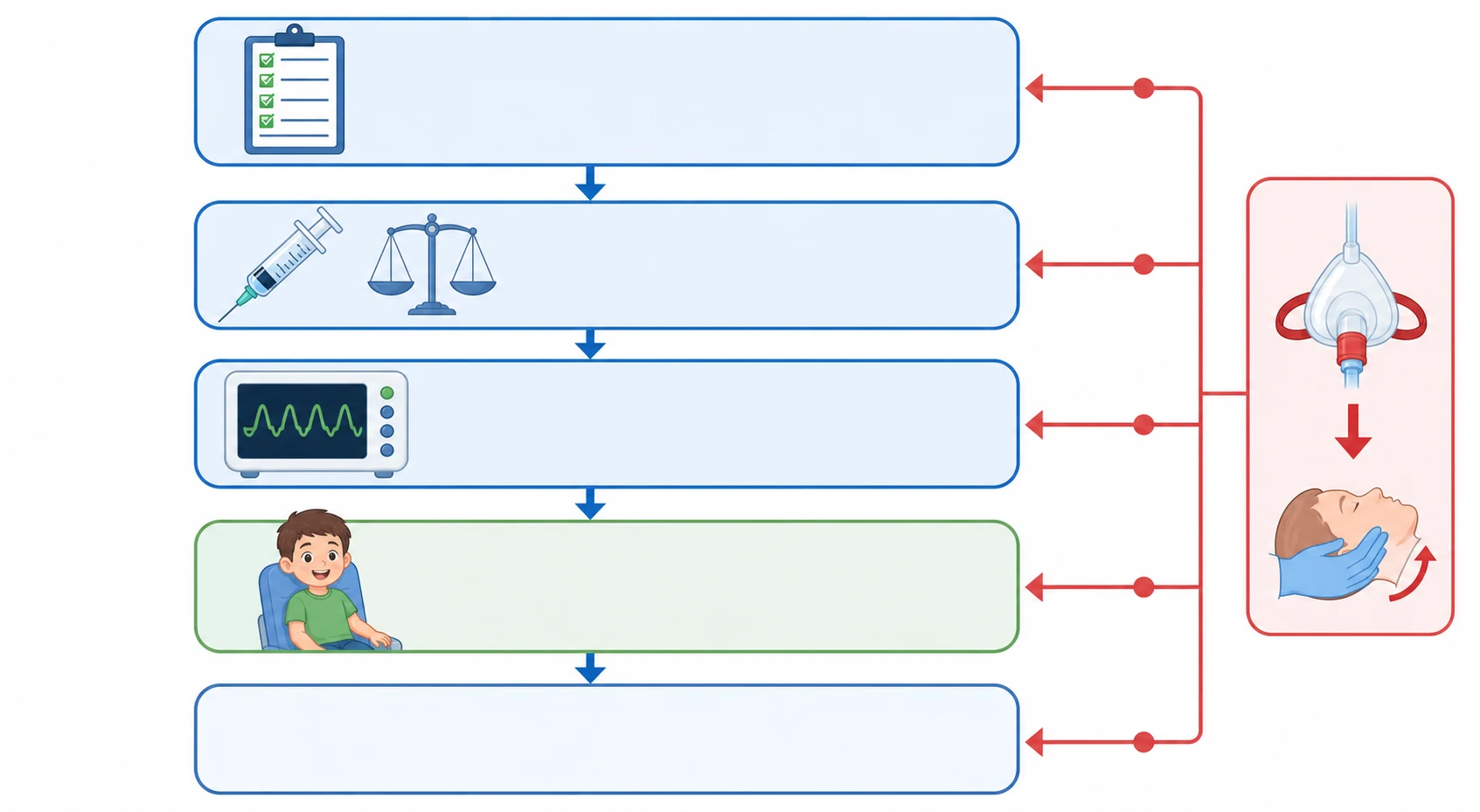
Definitive management of procedural sedation is the deliberate matching of agent, depth, and setup to the procedure, executed as a sequence rather than a single act. [1] [3]
Match the agent and depth to the stimulus. For a painful reduction or repair in a healthy child, choose dissociative ketamine by the intravenous route for reliable onset and titration, or by the intramuscular route when intravenous access is not feasible. For a brief, moderately painful procedure, choose nitrous oxide for its speed and preserved airway. For imaging in an anxious child, choose oral midazolam or dexmedetomidine, reserving propofol for brief, deep immobility under anaesthetic-capable supervision. [5] [3]
Dose by current weight, titrate to effect, and respect synergy. Ketamine is given at roughly one to two milligrams per kilogram intravenously or four to five milligrams per kilogram intramuscularly; midazolam intravenously at nought point nought five to nought point one milligram per kilogram titrated; fentanyl at one microgram per kilogram; dexmedetomidine intranasally at one to two micrograms per kilogram. When two classes are combined, especially an opioid with a benzodiazepine, reduce each dose because their respiratory depressions multiply. [3] [2]
Stand up the monitoring and the team before the drug. Attach pulse oximetry, capnography, ECG, and blood pressure with alarm limits set; confirm the independent sedationist, the proceduralist, and the SOAP-ME equipment; and pre-oxygenate. The team is briefed on who manages the airway, who calls the escalation, and who documents. [11] [4]
Run recovery to explicit discharge criteria. Once the procedure ends, watch the child in a monitored area until consciousness, airway, breathing, and circulation return to baseline, and apply a validated discharge score. The family is safety-netted on emergence phenomena, oral intake, and when to return, and the episode is documented with the agent, dose, depth achieved, adverse events, and the recovery time. [3] [1]
Bhatt et al., JAMA Pediatrics — preprocedural fasting and emergency department sedation outcomes in children
JAMA Pediatrics, 2018
Prospective multicentre cohort of paediatric emergency department sedations examining the association between fasting duration and adverse events
Key finding
The duration of preprocedural fasting was not associated with a clinically important change in the risk of desaturation, vomiting, or other adverse events during procedural sedation.
Practice change
Do not delay an urgent painful procedure in a child for a fasting window; weigh fasting status against the harm of postponement and manage aspiration risk with suction readiness and recovery positioning.
Specific Subtypes & Scenarios
Each agent owns a niche defined by its pharmacology, and an examiner expects you to place each drug, give its dose and route, and name its cardinal adverse effect. [3] [5]
Ketamine is the analgesic-sedative workhorse of paediatric emergency procedural sedation. It gives dissociative sedation that preserves airway reflexes and cardiovascular tone, it is given intravenously or intramuscularly, and its recovery lasts roughly half an hour to an hour. Its predictable adverse effects are hypersalivation, nausea and vomiting, nystagmus, and emergence phenomena, and its serious events, laryngospasm and transient apnoea, are rare and cluster in the very young, the heavily dosed, and those with airway or neurological abnormality. [3] [4]
Ketamine (paediatric procedural sedation)
NMDA antagonist — dissociative sedation with analgesia
Dose
Intravenous 1 to 2 mg/kg titrated; intramuscular 4 to 5 mg/kg when IV access not feasible
Nitrous oxide fills the light-sedation niche for brief, moderately painful procedures. Delivered as a fifty per cent mixture with oxygen by a demand-valve or continuous-flow system, it has a rapid onset and recovery and minimal haemodynamic effect, and it suits venepuncture, minor laceration repair, and dressing changes. It is contraindicated where gas expansion is dangerous, including pneumothorax, bowel obstruction, and middle-ear disease, and in vitamin B12 or folate deficiency, and it may simply be inadequate for the most painful reductions. [5]
Dexmedetomidine is the respiratory-sparing alpha-2 agonist chosen when preserving airway drive matters, such as in the neurodevelopmentally complex child or for imaging sedation. It produces a rousable, natural-sleep sedation and reduces opioid requirements, and combining it with ketamine blunts the ketamine emergence phenomena; its price is bradycardia and hypotension and a slower onset and recovery that limit rapid emergency use. [9] [10] [12]
Midazolam with an opioid remains a recognised combination for sedation with amnesia, but it is the combination most associated with synergistic respiratory depression, and it demands a dedicated observer, drawn-up naloxone, and conservative dosing of each agent. As a sole agent midazolam gives amnesia and anxiolysis but no analgesia, so using it alone for a painful procedure is the cardinal sedation error. [2] [4]
Propofol delivers deep sedation with a rapid onset and a crisp wake-up, which makes it attractive for brief procedures, but it has a narrow margin to apnoea and hypotension and no pharmacological reversal, so it is reserved for clinicians with anaesthesia-capable airway skills and immediate rescue. [4]
Complications & Pitfalls
The complications that matter in paediatric procedural sedation are few, and each has a recognised mechanism and a rehearsed response; naming them is a viva pass requirement. [3] [11]
Laryngospasm is the feared airway event, rare overall but concentrated in the youngest children, those with an active upper respiratory infection, and procedures around the airway and head and neck. The response is a firm jaw thrust with continuous positive airway pressure and one hundred per cent oxygen, deepening or a small paralytic dose by skilled hands if it persists, and a supraglottic rescue device ready. Screening for upper-airway infection and avoiding over-deepening in the vulnerable child are the preventions. [4]
Hypoventilation and hypoxia arise chiefly from the GABA agents and the opioid-benzodiazepine combination, and the pitfall is detecting them late because oximetry lags under supplemental oxygen. The defence is continuous capnography with alarm limits, a dedicated sedationist, and a reversal agent drawn up for the reversible classes. [11]
Emergence phenomena and vomiting are the common, less dangerous but distressing effects of ketamine; agitation and vivid experiences in recovery are managed with a low-stimulation environment, reassurance, and a benzodiazepine if severe and persistent, and vomiting is managed with suction, lateral positioning, and antiemetic only as needed. The family is forewarned so these are expected rather than alarming. [3] [10]
Oversedation from drug synergy is the iatrogenic pitfall, almost always from combining an opioid with a benzodiazepine or from redosing two classes when the stimulus is judged as inadequate analgesia. The discipline is to add an analgesic for break-through pain and a sedative for break-through anxiety, never to pile sedatives for pain, and to reduce each dose when classes are combined. [2] [4]
Prognosis & Disposition
The prognosis of procedural sedation is excellent when it is delivered by a trained team with the right monitoring and rescue, and the disposition is governed by recovery to explicit criteria rather than by a fixed time. [3] [1]
A child is observed in a monitored recovery area until consciousness, airway, breathing, and circulation are back to baseline and the validated discharge criteria are met, which typically takes thirty minutes to an hour after a ketamine episode and is faster after nitrous oxide. The family leaves with a clear safety-net covering the expected emergence phenomena, the resumption of oral intake, activity restrictions, and the features that should prompt return. [3] [5]
Any adverse event, however minor, is documented with the agent, dose, route, depth achieved, the monitors in use, and the response, and significant events are reported and reviewed. The learning loops back into protocol, training, and the screening of the next child, so that a laryngospasm or a near-miss becomes a system change rather than a recurring pattern. [4] [3]
Special Populations
Each higher-risk group changes the choice of agent or the setting in which it is given, and recognising the group is the trigger to escalate the plan. [3] [4]
Infants and children under two to three years carry the highest risk of laryngospasm and the narrowest margin between effective and excessive dose, so weight is measured, doses are titrated, and the threshold for anaesthetic involvement is lower. Upper-airway infection in this age group is a particular flag to reconsider deep or dissociative sedation. [4]
Children with neurodevelopmental complexity or technology dependence often need sedation most and tolerate it least, because airway tone, secretion handling, and drug clearance may be abnormal and cooperation is hard. These children frequently warrant anaesthetic rather than emergency department sedation, and a plan is made prospectively with the family and the treating team. [9] [4]
Children with obesity or obstructive sleep-disordered breathing have a reduced functional residual capacity and a collapsible upper airway, so hypoventilation and obstruction come early and deep sedation is riskier. Dexmedetomidine or ketamine, which spare respiratory drive relative to the GABA agents, are favoured, and the airway is watched with particular vigilance. [11] [9]
Aboriginal and Torres Strait Islander, Maori, and other Indigenous children, and children from regional, remote, or disadvantaged backgrounds may travel long distances for a procedure, which raises the stakes of a safe single episode and the importance of clear communication, culturally safe consent, and a recovery plan that accounts for the journey home. The fasting and discharge instructions are given in a way the family can act on. [7] [1]
Evidence, Guidelines & Regional Differences
The evidence base for paediatric procedural sedation has shifted from agent surveys and single-centre cohorts to very large international analyses and multicentre fasting studies, and the core lessons are stable across regions. [1] [3]
Borland's PREDICT study mapped how Australasian emergency departments sedated children and found a standardised practice built around ketamine, and Schofield's survey of forearm fracture reduction confirmed the same dominance in the commonest painful procedure. Green's international ketamine analysis then quantified the rare critical adverse events and named their predictors, and Cosgrove's analysis of more than a quarter of a million episodes defined who laryngospasm strikes. [1] [2] [3] [4]
The fasting question was resolved by Roback's cohort finding no relation between fasting and adverse events, confirmed by Bhatt's JAMA Pediatrics multicentre study, and extended by Chumpitazi's work showing shortened fasting was safe, collectively reframing fasting as a consideration rather than a barrier in the emergency setting. Langhan's capnography work showed that end-tidal carbon dioxide monitoring catches hypoventilation that oximetry misses during ketamine sedation. [6] [7] [8] [11]
The dexmedetomidine evidence is newer and rests on pharmacology reviews such as O'Kane's systematic review and Weerink's pharmacokinetic and pharmacodynamic analysis, with Li's meta-analysis showing that combining dexmedetomidine with ketamine blunts the ketamine emergence phenomena. Tobias's review frames nitrous oxide in its light-sedation niche. [9] [12] [10] [5]
In Australasia, the Royal Children's Hospital Melbourne guidelines and the PREDICT network consensus anchor practice around ketamine for painful emergency procedures, with nitrous oxide and dexmedetomidine in defined roles and a strong expectation of capnography and a dedicated sedationist. The AMH Children's Dosing Companion and local sedation policies give the doses. [1] [2]
Exam Pearls
Mnemonic — the five agents by receptor: Ketamine at NMDA, Nitrous inhaled, Midazolam and Propofol at GABA-A, and Dexmedetomidine at alpha-2. Remember "K-N-MP-D", and that only ketamine and the opioids carry real analgesia, which is why sedating a painful procedure with midazolam alone is the cardinal error. [3] [12]
Frequently misremembered facts, correctly stated. Ketamine preserves, not depresses, airway reflexes and cardiovascular tone; capnography detects hypoventilation earlier than oximetry, not the other way around; fasting does not reduce emergency-sedation adverse events, so an urgent painful procedure proceeds; and an effective sedation team has a dedicated sedationist separate from the proceduralist, not one person doing both. [3] [7] [11]
The viva trap. Asked "how would you sedate a child for a forearm fracture," do not name a drug and stop. Give the structured answer: assess the airway and ASA status, set the depth to dissociative, give intravenous or intramuscular ketamine dosed by current weight, stand up a dedicated sedationist with capnography and SOAP-ME, manage recovery to explicit discharge criteria, and pre-empt laryngospasm by screening for upper-airway infection. Add that fasting does not delay an urgent procedure, and that an opioid-benzodiazepine combination is the one to respect for apnoea. [3] [4] [2]
References
- [1]Borland M, Esson A, Babl F, Krieser D Procedural sedation in children in the emergency department: a PREDICT study Emerg Med Australas, 2009.PMID 19254316
- [2]Schofield S, Schutz J, Babl FE, Paediatric Research in Emergency Departments International Collaborative (PREDICT) Procedural sedation and analgesia for reduction of distal forearm fractures in the paediatric emergency department: a clinical survey Emerg Med Australas, 2013.PMID 23759045
- [3]Green SM, Tsze DS, Roback MG Emergency Department Ketamine Sedation: Frequency and Predictors of Critical and High-Risk Adverse Events Ann Emerg Med, 2025.PMID 40481829
- [4]Cosgrove P, Krauss BS, Cravero JP, Fleegler EW Predictors of Laryngospasm During 276,832 Episodes of Pediatric Procedural Sedation Ann Emerg Med, 2022.PMID 35752522
- [5]Tobias JD Applications of nitrous oxide for procedural sedation in the pediatric population Pediatr Emerg Care, 2013.PMID 23546436
- [6]Roback MG, Bajaj L, Wathen JE, Bothner J Preprocedural fasting and adverse events in procedural sedation and analgesia in a pediatric emergency department: are they related? Ann Emerg Med, 2004.PMID 15520704
- [7]Bhatt M, Johnson DW, Taljaard M, Chan J, Barrowman N, Farion KJ Association of Preprocedural Fasting With Outcomes of Emergency Department Sedation in Children JAMA Pediatr, 2018.PMID 29800944
- [8]Chumpitazi CE, Camp EA, Bhamidipati DR, Montillo AM, Chantal Caviness A, Mayorquin L Shortened preprocedural fasting in the pediatric emergency department Am J Emerg Med, 2018.PMID 29395760
- [9]O'Kane A, Quinney SK, Kinney E, Bergstrom RF, Tillman EM A systematic review of dexmedetomidine pharmacology in pediatric patients Clin Transl Sci, 2024.PMID 39644147
- [10]Li HP, Liu KP, Yao L Dexmedetomidine in combination with ketamine for pediatric procedural sedation or premedication: A meta-analysis Am J Emerg Med, 2021.PMID 34492589
- [11]Langhan ML, Chen L, Marshall C, Santucci KA Detection of hypoventilation by capnography and its association with hypoxia in children undergoing sedation with ketamine Pediatr Emerg Care, 2011.PMID 21494162
- [12]Weerink MAS, Struys MMRF, Hannivoort LN, Barends CRM, Absalom AR, Colin P Clinical Pharmacokinetics and Pharmacodynamics of Dexmedetomidine Clin Pharmacokinet, 2017.PMID 28105598