Paeds · growth-development-and-behaviour
Developmental assessment: history, examination and standardised tools
Also known as Developmental assessment · Developmental examination · Standardised developmental tools · Bayley developmental testing · ASQ developmental screen
Fellowship approach to structured developmental history and examination, correct age use, selection and limits of standardised screening and diagnostic tools, first-line hearing and vision, synthesis, referral and exam performance.
On this page & tools
Your progress
Saved locally on this device.
Practise this topic
Target exams
Red flags
Life stages
Care settings
Clinical exam formats
Board mappings
H.O.T.E.L. assessment
Overview & Definition
A developmental assessment answers one practical question: what can this child do across domains, how does that compare with expected skills for age, and what do we do next? It is not a single questionnaire. It is a structured clinical process that combines caregiver report, observation, physical examination and, when appropriate, a standardised instrument. [1]
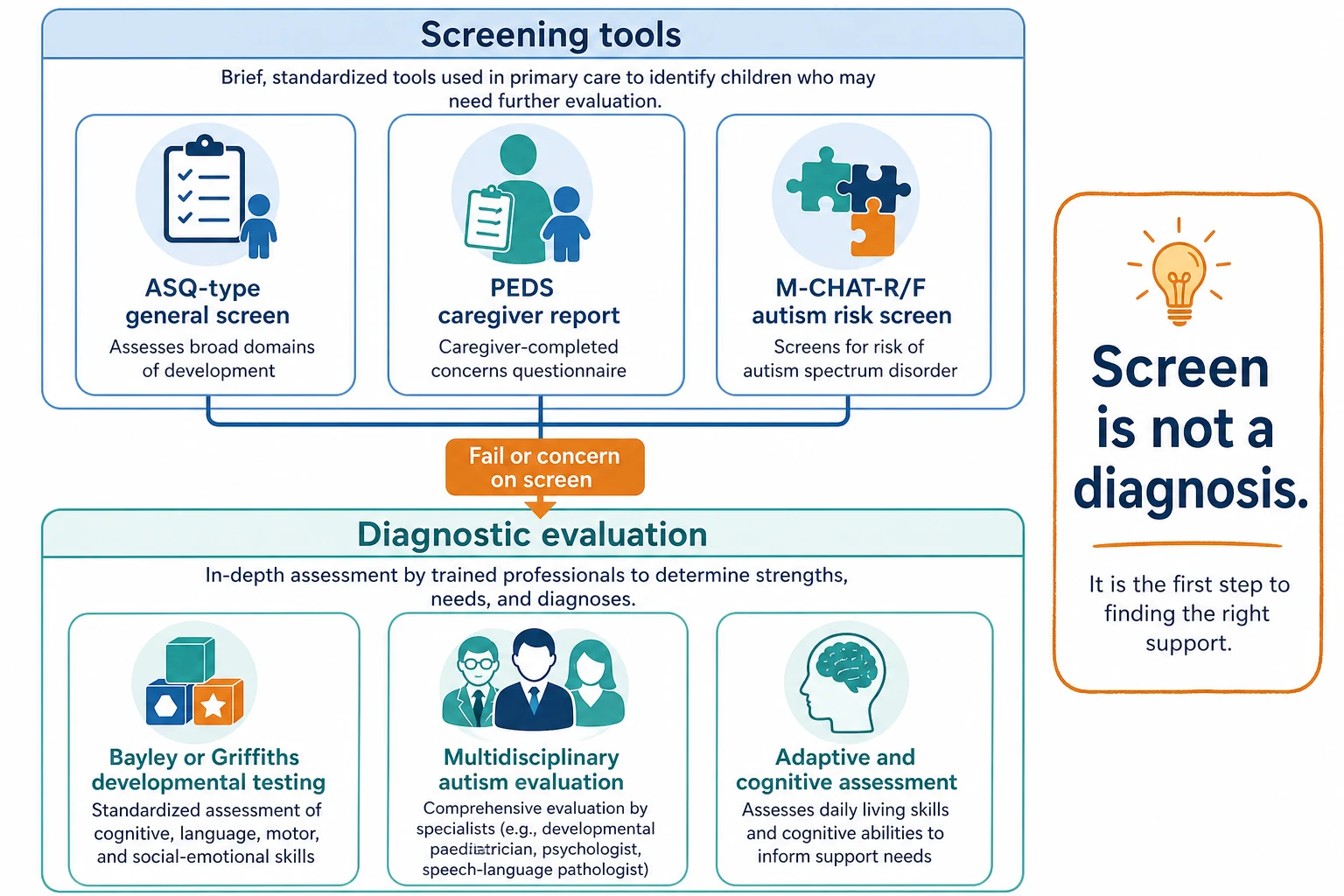
Surveillance is continuous watching and asking at every visit. Screening uses a validated tool with known performance characteristics. Diagnostic evaluation uses deeper instruments and multidisciplinary judgement that can support a diagnosis and service plan. This page teaches how to run the assessment itself and how to place tools in the right tier. [1] [3]
Use evidence-informed milestones rather than personal folklore. Tools and lists should reflect skills most children of that age achieve, not outdated “average age” lists that falsely reassure. [2]
Classification
Classify the purpose of the encounter first: routine well-child check, targeted concern visit, neonatal follow-up, or school-entry problem. Then classify the pattern: isolated domain lag, multi-domain delay, social-communication pattern, plateau, or regression. Finally classify the tool tier: caregiver-report screen, general developmental screen, autism-specific screen, or formal diagnostic developmental testing. [1] [3]
For preterm infants, use corrected age for early developmental interpretation as your local follow-up protocol advises, then transition to chronological age according to service rules. Wrong age choice is a common exam and clinic error. [1] [5]
Epidemiology & Risk Factors
Children at higher risk of delayed or incomplete assessment include those born preterm, those with complex chronic disease, families facing language discordance or transport barriers, and children in fragmented care. Medical complexity invites diagnostic overshadowing: teams explain everything by the known diagnosis and stop looking for treatable developmental needs. [7]
Caregiver concern is a high-value signal. Treat “I am worried about speech” or “they used to wave and stopped” as data, not soft noise. Professional interpreting improves history quality and counselling about tool results when language discordance is present. [1] [8]
Pathophysiology
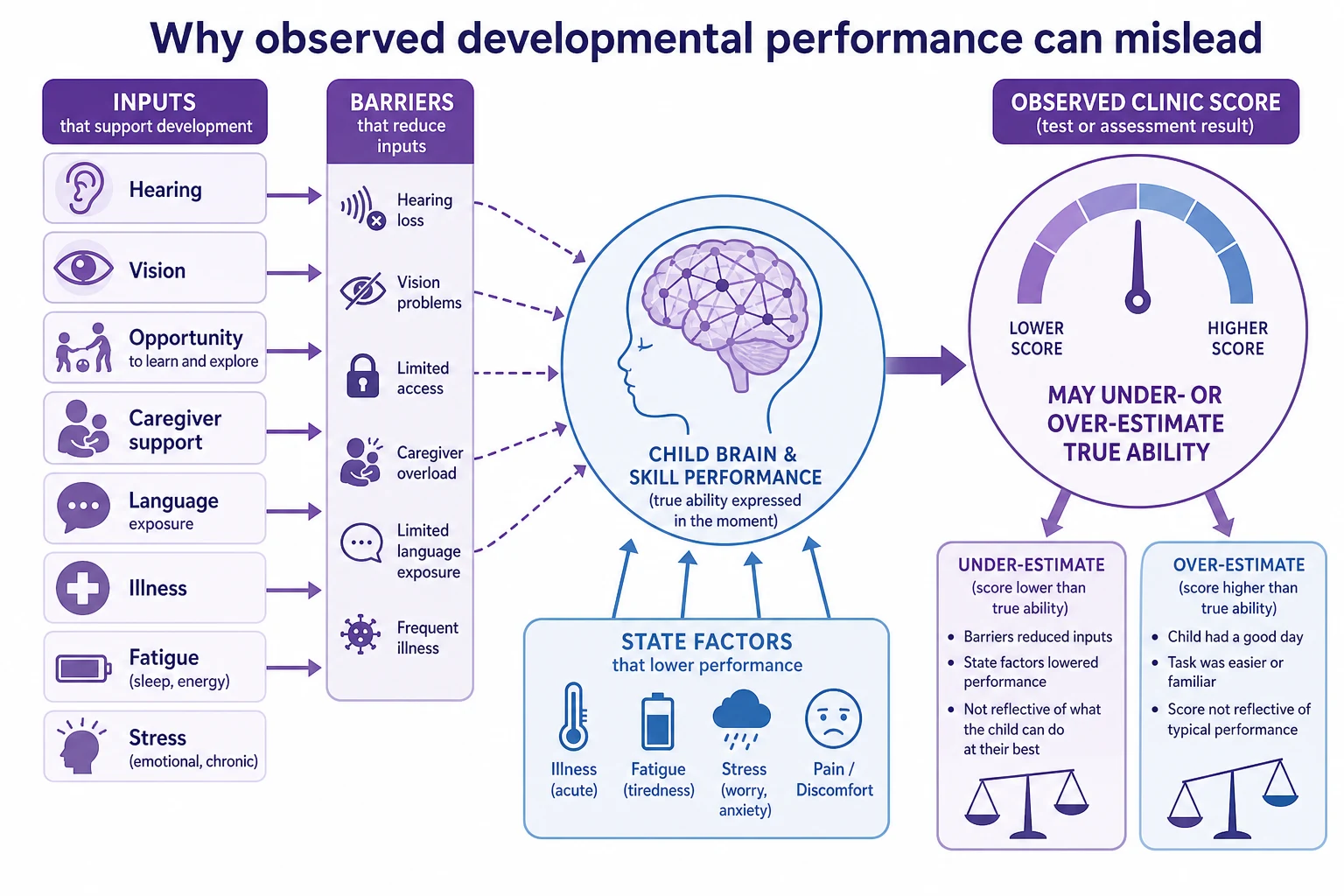
Observed performance is the product of brain development, sensory input, opportunity to practise skills, and the child’s state on the day. Hearing loss can look like language delay. Severe visual impairment changes how motor and social skills appear. Hunger, fever, sedation after procedures, trauma-related hyperarousal or extreme shyness can all depress scores without rewriting the child’s true trajectory. [1] [10]
Standardised tools reduce the false reassurance of a brief “looks fine on the table.” They do not remove the need for clinical context. Psychometric work on instruments such as the Bayley Scales of Infant and Toddler Development–III shows why trained administration and local validation matter when scores drive decisions. [5]
Clinical Presentation
Families may say the child is “quiet,” “in their own world,” “clumsy,” “not talking like cousins,” or “was saying words and stopped.” In the room you may see reduced joint attention, limited gesture, delayed babble or words, asymmetric tone, or a preschooler who cannot follow dual commands. Behaviour that prevents testing — extreme distress, elopement, refusal — is itself clinical data and may force a staged assessment rather than a forced full battery today. [1] [3]
Differential Diagnosis
Separate global developmental delay from isolated domain delay. Consider hearing impairment in any language concern. Consider autism-pattern social communication when joint attention, reciprocal interaction and restricted patterns dominate. Consider motor disorder or cerebral palsy risk when tone, posture and primitive reflexes are abnormal. Consider opportunity deprivation or neglect when the environment cannot support practice — and open safeguarding routes without abandoning medical evaluation. [1] [4] [10]
Clinical & Bedside Assessment
History
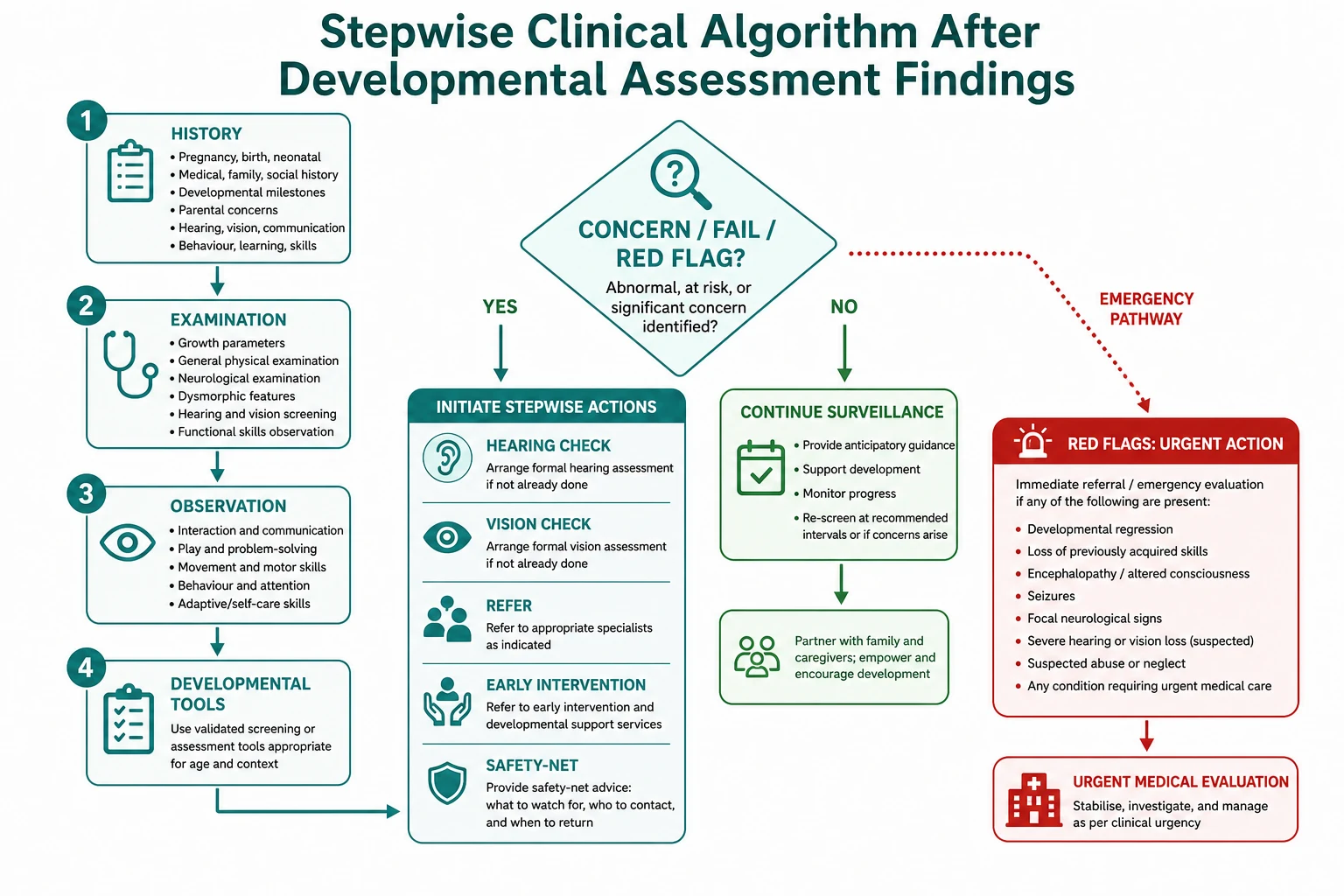
Start open: “Do you have any concerns about how your child is learning, playing, speaking or moving?” Then take a structured developmental history: pregnancy and birth, gestational age, neonatal course, hearing newborn screen results, vision concerns, milestones by domain, loss of skills, sleep and behaviour, family history of developmental or learning problems, school or childcare reports, and social supports. Source-attribute who reported each skill. [1] [2]
Observation before tools
Watch free play before you direct the child. Note eye contact, response to name, gesture, babble or words, pincer, sit/stand/walk, and how the child uses the caregiver for comfort. Observation often reveals more than a checklist completed while the child cries on a lap. [1] [2]
Examination
Measure growth and plot it. Examine dysmorphic features, skin findings, tone, power, deep tendon reflexes, posture, gait when walking, cranial nerves as age allows, and hearing and vision screens appropriate to setting. Document neurological soft signs that change the differential. [1] [4]
Standardised tools — how to choose
General developmental screens (for example Ages and Stages Questionnaire–type tools used by your service) support broad domain risk identification at key ages or on concern. Caregiver-report tools such as PEDS-type instruments capture parent concern efficiently and have been adapted for remote and m-health delivery in research settings. Autism-specific screens such as M-CHAT-R/F target social communication risk in toddlers and need the validated follow-up interview pathway — a single checkbox form is not a diagnosis. [1] [3] [6]
Diagnostic developmental instruments (Bayley-type infant–toddler scales, Griffiths-type scales, and school-age cognitive and adaptive batteries) belong with trained assessors. They characterise performance across domains and support evaluation of global delay or intellectual disability pathways. Do not invent cut-offs from memory and do not promise an IQ from a brief clinic screen. [4] [5]
Use the tool’s official age form. Correct prematurity when the tool and local protocol require it. Stop and reschedule if the child is too unwell or distressed for a valid session, unless emergency red flags force an acute pathway instead. [1] [5]
Synthesis
Write a problem representation: age (corrected if used), domains affected, trajectory (delay, plateau, regression), sensory checks, tool results with dates, and next actions. Hand over clearly if another clinician will complete testing. [9]
Investigations
Screens guide referral; they rarely replace hearing and vision when communication or global development is delayed. Targeted medical and genetic evaluation for global developmental delay or intellectual disability follows frameworks such as Moeschler and colleagues: history, examination, and stepwise testing rather than random panels from one failed milestone. Avoid shotgun laboratories after a single missed skill without context. [1] [4]
Management — Resuscitation
Most developmental assessment is outpatient. Exceptions are not subtle: acute regression with encephalopathy, new seizures with skill loss, severe dehydration or safeguarding emergencies. Those use acute paediatric pathways first. Trauma-informed practice still applies while you keep the child safe. [1] [10]
Management — Definitive & Stepwise
- Complete history, observation and examination.
- Deploy the right validated tool for age and question, or document why a tool was deferred.
- Interpret results with clinical judgement — strong concern can justify referral even if paperwork is incomplete.
- Arrange hearing and vision when indicated.
- Refer early to developmental-behavioural, allied health and early intervention services per local pathways.
- Explain screening versus diagnosis with teach-back and a written plan.
- Safety-net: interim strategies, how to chase referrals, when to return sooner. [1] [3] [4]
Specific Subtypes & Scenarios
Ex-preterm infant. Use corrected age early as protocol directs. Formal tools such as Bayley-type scales are common in high-risk follow-up clinics; still integrate caregiver concern and neurology. [1] [5]
Toddler speech and social concern. Combine general developmental assessment with autism-specific screening using follow-up when indicated, and do not delay hearing assessment. [3]
Medical complexity. Ask what is new for this child. Adapt testing environment and avoid attributing every lag to the known diagnosis without looking. [7]
Language-discordant family. Use professional interpreters for history, tool items that require verbal mediation, and result counselling. [8]
School-age learning concern. Frame cognitive and adaptive function carefully; brief clinic screens do not replace educational psychology assessment when learning disorder is the question. [4]
Regression. Urgent structured evaluation — not “review in six months.” [1]
Complications & Pitfalls
Treating a screen as a diagnosis. Using the wrong age form. Ignoring hearing. Reassuring on outdated milestone folklore. Over-interpreting one tired session. Losing families on long waitlists without interim support. Incomplete handover of tool results. [1] [2] [9]
Prognosis & Disposition
Earlier structured assessment and earlier access to services improve functional trajectories for many children with developmental disorders. Disposition is not “refer and forget”: name who owns follow-up, what interim therapy can start, and how the family escalates if skills worsen. [1] [4]
Special Populations
NICU graduates, children with known genetic syndromes, neurodiverse families seeking affirming care, Indigenous families needing culturally safe services, migrant and refugee families with interrupted care, and children in out-of-home care all need active, adapted assessment rather than passive assumptions. Trauma-informed and interpreter-supported care are part of valid assessment, not optional extras. [7] [8] [10]
Evidence, Guidelines & Regional Differences
AAP clinical guidance from Lipkin and colleagues frames surveillance plus screening and early action. [1] Zubler and colleagues provide evidence-informed milestone content for surveillance tools. [2] Robins and colleagues validated M-CHAT-R/F with follow-up for toddler autism risk. [3] Moeschler and Shevell outline comprehensive evaluation for intellectual disability and global developmental delay. [4] Bayley-III psychometric studies illustrate reliability and validity work that underpins formal developmental testing. [5]
Use local child health books, jurisdictional screening schedules, and early childhood early intervention pathways. Cultural safety and interpreter access are part of valid assessment. Name the tool your service is licensed and trained to use rather than inventing cut-offs. [8]
Healthy child programme schedules, NICE autism recognition guidance, and community paediatric and speech and language pathways shape referral thresholds. Map local access rather than assuming a universal US tool list. [1]
Bright Futures and AAP schedules drive screening ages; Canadian provincial programmes vary. State the local tool and training requirement. [1] [2]
Exam Pearls
- Assessment = history + observation + exam + right tool, not a form alone. [1]
- Corrected age for early preterm interpretation as protocol directs. [1]
- Evidence-informed milestones, not memory folklore. [2]
- Screen is not diagnosis; M-CHAT needs follow-up pathway. [3]
- Hearing first in language delay. [1]
- Global delay evaluation is structured, not a random panel. [4]
- Document domains and source of each skill report. [9]
- Strong clinical concern can justify referral even when paperwork is incomplete. [1]
References
- [1]Lipkin PH Promoting Optimal Development: Identifying Infants and Young Children With Developmental Disorders Through Developmental Surveillance and Screening Pediatrics, 2020.PMID 31843861
- [2]Zubler JM Evidence-Informed Milestones for Developmental Surveillance Tools Pediatrics, 2022.PMID 35132439
- [3]Robins DL Validation of the modified checklist for Autism in toddlers, revised with follow-up (M-CHAT-R/F) Pediatrics, 2014.PMID 24366990
- [4]Moeschler JB Comprehensive evaluation of the child with intellectual disability or global developmental delays Pediatrics, 2014.PMID 25157020
- [5]Pavlova P A psychometric study of the Russian-language version of the Bayley Scales of Infant and Toddler Development-third edition: An assessment of reliability and validity Front Psychol, 2022.PMID 36118487
- [6]Maleka BK Developmental Screening-Evaluation of an m-Health Version of the Parents Evaluation Developmental Status Tools Telemed J E Health, 2016.PMID 27286191
- [7]Kuo DZ Recognition and Management of Medical Complexity Pediatrics, 2016.PMID 27940731
- [8]Boylen S Impact of professional interpreters on outcomes for hospitalized children from migrant and refugee families with limited English proficiency: a systematic review JBI Evid Synth, 2020.PMID 32813387
- [9]Starmer AJ Changes in medical errors after implementation of a handoff program N Engl J Med, 2014.PMID 25372088
- [10]Forkey H Trauma-Informed Care Pediatrics, 2021.PMID 34312292