Paeds · growth-development-and-behaviour
Feeding problems, food refusal and selective eating
Also known as Picky eating · Selective eating · Food refusal · Food neophobia · Pediatric feeding disorder · ARFID · Avoidant restrictive food intake disorder · Texture aversion
Fellowship approach to feeding problems, food refusal and selective eating: separate ordinary toddler neophobia from pediatric feeding disorder and ARFID, exclude organic red flags, map four PFD domains, stop force-feeding, and deliver stepwise multidisciplinary care with clear safety-nets.
On this page & tools
Your progress
Saved locally on this device.
Practise this topic
Target exams
Red flags
Life stages
Care settings
Clinical exam formats
Board mappings
Overview & Definition
A parent says, “My child will only eat three foods.” That sentence can describe a healthy toddler in a temporary beige phase. It can also describe a child whose iron is falling, whose school lunch is a daily crisis, or whose mealtimes have become a battle that damages the whole household. Your job is to sort severity, mechanism and next step — not to hand out a label in the first minute. [1] [22]
Feeding problems in this leaf mean restricted variety, food refusal, texture avoidance or mealtime conflict that worries caregivers or threatens nutrition, growth, development or family function. The spectrum runs from common food neophobia to severe chronic restriction. PFD is the consensus framework for impaired oral intake that is not age-appropriate and is linked to dysfunction in one or more of four domains: medical, nutritional, feeding skill and psychosocial. ARFID is a DSM eating-disorder diagnosis used when avoidance or restriction causes significant nutritional, growth, psychosocial or dependence problems without the weight/shape overvaluation that defines anorexia nervosa. [2] [5] [6]
This page owns developmental and behavioural selective eating. Link the dedicated poor-feeding page for acute threat triage in neonates and unwell infants, and the faltering-growth page for full growth-algorithm detail. Do not collapse every picky eater into a specialist clinic, and do not reassure when charts are falling. [24] [25]
Classification
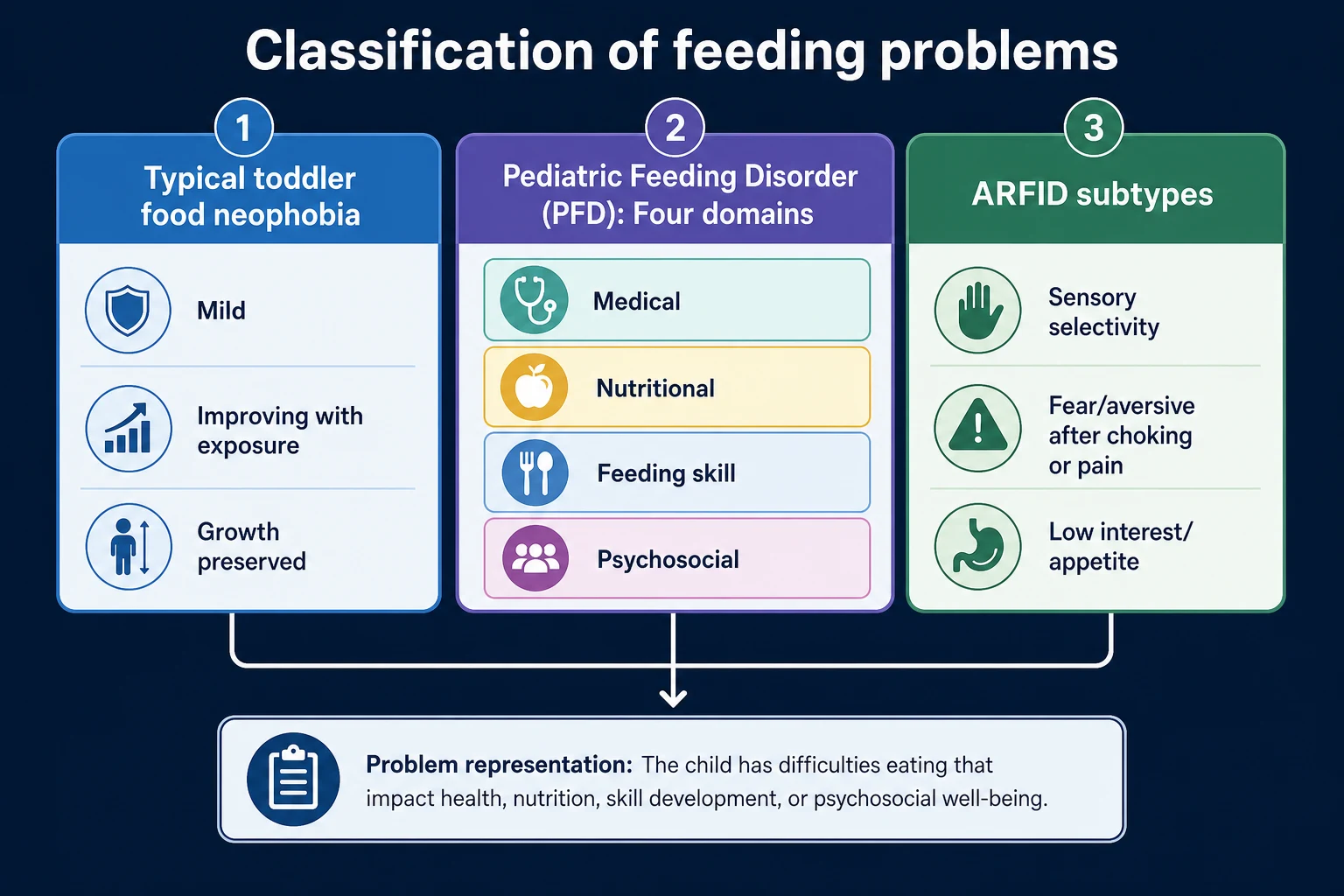
Start with significance, then framework, then subtype. [1] [2]
Significance. Kerzner’s practical approach remains high-yield at the bedside. Many children brought for “feeding difficulty” are mildly affected or even misperceived as problem feeders by anxious adults. A smaller group has a serious feeding disorder that needs structured care. The discriminating questions are: is growth preserved, is the diet nutritionally viable, is swallow safe, and is family function collapsing? [1] [22]
PFD domains. Name which domains are active. Medical means pain, reflux disease when truly present, allergy, dysphagia or other organic drivers. Nutritional means energy, macronutrient or micronutrient risk and growth impact. Feeding skill means oral-motor limits, texture progression and sensory-motor skill. Psychosocial means caregiver–child conflict, pressure tactics, anxiety and environment. Treating only one domain while ignoring the others is a classic exam trap. [2] [4]
ARFID pattern. Common clinical groupings are sensory-based selectivity, fear/aversive restriction after choking or vomiting, and low interest or low appetite with little drive to eat. Children can show mixed features. Classification work in paediatrics helps organise assessment without forcing every restricted eater into one box. [6] [12]
PFD versus ARFID. They overlap. Estrem consensus work exists precisely because teams were double-counting, under-counting or arguing labels instead of treating function. Use the label that organises care in your service, state the active problems clearly, and do not let taxonomy delay dietetics or safety checks. [5] [20]
Epidemiology & Risk Factors
Picky eating is common in early childhood. Population trajectories show that many children become less selective over time, while a persistent subgroup remains restricted and carries higher behavioural and nutritional concern. That is why “they will grow out of it” is sometimes true and sometimes a dangerous delay. [8] [9] [10]
PFD has a substantial paediatric burden in nationwide administrative data, especially in younger children and those with medical complexity. ARFID presentations appear across childhood and adolescence, with age- and sex-specific patterns in clinic and population work. Broad ARFID-phenotype cohorts also show high rates of co-occurring mental and somatic conditions, so comorbidity hunting is part of assessment, not optional colour. [3] [11] [21]
Risk rises with autism and sensory hypersensitivity, intellectual disability, prematurity and NICU oral history, chronic illness, prior tube feeding, and early highly pressured feeding practices. Caregiver anxiety, depression, food insecurity and conflicting advice amplify both true restriction and help-seeking. Ask about these openly. [7] [13] [14] [15]
Pathophysiology
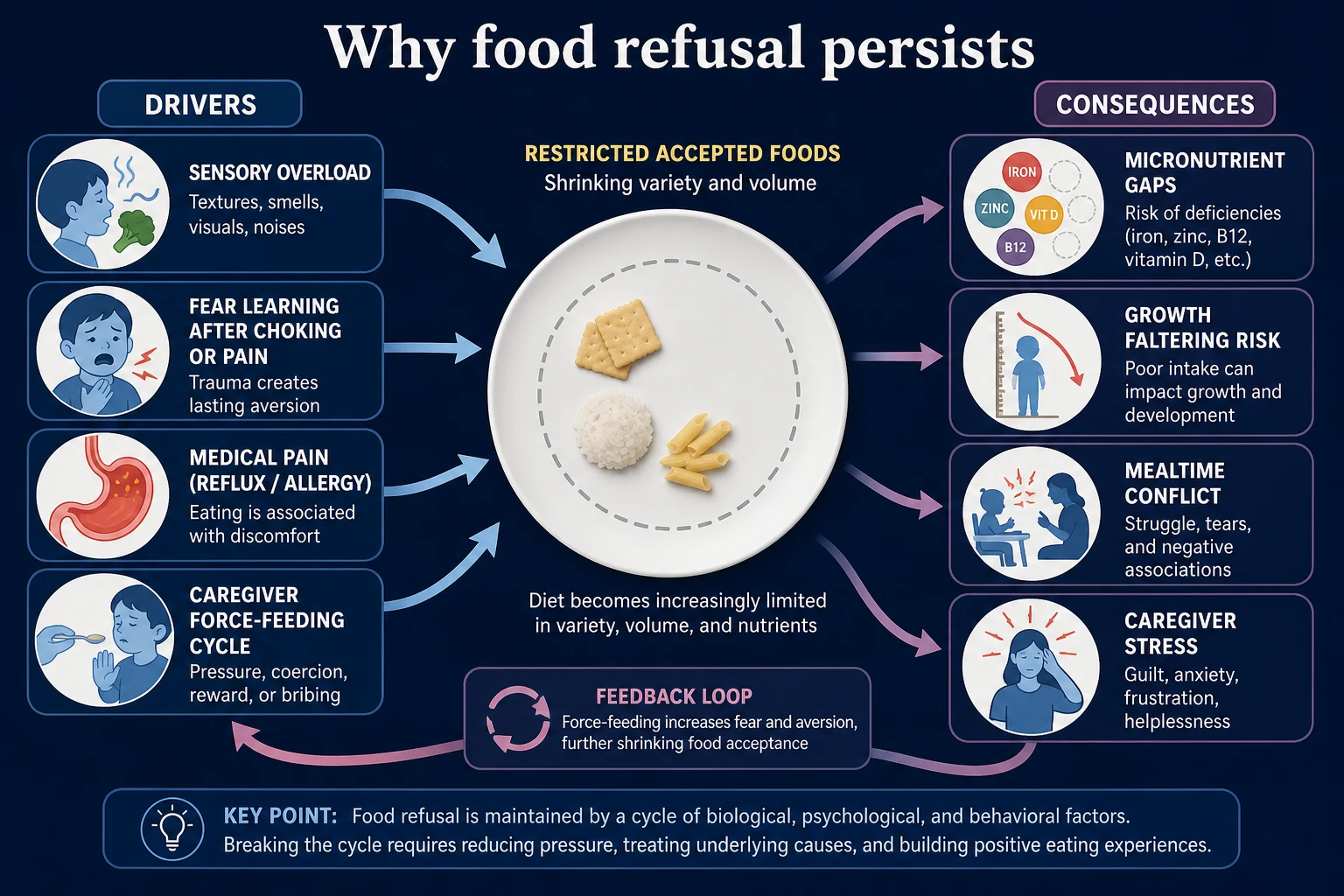
Typical food neophobia peaks in the toddler years. New colours, smells and textures feel threatening. With repeated calm exposure, most children widen their diet. The learning system is plastic: neutral or positive experiences expand the repertoire; aversive experiences shrink it. [1] [22]
Sensory hypersensitivity changes the equation. A crunch, a mixed texture or a strong smell can feel intolerable. In autism, food selectivity often tracks sensory sensitivity and can stay rigid for years, including brand-specific rules. That is not “stubbornness” in the moral sense. It is a nervous system setting that still needs nutritional protection. [13] [14] [7]
Fear learning is fast. One choking episode, one violent vomit, or repeated pain with feeds can create anticipatory refusal. Low-interest patterns look different: the child seems uninterested in food, grazes poorly and may fail to thrive without dramatic gagging. Chatoor’s work on lack of interest in eating and food highlights this developmental pathway. [6] [30]
Force-feeding and high conflict close the loop. When every meal is a battle, the child learns that food equals threat and loss of control. Caregivers then push harder. Intake may rise for a week and then collapse. Stopping the coercive cycle is treatment, not permissiveness. [1] [15]
Downstream, restricted diets risk iron deficiency, vitamin D deficiency, other micronutrient gaps, energy shortfall and growth faltering. Swallow safety problems can hide under a “behaviour” label if nobody asks about cough, wet voice or chest infections. [24] [25] [27]
Clinical Presentation
Listen to the exact script. [1]
Toddler. “He used to eat everything. Now he only wants yoghurt and crackers.” Meals run long. New foods are rejected on sight. Growth is often still fine. Caregiver distress may exceed medical risk. [1] [8]
Preschooler. Texture refusal, gagging on lumps, brand specificity and table battles dominate. Ask about iron-rich food avoidance, constipation, sleep and childcare policies. [22]
School-age, including autism. Extreme selectivity, same plate every day, melting down if packaging changes, and school lunch avoidance are common. Sensory feeding patterns are frequent in autism and still need growth and swallow review. [7] [13] [14]
Fear subtype. After choking or vomiting, the child avoids solids or whole food groups, panics near the table and may accept only purees or liquids. [6] [12]
Low-interest subtype. Little hunger cueing, long grazing, low volume and quiet growth failure without dramatic food wars. [30] [6]
Adolescent. Restriction without body-image goals can still be ARFID. Restriction with weight/shape overvaluation points toward anorexia nervosa pathways. Get this boundary right because the service route differs. [6] [11]
Differential Diagnosis
Build a short table in your head before you order anything. [1] [5]
| Pattern | Favours | Against / rethink |
|---|---|---|
| Mild neophobia, growth OK, short history | Ordinary picky eating | Falling centiles, micronutrient signs |
| Multi-domain impairment | PFD | Single-visit “phase” reassurance |
| Restriction without body-image goals | ARFID pattern | Weight/shape overvaluation |
| Cough, wet voice, chest infections | Dysphagia / aspiration risk | Pure behavioural label |
| Arching, blood/mucus stool, pain | Organic gut / allergy / true GERD pathway | Empiric long-term PPI without review |
| Adolescent thinness + body-image fear | Anorexia nervosa pathway | Calling everything ARFID |
| Mealtime violence / injury | Safeguarding | “Strict parenting only” |
Cannot-miss traps include silent aspiration labelled as picky eating, coeliac disease or inflammatory disease presenting as restriction, cardiac or respiratory work limiting intake in younger children, and severe malnutrition hidden by “he has always been small.” [27] [24] [25]
Clinical & Bedside Assessment
History. Take a structured feeding history, not a free-form chat. List accepted foods and textures. Ask brand rules, meal duration, where the child eats, who feeds, what happens after refusal, bribes, threats and force. Ask about choking, coughing, wet voice, vomiting, stool pattern, energy, sleep, school lunch and previous advice. Screen development, autism traits, anxiety and mood. Ask about food insecurity without shame. [1] [2] [7]
Growth. Plot weight, length/height and BMI or weight-for-length on appropriate charts. Use serial points. A single number without tempo misleads. WHO standards anchor early childhood growth interpretation. [26] [24]
Observe. If safe and feasible, watch a snack or meal. Look for approach, gagging, packing, expulsion, pocketing, caregiver hovering, force and child shutdown. Interaction data often explain more than laboratory panels. [1] [4]
Examine. Check oromotor structure, dentition, thrush, abdomen, tone, hydration, skin and any signs of micronutrient deficiency. Assess work of breathing and cardiac clues if intake fatigue is part of the story in younger children. [27] [28]
Team. Involve dietetics early when variety is tiny or growth is threatened. Add speech-language pathology or feeding therapy for skill and sensory texture work. Add occupational therapy when sensory processing dominates. Add psychology or eating-disorder services for ARFID fear/low-interest patterns and family accommodation. Add gastroenterology, ENT or other medical teams when red flags appear. [2] [6] [16]
Investigations
Most thriving children with short-lived mild selectivity need no shotgun blood panel. Investigation follows hypothesis. [1] [22]
Consider bloods when growth is faltering, the diet is extremely narrow, energy is poor, or symptoms suggest deficiency or organic disease. Common targets guided by history include full blood count and iron studies, vitamin D, and other micronutrients selected by diet pattern. Coeliac serology belongs when growth, stool, family history or other clues raise it — not as automatic decoration. [24] [25]
Pursue swallow assessment when cough, wet voice, recurrent chest infection or neurological concern suggests unsafe swallow. Clinical feeding evaluation comes first; instrumental tests are for selected children who are stable enough and in whom results will change management. [27] [28]
Avoid low-value cascades: routine abdominal imaging for every picky eater, automatic long-term acid suppression without a clear indication, and endless allergy panels driven by parental fear alone. NASPGHAN/ESPGHAN reflux guidance argues for stewardship, not reflexive PPI use. [23]
Management — Resuscitation
Most children on this page are ambulatory. A minority are not. [1] [24]
Treat as urgent or emergency when there is dehydration, inability to maintain fluids, suspected hypoglycaemia risk from near-zero intake, severe malnutrition, progressive aspiration risk, or an acute medical illness wearing a “food refusal” mask. ABCDE, glucose when indicated, fluids and senior review come before behavioural coaching. Admit when home safety is uncertain. [24] [25]
If the child is medically unstable, pause graded exposure work. You cannot desensitise a child who needs intravenous rehydration or airway protection. [27]
Management — Definitive & Stepwise
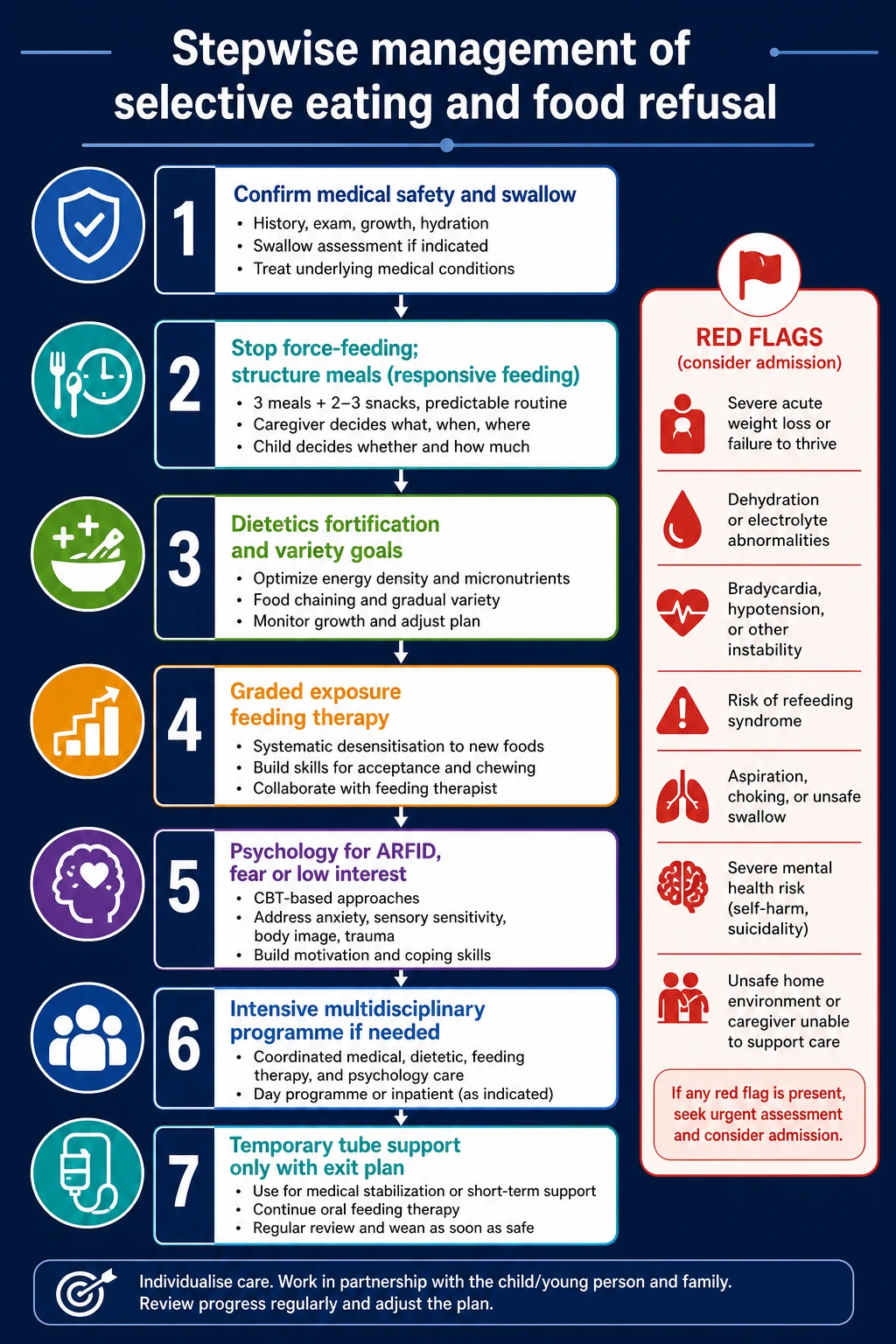
Once safety is clear, use a ladder. Climb only as far as the child needs. [1] [2] [20]
- Name the problem representation in one sentence for the family and the notes. [2]
- Stop force-feeding. Replace battles with structured meals and snacks, calm presence and clear caregiver roles. Responsive feeding principles matter more than a perfect recipe list. [1]
- Protect nutrition now. Dietetics plans fortification of accepted foods, practical supplements when indicated, and realistic variety goals. Growth rescue and relationship repair can run in parallel. [2] [4]
- Graded exposure and feeding therapy. Offer new foods without pressure, start with look–touch–smell–taste hierarchies when useful, and progress textures skillfully. Sensory-informed work is essential for many autistic children. [7] [14]
- Psychological therapy for ARFID-pattern fear or low interest. CBT-based and related approaches are used; current reviews and meta-analytic work are expanding the evidence base, especially for older youth, while child adaptations and service models continue to evolve. [6] [19] [20]
- Intensive multidisciplinary programmes for severe chronic food refusal, tube dependence or failed outpatient care. US landscape data show specialised day programmes exist but access is uneven; long-term outcome work supports meaningful gains for selected children, with ongoing need for maintenance planning. [16] [17] [18]
- Temporary tube support only when oral energy or safety cannot be met, with explicit goals, monitoring and an exit or reassessment plan. Tube feeding is a bridge. ESPGHAN position work on jejunal feeding reminds teams that route choice is specialist and indication-driven. [29] [18]
Specific Subtypes & Scenarios
Anxious parents, typical toddler neophobia. Validate concern, show the growth chart, explain normal neophobia, coach responsive feeding, and review early if variety collapses or growth slips. [1] [8]
Preschool beige diet with iron risk. Dietetics for iron-rich accepted options and fortification; limit milk excess if it displaces food; plan bloods if clinical risk is high; avoid shaming. [22] [25]
Autism with brand-specific rigidity. Expect sensory rules. Change one variable at a time. Protect calories while expanding flexibility. Do not demand a neurotypical plate as the first goal. [7] [13] [14]
Post-choking fear. Medical clearance of swallow if indicated, then graded fear-based treatment with psychology and feeding therapy. Do not force solids “to prove it is safe.” [6] [27]
Low-interest ARFID with quiet faltering growth. Schedule meals, reduce endless grazing, assess medical contributors, involve dietetics and mental-health supports early. [30] [6]
Ex-preterm oral aversion. History of tubes and aversive oral experiences matters. Intensive or specialised feeding support may be needed; pair with family mental-health attention. [17] [15]
Adolescent boundary with anorexia nervosa. Explicitly assess weight/shape overvaluation, purging and compulsive exercise. Wrong pathway delays the right team. [6] [11]
Rural or telehealth review. Use video of a meal if possible, local growth measurements, clear escalation criteria and early dietetic telehealth. Do not pretend observation is complete when it is not. [1]
Complications & Pitfalls
Common errors are predictable and examinable. [1] [5] [23]
- Calling every selective eater disordered, or calling every disordered eater “just picky.” [1]
- Missing dysphagia or pain while escalating behaviour charts. [27]
- Force-feeding that deepens aversion. [1]
- Starting long-term PPIs without a clear indication and review plan. [23]
- Ordering a laboratory catalogue instead of a hypothesis. [1]
- Leaving an NG tube without rehabilitation goals. [29]
- Ignoring caregiver mental health and food insecurity. [15]
- Missing anorexia nervosa in an adolescent by overusing the ARFID label. [6]
Prognosis & Disposition
Many mild cases improve with structured primary-care advice, reduced pressure and time. Persistent selectivity, autism-related rigidity, fear-based restriction and multi-domain PFD need longer multidisciplinary courses. Intensive programmes can improve tube dependence and chronic refusal in selected children, but gains need maintenance and family support. [8] [16] [18]
Primary care / medical home fits mild neophobia with preserved growth and a workable plan. Secondary feeding clinic fits multi-domain impairment, micronutrient risk or failed first-line coaching. Tertiary intensive or eating-disorder pathways fit severe ARFID, medical instability, or failed outpatient care. Safety-net every discharge: red flags, next weight check date, and who to call. [2] [6]
Outcomes that matter are growth trajectory, dietary variety, mealtime stress, micronutrient status, school participation and caregiver confidence — not a perfect food pyramid photo. [4]
Special Populations
Autism and sensory differences. Selectivity is common and can be severe. Sensory-informed goals beat generic “try everything” advice. Still check growth and swallow. [7] [14]
Intellectual disability. Restriction and caregiver accommodation can be long-standing; diet quality and constipation often need active surveillance. [21]
NICU graduates and tube history. Oral aversion and skill gaps are expected risks; plan early feeding support and family mental-health attention. [17] [15]
Down syndrome and craniofacial difference. Higher rates of feeding difficulty and possible tube dependence; coordinate skill, medical and nutritional domains. [2]
Indigenous, migrant and language-discordant families. Use interpreters, respect food culture, and avoid judging traditional foods as the problem. Ask about access and racism in prior care. [1]
Food insecurity. A restricted diet may be poverty plus preference. Fix access while you coach feeding behaviour. [15]
Out-of-home care and safeguarding. Mealtime control and force can signal broader harm. Document carefully and follow local safeguarding pathways. [1]
Evidence, Guidelines & Regional Differences
Key anchors for this leaf are Kerzner’s practical classification, Goday’s PFD consensus, Sharp’s characterisation and intensive-programme work, Estrem’s PFD–ARFID boundary consensus, Cardona Cano population trajectories, Katzman ARFID epidemiology/classification, and growing ARFID psychological-treatment evidence. NICE-summary faltering-growth guidance and WHO growth standards support when growth concern changes threshold. Reflux stewardship follows NASPGHAN/ESPGHAN recommendations. [1] [2] [4] [5] [8] [11] [16] [19] [23] [24] [26]
ANZ. Use local child-health pathways, RCH-style growth resources and multidisciplinary community feeding supports where available. RACP training expects growth, nutrition and behavioural synthesis in long and short cases. [24]
UK. NICE NG75-era faltering-growth thinking influences thresholds for investigation and support. Community dietetics and CAMHS/eating-disorder interfaces vary by region. [24]
US. AAP-aligned primary care plus NASPGHAN pathways are common. Intensive multidisciplinary day programmes are more visible in the literature but access is uneven. [16] [23]
Canada. Practice patterns blend primary care, paediatric feeding teams and mental-health services; ARFID classification literature includes strong Canadian paediatric contributions. [11] [12]
Controversies worth naming in viva: how aggressively to medicalise picky eating; how to operationalise PFD versus ARFID in service design; how early to use intensive programmes; and how far child ARFID therapy evidence can be extrapolated from adolescent/adult datasets. [5] [19] [22]
Exam Pearls
- Impairment and nutrition define significance, not parental annoyance alone. [1]
- PFD is four domains; treat the ones that are active. [2]
- Stop force-feeding before adding another clinic letter. [1]
- Autism selectivity is common and still needs growth and safety checks. [7]
- ARFID has no weight/shape overvaluation — use that to separate anorexia nervosa. [6]
- Tubes need exit plans. [29] [18]
- Observe a meal when you can. [1]
- Safety-net with dates, not vibes. [24]
FEED-SAFE selective eating checklist
Long-case ready synthesis
In a long case, open with growth trajectory and medical safety, then map domains, then give a staged plan with who does what this month. Examiners reward clear communication with exhausted caregivers and a refusal to moralise the child. [2] [6]
References
- [1]Kerzner, B A practical approach to classifying and managing feeding difficulties Pediatrics, 2015.PMID 25560449
- [2]Goday, PS Pediatric Feeding Disorder: Consensus Definition and Conceptual Framework J Pediatr Gastroenterol Nutr, 2019.PMID 30358739
- [3]Kovacic, K Pediatric Feeding Disorder: A Nationwide Prevalence Study J Pediatr, 2021.PMID 32702429
- [4]Sharp, WG Toward Better Understanding of Pediatric Feeding Disorder: A Proposed Framework for Patient Characterization J Pediatr Gastroenterol Nutr, 2022.PMID 35687655
- [5]Estrem, HH A US-Based Consensus on Diagnostic Overlap and Distinction for Pediatric Feeding Disorder and Avoidant/Restrictive Food Intake Disorder Int J Eat Disord, 2025.PMID 39679744
- [6]Kambanis, PE Assessment and Treatment of Avoidant/Restrictive Food Intake Disorder Curr Psychiatry Rep, 2023.PMID 36640211
- [7]Bourne, L Avoidant/restrictive food intake disorder and severe food selectivity in children and young people with autism: A scoping review Dev Med Child Neurol, 2022.PMID 35112345
- [8]Cardona Cano, S Trajectories of picky eating during childhood: A general population study Int J Eat Disord, 2015.PMID 25644130
- [9]Cardona Cano, S Picky eating: the current state of research Curr Opin Psychiatry, 2015.PMID 26382157
- [10]Cardona Cano, S Behavioral outcomes of picky eating in childhood: a prospective study in the general population J Child Psychol Psychiatry, 2016.PMID 26892643
- [11]Katzman, DK Incidence and Age- and Sex-Specific Differences in the Clinical Presentation of Children and Adolescents With Avoidant Restrictive Food Intake Disorder JAMA Pediatr, 2021.PMID 34633419
- [12]Katzman, DK Classification of Children and Adolescents With Avoidant/Restrictive Food Intake Disorder Pediatrics, 2022.PMID 35945342
- [13]Bandini, LG Changes in Food Selectivity in Children with Autism Spectrum Disorder J Autism Dev Disord, 2017.PMID 27866350
- [14]Chistol, LT Sensory Sensitivity and Food Selectivity in Children with Autism Spectrum Disorder J Autism Dev Disord, 2018.PMID 29116421
- [15]Babik, K Infant feeding practices and later parent-reported feeding difficulties: a systematic review Nutr Rev, 2021.PMID 33486523
- [16]Sharp, WG Intensive Multidisciplinary Feeding Day Programs in the United States: A Report Regarding the Treatment Landscape J Pediatr, 2024.PMID 38815739
- [17]Sharp, WG Intensive Multidisciplinary Feeding Intervention for High-Risk Infants Clin Perinatol, 2023.PMID 36868708
- [18]Volkert, VM Long-term outcomes of intensive multidisciplinary intervention for feeding tube dependence and chronic food refusal JPGN Rep, 2025.PMID 41245046
- [19]Winten, CG A Systematic Review and Meta-Analysis of Psychological Therapies for Avoidant/Restrictive Food Intake Disorder (ARFID) in Adolescents and Adults Int J Eat Disord, 2026.PMID 41913341
- [20]Lukens, CT Psychological Treatment for Pediatric Feeding Disorder (PFD) and Avoidant/Restrictive Food Intake Disorder (ARFID) Int J Eat Disord, 2026.PMID 42178663
- [21]Wronski, ML Mental and Somatic Conditions in Children With the Broad Avoidant Restrictive Food Intake Disorder Phenotype JAMA Pediatr, 2025.PMID 39960738
- [22]Alarcon, P Beyond It's Just a Phase: A Review of Picky Eating in Children Nutrients, 2026.PMID 42075060
- [23]Rosen, R Pediatric Gastroesophageal Reflux Clinical Practice Guidelines: Joint Recommendations of the North American Society for Pediatric Gastroenterology, Hepatology, and Nutrition and the European Society for Pediatric Gastroenterology, Hepatology, and Nutrition J Pediatr Gastroenterol Nutr, 2018.PMID 29470322
- [24]Gonzalez-Viana, E Faltering growth in children: summary of NICE guidance BMJ, 2017.PMID 28963099
- [25]Cole, SZ Failure to thrive: an update Am Fam Physician, 2011.PMID 21524049
- [26]WHO Multicentre Growth Reference Study Group WHO Child Growth Standards based on length/height, weight and age Acta Paediatr Suppl, 2006.PMID 16817681
- [27]Lawlor, CM Diagnosis and Management of Pediatric Dysphagia: A Review JAMA Otolaryngol Head Neck Surg, 2020.PMID 31774493
- [28]Dodrill, P Pediatric Dysphagia: Physiology, Assessment, and Management Ann Nutr Metab, 2015.PMID 26226994
- [29]Broekaert, IJ The Use of Jejunal Tube Feeding in Children: A Position Paper by the Gastroenterology and Nutrition Committees of the European Society for Paediatric Gastroenterology, Hepatology, and Nutrition 2019 J Pediatr Gastroenterol Nutr, 2019.PMID 31169666
- [30]Chatoor, I Failure to thrive in toddlers with lack of interest in eating and food and their cognitive development during later childhood Front Pediatr, 2023.PMID 37705600