Paeds · growth-development-and-behaviour
Toilet training and elimination behaviour
Also known as Toilet training readiness · Potty training · Nocturnal enuresis · Bedwetting · Encopresis · Faecal soiling · Elimination disorders children · Constipation with overflow
Fellowship approach to toilet-training readiness and elimination behaviour: non-punitive counselling, DSM and ICCS classification of enuresis and encopresis, enuresis triad and constipation-overflow mechanisms, alarm versus desmopressin strategy, retentive encopresis bowel programmes, organic red flags, neurodiversity adaptations and regional pathway differences.
On this page & tools
Your progress
Saved locally on this device.
Practise this topic
Target exams
Red flags
Life stages
Care settings
Clinical exam formats
Board mappings
D.R.Y. C.L.E.A.N.
Overview & Definition
Picture a parent who says, “He is four and still wetting — we have tried everything, including smacking.” Your first job is clinical, not moral. Toilet training is the developmental process of learning daytime and night-time continence with support that matches motor, language and social readiness. Elimination behaviour problems include toilet refusal, delayed continence, enuresis and encopresis. [1] [2]
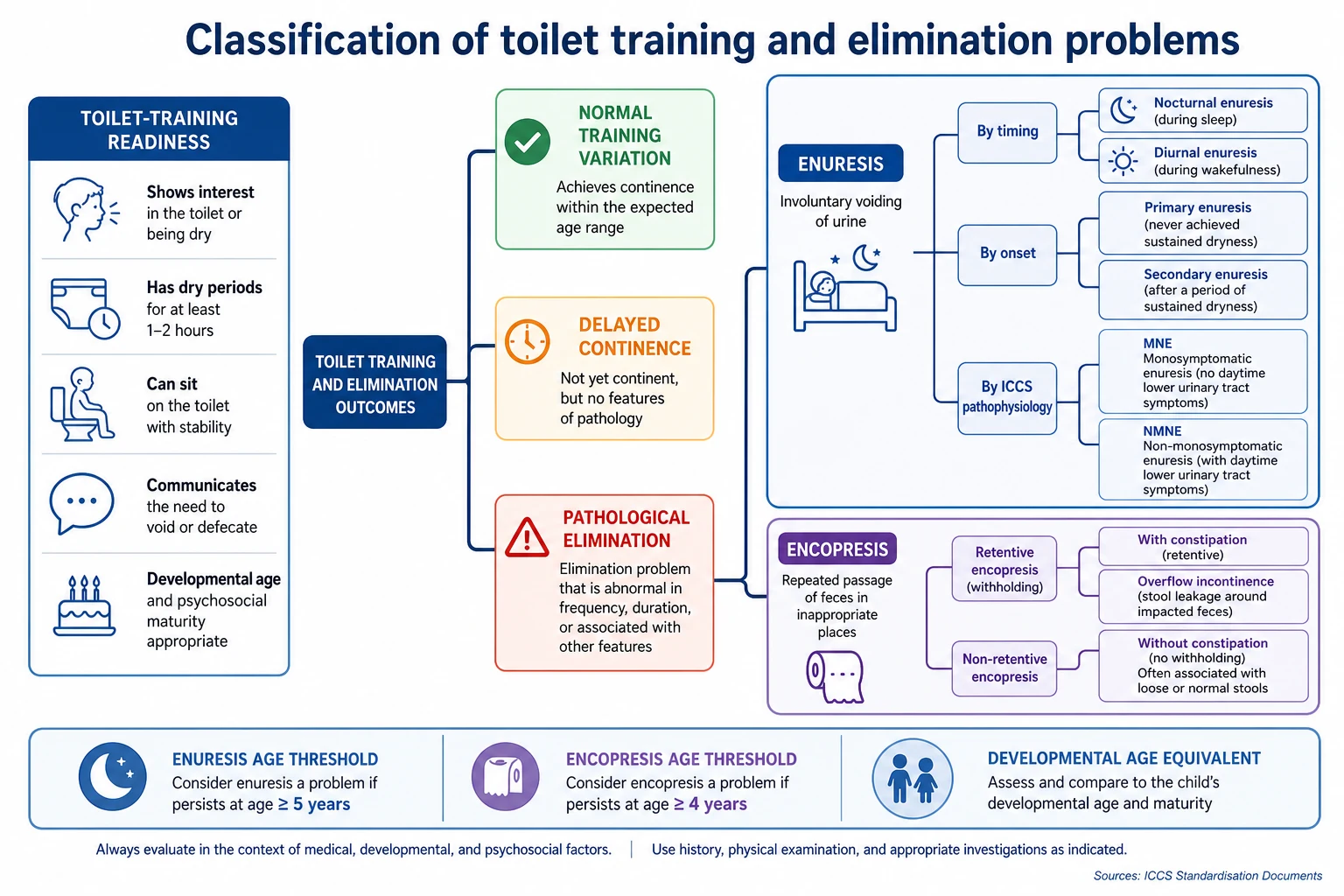
Enuresis is repeated voiding of urine into bed or clothes after chronological age at least 5 years (or equivalent developmental level), with frequency or impairment criteria, not solely explained by a substance or another medical condition. Encopresis is repeated passage of faeces into inappropriate places after age at least 4 years (or developmental equivalent), at least monthly for three months in classic teaching frameworks, not exclusively due to a substance or medical condition except through constipation. [1] [10] [11]
Hold both DSM-style psychiatric nosology and ICCS continence language used in paediatrics and urology. That dual vocabulary is what examiners reward. [2] [3]
Classification
Sort first by developmental task, then by phenotype. [1] [2] [3]
Toilet-training stage. Not started. In progress with readiness. Day dry/night wet. Fully continent. Toilet refusal or regression after a stressor. [1]
Enuresis axes. Timing: nocturnal only, diurnal only, or both. Course: primary (never sustained dryness) versus secondary (relapse after a dry period, commonly taught as about six months of continence). ICCS phenotype: monosymptomatic nocturnal enuresis (MNE) — night wetting without significant daytime lower urinary tract symptoms — versus non-monosymptomatic (NMNE) — night wetting plus daytime LUTS such as urgency, frequency or daytime incontinence. [1] [2] [3]
Encopresis axes. With constipation and overflow (retentive) versus without constipation (non-retentive). Most school-age soiling is retentive. [10] [11]
MNE
- Night wetting only
- No major daytime LUTS
- Often clinical diagnosis
- Alarm or desmopressin pathway
NMNE
- Daytime urgency/frequency/incontinence
- Often bowel-bladder dysfunction
- Treat daytime symptoms and constipation
- More specialist work-up
Retentive encopresis
- Constipation + overflow
- Withholding cycle
- Disimpact then maintain
- Most school-age soiling
Non-retentive
- No significant constipation
- Behavioural formulation
- Toileting programme
- Avoid useless chronic laxatives
Epidemiology & Risk Factors
Nocturnal enuresis is common in early school years and falls with age; residual adolescent enuresis is less common but highly impairing. Male predominance is typical for both enuresis and encopresis in clinical series. Familial aggregation is well recognised for nocturnal enuresis phenotypes. [1] [2]
Numbers candidates should own
Constipation, developmental delay, ADHD, autism, sleep problems, psychosocial stress, limited school toilet access and harsh toilet-training environments cluster with wetting and soiling. Parental intolerance predicts treatment drop-out and psychological harm. Out-of-home care and placement stress raise secondary incontinence rates. [1] [13]
Pathophysiology
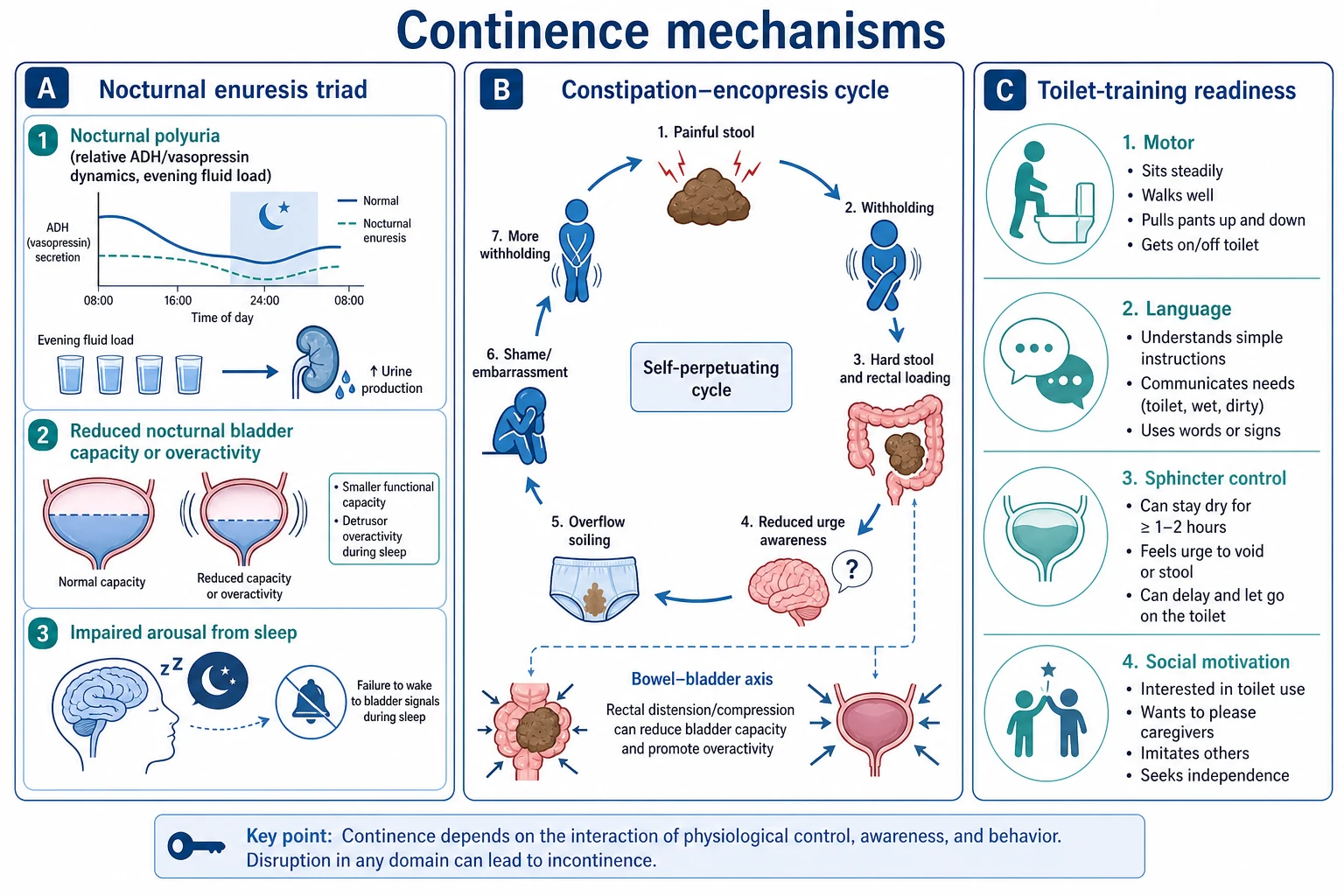
Enuresis triad (Butler framework; ICCS-aligned teaching). Night wetting usually loads on three factors in different proportions: (1) nocturnal polyuria — relative excess night urine from nocturnal vasopressin dynamics or evening fluid load; (2) reduced nocturnal bladder capacity or detrusor overactivity; (3) impaired arousal so the child does not wake to void. Alarm conditioning targets arousal and learning; desmopressin targets nocturnal urine volume. [2] [13]
Constipation–encopresis cycle. Painful or large stool leads to withholding, harder stool and rectal distension, reduced urge awareness, overflow soiling, shame and more avoidance of the toilet. Rectal loading also compresses the bladder — the bowel–bladder axis examiners expect you to name. [9] [11]
Readiness biology. Continence needs sphincter awareness, motor access to the toilet, language or signals to communicate need, and enough social motivation to practise. Forcing before readiness raises conflict without accelerating genuine continence. Sensory aversion and motor-planning differences change the pathway in autism and developmental disability. [1] [10]
Clinical Presentation
Parents may present with “lazy wetting,” toilet refusal, stained underwear, camp panic or school bullying. Listen for quieter signals: dry-day milestones never achieved, recent relapse, urgency, withholding postures, large-calibre stools, overflow liquid stool mistaken for diarrhoea, snoring, polyuria or polydipsia, and punitive home responses. [1] [4] [11]
Impact is part of the presentation. Shame, secrecy, low mood, school avoidance, sibling conflict and carer burnout often drive the visit more than wet sheets alone. Avoid moralistic wording such as “dirty” or “attention-seeking” in notes and in front of the child. [1] [10]
Differential Diagnosis
Discriminators, not shopping lists: [1] [2]
Normal delayed continence versus disorder. Before age thresholds, frame developmental variation and readiness support. After thresholds, use frequency, impairment and phenotype language. [1]
MNE versus NMNE versus daytime incontinence alone. Daytime urgency, frequency, holding manoeuvres or wetting reclassifies care toward bowel-bladder and specialist pathways. [2] [3]
Organic urinary disease. UTI, diabetes, CKD and structural uropathy declare themselves through secondary onset, dysuria, polyuria/polydipsia, weight loss, continuous wetting (ectopic ureter in girls), abnormal growth or blood pressure. [1] [2]
Neurogenic bladder/bowel. Spinal stigmata, neurological signs, gait change or known neural tube defects. [2]
Organic constipation red flags. Early severe constipation from infancy, delayed meconium passage history and other GI red flags raise Hirschsprung and related concerns. [9]
Retentive versus non-retentive soiling. Overflow around a loaded rectum is not wilful dirtiness; non-retentive soiling needs behavioural formulation after constipation is excluded. [10] [11]
Trauma and safeguarding. Secondary incontinence can accompany adversity. Soiling alone does not diagnose sexual abuse, but coercive toileting and other safeguarding indicators demand action. [1]
Clinical & Bedside Assessment
Structure every visit as phenotype + age threshold + primary/secondary + constipation + daytime LUTS + comorbidity + impact + parental response + red flags. [1] [2] [4]
- Confirm chronological or developmental age thresholds and impairment.
- Obtain a bladder and bowel diary for about 1–2 weeks when practical: wet/dry nights, voids, stools, fluids. [2] [4]
- Screen constipation even when the referral says “bedwetting only.” [9] [11]
- Classify MNE versus NMNE; map encopresis retentive versus non-retentive. [2] [3]
- Screen ADHD, autism traits, anxiety, learning, sleep, bullying and family conflict. [1]
- Examine growth, abdomen for faecal mass, spine and lower-limb neurology. Reserve genital examination for clear indication, with chaperone and sensitive consent. [1] [2]
- Name and stop punitive practices in the room. Parental intolerance predicts engagement failure. [13]
Toilet-training readiness checklist (teachable signs). Child shows interest in the toilet, stays dry for longer periods, can walk to the toilet and sit, can pull pants up/down, can follow simple instructions or signal need, and caregivers can offer consistent calm support. Absence of several signs means delay training pressure, not increase coercion. [1]
Investigations
Most primary MNE is a clinical diagnosis. Investigate when secondary onset, daytime symptoms, polyuria/polydipsia, failure to respond, recurrent UTI, abnormal examination or continuous wetting raise organic concern. [1] [2]
- Urinalysis (± culture) when infection or secondary onset is possible.
- Glucose testing if polyuria, polydipsia, weight loss or glycosuria risk.
- Renal/bladder ultrasound, uroflow, post-void residual, specialist urology for NMNE, continuous wetting, recurrent UTI, neurological signs or treatment resistance. [2]
- Encopresis/constipation: clinical diagnosis preferred; avoid routine unnecessary radiation; specialist GI tests for red flags. [9]
Before imipramine: cardiac history, consideration of ECG, and overdose-safety counselling. Before desmopressin: teach fluid restriction and hyponatraemia warning symptoms. [6] [7] [14]
Management — Resuscitation
Continence is rarely an emergency, but complications can be. [6] [7] [9]
Same-day pathways also apply to secondary enuresis with polyuria/polydipsia, continuous wetting needing urgent structural assessment, and any child who cannot safely return home because of punitive or abusive toileting practices. [1] [2]
Management — Definitive & Stepwise
Universal first steps
- Psychoeducation: common, usually involuntary, not laziness; stop punishment and shaming. [1] [4]
- Treat constipation aggressively when present — wetting often improves when the bowel is cleared. [9] [11]
- Optimise daytime voiding habits, fibre/fluid pattern appropriate to age, and toilet access at school. [1] [2]
- Treat ADHD, anxiety, sleep problems and family conflict in parallel — they drive adherence failure. [1]
Readiness-based toilet training
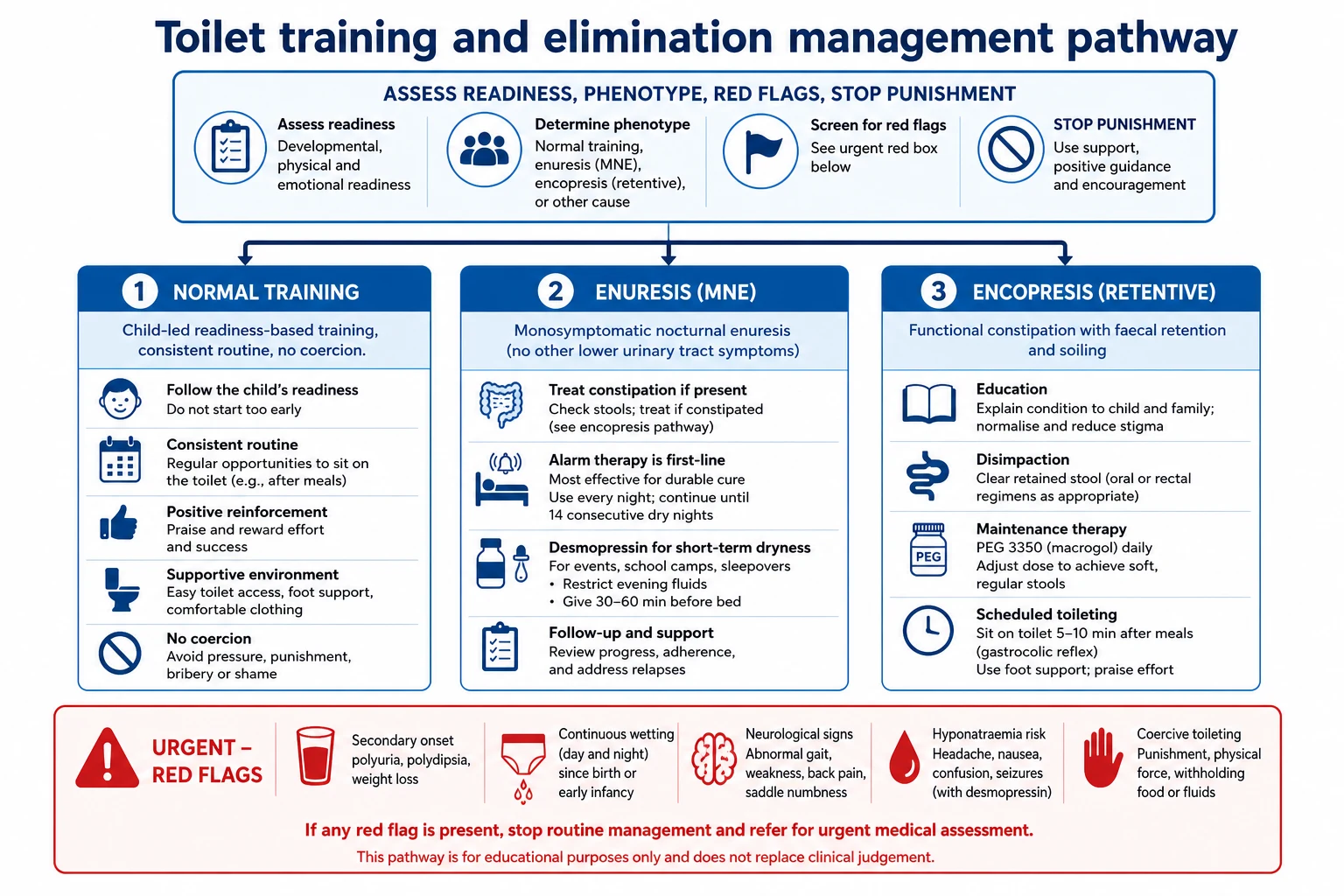
Use a child-led approach once readiness signs appear. Keep sessions short, use a potty or child seat with foot support, praise sitting and attempts rather than only dry outcomes, avoid punishment for accidents, and pause training during major stressors (new sibling, house move, illness). Do not force prolonged sits or shaming “accidents charts.” [1] [10]
Enuresis — durable dryness versus short-term dryness
Enuresis alarm (first-line for cure). A moisture sensor wakes the child and carers at wetting. Cochrane synthesis supports alarm therapy for achieving dryness; benefits are more likely to persist after treatment ends than with short-term drug-only approaches. Meta-analytic comparison for monosymptomatic enuresis supports superior sustained response with alarm strategies when the goal is durable cure. [5] [8] NICE-aligned teaching and AACAP both position behavioural/alarm approaches centrally for lasting dryness. [1] [4]
Practical pearls: family readiness, shared night-time plan, enough consecutive nights, treat constipation first, and do not abandon after a few wet nights. Parental intolerance predicts drop-out. [5] [13]
Desmopressin (short-term dryness). Synthetic antidiuretic analogue reducing nocturnal urine volume. Evidence supports night dryness during treatment; relapse is common when stopped. Best uses: camps, sleepovers, or when alarm is impractical, failed or refused. Prefer oral or oral-lyophilisate formulations where available; restrict evening free water; counsel headache, vomiting and hyponatraemia risk. [6] [14]
Exam-level dosing framework (always individualise; check local product information). Desmopressin oral/melt often starts around 0.2 mg at bedtime, with some pathways titrating toward 0.4 mg if needed and tolerated — verify product information. Imipramine remains third-line specialist only because of overdose and cardiotoxicity risk. Enforce evening fluid restriction with desmopressin; stop during vomiting or diarrhoea; counsel hyponatraemia symptoms. [6] [7] [14]
Imipramine and related tricyclics reduce wet nights versus placebo but carry a poorer safety profile than alarm or desmopressin for routine use. [7] Anticholinergics (for example oxybutynin) may adjunct selected daytime overactive bladder or NMNE presentations under continence guidance — not first-line monotherapy for pure MNE. [2]
Encopresis — treat the bowel first when retentive
ESPGHAN/NASPGHAN recommendations structure the medical half of retentive care: education, disimpaction, then maintenance to keep soft daily stools, plus toileting behaviour support. [9]
- Education — overflow is leakage around retained stool, not deliberate dirtiness. [9] [11]
- Disimpaction — clear the loaded rectum/colon (oral high-dose osmotic regimens commonly preferred; enemas only with clear indication and non-punitive framing). [9]
- Maintenance — polyethylene glycol (PEG 3350) is a cornerstone osmotic option; titrate to soft daily stools for months, not days. Exam framework often cites PEG 3350 oral on the order of 0.5–1.5 g/kg/day depending on phase and product — verify local PI and GI advice. [9] [12]
- Toileting programme — sit 5–10 minutes after meals (gastrocolic reflex), foot support, reward charts for sitting and success, never punish accidents. [9] [10]
- Behavioural/cognitive interventions add value for toileting refusal and non-retentive patterns. [10]
Non-retentive faecal incontinence: confirm absence of significant constipation; emphasise scheduled toileting, contingency management, school plan and mental health intervention rather than indefinite laxatives. [10] [11]
Clinic sequence that scores marks
Open without blame
Name that wetting and soiling are common and usually involuntary. Stop punishment before any drug talk.
Phenotype and red flags
Primary/secondary, day symptoms, constipation, polyuria, continuous wetting, neurology, impact.
Clear the bowel if loaded
Disimpact then maintain soft stools; many urinary symptoms improve.
Match treatment to goal
Alarm for durable dryness; desmopressin for camps/sleepovers or when alarm is unsuitable.
School and family plan
Toilet access, spare clothes, no public shaming, review date, referral if resistant or high risk.
Specific Subtypes & Scenarios
Early toilet-training pressure. If readiness signs are missing, protect the child from coercion and set a review. Cultural early-training practices can be supported when calm and child-responsive; pathologise harm, not culture. [1]
Primary MNE before camp. Psychoeducation, treat constipation, offer desmopressin for the event with fluid rules, and plan alarm for sustained cure afterwards. [4] [6]
Secondary enuresis. Full organic and psychosocial review before assuming “stress only.” [1]
NMNE with constipation. Clear bowel, daytime voiding schedule, then reassess night wetting. [2] [9]
Retentive encopresis mislabelled diarrhoea. Stop antidiarrhoeals; disimpact and maintain. [9] [11]
ADHD + dual incontinence. Treat ADHD and run structured toileting; do not wait for “perfect behaviour” before medical bowel care. [1]
ASD with toilet aversion. Visual schedules, sensory-friendly bathrooms, graded exposure; avoid forced traumatic experiences. [10]
Adolescent residual enuresis. Privacy-first care, peer stigma, shared decisions on alarm practicality versus medication windows. [4]
Complications & Pitfalls
- Punishing wet or soiled nights. [1] [13]
- Missing constipation while prescribing only enuresis drugs. [9] [11]
- Desmopressin without fluid restriction → hyponatraemia. [6] [14]
- Imipramine as first-line or accessible to younger siblings. [7]
- Labelling all soiling “behavioural” without disimpaction. [9] [11]
- Alarm failure from inadequate instruction or family intolerance. [5] [13]
- Ignoring school bullying and exclusion from camps. [1] [4]
- Forcing traumatic toileting in autistic or developmentally delayed children. [10]
Prognosis & Disposition
Spontaneous resolution of nocturnal enuresis is common across childhood, but waiting alone is not mandatory when impairment is high. Alarm therapy aims for sustained dryness; desmopressin usually works only while taken. [5] [6] [8] Retentive encopresis often needs months of maintenance laxatives; early cessation predicts relapse. [9] [12]
Disposition. Uncomplicated MNE: primary care or paediatric continence pathway. Red flags or treatment resistance: paediatric urology. Refractory constipation/encopresis: paediatric gastroenterology. Mental health services: significant psychiatric comorbidity, trauma, severe family conflict or secondary psychological sequelae. Step intensity to impairment and risk, not to parental embarrassment alone. [1] [2] [4] [9]
Special Populations
Developmental delay / intellectual disability. Use developmental-age thresholds; adapted toileting plans and longer timelines. [1] Autism. Sensory toilet aversion, visual schedules, avoid forced traumatic bathroom experiences. [10] ADHD. Structured routines; medication optimisation can support adherence. [1] Out-of-home care. Secondary incontinence common after placement stress; enforce non-punitive caregiving standards. [1] Cultural contexts. Toilet-training norms vary; do not pathologise normative collective practices, but do not delay assessment after age thresholds when impairment exists. Rural/remote. Alarm access, telehealth review and clear escalation routes matter as much as the drug choice.
Evidence, Guidelines & Regional Differences
ICCS terminology standardises lower urinary tract language and underpins MNE versus NMNE teaching. [2] [3] AACAP’s practice parameter remains a core assessment and treatment skeleton for enuresis. [1] Cochrane evidence supports alarms for dryness with better durability than drug-only approaches, and desmopressin for night dryness during treatment. [5] [6] [8] ESPGHAN/NASPGHAN guidance frames functional constipation care that underpins retentive encopresis. [9] Behavioural interventions add value for faecal incontinence. [10]
ANZ practice typically routes uncomplicated MNE through primary care or paediatrics with continence services where available. Mental health joins for comorbidity, trauma, severe family distress or treatment refusal. Alarm first for durable dryness and desmopressin for situational dryness align with international evidence used in local teaching. Verify product information for desmopressin and PEG dosing. [1] [4] [5]
Exam Pearls
- Age thresholds: enuresis ≥5, encopresis ≥4 (or developmental equivalent). [1]
- Most encopresis is constipation with overflow, not wilful dirtiness. [11]
- Alarm for cure; desmopressin for short-term dryness. [4] [5] [6]
- MNE versus NMNE is the ICCS high-yield split. [2] [3]
- Treat constipation before or with enuresis plans. [9]
- Desmopressin + free water excess → hyponatraemia/seizures. [6] [14]
- Imipramine is last-line specialist with overdose risk. [7]
- Stop punishment in the first minute of every continence consult. [1] [13]
References
- [1]Fritz G, Rockney R, et al. Practice parameter for the assessment and treatment of children and adolescents with enuresis J Am Acad Child Adolesc Psychiatry, 2004.PMID 15564822
- [2]Neveus T, Eggert P, Evans J, et al. Evaluation of and treatment for monosymptomatic enuresis: a standardization document from the International Children's Continence Society J Urol, 2010.PMID 20006865
- [3]Neveus T, von Gontard A, Hoebeke P, et al. The standardization of terminology of lower urinary tract function in children and adolescents: report from the Standardisation Committee of the International Children's Continence Society J Urol, 2006.PMID 16753432
- [4]Nunes VD, O'Flynn N, Evans J, Sawyer L Management of bedwetting in children and young people: summary of NICE guidance BMJ, 2010.PMID 20980375
- [5]Caldwell PH, Codarini M, Stewart F, Hahn D, Sureshkumar P Alarm interventions for nocturnal enuresis in children Cochrane Database Syst Rev, 2020.PMID 32364251
- [6]Hahn D, et al. Desmopressin for nocturnal enuresis in children Cochrane Database Syst Rev, 2025.PMID 40728007
- [7]Caldwell PH, Sureshkumar P, Wong WC Tricyclic and related drugs for nocturnal enuresis in children Cochrane Database Syst Rev, 2016.PMID 26789925
- [8]Peng CC, Yang SS, Austin PF, Chang SJ Systematic Review and Meta-analysis of Alarm versus Desmopressin Therapy for Pediatric Monosymptomatic Enuresis Sci Rep, 2018.PMID 30425276
- [9]Tabbers MM, DiLorenzo C, Berger MY, et al. Evaluation and treatment of functional constipation in infants and children: evidence-based recommendations from ESPGHAN and NASPGHAN J Pediatr Gastroenterol Nutr, 2014.PMID 24345831
- [10]Brazzelli M, Griffiths PV, Cody JD, Tappin D Behavioural and cognitive interventions with or without other treatments for the management of faecal incontinence in children Cochrane Database Syst Rev, 2011.PMID 22161370
- [11]Loening-Baucke V Functional fecal retention with encopresis in childhood J Pediatr Gastroenterol Nutr, 2004.PMID 14676600
- [12]Pashankar DS, Bishop WP, Loening-Baucke V Long-term efficacy of polyethylene glycol 3350 for the treatment of chronic constipation in children with and without encopresis Clin Pediatr (Phila), 2003.PMID 14686553
- [13]Butler RJ Childhood nocturnal enuresis: developing a conceptual framework Clin Psychol Rev, 2004.PMID 15533278
- [14]Chin X, et al. Desmopressin therapy in children and adults: pharmacological considerations and clinical implications Eur J Clin Pharmacol, 2022.PMID 35199198