Paeds · infectious-diseases
Approach to fever by age and immune status
Also known as Paediatric fever · Feverish child · Febrile infant · Fever without source · Fever in the immunocompromised child
An age- and immune-status-aware fellowship approach to the febrile child: clear the threat gate first, stratify by age band with validated rules (Step-by-Step, PECARN) for young infants, recognise why height of fever does not predict serious bacterial infection, run the immunocompromised-fever pathway, and close the loop with a specific safety-net.
On this page & tools
Your progress
Saved locally on this device.
Practise this topic
Target exams
Red flags
Life stages
Care settings
Clinical exam formats
Board mappings
A febrile child walks into your emergency department or clinic. The thermometer reads 39.2 °C. Before you reach for an antipyretic or a guideline table, look at the child. Are they toxic? Are they perfusing? Are they interactive? That single glance, paired with age and immune status, frames the entire encounter. [4] [5]
This hub page owns the presentation logic for fever across childhood. Sister pages take the deep disease algorithms: undifferentiated fever and fever without a source, paediatric sepsis, meningitis and encephalitis, bacteraemia, and fever in the returned traveller. [6] [8]
F.E.V.E.R. G.A.T.E.
Overview & Definition
Picture two children in adjacent cubicles. A three-year-old is running at 39.5 °C, drinking juice, and telling you about her favourite cartoon. Beside her lies a two-week-old at 38.2 °C who has stopped feeding and whose mother says "this is not my baby." The lower temperature is the sicker child. That contrast is the whole point of an age- and immune-status-aware approach. [1] [4]
Fever is an elevated core body temperature set by the hypothalamic thermostat in response to pyrogens. In practice, fever in a child is usually defined as a rectal temperature of 38 °C or higher. Axillary, tympanic and oral readings can mislead, especially in young infants, because they measure skin or canal temperature rather than core. A single falsely low tympanic reading in a febrile neonate is a classic exam trap. [4] [5]
Fever differs from hyperthermia, where heat gain overwhelms dissipation without a change in the hypothalamic set-point — think bundling, heat stroke, or malignant hyperthermia. Antipyretics reset the thermostat, so they work in fever and do little in hyperthermia. [12]
The decisive clinical question is never "how high is the fever?" but "how threatened is this child, and what is their SBI risk by age and immune status?" De and colleagues showed that body temperature lacks accuracy for detecting serious bacterial infection in febrile episodes. [4]
Classification
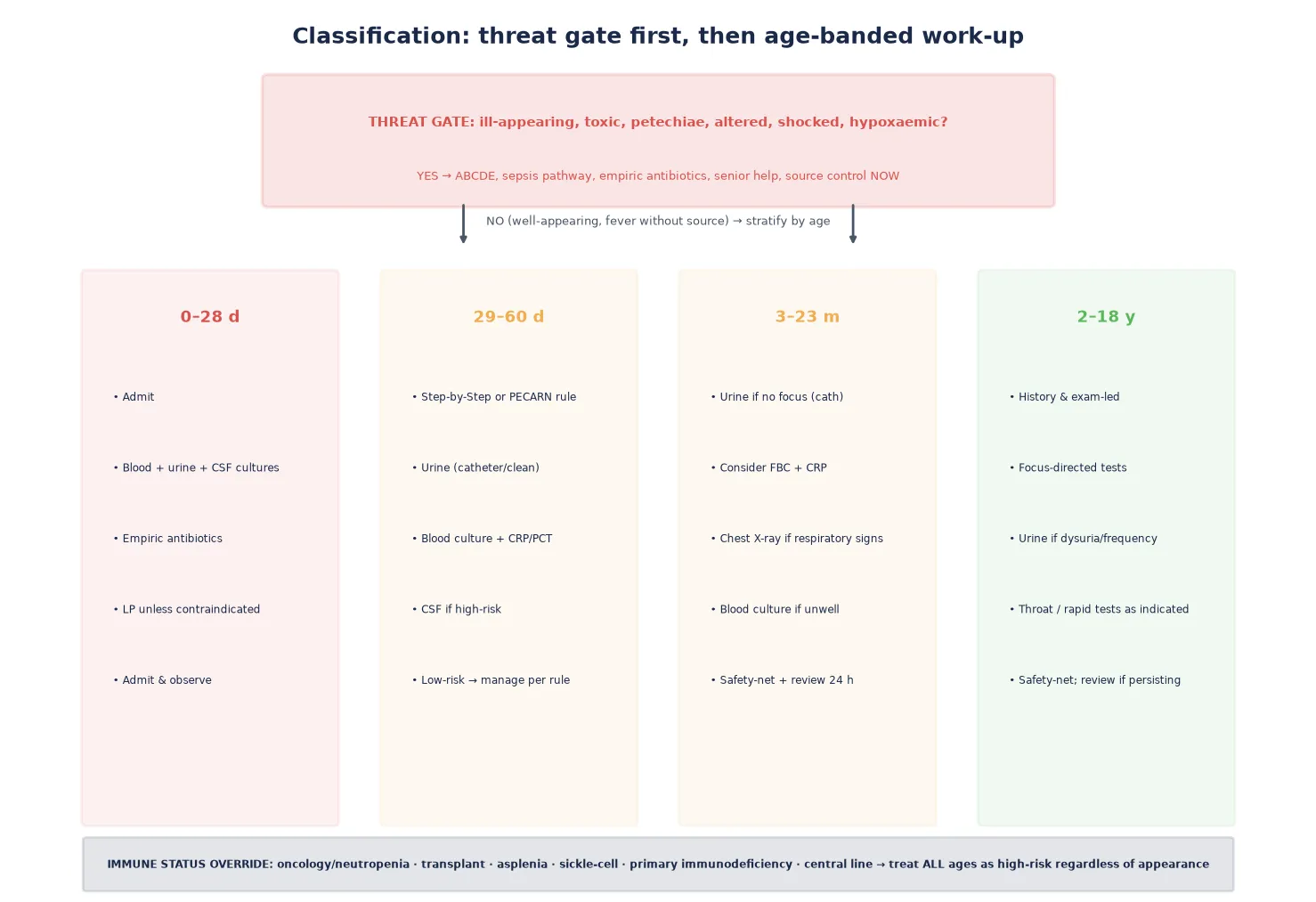
Sort the febrile child in two moves, not twenty. [1] [2]
Move 1 — the threat gate. Is this child toxic or shocked? Ill-appearance, abnormal cry, reduced interaction, mottled or cold peripheries, capillary refill of three seconds or more, hypoxaemia, grunting, or a rapidly progressive petechial rash push you straight into ABCDE and a sepsis pathway. This gate ignores age and appearance. [6] [8]
Move 2 — age-banded risk stratification once the threat gate is clear. Four practical bands drive the work-up threshold: [1] [2] [3]
- Neonate, 0–28 days. Any fever (or hypothermia) is sepsis until proven otherwise. Full septic work-up — blood, urine, cerebrospinal fluid — empiric antibiotics, and admission. [1]
- Young infant, 29–60 days. Apply a validated rule. The Step-by-Step approach and the PECARN clinical prediction rule stratify infants into low- and high-risk groups, guiding who can avoid lumbar puncture and hospitalisation. [2] [3]
- Older infant, 3–23 months. Fever without a source is urine-led. Catheterise or suprapubic aspirate for urinalysis and culture; consider bloods and chest radiograph if unwell. [13]
- Child and adolescent, 2–18 years. History and examination dominate. Most are viral; look for a focus and direct tests accordingly. [4]
Across every band, immune status rewrites the rule. An immunocompromised child — oncology with neutropenia, transplant, asplenia or sickle-cell disease, primary immunodeficiency, or a central venous line — is treated as high-risk regardless of age or how well they appear. [9]
Epidemiology & Risk Factors
The prevalence of serious bacterial infection in febrile infants falls steeply with age. Biondi and colleagues, in a systematic review and meta-analysis, reported that febrile neonates carry a substantial burden of bacteraemia and bacterial meningitis, with lower — but still meaningful — rates in infants in the second month of life. This single finding is the epidemiological engine behind the neonate rule: work them all up. [1]
Conjugate vaccination against Haemophilus influenzae type b and pneumococcus has lowered the baseline rate of occult bacteraemia in vaccinated older infants and children. That success does not extend to incompletely vaccinated, premature, or immunocompromised hosts, whose risk profile resembles the pre-vaccine era for encapsulated organisms. [1]
Young infants are biologically vulnerable. Their immune systems opsonise encapsulated bacteria poorly, their blood-brain barrier is more permeable, and they may not mount a febrile or inflammatory response proportionate to the threat. A neonate with sepsis can present with hypothermia, lethargy, apnoea, or feeding refusal rather than a high fever. [1] [5]
The immunocompromised child carries a different epidemiology. In oncology and neutropenic patients, gram-negative bacteraemia — particularly Pseudomonas aeruginosa — and line infections dominate and can progress to shock within hours. Asplenic and sickle-cell children risk overwhelming postsplenectomy infection from encapsulated organisms. Transplant recipients face viral reactivation and opportunistic infection. Each of these groups has its own urgent pathway. [9]
Social determinants shift detection. Incomplete vaccination, crowded housing, delayed presentation, language discordance, and remote location all change who arrives febrile and how quickly. Indigenous, refugee, and socioeconomically disadvantaged children may carry higher SBI risk and deserve a lower, not higher, threshold for work-up. [10]
Pathophysiology
Fever is a regulated response, not a malfunction. Exogenous pyrogens — viral particles, bacterial toxins, or microbial products — stimulate host immune cells to release endogenous cytokines such as interleukin-1, interleukin-6, and tumour necrosis factor-alpha. These cytokines reach the hypothalamus and drive prostaglandin E2 synthesis, largely through cyclo-oxygenase-2. Prostaglandin E2 resets the hypothalamic set-point upward, and the body generates heat through vasoconstriction, shivering, and behavioural seeking of warmth. [12]
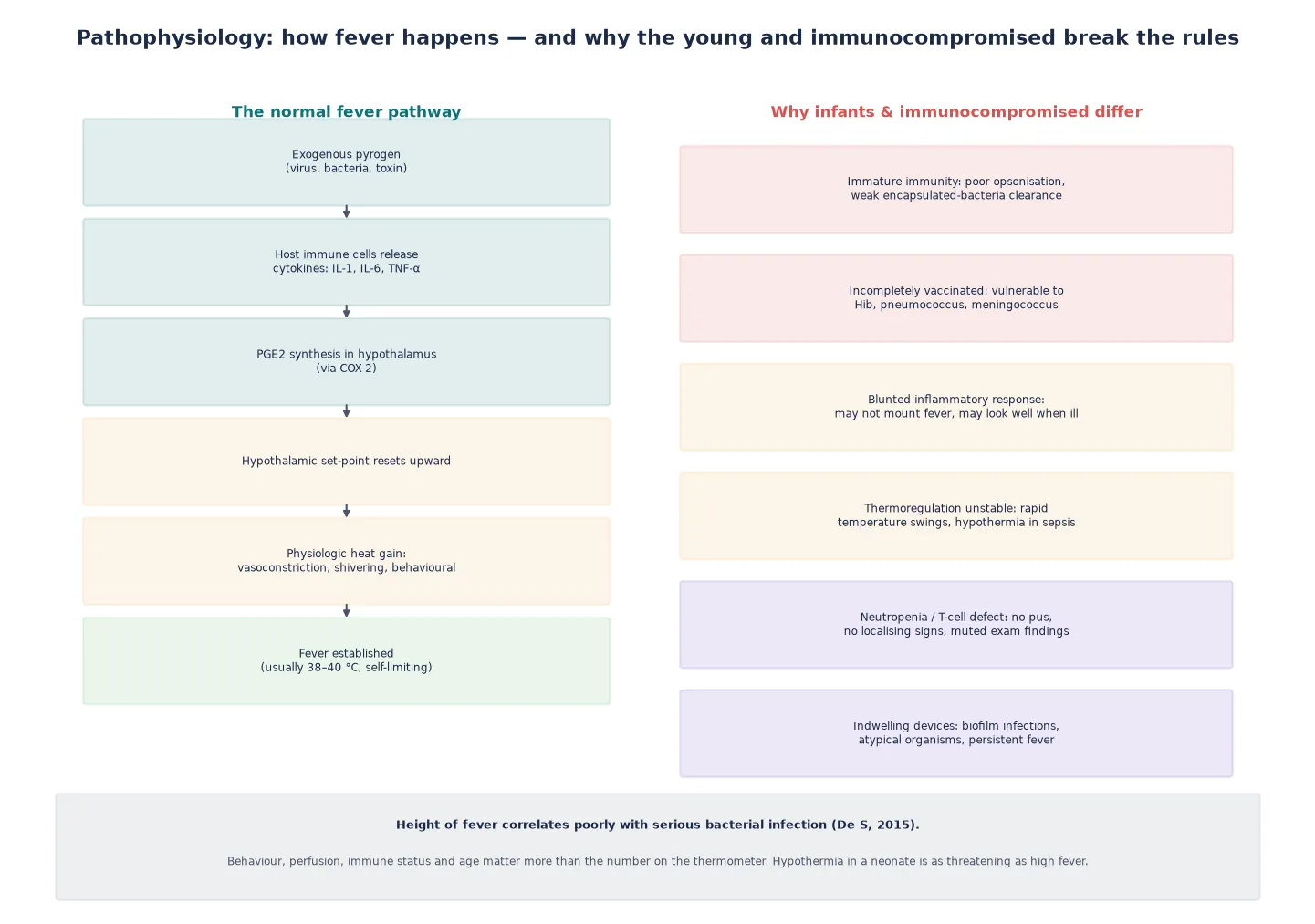
The magnitude of the temperature response does not map onto the severity of the infection. De and colleagues confirmed that body temperature alone lacks accuracy for detecting serious bacterial infection in febrile episodes. A child can mount 40 °C from a benign viral illness and 37.5 °C from early sepsis. The reason is that the fever height depends on the host's cytokine response and thermoregulatory capacity, not on the organism's virulence alone. [4]
This is why infants and immunocompromised children break the usual rules. Neonates have immature thermoregulation and a weak inflammatory response, so they may be hypothermic or afebrile in sepsis. Neutropenic children cannot generate pus, so they may have no localising signs and minimal fever. Asplenic children clear encapsulated bacteria poorly, so they can deteriorate within hours. T-cell-deficient and transplant children may not mount the cytokine signature you expect, so the absence of fever is not reassuring. [1] [9]
Indwelling devices add a mechanical dimension. Central venous lines, ventriculoperitoneal shunts, and chronic urinary catheters host biofilm infections with atypical and resistant organisms. A febrile child with a central line has a line infection until proven otherwise. [9]
Clinical Presentation
Neonates and young infants rarely declare their infection with a classic picture. Parents report poor feeding, lethargy, irritability, a high-pitched or abnormal cry, temperature instability, apnoea, or simply "not right." Any of these in a febrile or hypothermic neonate is sepsis language. Do not wait for a textbook cluster. [1] [5]
Older infants and toddlers may show a focal clue — pulling at an ear, limping, dysuria, respiratory distress, or a rash — but many present with fever without an obvious source. Your job is to find the source by history and examination, and to decide whether to investigate the child who has none. [13]
School-age children and adolescents can localise their symptoms more reliably. Sore throat, dysuria, headache, neck stiffness, abdominal pain, and cough point you toward a focus. Adolescents need a confidential history that includes sexual activity, substance use, and pregnancy, because sexually transmitted infection and pelvic inflammatory disease enter the differential. [4]
The immunocompromised child may look well when seriously infected. A febrile neutropenic child can be chatting and perfusing while gram-negative bacteraemia takes hold. This is why appearance is not a reliable gate in this group — the rule is cultures and empiric antibiotics regardless. [9]
The child with a petechial rash is a standalone emergency until proven otherwise. Rapidly progressive petechiae or purpura, especially with fever and toxicity, demands immediate assessment for meningococcal disease and other causes of disseminated sepsis. [6] [8]
Differential Diagnosis
Hold the common and the catastrophic together. [1] [8]
Must-not-miss at any age: sepsis and septic shock, meningitis, encephalitis, bacteraemia, pneumonia with hypoxaemia, surgical abdomen (appendicitis, intussusception), Kawasaki disease, and malaria in returned travellers. These stay open in every febrile child until the assessment clears them. [6] [8]
Common viral illness: upper respiratory infection, viral exanthem, gastroenteritis, influenza, and other self-limiting infections. These are the numerical majority, but they are diagnoses of inclusion after you have ruled out threat, not a default label for any febrile child. [4]
Occult serious bacterial infection dominates the young-infant differential: urinary tract infection, occult bacteraemia, occult pneumonia, and bone or joint infection. A positive urinalysis does not exclude concurrent bacteraemia or meningitis in young infants, as Mahajan and colleagues showed. [13]
Age shifts the ranking. Neonate: group B streptococcus, Escherichia coli, Listeria monocytogenes, and viral causes including herpes simplex. Young infant: the same bacterial causes plus respiratory and gastrointestinal viruses. Older infant and toddler: UTI, viral exanthem, streptococcal pharyngitis, pneumonia. School-age and adolescent: viral illness, streptococcal pharyngitis, UTI, and sexually transmitted infection. [1] [13]
Immunocompromised differential is deliberately broad. Gram-negative bacteraemia, line infection with coagulase-negative staphylococci or Staphylococcus aureus, fungal infection, viral reactivation (cytomegalovirus, Epstein-Barr virus, herpes simplex), and opportunistic organisms all belong on the list. Do not narrow prematurely. [9]
Clinical & Bedside Assessment
1. First impression before the thermometer. Use a paediatric assessment triangle glance: appearance and interaction, work of breathing, circulation to skin. A quiet, mottled, or poorly interactive febrile child is not "good because they are calm." [5] [10]
2. ABCDE if any threat feature exists. Airway, breathing, circulation, disability including glucose, and exposure. Start time-critical care while history continues in parallel. [8]
3. History that changes the differential. Onset and duration of fever. Immunisation status and any missed doses. Immune status — ask explicitly about chemotherapy, transplant, splenectomy, sickle-cell disease, primary immunodeficiency, central lines, and immunosuppressants. Exposure: travel, sick contacts, animal contact, tick bite. Feeding, urine output, and behaviour change in infants. Focal symptoms: dysuria, earache, cough, headache, neck stiffness, limb pain, rash. [1] [9]
4. Examination with intent. Interaction and consciousness. Temperature measured by the most reliable method for age. Heart rate and respiratory rate against age-normal ranges — Fleming and colleagues established these across birth to 18 years. Capillary refill, perfusion, and skin colour. Ears, throat, chest, abdomen, joints, and skin for a focus. Meningeal signs in any febrile child with headache or altered state. [5]
5. Caregiver concern as data. Mills and colleagues showed that caregiver concern for deterioration associates with critical illness in hospital-presenting children. If the parent says the child is worse than they appear, escalate the assessment rather than reassure on numbers. [10]
6. Verify the temperature. If the reading seems discordant with the child's appearance, remeasure with a more reliable method. A falsely low tympanic or axillary reading in a young infant is a documented cause of missed sepsis. [4]
7. Communication access. Use a professional interpreter when language discordance exists. Fever histories carry subtle detail — feeding change, behaviour shift, immunisation gaps — that ad-hoc translation loses. [10]
Investigations
Tests should discriminate the active differential by age band and immune status, not decorate the chart. [1] [2]
Neonate, 0–28 days. Full septic work-up regardless of appearance: blood culture, complete blood count and differential, urine culture from catheterisation or suprapubic aspirate (not bag, which is too contaminated), cerebrospinal fluid from lumbar puncture, and inflammatory markers. Add herpes simplex PCR if the story fits. Empiric antibiotics and admission. [1]
Young infant, 29–60 days. Apply a validated risk-stratification rule. The Step-by-Step approach uses age, appearance, urinalysis, white blood cell count, absolute neutrophil count, and procalcitonin to assign low, intermediate, or high risk. The PECARN clinical prediction rule incorporates similar variables to identify infants at low risk of serious bacterial infection. Low-risk infants may avoid lumbar puncture and hospitalisation with close follow-up; high-risk infants receive a full work-up. [2] [3]
Older infant and child. Direct tests by the suspected focus. Urinalysis and urine culture for the febrile infant without a source. Throat swab or rapid antigen for streptococcal pharyngitis. Chest radiograph for respiratory signs. Blood culture and inflammatory markers for the unwell child without a clear focus. [13]
Immunocompromised child. Blood cultures from every lumen of a central line and from a peripheral site. Complete blood count to confirm neutropenia. Consider chest radiograph, and additional cultures or viral panels guided by the differential. Do not send this child home on oral antibiotics. [9]
Normal early results can lie. A neonate with early sepsis can have a normal white cell count on hour one. Trajectory and clinical picture outrank a single reassuring number. [1] [14]
Management — Resuscitation
If the child is toxic or shocked, stop debating fever thresholds. [8]
Protect airway and breathing, give oxygen for hypoxaemia or work of breathing, and support circulation with fluid boluses for shock, reassessing after each. Check and treat hypoglycaemia. Deliver empiric antibiotics early when infection is the working diagnosis, guided by current paediatric sepsis principles. The 2024 Phoenix sepsis score and consensus criteria give you contemporary language for recognising paediatric sepsis and septic shock, and the 2026 Surviving Sepsis Campaign children's guideline anchors time-critical therapy. [6] [7] [8]
Choose empiric antibiotic cover by age, focus, immune status, and local resistance. State agent intent and timing rather than inventing a dose you cannot source. Lumbar puncture fits the resuscitation sequence when meningitis is plausible and there is no contraindication such as raised intracranial pressure, coagulopathy, or shock. [8]
Escalate beyond local capability early. Retrieval and PICU pathways exist for the febrile child who is deteriorating. Hand over the problem representation, actions, response, and residual risks so uncertainty is not lost between teams. [8]
Management — Definitive & Stepwise
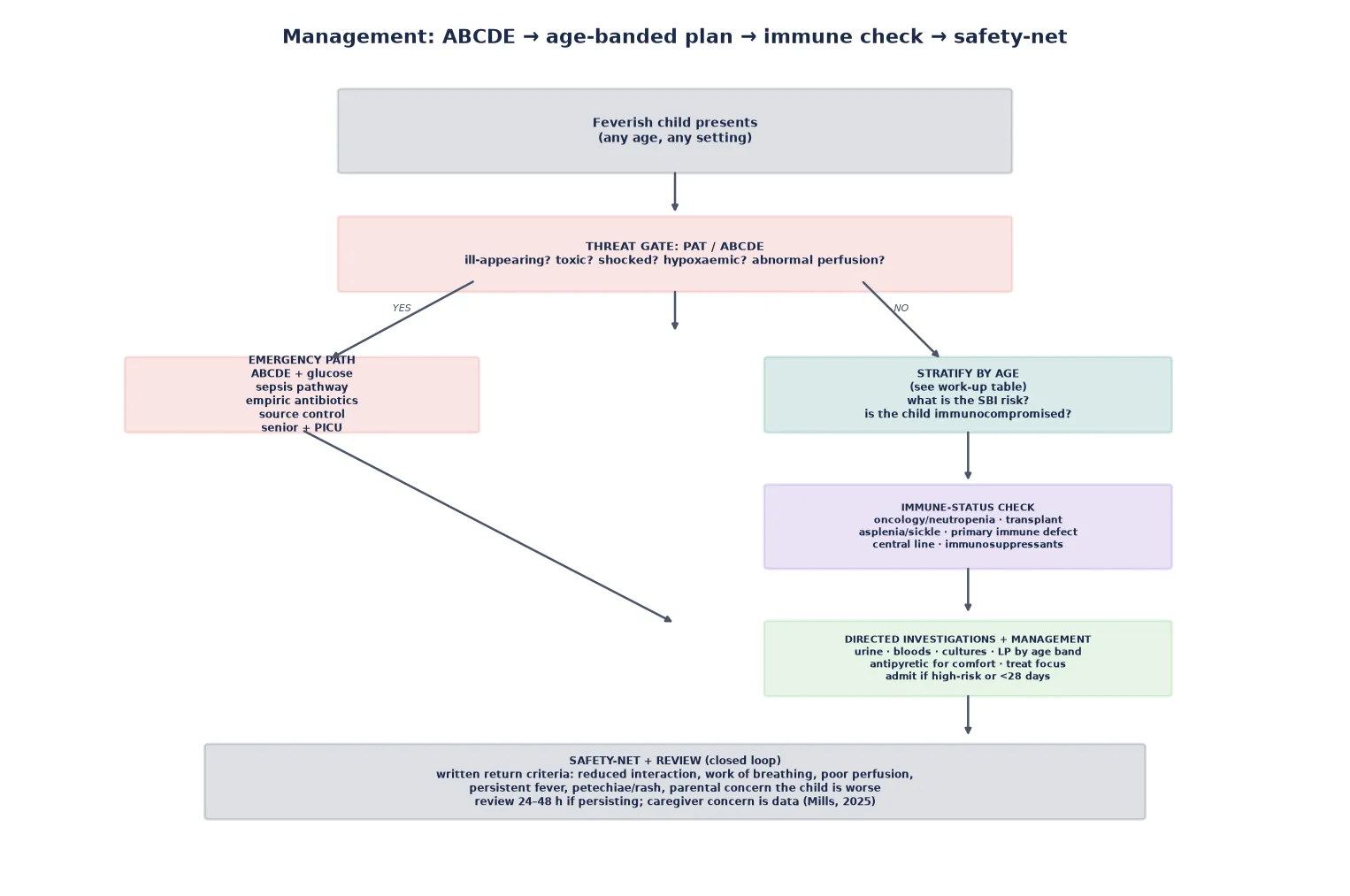
Step 1 — Clear the threat gate. Any toxic or shocked febrile child enters the emergency pathway. ABCDE, glucose, oxygen, fluids for shock, and empiric antibiotics. This is non-negotiable and overrides age rules. [8]
Step 2 — Stratify by age band. Once the child is well-appearing, apply the age-banded work-up. Admit all neonates. Risk-stratify 29–60-day infants with Step-by-Step or the PECARN rule. Run a urine-led assessment in older infants. Manage most children beyond two years with a focus and a safety-net. [1] [2] [3]
Step 3 — Check immune status explicitly. Before you decide on outpatient management, ask about oncology, neutropenia, transplant, asplenia, sickle-cell disease, primary immunodeficiency, central lines, and immunosuppressants. Any "yes" converts the encounter to an emergency pathway: cultures, empiric broad-spectrum antibiotics within 60 minutes, and admission. [9]
Step 4 — Treat the focus. Urinary tract infection, pneumonia, streptococcal pharyngitis, and other focal infections get directed therapy guided by current guidelines and local resistance. Name the agent, the intent, the duration, and the follow-up. [13]
Step 5 — Antipyretics for comfort, not abolition. Antipyretics improve comfort, fluid intake, and activity; they do not need to bring the temperature to normal. The PITCH trial found that combined paracetamol and ibuprofen reduced fever more than either alone in the first 24 hours, but combination is not universally required. Do not use antipyretic response as a test for serious infection — it is not reliable. [12]
Step 6 — Safety-net and review. Give a written, specific safety-net: return immediately for reduced interaction, work of breathing, poor perfusion, persistent fever, petechial or progressive rash, or if the parent feels the child is worse. Set a review in 24 to 48 hours if fever persists. Burvenich and colleagues confirmed that specific safety-netting improves care for acutely ill children. [10] [11]
Specific Subtypes & Scenarios
Febrile neonate, 0–28 days. Full septic work-up, empiric antibiotics, and admission regardless of appearance. This is the highest-yield rule in paediatric fever. [1]
Well-appearing febrile infant, 29–60 days. Apply Step-by-Step or the PECARN rule. A low-risk infant may avoid lumbar puncture and discharge with close follow-up; a high-risk infant receives a full work-up. [2] [3]
Older infant with fever without a source. Urine-led work-up. Consider inflammatory markers and chest radiograph if unwell. Review in 24 hours if fever persists. [13]
Febrile child with a petechial rash. Emergency assessment for meningococcal disease and other causes of disseminated sepsis. Do not reassure on a single set of observations. [6] [8]
Prolonged fever beyond five days. Kawasaki disease enters the differential, alongside occult infection, autoimmune disease, and malignancy. This is a sister-page algorithm; the point here is to recognise the threshold. [1]
Febrile neutropenic oncology child. Emergency pathway. Blood cultures from line and periphery, empiric broad-spectrum antibiotics within 60 minutes, and admission. Lehrnbecher and colleagues, in the 2023 guideline update, set the operational standard. [9]
Asplenic or sickle-cell child with fever. Assume overwhelming capsulated-organism sepsis. Emergency assessment, cover for pneumococcus and meningococcus, and admission. [9]
Returned traveller with fever. Malaria and travel-specific infections lead the differential. This is a sister-page algorithm; the point here is to ask the travel question early. [6]
Child with a central venous line and fever. Line infection pathway. Blood cultures from every lumen and a peripheral site, and empiric cover that includes line-associated organisms. [9]
Complications & Pitfalls
- Assuming a well-looking neonate is safe without a full work-up. [1]
- Using height of fever alone to rule serious illness in or out. [4]
- Forgetting to ask about immune status, chemotherapy, splenectomy, sickle-cell disease, central lines, and immunosuppressants. [9]
- Accepting a falsely low tympanic or axillary temperature in a young infant without a confirmatory measurement. [4]
- Delaying empiric antibiotics in the febrile neutropenic child beyond 60 minutes. [9]
- Reassuring a family on "just a virus" without specific safety-net return criteria. [11]
- Ignoring caregiver concern that the child is deteriorating. [10]
- Not recognising that hypothermia in a neonate can be as threatening as high fever. [1]
Prognosis & Disposition
Most well-appearing febrile children beyond infancy have a viral illness and recover with symptomatic care. The validated infant rules allow a subset of low-risk 29–60-day infants to avoid hospitalisation without missing serious disease, provided close follow-up is reliable. [2] [3]
The neonate, the toxic child, and the immunocompromised child carry the burden of morbidity and mortality. Early empiric antibiotics and source recognition change outcomes in these groups. Missed occult bacteraemia can progress to meningitis, which is why the threshold for work-up stays low in young infants. [1] [9]
Disposition is capability-matched. Neonates and high-risk infants need admission. Toxic and shocked children need ED, ward, or PICU pathways. Immunocompromised children need oncology or immunology-informed admission. Well-appearing older children with a focus and a reliable family can leave with a safety-net and early review. Unresolved red flags do not belong on a distant routine waitlist. [8] [11]
Special Populations
Neonates and young infants: the lowest threshold for full work-up, mandatory admission under 28 days, and high SBI prevalence. [1]
Immunocompromised children (oncology, neutropenia, transplant, primary immunodeficiency): blunted signs, broad differential, empiric antibiotics within 60 minutes, and admission. [9]
Asplenic and sickle-cell disease children: encapsulated-organism risk, emergency assessment regardless of appearance. [9]
Children with central lines or shunts: biofilm and device-related infection, cultures from device and periphery. [9]
Indigenous, refugee, and migrant families: incomplete vaccination, travel exposure, culturally safe care, and interpreters. [10]
Children with disability and neurodiversity: distinguish baseline from new illness, and ensure communication access. [10]
Evidence, Guidelines & Regional Differences
Biondi's meta-analysis establishes why febrile neonates and second-month infants carry a meaningful SBI burden and why the work-up threshold stays low. [1]
Gomez's Step-by-Step validation and Kuppermann's PECARN clinical prediction rule are the two pillars of modern 29–60-day febrile-infant risk stratification. Both reduce unnecessary hospitalisation and lumbar puncture in low-risk infants while preserving sensitivity for serious disease. [2] [3]
De's study is the high-yield reminder that fever height does not predict serious bacterial infection — a perennial exam point. [4]
Schlapbach and Sanchez-Pinto delivered the 2024 Phoenix sepsis consensus and score, the contemporary replacement for age-based organ-dysfunction definitions of paediatric sepsis. The 2026 Surviving Sepsis Campaign children's guideline anchors time-critical therapy. [6] [7] [8]
Lehrnbecher's 2023 fever-and-neutropenia guideline sets the operational standard for oncology children. [9]
Mills and Burvenich supply the safety triad: caregiver concern is data, specific safety-netting works, and families need written return criteria. [10] [11]
Hay's PITCH trial grounds antipyretic practice: combined paracetamol and ibuprofen reduces fever in the first 24 hours more than either alone, but comfort and fluid intake are the goals, not temperature normalisation. [12]
Mahajan's finding that young febrile infants with a positive urinalysis still carry concurrent bacteraemia or meningitis risk is the reason a UTI diagnosis does not close the work-up in this age group. [13]
The 2026 Burstein prediction rule for infants aged 28 days or younger is evolving evidence; frame it as research in progress rather than a settled operational rule. [14]
Australian and New Zealand emergency departments and primary care use local acute-assessment and sepsis pathways for febrile children, with strong rural and remote retrieval systems that change time-to-antibiotics for the febrile neonate. Care for Aboriginal and Torres Strait Islander, Māori, and Pasifika families must be culturally safe, whānau-centred, and equity-aware, with a lower threshold for work-up given higher SBI risk. [1] [9] [10]
NICE guidance on feverish illness in children under five uses a traffic-light assessment of risk (green, amber, red) to guide management and safety-netting. BPSU surveillance evidence informs UK exam answers on invasive bacterial disease epidemiology. Antipyretic advice emphasises comfort and fluid intake over temperature normalisation. [4] [12]
The AAP clinical practice guideline for well-appearing febrile infants 8 to 60 days old shapes US work-up thresholds and antimicrobial stewardship, and PECARN-derived rules integrate into emergency-department practice. The ABP content outline weights infectious diseases at 7 per cent. [3] [9]
Canadian paediatric pathways align febrile-infant work-up, immune-status assessment, and rural or remote access, with the RCPSC EPAs anchoring deterioration recognition and infectious-disease competence. [6] [9]
Exam Pearls
- A febrile neonate (0–28 days) gets a full septic work-up, admission, and empiric antibiotics regardless of appearance. [1]
- Height of fever does not reliably predict serious bacterial infection; behaviour and perfusion do. [4]
- 29–60-day infants: apply a validated rule (Step-by-Step, PECARN) before deciding on LP and disposition. [2] [3]
- Immunocompromised fever is an emergency: cultures, empiric broad-spectrum antibiotics within 60 minutes, admission. [9]
- Asplenic or sickle-cell fever: assume overwhelming capsulated-organism sepsis until proven otherwise. [9]
- Antipyretics are for comfort and fluid intake, not to abolish fever or decide fitness for discharge. [12]
- A positive urinalysis in a young infant does not exclude concurrent bacteraemia or meningitis. [13]
- Caregiver concern is data; safety-net with specific return criteria. [10] [11]
- Hypothermia in a neonate is as threatening as high fever. [1]
High-yield anchors
References
- [1]Biondi EA Prevalence of Bacteremia and Bacterial Meningitis in Febrile Neonates and Infants in the Second Month of Life: A Systematic Review and Meta-analysis JAMA Netw Open, 2019.PMID 30901044
- [2]Gomez B Validation of the Step-by-Step Approach in the Management of Young Febrile Infants Pediatrics, 2016.PMID 27382134
- [3]Kuppermann N A Clinical Prediction Rule to Identify Febrile Infants 60 Days and Younger at Low Risk for Serious Bacterial Infections JAMA Pediatr, 2019.PMID 30776077
- [4]De S Lack of Accuracy of Body Temperature for Detecting Serious Bacterial Infection in Febrile Episodes Pediatr Infect Dis J, 2015.PMID 26065864
- [5]Fleming S Normal ranges of heart rate and respiratory rate in children from birth to 18 years of age: a systematic review of observational studies Lancet, 2011.PMID 21411136
- [6]Schlapbach LJ International Consensus Criteria for Pediatric Sepsis and Septic Shock JAMA, 2024.PMID 38245889
- [7]Sanchez-Pinto LN Development and Validation of the Phoenix Criteria for Pediatric Sepsis and Septic Shock JAMA, 2024.PMID 38245897
- [8]Weiss SL Surviving Sepsis Campaign International Guidelines for the Management of Sepsis and Septic Shock in Children 2026 Pediatr Crit Care Med, 2026.PMID 41869844
- [9]Lehrnbecher T Guideline for the Management of Fever and Neutropenia in Pediatric Patients With Cancer and Hematopoietic Cell Transplantation Recipients: 2023 Update J Clin Oncol, 2023.PMID 36689694
- [10]Mills E Association between caregiver concern for clinical deterioration and critical illness in children presenting to hospital: a prospective cohort study Lancet Child Adolesc Health, 2025.PMID 40451224
- [11]Burvenich R Effectiveness of safety-netting approaches for acutely ill children: a network meta-analysis Br J Gen Pract, 2025.PMID 39117428
- [12]Hay AD Paracetamol plus ibuprofen for the treatment of fever in children (PITCH): randomised controlled trial BMJ, 2008.PMID 18765450
- [13]Mahajan P Serious Bacterial Infections in Young Febrile Infants With Positive Urinalysis Results Pediatrics, 2022.PMID 36097858
- [14]Burstein B Prediction of Bacteremia and Bacterial Meningitis Among Febrile Infants Aged 28 Days or Younger JAMA, 2026.PMID 41359314