Paeds · pain-palliative-and-end-of-life-care
Palliative care in cancer
Also known as Paediatric oncology palliative care · Supportive care in childhood cancer · End-of-life care in paediatric oncology · Hospice care for children with cancer · Bereavement care after childhood cancer death
Fellowship guide to palliative care in children with cancer. Covers the World Health Organization consensus definition of palliative care as the active total care of the child with a life-limiting illness and the family, the parallel model in which disease-directed and palliative care run together from the diagnosis of high-risk, relapsed or refractory malignancy, the dimensions of suffering (physical, psychological, social and spiritual) and the symptom burden of pain, fatigue, breathlessness and nausea, the early integration through the multidisciplinary team, the World Health Organization analgesic ladder and opioid stewardship for cancer pain, the advance care planning and goals-of-care conversation, the place-of-care and location-of-death decision between home, hospital and hospice, the bereavement follow-up and sibling support, the standards from IMPaCCT to GO-PPaCS, and the communication skill the fellow carries into the hardest conversation.
On this page & tools
Your progress
Saved locally on this device.
Practise this topic
Target exams
Red flags
Life stages
Care settings
Clinical exam formats
Board mappings
Overview & Definition
An eight-year-old girl with relapsed medulloblastoma is admitted with a pain flare, her parents exhausted and frightened, and the oncology team weighing another line of treatment against the burden it will bring. The single decision that protects this child from avoidable suffering is whether the clinician introduces palliative care as a partner that runs alongside the disease-directed therapy, rather than as the conversation reserved for the moment the treatment fails. Palliative care in childhood cancer is the active, total care of the child with a life-limiting malignancy and the family, delivered from the diagnosis of the high-risk disease and running in parallel with curative treatment through to the bereavement follow-up. [2][3]
The World Health Organization consensus definition, refined in the 2020 redefinition, frames palliative care as the active total care of people of all ages with serious health-related suffering due to severe illness, and it is offered from the diagnosis alongside the disease-directed treatment. In paediatric oncology the word palliative has been so stained by its association with dying that families and clinicians delay the referral, and the lesson of a generation of research is that the late referral is the harm. The integrated model reframes the work, because the palliative care team is brought in to manage the symptoms, the communication and the decision-making while the oncology team continues to treat the cancer. [3][4]
The task at the bedside is not to wait for the treatment to fail but to judge, at the diagnosis of the high-risk, the relapsed or the refractory disease, that this family now carries the burden of a serious illness and the suffering it brings, and to introduce the palliative care team in the same breath as the next cancer treatment. The gravity of the conversation is the reason this topic rewards the clinician who is honest and the family who is prepared, and it punishes the clinician who defers the referral and then cannot catch up in the last hours. The fellow who introduces the palliative partner early, who controls the symptoms, and who holds the goals-of-care conversation through the turning points is demonstrating exactly the reasoning the examination tests. [2][7]
Classification
The most useful way to classify palliative care in childhood cancer at the bedside is by the illness trajectory and by the timing of the integration, because the trajectory predicts the symptom burden and the timing decides whether the family is prepared. The relapsed or refractory trajectory follows a course of disease-directed treatment that has failed, and the palliative care moves from the concurrent role to the primary role as the cancer progresses. The advanced-incurable trajectory, where the cancer is incurable at the diagnosis, makes the palliative care the primary partner from the start. The long-remission-then-relapse trajectory keeps the palliative care in the background through the remission and brings it back to the foreground at the relapse. [2][6]
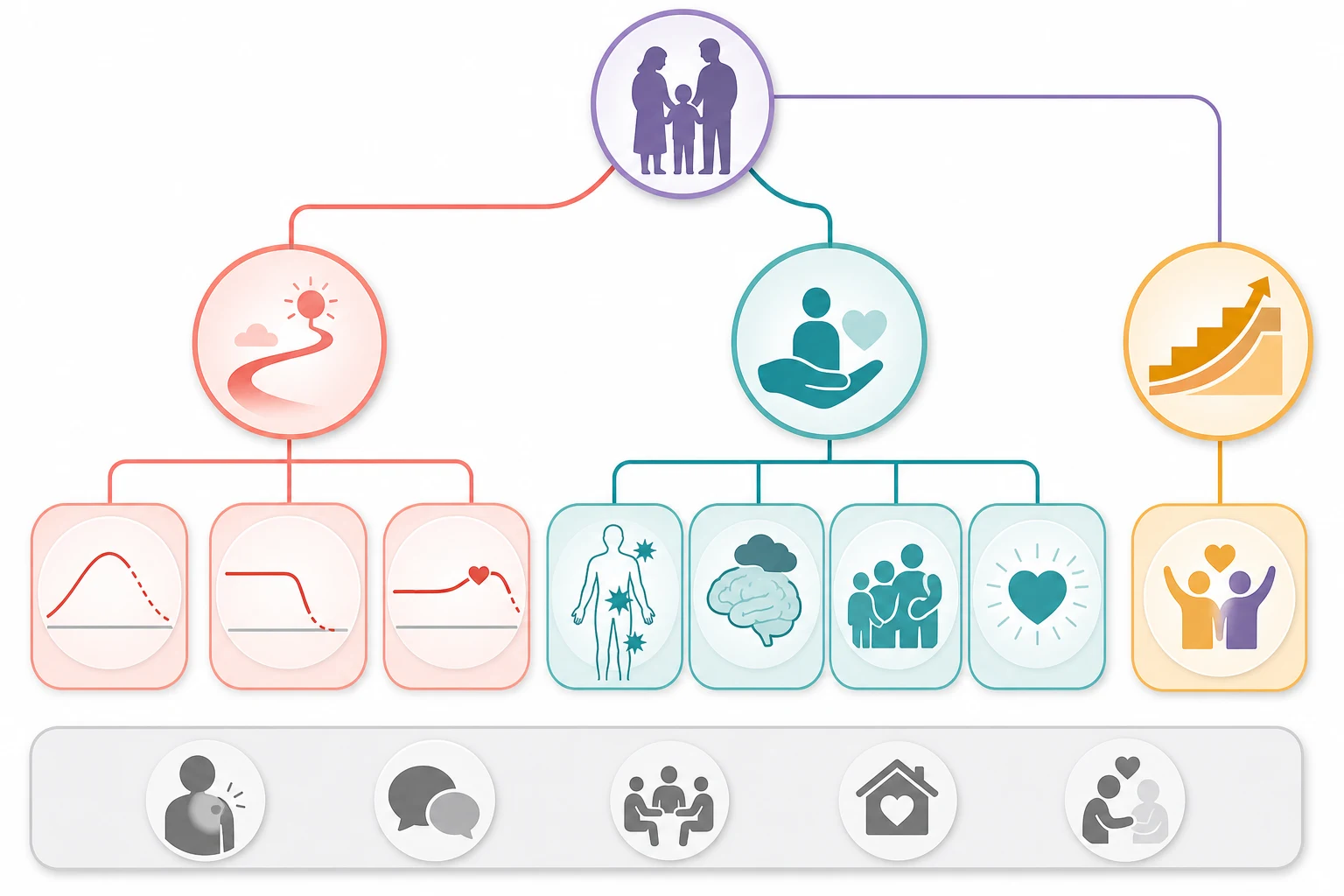
A parallel and more durable classification runs through the dimensions of the suffering, and it is the layer the fellow uses to build the assessment and the plan. The physical dimension holds the pain, the fatigue, the dyspnoea, the nausea, the anorexia and the sleep disturbance. The psychological dimension holds the anxiety, the depression, the fear and the loss of the autonomy. The social dimension holds the family's practical and financial burden, the school, the siblings and the relationships. The spiritual dimension holds the meaning, the hope and the existential questions that the child and the family carry. The assessment that misses a dimension is the assessment that leaves a suffering unaddressed, and the integrated plan holds all four. [5][7]
Physical
symptoms
- Pain is the most feared and the most treatable symptom, escalated up the World Health Organization analgesic ladder
- Fatigue is the commonest symptom at the end of life and is addressed by treating the reversible causes
- Dyspnoea responds to opioids and to the airflow and the anxiety measures
- Nausea, anorexia and secretions are managed with the anticipatory medicines
Psychological
mind and mood
- Anxiety and fear are addressed with honest communication and the family's presence
- Depression is screened for and treated in the child and the parents
- The loss of the autonomy and the body image are named and supported
- Child life and the play therapy hold the developmental needs
Social
family and practical
- The practical and the financial burden is assessed and supported by the social work
- The siblings' needs and the school are addressed
- The cultural and the language needs are met with the interpreter and the cultural support
- The place of care and the respite are planned
Spiritual
meaning and hope
- The meaning of the illness and the death is explored without imposing a framework
- The chaplaincy and the spiritual care are offered alongside the medical care
- Hope is reframed rather than removed, from the hope for cure to the hope for comfort and presence
- The existential questions are held honestly
Epidemiology & Risk Factors
Cancer remains the second commonest cause of death in children beyond the neonatal period in the high-income countries, and although the overall survival of childhood cancer now exceeds eighty per cent, roughly one in five children diagnosed with cancer will die of the disease. The malignancies that most often require palliative care are the high-risk and relapsed central nervous system tumours, the relapsed high-risk leukaemias and the metastatic solid tumours, and the children who carry these diagnoses are the children the fellow meets in the palliative pathway. The burden of the serious health-related suffering is therefore concentrated in the children with the high-risk, the relapsed and the refractory disease. [1][2]
The risk factors for the high palliative need are the clinical features that mark the progression and the burden. A relapse after the frontline treatment, a disease that is refractory to the first-line therapy, a central nervous system tumour with the progressive neurological deficits, and the metastatic or the disseminated disease at the diagnosis are the features that flag the child who needs the integrated palliative pathway. The young age, the developmental disability and the communication difficulty are the features that compound the symptom assessment, because the child who cannot report the pain relies on the observational tools and the family's proxy report. [2][9]
The social and the structural risk factors shape the access to the palliative care and the bereavement support, and they are the reason the equity of the care is so heavily weighted. The family living far from the specialist centre, the migrant or the refugee family with the language barrier, the family with the socioeconomic disadvantage, and the Aboriginal and the Torres Strait Islander and the Māori and the Pacific families with the cultural needs carry an additional burden, and the culturally safe, the locally delivered and the supported palliative care is the standard that addresses the inequity. The fellow should know the local services, the community teams and the funding that supports the home and the hospice care. [9][5]
Pathophysiology
The pathophysiology of the suffering in advanced childhood cancer begins in the tumour burden and the body's response to it, and it explains why the symptoms cluster and amplify as the disease progresses. The growing tumour and the metastatic disease produce the pain through the direct invasion of the nerves, the bones, the viscera and the hollow organs, and through the inflammatory and the pro-nociceptive cytokines that sensitise the peripheral and the central nervous system. The bone metastases and the leptomeningeal disease are the patterns that produce the most severe and the most refractory pain, and they are the patterns the fellow anticipates in the child with the progressive solid tumour. [12][8]
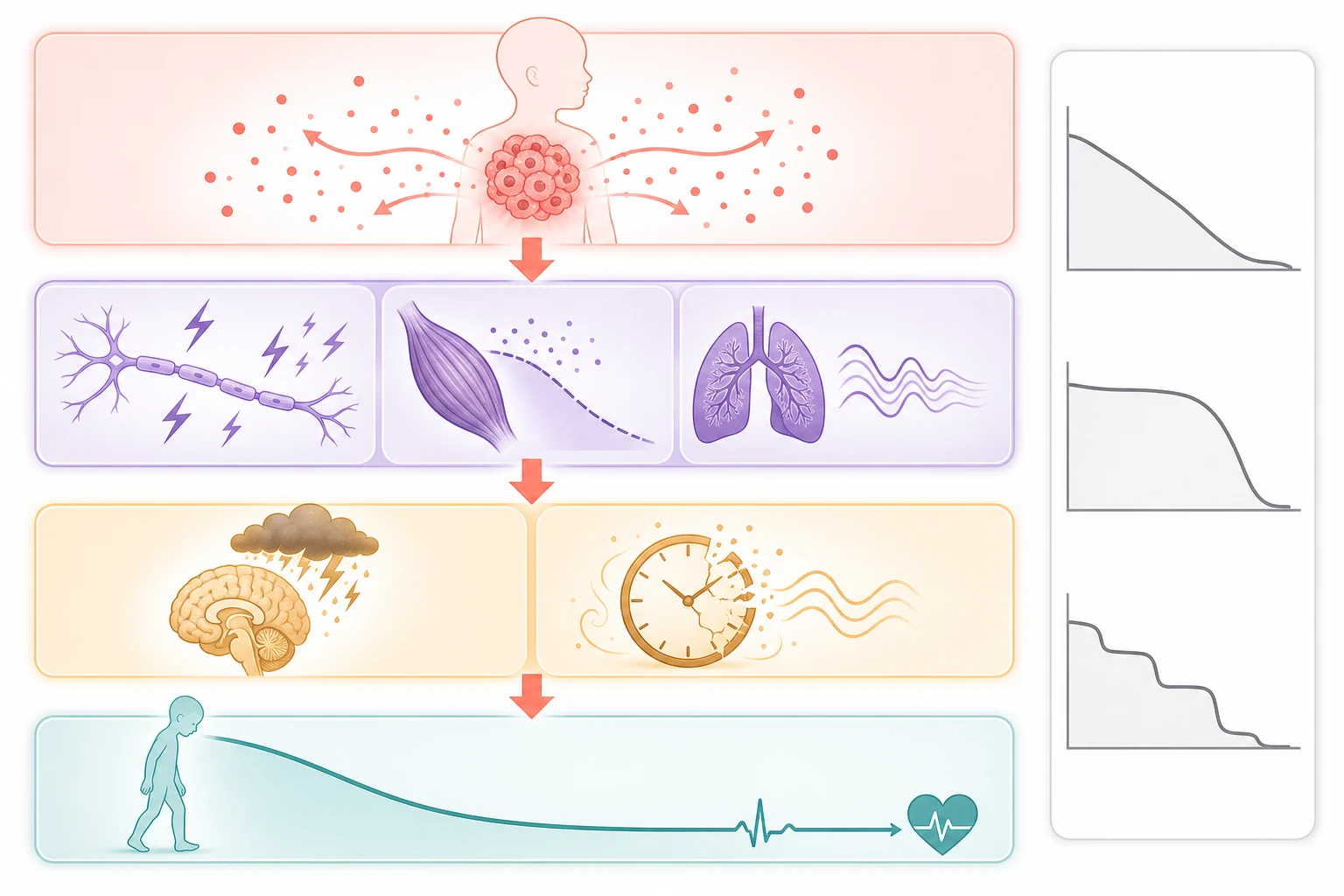
The cancer cachexia and the fatigue are driven by the systemic inflammatory response and the tumour-derived cytokines, and they are the symptoms that the families notice and that the simple nutritional measures cannot reverse. The tumour necrosis factor, the interleukins and the interferons reprogram the metabolism toward the muscle and the fat breakdown, and the anorexia, the weight loss and the fatigue follow. The breathlessness arises from the pleural effusion, the ascites, the pulmonary metastases, the anaemia and the cardiac failure, and it carries the central amplification through the anxiety and the fear. The pathophysiology of the suffering is therefore a cascade, and the treatment that targets one layer leaves the others unaddressed if the assessment is not complete. [12][1]
The dying phase has its own pathophysiology, and the fellow who understands it can prepare the family and the team. As the child moves into the last days, the oral intake falls, the consciousness dims, the secretions accumulate, the breathing changes its pattern, and the perfusion to the periphery declines. The terminal secretions, the rattly breathing and the agitated restlessness are the signs the family finds distressing, and the anticipatory medicines for the pain, the dyspnoea, the nausea, the agitation and the secretions are prescribed before they are needed. The mechanism is the body's orderly withdrawal, and the message to the family is that the child is not suffering in the way the appearance suggests, and that the medicines are there to keep the child comfortable. [12][1]
Clinical Presentation
The child who needs the integrated palliative pathway presents through one of several doors, and the recognition of the door is the skill that triggers the referral. The commonest door is the relapse, where the disease that was in remission returns, and the palliative care is reintroduced as the disease-directed treatment is reconsidered. The second door is the refractory disease, where the cancer does not respond to the first-line treatment and the goals of the care shift. The third door is the incurable diagnosis, where the cancer is advanced and incurable at the presentation, and the palliative care is the primary partner from the start. The fourth door is the progressive decline, where the child with the stable disease develops the new symptoms that signal the progression. [2][6]
The symptoms the family brings are the symptoms the fellow assesses and treats, and they are the burden the integrated team carries. The pain is the symptom the families fear the most, and the uncontrolled pain is the medical emergency that is escalated up the ladder without delay. The fatigue is the commonest symptom and the one the families struggle to relieve, and the dyspnoea is the symptom that distresses the family most at the end of life. The nausea, the vomiting, the anorexia, the constipation, the sleep disturbance, the anxiety and the agitation are the symptoms that follow, and the structured assessment is the foundation of the plan that addresses them. [1][4]
The psychological and the spiritual presentation is the layer the fellow must not miss, because the child's fear and the family's grief are the suffering that the medicines alone cannot reach. The child may withdraw, may regress, may express the fear of separation, may ask the questions about the death, and may carry the existential concern that the family cannot answer. The parents carry the anticipatory grief, the guilt, the decisional burden and the exhaustion, and the siblings carry the confusion, the jealousy, the fear and the isolation. The presentation is therefore the family's presentation, and the assessment that holds the child, the parents and the siblings is the assessment that meets the need. [10][5]
Differential Diagnosis
The differential of the symptom in the child with advanced cancer is built around the reversible causes that hide behind the symptom, because the relief often lies in the cause that the assessment uncovers. The pain differential holds the bone metastasis, the nerve infiltration, the visceral distension, the constipation, the mucositis, the procedure-related pain and the anxiety, and each is addressed by the targeted measure alongside the opioid. The fatigue differential holds the anaemia, the infection, the dehydration, the depression, the medication side effect and the sleep disturbance, and the reversible causes are treated before the fatigue is accepted as the dying. [1][8]
The dyspnoea differential holds the pleural effusion, the ascites, the pulmonary metastases, the pulmonary infection, the anaemia, the cardiac failure, the pulmonary embolism and the anxiety, and the pleural effusion that is drained and the anaemia that is transfused are the reversible causes that relieve the breathlessness. The nausea and the vomiting differential is built around the cause, the chemical driver such as the opioids or the hypercalcaemia, the gastric stasis, the bowel obstruction, the raised intracranial pressure and the vestibular cause, and each is matched to the antiemetic that targets the receptor. The fellow who builds the differential for the symptom is the fellow who finds the reversible cause. [8][4]
The chief diagnostic pitfall is the clinician who attributes the new symptom to the cancer progression and misses the treatable cause. The child whose back pain is labelled the disease progression rather than the epidural cord compression is the child who loses the neurological function. The child whose agitation is labelled the anxiety rather than the hypoxia, the pain, the urinary retention or the delirium is the child who does not receive the targeted measure. The single message for the exam is that the symptom in the child with cancer is assessed for the cause before it is accepted as the inevitable, and the reversible cause is treated. [1][7]
Clinical & Bedside Assessment
The bedside assessment of the child with advanced cancer is a search for the symptoms across the four dimensions, the reversible causes, and the family's understanding and the goals. The assessment begins with the general inspection for the comfort, the pain, the distress and the consciousness, and the vital signs and the pain score are recorded at every contact. The child who is in the uncontrolled pain or the respiratory distress is moved to the immediate relief before the fuller assessment continues, because the symptom is treated first and the history follows. [4][7]
The symptom assessment uses the age-appropriate and the validated tools, because the child's self-report is the gold standard wherever it can be obtained. The school-age and the adolescent child uses the self-report scales such as the numeric rating scale and the faces scale, and the younger child and the child with the developmental disability uses the observational tools such as the r-FLACC. The symptom clusters are mapped with the validated symptom-assessment tools, and the family's proxy report is the essential complement to the child's report. The assessment that holds the self-report, the observational and the family's report is the assessment that meets the child where the child is. [8][9]
The focused assessment of the child with advanced cancer
Assess the comfort, the pain score and the distress first, and relieve the uncontrolled symptom before the fuller history
Use the age-appropriate and the validated symptom-assessment tool, the self-report where possible and the observational tool where the child cannot self-report
Screen for the symptom cluster across the pain, the fatigue, the dyspnoea, the nausea, the constipation, the sleep, the anxiety and the depression
Examine for the reversible causes of each symptom, the effusion, the anaemia, the infection, the cord compression and the bowel obstruction
Assess the psychological and the spiritual dimension through the child, the parents and the siblings
Explore the family's understanding of the prognosis, the goals of the care and the place-of-care preference
Document the plan, the anticipatory medicines and the next conversation in the shared record
The assessment of the family's understanding and the goals is the conversation that the fellow must learn to hold, and it is the skill the examination tests heavily. The honest, the empathic and the structured communication opens with the family's understanding of the illness, explores the hopes and the worries, shares the prognosis in the honest and the hopeful frame, and aligns the plan with the goals. The conversation is revisited at every turning point, the relapse, the progression, the new complication and the acute deterioration, and the documented goals-of-care plan guides the decisions in the crisis. The fellow who holds the conversation well is the fellow who does not abandon the family to the decision in the last hours. [2][6]
Investigations
The investigation of the child with advanced cancer in the palliative pathway is guided by the principle of the proportionality, because the test that does not change the plan is the test that adds the burden. The blood tests are sent for the reversible causes, the full blood count for the anaemia that will be transfused, the electrolytes for the dehydration and the renal failure, the calcium for the hypercalcaemia, and the inflammatory markers for the infection. The imaging is sent for the reversible cause that the symptom suggests, the chest radiograph for the pleural effusion, the ultrasound for the ascites, and the magnetic resonance imaging for the cord compression. [4][7]
The principle the fellow holds is that the investigation is justified by the change it makes to the plan, and the burden of the transfer, the scan and the wait is weighed against the benefit of the answer. The child with the new back pain and the progressive limb weakness has the emergency magnetic resonance imaging for the epidural cord compression, because the finding changes the plan to the dexamethasone and the radiotherapy. The child with the stable dyspnoea and the known pleural effusion has the chest radiograph and the drainage, because the relief is the aim. The child in the last days of life with the comfort as the goal has the investigation that adds the comfort and is spared the test that does not. [4][12]
Across Australia, Aotearoa New Zealand, the United Kingdom, the United States and Canada, the investigation in the paediatric palliative pathway is guided by the principle of the proportionality, and the test is justified by the change it makes to the plan. The reversible causes, the anaemia, the hypercalcaemia, the cord compression, the pleural effusion and the infection, are sought and treated because the relief is the aim, and the burdensome test in the child whose goal is the comfort is the test that is forgone. The fellow should know the local imaging and the laboratory access and the rapid-response pathways for the cord compression.
[4][5]The shared record and the advance care plan are the documents that carry the assessment into the future, and they are the reason the plan is not lost between the encounters. The documented goals-of-care plan, the symptom plan, the anticipatory medicines and the resuscitation decisions are recorded in the shared record that follows the child across the settings, the home, the hospital and the hospice. The advance care plan is the document the family and the team build together, and it is revisited at every turning point. The fellow who documents the plan and the conversation is the fellow who protects the child and the family from the crisis decision. [2][5]
Management — Resuscitation
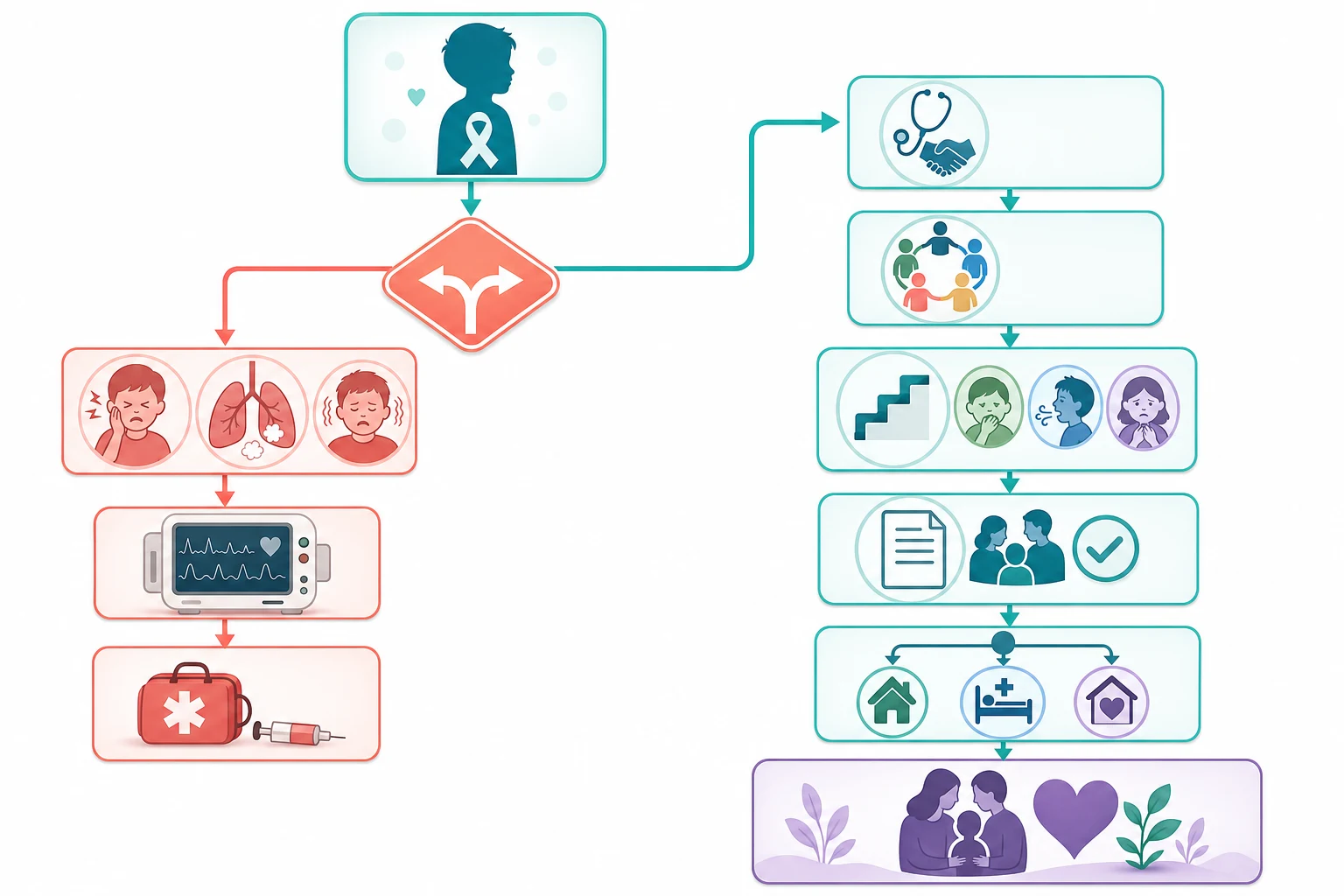
The resuscitation of the suffering in the child with advanced cancer rests on the immediate relief of the uncontrolled symptom and the anticipation of the next one, because the symptom that is uncontrolled is the symptom that escalates the family's distress. The pain flare is the emergency that is treated with the breakthrough opioid at the dose matched to the background, and the child is reassessed within the hour. The respiratory distress is treated with the opioid for the dyspnoea, the airflow measure, the anxiety measure and the treatment of the reversible cause. The seizure is treated with the benzodiazepine, and the agitation is treated with the assessment of the cause and the anxiolytic. [1][8]
The cancer pain is built around the World Health Organization analgesic ladder, and the principles the fellow must carry are the by-the-mouth, the by-the-clock, the by-the-ladder and the for-the-individual. The first step holds the non-opioid analgesics, the paracetamol and the non-steroidal anti-inflammatory drugs, for the mild pain. The second and the third steps hold the opioids, the weak opioids such as the codeine being largely abandoned in the child, and the strong opioids, the oral morphine, the oxycodone and the hydromorphone, for the moderate and the severe pain. The adjuvant analgesics, the gabapentinoids for the neuropathic pain, the corticosteroids for the inflammatory and the raised-pressure pain, and the bisphosphonates for the bone pain, are added at every step. [8][2]
The morphine remains the first-line strong opioid for the cancer pain in the child, and the starting dose is titrated to the effect and the side effect. The oral morphine is started for the child who can swallow, and the subcutaneous or the intravenous morphine is used for the child who cannot. The breakthrough dose is roughly one-sixth of the total daily background opioid, given every one to two hours as needed, and the background is titrated upward from the breakthrough use over the preceding twenty-four hours. The opioid rotation to the oxycodone or the hydromorphone is used for the intolerable side effect or the uncontrolled pain, with the equianalgesic conversion and the dose reduction for the incomplete cross-tolerance. [8][2]
Management — Definitive & Stepwise
The definitive management of the integrated palliative pathway is built around the multidisciplinary team and the structured plan, and the combination is tailored to the child, the family and the trajectory. The overarching principle is that the palliative care runs concurrently with the disease-directed therapy from the diagnosis of the high-risk disease, that the symptom control is built across the four dimensions, and that the advance care planning carries the family through the turning points to the last days and the bereavement. The team holds the paediatric oncology, the palliative care, the nursing, the psychology, the social work, the chaplaincy, the child life and the family, and the named key worker holds the coordination. [2][4]
[2] [9]The symptom control is built across the four dimensions, and the plan is reviewed at every contact. The pain is managed by the ladder and the breakthrough, the dyspnoea by the opioid and the airflow and the anxiety measure, the nausea by the cause-matched antiemetic, the constipation by the regular laxative, and the secretions by the anticholinergic. The fatigue is addressed by the treatment of the reversible causes and the energy conservation, the sleep by the sleep hygiene and the anxiolytic, and the anxiety and the depression by the psychological therapy and the medication. The psychological and the spiritual dimensions are held by the psychology, the chaplaincy, the child life and the family's presence. [4][5]
Anticipatory medicines for the last days of life in the child with cancer
Dose
A subcutaneous or buccal set of medicines prescribed in anticipation of the symptoms of the last days, typically an opioid for the pain and the dyspnoea, a benzodiazepine for the agitation and the seizure, an antiemetic for the nausea, an anticholinergic such as glycopyrrolate or hyoscine for the secretions, and where appropriate a local anaesthetic for a painful lesion
The advance care planning and the place-of-care decision are the elements of the pathway that carry the family through the turning points. The advance care plan documents the goals of the care, the resuscitation decisions, the preferred place of the care and the death, and the anticipatory medicines, and it is revisited at every turning point. The place-of-care decision between the home, the hospital and the hospice is made with the family, and it weighs the child's and the family's preference, the symptom burden, the local services and the supports. The achieved place of the death often differs from the preference, and the flexible plan and the supported transfer are the elements that meet the need. [6][11]
RELIEF
The bereavement follow-up and the sibling support are the elements of the pathway that extend beyond the death, and the fellow who builds them demonstrates the care that does not end at the death. The bereavement-risk assessment of the parents and the siblings is performed before and after the death, and the structured follow-up, the contact, the counselling and the peer support are offered to the families at the higher risk. The siblings of the child who died of cancer carry the grief, the confusion and the isolation, and the structured sibling support, the memory work and the school liaison reduce the complicated grief. The follow-up at the weeks, the months and the year is the care that holds the family. [10][5]
Specific Subtypes & Scenarios
The relapsed central nervous system tumour and the progressive disability
The relapsed brain or spinal tumour is the scenario the fellow meets often, because the central nervous system tumours are the commonest solid tumours of childhood and the relapse carries the poor prognosis. The child develops the progressive neurological deficit, the headache, the vomiting, the ataxia, the seizure and the declining consciousness, and the palliative care moves from the concurrent to the primary role as the disease-directed treatment is reconsidered. The raised intracranial pressure is managed with the dexamethasone, and the seizure is managed with the benzodiazepine and the antiepileptic. The family is supported through the loss of the function and the cognition, and the goals-of-care conversation is held at the turning points. [2][6]
The refractory leukaemia and the transplant failure
The child with the refractory leukaemia or the failed stem-cell transplant carries the high symptom burden and the guarded prognosis, and the integrated palliative pathway runs alongside the experimental and the salvage treatment. The pain, the mucositis, the infection, the graft-versus-host disease and the fatigue are the symptoms that cluster, and the symptom control is intensive and the adjuvants are added early. The family's decisional burden is heavy, and the honest communication, the documented goals and the supported decision-making are the elements that hold the family. The place-of-care decision and the advance care plan are revisited as the trajectory changes. [2][7]
The advanced solid tumour and the home and the hospice care
The child with the metastatic or the advanced solid tumour, the metastatic neuroblastoma, the progressive sarcoma or the metastatic germ-cell tumour, is the child who may be cared for in the home or the hospice in the stable phase. The community palliative team, the local nursing, the equipment and the medication support the home care, and the hospice offers the respite, the symptom control and the end-of-life care. The family is supported by the key worker, the twenty-four-hour phone contact and the flexible plan, and the achieved place of the death is the place that meets the child's and the family's needs at the time. [9][11]
The adolescent and young adult and the autonomy
The adolescent and the young adult with the cancer carries the additional burden of the developmental task, the autonomy, the identity, the intimacy and the fertility, and the palliative care addresses the specific needs of this group. The honest prognostic communication, the inclusion of the young person in the decisions, the fertility and the body-image support, the peer and the partner relationships, and the transition between the paediatric and the adult services are the elements of the care. The young person's voice is held alongside the family's voice, and the advance care planning is done with the young person. [6][5]
Complications & Pitfalls
The complications of the advanced childhood cancer and the palliative pathway divide into the disease-related, the treatment-related and the iatrogenic, and the fellow must hold all three because the iatrogenic harm can rival the disease. The disease-related complications are the progressive pain, the cord compression, the raised intracranial pressure, the seizure, the effusion, the bowel obstruction, the anaemia and the infection. The treatment-related complications are the chemotherapy and the radiotherapy toxicity, the mucositis, the nausea, the neutropenic sepsis and the fatigue. The iatrogenic complications are the opioid-induced constipation, the sedation, the delirium, the myoclonus and the unrecognised pain. [1][4]
The complications of the communication are the ones the fellow must hold with the most care, because the failure of the communication is the harm the family carries longest. The withheld prognosis, the false hope, the decisional burden placed on the family without the support, the conversation deferred to the last hours, and the abandonment of the family after the death are the communication failures that the integrated pathway is built to prevent. The lesson is that the honest and the empathic communication, the documented plan, the revisited goals and the bereavement follow-up are the measures that prevent the harm, and the fellow who learns the communication is the fellow who prevents it. [2][10]
The medication pitfalls are the ones the fellow must hold because the symptomatic medicines are the medicines the child takes through the pathway. The opioid without the regular laxative is the opioid that causes the constipation and the abdominal pain, and the regular stimulant and the stool softener are prescribed from the start of the opioid. The opioid-induced neurotoxicity, the delirium, the myoclonus and the sedation, signals the need for the opioid rotation and the dose reduction. The anticholinergic for the secretions is given early and is explained to the family, because the secretions that are treated late are the secretions that distress the family. [8][1]
Prognosis & Disposition
The prognosis of the child with cancer who enters the palliative pathway spans the range from the months to the years of the concurrent care to the days to the weeks of the dying phase, and the honest prognostic communication is the foundation of the plan. The trajectory decides the tempo, and the structured prognostication, the honest frame, the acknowledgement of the uncertainty and the revisited conversation are the elements the fellow carries. The family is supported through the prognostic communication with the empathy and the honesty, and the hope is reframed rather than removed, from the hope for the cure to the hope for the comfort and the presence. [2][6]
The disposition of the child is the integrated pathway, and the care is delivered through the multidisciplinary team across the settings. The child is cared for in the home, the hospital, the hospice and the outpatient setting, and the flexible plan, the shared record and the key worker hold the continuity. The community palliative team, the local nursing and the equipment support the home care, and the hospice offers the respite and the end-of-life care. The achieved place of the death often differs from the preference, and the supported transfer and the flexible plan are the elements that meet the need. [9][11]
In Australia and Aotearoa New Zealand, the child with cancer is supported by the tertiary paediatric oncology and the palliative care service, with the community palliative care teams, the local nursing and the hospice services delivering the home and the respite care. The Aboriginal and the Torres Strait Islander and the Māori and the Pacific families are supported by the culturally safe services and the local teams, and the long distances are met by the telehealth and the retrieval services. Very Special Kids in Victoria, Bear Cottage in New South Wales, Hummingbird House in Queensland and the Laura Fergusson Brain Injury Trust hospice services and the regional children's hospice services offer the respite and the end-of-life care, and the fellow should know the local services.
[9][5]The bereavement follow-up and the longer-term family support are the disposition that extends beyond the death. The bereavement-risk assessment, the contact at the weeks, the months and the year, the counselling and the peer support are offered to the families, and the families at the higher risk are offered the more intensive support. The complicated grief in the parents and the siblings is screened for and treated, and the sibling support and the school liaison are the elements that reduce the longer-term harm. The fellow who builds the bereavement plan demonstrates the care that does not end at the death. [10][5]
Special Populations
The adolescent and the young adult is the special population that carries the additional burden of the developmental task, and the palliative care addresses the autonomy, the identity, the intimacy, the fertility and the transition. The honest communication, the inclusion of the young person in the decisions, the fertility and the body-image support, the peer and the partner relationships, and the transition between the paediatric and the adult services are the elements of the care. The young person's voice is held alongside the family's voice, and the advance care planning is done with the young person, respecting the evolving capacity. [6][2]
The child with the developmental disability and the communication difficulty is the special population that holds the additional burden of the symptom assessment. The child who cannot report the pain relies on the observational tools and the family's proxy report, and the structured assessment, the family's knowledge and the low threshold for the analgesic trial are the elements of the care. The behavioural change, the sleep disturbance and the altered tone are the signs of the pain in the child with the severe disability, and the analgesic trial is the diagnostic and the therapeutic measure. [8][9]
The Aboriginal and the Torres Strait Islander and the Māori and the Pacific families, the migrant and the refugee families, and the families with the socioeconomic disadvantage are the special populations that carry the additional burden of the access and the equity. The culturally safe services, the interpreter, the local teams, the telehealth and the supported travel are the elements of the care that address the inequity, and the cultural, the spiritual and the community practices are respected and the integrated into the plan. The family is held by the team that knows the local services and the funding. [9][5]
The family far from the specialist centre is the special population that holds the burden of the distance, and the locally delivered palliative care, the community team, the equipment and the medication support, and the twenty-four-hour phone contact are the elements of the care that meet the need. The telehealth, the retrieval and the supported transfer between the home, the hospital and the hospice are the elements that hold the continuity, and the local team is supported by the specialist centre. The fellow should know the local services and the regional children's hospice. [9][11]
Evidence, Guidelines & Regional Differences
The landmark evidence that underpins the modern palliative care in childhood cancer is the product of the symptom-burden studies, the integration studies and the standards development. The Wolfe study of the symptoms and the suffering at the end of life in the children with cancer, published in the New England Journal of Medicine, established that the children still suffered from the fatigue and the pain in the last weeks of life, and it drove the field toward the earlier integration and the better symptom control. The systematic review of the impact of the specialty palliative care in the paediatric oncology found the improved symptom control and the quality of life, and it established the integration as the standard. [1][4]
The contemporary evidence is built around the integration, the standards and the community delivery. The Snaman review of the pediatric palliative care in oncology, published in the Journal of Clinical Oncology, framed the concurrent model, and the Benini international standards, from the IMPaCCT to the GO-PPaCS, set the standards for the care. The Kaye review of the paediatric palliative care in the community, published in the CA Cancer J Clin, set the framework for the home and the community delivery, and the Johnston and Rosenberg review of the palliative care in the adolescents and the young adults addressed the specific needs of the group. [2][5]
Across Australia, Aotearoa New Zealand, the United Kingdom, the United States and Canada, the World Health Organization consensus definition, the concurrent integration model and the World Health Organization analgesic ladder are the consistent standard. The services and the funding vary across the regions, with the home palliative care, the hospice and the bereavement services more developed in some regions than others, and the access to the strong opioids and the community teams the variable that most often limits the care. The fellow should know the local services, the funding and the access to the opioids and the community teams, and the international standards from the IMPaCCT to the GO-PPaCS.
[3][5]The controversies and the open questions are the live ones. The optimal timing of the palliative referral, the integration of the disease-directed and the palliative care in the advanced disease, and the place of the immunotherapy and the targeted therapy in the refractory disease are the continuing questions. The access to the strong opioids and the community palliative care in the lower-resource settings, the bereavement support for the siblings, and the cultural and the spiritual care for the indigenous and the migrant families are the equity questions. The research priorities in the paediatric palliative care, set by the field, address the symptom assessment, the communication, the bereavement and the delivery, and they shape the field. [7][5]
Exam Pearls
The high-yield facts for the exam are the ones that change the care of the child and the family, and they are worth carrying as sharp statements. The World Health Organization consensus definition of the palliative care is the active total care of the child with the life-limiting illness and the family, and it runs concurrently with the disease-directed therapy, not only after it fails. The referral is made early, at the diagnosis of the high-risk, the relapsed or the refractory disease, and the late referral is the harm. The four dimensions of the suffering, the physical, the psychological, the social and the spiritual, are held in the integrated assessment and the plan. [2][3]
The cancer pain is escalated up the World Health Organization analgesic ladder, from the non-opioid to the strong opioid, with the adjuvant analgesics at every step, and the principles are the by-the-mouth, the by-the-clock, the by-the-ladder and the for-the-individual. The breakthrough opioid is roughly one-sixth of the total daily background opioid, and the background is titrated from the breakthrough use. The opioid rotation uses the equianalgesic conversion and the dose reduction for the incomplete cross-tolerance. The fear of the opioids must never deny a child the adequate analgesia. [8][2]
The final pearls are the ones that catch the candidate who has learned the headline and forgotten the corner. The symptoms at the end of life in the childhood cancer are the pain, the fatigue, the dyspnoea, the nausea and the agitation, and the family is prepared and supported through the last days. The anticipatory medicines for the pain, the dyspnoea, the nausea, the agitation and the secretions are prescribed before they are needed. The reversible cause of the symptom is sought before the symptom is accepted as the inevitable, and the cord compression is the emergency that is imaged. The message for the exam is that the early integration and the honest communication are decisive, and the family is held from the diagnosis through the bereavement. [1][10]
References
- [1]Wolfe J, Grier HE, Klar N, Levin SB, Ellenbogen JM, Salem-Schatz S, Emanuel EJ, Weeks JC Symptoms and suffering at the end of life in children with cancer. N Engl J Med, 2000.PMID 10655532
- [2]Snaman JM, McCarthy S, Wiener L, Hulbert A, Remke S, Singer M, Wolfe J Pediatric Palliative Care in Oncology. J Clin Oncol, 2020.PMID 32023163
- [3]Radbruch L, De Lima L, Knaul F, Wenk R, Ali Z, Bhatnagar S, Blanchard C, Bruera E, Cerchietti L, Cleary JF, Connor S, Eisenach J, Eser P, Goh C, Harding R, Henson L, Luyirika E, Munyoro E, Murray SA, Pettus K, Phillips T, Puchalski C, Rajagopal MR, Rajagopal M, Ryan KM, Selman LE, Shaw A, Shim JO, Sihuin M, Silbermann M, Stiel S, Tassinari S, Tsouros A, Twycross R, Vermandere M, Yong J Redefining Palliative Care-A New Consensus-Based Definition. J Pain Symptom Manage, 2020.PMID 32387576
- [4]Kaye EC, Weaver MS, DeWitt LH, Torkildson J, Winick N, Levine D, Gonzalez-Gomez I, Liu H, Baker JN The Impact of Specialty Palliative Care in Pediatric Oncology: A Systematic Review. J Pain Symptom Manage, 2021.PMID 33348034
- [5]Benini F, Papadatou D, Bernadá M, Centini G, Cordone G, Escher M, Brouwer M, DeLeon D, Findeisen A, Jalmbrant M, Kavanagh S, Kreicbergs U, Lassiter P, Maciel A, Marston J, Menezes A, Molina E, Monterosso L, Onwuasoanya M, Palat G, Rushton C, Santos F, Sequeira J, Sidgwick P, Valdes A, Weaver MS, Zernikow B, Zuur C International Standards for Pediatric Palliative Care: From IMPaCCT to GO-PPaCS. J Pain Symptom Manage, 2022.PMID 35031506
- [6]Johnston EE, Rosenberg AR Palliative Care in Adolescents and Young Adults With Cancer. J Clin Oncol, 2024.PMID 37862672
- [7]Baker JN, Levine DR, Hinds PS, Weaver MS, Foley GV, Friebert S, Wolfe J Research Priorities in Pediatric Palliative Care. J Pediatr, 2015.PMID 26028284
- [8]Zernikow B, Smale H, Michel E, Hasan C, Jorch N, Hauswald M, Schießl N, Aksakal N, Höhn A, Roth B, Ludwig S, Wager J Paediatric cancer pain management using the WHO analgesic ladder--results of a prospective analysis from 2265 treatment days during a quality improvement study. Eur J Pain, 2006.PMID 16243549
- [9]Kaye EC, Rubenstein J, Levine D, Baker JN, Drotar D, Noll RB Pediatric palliative care in the community. CA Cancer J Clin, 2015.PMID 25955682
- [10]Barrera M, Alam R, D'Agostino NM, Nicholas DB, Schneiderman G Parental perceptions of siblings' grieving after a childhood cancer death: a longitudinal study. Death Stud, 2013.PMID 24600719
- [11]Kassam A, Skiadaresis J, Alexander S, Wolfe J Parent and clinician preferences for location of end-of-life care: home, hospital or freestanding hospice? Pediatr Blood Cancer, 2014.PMID 24265171
- [12]Boire A, Burke K, Cox TR, Correia AL, Kumar S, Dillekås H, Edlund S, Erez A, Fischbach C, Gilbert-Ross M, Hannon GJ, Hirst DG, Huh J, Hunter KW, Jacobsen BM, Janus JR, Kelly T, Khuon T, Koh B, Krummel MF, Laughney AM, Lowe SW, Lyden D, Maiuri P, Malanchi I, Mantovani A, Massagué J, Miles FL, Necela BM, Nelson CM, Plodinec M, Polyak K, Riethmüller G, Schwab LP, Soto-Pantoja DR, Span PN, Sukumar S, Trujillo C, Tung JC, Vargo-Gogola T, Welm AL, Welm BE, Williams C, Zardawi SJ, Wynn TA Why do patients with cancer die? Nat Rev Cancer, 2024.PMID 38898221