Paeds · preventive-and-community-paediatrics
Childhood injury prevention and anticipatory guidance
Also known as Injury prevention · Anticipatory guidance injury · Childhood accident prevention · Home safety counselling · Unintentional injury prevention · TIPP · Haddon matrix injury
Fellowship-level childhood injury prevention and anticipatory guidance: Haddon energy model, age-banded hazards, passive versus active strategies, office-based counselling evidence, modern household toxins, safeguarding interface, and regional practice differences.
On this page & tools
Your progress
Saved locally on this device.
Practise this topic
Target exams
Red flags
Life stages
Care settings
Clinical exam formats
Board mappings
Overview & Definition
A well toddler climbs onto a windowsill while a parent turns to stir pasta. Nothing has happened yet. That is still your clinic problem. Childhood injury prevention is the work of reducing the chance that mechanical, thermal, chemical or electrical energy reaches a child in a harmful dose. Anticipatory guidance is how you do that work before the event: you predict the next developmental skill, name the hazards it unlocks, and agree a plan the family can actually run at home. [1] [4] [5]
Say injury, not accident. Accident implies fate. Injury science treats harm as a host–agent–environment interaction you can change. Office-based counselling is one tool among many. Product design, packaging laws, building codes and equipment provision often move risk more than a leaflet alone. Your job is to use the clinic visit well, then link families to the stronger levers when they exist. [1] [2] [5]
This leaf is the framework and age-banded home/clinic guidance chapter. Detailed passenger, bicycle, pedestrian and firearm content lives in its sibling leaf. Detailed drowning and water safety lives in another. Safe sleep is its own critical chapter. Cross-link those pages rather than re-teaching them here. [1]
Classification
Classify in three layers that examiners love to mix: mechanism, intent, and Haddon phase. Mechanism tells you what energy is moving. Intent separates most unintentional household injuries from maltreatment or self-harm pathways. Haddon phases tell you when to intervene — before the energy is free, while it is being transferred, or after tissue is already hurt. [4] [5]
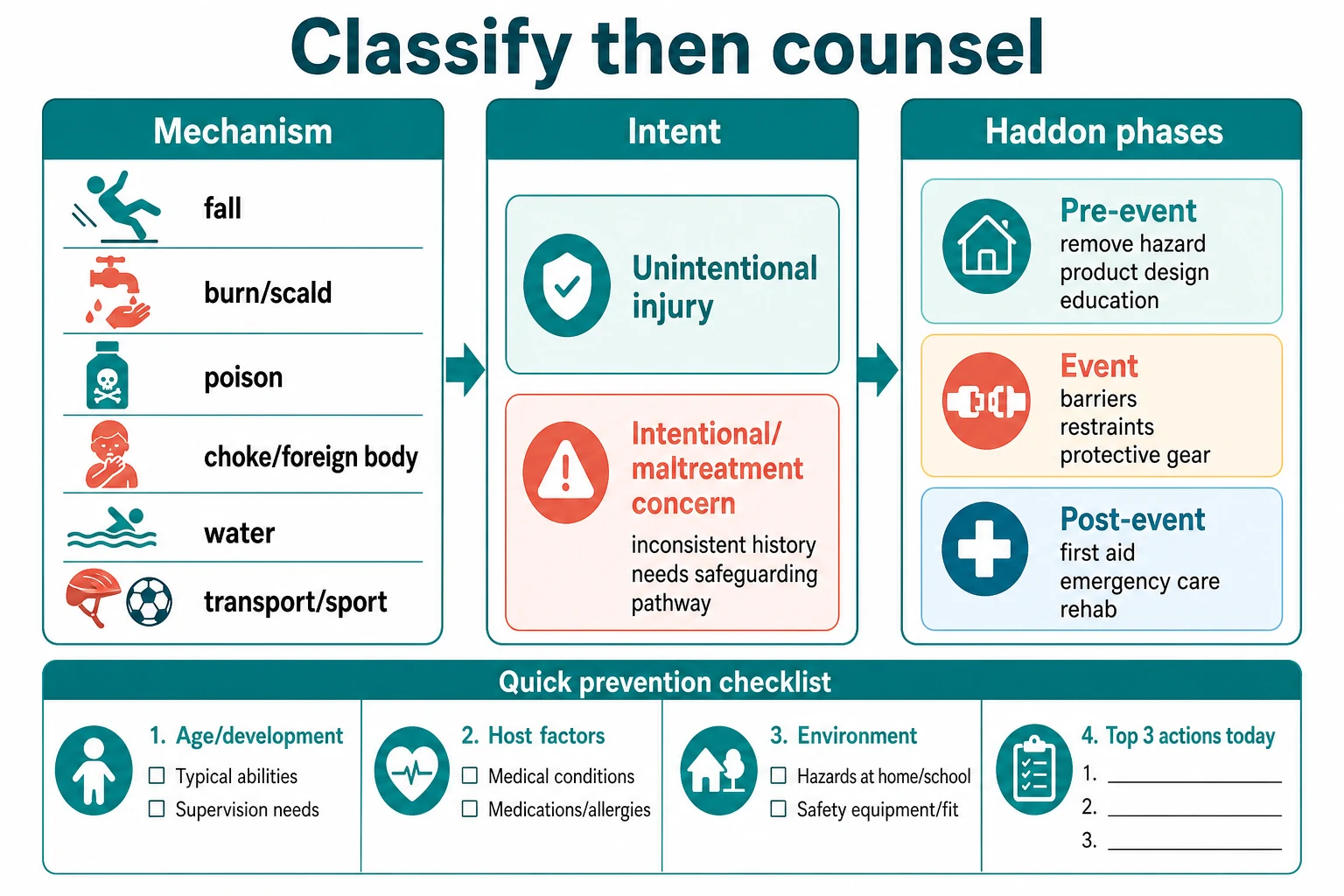
Three questions that sort the case
- Fall = mechanical height and impact
- Scald/burn = thermal
- Poison/battery = chemical
- Choke = mechanical airway obstruction
- Most clinic work is unintentional injury prevention
- Inconsistent history needs safeguarding thinking
- Self-harm and violence need different safety plans in adolescents
- Pre-event: remove poison, lock window, lower water temperature
- Event: helmet, restraint, stair gate, pool barrier
- Post-event: cool a burn, open airway, call emergency services
Age reclassifies the same object. A remote-control battery is low risk in a newborn’s room and high risk once mouthing and mobility arrive. A second-storey window is a ventilation feature until climbing starts. Always classify hazards against current developmental capacity, not calendar age alone. [1] [24]
Epidemiology & Risk Factors
After infancy, unintentional injury remains a leading cause of death and serious disability in children and youth in high-income settings. The exact rank order shifts by country and year, but the clinical message is stable: preventable mechanisms dominate the remaining mortality curve once congenital and perinatal causes recede. [22]
Age peaks are predictable. Young infants fall from surfaces and face choking and sleep-related hazards. Mobile infants and toddlers explore with hands and mouths: stairs, windows, poisons, scalds, batteries and water become front-line topics. School-age children add sport, bicycles and pedestrian exposure. Adolescents add road risk, sport intensity, substance-related injury and intentional injury interfaces. Pediatricians already report that the content of injury anticipatory guidance shifts by age group; your counselling should too. [1] [23] [24]
Host factors include age, sex patterns for some mechanisms, developmental disability, ADHD, previous injury, and caregiver capacity. Environmental factors include housing quality, stairs without gates, openable windows, hot water systems, poison storage, product design and poverty. Inequity is not a footnote. Families without money for equipment, living in temporary housing, or rotating between carers cannot “just supervise better” as the only plan. [7] [22]
Pathophysiology
Haddon’s core insight is simple enough to say in a viva: injury is damage from energy that reached tissue in a harmful amount. Prevention either prevents the energy from being freed, modifies it during transfer, or limits damage after transfer. That is why a stair gate, a lower water temperature and cool running water first aid sit in different phases of the same model. [4] [5]
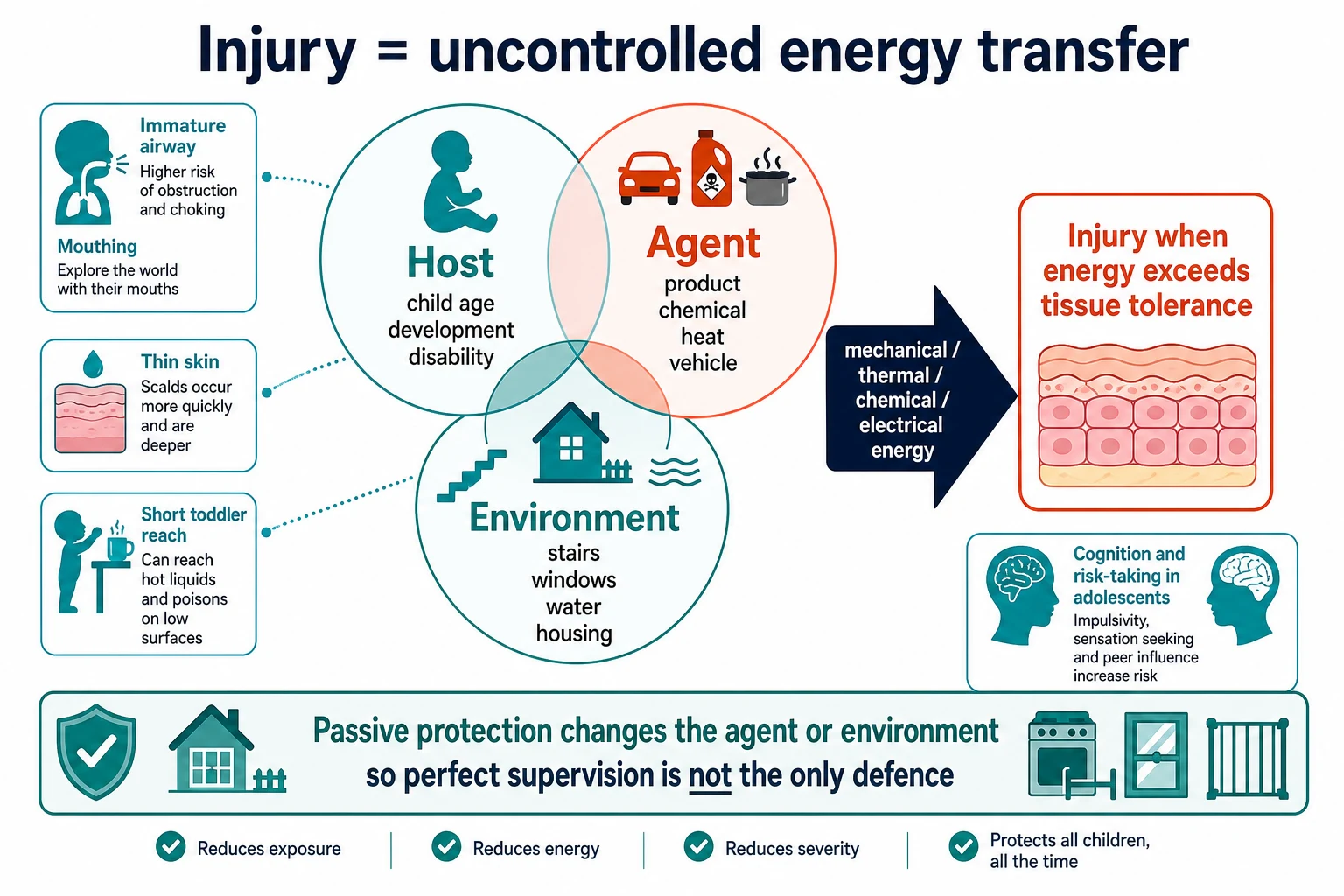
Children are not small adults in this model. Thin skin burns faster in hot water. A short toddler’s face is at the height of a pulled tablecloth or dangling kettle cord. Mouthing converts button batteries and small toys into airway or oesophageal threats. Immature judgement and peer effects later raise adolescent risk-taking. You do not need a molecular cascade for every mechanism. You need the age-specific reason the same energy dose is more dangerous. [11] [13] [15]
Passive protection changes the agent or environment so the child is safer even when a tired adult looks away for ten seconds. Child-resistant packaging, window locks, thermostatic mixer valves, pool barriers and safer product design all work this way. Active strategies still matter — supervision rules, not walking with hot drinks, helmet use — but they fail when attention fails. Lead with passive options whenever they exist. [4] [7] [18]
Clinical Presentation
Most of the time the “patient” is a well child at a health-supervision visit. The caregiver may not ask about injury at all. You still open the topic with a developmental hook: “Now that she pulls to stand, stairs and windows matter more than last month.” Parents of young children already worry about falls; your role is to convert worry into a short, ranked plan. [1] [24]
Other presentations you must recognise: [1]
- Near-miss counselling after a child almost swallowed a battery, almost fell from a balcony, or pulled a hot cup. [13] [19]
- Post-injury visit in clinic or ED where the wound is fixed but the home hazard is not. [1]
- Hidden concern — repeated injuries, delayed care-seeking, or a story that does not match developmental stage. That is no longer pure prevention counselling. [1]
Caregivers often describe intended practice, not real practice. Night feeds, visiting grandparents, shared custody homes and temporary housing change the hazard map. Ask what happened yesterday, not what the family believes is ideal. [24]
Differential Diagnosis
For prevention visits the main differential is conceptual, not laboratory-based. [1]
Unintentional injury is the default when mechanism, developmental stage and environment fit. Maltreatment or neglect rises when the history is inconsistent, the injury is incompatible with the child’s motor skills, there are injuries of different ages without explanation, or care-seeking is delayed without a credible reason. Medical mimics (for example osteogenesis imperfecta, bleeding disorders, metabolic bone disease) enter when fractures or bruises do not fit either a simple fall or a clear abusive pattern — those work-ups belong to the injury/safeguarding clinical pathway, not to a well-child leaflet. [1]
Do not stop prevention work because safeguarding is open. A child in an unsafe home still needs the window lock and the poison cupboard sorted while multi-agency assessment proceeds. [1]
Clinical & Bedside Assessment
Use a short, non-judgemental home-safety history tied to the child’s current skills. Shame makes families hide the real layout of the house. [1] [24]
Five-minute injury-prevention assessment
Developmental unlock
What can this child newly do — roll, crawl, walk, climb, run into the street, stay home alone?
Top mechanisms
For this age, ask specifically about falls, burns/scalds, poisons/batteries, choking hazards and water access.
Passive barriers
Stair gates, window locks, smoke alarms, hot-water control, child-resistant storage, pool fencing where relevant.
Real supervision map
Who is present at busy times? Multiple homes? Fatigue, substance use, siblings as supervisors?
Equity and teach-back
What blocks the plan? Cost, landlord, language, shared housing? Agree three actions and hear them back.
Watch interaction in the room. A mobile toddler with free access to your clinical bin while caregivers do not notice is data. Examine the child as usual for the well visit, but use skin findings, oral injuries and developmental stage as context when an injury history is offered. Document what you advised and what remains unfinished. [1]
Investigations
Routine anticipatory guidance needs no blood tests or imaging. The “investigation” is the history, the hazard inventory and the feasibility of the plan. [1]
Investigations belong to clinical pathways outside routine well-visit counselling: [1]
- Acute injury care after a fall, burn, ingestion or immersion.
- Safeguarding work-ups when the story does not fit.
- Product identification after a possible battery or chemical exposure (bring the packet, note imprint codes). [13] [14]
Do not order a “prevention panel.” Do document counselling and barriers, because incomplete guidance is associated with more later injury visits in observational data and because follow-up depends on knowing what still needs fixing. [10]
Management — Resuscitation
Prevention topics still own the first minutes of common household emergencies. Keep these crisp. [1]
Choking. If the child cannot cough effectively or becomes silent and cyanosed, use age-appropriate back blows and chest or abdominal thrusts per local paediatric BLS guidance and call emergency services early. Prevention counselling afterwards targets food size, shape and supervision, and non-food small objects. [11] [12]
Scald or burn. Cool with cool running water as first aid teaching. Avoid ice, butter or toothpaste myths. Assess depth, size, airway and need for specialist burn care using local thresholds. Prevention afterwards targets water temperature, kettle cords, hot drinks and cooking zones. [15] [16]
Button battery or serious poisoning. Treat suspected oesophageal button battery as time-critical. Do not delay transfer for non-essential tests. Identify the product when safe to do so. Prevention afterwards is locked storage and removing loose batteries from the child’s reach. [13] [14]
Immersion or major trauma. Start paediatric BLS/ALS and retrieval pathways. Detailed drowning and transport chapters take the mechanism-specific depth; your job here is not to delay rescue while finishing a safety checklist. [1]
Management — Definitive & Stepwise
Definitive management for this leaf is structured anticipatory guidance plus passive hazard control, repeated across visits as development changes. [1] [3]
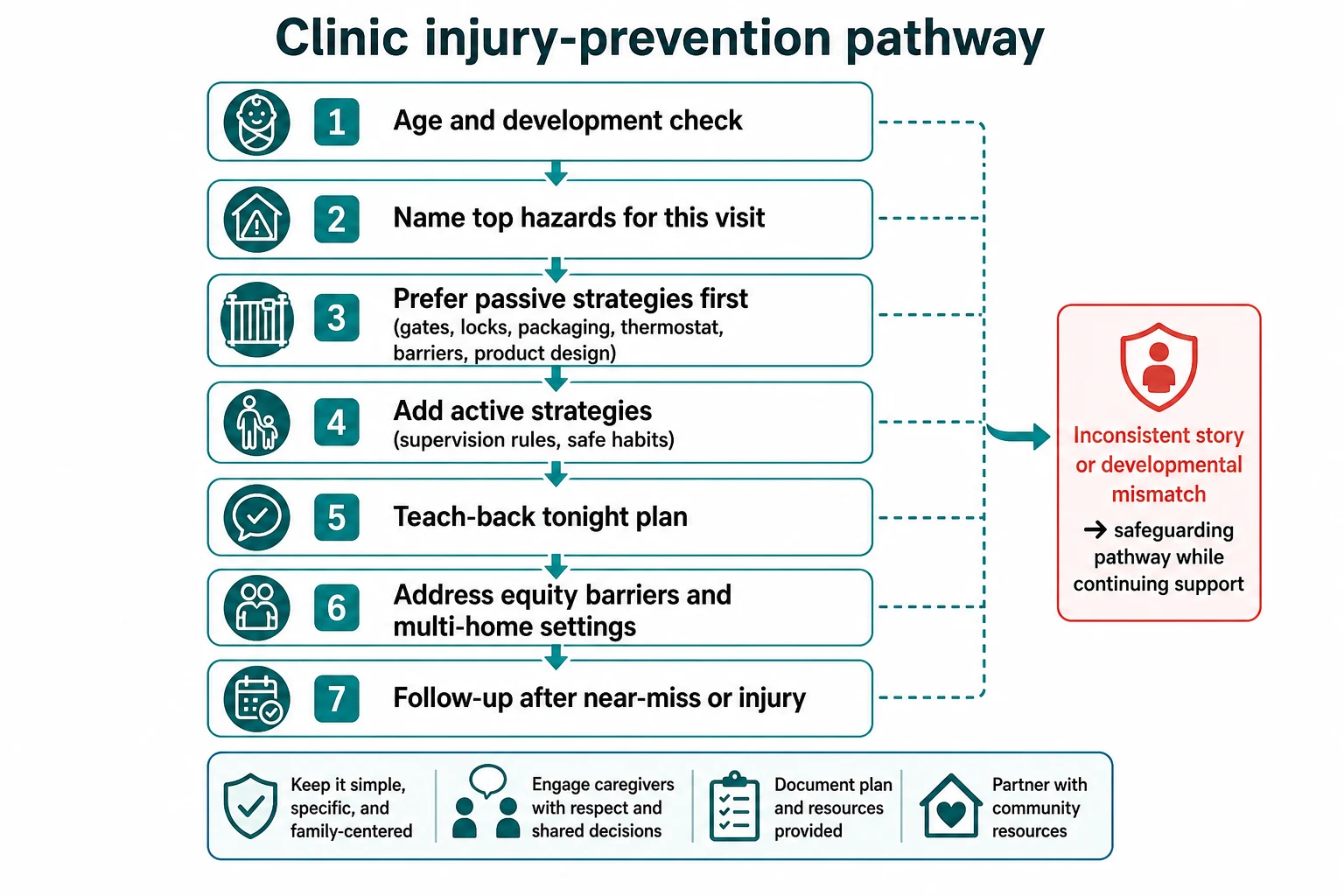
Step 1 — Pick the visit’s top hazards
Do not recite twenty tips. Pick three that match this child’s new skills. Evidence and reviews of office counselling support focused, age-appropriate messages rather than unfocused lists. Less anticipatory guidance has been associated with more subsequent infant injury visits in observational work, so skipping the topic is not neutral. [1] [2] [10] [23]
Step 2 — Prefer passive, then active
Examples that examine well are passive-first pairs by mechanism: [1] [7]
| Hazard | Passive first | Active adjunct |
|---|---|---|
| Stairs | Gate installed correctly | Supervise on stairs; teach holding rail later |
| Windows/balconies | Locks/guards; furniture away from sills | Never rely on a flyscreen |
| Poisons | Locked storage; child-resistant packaging | Do not call medicine “lollies” |
| Scalds | Safer hot-water delivery / mixer valves where feasible | No hot drinks while holding child |
| Choking | Age-safe food form; keep small objects out | Sit to eat; supervise |
| Batteries | Secure battery compartments; no loose cells | Check remote controls and toys |
Home safety education combined with equipment improves safety practices more reliably than education alone in systematic review evidence. Poisoning-prevention education and equipment improve safe storage practices. Use that pattern in clinic: advice plus a path to the device. [7] [8]
Step 3 — Teach-back and write the plan
Ask: “What are you changing tonight?” If the answer is vague, the plan is not done. Enhanced anticipatory guidance models and structured programmes (including modern evaluations of injury-prevention programmes in primary care) treat counselling as a behaviour-change task, not a monologue. [9] [21]
Step 4 — Close the loop after injury or near-miss
Every injury visit should end with one prevention action. A cooled scald still needs a water-temperature plan. A window fall still needs locks and furniture moved. A battery scare still needs a house sweep for loose cells. [13] [19]
Specific Subtypes & Scenarios
Newborn to early infant
Falls from beds, sofas and change tables; hot water; smoke alarms; small objects left by older siblings; safe sleep cross-link. Keep bags, coins and button batteries out of the sleep space and change area. [1] [11]
Mobile infant and toddler
This is the densest anticipatory-guidance band. Stairs, windows, poisons, cleaning products, liquid nicotine, medicines, button batteries, high-powered magnets, scalds, bath supervision and doorway gates dominate. Parents describe falls happening in the seconds before they can reach the child — design must cover those seconds. [13] [24]
Preschool
Playground behaviour, street-start rules, cooking imitation toys versus real kitchens, and continuing poison/battery vigilance as climbing improves. Keep shopping trolleys and carts in mind as a fall mechanism when families describe supermarket injuries. [1]
School-age
Helmets and sport gear, pedestrian skills, home-alone readiness, kitchen and tool use, and bullying or risk-taking beginnings. Cross-link passenger and bicycle detail to the transport safety leaf. [1] [23]
Adolescent
Road exposure, sport, substance-related injury, work injury in some settings, and the intentional injury interface. Prevention language shifts toward shared decision-making with the young person, not only the parent. Firearm and detailed passenger content sit in the sibling leaf; name the interface without pretending this page replaces it. [1] [22]
Multi-home and rural scenarios
Separated parents need the same passive barriers in both houses. Rural families may face delayed emergency response, farm machinery and all-terrain vehicles — prioritise barriers and supervision rules that match delayed help. [1]
Complications & Pitfalls
Other traps: assuming flyscreens stop window falls; believing child-resistant caps are child-proof; teaching burn first aid with ice or household remedies; forgetting visitors and grandparents as hazard sources; ignoring landlord barriers to installing safety devices. [8] [19] [20]
Prognosis & Disposition
Most well-child injury-prevention encounters end with home disposition and a written or patient-portal plan. Prognosis at population level improves most when clinic advice rides alongside legislation, product standards and affordable equipment. Clinic counselling alone has mixed strength depending on topic and intensity; that is an argument for better counselling design and equipment linkage, not for silence. [2] [7] [21]
After a significant injury, disposition includes both medical follow-up and hazard removal. After a safeguarding concern, disposition follows multi-agency pathways while immediate dangers in the environment are still addressed. [1]
Special Populations
Socioeconomic disadvantage. Prioritise free or low-cost equipment schemes, landlord advocacy and the highest-yield passive changes. Do not equate poverty with neglect. [7]
Indigenous families. Use culturally safe, non-blaming language and local programmes. Address housing and resource access rather than delivering a deficit lecture. [1]
Disability and neurodiversity. Children with developmental delay, autism, ADHD or seizures may need longer supervision horizons and different barriers (door alarms, water proximity plans, medication storage). Redesign the environment; do not only ask for hypervigilance. [1]
Out-of-home care and multiple caregivers. Every placement needs the same hazard inventory. Written plans travel better than verbal tips. [1]
Technology-dependent children. Oxygen tubing, trachs, pumps and hospital equipment create trip, strangulation and burn risks. Involve the home-care team in the safety plan. [1]
Migrant and refugee families. Use interpreters. Housing may be temporary or overcrowded; adapt the top-three list to the real dwelling. [1]
Evidence, Guidelines & Regional Differences
Haddon supplies the conceptual spine: energy damage and countermeasure strategies across phases. Use it to structure answers, not as a scoring tool. [4] [5] [6]
Office-based counselling. AAP statements support age-appropriate unintentional injury counselling in primary care. Critical reviews show counselling can change some safety practices, with stronger effects when messages are specific and supported by equipment or legislation. Enhanced anticipatory guidance trials and programme evaluations continue to test how to deliver that counselling at scale. [1] [2] [3] [9] [21]
Home safety evidence. Cochrane and related systematic reviews support home safety education and equipment for improving safety practices; poisoning-focused reviews show better storage practices after education and equipment strategies. [7] [8]
Mechanism-specific evidence you should be able to name: [11] [13] [15] [19]
- Choking: AAP prevention guidance and food-choking epidemiology. [11] [12]
- Button batteries: Litovitz clinical implications and task-force updates — prevention and time-critical care. [13] [14]
- Scalds: classic tap-water burn literature and later policy/thermostatic valve approaches. [15] [16] [17] [18]
- Window falls: not limited to high-rises; ongoing need for locks and furniture placement. [19] [20]
Controversy to defend in a viva. How much does a busy clinic conversation change injury outcomes versus redesign and law? Honest answer: counselling is necessary but rarely sufficient. The strongest programmes combine focused advice, equipment, and environmental or legislative change. Do not claim a single pamphlet prevents all toddler falls. Do claim that ranked, age-banded, passive-first counselling is still part of competent paediatric care. [2] [7] [21]
Exam Pearls
Worked micro-cases
18-month-old well visit. Top list: stair gate, poisons/batteries locked, hot drinks and water temperature, bath supervision, window locks if climbing. Teach-back three items. [1] [13]
4-year-old after ED visit for window fall from a first-floor sill. Medical clearance is not the end. Move furniture, fit locks/guards, explain screens do not hold children, check other homes the child visits. [19] [20]
2-year-old with coughing after a sibling’s remote lost its battery. If any concern for ingestion, emergency pathway first. If battery found outside the child, still counsel locked storage and secure compartments. [13] [14]
What boards are testing
Written papers test Haddon logic, age-banded hazards, passive versus active strategies and modern toxins. Communication OSCEs test non-judgemental counselling and teach-back. Long cases test whether you integrate social determinants and safeguarding without losing the concrete home plan. If you can only remember one clinic algorithm: age → top hazards → passive first → teach-back → fix barriers. [1] [4] [7]
References
- [1]Gardner, HG Office-based counseling for unintentional injury prevention Pediatrics, 2007.PMID 17200289
- [2]Bass, JL Childhood injury prevention counseling in primary care settings: a critical review of the literature Pediatrics, 1993.PMID 8414825
- [3]American Academy of Pediatrics Committee on Injury and Poison Prevention Office-based counseling for injury prevention. American Academy of Pediatrics Committee on Injury and Poison Prevention Pediatrics, 1994.PMID 7936874
- [4]Haddon, W Jr Energy damage and the 10 countermeasure strategies. 1973 Inj Prev, 1995.PMID 9345992
- [5]Haddon, W Jr Advances in the epidemiology of injuries as a basis for public policy Public Health Rep, 1980.PMID 7422807
- [6]Haddon, W Jr Options for the prevention of motor vehicle crash injury Isr J Med Sci, 1980.PMID 7358516
- [7]Kendrick, D Home safety education and provision of safety equipment for injury prevention Cochrane Database Syst Rev, 2007.PMID 17253536
- [8]Kendrick, D Effect of education and safety equipment on poisoning-prevention practices and poisoning: systematic review, meta-analysis and meta-regression Arch Dis Child, 2008.PMID 18337279
- [9]Gielen, AC Randomized trial of enhanced anticipatory guidance for injury prevention Arch Pediatr Adolesc Med, 2001.PMID 11177061
- [10]Simon, TD Less anticipatory guidance is associated with more subsequent injury visits among infants Ambul Pediatr, 2006.PMID 17116604
- [11]Committee on Injury, Violence, and Poison Prevention Prevention of choking among children Pediatrics, 2010.PMID 20176668
- [12]Chapin, MM Nonfatal choking on food among children 14 years or younger in the United States, 2001-2009 Pediatrics, 2013.PMID 23897916
- [13]Litovitz, T Emerging battery-ingestion hazard: clinical implications Pediatrics, 2010.PMID 20498173
- [14]Jatana, KR Pediatric button battery injuries: 2013 task force update Int J Pediatr Otorhinolaryngol, 2013.PMID 23896385
- [15]Feldman, KW Tap water scald burns in children Pediatrics, 1978.PMID 683765
- [16]Katcher, ML Scald burns from hot tap water JAMA, 1981.PMID 7265410
- [17]Han, RK Cost-effectiveness analysis of a proposed public health legislative/educational strategy to reduce tap water scald injuries in children Inj Prev, 2007.PMID 17686935
- [18]Kendrick, D Randomised controlled trial of thermostatic mixer valves in reducing bath hot tap water temperature in families with young children in social housing: a protocol Trials, 2008.PMID 18348736
- [19]Houlton, AY Observational study of falls in children from windows and balconies: What has changed? J Paediatr Child Health, 2021.PMID 33107150
- [20]Vish, NL Pediatric window falls: not just a problem for children in high rises Inj Prev, 2005.PMID 16203839
- [21]Perrin, EM The Injury Prevention Program to Reduce Early Childhood Injuries: A Cluster Randomized Trial Pediatrics, 2024.PMID 38557871
- [22]West, BA Unintentional injury deaths in children and youth, 2010-2019 J Safety Res, 2021.PMID 34399929
- [23]Burr, WH Pediatrician-Reported Injury Prevention Anticipatory Guidance by Patient Age Group Acad Pediatr, 2023.PMID 36682449
- [24]Molocznik, A Before I Could Get Him, He Fell: Experiences, Concerns, and Fall Prevention Strategies of Parents With Young Children Clin Pediatr (Phila), 2023.PMID 36919814