Paeds · professional-practice-and-evidence
Clinician wellbeing, fatigue and sustainable practice
Also known as Physician burnout · Doctor fatigue and sleep deprivation · Clinician wellbeing · Second victim phenomenon · Resilience and sustainable medical practice
Fellowship guide to clinician wellbeing, fatigue and sustainable practice: defining burnout and the Maslach dimensions, the demands-resources mechanism, why sleep loss and burnout harm patient safety, the second-victim phenomenon, and the layered individual, team and organisational response that lets a clinician practise well for a career.
On this page & tools
Your progress
Saved locally on this device.
Practise this topic
Target exams
Red flags
Life stages
Care settings
Clinical exam formats
Board mappings
Overview & Definition
A paediatric registrar has slept four hours in two days. On a night shift she nearly gives ten times the intended opioid dose. She is exhausted, withdrawn, and beginning to doubt whether she is cut out for medicine. Your job is to keep that registrar — and every child she cares for — safe. That is the territory of clinician wellbeing, fatigue and sustainable practice: the personal and system conditions that let a doctor practise well across a career, and the failure modes — fatigue, burnout, impairment, the second-victim response — when those conditions are not met. [1] [11]
Burnout is a work-related syndrome, not a personal weakness or a medical diagnosis. Maslach defines it along three dimensions: overwhelming emotional exhaustion, depersonalisation (a cynical, detached, sometimes callous response to patients and colleagues), and a reduced sense of personal accomplishment. Fatigue is the state of reduced mental or physical capacity caused by sleep loss, prolonged wakefulness, circadian disruption, or workload that exceeds recovery. An impaired clinician is one whose performance is compromised by fatigue, illness, substance use or psychological distress. The second victim is a clinician who is traumatised by involvement in an adverse event, medical error, or patient harm — Wu's term for the doctor who "makes the mistake" and then needs help too. Holding these four ideas apart is half the viva. [10] [11]
Classification
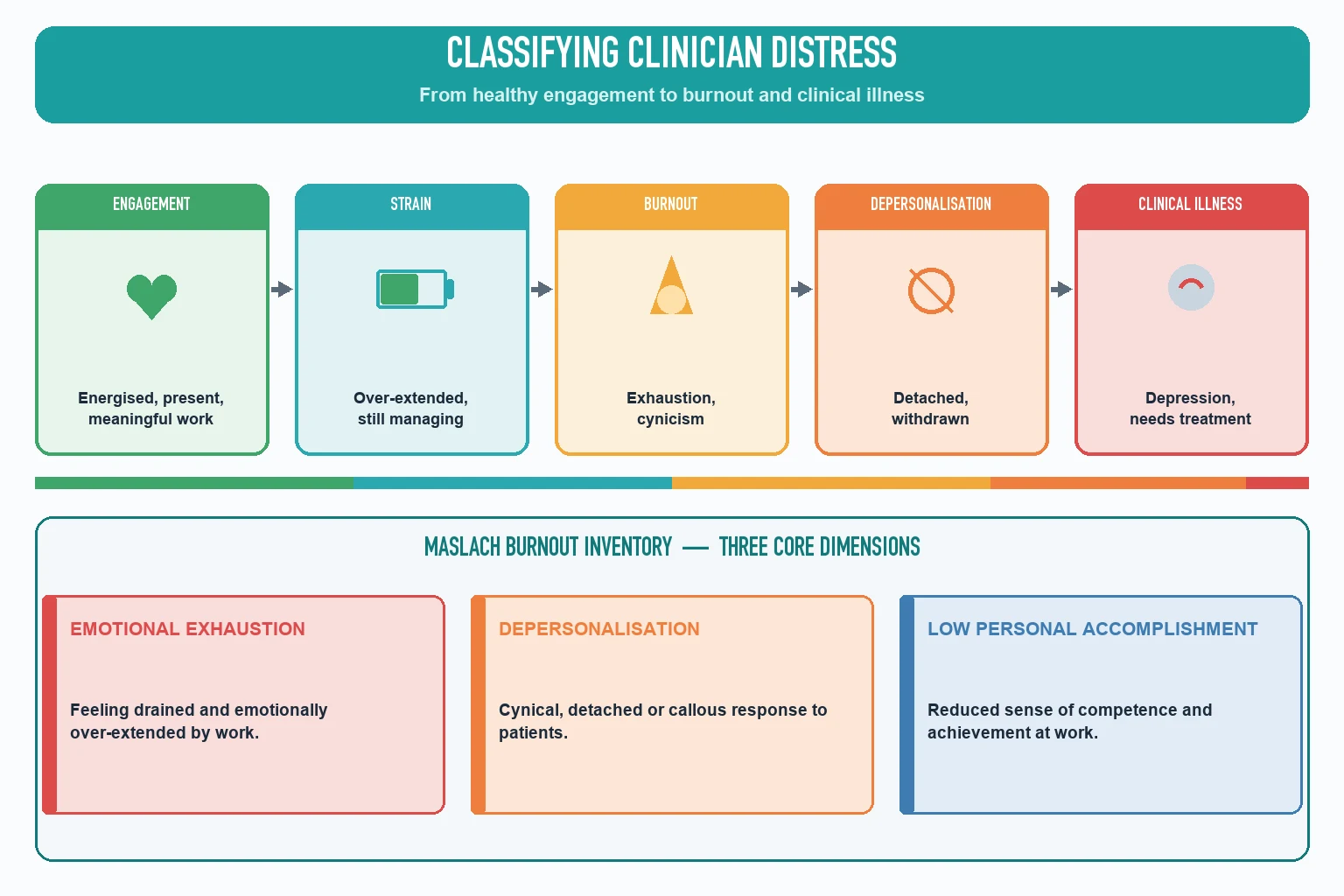
Classify clinician distress along two axes the examiner expects: a continuum from healthy engagement to clinical illness, and the three Maslach dimensions of burnout itself. A clinician normally sits in engagement — energised, present, finding meaning in the work. Under unrelieved strain they tip into over-extension, still functioning but running on reserves. When strain is chronic and unopposed, burnout appears with its three dimensions; depersonalisation can become pronounced enough that the clinician is detached from patients and team; and a subset cross into a clinical disorder such as depression or anxiety that needs treatment. The point of the continuum is that early strain is recoverable with rest and reorganisation, while the late stages need active clinical care. [10] [4]
The Maslach Burnout Inventory (MBI) operationalises the three dimensions so burnout can be measured rather than guessed at. Emotional exhaustion captures the depleted "I have nothing left to give" feeling. Depersonalisation captures the cynical "these patients are draining me" stance that corrodes care. Reduced personal accomplishment captures the "nothing I do makes a difference" loss of meaning. High scores on the first two and a low score on the third define burnout; this is the language of a wellbeing survey and an examiner answer. [10]
Four terms that trip up candidates
- Work-related syndrome, three Maslach dimensions
- Driven by chronic unmanaged workplace stress
- Primarily an organisational fix
- Acute or cumulative sleep loss and workload
- Degrades attention, memory and reaction
- Reversible with recovery and rest
- Performance compromised right now
- From fatigue, illness, substance use or distress
- Step aside safely and tell someone
- Clinician traumatised by an adverse event
- Guilt, shame, withdrawal, re-living
- Needs structured peer support, not blame
Epidemiology & Risk Factors
Burnout is common across medicine, and paediatrics and its intensive-care subspecialties sit at the higher end. Shanafelt's 2012 study showed US physicians were more burnt out and less satisfied with work-life balance than the working population they serve, and his 2015 follow-up showed burnout and satisfaction worsening between 2011 and 2014 while the general population stayed stable. Frontline specialties, trainees, and those carrying high emotional load and administrative burden carry the heaviest weight. In paediatrics the drivers concentrate at the bedside: high-acuity neonatal and paediatric intensive care, chronic and life-limiting illness, the emotional labour of caring for children and their families, and night-shift and retrieval work. [4] [5]
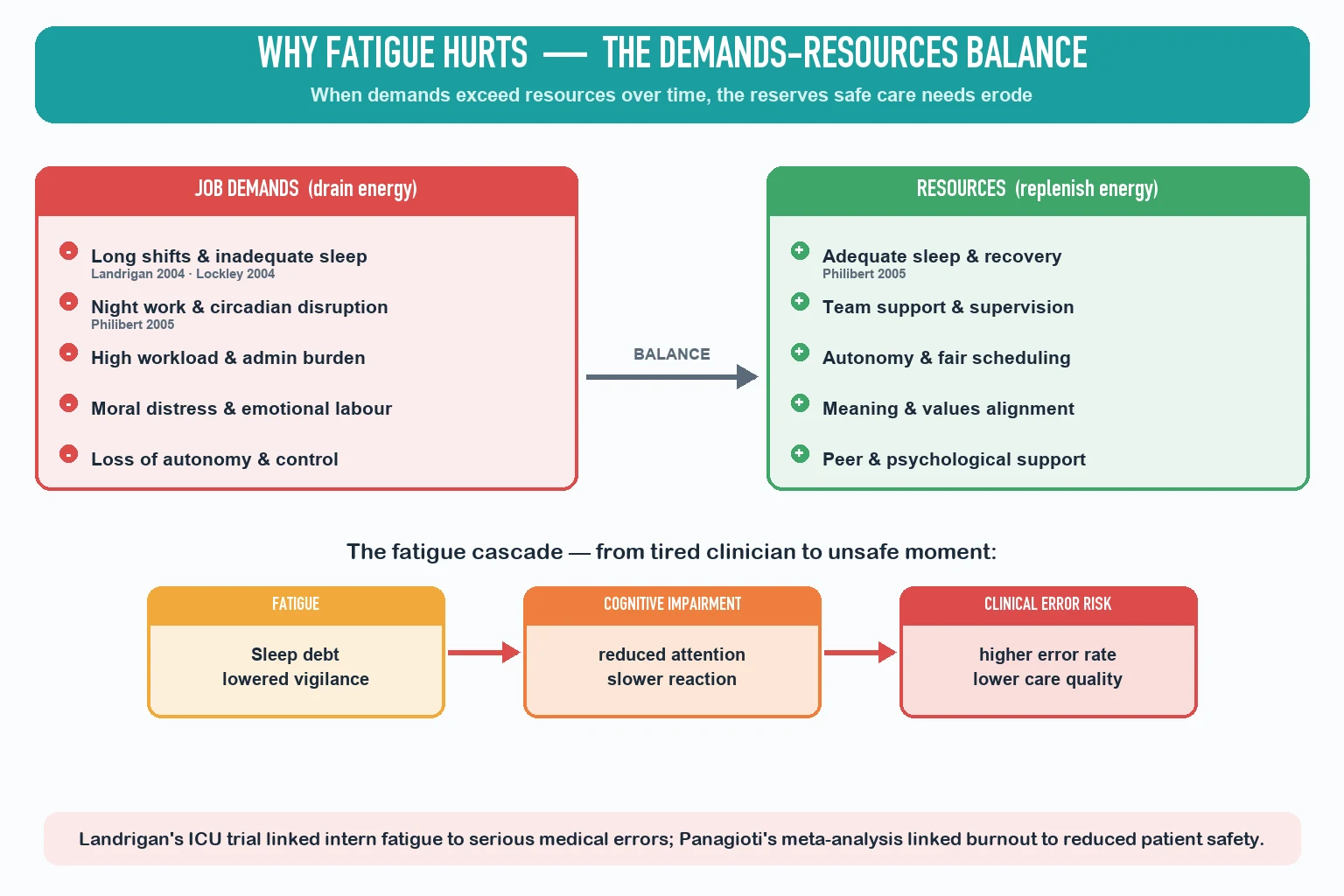
The risk factors cluster into demands that drain and resources that protect. Demands include long shifts, inadequate sleep, night work and circadian disruption, high workload and administrative burden, moral distress, loss of autonomy, and exposure to death, suffering and complaint. Thinning resources include weak team support, poor supervision, unfair scheduling, absence of meaning or control, and stigma against asking for help. When demands rise and resources fall, burnout follows — and the same configuration produces fatigue-related error. [8]
Pathophysiology
Think of a clinician's capacity as a finite energy reservoir filled by resources and drained by demands — the job demands–resources framing. Sleep, recovery, team support, autonomy, meaning and fairness refill the reservoir. Long shifts, nights, high workload, moral distress and loss of control drain it. When outflow exceeds inflow for long, the reservoir empties: acute fatigue shows first, then chronic exhaustion, cynicism and a collapsing sense of accomplishment — the burnout syndrome. Maslach frames this as an imbalance between chronic demands and the resources to meet them, not as individual frailty. [10] [8]
The mechanism from tiredness to patient harm is concrete. Sleep is a biological need, not an optional extra. Philibert's meta-analysis showed sleep loss degrades performance comparably to alcohol, and that the impairment worsens the longer a resident is awake. Lockley and Landrigan's intensive-care trials showed that traditional long-duration shifts produce more attentional failures and serious medical errors, and that shortening those hours reduced them. Fatigue erodes the front-line cognitive defences — sustained attention, working memory, decision-making, communication — that prevent error, so a tired clinician makes more slips and worse judgements at exactly the moments that matter. Panagioti's meta-analysis extended the chain: physician burnout is significantly associated with reduced patient safety, lower professionalism and lower patient satisfaction. The mechanism is a cascade, not a single event. [1] [2] [3] [9]
Clinical Presentation
Burnout and fatigue present in the clinician, not the patient — though patients notice. The burnt-out or exhausted doctor reports persistent tiredness not relieved by rest, emotional depletion, cynicism and detachment from patients and colleagues, irritability, and a creeping sense that the work is pointless or that they are bad at it. Physically there may be headaches, sleep disruption, weight change, or frequent minor illness. Behaviourally there is withdrawal, reduced engagement in teaching or teams, presenteeism and absenteeism, and sometimes substance use to wind down or stay awake. Families and partners often notice the change before the clinician admits it. [10] [8]
Fatigue presents acutely at the sharp end. After prolonged wakefulness or a long night shift a clinician shows microsleeps, slowed reaction, lapses in attention, impaired short-term memory, irritability, and a narrowed focus that misses peripheral information — the "tunnel vision" of the tired doctor. The presentation is often a near miss: a dose almost given wrongly, a result almost missed, a handover almost omitted. An impaired colleague may be spotted by smell, by behaviour, or by a pattern of uncharacteristic errors. The second victim presents after an adverse event with shock, guilt, re-living, shame, withdrawal, sleep disturbance and sometimes suicidal ideation, often within hours to weeks of the event. [11] [12]
Differential Diagnosis
- Burnout versus a depressive or anxiety disorder — they overlap heavily and can coexist; persistent low mood, anhedonia and hopelessness, especially with any suicidal ideation, point to clinical illness needing treatment. [8]
- Burnout versus normal, recoverable tiredness — burnout persists despite rest and is anchored to work; ordinary fatigue lifts with sleep and leave. [10]
- Acute fatigue versus an underlying medical cause of exhaustion — anaemia, thyroid disease, sleep apnoea, pregnancy, and untreated mood or substance-use disorders. [3]
- Second-victim distress versus post-traumatic stress disorder or major depression after an adverse event — severe or persistent symptoms cross the line into clinical disorder. [11] [12]
- Substance-related impairment versus fatigue or illness — do not assume; investigate and support.
- Moral injury and compassion fatigue — distinct from burnout, arising from being asked to act against one's values or from cumulative emotional exposure; name it to address it. [8]
Clinical & Bedside Assessment
Assess the clinician the way you would assess a patient — with structure and without judgement. Take an occupational history: hours worked, nights and long shifts in the past week and month, recovery and sleep between shifts, workload, supervision and team support, recent adverse events or complaints, and any leave taken. Screen for the three burnout dimensions directly: exhaustion ("are you emotionally depleted by your work?"), depersonalisation ("have you become more cynical or callous toward patients or colleagues?"), and personal accomplishment ("do you still feel you are doing meaningful, competent work?"). A validated single-item or two-item screener can flag burnout quickly in a busy service. [10] [4]
Always assess safety. Ask explicitly about low mood, hopelessness, suicidal ideation and any use of alcohol or other substances to cope — a colleague's distress can be a life-threatening emergency. Identify whether the clinician is acutely impaired right now: have they slept, are they mid-long-shift, are they about to perform a safety-critical task? Map the demands-versus-resources balance concretely: what is draining them, what could replenish them, and what is within their control versus the system's. Crucially, separate the person from the problem — a burnt-out colleague is signalling an unwell workplace, not a weak doctor. [8] [11]
SIGECAPS-with-work — screening the burnt-out colleague
Investigations
There are no blood tests for burnout. "Investigation" here means structured assessment of the person and the system. For the person, use a validated instrument — the Maslach Burnout Inventory or its short form (MBI-HSS), or a two-item screener — to objectify the three dimensions and track change over time. Screen for treatable medical contributors: full blood count and ferritin, thyroid function, and where indicated a sleep assessment for sleep apnoea or insomnia. Screen for depression and anxiety with a standard tool, and always assess substance use and suicide risk directly. [10] [8]
For the system, investigate the same way a root-cause analysis investigates an incident. Examine rosters for consecutive long shifts, inadequate recovery, and night-load; audit workload, supervision ratios and handover quality; review the pattern of near misses and errors against shift length and time of day; and survey the team with a validated burnout or engagement instrument to reveal whether the problem is individual or environmental. The dose-citation principle applies to fatigue data just as it does to drug doses — quantify the exposure (hours awake, hours between shifts, number of nights) rather than relying on impression. Linking a cluster of near misses to a rostering pattern is exactly the kind of evidence that converts a vague "we're all tired" into an actionable system change. [1] [3]
Management — Resuscitation
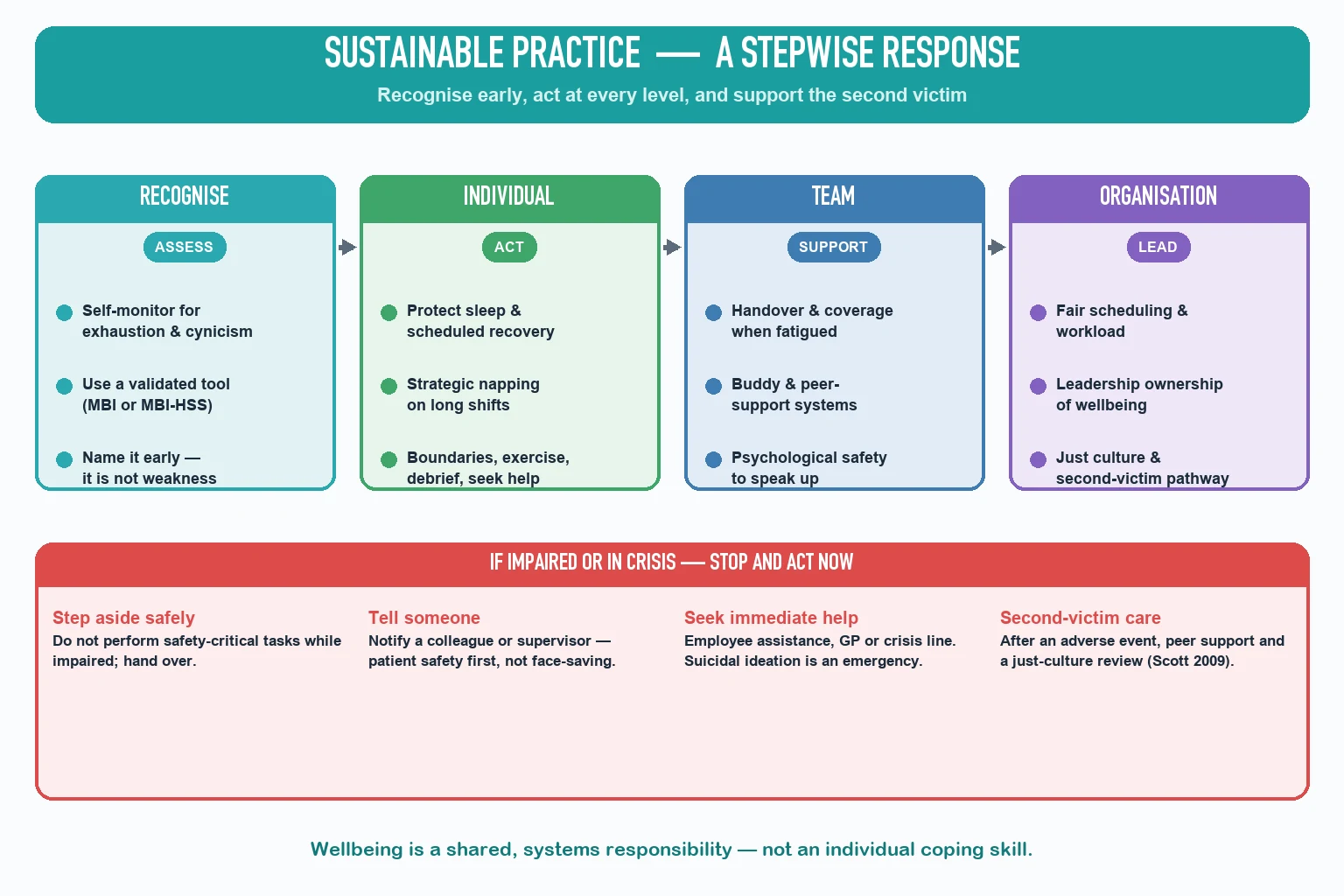
- If acutely impaired, step aside safely. Do not perform safety-critical tasks while impaired by fatigue, illness or distress; hand over to a colleague. Patient safety comes before face-saving. [1]
- If in crisis or suicidal, act now. A clinician with active suicidal ideation is an emergency — ensure they are not alone, remove access to means where possible, and escalate to crisis services, the employee-assistance programme, or emergency care. [11]
- If a second victim, intervene early. After a serious adverse event, offer immediate peer support, relieve the clinician from further high-risk tasks in the short term, and start a structured, blame-free debrief. [12]
- Tell someone. Notify a trusted colleague, supervisor or medical lead — speaking up about impairment or distress is a patient-safety action, not a failure. [8]
- Protect the patient immediately. If an impaired colleague will not step down, escalate through the chain of command; this is patient safety, not betrayal. [1]
Management — Definitive & Stepwise
Sustainable practice is built at three levels — individual, team and organisation — and the evidence is clear that organisational change does the heavy lifting. West's Lancet meta-analysis showed that both organisation-directed and individual-directed interventions reduce burnout, and that organisational approaches have the larger effect. Shanafelt and Noseworthy set out nine leadership strategies, from developing and appraise leaders on wellbeing, to measuring it, building communities at work, and rewarding caring leadership. The fellowship candidate names both and explains why. [7] [6]
Step 1 — Protect sleep and recovery. Design rosters that cap consecutive long shifts, guarantee adequate time between shifts, limit consecutive nights, and build in recovery. Encourage strategic napping on long or night shifts and a planned handover for the fatigued clinician. [2] [3]
Step 2 — Right-size workload and autonomy. Match staffing to acuity, reduce low-value administrative burden, protect time for the work that gives meaning, and give clinicians control over how they practise. [6]
Step 3 — Build team and supervisory support. Strong handover, visible senior support, buddy systems, and psychological safety to speak up turn a group of tired individuals into a resilient team. After an adverse event, a formal second-victim support pathway — peer supporters, structured debrief, just-culture review — shortens recovery and keeps clinicians in practice. [12]
Step 4 — Give leadership ownership of wellbeing. Leaders set the climate; appraise and develop them on team welfare, measure burnout and act on it, and reward the leaders who look after their people. [6]
Step 5 — Support individual health. Encourage help-seeking, normalise care for physical and mental health, provide confidential access to employee-assistance and practitioner-health programmes, and address the stigma that keeps doctors from asking for help. [8]
Step 6 — Make it a just culture. Separate blameless error and system failure from recklessness; investigate events for learning, support those involved, and choose strong system actions over individual sanction. [11] [12]
Building a sustainable practice environment — layered sequence
Measure burnout and fatigue with validated tools and act on the data
Design rosters that protect sleep, recovery and circadian rhythm
Match workload to acuity and protect meaningful, autonomous work
Build team handover, supervision and psychological safety
Give leaders ownership of wellbeing and appraise them on it
Provide confidential help pathways and a second-victim support programme
Specific Subtypes & Scenarios
The night shift and the long shift. Acute sleep deprivation is the commonest fatigue scenario. The evidence-based responses are roster design (cap consecutive long shifts, guarantee inter-shift recovery, limit consecutive nights), strategic napping during prolonged shifts, and a planned, blame-free handover for the clinician who recognises they are impaired. [1] [2]
The second victim. After an adverse event, the involved clinician is at high risk of guilt, shame, withdrawal and leaving practice. Scott described a natural recovery trajectory that for a substantial minority becomes chronic. The intervention is structured and early: peer support, relief from immediate high-risk duties, a blame-free debrief, and access to practitioner-health services. A formal second-victim pathway is now a marker of a mature safety culture. [12] [11]
The burnt-out trainee. Trainees are a high-risk group, exposed to long hours, steep learning curves, relocation and isolation. Supervisor noticing, protected supervision time, validated screening, and access to confidential support matter; telling a struggling trainee to "be more resilient" is both ineffective and harmful. [5] [8]
The impaired colleague. When a colleague's performance is compromised by fatigue, illness or substance use, the duty is to patients first and to the colleague second: ensure immediate patient safety, then support and signpost the colleague to appropriate assessment and treatment, following the local impaired-practitioner pathway. [8]
The paediatric intensivist and retrieval clinician. Neonatal and paediatric intensive care and retrieval concentrate every risk factor — high acuity, long shifts, nights, emotional load, and life-critical decisions. Fatigue-risk management here is patient safety: standardised handover, mandated rest, and team-based coverage. [1]
Complications & Pitfalls
- Treating burnout as an individual failing and prescribing resilience instead of fixing the demands-resources imbalance. [10] [6]
- Ignoring fatigue risk because "we've always worked these hours" — the cost is measured in errors and harm. [1]
- Failing to ask about suicide and substance use — clinicians die by suicide, and direct asking saves lives. [8]
- Abandoning the second victim after an adverse event — blame, isolation and silence prolong suffering and drive clinicians out. [11] [12]
- Letting an impaired colleague continue to practise rather than escalating — patient safety is the duty. [1]
- Measuring burnout once and doing nothing with the data; measurement without action erodes trust. [6]
- Confusing burnout with laziness, incompetence, or a bad attitude — mislabelling delays the right response. [10]
Prognosis & Disposition
Acute fatigue recovers with rest — the prognosis is good when recovery is protected and the work pattern changes. Burnout has a more variable course: with early recognition and genuine organisational change most clinicians recover engagement and meaning, but unrecognised and untreated it can become chronic, lead to clinical depression, substance use, leaving the profession, and in the worst case suicide. The second victim most often recovers with structured support, but a substantial minority move into chronic distress, post-traumatic symptoms, or leave practice — which is why early, formal support changes the prognosis. Disposition is about return to safe, sustainable practice: phased return after crisis, protected supervision, roster adjustment, and ongoing access to support. A good outcome is a clinician who stays in medicine, practises safely, asks for help, and works in a system that has learned. [8] [12]
Special Populations
Trainees and early-career clinicians carry the highest exposure — long hours, steep learning, relocation, isolation, and the least control over their working pattern — and they are the group most often screened in wellbeing surveys. Women and clinicians with caring responsibilities face the well-documented conflict between work and home demands that drives the work-life imbalance burnout literature. Clinicians from minority, migrant or internationally trained backgrounds may face discrimination, credentialing stress and weaker support networks, and may avoid help-seeking because of visa or registration concerns. Paediatric intensive-care, oncology, palliative and retrieval clinicians bear the heaviest emotional load and need the strongest structural support. Rural and remote clinicians combine professional isolation, on-call burden and limited relief cover, making peer and telehealth support essential. In every group the principle holds: the higher the demand and the thinner the resource, the more deliberately the system must protect the clinician. [4] [5] [8]
Evidence, Guidelines & Regional Differences
The evidence base is mature. The Harvard work-hour trials — Landrigan on serious medical errors and Lockley on attentional failures in the same 2004 issue of the New England Journal — established that traditional long-duration shifts harm patients through fatigue, and Philibert's meta-analysis quantified sleep-loss impairment. Maslach's three-dimension framework and her 2016 synthesis with Leiter remain the conceptual backbone of burnout. Shanafelt's prevalence and trajectory studies (2012 and 2015) established burnout as common and worsening in physicians, and the Shanafelt–Noseworthy nine-strategy paper (2017) translated that into organisational action. West's Lancet meta-analysis (2016) and West's solutions review (2018) synthesised the intervention evidence, and Panagioti's 2018 JAMA Internal Medicine meta-analysis closed the loop between burnout and patient safety. Wu (2000) named the second victim, and Scott (2009) mapped its recovery trajectory. The National Academy of Medicine consensus report framed the whole field as a systems problem requiring a systems response. [1] [2] [7] [9]
The Royal Australasian College of Physicians names physician health and wellbeing as a professional responsibility and provides practitioner-health pathways. State-based doctor-health programmes offer confidential assessment and treatment. Apply local fatigue-risk and rostering policy by name, and know your local employee-assistance and peer-support contacts. [8]
Controversies: whether duty-hour limits improve outcomes or just shift fatigue, whether individual resilience programmes help or deflect from system change, how to measure burnout validly without survey fatigue, and how to protect confidentiality so clinicians answer honestly. Answer with principles and local policy, not slogans. [6] [8]
Exam Pearls
- Burnout is an occupational syndrome with three Maslach dimensions: emotional exhaustion, depersonalisation, reduced personal accomplishment. [10]
- It is primarily an organisational problem, not a personal weakness — the fix is system change. [6]
- Sleep loss degrades performance; long shifts cause more attentional failures and serious errors. [1] [2] [3]
- Burnout is associated with reduced patient safety, professionalism and satisfaction. [9]
- The second victim is the traumatised clinician after an adverse event — support them, don't blame them. [11] [12]
- If impaired, step aside safely and tell someone — patient safety first. [1]
- Organisation-directed interventions reduce burnout more than individual ones. [7]
- Ask directly about suicide and substance use — clinicians die by suicide. [8]
- Measure burnout with validated tools and act on the data. [6]
- Shanafelt and Noseworthy: nine organisational strategies, led from the top. [6]
References
- [1]Landrigan CP Effect of reducing interns' work hours on serious medical errors in intensive care units N Engl J Med, 2004.PMID 15509817
- [2]Lockley SW Effect of reducing interns' weekly work hours on sleep and attentional failures N Engl J Med, 2004.PMID 15509816
- [3]Philibert I Sleep loss and performance in residents and nonphysicians: a meta-analytic examination Sleep, 2005.PMID 16335329
- [4]Shanafelt TD Burnout and satisfaction with work-life balance among US physicians relative to the general US population Arch Intern Med, 2012.PMID 22911330
- [5]Shanafelt TD Changes in Burnout and Satisfaction With Work-Life Balance in Physicians and the General US Working Population Between 2011 and 2014 Mayo Clin Proc, 2015.PMID 26653297
- [6]Shanafelt TD Executive Leadership and Physician Well-being: Nine Organizational Strategies to Promote Engagement and Reduce Burnout Mayo Clin Proc, 2017.PMID 27871627
- [7]West CP Interventions to prevent and reduce physician burnout: a systematic review and meta-analysis Lancet, 2016.PMID 27692469
- [8]West CP Physician burnout: contributors, consequences and solutions J Intern Med, 2018.PMID 29505159
- [9]Panagioti M Association Between Physician Burnout and Patient Safety, Professionalism, and Patient Satisfaction: A Systematic Review and Meta-analysis JAMA Intern Med, 2018.PMID 30193239
- [10]Maslach C Understanding the burnout experience: recent research and its implications for psychiatry World Psychiatry, 2016.PMID 27265691
- [11]Wu AW Medical error: the second victim. The doctor who makes the mistake needs help too BMJ, 2000.PMID 10720336
- [12]Scott SD The natural history of recovery for the healthcare provider second victim after adverse patient events Qual Saf Health Care, 2009.PMID 19812092