Paeds · professional-practice-and-evidence
Paediatric study design and bias
Also known as Study design in paediatric research · Hierarchy of evidence and bias appraisal · Selection bias, information bias and confounding · Randomisation, allocation concealment and blinding · Internal and external validity in child health research
Fellowship guide to paediatric study design and bias: the hierarchy of evidence, the major designs (case series, cross-sectional, case-control, cohort, randomised trial, systematic review, ecological), the three core biases (selection, information, confounding), the design manoeuvres that prevent each, risk-of-bias appraisal with RoB 2 and ROBINS-I, external validity and applicability to a child, and paediatric-specific challenges, with worked examples and ANZ, UK, US and Canada guidance.
On this page & tools
Your progress
Saved locally on this device.
Practise this topic
Target exams
Red flags
Life stages
Care settings
Clinical exam formats
Board mappings
Overview & Definition
A parent brings you a headline claiming a new therapy dramatically improves a childhood condition, and you must decide whether to believe it. The headline rarely names the study design, yet the design is the single largest determinant of whether the claim can be trusted. A dramatic result from a single small case series means something very different from the same result reproduced in a large blinded randomised trial, because the designs offer different levels of protection against being misled. [1] [2]
A study design is the architecture of a research project. It decides who is studied, when the exposure and the outcome are measured relative to one another, and how the comparison between groups is protected from extraneous influences. The design is chosen to suit the question: a therapy question asks whether an intervention changes an outcome, a harm question asks whether an exposure causes harm, a prognosis question asks what happens to a defined group over time, and a descriptive question asks how common something is. Each question has a design that answers it best, and using the wrong design does not just weaken the answer, it can produce a wrong one. [2] [8]
Bias is the reason design matters. A bias is any systematic error that distorts the comparison between groups, as distinct from random error, which chance produces and which larger samples reduce. The three biases that threaten every study are selection bias, information bias, and confounding, and each has a design manoeuvre that resists it. The hierarchy of evidence is really a hierarchy of protection against these biases, climbing from designs that control none of them to designs that control all three. This page owns the choice and appraisal of study designs and the recognition and prevention of bias; the computation of effect estimates belongs to the clinical epidemiology leaf, and the appraisal workflow belongs to the evidence-based medicine leaf. [6] [11]
Classification
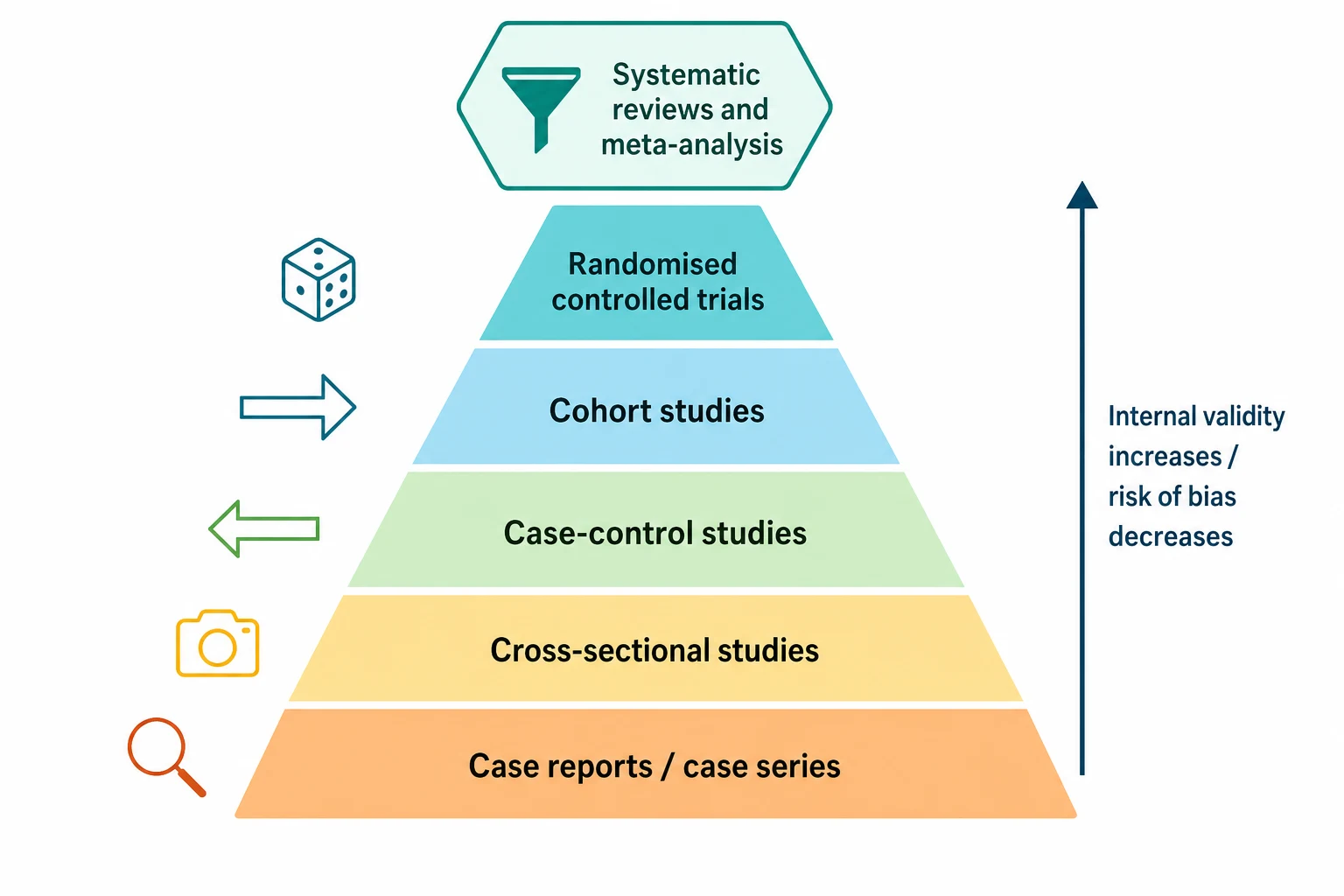
Sort the designs you meet by the question they can answer and the direction in which they move through time, because both dictate how confidently the result can be read as causal. [2] [3]
Descriptive designs describe but cannot prove causation. A case report is a single patient's story and a case series collects several similar cases; both are invaluable for recognising new diseases or adverse events but cannot measure how often something happens or whether an exposure caused it, because they have no comparison group. The cross-sectional survey measures the exposure and the outcome in a population at a single point in time, so it generates prevalence but cannot establish which came first, making it weak for causal claims. These designs sit at the base of the hierarchy because they control no bias by design, but they generate the hypotheses that stronger designs later test. [3]
Analytical designs test an association, and they differ by the direction they move through time. A case-control study starts with the outcome and works backwards to the exposure, which makes it the design of choice for a rare outcome but vulnerable to recall bias. A cohort study starts with the exposure and moves forward to the outcome, which makes it the design of choice for a rare exposure and for measuring incidence, but it is vulnerable to loss to follow-up. The randomised controlled trial starts with a defined population, assigns the exposure by chance, and follows everyone forward to the outcome, which makes it the most powerful design for a therapy question because randomisation balances both known and unknown confounders. [4] [5]
Synthesis designs pool evidence, and population designs compare groups. A systematic review uses explicit methods to find, appraise, and combine all relevant studies, and a meta-analysis adds a statistical pooling of their results, sitting at the apex of the hierarchy when the pooled studies share a low risk of bias. An ecological study compares groups rather than individuals, correlating a population-level exposure with a population-level outcome, and it is efficient for generating hypotheses but cannot be read at the level of the individual patient. [15] [8]
Epidemiology & Risk Factors
Study design and bias literacy is not a specialist skill, because almost every clinical decision rests on evidence that a design produced and that a bias could be distorting. Understanding how designs generate their data and where they are vulnerable is therefore core to practising safely. [1] [2]
Observational designs dominate paediatric evidence because randomised trials are often impractical or unethical in children. You cannot randomise a child to a harmful exposure to study its effects, and many paediatric conditions are too rare or too heterogeneous to recruit a trial, so most of what is known about paediatric harm, prognosis, and natural history comes from cohort and case-control studies. This makes bias appraisal essential rather than optional, because the very designs that carry the evidence are the ones most open to confounding and selection effects. [6] [11]
Several conditions raise the risk of bias in paediatric research. Populations are small and heterogeneous across developmental stages, so a single age band may hold too few children for a precise trial. Outcomes are often rare, which drives researchers toward case-control designs and their recall-prone architecture. Therapies are frequently promoted on surrogate endpoints, where an effect on an intermediate measure stands in for the outcome a family actually cares about. And much of the evidence is extrapolated from adults, so the population that generated the estimate is not the child in the bed. [1] [10]
The paediatric-specific challenges compound these threats. Recruitment and retention of children and families is difficult, so trials may be underpowered or lose participants to follow-up in ways that bias the result. The ethics of randomisation in minors demands assent and careful consent, which narrows eligibility. Developmental heterogeneity means a drug's effect, dose, and metabolism differ across age bands, so a result in school-age children may not transfer to a neonate. And off-label prescribing is driven by extrapolated evidence, which makes judging applicability a daily clinical task rather than a research nicety. [10] [9]
Pathophysiology
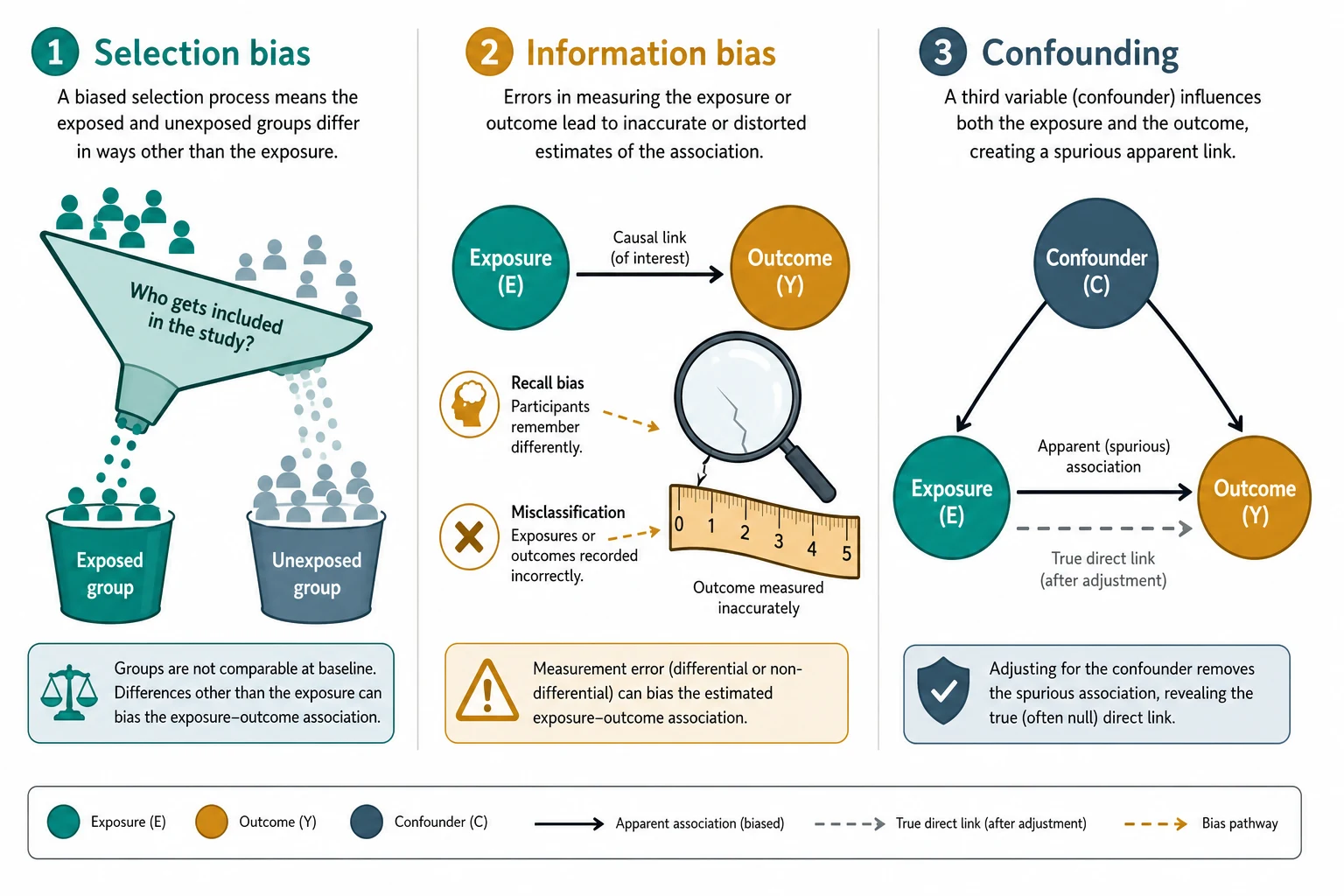
Bias works the way a disease works: it has a mechanism, it enters the study at a predictable point, and it has a treatment that the design provides. Learn the mechanism of each of the three core biases, and you will see them before they distort the comparison. [6] [2]
Selection bias enters at recruitment or follow-up. It is a systematic difference between those who are selected for study and those who are not, or between the groups within a study, and it arises whenever the groups being compared differ in ways other than the exposure itself. In a case-control study it appears as the healthy-worker effect or as differential selection of controls; in a cohort study it appears as selective loss to follow-up, where those who drop out differ from those who stay; and in a trial it appears as broken allocation concealment, where foreknowledge of the next assignment lets staff steer certain patients to one arm. The design defence is a well-defined population, prospective assembly of the groups, and allocation concealment that hides each assignment until it is irreversible. [6] [7]
Information bias enters at measurement. It is a systematic error in how the exposure or the outcome is measured or recorded, and it comes in several forms. Recall bias arises when parents of affected children, searching for a cause, remember past exposures more thoroughly than parents of unaffected children. Interviewer bias arises when the person asking questions probes more intensely in one group. Misclassification arises when a measurement is imprecise, and it is differential when the error is linked to group status and non-differential when it is random, with non-differential misclassification usually biasing toward the null. Surveillance or detection bias arises when one group is watched more closely and so has more outcomes detected. The design defence is blinding of participants, carers, and outcome assessors, and the use of objective, standardised measurements made prospectively. [6] [5]
Confounding enters through a third variable. It is the mixing of the effect of a third variable with the effect of the exposure, and it occurs when that variable is associated with the exposure, independently associated with the outcome, and not itself on the causal pathway between the two. A confounder makes a spurious association look real or hides a true one, and because it distorts the comparison, it must be removed rather than reported. The design defence is randomisation, which distributes confounders — known and unknown — evenly across groups, or, in observational work, restriction, matching, and statistical adjustment. [6] [11]
Clinical Presentation
You will meet study design and bias in a handful of recognisable shapes in the literature, and naming the shape tells you which trap to defend against. [2] [6]
The dramatic trial abstract. A randomised trial reports a large benefit for a new paediatric therapy, and the headline sits in every news feed. The trap is trusting the size of the effect before checking that randomisation was real, allocation was concealed, and outcome assessment was blinded. Your move is to read the methods for sequence generation, allocation concealment, and blinding before you believe the magnitude, because a large effect from a poorly concealed trial is the classic signature of bias. [7] [12]
The strong observational association. A cohort or case-control study reports a powerful link between an exposure and a childhood outcome, and the authors imply causation. The trap is reading the association as causal without asking whether confounding, selection bias, or information bias could explain it. Your move is to list the likely confounders, check whether they were measured and adjusted for, and name the residual confounders that remain. [6] [11]
The recall-prone case-control study. A case-control study of a rare adverse event asks parents to remember an exposure from years earlier. The trap is recall bias, because parents of affected children search harder for a cause and remember more. Your move is to check whether exposure data were collected identically in cases and controls, ideally from records made before the outcome was known. [5] [6]
The loss-prone cohort study. A long cohort study following children from birth reports a clean result, but a quarter of participants were lost along the way. The trap is attrition bias, because those lost may differ systematically from those who remain. Your move is to quantify the loss, check whether it was differential, and read any sensitivity analysis that tests whether the losses could have changed the conclusion. [4] [12]
The pooled meta-analysis of mismatched studies. A systematic review pools studies of different designs, populations, and settings and offers a single summary estimate. The trap is believing the summary applies to any one child when its components disagree. Your move is to read the heterogeneity, inspect the forest plot, and judge whether the pooling is defensible or whether the studies should be reported separately. [11] [8]
Differential Diagnosis
Before you act on a result, name the threat that actually applies, because the three core biases each carry a different fix and are often confused. [6] [2]
| You see | The real threat | Defence |
|---|---|---|
| Groups differ at baseline | Selection bias | Allocation concealment, prospective assembly |
| Measurement differs by group | Information bias | Blinding, objective measures |
| Third variable linked to both | Confounding | Randomisation, adjustment, matching |
| Outcome searched harder in one group | Surveillance bias | Identical follow-up intensity |
| Parents of cases remember more | Recall bias | Prospective exposure data |
Selection bias versus information bias. Both are systematic errors, but they enter at different points. Selection bias corrupts who is in the study and in which group, so it is a problem of recruitment and follow-up; information bias corrupts how the variables are measured, so it is a problem of data collection. The fix for selection is a well-defined population and concealed allocation; the fix for information is blinding and objective measurement. [6] [7]
Confounding versus effect modification. This is the most examinable distinction. Confounding is a distortion — a third variable manufacturing a spurious association — and the correct response is to remove it by randomisation or adjustment. Effect modification is a true biological difference — the effect genuinely differs between subgroups — and the correct response is to report it, not remove it. Adjusting away effect modification hides a real finding; leaving confounding unadjusted manufactures a false one. [6] [11]
A confounder versus a mediator. Both are third variables linked to the exposure and the outcome, but they sit in different places on the causal path. A confounder is not on the causal pathway, so adjusting for it removes distortion. A mediator is on the causal pathway — it is part of how the exposure produces the outcome — so adjusting for it removes real effect and biases the estimate toward the null. The error of adjusting for a mediator is common and silent, and it understates the true benefit or harm. [6] [11]
Internal validity versus external validity. Internal validity asks whether the study answered its question correctly for its own participants, and bias destroys it. External validity asks whether that answer applies to the child in front of you, and indirectness destroys it. A trial can be internally flawless and externally useless if it excluded your patient's age, complexity, or setting, so the two judgements are separate and both required. [10] [8]
Clinical & Bedside Assessment
Read every study in a fixed order, so that no step is skipped under the pressure of a dramatic headline. [2] [12]
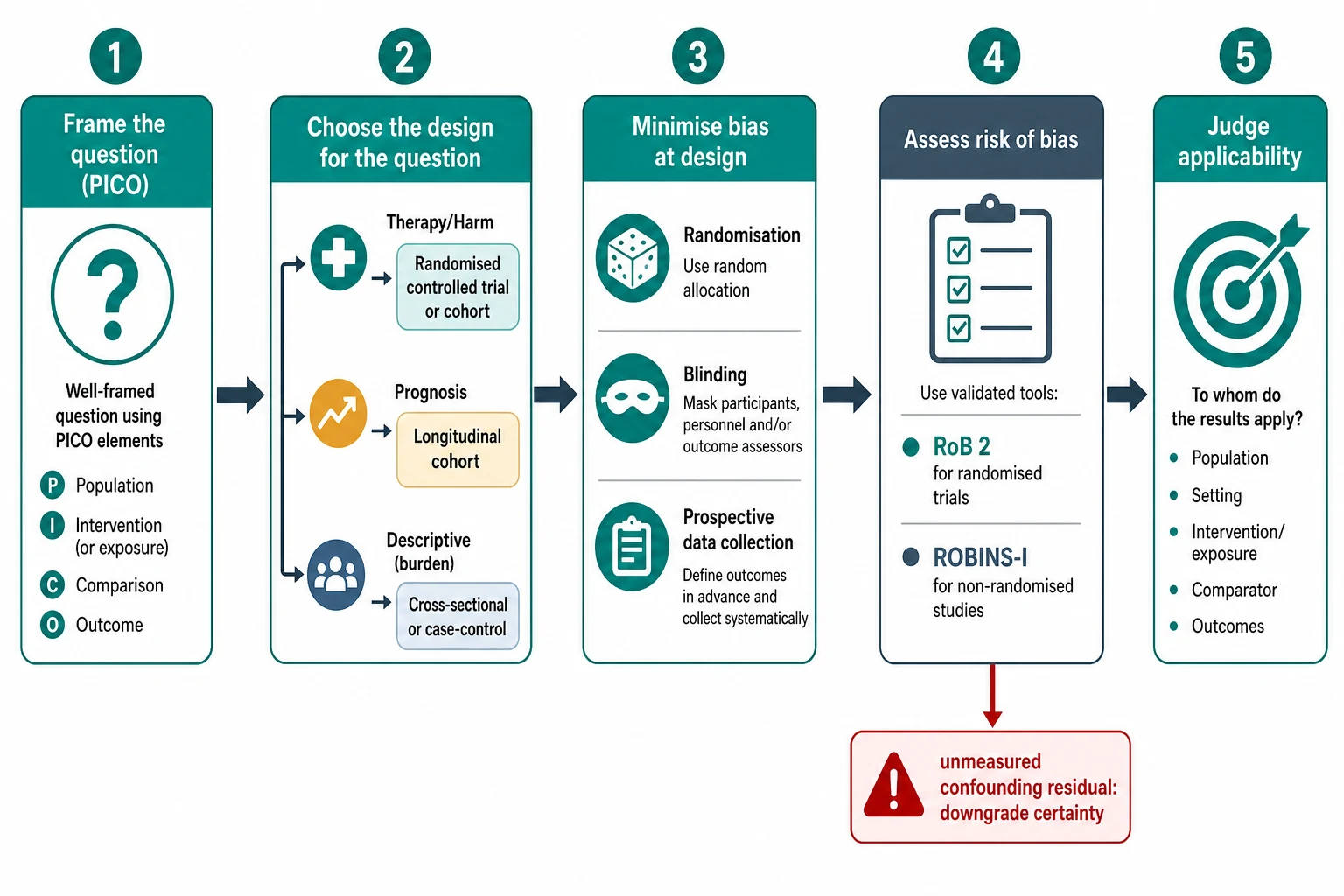
Frame the question first. Restate the clinical question in PICO terms — the population, the intervention, the comparator, and the outcome — because the design must match the question. A therapy question needs a trial; a harm question needs a cohort or case-control study; a prognosis question needs a longitudinal cohort; and a descriptive question needs a cross-sectional survey. Naming the question prevents the common error of accepting a design that cannot answer it. [2] [8]
Identify the design and its direction. State whether the study is a case series, cross-sectional, case-control, cohort, randomised trial, or systematic review, and name the direction it moves through time. The direction tells you whether temporality can be established, which is a prerequisite for any causal claim. [3] [5]
Assess the risk of bias for that design. Apply the matched tool rather than an impression. For a randomised trial, use RoB 2 and its five domains: the randomisation process, deviations from intended interventions, missing outcome data, measurement of the outcome, and selection of the reported result. For a non-randomised study of an intervention, use ROBINS-I and its seven domains, which add confounding, selection, and classification of interventions to the shared concerns. [14] [13]
Read the effect with its uncertainty. State the magnitude of the association or effect, then read its confidence interval against the null to judge precision and significance. A precise estimate around a trivial effect is not clinically useful, and a large estimate with an interval crossing the null is not a positive result. The computation of the measures themselves belongs to the clinical epidemiology leaf; here the task is to place the estimate in context. [1] [8]
Judge applicability to the child. Ask whether the participants, the intervention, the comparator, the outcomes, and the setting match the child and the care environment in front of you, and downgrade the certainty where they do not. This is external validity, and it is where the evidence meets the patient. [10] [8]
Investigations
The investigation here is the appraisal itself: extract the methods, apply the matched risk-of-bias tool, and check the reporting against the published standard. [12] [2]
Extract the design and the population. From the methods, pull the study design, the inclusion and exclusion criteria, the definitions of the exposure and the outcome, and the duration of follow-up. A surprising number of abstracts overstate the design or the population, so this step grounds the appraisal in what was actually done. [2] [3]
Check the randomisation process for a trial. Confirm that the allocation sequence was adequately generated, by a computer or a random-number table, and that allocation was concealed until assignment was irreversible. Concealment is distinct from blinding: concealment prevents selection bias at the moment of enrolment, while blinding prevents bias after it. Inadequate concealment is the single most damaging flaw, because it exaggerates the treatment effect by about 30 to 40 percent. [7] [12]
Quantify the loss to follow-up. Count how many participants were lost and judge whether the loss is likely to be differential, because those who drop out often differ from those who stay. A rough rule is that losses above 20 percent threaten validity, and the more serious test is whether the missing data could have changed the conclusion. [4] [14]
Identify measured and unmeasured confounders. List the confounders the authors adjusted for, and then name the likely confounders they could not measure, because residual confounding is the irreducible weakness of every observational study. The honest appraisal states both. [6] [11]
Check reporting against the standard. Judge whether the trial reports to the CONSORT standard, the observational study to STROBE, and the systematic review to PRISMA, because inadequate reporting is both a marker of poor conduct and an obstacle to appraisal. [12] [13]
Management — Resuscitation
Some moments are emergencies of judgement, where a biased result is about to drive an expensive or harmful decision. [2] [7]
Imminent practice change on a single observational study. A team is about to adopt a new protocol on the strength of one dramatic observational study with no adjustment for confounding. Stop the decision, name the likely confounders, and place the study in the hierarchy before letting it change care, because a strong unadjusted association is the classic shape of confounding rather than causation. [6] [11]
The poorly concealed trial called definitive. A guideline is being built on a trial whose allocation was inadequately concealed, and the team treats its large effect as a low risk of bias. Correct the overclaim before it sets the standard, because inadequate concealment empirically exaggerates the treatment effect by about 30 to 40 percent, and the true effect is closer to the null. [7] [14]
The pooled estimate hiding heterogeneity. A meta-analysis pools observational and randomised evidence as though equivalent and offers a single summary. Insist on reading the heterogeneity and the forest plot before acting, because designs carry very different risks of bias, and a pooled estimate across disparate designs describes no real patient. [11] [8]
The adult extrapolation applied to a child. A therapy is being prescribed to a neonate on the basis of an adult trial, without judging developmental applicability. Pause to weigh the indirectness, because dosing, metabolism, and outcomes differ across age bands, and an adult effect estimate may not transfer. [10] [1]
Management — Definitive & Stepwise
Work through the choice of design and the prevention of bias in a fixed sequence, so that the evidence you generate or consume is protected from systematic error. [2] [6]
- Match the design to the question. Choose a randomised trial for a therapy question, a cohort for harm and prognosis, a case-control for a rare outcome, a cross-sectional survey for prevalence, and a case series for hypothesis generation. The design must fit the question, or the answer will not. [2]
- Prevent bias at the design stage. For a trial, randomise with an unpredictable sequence, conceal allocation, blind participants and assessors where feasible, follow up everyone, and measure outcomes identically in all arms. For an observational study, define the population in advance, match or restrict on key confounders, measure exposures prospectively where possible, and plan the adjustment. [7] [12]
- Assess risk of bias with the matched tool. Use RoB 2 for a randomised trial, ROBINS-I for a non-randomised study of an intervention, and QUADAS-2 for a diagnostic accuracy study, and record the judgement for each domain. [14] [13]
- Read the effect with its confidence interval. State the magnitude, read the interval against the null, and judge both precision and clinical importance. [1] [8]
- Judge applicability and rate the certainty. Use PICO concordance to judge whether the result applies to the child, and downgrade the certainty for risk of bias, inconsistency, indirectness, imprecision, and publication bias through GRADE. [10] [8]
Preventing confounding is the central design problem. Randomisation is the only method that controls confounders you have not measured, which is why the randomised trial sits atop the hierarchy for therapy questions. In observational work, where randomisation is impossible, the defence is layered: restriction narrows the confounders, matching balances them, stratification and multivariable adjustment remove the effect of those measured, and propensity methods balance measured confounders across exposure groups. None removes unmeasured confounding, so residual confounding is the irreducible limit of every observational study. [6] [11]
Preventing information bias is a matter of measurement. Blinding the participants, the carers, and the outcome assessors prevents the differential probing and expectation that distort measurement. Using objective, standardised instruments, and collecting exposure data before the outcome is known, prevents recall bias. Measuring identically in all groups prevents differential misclassification, and accepting that non-differential misclassification biases toward the null keeps you from over-interpreting a small estimate. [5] [6]
Specific Subtypes & Scenarios
A worked scenario for each major design fixes the appraisal in memory better than any definition, so work through these until the pattern is automatic. [2] [6]
A randomised trial of a paediatric therapy. Suppose a blinded trial randomises children to a new drug or placebo and reports a clear benefit. The appraisal checks the randomisation process for an unpredictable sequence, confirms that allocation was concealed, verifies that outcome assessment was blinded, and quantifies loss to follow-up. If concealment was adequate and losses low, the result carries a low risk of bias and the effect estimate can be trusted, then judged for applicability to the child. If concealment was broken, the large effect is suspect, because the exaggeration from inadequate concealment is empirically about 30 to 40 percent. [7] [14]
A cohort study of a neonatal exposure and a later outcome. A prospective cohort follows preterm infants exposed to a neonatal intervention and compares later neurodevelopment with unexposed infants. The appraisal distinguishes this from a cross-sectional snapshot by confirming that exposure was recorded before the outcome, identifies loss to follow-up as a key threat, and asks whether the groups differed at baseline in a way that confounding could explain. The honest report adjusts for the measured confounders and names the residual ones. [4] [6]
A case-control study of a rare adverse event. A case-control study assembles children who suffered a rare adverse drug reaction and compares their past exposures with matched controls. The design suits the rare outcome, because assembling a cohort large enough to capture it prospectively would be impractical. The signature threat is recall bias, so the appraisal checks whether exposure data were collected identically in cases and controls, ideally from records made before the reaction. Matching on age and setting controls some confounding, but residual confounding remains. [5] [6]
A meta-analysis pooling disparate studies. A systematic review pools several trials of a therapy across different age bands and settings and reports a summary estimate. The appraisal reads the heterogeneity and the forest plot, judges whether the pooling is defensible, and checks that each component study was appraised for risk of bias. If the studies disagree, the summary estimate describes no real patient, and the review should report the subgroups separately rather than average them away. [11] [8]
Extrapolating adult evidence to a child. A drug is prescribed to an infant on the basis of an adult trial, and the clinician must judge applicability. The appraisal names the threats of indirectness — the adult population, the adult dosing, and the adult outcomes — and weighs the developmental heterogeneity that means the infant may metabolise and respond differently. The honest conclusion is that the evidence is indirect, the certainty is downgraded, and the decision is made through shared decision-making with close monitoring. [10] [1]
Complications & Pitfalls
- Treating the hierarchy of evidence as a rule that a randomised trial always beats an observational study, when the right design depends on the question. [8]
- Reading an observational association as causal without assessing confounding, selection bias, and information bias. [6]
- Trusting a trial with inadequate allocation concealment, which empirically exaggerates the treatment effect by about 30 to 40 percent. [7]
- Adjusting for a mediator on the causal pathway, which removes real effect and biases the estimate toward the null. [6]
- Extrapolating a trial population to a child who was excluded from the trial, especially by age, complexity, or comorbidity. [10]
- Believing a meta-analysis is reliable simply because it pools many studies, when the pooled estimate is only as trustworthy as its weakest component. [11]
- Confusing effect modification with confounding, and averaging away a true subgroup difference instead of reporting it. [6]
- Reading an ecological association — a correlation between groups — as if it applied to individuals, which is the ecological fallacy. [15]
Prognosis & Disposition
A well-appraised study is measured by whether it protects the child from a wrong conclusion, not by how large or impressive its result looks. [1] [2]
Markers of success. The design matches the question, the risk of bias is low and assessed with the matched tool, the effect is reported with its confidence interval and read against the null, the applicability to the child is judged explicitly, and the certainty is rated. The clinician can state the design, the bias threats, the magnitude, the applicability, and the certainty in plain terms the family can follow. [14] [13]
When to defer. Where the risk of bias is high, the heterogeneity is unexplained, or the evidence is too indirect for the child, defer the decision until better evidence arrives or choose the reversible option and reassess. A large effect from a biased study is not a green light. [9] [6]
When to escalate. A decision resting on sparse or extrapolated evidence with high stakes warrants a second opinion, specialist input, or a multidisciplinary discussion, especially where the family's values pull against the average recommendation. [1] [10]
Disposition includes documentation. Record the design, the key bias threats and their assessment, the effect estimate with its interval, the applicability judgement, and the certainty rating, so the reasoning survives the moment and teaches the next clinician. [12] [2]
Special Populations
Neonates and infants. Trial populations often exclude the youngest and smallest, so the evidence is frequently indirect and must be read down for developmental heterogeneity in dosing, metabolism, and outcomes. [10] [1]
Children with rare disease. Outcomes are rare and trials are small or absent, so lean on registries, case series, and adaptive designs, and assess their bias explicitly rather than dismissing them. [3] [11]
Aboriginal and Torres Strait Islander, Maori, and other Indigenous children. Check whether the study was conducted with the community and is applicable to the population, and privilege locally generated and Indigenous-governed data over extrapolated estimates. [1] [10]
Adolescents. Confirm that adolescents were represented in the study population, judge whether the developmental stage matches the child, and weigh the recruitment and retention challenges that often narrow adolescent samples. [10]
Children with medical complexity. Trial populations usually exclude these children, so weigh indirectness heavily and prioritise patient-centred outcomes such as quality of life and family burden alongside the headline effect. [8] [6]
Evidence, Guidelines & Regional Differences
The core anchors for study design and bias are the Grimes and Schulz Lancet series on the overview of clinical research, descriptive studies, cohort studies, case-control studies, and bias in observational research; the Schulz empirical evidence of bias; the Concato hierarchy of research designs; the Rothwell series on external validity; the Vandenbroucke essay on the two views of medical science; the Ioannidis work on contradicted effects; the CONSORT, ROBINS-I, and RoB 2 reporting and bias tools; and the Sedgwick note on the ecological fallacy. [2] [3] [4] [5] [6] [7] [8] [9] [10] [11] [12] [13] [14] [15]
The RACP curriculum frames study design and bias appraisal within evidence-based practice and critical appraisal as core professional skills, and Cochrane Australasia publishes appraised syntheses whose component studies carry explicit risk-of-bias judgements. Use locally endorsed guidelines and registries, and where the evidence is sparse for Aboriginal and Torres Strait Islander and Maori children, seek community-generated data and culturally safe pathways before applying an extrapolated estimate. [1] [14]
The RCPCH Progress+ curriculum frames evidence-based practice and research methodology as a core professional skill, and the National Institute for Health and Care Excellence publishes guidelines built on appraised evidence with explicit risk-of-bias assessment. Use NICE and Cochrane syntheses, and name the design and the bias threats when translating a result to a child. [12] [13]
The American Academy of Pediatrics issues clinical practice guidelines built on graded evidence, and the United States Preventive Services Task Force grades recommendations on a transparent scale whose certainty turns on the design and risk of bias of the underlying studies. Apply these alongside Cochrane reviews, and judge applicability to the child explicitly. [8] [14]
The CanMEDS Scholar role maps directly onto locating, appraising, and applying evidence, and Canadian guideline bodies publish recommendations whose strength rests on the risk of bias of the underlying designs. Use locally endorsed guidance and appraised syntheses, and document the design, the bias assessment, and the certainty behind each decision. [11] [2]
Controversies remain live in three places: whether observational evidence can ever rival randomised evidence for questions of harm, where randomisation is unethical; how to handle the extrapolation from adult to paediatric populations responsibly; and how to incorporate Indigenous data sovereignty into both the design of studies and the judgement of applicability. Exam answers show the right design for the question, the matched bias assessment, an honest reading of the effect and its interval, and local humility. [6] [10] [11]
Exam Pearls
- Randomisation with allocation concealment controls confounding; blinding controls information bias; prospective measurement controls recall bias. [7]
- Inadequate allocation concealment exaggerates the treatment effect by about 30 to 40 percent — the single most examinable empirical bias fact. [7]
- Case-control is the design of choice for a rare outcome; cohort is the design of choice for a rare exposure. [5] [4]
- Cross-sectional measures exposure and outcome at the same instant and cannot establish temporality, so it cannot prove causation. [3]
- Confounding is removed by adjustment; effect modification is reported, not removed. [6]
- A mediator lies on the causal pathway and must never be adjusted for, or the estimate is biased toward the null. [6]
- Loss to follow-up above 20 percent threatens validity because those lost may differ systematically from those who remain. [4]
- External validity asks to whom the results apply; a meta-analysis cannot create external validity its component studies lack. [10] [15]
The three biases and their fixes
Selection bias is fixed by Concealment of allocation · Information bias is fixed by Blinding · Confounding is fixed by Randomisation. Remember the pairings as SC-IB-CR: each bias has one design defence, and the defence must match the threat. A study that conceals but does not blind still leaves information bias open, and a study that randomises has already dealt with confounding. [6] [7]
Appraise a study's design and risk of bias
Frame the question in PICO and name the design that fits it
Read the methods for sequence generation, allocation concealment, and blinding
Quantify loss to follow-up and judge whether it is differential
Apply the matched risk-of-bias tool: RoB 2 for trials, ROBINS-I for non-randomised studies
Read the effect estimate with its confidence interval against the null
Judge applicability to the child and rate the certainty of the evidence
References
- [1]Sackett DL, Rosenberg WM, Gray JA, Haynes RB, Richardson WS Evidence based medicine: what it is and what it isn't BMJ, 1996.PMID 8555924
- [2]Grimes DA, Schulz KF An overview of clinical research: the lay of the land Lancet, 2002.PMID 11809203
- [3]Grimes DA, Schulz KF Descriptive studies: what they can and cannot do Lancet, 2002.PMID 11809274
- [4]Grimes DA, Schulz KF Cohort studies: marching towards outcomes Lancet, 2002.PMID 11830217
- [5]Schulz KF, Grimes DA Case-control studies: research in reverse Lancet, 2002.PMID 11844534
- [6]Grimes DA, Schulz KF Bias and causal associations in observational research Lancet, 2002.PMID 11812579
- [7]Schulz KF, Chalmers I, Hayes RJ, Altman DG Empirical evidence of bias. Dimensions of methodological quality associated with estimates of treatment effects in controlled trials JAMA, 1995.PMID 7823387
- [8]Concato J, Shah N, Horwitz RI Randomized, controlled trials, observational studies, and the hierarchy of research designs N Engl J Med, 2000.PMID 10861325
- [9]Ioannidis JP Contradicted and initially stronger effects in highly cited clinical research JAMA, 2005.PMID 16014596
- [10]Rothwell PM External validity of randomised controlled trials: to whom do the results of this trial apply? Lancet, 2005.PMID 15639683
- [11]Vandenbroucke JP Observational research, randomised trials, and two views of medical science PLoS Med, 2008.PMID 18336067
- [12]Moher D, Hopewell S, Schulz KF, et al. CONSORT 2010 explanation and elaboration: updated guidelines for reporting parallel group randomised trials BMJ, 2010.PMID 20332511
- [13]Sterne JA, Hernán MA, Reeves BC, et al. ROBINS-I: a tool for assessing risk of bias in non-randomised studies of interventions BMJ, 2016.PMID 27733354
- [14]Sterne JAC, Savović J, Page MJ, et al. RoB 2: a revised tool for assessing risk of bias in randomised trials BMJ, 2019.PMID 31462531
- [15]Sedgwick P Understanding the ecological fallacy BMJ, 2015.PMID 26391012