Paeds · professional-practice-and-evidence
Refusal of treatment and disagreement over care
Also known as Parental refusal of treatment in paediatrics · Treatment refusal and the harm principle · Goals-of-care and futility disputes · Blood-product refusal and Jehovah's Witness families · When parents and clinicians disagree
Fellowship guide to refusal of treatment and disagreement over care in paediatrics: distinguishing parental refusal from goals-of-care disputes and adolescent refusal; applying the best-interests standard and the harm principle as thresholds for overriding a refusal; assessing parental capacity and adolescent competence; exploring the fears, values and information gaps that drive most refusals; escalating an unresolved dispute through second opinion, ethics consultation and mediation to the courts; the high-yield scenarios of blood-product refusal (including Jehovah's Witness families) and vaccine refusal; and ANZ/UK/US/Canada legal and ethical frameworks.
On this page & tools
Your progress
Saved locally on this device.
Practise this topic
Target exams
Red flags
Life stages
Care settings
Clinical exam formats
Board mappings
Override a parental refusal — when is the threshold met? HARM
Overview & Definition
A mother refuses the blood transfusion her bleeding six-year-old needs after surgery, because her faith forbids it. The team is certain the child will die without it. That is a refusal of treatment, and it is one of the hardest tests of professionalism and ethics in paediatrics. [4] [5]
A parental refusal is a decision by those with parental responsibility to decline care the treating team recommends. Parents ordinarily hold authority over their child's medical care, and most refusals are reasonable, reversible or negotiable. The clinician's difficulty arises when the refusal risks serious harm to the child, because the duty to protect the child now sits against respect for the family's decision-making authority. [1] [2]
This territory holds three overlapping problems, and naming which one you are in changes what you do. A parental refusal turns on whether the refusal meets the threshold for overriding it. A goals-of-care or futility dispute is a disagreement about the aims or limits of treatment, often in intensive care, and the work is a goals conversation rather than a single decision. An adolescent refusal turns on the young person's own competence, weighted to the gravity of the consequences. [3] [12]
This page owns the ethics, law and process of refusal and disagreement. Cross-link the dedicated leaves for consent and parental responsibility, shared decision-making and assent, confidentiality with adolescents, conflict and difficult encounters, breaking bad news, best-interests decisions and treatment limitation, and trauma-informed care. Do not rebuild their content here. [1] [6]
Classification
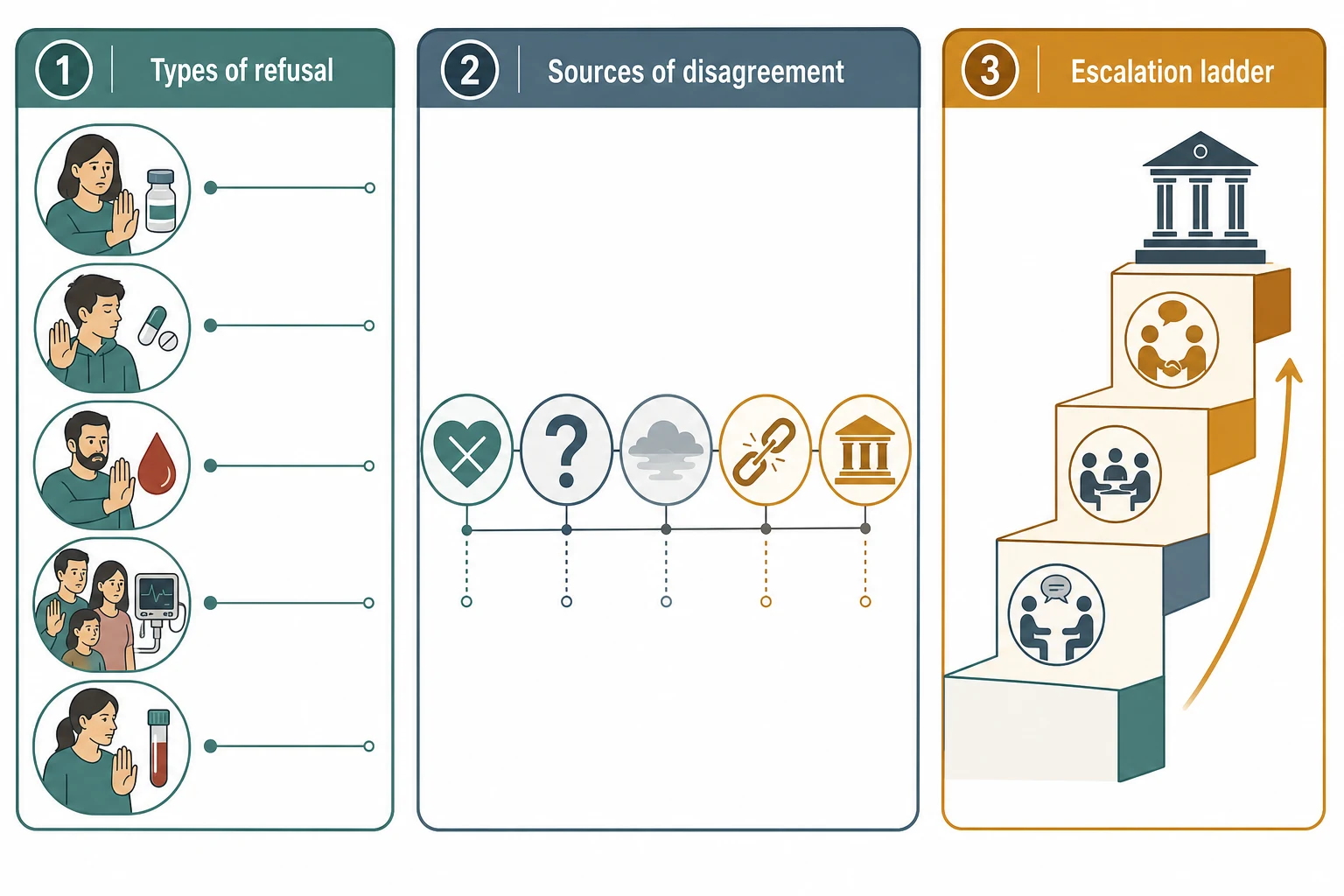
Sort the work by the shape the refusal takes and where the disagreement sits, because each shape has a different first move. [1] [3]
What is refused. Refusal of a specific, life-saving intervention such as a blood product, chemotherapy or a procedure. Refusal of withdrawal or limitation of life-sustaining treatment, where the family wants to continue care the team judges non-beneficial. Refusal of routine or preventive care such as vaccination, vitamin K prophylaxis or newborn screening. And refusal of monitoring or investigation where the child faces future risk. [4] [8]
Sources of disagreement. A values or religious conflict, where what the family most wants is not what the team most recommends. An information gap or misinformation, where honest and accessible explanation dissolves the refusal. Prognostic uncertainty, where reasonable people disagree about the outcome and the burden. A trust breakdown, often after a prior adverse experience or inconsistent messaging. And a cultural or family-dynamics conflict, where the decision is entangled with relationships and authority inside the family. [6] [14]
The escalation ladder. Bedside discussion with the treating clinician; senior review and an independent second opinion; formal ethics consultation; mediation; and finally a court application. Each rung carries more weight and a longer paper trail, which is why early, in-room resolution matters and why the supports higher up the ladder should be called before positions harden. [6] [10]
Epidemiology & Risk Factors
Treatment refusal and disagreement are common in paediatrics, not rare. They cluster around the decisions that carry the most weight: immunisation, blood products, cancer therapy, and the continuation or withdrawal of life-sustaining treatment. Most refusals resolve with respectful engagement, balanced information and time, and only a minority climb the escalation ladder to ethics consultation or the courts. [8] [10]
Disputes are predicted by how the decision was handled upstream. Poor prior communication, prognostic uncertainty, inconsistent messages between clinicians, and a family already carrying mistrust from a previous adverse experience all tilt an ordinary decision toward a hard one. Naming these upstream drivers is part of the management, because a family labelled "refusing" without examining the system is misdiagnosed. [6] [14]
Vaccine refusal occupies its own space. A measurable minority of parents decline one or more routine immunisations, driven by safety fears, misinformation, a values stance or a past experience. The decision rarely threatens the child today, but it changes their future risk and the community's, and it tests the clinician's ability to inform without alienating. [8] [9]
Adolescent refusal carries special weight where the young person is competent and the consequences are severe or irreversible. Here the tension is between respecting an emerging autonomy and protecting a young person whose judgement may not yet match the gravity of the decision. [12] [13]
Pathophysiology
Think about the mechanisms that turn an unexplored values gap into entrenched refusal, and about what interrupts the chain. [1] [6]
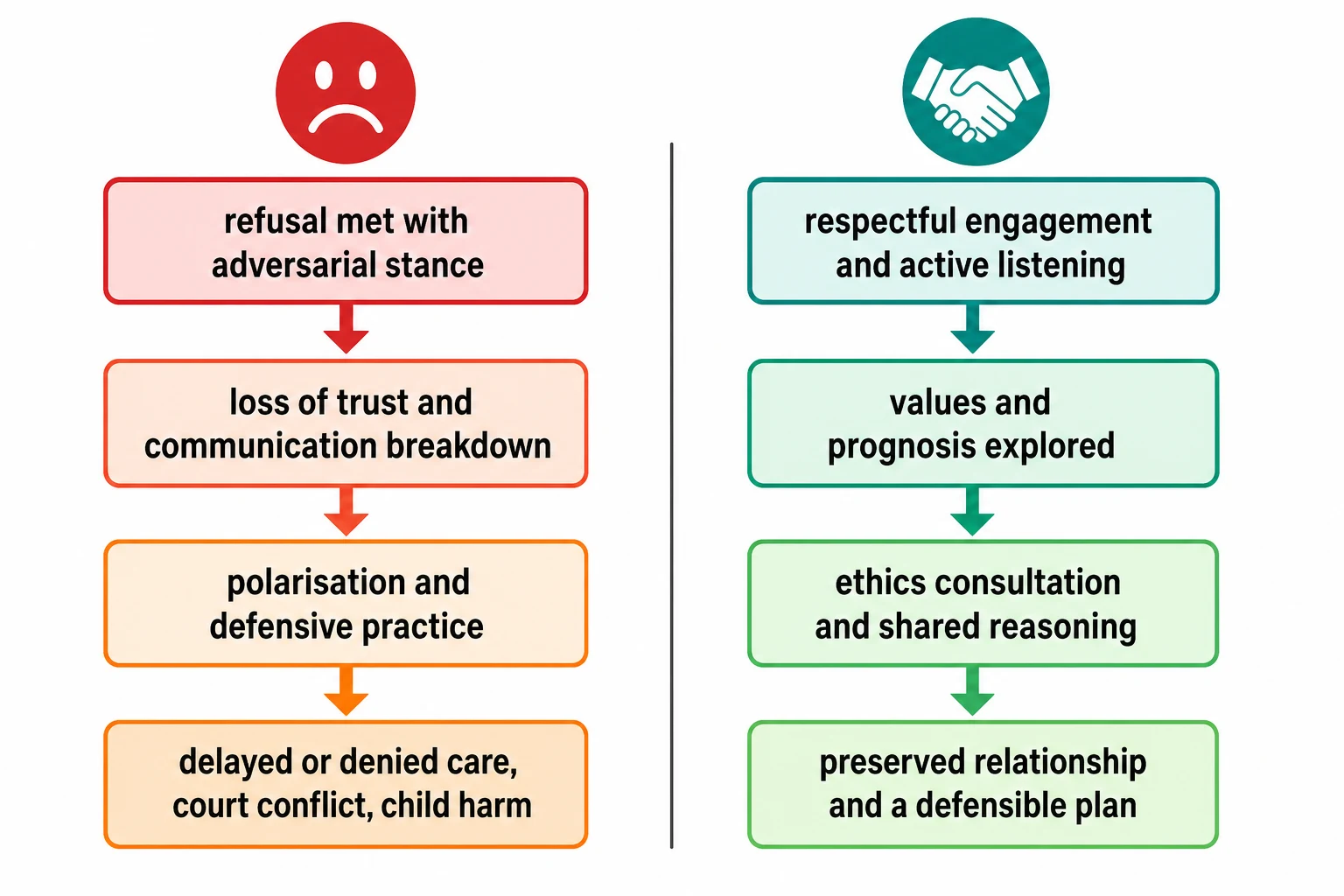
The polarisation cascade. A refusal met with an adversarial stance — justification, pressure, or the implicit threat of override — tends to harden rather than resolve. Each side retreats into its certainty, trust erodes, and the family stops hearing the clinical reasoning even when it is sound. The move that lowers the temperature is the opposite of defending the team's position: to understand the refusal before you try to overturn it. [1] [14]
The harm principle as a threshold. Diekema frames the working rule: clinicians should respect parental authority until the refusal risks serious and demonstrable harm to the child — harm that is likely, significant, and not outweighed by the benefits of respecting the family's decision. Below that threshold, persuasion, patience and a second opinion are the tools. Above it, the duty to protect the child takes over, and the legitimate route is treatment in the child's best interests under emergency, safeguarding or court authority. [1]
The relational cost. Disputes are expensive. They delay care, consume trust, exhaust clinicians, and risk a court outcome that, even when correct, fractures the therapeutic relationship so badly that ongoing care is lost. Good management works to preserve the relationship through the disagreement, because the child still needs the team afterwards. [6] [10]
Why a competent adolescent's refusal is different. Where the young person can understand, weigh and hold the information, their voice carries real weight, and the older and more mature they are, the more weight it carries. The ethical question is no longer only whether to override a parent, but how to honour an emerging autonomy while protecting a young person from an irreversible decision they may later regret. [12] [13]
Clinical Presentation
You will meet this territory in several recognisable shapes, and the first move differs for each. [1] [4]
The parent who refuses a specific intervention. A vaccine at the four-year check, a blood transfusion after trauma, chemotherapy for a curable leukaemia. The child is stable enough that the decision is a decision, not yet an emergency, and you have time to work. [8] [9]
The family in entrenched goals-of-care conflict. Parents want to continue full life-sustaining treatment the team judges non-beneficial, or refuse a limitation the team recommends, often in neonatal or paediatric intensive care. The stakes are existential and the room is full of grief. This is the mirror image of refusal, and the work is the same: a goals conversation, a second opinion, and early ethics support. [6] [7]
The adolescent who refuses care. A young person declines recommended treatment, or wants treatment the parents refuse. The question is competence, and the work is to assess it honestly, weighting it to the gravity and reversibility of the consequences. [12] [13]
The family that refuses preventive or monitoring care. Vitamin K prophylaxis, newborn screening, routine surveillance of a chronic condition. The child faces future rather than immediate risk, which gives you time — but also means the harm may arrive quietly if the refusal is not revisited. [8] [11]
The refusal that emerges mid-treatment. A family that consented at the outset now refuses after a complication, a second opinion, or new information. Treat it as a new decision: reassess capacity, re-share the prognosis, and re-explore the driver. [6] [14]
The refusal that is an emergency. A child who needs a blood product now, whose parents refuse now. Here you stabilise first and reason alongside, invoking emergency or court authority rather than allowing irreversible harm. [4] [5]
Differential Diagnosis
Before you reach for override or coercion, name what is actually driving the refusal, because each driver has a different remedy. [1] [6]
| You see | More likely | The trap |
|---|---|---|
| Refusal of a blood product on religious grounds | A sincere, considered values stance | Dismissing it as irrational, or overriding without authority |
| Refusal driven by a safety fear | Misinformation or a past adverse experience | Flooding the family with data without hearing the fear |
| A family demanding non-beneficial treatment | Unmet hope and unclear prognosis | Calling it futile and withdrawing abruptly |
| An adolescent refusing care | Competence that must be assessed, not assumed | Overriding the young person without assessing capacity |
| Refusal that is inconsistent or fluctuating | Fear, fatigue or impaired capacity in the parent | Accepting the refusal without reassessing [1] [2] |
Genuine conviction versus fear or misunderstanding. The first task is to tell a sincere, considered values stance from a refusal born of fear, misinformation or a moment of overwhelm. The two need opposite remedies: the first is honoured and negotiated, the second is dissolved by listening and clear information. [1] [14]
Capacity-impairing factors in the parent. Fear, fatigue, pain, mental illness or intoxication can make a refusal less settled than it sounds. A refusal given in an acute state warrants reassessment once that state settles, before you treat it as a final decision. [2] [3]
A safeguarding concern. Occasionally a refusal is a guise for neglect, or the refusal itself places the child at ongoing risk. Follow your safeguarding pathway exactly as you would anywhere else: the duty to protect does not pause for a family's objection. [1] [5]
Clinical & Bedside Assessment
Assess before you act. The first assessment is always the risk of serious harm, then capacity, then the driver. [1] [2]
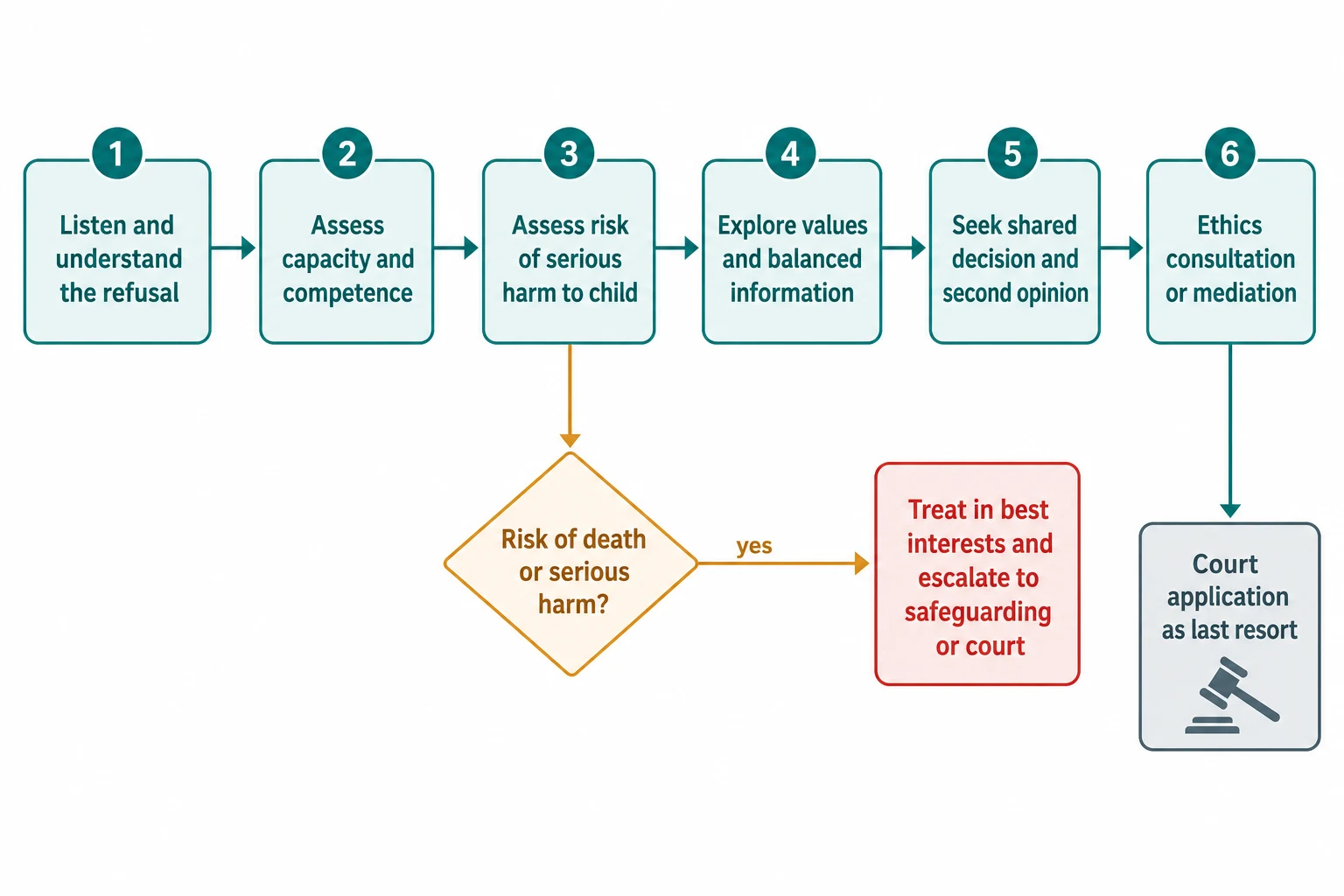
Assess the risk of serious harm first. Is the refusal placing the child at imminent risk of death or serious and irreversible harm? If yes, treat in the child's best interests under emergency or safeguarding authority and escalate at once. If no, you have time to work, and time is the ally of a shared decision. [1] [4]
Assess parental capacity to refuse. Can the parent understand the proposed treatment, the nature of the refusal, its consequences, and hold and weigh that information without coercion? Capacity is decision-specific and time-specific; a parent may have capacity for one decision and not another, and capacity impaired today may return tomorrow. [2] [3]
Assess the adolescent's competence. Where the young person is the one refusing, assess their competence to make this specific decision, weighted to its gravity and irreversibility. A competent adolescent's voice carries significant weight, especially for reversible decisions; the younger the adolescent and the graver the consequence, the more the duty to protect dominates. [12] [13]
Explore the driver openly. Ask what the refusal means to the family, where it comes from, and what they fear most. Most refusals carry an accessible story — a fear, a conviction, a past hurt, a piece of misinformation — and naming it is often half the work of resolution. [1] [14]
Read the team and the child. Has the team been consistent? Are the messages aligned? Where is the child in the room, and what do they understand and want? A child's view, sought developmentally, informs the decision even when it does not determine it. [6] [10]
Investigations
The "investigations" here are preparations and fact-finding, not blood tests. [6] [10]
Review the facts and the prognosis. Before you respond to a refusal, confirm the medical basis for recommending the treatment and the likely consequences of declining it. Identify any genuine uncertainty honestly; a defensible response begins with the truth, including what you do not know. [1] [7]
Align the team and gather collateral. What did nursing hear? What did a colleague already say? Never contradict a colleague in front of the family. Align the team first so the family hears one consistent message — inconsistency is a powerful fuel for dispute. [6] [10]
Check for a care plan or prior record. Is there an existing advance care plan, an ethics record, a safeguarding flag, or a documented prior decision? These bear on both the decision and its documentation. [11]
Consider a second opinion early. A genuine independent second opinion serves two purposes: it tests the clinical recommendation, and it signals to the family that their objection is being taken seriously rather than overridden. Offer it before positions harden. [6] [10]
Document contemporaneously. Record what was offered, the risks explained, the parent's reasons, the child's view where given, and the agreed plan or the unresolved disagreement. Contemporaneous, factual documentation is the foundation of any later ethics, complaint or court process. [1] [5]
Management — Resuscitation
Some refusals are emergencies, and the duty to protect the child outranks the duty to respect the refusal. [1] [4]
Imminent risk of death or serious irreversible harm. When refusal places the child at imminent risk, treat in the child's best interests under the emergency doctrine or safeguarding authority, and escalate to senior clinicians, the ethics service and the court at once. The emergency buys the time to treat; it does not end the obligation to reason with the family alongside. [1] [4]
Life-threatening blood-product refusal. Stabilise the bleeding or anaemic child first. Continue respectful engagement with the family throughout, and where the family will not consent and the child faces death or irreversible harm, invoke emergency or court authority. The clinical team should not allow a child to die for a refusal the court would not uphold. [4] [5]
Refusal as a guise for neglect. Where the refusal is part of a pattern that exposes the child to ongoing harm, follow your local safeguarding and child-protection pathway. Separate the child if needed, escalate to the safeguarding team, and document. [1]
Hostile or threatening family. If the disagreement becomes a safety problem — a threat, a weapon, intoxication — withdraw and call security, exactly as in any difficult encounter. Safety leads before negotiation. [1]
Management — Definitive & Stepwise
Match the move to the shape of the refusal. The same opening — understand the refusal and assess the risk — serves all of them. [1] [6]
Understand the refusal before you try to overturn it. Listen to the family, name the driver, and acknowledge their values and fears. Most refusals soften measurably once the family believes they are being heard rather than managed, because being heard is often what they most wanted. [1] [14]
Provide balanced, honest information. Explain the proposed treatment, the genuine alternatives, and the consequences of refusal, in a form the family can use. Use an interpreter if needed. Share prognostic uncertainty honestly rather than overstating certainty to win agreement. [6] [7]
Seek a shared decision and a second opinion. Explore whether a genuine alternative exists that honours the family's values while protecting the child. Offer an independent second opinion; it tests the recommendation and demonstrates that the objection is taken seriously. [6] [10]
Escalate up the ladder before positions harden. For an entrenched dispute, move to senior review, a formal ethics consultation, and mediation. A randomised trial showed ethics consultation reduced non-beneficial life-sustaining treatment and conflict in intensive care. Call these supports early, not as a last resort. [6]
When the threshold is met, treat in best interests and go to court. If the refusal risks serious harm and cannot be reconciled, treat the child in their best interests under proper authority and apply to the court for a determination. The court is the legitimate arbiter of an irreconcilable dispute, and framing the referral this way protects both the child and the clinician. [1] [5]
Preserve the relationship and keep the door open. Continue to offer care, avoid dismissing the family except as a genuine last resort with safeguards, and plan for the relationship after the dispute. A child whose family has been alienated still needs a team. [8] [14]
Specific Subtypes & Scenarios
Jehovah's Witness family refusing blood products. The classic and highest-yield scenario. Respect the conviction, provide accurate information about blood-conserving strategies, and document the boundaries the family will accept. Where the child faces death or serious irreversible harm, treat in the child's best interests and invoke emergency or court authority; judicial review consistently supports transfusion of a child against parental refusal where life is at stake. Keep engaging the family throughout. [4] [5]
Parental refusal of routine immunisation. First understand the reason — a safety fear, misinformation, a values stance, a past experience. Provide honest, accessible information, document the discussion and the refusal, and explore the child's view where they can give it. Avoid dismissal of the family except as a genuine last resort, because losing the medical home compounds the risk. Keep the door open; today's refusal is not necessarily tomorrow's. [8] [9]
Conflict over limiting life-sustaining treatment in NICU or PICU. Run a structured family meeting, re-share prognosis honestly, explore what the family most wants for their child, seek shared goals, offer a second opinion, and call ethics consultation early. Neonatal and paediatric intensive care carry the deepest prognostic uncertainty and the most grief; pace the conversation and keep the relationship intact even when you disagree. [6] [7]
A competent adolescent who refuses treatment. Assess competence honestly, weighted to the gravity and reversibility of the consequences. A competent young person's refusal of reversible care carries real weight; a refusal of life-saving, time-critical care by a younger or less mature adolescent leans toward protection. Mediate between the young person's autonomy and the duty to protect, and document the assessment. [12] [13]
Refusal of chemotherapy or other life-saving therapy for a curable condition. A high-stakes refusal where the benefits of treatment are large and the cost of delay is real. Engage urgently, provide a second opinion, call ethics consultation, and where the child faces serious harm, treat in best interests and seek court authority without delay. [1] [11]
Refusal of vitamin K prophylaxis or newborn screening. Lower acuity but real future risk. Provide balanced information, document the refusal, and revisit the decision at later contacts — the harm from a missed vitamin K or a missed screen may arrive quietly. [8]
A family that accepts most care but refuses one element. A common and workable scenario. Negotiate a plan that honours the boundary where it is safe to do so, uses alternatives where they exist, and is explicit about the line the team will not cross if the child is harmed. Document the agreed boundary and the review plan. [4] [6]
Complications & Pitfalls
- Overriding a settled refusal without proper authority or documentation, exposing the child and the clinician to harm. [1] [5]
- Failing to explore the driver of the refusal, and dismissing a fear or information gap that was readily addressable. [1] [14]
- Escalating to coercion, pressure or abrupt dismissal of the family, which hardens the refusal and fractures trust. [6] [8]
- Labelling a family non-compliant without examining the clinician and team contribution to the disagreement. [6] [10]
- Missing a safeguarding concern where refusal is a guise for neglect or where it risks serious harm. [1]
- Waiting too long to call ethics consultation or mediation, by which point positions have hardened. [6] [10]
- Accepting a refusal given in an acute state — fear, pain, intoxication — without reassessing capacity once it settles. [2] [3]
- Failing to document the refusal pathway, undermining any later ethics, complaint or court process. [5] [11]
Prognosis & Disposition
A well-managed refusal is judged not by whether the family finally agreed but by what the process left behind. [1] [6]
Markers of resolution. The family can state the plan and its reasoning. Trust is preserved or repairable, even where the team had to act against the refusal. The child's safety is assured, and follow-up is arranged. The team is aligned and has debriefed. [10] [14]
When to defer or reconvene. If emotion is too high, the facts are unclear, or a key person is absent, it is legitimate to acknowledge, support, and set a time to return. Deferral is a deliberate choice — name it and schedule it, rather than drifting into avoidance. [6]
When to escalate. A refusal that risks serious harm, a values conflict that cannot be reconciled at the bedside, or a breakdown of trust warrants a second opinion, formal ethics consultation, mediation, and ultimately a court application. Use these supports early; they work far better before positions harden. [6] [10]
Disposition includes the clinician and the relationship. High-stakes disputes are stressful and can drive defensive practice if the clinician is unsupported. Build debrief, peer support and team learning into the routine, and plan for the therapeutic relationship after the dispute is resolved. [10] [14]
Special Populations
Adolescents. Hold the young person's voice, competence and confidentiality within a family dispute. Where the adolescent's goals and the parents' diverge, assess competence and mediate rather than defaulting to either party. A competent adolescent's refusal of reversible care deserves real respect. [12] [13]
Culturally and linguistically diverse families. Much refusal is born of simple misunderstanding. Always use a trained interpreter — never a child or family member — and consider a cultural broker. Ask how the family wishes decisions to be made and with whom. [4] [6]
Families of children with medical complexity and technology dependence. These families carry the highest-stakes, highest-trust longitudinal relationships. A dispute here is costly precisely because the relationship is long and load-bearing; invest early in shared decisions, written plans and reliable access. [11] [14]
Families affected by poverty, housing instability or out-of-home care. Much apparent refusal is structural — cost, transport, chaos, past trauma. Recognise the driver before judging the behaviour, and bring in social work and community supports. [6]
Families with strong religious identity. Honour the conviction where it is safe, negotiate the boundaries explicitly, and invoke authority only where the child faces serious harm. A respectful, documented boundary is usually workable; an adversarial override is usually not. [4] [5]
Evidence, Guidelines & Regional Differences
Core anchors are Diekema's harm principle as the threshold for overriding parental refusal, the Diekema and Pope work on the best-interests standard, Conti and Wheeler on blood-product refusal and judicial responses in Jehovah's Witness families, the Schneiderman randomised trial of ethics consultations, Lantos on neonatal decision-making, Diekema and Opel on vaccine refusal and optimal vaccine policy, Morrison on paediatricians' experience of ethics consultation, Kunz on navigating refusal for co-morbidities in complex infants, Diekema and Slonina on adolescent decision-making and the mature minor doctrine, and Madrigal on trust and decision-making preferences among parents of children with serious illness. [1] [2] [3] [4] [5] [6] [7] [9] [10] [12] [13] [14]
Those with parental responsibility ordinarily consent for a child; where a refusal risks serious harm, the team treats in the child's best interests and seeks authority through the state child-protection framework or the Family Court. The Medical Board of Australia's Good medical practice frames consent and the care of children and young people. State child-protection legislation allows emergency treatment of a child at risk, and the Family Court can determine an irreconcilable dispute. Use locally endorsed pathways and do not invent statutory wording. [1] [4]
The Children Act makes the child's welfare the paramount consideration. A person with parental responsibility can consent, but the court can override a refusal where the child's welfare requires it; in England and Wales a parent cannot lawfully refuse treatment that would lead a child to die or suffer serious irreversible harm where the court would authorise it. The GMC's 0–18 years and Consent guidance frame the clinician's duties. Gillick competence governs a competent young person's own consent, and an adolescent's refusal of life-saving treatment remains a live area of law. RCPCH frameworks guide limiting treatment in life-limiting conditions. [3] [5] [13]
Parents ordinarily hold decision-making authority, but the state's parens patriae power allows intervention where a refusal places a child at serious risk of harm. Hospital ethics committees and consult services are widespread, and child-abuse-and-neglect statutes and court orders authorise emergency treatment. The mature minor doctrine varies by state and bears on an adolescent's refusal. The American Academy of Pediatrics frames consent, parental permission and assent. [1] [8] [12]
The CanMEDS roles — Communicator, Collaborator, Professional and Health Advocate — map directly onto navigating refusal and disagreement. Provincial child-welfare legislation governs emergency treatment of a child at risk, and the courts determine irreconcilable disputes. In several provinces a mature minor's consent or refusal carries legal weight, weighted to capacity rather than age alone. Use local documents and trained interpreters. [1] [13]
Controversies: the precise threshold for overriding a parental refusal; whether and when to dismiss vaccine-refusing families from a practice; the weight of a competent adolescent's refusal of life-saving, time-critical treatment; and how to honour religious conviction without exposing a child to serious harm. Exam answers show structured ethical reasoning, honest acknowledgement of uncertainty, and local humility about the legal framework you practise within. [1] [8] [12]
Exam Pearls
- The clinician does not override a refusal alone — once the immediate emergency passes, the court is the arbiter. [1] [5]
- Best interests is the working guide; the harm principle is the threshold for overriding parental authority. [1]
- Most refusals are driven by fear, misunderstanding or a values stance that respectful engagement can address — listen before you try to overturn. [1] [14]
- Assess parental capacity, and for an adolescent assess competence weighted to the gravity and reversibility of consequences. [2] [12]
- Escalate early: second opinion, ethics consultation, mediation — before positions harden. [6] [10]
- Treat in the child's best interests under emergency or safeguarding authority where refusal risks imminent death or serious irreversible harm. [1] [4]
- Judicial review consistently supports transfusion of a child against parental refusal where life is at stake. [4] [5]
- Document the refusal pathway: what was offered, the risks explained, the reasons, the child's view, and any override. [5] [11]
- Keep the door open: preserve the relationship and continue to offer care wherever possible. [8] [14]
A parental refusal of a recommended treatment
Assess risk: is the refusal placing the child at imminent risk of death or serious irreversible harm
Understand the refusal and its driver; confirm parental capacity and any adolescent competence
Provide balanced information on the treatment, alternatives and consequences of refusal
Seek a shared decision and offer an independent second opinion
For an entrenched dispute, call ethics consultation or mediation early
If the threshold is met, treat in best interests and seek safeguarding or court authority; document and keep the door open
References
- [1]Diekema DS Parental refusals of medical treatment: the harm principle as threshold for state intervention Theor Med Bioeth, 2004.PMID 15637945
- [2]Diekema DS Revisiting the best interest standard: uses and misuses J Clin Ethics, 2011.PMID 21837884
- [3]Pope TM The best interest standard: both guide and limit to medical decision making on behalf of incapacitated patients J Clin Ethics, 2011.PMID 21837885
- [4]Conti A Blood Transfusion in Children: The Refusal of Jehovah's Witness Parents' Open Med (Wars), 2018.PMID 29666843
- [5]Wheeler R Children of Jehovah's witnesses: a review of judicial responses to the refusal of blood transfusion Arch Dis Child, 2026.PMID 41443962
- [6]Schneiderman LJ Effect of ethics consultations on nonbeneficial life-sustaining treatments in the intensive care setting: a randomized controlled trial JAMA, 2003.PMID 12952998
- [7]Lantos JD Ethical Problems in Decision Making in the Neonatal ICU N Engl J Med, 2018.PMID 30403936
- [8]Diekema DS Physician Dismissal of Families Who Refuse Vaccination: An Ethical Assessment J Law Med Ethics, 2015.PMID 26479574
- [9]Opel DJ Achieving an Optimal Childhood Vaccine Policy JAMA Pediatr, 2017.PMID 28672396
- [10]Morrison W Pediatricians' Experience with Clinical Ethics Consultation: A National Survey J Pediatr, 2015.PMID 26210945
- [11]Kunz SN A quality of life quandary: a framework for navigating parental refusal of treatment for co-morbidities in infants with underlying medical conditions J Clin Ethics, 2015.PMID 25794289
- [12]Diekema DS Adolescent Brain Development and Medical Decision-making Pediatrics, 2020.PMID 32737228
- [13]Slonina MI State v. Physicians et al.: legal standards guiding the mature minor doctrine and the bioethical judgment of pediatricians in life-sustaining medical treatment Health Matrix Clevel, 2007.PMID 17849820
- [14]Madrigal VN Trust in Physicians, Anxiety and Depression, and Decision-Making Preferences among Parents of Children with Serious Illness J Palliat Med, 2022.PMID 34516933