Paeds · professional-practice-and-evidence
Research ethics and assent in paediatric research
Also known as Paediatric research ethics · Child assent to research · Parental permission for paediatric research · Minimal risk in child research · Deferred consent paediatric trials · Therapeutic misconception in children · Vulnerable populations research children
Fellowship-level approach to research ethics and assent in paediatric research: why children are vulnerable, parental permission versus child assent and consent, the risk-benefit categories of 45 CFR 46 Subpart D and international equivalents, the assent process from age ~7, waivers and dissent, therapeutic misconception, deferred consent in emergency research, placebo and biobank ethics, and ANZ/UK/US/Canada regional frameworks.
On this page & tools
Your progress
Saved locally on this device.
Practise this topic
Target exams
Red flags
Life stages
Care settings
Clinical exam formats
Board mappings
Overview & Definition
Picture a clinician walking towards a family with a clipboard, not a prescription. The clipboard holds a research protocol. The question on it is never "what is best for this child?" alone — it is "what can we learn, and is it fair to ask this child to help us learn it?" That second question is the whole subject of paediatric research ethics. [8]
Research is systematic investigation designed to develop or contribute to generalisable knowledge. The thing that makes research different from treatment is the aim. Treatment serves the person in front of you. Research serves future patients, and the child in front of you helps by taking part. When the aims diverge, the rules change, because a child should not carry risk for someone else's benefit without careful justification. [8] [3]
Children occupy a special place here because they cannot fully protect their own interests. They cannot give legal consent, their capacity to understand grows with age, and they are susceptible to the authority of adults who may be both their doctors and the investigators. The historical record makes plain what happens without protection — from the deliberate exposure of children to hepatitis at Willowbrook to dosing errors from untested medicines. Those abuses are the reason every modern framework layers safeguards on top of ordinary adult research ethics. [8] [1]
The job of the clinician-investigator is therefore to make the protections visible at the bedside. Identify that this is research. Take it to an ethics committee. Get the parent's informed permission and the child's assent. Sort the study by how much risk it carries and whether the child can benefit. Then keep checking that the family still understands and still agrees. [3] [1]
Classification
Begin with the people, not the categories. In a research encounter there are two decisions being made, by two different people, for two different reasons — and mixing them up is the most common exam error. [3]
The parent gives permission. Permission is informed authorisation by the person who holds responsibility for the child. It carries the same elements as informed consent — purpose, procedures, risks, benefits, alternatives, confidentiality, voluntariness, and the right to withdraw — but it is given on the child's behalf, because the child cannot yet authorise research on their own body. [3] [2]
The child gives assent. Assent is affirmative agreement that matches the child's developmental level. A seven-year-old cannot weigh probabilities, but they can understand that a doctor wants to do something, that it involves a needle or a questionnaire, that they can say no, and that saying yes is up to them. Assent is not a diluted consent; it is a separate moral good that respects the child as a person whose body and voice matter. [3] [4]
When a child objects, that is dissent. A child's dissent to research that offers them no direct benefit should generally be treated as binding. A child's objection to research that could help them is weighed against their welfare, but it is still recorded and taken seriously. [3] [8]
The other classification an examiner wants is the risk the study carries. The international and US standard (45 CFR 46 Subpart D) sorts paediatric research into four tiers, and the tier decides what the ethics committee may approve. [1] [6]
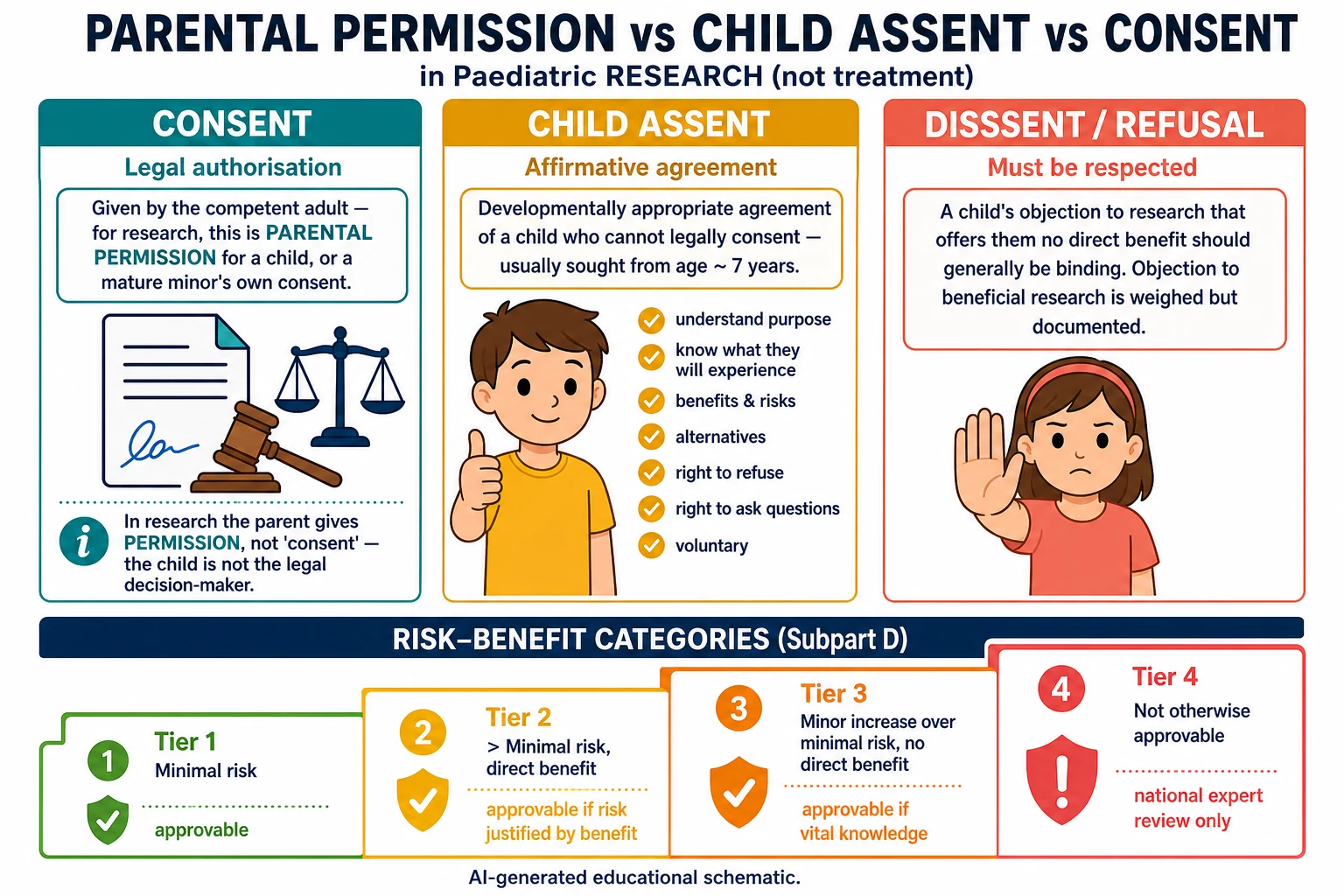
| Aspect | Permission | Assent | Consent |
|---|---|---|---|
| Who gives it | Parent or legal guardian | Child not yet able to consent | Competent adolescent or adult |
| Legal status | Authorises the child's participation | Respects developing autonomy | Legally binding authorisation |
| When sought | Always, unless waived | From ~age 7, adapted to the child | When the minor is a mature minor for this decision |
| If refused | Child does not enrol | Dissent to non-beneficial research is generally binding | Valid refusal usually ends participation |
Epidemiology & Risk Factors
For decades children were simply left out of research, and the harm flowed the other way. Medicines were licensed for adults and given to children off-label, on the assumption that a child was a small adult. They are not. Chloramphenicol caused fatal "grey baby" syndrome in neonates because their immature livers could not clear it; oxygen given freely to premature infants contributed to retinopathy and blindness. The lesson written in those children was that failing to study children ethically is itself an ethical failure, because it leaves carers to guess at doses that then harm. [8] [13]
Legislation followed the harm. The United States passed the Pediatric Rule, then the Best Pharmaceuticals for Children Act and the PREA, requiring and rewarding paediatric studies. The European Union Paediatric Regulation made a paediatric investigation plan a condition of new marketing authorisations. The shared aim is to generate child-specific evidence rather than extrapolate from adults. [8]
The risk factors for an ethically weak encounter cluster around the child and the family. Younger children are asked less, and asked in less age-appropriate ways. Children with serious illness are vulnerable to therapeutic misconception because their families are desperate for benefit. Families with low health literacy or language barriers may sign forms they do not understand. Families in financial precarity may be swayed by compensation that an affluent family would weigh differently. And any child in a dependent relationship — in hospital, in custody, in an institution — is more exposed to subtle coercion, because the people asking are also the people caring for them. [5] [10]
A striking finding is how much committees themselves vary. In a national study, institutional review boards applied the federal risk and benefit standards to the same paediatric protocols very differently, and their practices around assent — including the age at which they required it — also varied. The framework is clear; its application at the gate is inconsistent, which is why the bedside clinician cannot simply trust that approval means the family understands. [1] [2]
Pathophysiology
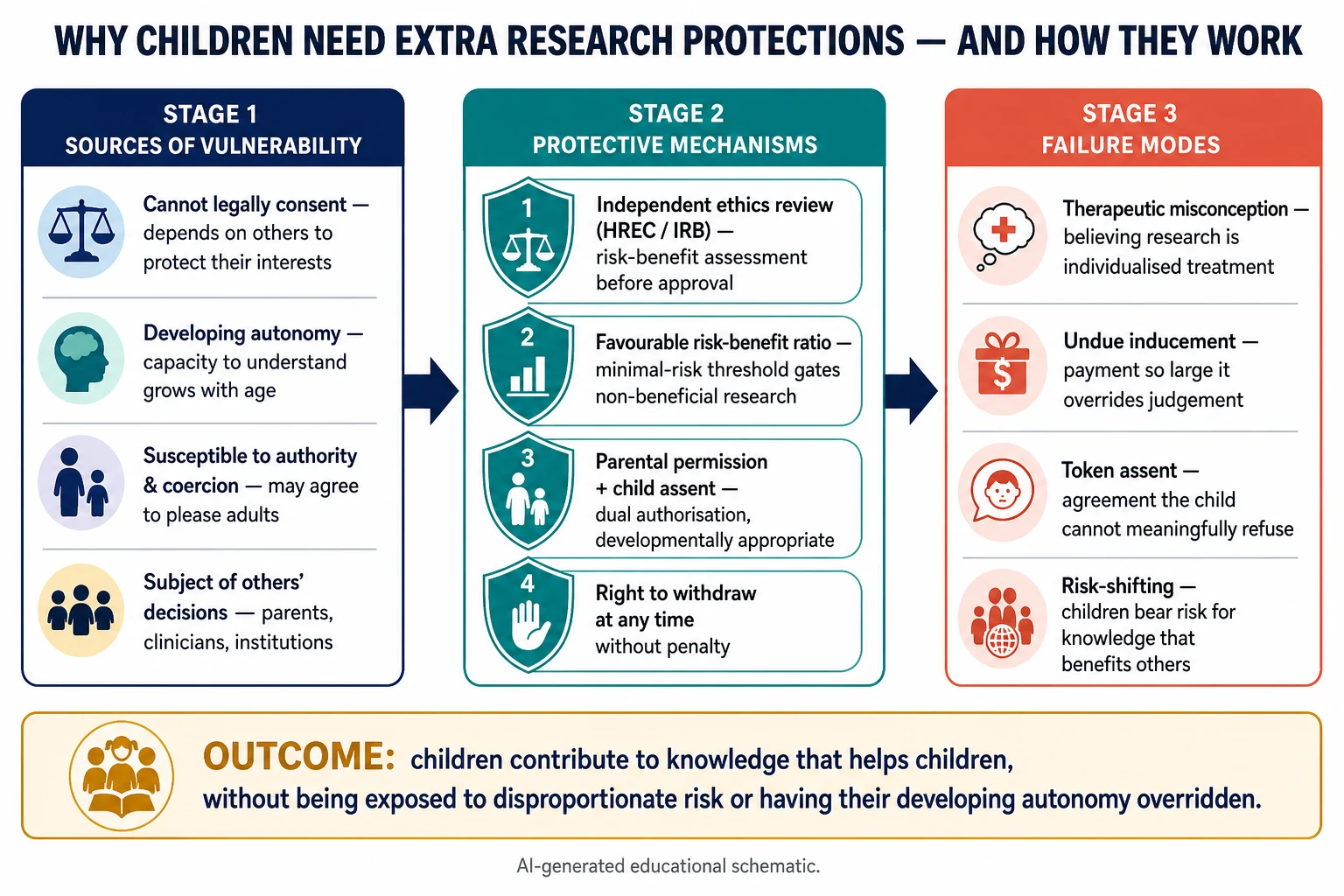
There is no enzyme for an ethical decision, but there is a mechanism, and you can trace it. The mechanism begins with the moral fact that children cannot fully protect their own interests, and it ends with the layered protections that compensate for that fact. [8] [3]
The vulnerability operates through four channels. A child cannot give legal consent, so someone must act for them. A child's capacity to understand grows with age, so a blanket rule will either over- or under-protect. A child is susceptible to the authority of adults, so an agreement to take part may reflect compliance rather than choice. And a child is dependent on the very clinicians and parents who may be asking them to participate, so a refusal may carry a hidden cost the child fears. [3] [8]
The protections work by layering four mechanisms on top of each other. Independent ethics review by a committee forces the study to be justified by someone other than the investigator. A favourable risk-benefit ratio uses the minimal-risk threshold to gate how much non-beneficial research a child may face. Parental permission plus child assent splits the authorisation so that an adult assesses the interests while the child contributes their voice. And the right to withdraw at any time keeps the choice live throughout. [1] [6]
The minimal-risk threshold deserves a moment, because examiners test it. Minimal risk means the probability and magnitude of harm no greater than those ordinarily encountered in daily life or during routine physical or psychological examinations. It is the boundary below which a child may take part in non-beneficial research without a special justification, because they face nothing unusual. Above that line the justifications must get stronger. The concept is debated — daily life for a healthy child and for a child with chronic illness look different — but it remains the operational hinge of the whole framework. [7] [6] [13]
The mechanism also has its failure modes, and naming them is half the exam. Therapeutic misconception is the belief that a research protocol is individualised treatment for the participant; it corrupts permission because the family consents to something they have misunderstood. Undue inducement is compensation or hope so large that it overrides judgement; it corrupts voluntariness. Token assent is agreement the child cannot meaningfully refuse; it corrupts respect. Risk-shifting is asking children to bear risk for knowledge that benefits others; it corrupts the risk-benefit ratio. Every protection above exists to stop one of these four. [3] [11] [5]
Clinical Presentation
You will recognise a research-ethics question the moment a study meets a family. A clinician-investigator approaches the bedside with a protocol and an information sheet. The encounter that follows can be sound or subtly broken, and the presentation tells you which. [1]
The first presentation is the straightforward recruitment. The study is minimal risk, the information sheet is readable, the parent asks good questions, the school-age child nods and asks one too. You document permission and assent and move on. This is the easy case, and it is the model you aim for. [10]
The high-yield presentations are the ones that should make you slow down. A parent who says "if it helps my child, of course we'll do it" is signalling therapeutic misconception — they have heard the study as treatment. An eight-year-old who asks "do I have to?" when handed a form is teetering between assent and compliance, and the answer they get will shape whether their agreement is real. An adolescent who wants to take part in a study her parents oppose — or who refuses a study they want — raises a capacity question alongside the permission question. [11] [4]
Some presentations are structural. A team planning a resuscitation trial knows they cannot obtain prospective consent from a parent whose child is in cardiac arrest, and so deferred consent becomes the design question. A sponsor proposes a placebo arm in a paediatric drug trial where an effective therapy already exists, and you must decide whether placebo is justified. A biobank asks parents for broad, open-ended consent to store and re-use their child's samples for future unspecified research, and you must weigh that against the child's future right to decide. [14] [15]
Differential Diagnosis
When a study is being planned or a family is being asked, the first diagnosis is not the disease — it is the kind of activity in front of you. Mislabel research and the whole ethical apparatus is misapplied. [8]
Is this research — a systematic investigation to produce generalisable knowledge? If yes, it needs ethics review, a protocol, and full permission-plus-assent. Is it quality improvement or audit, which uses existing data to improve local care and may not need full review? Is it an innovative therapy, a one-off deviation to help a single child, which is clinical practice and must be justified as such but is not research? Or is it public health surveillance, which has its own governance? The labels matter because families and ethics committees treat them differently, and "calling it QI to avoid the ethics committee" is a recognised and dangerous shortcut. [8] [13]
The next diagnosis is the risk the study carries. A questionnaire or a non-invasive observation is likely minimal risk. A trial of a new drug with a prospect of benefit is greater-than-minimal risk but may be justified by that benefit. A non-beneficial physiology study that adds extra blood draws is a minor increase over minimal risk, and is approvable only if the knowledge is vital. Sorting the study into its tier tells you what the committee may approve and what the family must be told. [1] [6]
Finally, diagnose the agreement. Is the parent's permission genuinely informed, or is it therapeutic misconception? Is the child's assent real, or token compliance? Is the compensation reasonable reimbursement, or undue inducement? Each of these has a corrective — re-education, a better assent conversation, or a revised payment structure — but only if you name it. [3] [5]
Clinical & Bedside Assessment
Assess the study before you assess the family. Classify the activity, confirm ethics approval, and identify the risk-benefit category. Those three steps stop you from recruiting a family into a study that should not have left the drawing board. [1]
Then assess the participants. How old is the child, and what is their developmental capacity to assent? A neonate cannot assent at all; a seven-year-old can give simple concrete assent; an articulate fifteen-year-old may be a mature minor who can consent for themselves on some decisions. What is the parent's preferred role, and what is their health literacy and language need? These shape how you deliver the same content. [3] [10]
The minimum bedside assessment for ethical enrolment is a sequence you can recite. [3] [1]
- Confirm the study has ethics-committee approval and identify its risk category. [1]
- Assess the child's developmental capacity and decide whether to seek assent. [3] [2]
- Give information at an appropriate reading level and check understanding with teach-back. [10] [9]
- Screen for therapeutic misconception by asking what the family expects to gain. [11] [15]
- Confirm voluntariness, including whether payment is proportionate and free of coercion. [5]
- Record the child's assent or dissent in their own words, not just the adults' decision. [4] [12]
Readability is not a nicety; it is a validity condition. Consent and assent documents that exceed the family's reading level produce permission that looks valid on paper but is not understood in fact. Testing and improving the readability of paediatric consent forms measurably improves parental understanding, and multimedia aids can extend that benefit to the child. [10] [9]
Investigations
There is no blood test for research ethics. The investigations here are the instruments that make the protections visible, repeatable, and auditable. [1] [9]
- Ethics approval letter naming the risk category and any waivers of assent or permission. [1]
- Information sheets and assent forms written and readability-tested for the right age band. [10] [9]
- Comprehension tools such as the Quality of Informed Consent scale to measure what families actually understood. [10]
- Public trial registration on ANZCTR, ClinicalTrials.gov or ISRCTN, which guards against selective reporting. [14]
- Data and safety monitoring plan with defined stopping rules and adverse-event reporting to the committee. [14]
- Documentation audit trail: version-controlled forms, signatures, who obtained consent, and any withdrawal records. [2]
Adolescents describe their own research participation in ways that should change how you assess it. When adolescents are asked what taking part in research means to them, they speak about wanting to help others, about feeling respected when asked properly, and about discomfort when the process is rushed or token. Their voices are an instrument: if the assent conversation would not satisfy the adolescent who described it, improve it. [4] [12]
Management — Resuscitation
In a time-critical emergency, the ordinary consent pathway breaks down, because the child is dying and the parent is not yet reachable. A resuscitation trial — testing a therapy after cardiac arrest, in status epilepticus, or in severe shock — cannot wait for a measured conversation. The ethics framework answers this with a specific mechanism, not a free pass. [14]
Deferred consent allows the child to be enrolled at the moment of crisis and the family to be notified and asked about ongoing participation as soon as it is feasible. It is approved in advance by the ethics committee, it is accompanied by community consultation and public disclosure before and after the study, and it is not a unilateral clinician decision. The landmark paediatric cardiac arrest trials of therapeutic hypothermia were built on exactly this design, precisely because enrolment had to happen within minutes of a collapse. [14]
Two rules govern the resuscitation case. First, research procedures must never delay or compromise the emergency care the child needs. Second, once the family is reachable you seek permission for ongoing participation and offer withdrawal of the data already collected according to the protocol. The child who recovers is then brought into the assent process for any further involvement. [14]
Management — Definitive & Stepwise
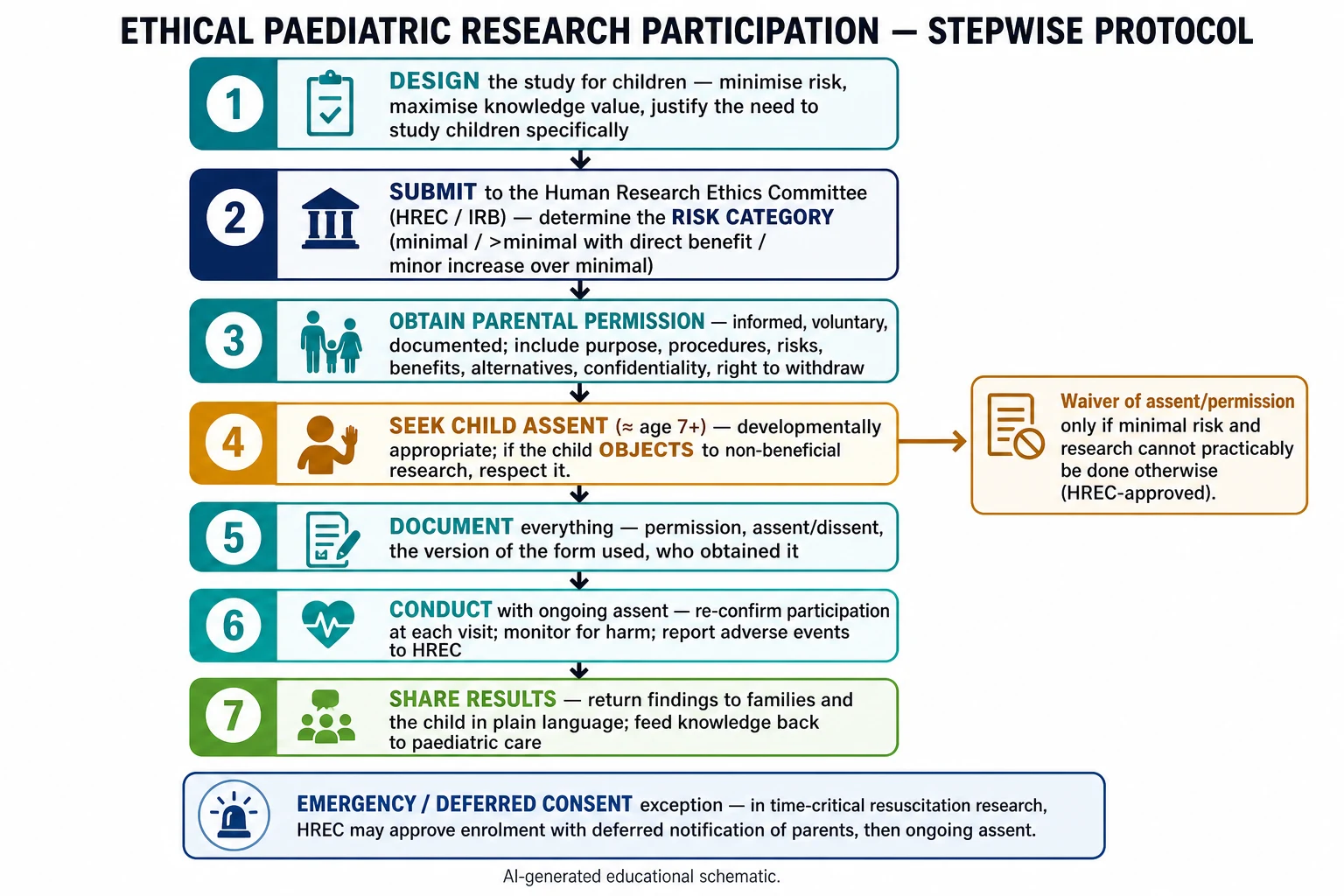
Run the ethical enrolment as a sequence you can defend under viva pressure. The steps move from design to dissemination, with assent threaded through. [3] [1]
Ethical paediatric research participation
Design the study for children — minimise risk, maximise knowledge value, justify why children must be studied
Submit to the HREC/IRB and obtain approval with a risk-category determination and any waivers
Obtain documented informed parental permission covering all required elements
Seek developmentally appropriate child assent from ~age 7; respect dissent to non-beneficial research
Screen for and correct therapeutic misconception and undue inducement before enrolment
Document permission, assent or dissent, form versions, and who obtained them
Maintain ongoing assent across visits, monitor adverse events, and return results to families
Obtain permission properly. The parent must understand the purpose of the research, the procedures, the foreseeable risks and discomforts, the potential benefits, the reasonable alternatives, the extent of confidentiality, the voluntary nature of participation, and the right to withdraw at any time without penalty to their care. Permission given without these is not permission. [3] [10]
Seek assent at the right developmental level. For a young school-age child, that means simple concrete language about what will happen and that they can say no. For an older child or young adolescent, it means the elements in fuller form — purpose, experience, benefits and risks, alternatives, the right to refuse, the right to ask questions, and voluntariness. Use the child's own words in the record. [3] [4]
Use waivers only when justified. An ethics committee may waive assent or parental permission only if the research is minimal risk, it could not practicably be carried out with permission, and the rights and welfare of participants are protected. Waiver is an exception, not a convenience, and examiners test the conditions. [1] [6]
Specific Subtypes & Scenarios
Minimal-risk observational study. A questionnaire about sleep, or a non-invasive sensor reading, is typically minimal risk. Assent is sought from about age 7, the burden is low, and a committee may approve a waiver of documentation if risk is minimal and the data are de-identified. The ethics here are mostly about privacy and voluntariness. [6] [13]
Greater-than-minimal-risk trial with direct benefit. A randomised trial of a new antiepileptic in children carries more than minimal risk, but the child may benefit. Full parental permission and child assent are required, the risk must be justified by the prospect of direct benefit, and the committee must find the balance favourable. This is the bread-and-butter therapeutic trial. [1]
Non-beneficial physiology study. Extra venepuncture or a non-therapeutic metabolic study that a child would not otherwise undergo is a minor increase over minimal risk with no prospect of direct benefit. It is approvable only if the knowledge is of vital importance and cannot be obtained otherwise. This is the tier examiners use to test whether you understand that risk to the child must be earned by knowledge for children. [6] [7]
Early-phase oncology in life-limiting illness. Phase I and early-phase cancer trials in children are a high-risk zone for therapeutic misconception. Families facing a life-limiting illness may read an early dose-finding study as treatment for their child, when its primary aim is to find a safe dose for future patients. The ethical task is to distinguish research from treatment honestly, without extinguishing reasonable hope, and to document that the family understands the difference. [11]
Emergency resuscitation trial. Studies such as the therapeutic hypothermia after paediatric cardiac arrest trials enrol children within minutes of collapse and rely on deferred consent with community consultation. They show how the framework adapts to the genuinely impossible-consent scenario without abandoning oversight. [14]
Placebo-controlled drug trial. Placebo is ethically defensible in children only when no proven effective therapy exists, or when placebo use carries minimal risk and the trial answers a question important to children. Using placebo where an effective treatment is available, or withholding it to the child's detriment, is not defensible. [11] [8]
Paediatric biobank and genomics. Genomic and biobank studies ask for broad consent to store and re-use a child's samples and data for future unspecified research. The ethical tensions are the child's future right to decide, the management of incidental findings, and whether a "dual purpose" — hoping for personal results while contributing to knowledge — is understood. Parents and participants often hold a "duality of purpose" that investigators must elicit and address. Re-consent at maturity is increasingly expected. [15]
Adolescent-only study. Studies of adolescent mental health, substance use, or sexual health may rely on mature-minor consent and a strong confidentiality guarantee. The payment structure must reimburse burden without inducing participation, and the dependent setting — inpatient, justice, residential — must be recognised as a coercion risk. [5] [4]
Complications & Pitfalls
- Therapeutic misconception: the family consents to research they have mistaken for treatment. [11] [15]
- Undue inducement: payment or hope so large it overrides voluntary judgement. [5]
- Token assent: agreement the child cannot meaningfully refuse, recorded as if it were real. [3] [12]
- Misclassifying research as quality improvement to bypass ethics review. [8] [13]
- Failing to seek or document assent, or ignoring a recorded dissent. [2] [3]
- Exposing children to greater-than-minimal risk for research that does not benefit them or children generally. [6] [1]
- Using children as a convenient population for questions that belong to adult medicine. [8]
- Consent and assent forms written above the family's reading level, producing permission that is valid on paper and empty in fact. [10] [9]
Prognosis & Disposition
Well-conducted paediatric research is a good in itself. It replaces off-label guessing with child-specific evidence, it reduces dosing harm, and it answers the questions that only studying children can answer. The goal of the whole framework is to make that good available without trading on a child's vulnerability. [8] [13]
For the family, the disposition of an ethical encounter is a documented record. The permission, the assent or dissent, the form version, the risk category, and the route to withdrawal are all written down. Adverse events and protocol deviations are reported to the ethics committee, and families are told what they need to know. [1] [14]
The disposition also runs forward in time. Results should be returned to participants and to the child in plain language, and the study should be published regardless of whether the findings were favourable. Withholding negative results is itself an ethical failure, because it asks children to carry risk for knowledge that is then hidden. Public registration and results reporting exist to prevent exactly this. [14] [15]
Special Populations
Neonates. Neonates are the most vulnerable research participants: they cannot assent at all, their physiology makes dosing genuinely dangerous, and much of their care is off-label. Proxy permission is the only authorisation, and dedicated neonatal ethics frameworks and risk-benefit calibration apply. [8]
Pre-verbal infants and toddlers. Permission only; assent is not yet possible. Watch the child's distress signals, keep procedures to the minimum the science requires, and never let the family's enthusiasm override the child's evident discomfort. [3]
School-age children. Concrete, age-appropriate assent is the standard. Translate the assent elements into language the child can use, and record their view in their own words. [3] [4]
Adolescents. Where a young person meets the mature-minor standard for the decision, their own consent may be valid; otherwise permission plus assent applies. Offer confidentiality appropriate to the study, recognise the coercion risk in dependent settings, and support the move toward autonomous participation as transition approaches. [5] [4]
Children with intellectual or developmental disability. Use supported assent matched to the child's capacity, and never assume incapacity from the diagnosis alone. A non-verbal child may still communicate assent or dissent through behaviour, which must be read and respected. [3] [12]
Life-limiting illness. Therapeutic misconception risk is highest here. Separate research from treatment with care, preserve reasonable hope, and ensure the family understands that the primary aim may be knowledge for future children. [11]
Culturally and linguistically diverse families. Use professional interpreters, plain language, and, where appropriate, community engagement before recruitment. Research that only reaches articulate, English-fluent families widens inequity rather than closing it. [10] [9]
Evidence, Guidelines & Regional Differences
The international framework is built from a shared history. The Declaration of Helsinki set the modern baseline in 1964 and was revised again in 2024 to address research in vulnerable groups and the return of results. The Belmont Report identified respect for persons, beneficence and justice as the analytic principles, with children named as a vulnerable population needing additional protection. The CIOMS International Ethical Guidelines extended these to low-resource settings and to children specifically. The ICH Good Clinical Practice standard and the ICH E11 guideline on clinical investigation of medicinal products in children gave the framework its operational backbone for drug trials. [8] [3]
The empirical evidence base is what examiners reach for when they ask "how well does this actually work?" Shah and colleagues showed that institutional review boards applied the federal risk and benefit standards inconsistently to the same paediatric protocols. Whittle showed that assent practices and age thresholds varied between committees. Wendler grounded assent theoretically and practically. Kopelman defended the minimal-risk threshold as an international standard and argued it should govern all non-beneficial paediatric studies. Tait showed that improving the readability of consent forms, and adding multimedia, measurably improved parental understanding. Unguru mapped the ethical hazards of early-phase research in life-limiting illness, and Marron documented the "duality of purpose" parents and participants bring to genomic profiling research. The therapeutic hypothermia after paediatric cardiac arrest trials remain the worked example of deferred consent in a genuine emergency. [1] [2] [3] [6] [9] [10] [11] [14] [15]
Controversies to handle calmly in a viva: how to define and apply minimal risk across healthy and chronically ill children; whether placebo is ever justified when an effective therapy exists; how far broad biobank consent can reach into a child's future; how much payment crosses into undue inducement; and whether deferred consent truly respects families who learn their child was enrolled in crisis. The mark of a strong candidate is to state the tension, name the safeguard, and not pretend the dilemma is resolved. [6] [14]
In Australia and Aotearoa New Zealand the National Statement on Ethical Conduct in Human Research governs, administered through Human Research Ethics Committees under the NHMRC in Australia and the Health and Disability Ethics Committees in New Zealand. The National Statement explicitly addresses research with children and young people, requiring that the research be of value to children, that consent be obtained from parents or guardians and assent from the young person where able, and that participation be voluntary. Trials are registered on the ANZCTR. [8]
Exam Pearls
PROTECT
References
- [1]Shah S, Whittle A, Wilfond B, Gensler G, Wendler D How do institutional review boards apply the federal risk and benefit standards for pediatric research? JAMA, 2004.PMID 14747505
- [2]Whittle A, Shah S, Wilfond B, Gensler G, Wendler D Institutional review board practices regarding assent in pediatric research Pediatrics, 2004.PMID 15173501
- [3]Wendler DS Assent in paediatric research: theoretical and practical considerations J Med Ethics, 2006.PMID 16574878
- [4]Grady C, Wiener L, Abdoler E, Lyon M, Treiser M, Wendler D Assent in research: the voices of adolescents J Adolesc Health, 2014.PMID 24630932
- [5]Wiener L, Viola A, Koren G, et al Contrasting views of risk perception and influence of financial compensation between adolescent research participants and their parents J Empir Res Hum Res Ethics, 2015.PMID 25742666
- [6]Kopelman LM Using the minimal risk threshold for all no-benefit pediatric studies Am J Bioeth, 2014.PMID 25127267
- [7]Kopelman LM Minimal risk as an international ethical standard in research J Med Philos, 2004.PMID 15512977
- [8]Kopelman LM Children as research subjects: a dilemma J Med Philos, 2000.PMID 11262635
- [9]Tait AR, Voepel-Lewis T, Levine R Using digital multimedia to improve parents' and children's understanding of clinical trials Arch Dis Child, 2015.PMID 25829422
- [10]Tait AR, Voepel-Lewis T, Malviya S, Philipson SJ Improving the readability and processability of a pediatric informed consent document: effects on parents' understanding Arch Pediatr Adolesc Med, 2005.PMID 15809387
- [11]Unguru Y Ethical Challenges in Early-Phase Pediatric Research for Life-Limiting Illness Semin Pediatr Neurol, 2015.PMID 26358428
- [12]Grady C, Wiener L, Wendler D Adolescent Research Participants' Descriptions of Medical Research AJOB Empir Bioeth, 2016.PMID 27004235
- [13]Lantos JD, Feudtner C Considerations in the evaluation and determination of minimal risk in pragmatic clinical trials Clin Trials, 2015.PMID 26374686
- [14]Moler FW, Silverstein FS, Holubkov R, et al Rationale, timeline, study design, and protocol overview of the therapeutic hypothermia after pediatric cardiac arrest trials Pediatr Crit Care Med, 2013.PMID 23842585
- [15]Marron JM, Santistevan S, Genvasini C, et al Duality of purpose: Participant and parent understanding of the purpose of genomic tumor profiling research among children and young adults with solid tumors JCO Precis Oncol, 2019.PMID 31240271