Paeds · professional-practice-and-evidence
Teaching, supervision and feedback in paediatrics
Also known as Clinical teaching paediatrics · Feedback to trainees · Clinical supervision of trainees · Workplace-based assessment paediatrics · Debriefing with good judgment · Entrustable professional activities · R2C2 feedback model · Struggling learner management
Fellowship-level approach to teaching, clinical supervision and feedback in paediatrics: feedback models (Ende, Pendleton, ask-tell-ask, R2C2, debriefing with good judgment), the educational alliance, entrustable professional activities, workplace-based assessment, supervision duties and patient safety, the struggling learner, and regional curricular frameworks.
On this page & tools
Your progress
Saved locally on this device.
Practise this topic
Target exams
Red flags
Life stages
Care settings
Clinical exam formats
Board mappings
Overview & Definition
A registrar puts in a cannula while you watch. They miss, then succeed. What you do in the next thirty seconds — what you say, how you say it, and what you write down — is the whole of this topic. A consultant who teaches, supervises and feeds back well turns a missed cannula into a better doctor. A consultant who does none of those things turns it into a resentful trainee and, eventually, an unsafe one. [1] [5]
Teaching is facilitating learning at the point of patient care — at the bedside, in clinic, on a ward round. Supervision is oversight of a trainee's clinical activity, with dual responsibility for the patient's safety and the learner's development. Feedback is specific information about observed performance, intended to guide improvement. These three are separate skills that reinforce each other, and none of them is optional or automatic. [2] [7]
The trap is to treat feedback as a personality verdict and supervision as signing a form. Feedback is about what the learner did, not who the learner is. Supervision is staying close enough to keep the patient safe, not lending your name to work you never saw. The rest of this topic is how to do all three in a busy paediatric service without losing your temper or your day. [1] [3]
Classification
Sort the tools before you sort the moment, because the right model depends on the setting. [8]
Feedback models share one aim — to move the learner forward — but they get there differently. Pendleton's rules ask the learner to self-assess, then hear what they did well, then what they could do differently. Ask-tell-ask opens with the learner's own view, adds your observations, then closes with a joint plan. The R2C2 model builds the relationship, elicits the learner's reaction, explores the content, then moves to coaching. Debriefing with good judgment pairs an observation (advocacy) with a genuine question (inquiry). The feedback sandwich — positive, negative, positive — is popular but weakens the message and is increasingly discouraged. [8] [12] [6]
Assessment splits into formative and summative. Formative assessment is developmental and low-stakes; it guides learning and does not hold the learner back. Summative assessment is a judgement for a decision — pass, fail, progress, competence. Miller's pyramid frames the layers a learner must climb: knows (facts), knows how (application), shows how (simulation), and does (real practice under supervision). You supervise and feed back at the "does" layer, where it matters most. [13] [10]
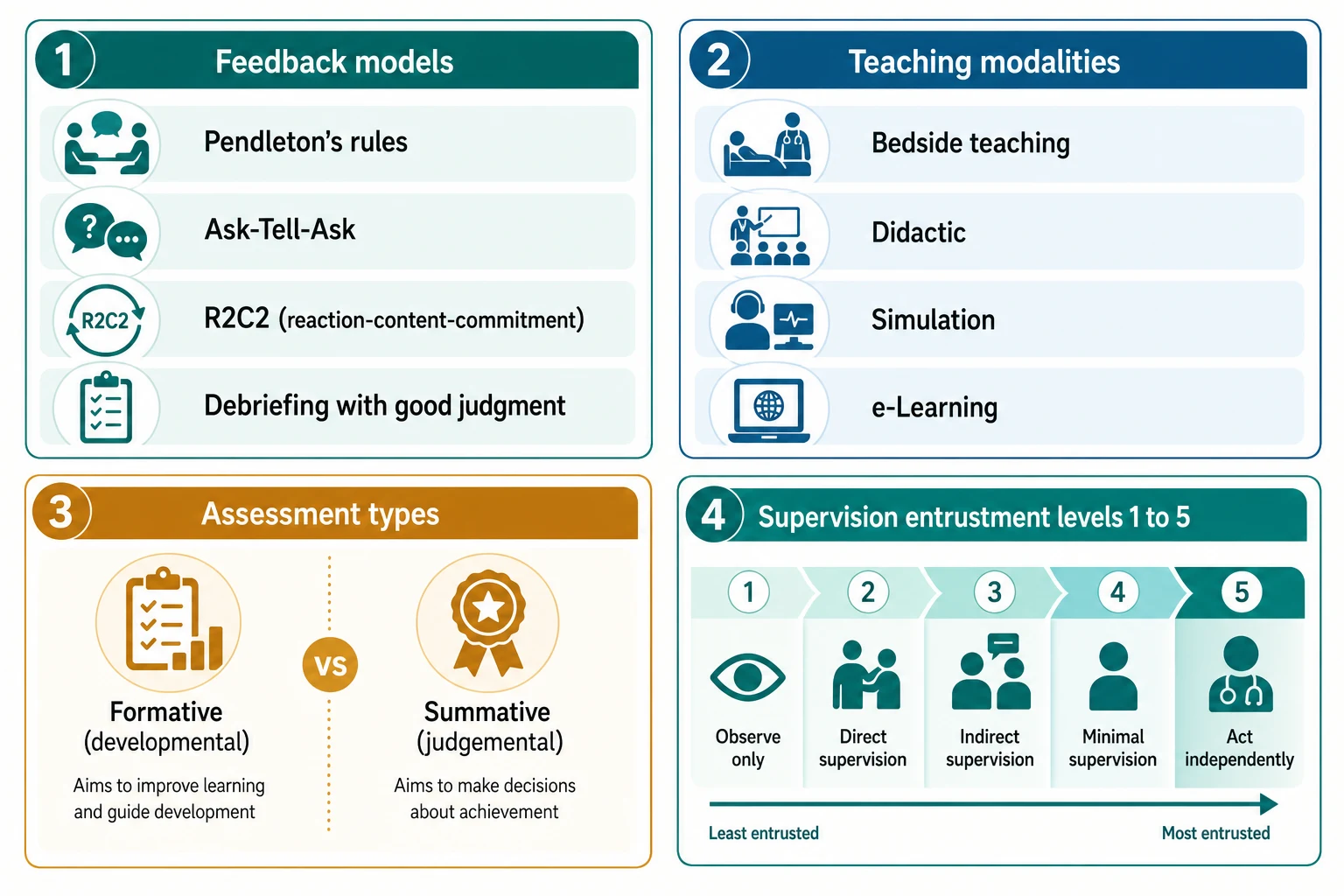
Teaching modalities range from bedside teaching — the gold standard because it is real and patient-centred — through didactic lectures, case-based discussion and simulation, to e-learning. Supervision runs along an entrustment continuum: from observe only, through direct and indirect supervision, up to minimal supervision and independent practice. Your job is to match the entrustment level to the observed competence for each task, and to revisit it as the learner grows. [11] [7]
| Aspect | Feedback | Evaluation | Assessment |
|---|---|---|---|
| Question answered | How can I improve this performance? | How good is this person? | What can this person do? |
| Object | The performance / behaviour | The person overall | The competency level |
| Stakes | Formative, developmental | Often summative, judgemental | Formative or summative |
| Time frame | Immediate and ongoing | Endpoint of a period | Point-in-time measurement |
| Tone | Coaching | Judgement | Measurement |
Epidemiology & Risk Factors
Feedback is talked about far more than it is delivered well. Trainees across paediatrics and other specialties reliably report wanting more feedback than they receive, and much of what they do get is vague — "good job" — rather than specific and actionable. The BEME systematic review found that assessment and feedback can improve physicians' clinical performance, but the transfer into everyday practice is inconsistent and often modest. [10] [2]
The risk factors for poor feedback cluster around the teacher, the learner and the system. Teachers cite time pressure, fear of damaging the relationship, and uncertainty about how the message will land. Learners vary in how they respond: fear and low confidence shut down reflection, while credibility and a felt sense of safety open it. Systems reward throughput over teaching, so the feedback that survives is the feedback that is fastest, not the feedback that is best. [9] [4]
Supervision fails for predictable reasons too. The supervisor is physically or cognitively absent; the entrustment level is unclear to either party; production pressure pushes a learner beyond their competence; or the supervisor signs forms without ever watching the trainee work. Each of these converts a teaching opportunity into a patient-safety risk. [7] [11]
Pathophysiology
There is no enzyme for good feedback, but there is a mechanism, and understanding it stops you from treating feedback as a soft skill you either have or don't. Feedback works through a loop: you set a goal, the learner acts and you observe, you give specific feedback, the learner reflects, and a new goal is set. When the loop runs, performance improves; when a link breaks, learning stalls no matter how clever the teaching. [1] [3]
The ingredient that lets feedback land is the educational alliance — the trust and partnership between teacher and learner. Telio reconceptualised feedback around exactly this idea: the same words land very differently inside a trusting relationship than inside an adversarial one. Specificity, timeliness and psychological safety are the other drivers. A learner who feels safe will reflect; a learner who feels threatened will defend, and defending is the opposite of learning. [3] [9]
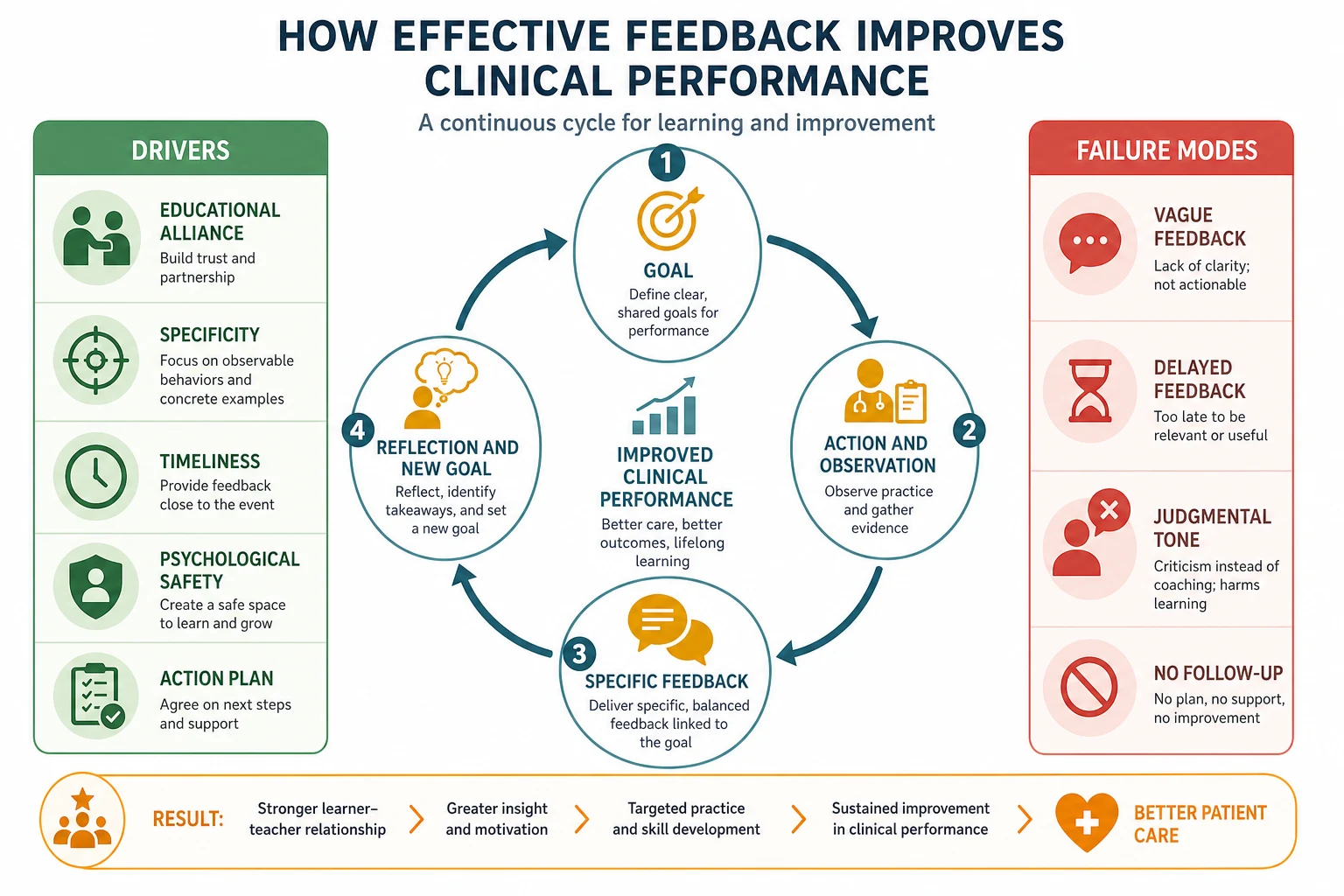
Emotions mediate the whole pathway. Sargeant's work on multi-source feedback showed that acceptance of feedback is shaped less by the content than by the learner's emotional response to it — and that reflection helps convert a stinging message into a useful one. Supervision, meanwhile, protects patients by holding the learner within a safe zone while entrustment is built. The failure modes — vague praise, delayed comments, judgemental tone, no follow-up — each break a different link in the same loop. [4] [11]
Clinical Presentation
You will recognise a feedback or supervision problem the same way you recognise a clinical one: by what you see and hear. A registrar repeats the same error on three consecutive shifts and cannot tell you why. A trainee, asked for their goals, looks blank. A learner's portfolio is full of "good job" with no behaviour named. These are presentations of a teaching gap. [2] [8]
The high-yield presentations of feedback gone wrong are worth learning as signs. A learner becomes tearful or hostile after a comment that was framed as judgement rather than coaching. A supervisor is nowhere to be found during a procedure that is at the edge of the trainee's competence. A feedback encounter ends with both parties feeling relief rather than a plan. A teaching opportunity is swallowed whole by a ward round that values speed over learning. [9] [7]
Differential Diagnosis
When a learner is "not performing", diagnose the cause before you reach for a remedy, because the treatment differs entirely. [7] [9]
| Surface story | Likely real cause | What to do |
|---|---|---|
| "They keep making the same mistake" | No one observed and no one told them — a feedback gap | Observe directly, then give specific, timely feedback with a plan |
| "They can't do the procedure" | Entrustment mismatch — given too much too soon | Step back a supervision level; rehearse in simulation |
| "They're defensive when corrected" | Threat response to judgemental framing | Rebuild the alliance; switch to ask-tell-ask |
| "They've gone downhill" | A learner in difficulty, not underperforming | Screen for health, wellbeing, fatigue, personal crisis |
| "They just don't seem engaged" | Burnout, or a system that never teaches | Ask about workload and meaning; protect teaching time |
Distinguish the struggling learner — a competence problem needing remediation — from the learner in difficulty, whose performance is dragged down by health, wellbeing or circumstance. They look alike, and confusing them causes real harm: you discipline a person who needed support, or you over-support a person who needed structure. [7]
Clinical & Bedside Assessment
Assess the learner before you assess the task. What stage are they at, what are their goals for this rotation, and how do they prefer to receive feedback? A two-minute conversation at the start of a term prevents weeks of mismatched expectations. [8] [5]
Then observe directly. Direct observation is the single most underused assessment tool in medicine: you cannot give specific feedback on a performance you never watched. Diagnose the teaching moment — is this a one-minute preceptor encounter on a ward round, a full bedside case, or a simulation debrief? Each has its own structure, and choosing the wrong one wastes everyone's time. [5] [6]
Minimum teaching and feedback assessment: [1] [8]
- Confirm the entrustment level for this task and whether it is safe. [11]
- Agree a specific learning goal before the encounter. [5]
- Observe the performance and gather concrete behaviours, not impressions. [1]
- Read the learner's emotional state and adjust your delivery. [9]
- Check understanding with teach-back of the learning point. [8]
Investigations
You do not order blood tests for teaching. The "investigations" here are the structured tools and documentation that make learning and entrustment visible and repeatable. [10] [11]
- Mini-CEX (mini clinical evaluation exercise): a focused observed encounter with structured feedback, ideal for a clinic or ward assessment. [10]
- DOPS (direct observation of procedural skills): for a paediatric procedure such as cannulation, lumbar puncture or suturing. [10]
- CBD (case-based discussion): probes clinical reasoning around a case the learner managed. [10]
- Multisource feedback (360): gathers views from nurses, peers, families and other team members, with reflection on recurring themes. [4]
- Entrustment ratings and EPA supervisor reports: record the level of supervision the learner needed for each professional activity. [11]
- Reflective portfolio: the learner's own goals, action plans and follow-up, making the loop explicit. [3]
A single tool is a snapshot; a portfolio of tools, triangulated, is a defensible picture of competence. [13] [10]
Management — Resuscitation
When a learner's action threatens the patient, you manage safety first and teach afterwards. Stop the unsafe practice, correct it, and protect the child — exactly as you would in any resuscitation. Teaching does not outrank safety, and a difficult conversation never outranks a child's welfare. [7] [5]
Give a brief, immediate correction for the time-critical element, then arrange fuller feedback once the moment has passed and the learner can hear it. After a frightening event — a failed airway, a near-miss — reassure the distressed learner and defer the formal debrief until emotion has settled enough for reflection. [6] [9]
Management — Definitive & Stepwise
Use a structure you can recite under viva pressure. The ask-tell-ask model, built on the educational alliance, is the cleanest scaffold for a feedback conversation, with debriefing-with-good-judgment available for simulation and complex events. [3] [6]
The feedback and supervision algorithm
Observe the learner directly and gather specific, behavioural evidence
Build the educational alliance — name that you are invested in their growth
Ask the learner for their self-assessment first
Tell them your specific observations, balanced and behaviour-focused
Co-create a focused, single action plan with the learner
Agree the follow-up, the new entrustment level, and document it
Choose the model to fit the moment. For a busy ward round, the one-minute preceptor gets a learning point into thirty seconds: get a commitment, probe for reasoning, teach one general principle, give one specific reinforcement, and correct one error. For a simulation or a serious event, debriefing with good judgment pairs advocacy ("I noticed you did X, and I inferred Y") with inquiry ("was that what was going on for you?") — rigorous feedback joined to genuine curiosity. For ongoing coaching, the R2C2 model walks through relationship, reaction, content and coaching so the learner owns the next steps. [5] [6] [12]
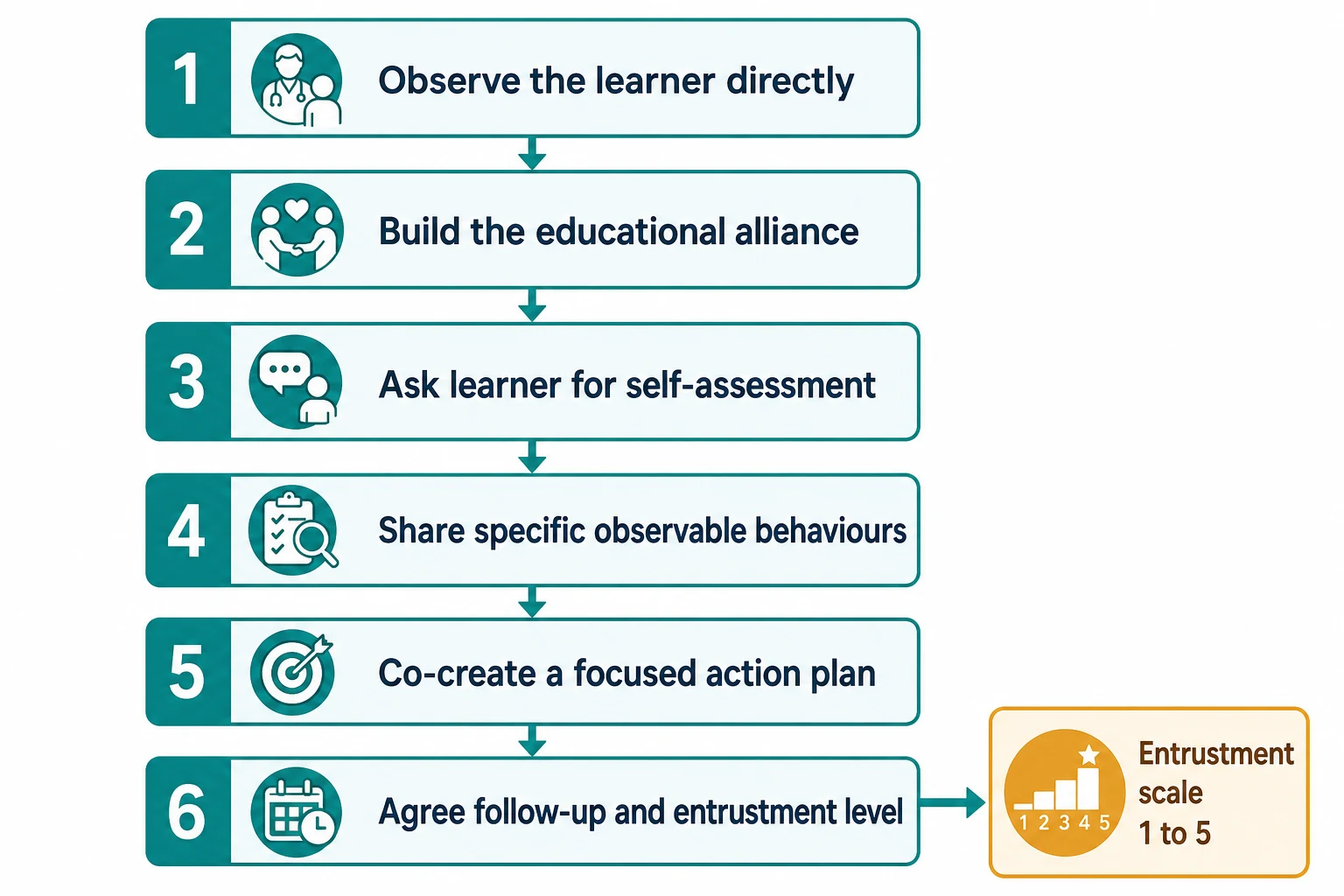
Set the entrustment deliberately. For each task, decide how close you need to be — observe, direct supervision, indirect supervision, minimal supervision, or independent — based on what you have actually seen the learner do. Make the level explicit so neither of you is guessing, and move it up as competence grows. Document the feedback given, the action plan agreed, and the follow-up arranged. [11] [7]
Specific Subtypes & Scenarios
Bedside teaching with a child and family. The gold standard, but it carries consent and dignity duties. Brief the family that teaching will occur, seek their assent, keep the child central, and never reduce a patient to a "teaching case". Teach one focused point, involve the learner in the history or examination, and debrief away from the bedside. [5]
Simulation debrief. Use debriefing-with-good-judgment. State the rules of psychological safety at the start, then explore what happened with advocacy-inquiry pairs that name a behaviour and hypothesise a frame, always inviting the learner's view. The debrief is where most of the learning lives, not the scenario itself. [6]
One-minute preceptor on a ward round. When service pressure is high, take one minute: get a commitment, probe reasoning, reinforce one strength, correct one error, teach one principle. Frequency beats length — a daily one-minute teach compounds. [5] [8]
Giving difficult feedback to a struggling learner. Prepare, be specific, separate the behaviour from the person, and agree a concrete plan. If performance is persistently unsafe or well below expectations, move from informal feedback into the formal remediation pathway, with the supervisor of record and the training body. [7] [9]
Procedural supervision. For a paediatric procedure, graduate the entrustment: talk through it, then do it with them, then watch them do it with you ready, then let them do it at distance. Never let a learner attempt a task beyond their observed competence simply because the team is busy. [11] [10]
The learner in difficulty. When a learner deteriorates, screen for health, wellbeing, fatigue and personal crisis before assuming a competence failure. Signpost practitioner-health pathways and adjust workload while support is put in place. [7] [9]
Complications & Pitfalls
- Feedback framed as judgement of the person rather than coaching of the behaviour. [1] [3]
- The feedback sandwich that buries the message or erodes trust. [8]
- Vague praise ("good job") the learner cannot repeat or change. [2]
- Delayed feedback that has lost its corrective power. [1]
- Nominal supervision: signing entrustment forms without observing practice. [7] [11]
- Halo and horns, gender and cultural bias in assessment. [10] [4]
- Treating a learner in difficulty as a struggling learner until a crisis forces the distinction. [7]
Prognosis & Disposition
Specific, timely feedback delivered inside an educational alliance reliably improves performance and engagement. Good supervision reduces patient harm and builds entrustment over time, and an authentic feedback culture lowers burnout and improves retention — outcomes that matter to a paediatric service as much as any clinical result. [10] [3]
Disposition is a documented action plan. Name the behaviour to change, the action agreed, the follow-up date, and the entrustment level for the next encounter. Escalate to the training programme, the remediation pathway, or practitioner-health services when performance is unsafe, persistently below standard, or driven by a wellbeing crisis. [7] [11]
Special Populations
International medical graduates. Cultural and health-system differences shape how feedback is given, received and acted on. Be explicit about expectations, check understanding with teach-back, and avoid mistaking unfamiliarity for incompetence. [9]
Learners with disability, neurodiversity or health conditions. Adapt the feedback channel and pace, agree reasonable adjustments, and never assume incapacity from a diagnosis. [7]
Learners returning from leave or between stages. Re-assess entrustment from observed practice rather than calendar time; a long absence often warrants a supervised ramp back to independence. [11]
Undergraduates versus postgraduates. Match the depth of supervision and the stakes of feedback to the learner's stage; a medical student needs more scaffolding and lower entrustment than a senior registrar. [5]
The child and family in the teaching encounter. Consent and assent matter: a family should know teaching is happening, and a child should never be used as material without awareness or dignity. [5]
Evidence, Guidelines & Regional Differences
Practice anchors: Ende's foundational definition of feedback; Archer's state-of-the-science review; Telio's educational alliance; the Veloski BEME systematic review showing assessment and feedback improve performance; Rudolph's debriefing-with-good-judgment; Kilminster's AMEE Guide 27 on supervision; ten Cate's EPAs and AMEE Guide 99; and the R2C2 in-the-moment coaching model. [1] [2] [3] [6] [10] [12]
Controversies to handle calmly: whether the feedback sandwich helps or harms; how reliable self-assessment really is; how to assess entrustment fairly and free of rater bias; and how to protect teaching and feedback time inside a service that measures throughput. [8] [9] [11]
The RACP frames teaching and supervision as a core part of the consultant role, with renewed curriculum learning goals on communication, teaching-learning-supervision and professional behaviour. Entrustment and workplace-based assessment are embedded in college training. Practitioner-health services support learners in difficulty. [7]
Exam Pearls
TEACHER
Self-test: which feedback model fits which moment?
References
- [1]Ende J Feedback in clinical medical education JAMA, 1983.PMID 6876333
- [2]Archer JC State of the science in health professional education: effective feedback Med Educ, 2010.PMID 20078761
- [3]Telio S, Regehr G, Ajjawi R The educational alliance as a framework for reconceptualizing feedback in medical education Acad Med, 2015.PMID 25406607
- [4]Sargeant J, Mann K, Sinclair D, Van der Vleuten C, Metsemakers J Understanding the influence of emotions and reflection upon multi-source feedback acceptance and use Adv Health Sci Educ Theory Pract, 2008.PMID 17091339
- [5]Irby DM, Wilkerson L Teaching when time is limited BMJ, 2008.PMID 18276715
- [6]Rudolph JW, Simon R, Rivard P, Dufresne RL, Raemer DB Debriefing with good judgment: combining rigorous feedback with genuine inquiry Anesthesiol Clin, 2007.PMID 17574196
- [7]Kilminster S, Cottrell D, Grant J, Jolly B AMEE Guide No. 27: Effective educational and clinical supervision Med Teach, 2007.PMID 17538823
- [8]Ramani S, Krackov SK Twelve tips for giving feedback effectively in the clinical environment Med Teach, 2012.PMID 22730899
- [9]Eva KW, Armson H, Holmboe E, Lockyer J, Loney E, Mann K, Sargeant J Factors influencing responsiveness to feedback: on the interplay between fear, confidence, and reasoning processes Adv Health Sci Educ Theory Pract, 2012.PMID 21468778
- [10]Veloski J, Boex JR, Grasberger MJ, Evans A, Wolfson DB Systematic review of the literature on assessment, feedback and physicians' clinical performance: BEME Guide No. 7 Med Teach, 2006.PMID 16707292
- [11]Ten Cate O, Chen HC, Hoff RG, Peters H, Bok H, van der Schaaf M Curriculum development for the workplace using Entrustable Professional Activities (EPAs): AMEE Guide No. 99 Med Teach, 2015.PMID 26172347
- [12]Lockyer J, Lee-Krueger R, Armson H, Hanmore T, Koltz E, Konings K Application of the R2C2 Model to In-the-Moment Feedback and Coaching Acad Med, 2023.PMID 37797303
- [13]Miller GE The assessment of clinical skills/competence/performance Acad Med, 1990.PMID 2400509