Paeds · rural-remote-and-contextual-paediatrics
Rural developmental, disability and mental-health care
Also known as Rural developmental, disability and mental-health care · Rural developmental, disability and mental-health care rural · Rural developmental, disability and mental-health care remote · Rural developmental, disability and mental-health care paediatric · Rural developmental, disability and mental-health care fellowship
Fellowship guide to rural developmental, disability and mental-health care. Covers context-specific assessment, resource-aware pathways, escalation and retrieval, equity and cultural safety, documentation, and board-relevant practice for RACP, RCPCH/MRCPCH, ABP/ACGME and RCPSC examinations.
On this page & tools
Your progress
Saved locally on this device.
Practise this topic
Target exams
Red flags
Life stages
Care settings
Clinical exam formats
Board mappings
Overview & Definition
A seven-year-old in a remote town has delayed speech, challenging behaviour and a twelve-month wait for the nearest developmental clinic. The fellowship task is to convert geography and resource limits into a safe, equitable plan rather than an excuse for delayed care. [1] [2] [3]
Rural developmental, disability and mental-health care closes access gaps with local assessment, tele-MDT models, school partnership and culturally safe pathways rather than waiting for metropolitan waitlists alone. [1] [2] [3]
Rural, remote and contextual paediatrics is not second-class metropolitan care. It is a distinct craft: excellent basics, honest capability assessment, early escalation, cultural safety, and system design that stops blaming families for distance. [1] [2] [3] [4]
Classification
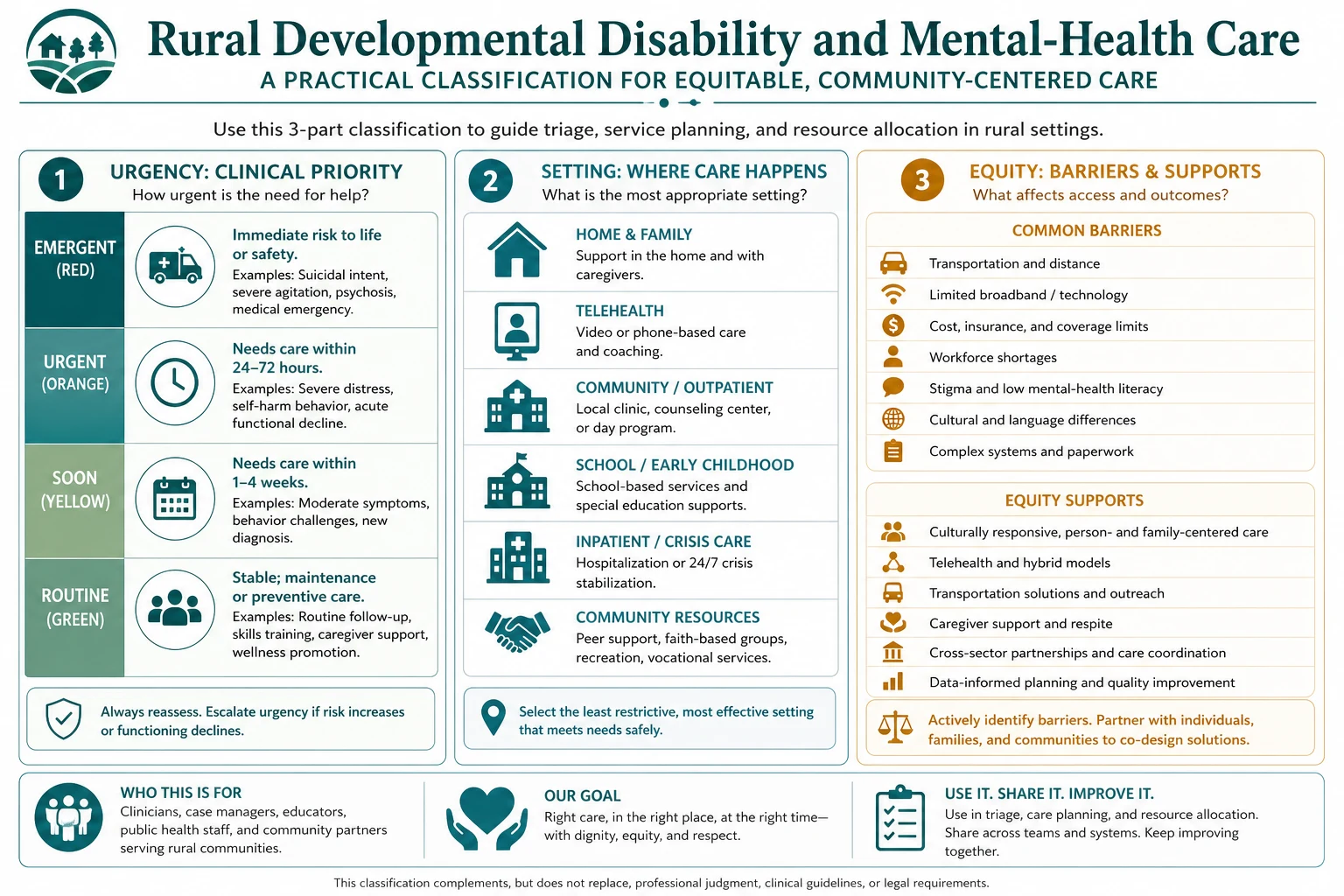
Classification is useful when it changes the stay-versus-go decision or the equity intervention. [1] [2] [3]
By urgency. Preventive/ambulatory; urgent same-day; emergency stabilisation; critical retrieval. [1] [2] [3]
By resource setting. Regional hospital with paediatric cover; small rural hospital; remote clinic; retrieval platform. [1] [2] [3]
By equity lens. Distance and transport; cultural safety; socioeconomic barrier; workforce gap. [1] [2] [3]
Restate the classification whenever physiology, weather, staffing or transport capacity changes. [1] [2] [3]
Epidemiology & Risk Factors
Rural and remote children experience higher rates of injury, some infectious diseases, developmental service gaps and delayed specialist access compared with metropolitan peers. Workforce shortages and transport barriers amplify every risk. [1] [2] [3]
Risk concentrates where poverty, racism, disability, newborn vulnerability and distance intersect. [1] [2] [3] [4]
Service design that ignores these gradients reproduces inequity even when individual clinicians work hard. [1] [2] [3]
Pathophysiology
The pathophysiology of harm is often systems physiology: delayed recognition, delayed antibiotics or airway support, hypothermia, hypoglycaemia, and information loss at handover. [1] [2] [3]
The mechanism of harm in rural developmental, disability and mental-health care is often delayed recognition plus delayed escalation rather than lack of a single drug. [1] [2] [3]
Distance multiplies every decision: what is safe to watch locally, what must move, and how packaging preserves physiology in transit. [1] [2] [3]
Trust, cultural safety and clear communication determine whether families engage early enough for prevention and safe follow-up. [1] [2] [3]
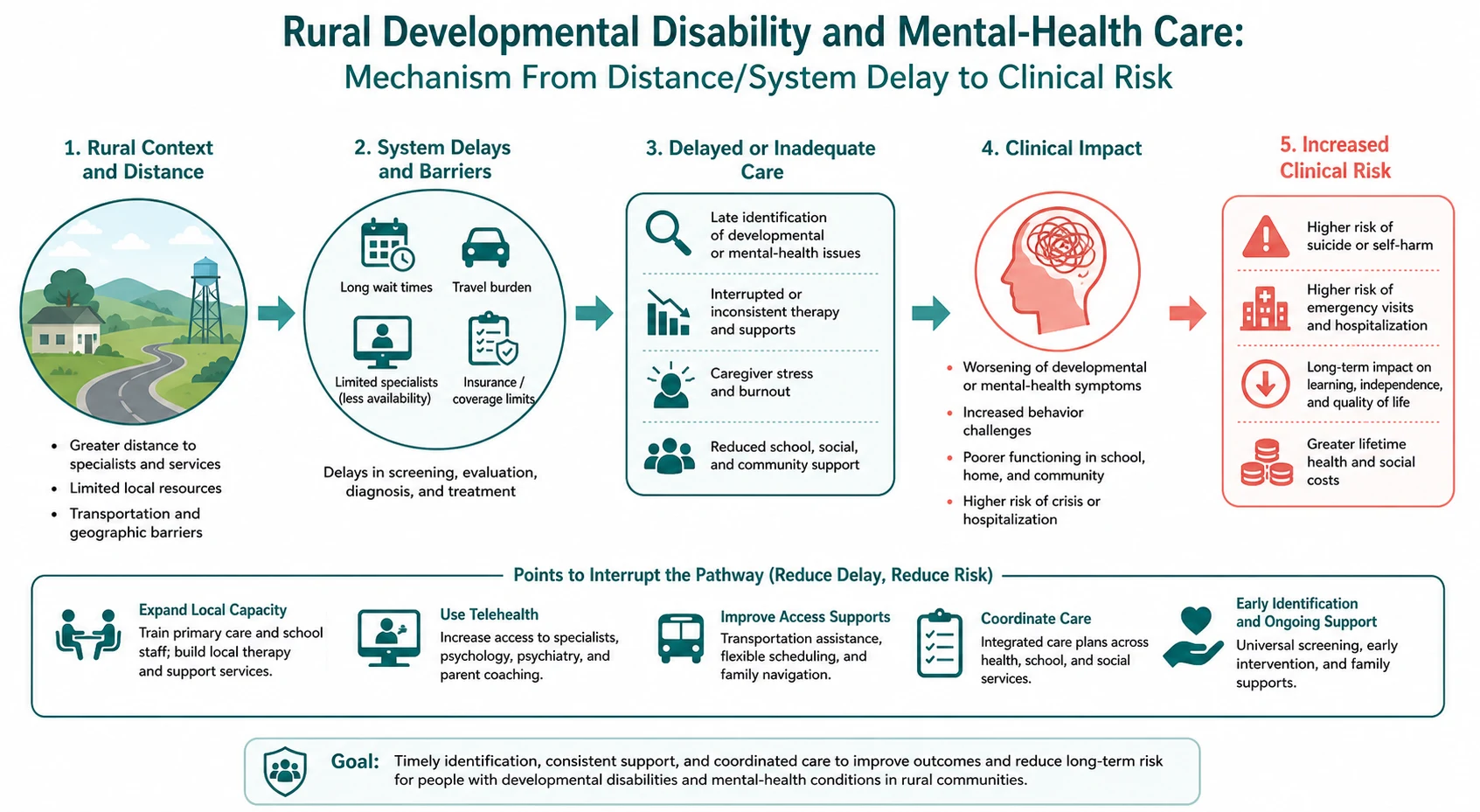
Understanding this pathway keeps the focus on time-critical basics and escalation rather than rare tertiary procedures that cannot be delivered on site. [1] [2] [3]
Clinical Presentation
Presentations range from the unexpected delivery and septic infant to chronic developmental need, mental-health crisis, child-protection concern and disaster displacement. [1] [2] [3]
Families may present late because of cost, weather, work on the land, distrust or prior racist encounters. Staff may present with skill-mix gaps and moral distress. [1] [2] [3] [4]
Red flags include physiological deterioration, inability to observe safely, cultural unsafety, and repeated failed access. [1] [2] [3]
Differential Diagnosis
Not every transfer request is necessary and not every local observation plan is safe. Differentiate true time-critical pathology from logistics-driven anxiety, and differentiate family non-attendance from system-created barriers. [1] [2] [3]
[1] [2] [3]Clinical & Bedside Assessment
Assess the child and the context together: ABCDE, weight, glucose, temperature, pain, plus staffing, diagnostics, transport time and family logistics. [1] [2] [3]
Use structured communication tools and ask who else needs to be in the room, including Aboriginal health workers or interpreters. [1] [2] [3] [4]
[1] [2] [3]Investigations
Order tests that change the immediate plan and can be actioned locally or during transfer. Do not delay oxygen, fluids, glucose or antibiotics for non-essential imaging. [1] [2] [3]
Point-of-care glucose, oxygen saturation and, where available, blood gas or lactate often outrank delayed laboratory panels. [1] [2] [3] [4]
Management — Resuscitation
Resuscitation follows standard paediatric algorithms with local equipment reality. Start airway support, oxygen, fluids and glucose while help is called. [1] [2] [3]
If cardiac arrest or peri-arrest occurs, run PALS/APLS-aligned care and prepare for prolonged resuscitation logistics including parental presence. [1] [2] [3]
Management — Definitive & Stepwise
-
Assess with a context-aware ABCDE and local capability scan; measure weight and use paediatric references. [1] [2] [3]
-
Call for senior, telehealth or retrieval help early with a structured SBAR handover. [1] [2] [3]
-
Stabilise airway, breathing, circulation, glucose, temperature and pain while the pathway is decided. [1] [2] [3]
-
Document thresholds, destination, family plan and follow-up; close the loop with the receiving or community team. [1] [2] [3]
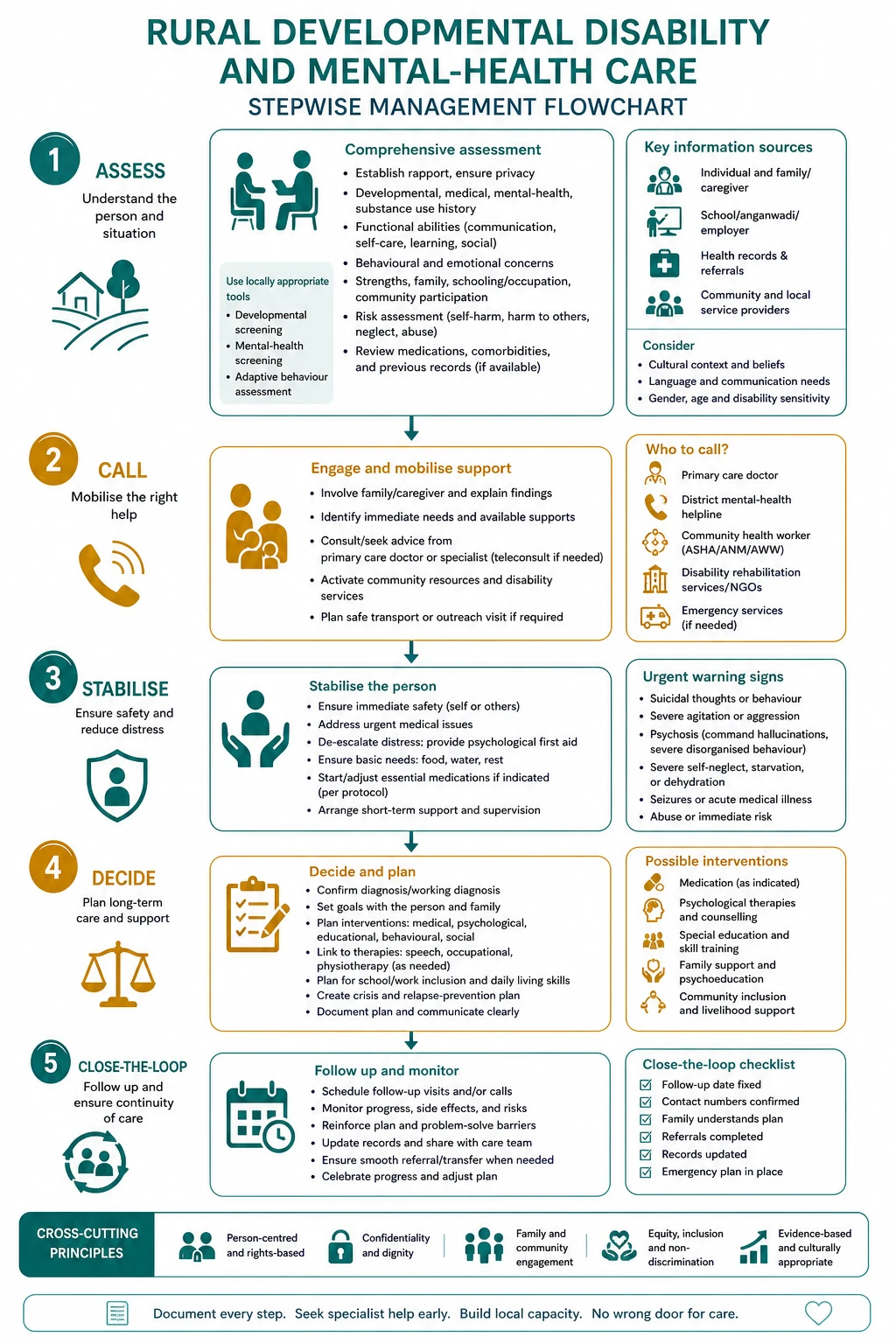
Assess
Context-aware ABCDE, weight, glucose and local capability scan.
Call
Senior, telehealth or retrieval help with structured SBAR.
Stabilise
Airway, breathing, circulation, temperature, pain and packaging.
Decide
Local care versus transfer with explicit thresholds.
Close the loop
Document, hand over, and confirm receiving or community follow-up.
Never let documentation wait until after transfer without a contemporaneous plan; write thresholds and destination clearly. [1] [2] [3] [4]
Specific Subtypes & Scenarios
Regional hospital night cover
One senior decision-maker, limited diagnostics, high value on early retrieval thresholds. [1] [2] [3]
Remote clinic without inpatient beds
Stabilise, package, and move; do not invent phantom ward capacity. [1] [2] [3]
Indigenous community context
Work with Aboriginal health workers and family decision structures from the first contact. [1] [2] [3]
Multi-child family logistics
Plan transport, sibling care and return travel as part of the clinical plan. [1] [2] [3]
Complications & Pitfalls
Pitfalls include late calls, adult dosing errors, hypothermia in transfers, missing glucose, excluding family and cultural supports, and unsafe dual relationships in small towns. [1] [2] [3]
High-yield examiner traps
Do not delay the call for help while attempting heroic care beyond local capability. Do not ignore glucose, weight and oxygen. Do not treat cultural safety as optional. Do not hand over without closed-loop confirmation.
Prognosis & Disposition
Prognosis improves when time-critical therapies start before wheels-up and when follow-up is explicit. Disposition may be local ward care, outbound retrieval, telehealth-supported observation, or community follow-up with hard safety-net instructions. [1] [2] [3] [4]
Special Populations
Neonates, Indigenous children, children with disability and technology dependence, refugee families and adolescents in small communities each need tailored pathways. Confidentiality is harder and more important in small towns. [1] [2] [3]
Evidence, Guidelines & Regional Differences
[1] [2] [3] [4]Retrieval literature, telehealth evaluations and rural workforce studies converge on early escalation, networked care and equity-focused design. [1] [2] [3] [4] [5]
Exam Pearls
- Call early; pride is not a airway adjunct. [1] [2]
- Weight, glucose and oxygen first. [1] [2]
- SBAR every handover across distance. [1] [2]
- Cultural safety is a clinical intervention. [1] [2]
- Design the system; stop blaming the family for geography. [1] [2]
RURAL safety frame
References
- [1]Winata T et al. Effectiveness of a Digital Screening and Navigation Model in Addressing Unmet Social Needs among Parents and Caregivers in Priority Population Groups: A Randomised Controlled Trial. Int J Integr Care, 2026.PMID 42405227
- [2]GBD 2023 Diarrhoeal Disease and Enteric Infectious Diseases Collaborators et al. Global burden of enteric infectious diseases, diarrhoeal diseases, and corresponding aetiologies, 1990-2023: a systematic analysis for the Global Burden of Disease Study 2023. Lancet Infect Dis, 2026.PMID 42229499
- [3]Augustin C et al. Understanding child mental health care pathways in community-based services: a qualitative study in a French child and adolescent medico-social centre (CMPP). BMC Health Serv Res, 2026.PMID 42210221
- [4]Sanford CV et al. Kicking the can down the road? Referral services and a school-based primary healthcare service for rural primary school children. Rural Remote Health, 2026.PMID 42458681
- [5]Wallin L et al. Blended Trauma-Focused Cognitive Behavioral Therapy With Compassion for Adolescents With Posttraumatic Stress Disorder: Protocol for a Pilot Randomized Controlled Trial in Northern Sweden. JMIR Res Protoc, 2026.PMID 42456165
- [6]Allen SE et al. Understanding Rurality and Associated Suicide Risks: Perspectives of Adolescents and Caregivers. Acad Pediatr, 2026.PMID 42448222
- [7]Singh M et al. Four years of experience of telemedicine for paediatric care in three Punjab hospitals, North India: achievements and lessons. Postgrad Med J, 2010.PMID 20870650
- [8]Smith AC et al. Clinical services and professional support: a review of mobile telepaediatric services in Queensland. Stud Health Technol Inform, 2010.PMID 21191168