Phys · general-medicine
Quality AND Safety IN Medicine
Also known as Quality AND Safety IN Medicine · quality and safety in medicine
Consultant-physician depth guide to Quality AND Safety IN Medicine for FRACP DWE/DCE preparation — presentation, differentials, investigations, management, complications and exam angles.
On this page & tools
Your progress
Saved locally on this device.
Practise this topic
Target exams
Red flags
The answer first
Quality AND Safety IN Medicine is managed with an answer-first physician approach: recognise the pattern, exclude dangerous differentials, choose investigations that change action, and deliver a sequenced management plan that accounts for multimorbidity. [1] [2]
The FRACP candidate must be able to open a long-case presentation, defend thresholds, and answer DWE vignettes without hedging. Lead with the decision, then the evidence and the trap. [1]

Clinical spectrum and red flags
Presentations range from incidental or outpatient findings to emergency decompensation. Always ask what would make this urgent today — airway, perfusion, neurological threat, metabolic crisis, infection, or bleeding. [1] [2]
Red flags force same-day action rather than elective pathways. Document them explicitly in the plan. [1]
Classification that changes management
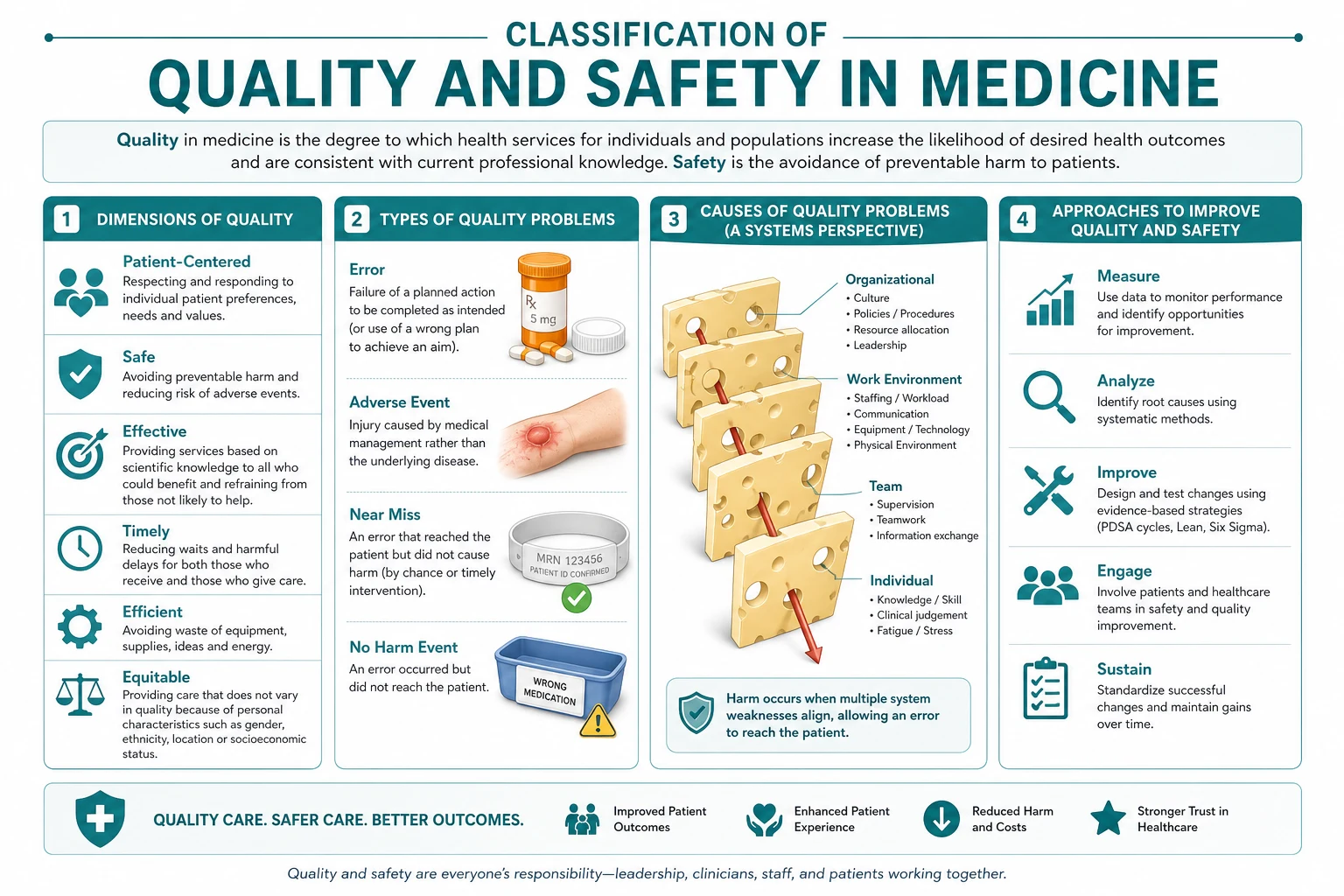
Classify by acuity, mechanism, severity and care setting. A useful classification changes investigation choice, initial therapy, disposition or specialist referral — otherwise it is taxonomy without purpose. [1] [2]
Pathophysiology linked to bedside decisions
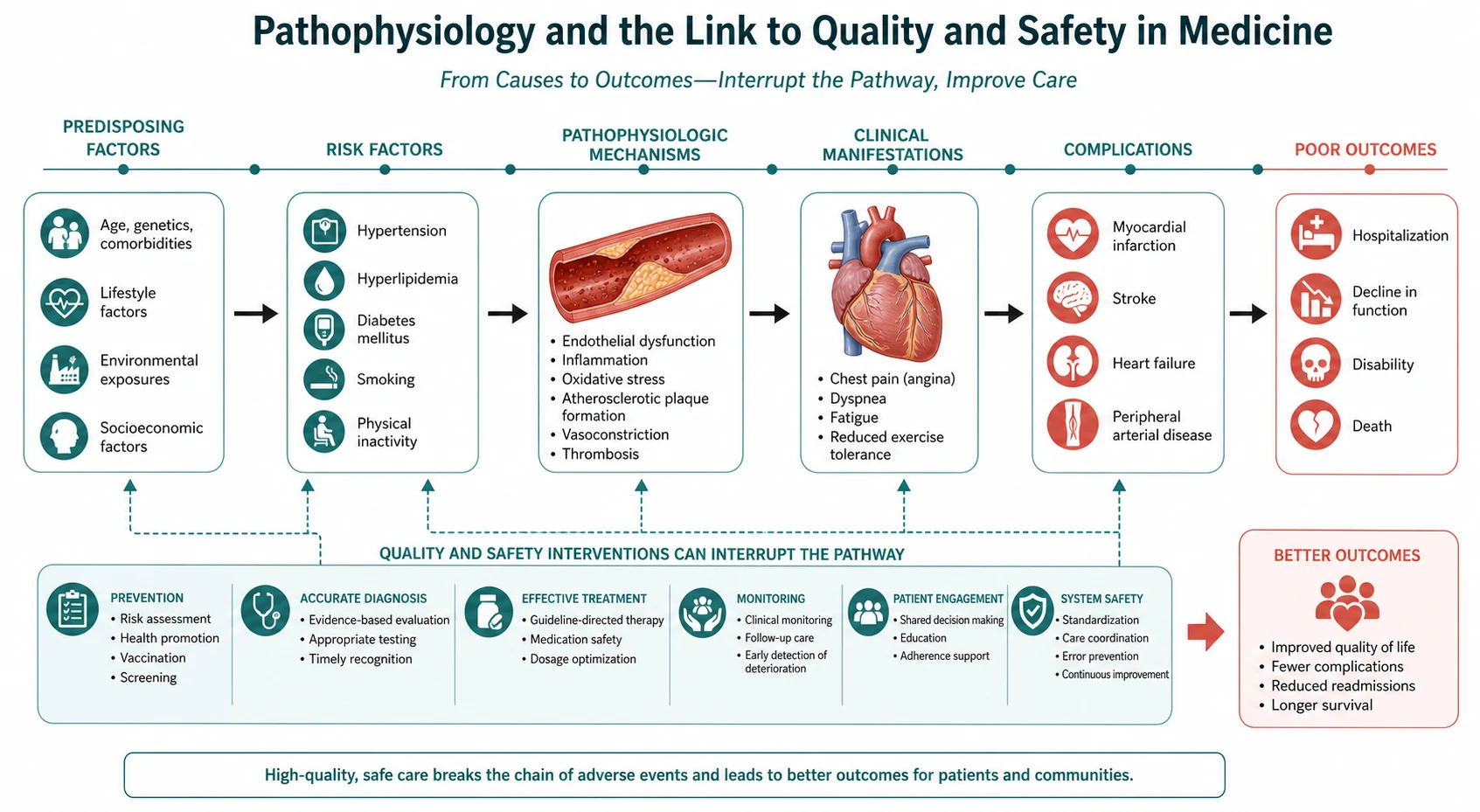
Mechanism matters when it predicts treatment response, complications or monitoring. Teach pathophysiology as a bridge to action, not as isolated basic science. [1] [2] [3]
Differentials and discrimination
Build a short differential that includes the common, the dangerous and the commonly missed. For each alternative, name one history clue, one examination clue and one investigation that discriminates. [1] [2]
Investigations
Order tests that change management. State what is required now, what can wait, and what is low-value or harmful. Interpret results in clinical context rather than in isolation. [1] [2]
Management — immediate then definitive
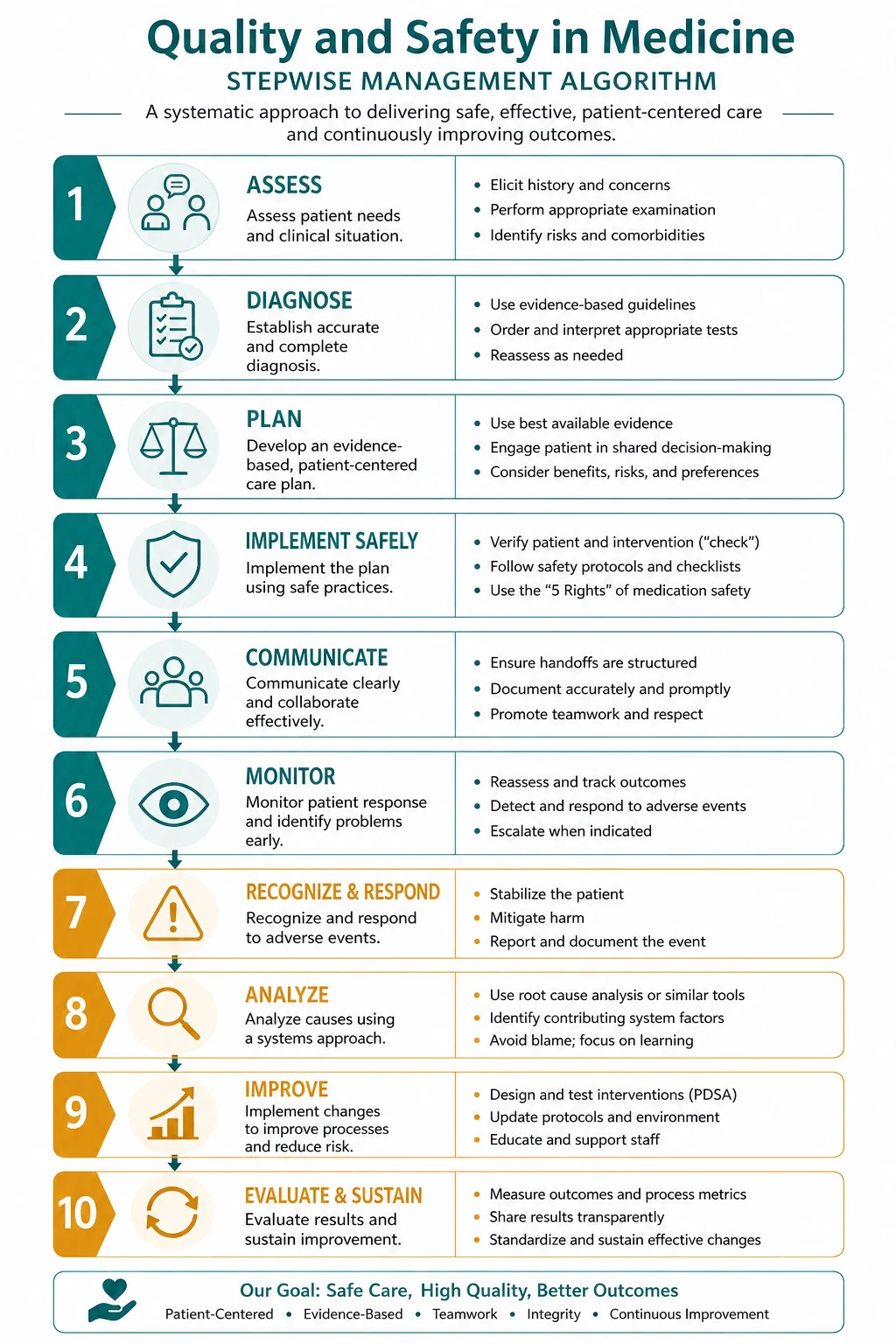
- Stabilise threats to life and organ function. [1]
- Start disease-specific therapy once the working diagnosis is secure enough to act. [1] [2]
- Address complications, drug interactions and monitoring. [1] [2]
- Plan disposition, follow-up intensity and patient education with safety-net advice. [1]
Complications and prognosis
Anticipate early and late complications. Prognosis depends on severity at presentation, speed of effective therapy, comorbidity and adherence to secondary prevention or disease-modifying treatment. [1] [2]
Special populations and multimorbidity
Adjust for pregnancy potential, frailty, CKD, liver disease, immunosuppression and polypharmacy. In older adults, goals-of-care and treatment burden can change the preferred plan even when disease-directed options remain available. [1] [2]
DCE long-case angles
Open with a one-sentence synthesis, then a prioritised problem list, then an integrated plan covering investigations, treatment, prevention and communication. Link Quality AND Safety IN Medicine to cardiovascular risk, infection risk, medications and social context where relevant. [1] [2]
DCE short-case angles
Be prepared to demonstrate or discuss focused examination findings, interpret a key investigation, and counsel on risks, benefits and follow-up in plain language. [1]
Exam traps
- Delaying urgent care because the presentation looks "stable enough". [1]
- Treating a syndrome label without confirming mechanism. [1] [2]
- Forgetting drug interactions and organ-function dosing. [1] [2]
- Omitting safety-net advice and follow-up ownership. [1]
- Quoting thresholds without knowing the source trial or guideline. [1] [2] [3]
References
- [1]Xi Y, Yao T, Zhang C, Zhuang T Effectiveness of safety care and clinical nursing pathway in patients undergoing cardiovascular intervention: a randomized controlled trial Perioper Med (Lond), 2026.PMID 42469924
- [2]Marks FJ, Walters SJ, Sutton L, Jacques RM What statistical methods are more appropriate for predicting recruitment at the design stage of a randomised controlled trial? Trials, 2026.PMID 42469922
- [3]Hajiaqaei M, Mohammadi A Transcranial random noise stimulation (tRNS) over the left dorsolateral prefrontal cortex ameliorates emotion dysregulation and executive function: a single-blind, randomized, sham-controlled clinical trial BMC Psychol, 2026.PMID 42469906
- [4]Li S, Gu J, Zhang Y, Li X, et al. Preanesthetic withdrawal improves the conversion efficacy of prolonged epidural labor analgesia to epidural surgical anesthesia: a prospective cohort study combined with MRI mechanistic exploration BMC Pregnancy Childbirth, 2026.PMID 42469679
- [5]Adhena BM, Chapman A, Fiolet R, Hutchinson AM Primary care providers' perspectives on barriers and enablers influencing preconception care provision for African migrant and refugee women: qualitative interviews Health Promot Int, 2026.PMID 42467458
- [6]Remien KA, Hardy C, Allen K, Wysong M, et al. Continuous Aerosolized Albuterol Treatment for Status Asthmaticus on the General Care Floor: A Quality Improvement Initiative Pediatr Qual Saf, 2026.PMID 42466158
- [7]Goldberg JB, Mehaffey JH, Paras ML, Vardas PN, et al. The Society of Thoracic Surgeons Expert Consensus Document on Tricuspid Valve Endocarditis in People Who Inject Drugs Ann Thorac Surg, 2026.PMID 42468870
- [8]Andratschke N, Willmann J, Ippolito E, Greco C, et al. ESTRO clinical practice guideline on high-dose thoracic reirradiation for non-small cell lung cancer Radiother Oncol, 2026.PMID 42468604
- [9]Martakis K, Abreu NJ, Baker JJ, Baker Ii PR, et al. Neurofilament light chain (NfL) as a surrogate outcome measure for GM2 gangliosidoses J Neurol, 2026.PMID 42467089
- [10]Yamamuro K, Ide K, Arai Y, Muraoka H, et al. Association Between Participant Satisfaction and Self-Reported Clinical Practice Behaviors in a Nationwide Guideline Education Program Neuropsychopharmacol Rep, 2026.PMID 42448624
- [11]Kim CJ, Waddell LM, Nemeth Z, Gross CP Prevalence of industry ties in the US cancer ecosystem: a systematic review and meta-analysis J Natl Cancer Inst, 2026.PMID 42448352
- [12]Van Ameringen M, Fineberg NA, Ravindran A, Arnold PD, et al. Canadian Network for Mood and Anxiety Treatments (CANMAT) and International College of Obsessive-Compulsive Spectrum Disorders (ICOCS) 2025 international guidelines for the management of patients with obsessive-compulsive disorder J Psychiatr Res, 2026.PMID 42441734