Psych · Addiction psychiatry
Anti-craving pharmacotherapy (naltrexone, acamprosate, disulfiram)
Also known as Relapse prevention medication alcohol · Naltrexone alcohol · Acamprosate · Disulfiram · COMBINE study · XR-NTX alcohol · Anti-craving drugs AUD
Exam-exhaustive fellowship topic on anti-craving pharmacotherapy for alcohol use disorder — naltrexone (oral and XR-NTX), acamprosate, and disulfiram with named doses, mechanisms, liver and renal constraints, hard contraindications, COMBINE trial interpretation, monitoring, psychosocial pairing, special populations, and multi-board guideline deltas. FRANZCP-primary, globally tagged.
On this page & tools
Your progress
Saved locally on this device.
Target exams
Red flags
Anti-craving pharmacotherapy is a high-yield leaf of the alcohol-use-disorder atlas. Examiners punish three failures: mixing detox drugs with relapse-prevention drugs, vague dosing without agent + dose + route + monitoring + contraindication, and cartoon readings of COMBINE.[1][5][9]
Overview and definition
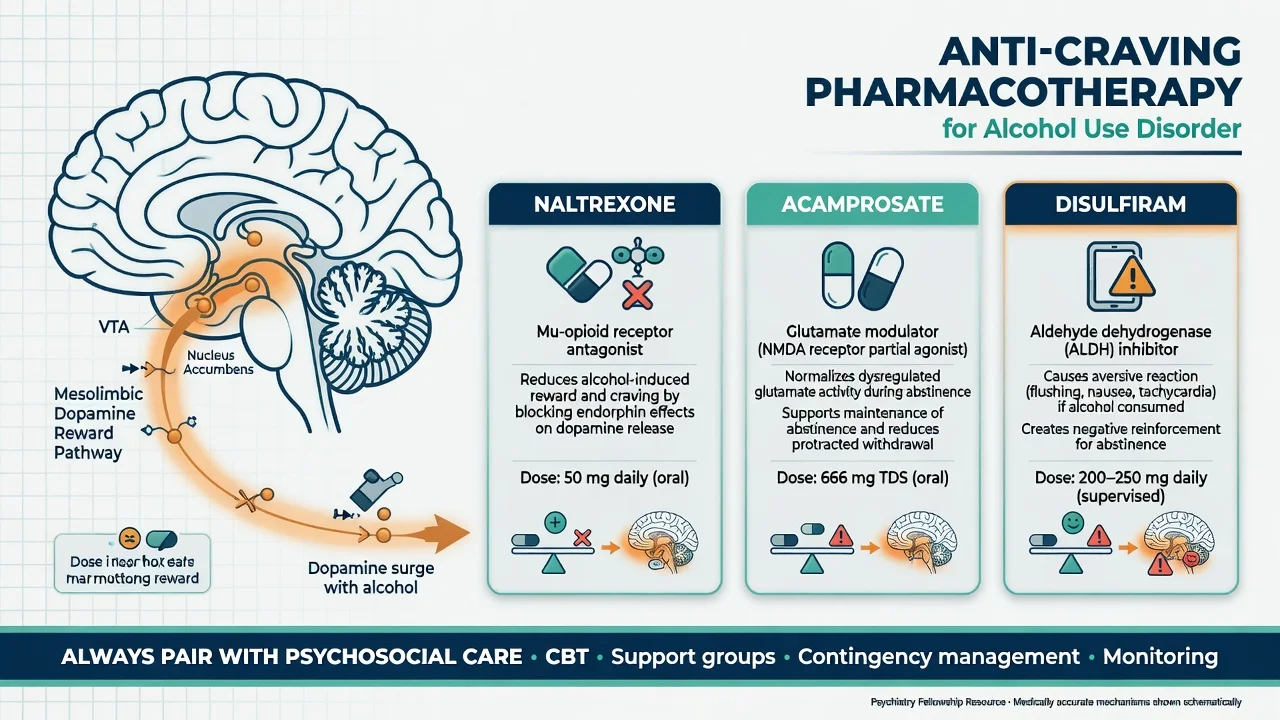
Anti-craving / relapse-prevention pharmacotherapy means medications that reduce return to heavy drinking, support continuous abstinence, or create an aversive contingency against drinking. They are not treatments for acute alcohol withdrawal, seizures, or delirium tremens — those use benzodiazepines guided by clinical severity (often CIWA-Ar) plus thiamine and medical support.[5][11][13][16]
The three agents every fellowship candidate must master for alcohol use disorder (AUD) are naltrexone (µ-opioid receptor antagonist), acamprosate (glutamate-system modulator supporting abstinence maintenance), and disulfiram (aldehyde dehydrogenase inhibitor creating an aversive reaction with alcohol).[3][5][8]
Classification — agents, goals, and endpoints
| Agent | Primary mechanism teaching | Typical goal framing | Standard adult dose (exam) | Hard gate |
|---|---|---|---|---|
| Naltrexone oral | µ-opioid antagonism → less alcohol reward | Reduce heavy-drinking days; also used in abstinence plans | 50 mg oral once daily (optional 25 mg test days) | Opioid-free; LFT caution |
| XR-NTX | Same receptor class, depot adherence | Adherence-limited patients | Monthly IM (product-specific) | Opioid-free; injection logistics |
| Acamprosate | Glutamate modulation post-detox | Maintain abstinence after detox | 666 mg TDS if renal function allows | eGFR / renal dose or avoid |
| Disulfiram | ALDH inhibition → acetaldehyde reaction | Supervised abstinence contingency | 200–250 mg oral daily supervised | Consent, cardiac risk, no impulsive drinking |
Trial endpoints matter for viva literacy: return to heavy drinking, percent heavy-drinking days, continuous abstinence, and time to first drink are not interchangeable. Meta-analyses suggest naltrexone often shines for heavy-drinking outcomes; acamprosate often for abstinence maintenance after detox — a useful Maisel-style phenotype/goal framing, not a rigid exclusivity rule.[3][4][6]
Off-label or regional options (baclofen, nalmefene, topiramate, gabapentin) appear in stems. State evidence uncertainty and local approval status; do not displace first-line teaching of naltrexone/acamprosate/disulfiram in ANZ fellowship answers without reason.[5][9][10]
Epidemiology and under-use
AUD is common and undertreated with medication despite substantial morbidity and mortality. Pharmacotherapy uptake remains low relative to need; candidates should frame under-prescribing as a systems and skills gap, not patient “motivation failure” alone.[9][10][15]
Priority candidates after detox: severe AUD, high craving or binge pattern, prior psychosocial-only failure, high medical risk from continued drinking, and patients who want a structured medication-supported recovery plan.[5][9][10]
Pathophysiology and mechanisms
Naltrexone
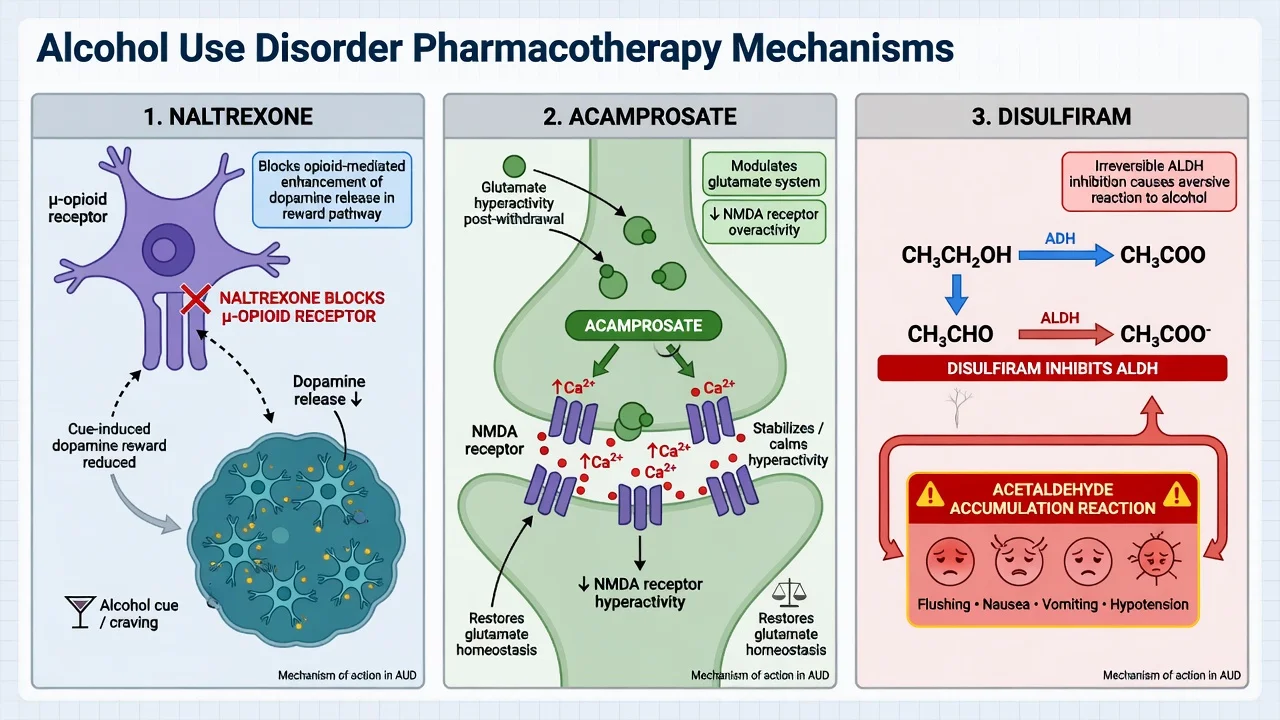
Alcohol activates endogenous opioid signalling that facilitates mesolimbic dopamine reward. Competitive µ-opioid receptor antagonism blunts that cascade, reducing the reinforcing “buzz” and cue-driven heavy drinking. Classic efficacy signal: Volpicelli 1992 oral naltrexone in alcohol dependence.[2][4]
Acamprosate
Chronic heavy drinking and withdrawal remodel excitatory/inhibitory balance. Acamprosate is taught as a glutamatergic modulator that dampens post-detox hyperexcitability and supports abstinence maintenance. It does not substitute for benzodiazepines in acute withdrawal.[4][6][11]
Disulfiram
Disulfiram inhibits aldehyde dehydrogenase. If ethanol is consumed, acetaldehyde accumulates → flushing, nausea, vomiting, tachycardia, and risk of hypotension and cardiovascular strain. This is an aversive contingency, not a craving-receptor blockade. Benefit concentrates in supervised programmes with informed, motivated patients.[8][5]
Why combination is not automatic
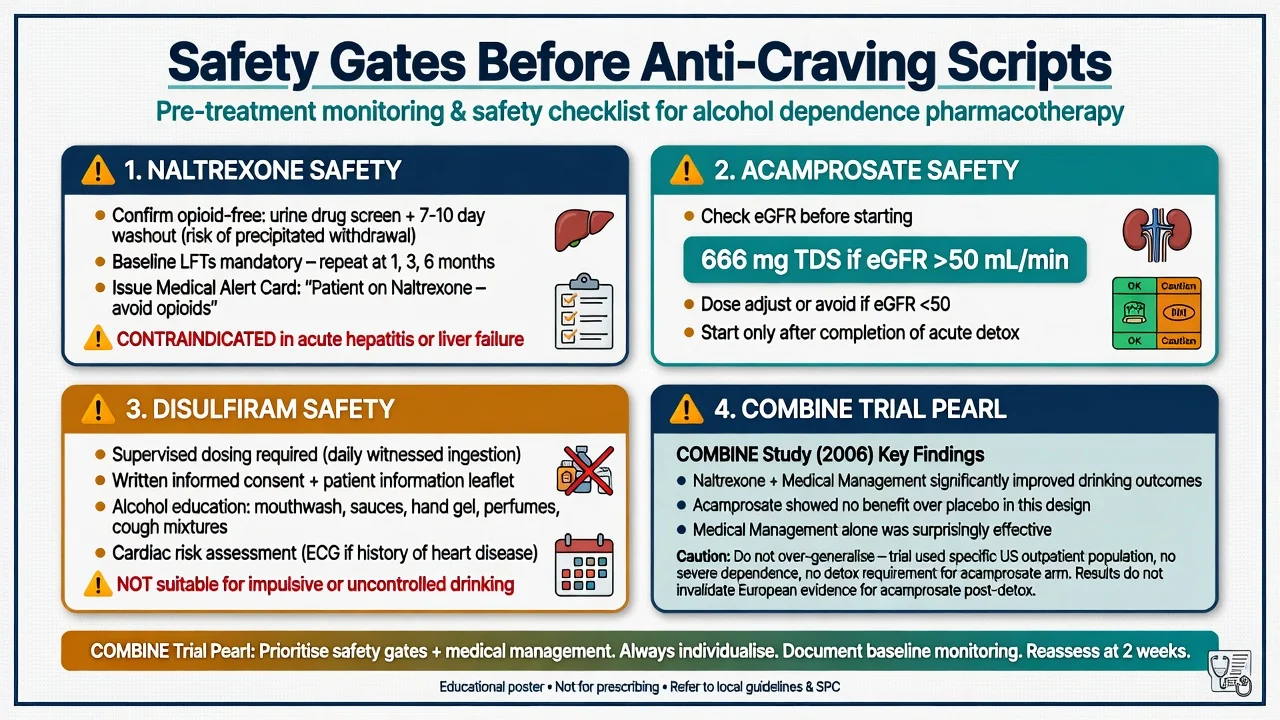
Naltrexone + acamprosate is pharmacologically plausible (reward + glutamate axes). COMBINE did not show a simple additive superiority story for the combination over best-performing arms in its primary analyses — quote design and results rather than inventing synergy.[1]
Clinical presentation and selection phenotype
Think in clinic stories, not product monographs alone — goal and phenotype should guide agent choice after safety gates.[4][5]
- Reward / binge / heavy-drinking days dominant → naltrexone often first teaching choice if opioid-free.[3][4][5]
- Post-detox abstinence goal, craving in early sobriety → acamprosate when kidneys allow.[4][6]
- Highly motivated, supervised, abstinence-only, no impulsive drinking → consider disulfiram.[5][8]
- Oral non-adherence → consider XR-NTX where available after opioid-free confirmation.[7]
History items that change the script: last opioid exposure (including OAT and codeine), planned surgery/analgesia, LFTs and known liver disease, eGFR, cardiac disease, pregnancy, suicide risk, alcohol-containing products in the home, and capacity for supervised dosing.[5][8][9]
Differential and common confusions
| Confusion | Discriminator |
|---|---|
| Anti-craving vs detox | Detox = benzos + medical care for withdrawal; anti-craving = post-acute relapse prevention |
| Naltrexone for AUD vs OUD | Same antagonist class; induction rules and clinical pathways differ — still opioid-free for start |
| Primary craving vs anxiety/PTSD/insomnia | Treat comorbidity drivers of relapse; medication alone will not fix untreated trauma nightmares |
| Disulfiram reaction vs anaphylaxis/panic | Temporal link to alcohol; flushing, nausea, tachycardia; supportive care pathway |
| Non-response vs non-adherence | Ask about missed doses, covert drinking, wrong goal match before “failed naltrexone” labels |
Assessment before prescribing
- Confirm AUD and treatment goals (abstinence vs reduction) with shared decision-making.[5][9][12]
- Substance map: alcohol quantity/frequency, other drugs, opioids, OAT, OTC opioids.[5][9]
- Medical: liver, renal, cardiac, pregnancy; prior drug reactions.[5]
- MSE and risk: suicide, violence, vulnerability, capacity (critical for disulfiram consent).[9][10]
- Supports: supervised dosing person, psychosocial plan, mutual aid willingness.[1][5][8]
- Screening scales (AUDIT etc.) support case-finding; they do not replace diagnosis or consent for medication.[12]
Investigations
| Test | Why | Agent focus |
|---|---|---|
| LFTs (baseline ± follow-up) | Hepatotoxicity caution; disease staging | Naltrexone; also general AUD care |
| eGFR / creatinine | Renal clearance | Acamprosate dose or avoid |
| Urine drug screen (selected) | Confirm opioid-free if history uncertain | Naltrexone |
| Beta-hCG | Pregnancy alters risk–benefit | All, especially disulfiram avoid |
| ECG / cardiac review (selected) | Cardiovascular risk of aversive reaction | Disulfiram candidates with cardiac risk |
| Optional biomarkers (PEth, EtG) | Monitoring adjuncts — not mandatory for every start | Programme-dependent |
Liver teaching for exams. Do not start naltrexone casually in acute hepatitis or decompensated liver failure; review product guidance and LFTs; many stable patients with mild LFT elevation still receive naltrexone under monitoring — the exam point is check and reason, not universal refusal for any GGT rise.[5][3][9]
Acute / emergency interfaces
- Disulfiram–alcohol reaction: ABCDE, oxygen, IV access, monitoring for hypotension/arrhythmia; supportive care; exclude alternative catastrophic diagnoses.[8]
- Naltrexone + acute severe pain: plan non-opioid analgesia; antagonist occupancy complicates standard opioid titration — coordinate acute pain/anaesthesia early; medical alert card is not optional education fluff.[5][7]
- Precipitated opioid withdrawal: if naltrexone is given too soon after opioids — supportive management; future start only after adequate opioid-free interval and reassessment.[5]
Definitive management — doses, monitoring, duration
Naltrexone (oral)
- Dose: typically naltrexone 50 mg orally once daily. Some clinicians start 25 mg for a few days if nausea risk is high, then increase to 50 mg.[2][3][5]
- Prerequisites: opioid-free (including methadone, buprenorphine, and many PRN opioids); counsel blocked analgesia; baseline LFTs and clinical liver review.[5][3]
- Common adverse effects: nausea, headache, fatigue, sleep disturbance; monitor mood and adherence.[3][5]
- Duration: often plan at least 3–6 months if beneficial/tolerated, then review continuation — chronic disease logic, not “one month and stop”.[5][9]
Long-acting injectable naltrexone (XR-NTX)
Monthly intramuscular XR-NTX improves adherence for selected patients after opioid-free confirmation. Landmark RCT evidence supports efficacy/tolerability in alcohol dependence (Garbutt 2005). Availability and funding vary by region — state the formulation and local access honestly.[7][5]
Acamprosate
- Dose (normal renal function): acamprosate 666 mg orally three times daily (two 333 mg tablets TDS is the classic teaching formulation).[3][5][6]
- Start timing: after detoxification when the goal is abstinence maintenance; not a withdrawal drug.[5][6]
- Renal: reduce dose or avoid in significant renal impairment per product information — always check eGFR before prescribing.[5][6]
- Adverse effects: diarrhoea and GI upset common; generally limited hepatic metabolism — useful when liver disease makes naltrexone less attractive, provided kidneys allow.[5][6][9]
Disulfiram
- Dose: commonly 200–250 mg orally once daily after a documented alcohol-free interval and education (regional product strengths differ; UK teaching often 200 mg, many US materials 250 mg).[5][8]
- Mandatory process: informed consent; supervised dosing whenever feasible; absolute alcohol education (drinks, some mouthwashes, sauces, hand gels); emergency advice if reaction occurs.[5][8]
- Contraindications / high-risk exclusions: significant cardiac disease, psychosis or cognitive states that impair informed aversive consent, pregnancy, likelihood of drinking through the reaction, inability to supervise.[5][8]
- Evidence is strongest when dosing is supervised; unsupervised use underperforms and is a classic pitfall.[8][3]
Psychosocial package (non-negotiable)
Medication is adjunctive. Pair with motivational enhancement / MI, CBT for alcohol, contingency management where available, twelve-step facilitation or mutual aid (AA, SMART Recovery), family support, and social work for housing/employment/legal needs. COMBINE’s medical management platform is itself a structured behavioural intervention — do not invent “pills alone” as best practice.[1][5][9][10]
Practical selection algorithm
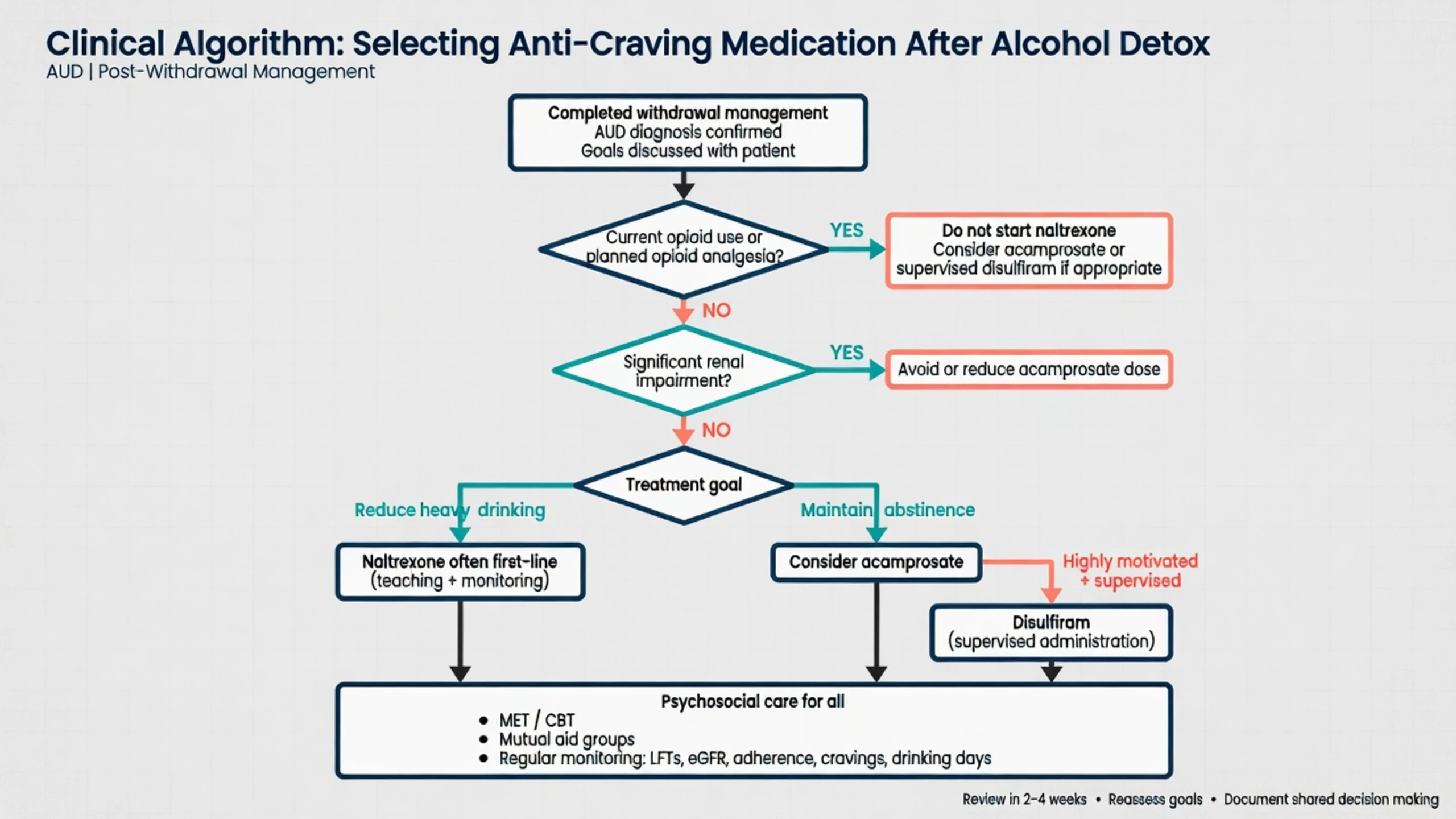
- Still withdrawing? → finish medical detox first.[11][14]
- Opioids on board or imminent? → do not start naltrexone; consider acamprosate or supervised disulfiram if otherwise suitable.[5]
- Significant renal impairment? → avoid or dose-adjust acamprosate.[5][6]
- Goal and supports? → heavy-drinking reduction often naltrexone; abstinence maintenance acamprosate; supervised abstinence disulfiram.[3][4][5]
- Always: psychosocial care + early review + monitoring plan.[1][5]
COMBINE trial — viva-safe interpretation
Subtypes and scenarios
Post-detox day 3–7 clinic
Stabilised after CIWA-Ar-guided detox, motivated for recovery medicines: choose agent by gates and goals; start psychosocial follow-up within days; safety-net early slips.[5][11][13]
Chronic pain on opioids
Cannot start naltrexone until opioids are safely ceased with an analgesia plan. Acamprosate or (if suitable) supervised disulfiram may be alternatives; coordinate pain and addiction services.[5][9]
Cirrhosis / elevated LFTs
Reassess naltrexone carefully; acamprosate may be preferred if renal function allows; avoid disulfiram in significant liver disease and high-risk medical states. Detox agent choice may already have shifted to lorazepam — separate topic, linked logic.[5][9]
Dual diagnosis
Depression, anxiety, PTSD, bipolar disorder, and psychosis commonly co-occur. Treat both streams; anti-craving remains indicated when AUD is active. Integrated care outperforms pure sequential silos in principle.[9][10]
Supervised workplace / forensic programmes
Disulfiram may appear in highly structured programmes with consent and monitoring — still not for impulsive high-risk drinkers without safeguards.[8]
Complications and pitfalls
- Opioid trap with naltrexone.[5]
- Treating withdrawal with anti-craving tablets alone.[11][16]
- Unsupervised disulfiram and covert alcohol exposure.[8]
- Ignoring renal dosing for acamprosate.[5][6]
- Over-dismissing acamprosate from COMBINE alone.[1][4][6]
- No psychosocial follow-up after the script.[1][5]
- Stopping effective medication after a single lapse without reformulating care intensity.[9][10]
Prognosis and disposition
Effect sizes for naltrexone and acamprosate versus placebo are moderate in meta-analyses; adherence and concurrent psychosocial care drive real-world outcomes. Relapse is common — frame as chronic disease management.[3][4][6][9]
Disposition template: start medication with written plan; review within 1–2 weeks for tolerability/adherence; continue structured addiction follow-up; step up to intensive outpatient or residential care if heavy drinking persists despite adherence.[5][9][10]
Special populations
Pregnancy. Alcohol is teratogenic; prioritise specialist obstetric–addiction care and psychosocial support. Avoid disulfiram. Naltrexone and acamprosate require extreme caution and specialist decision-making — do not recite casual outpatient starts.[5][9]
Older adults. Renal clearance (acamprosate), hepatic reserve (naltrexone), polypharmacy, falls, and cardiac risk (disulfiram) dominate selection.[5][9]
Adolescents. Limited trial base; psychosocial first-line emphasis; specialist prescribing only.[9][10]
OUD on agonist treatment. Naltrexone conflicts with methadone/buprenorphine. Integrate OAT planning; do not force antagonist starts onto active agonist therapy.[5]
Indigenous and culturally diverse communities. Access, stigma, supervised community models, and culturally safe engagement determine whether any pharmacotherapy is usable in practice.[9][10]
Evidence, guidelines, and regional deltas
Australian Guidelines for the Treatment of Alcohol Problems and local health-service protocols frame detox, then naltrexone/acamprosate/disulfiram literacy with psychosocial care. RANZCP addiction teaching expects dose-precise answers and COMBINE literacy, not brand marketing.[9][10]
Name these in viva: COMBINE (Anton 2006); Volpicelli naltrexone; Garbutt XR-NTX; Jonas outpatient meta-analysis; Maisel naltrexone/acamprosate meta-analysis; Rösner acamprosate Cochrane; Fuller on disulfiram’s supervised role; APA 2018 guideline.[1][2][3][4][5][6][7][8]
Exam pearls
- Naltrexone 50 mg daily oral; XR-NTX monthly; opioid-free + LFT caution.[2][5][7]
- Acamprosate 666 mg TDS; renal adjust; post-detox abstinence maintenance.[5][6]
- Disulfiram 200–250 mg supervised; ALDH aversive reaction; not for impulsive unsupervised drinkers.[5][8]
- COMBINE: naltrexone/medical management worked; acamprosate null in that design — do not over-generalise.[1]
- Anti-craving ≠ detox benzodiazepines.[11][16]
- Always name the psychosocial package with the prescription.[1][5]
- Hard stops: opioids → no naltrexone; severe renal failure → no/adjust acamprosate; cardiac/impulsivity/unsupervised → no disulfiram.[5][6][8]
Self-test: naltrexone on the ward
A 46-year-old completes alcohol detox. He wants “the craving tablet”. He is still on PRN oxycodone for rib fractures. LFTs mildy raised (GGT 90). What do you do?[5]
Answer. Do not start naltrexone while opioids remain on board — precipitated withdrawal and blocked analgesia risk. Complete opioid plan first (or choose non-naltrexone path). Consider acamprosate 666 mg TDS if eGFR normal and abstinence-oriented, or later naltrexone once opioid-free with LFT review. Pair with psychosocial care; mild LFT rise is a monitoring issue, not automatic exclusion without clinical liver failure context.[5][6][3]
References
- [1]Anton RF, O'Malley SS, Ciraulo DA, et al. Combined pharmacotherapies and behavioral interventions for alcohol dependence: the COMBINE study: a randomized controlled trial JAMA, 2006.PMID 16670409
- [2]Volpicelli JR, Alterman AI, Hayashida M, et al. Naltrexone in the treatment of alcohol dependence Arch Gen Psychiatry, 1992.PMID 1345133
- [3]Jonas DE, Amick HR, Feltner C, et al. Pharmacotherapy for adults with alcohol use disorders in outpatient settings: a systematic review and meta-analysis JAMA, 2014.PMID 24825644
- [4]Maisel NC, Blodgett JC, Wilbourne PL, et al. Meta-analysis of naltrexone and acamprosate for treating alcohol use disorders: when are these medications most helpful? Addiction, 2013.PMID 23075288
- [5]Reus VI, Fochtmann LJ, Bukstein O, et al. The American Psychiatric Association Practice Guideline for the Pharmacological Treatment of Patients With Alcohol Use Disorder Am J Psychiatry, 2018.PMID 29301420
- [6]Rösner S, Hackl-Herrwerth A, Leucht S, et al. Acamprosate for alcohol dependence Cochrane Database Syst Rev, 2010.PMID 20824837
- [7]Garbutt JC, Kranzler HR, O'Malley SS, et al. Efficacy and tolerability of long-acting injectable naltrexone for alcohol dependence: a randomized controlled trial JAMA, 2005.PMID 15811981
- [8]Fuller RK, Gordis E Does disulfiram have a role in alcoholism treatment today? Addiction, 2004.PMID 14678055
- [9]Connor JP, Haber PS, Hall WD Alcohol use disorders Lancet, 2016.PMID 26343838
- [10]Knox J, Hasin DS, Larson FRR, et al. Prevention, screening, and treatment for heavy drinking and alcohol use disorder Lancet Psychiatry, 2019.PMID 31630982
- [11]Mayo-Smith MF Pharmacological management of alcohol withdrawal. A meta-analysis and evidence-based practice guideline. American Society of Addiction Medicine Working Group on Pharmacological Management of Alcohol Withdrawal JAMA, 1997.PMID 9214531
- [12]Saunders JB, Aasland OG, Babor TF, et al. Development of the Alcohol Use Disorders Identification Test (AUDIT): WHO Collaborative Project on Early Detection of Persons with Harmful Alcohol Consumption--II Addiction, 1993.PMID 8329970
- [13]Sullivan JT, Sykora K, Schneiderman J, et al. Assessment of alcohol withdrawal: the revised clinical institute withdrawal assessment for alcohol scale (CIWA-Ar) Br J Addict, 1989.PMID 2597811
- [14]Daeppen JB, Gache P, Landry U, et al. Symptom-triggered vs fixed-schedule doses of benzodiazepine for alcohol withdrawal: a randomized treatment trial Arch Intern Med, 2002.PMID 12020181
- [15]Grant BF, Goldstein RB, Saha TD, et al. Epidemiology of DSM-5 Alcohol Use Disorder: Results From the National Epidemiologic Survey on Alcohol and Related Conditions III JAMA Psychiatry, 2015.PMID 26039070
- [16]Amato L, Minozzi S, Vecchi S, et al. Benzodiazepines for alcohol withdrawal Cochrane Database Syst Rev, 2010.PMID 20238336