Psych · Addiction psychiatry — perinatal substance use
Pregnancy, puerperium and substance use
Also known as Perinatal substance use · Substance use in pregnancy · Pregnancy and addiction · Opioid use disorder pregnancy · Neonatal abstinence syndrome · NOWS · Perinatal OAT · Alcohol in pregnancy · Stimulants in pregnancy
Exam-exhaustive fellowship reference on substance use across pregnancy and the puerperium — alcohol and FASD prevention, opioid agonist treatment and NAS/NOWS, stimulants, tobacco, benzodiazepines, universal non-punitive screening, integrated obstetric-addiction care, postpartum relapse and breastfeeding. FRANZCP-primary, globally tagged.
On this page & tools
Your progress
Saved locally on this device.
Target exams
Red flags
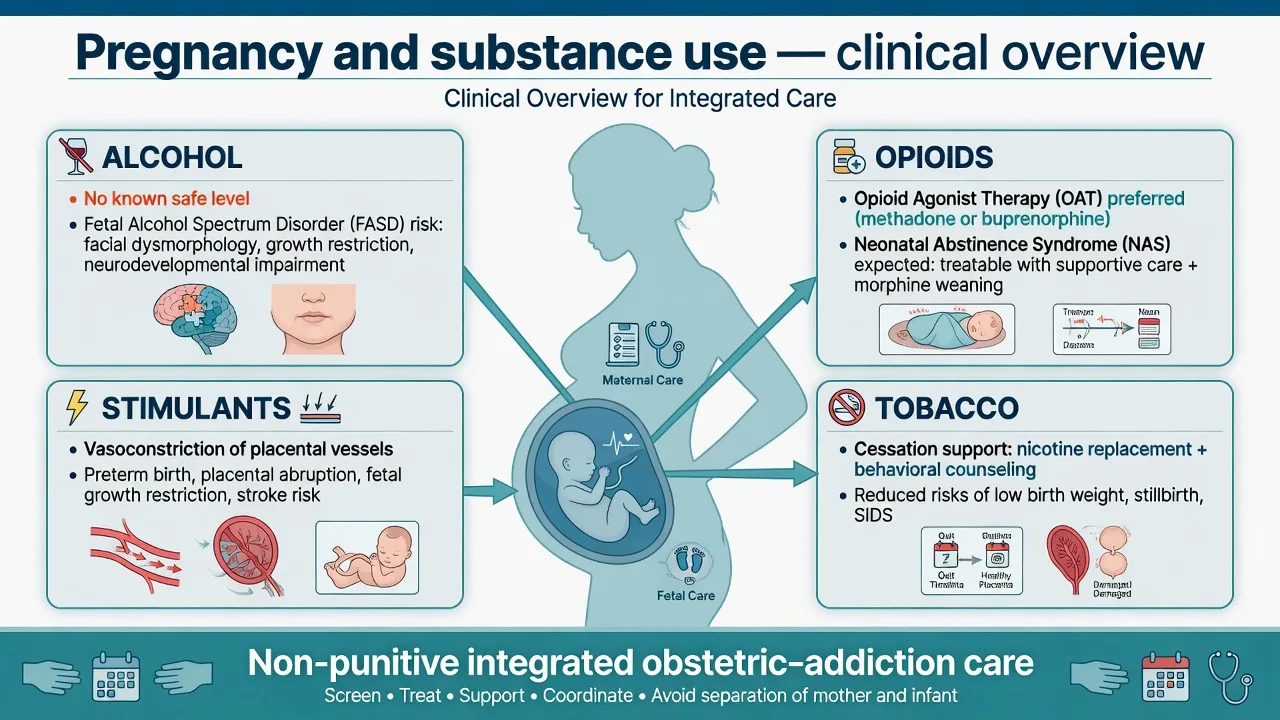
Pregnancy and the puerperium are high-yield addiction psychiatry interfaces across FRANZCP MEQs and CASCs, MRCPsych papers, ABPN items, and MD/DNB vivas. Examiners test substance-specific risk (alcohol versus opioids versus stimulants), opioid agonist treatment (OAT) decisions, neonatal abstinence (NAS/NOWS), and the ethics of non-punitive care — because criminalisation and urine-test “gotchas” drive people away from antenatal services and worsen outcomes.[5][6][11][12]
Overview and definition
Perinatal substance use disorder applies DSM-5-TR substance use disorder criteria (impaired control, social impairment, risky use, pharmacological criteria) across pregnancy and the postpartum year. ICD-11 frames harmful pattern of use and dependence. Physiological dependence (tolerance and withdrawal) is expected with sustained opioids or benzodiazepines and does not alone equal addiction when medicines are taken as prescribed — but pregnancy still requires obstetric–addiction planning.[6][7][11]
NAS / NOWS describes a postnatal withdrawal syndrome most often after in-utero opioid exposure (illicit or therapeutic OAT). FASD is a lifelong neurodevelopmental spectrum from prenatal alcohol exposure — a different construct from acute neonatal withdrawal.[8][9][10]
Classification and risk map by substance
Alcohol
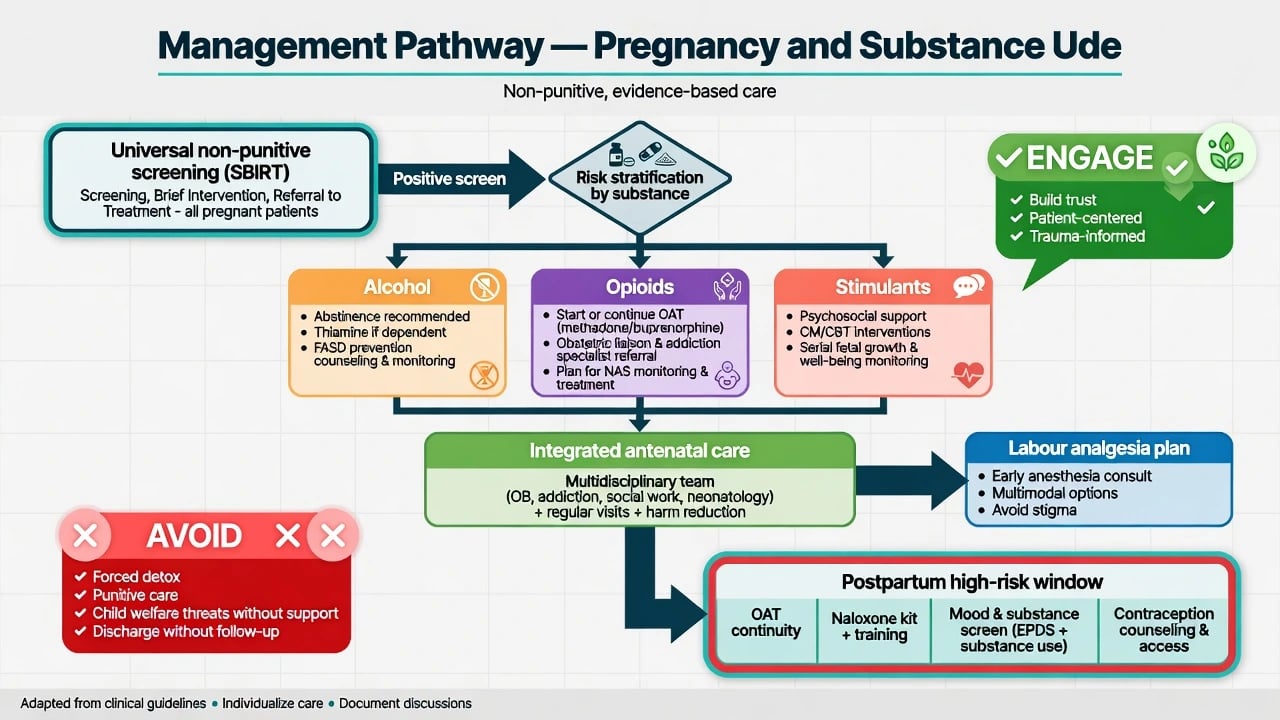
- Teratogen across gestation; no known safe level
- FASD prevention is primary goal
- Maternal withdrawal can seize — medical emergency
- Disulfiram generally avoided in pregnancy
Opioids
- OAT (methadone or buprenorphine) preferred over detox
- NAS/NOWS expected and treatable
- Overdose risk maternal and neonate observation needed
- ACOG/ASAM support maintenance treatment
Stimulants
- No standard agonist replacement therapy
- Vasoconstriction, IUGR, preterm, abruption risk
- Psychosocial care + obstetric surveillance
- Methamphetamine increasingly common in some cohorts
Tobacco / cannabis / benzos
- Smoking: behavioural support ± NRT individualised
- Cannabis: counsel developmental uncertainty; reduce/stop
- Benzodiazepines: minimise; plan neonatal hypotonia/withdrawal
- Polysubstance multiplies risk
Epidemiology and risk
Headline perinatal substance facts
Global alcohol use during pregnancy is common enough to drive substantial FAS burden; Popova and colleagues estimated about one in ten pregnancies with alcohol exposure in pooled analyses and quantified FAS prevalence estimates for planning prevention.[8] Maternal opioid-related diagnoses and NAS have increased substantially in high-income surveillance systems, with rising NICU resource use.[14][15][18] Methamphetamine has been a major reason for treatment admission among pregnant people in some US cohorts, reminding examiners that stimulant pathways are not rare edge cases.[16]
Risk clusters: trauma, intimate partner violence, co-occurring mental illness, social disadvantage, justice involvement, late booking, and partner substance use. Equity requires culturally safe care — especially for Indigenous families — without stereotyping communities as “the problem.”[5][11]
Pathophysiology
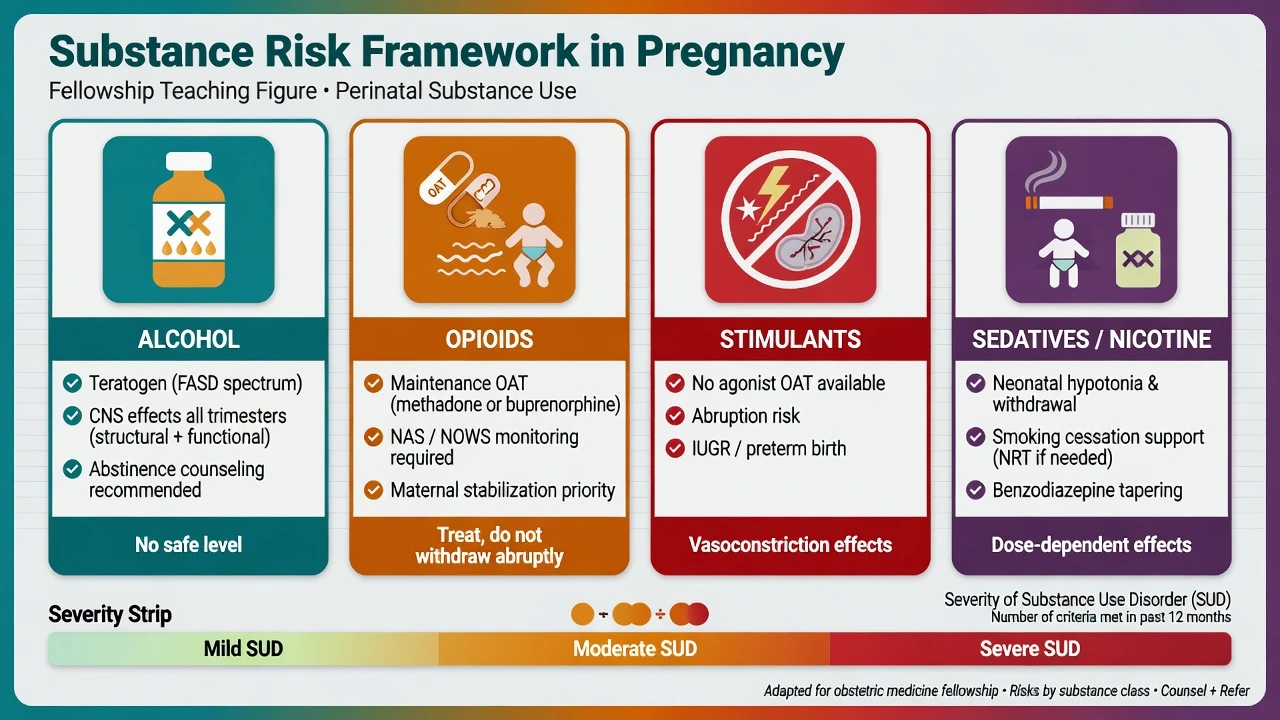
Ethanol is a teratogen; the central nervous system remains vulnerable throughout gestation, while classic facial features reflect early first-trimester effects. Opioids cross the placenta; chronic exposure produces fetal neuroadaptation so that abrupt postnatal absence of opioid tone yields NAS/NOWS. Maternal opioid withdrawal can increase fetal stress and obstetric complications — a mechanistic reason maintenance OAT is preferred to forced detox in dependent patients.[1][3][9][10]
Stimulants (cocaine, methamphetamine) cause maternal and placental vasoconstriction, with associations including low birth weight, preterm birth, and abruption risk clusters. Nicotine reduces oxygen delivery and is linked to growth restriction and sudden infant death risk pathways. Psychosocial mediators — stress, stigma, missed antenatal visits — amplify pharmacological harm.[9][11][17]
Clinical presentation
Antenatal. Intoxication or withdrawal at clinic or ED; inconsistent stories about last use; track marks; partner-related control; missed scans. Obstetric red flags. Preterm labour, IUGR, stillbirth risk clusters, abruption (especially stimulants/cocaine), poor engagement with care.[9][11]
Neonatal. NAS/NOWS: CNS hyperirritability (tremor, high-pitched cry, sleep disturbance), autonomic signs (sweating, sneezing, fever), gastrointestinal dysfunction (poor feeding, vomiting, diarrhoea). Onset timing depends on opioid half-life (earlier after short-acting heroin; later after methadone). Not every exposed neonate needs pharmacotherapy; many settle with supportive care (low stimulation, feeding support, rooming-in where safe).[10][14]
Postpartum. Sleep deprivation, mood disorders, bonding strain, and rapid return to previous networks create a high-relapse and overdose-risk window — especially if OAT access is lost after delivery.[5][7]
Differential diagnosis
Postpartum psychosis
- Acute onset delusions, confusion, risk to infant
- Emergency mother–baby unit pathway
- Not 'just drugs' even if UDS positive
- Treat both if dual diagnosis
Neonatal NAS mimics
- Sepsis, hypoglycaemia, hypocalcaemia
- Neurologic disease, hyperthyroidism
- SSRI poor neonatal adaptation overlap
- Score + investigate in parallel
Maternal seizures
- Alcohol withdrawal vs eclampsia
- Benzodiazepine withdrawal
- Stimulant toxicity / ICH
- Obstetric and toxicology dual work-up
Prescribed OAT
- Therapeutic dependence without illicit use
- Still plan for NAS observation
- Do not equate OAT with unfit parenting
- Document stability and engagement
Assessment
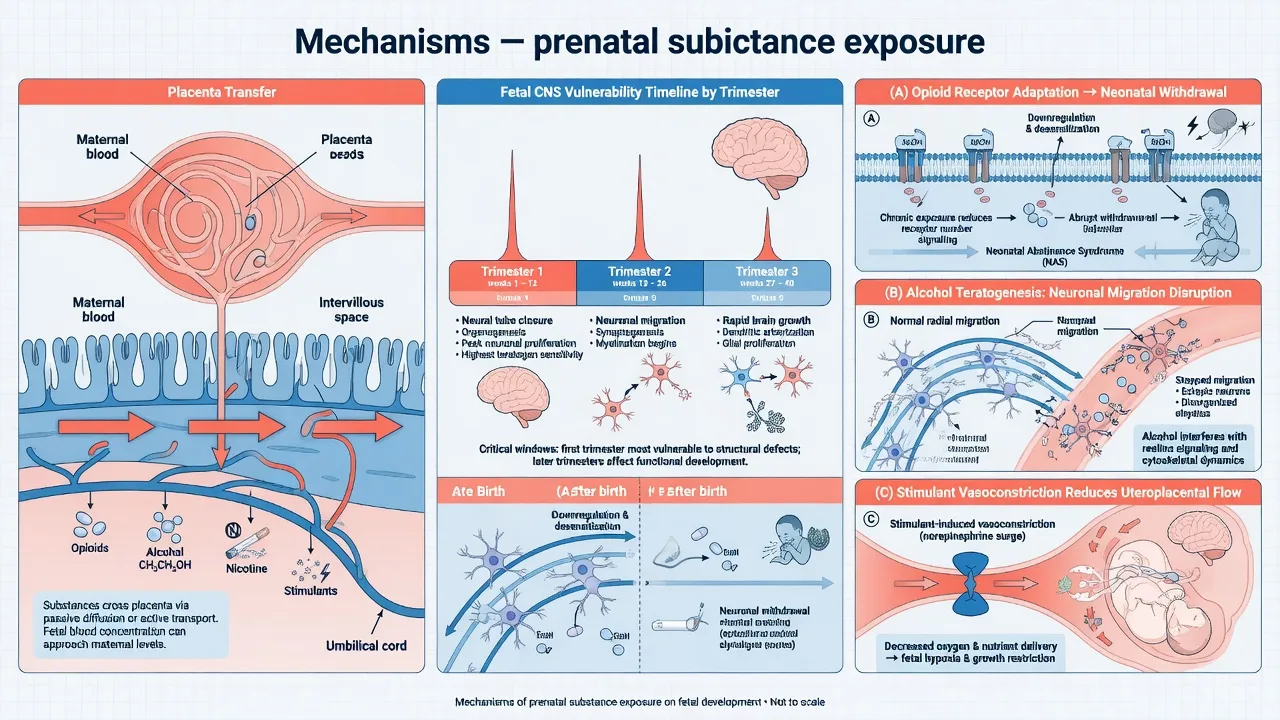
Universal verbal screening every trimester and postpartum is preferred to selective suspicion. SBIRT (screening, brief intervention, referral to treatment) is the systems frame for the perinatal period; validated tools (AUDIT-C, 4Ps Plus, NIDA Quick Screen and similar) support conversation, not prosecution.[12]
History inventory: substances (type, route, amount, last use), prior OAT doses and clinic, overdoses, injecting and BBV, alcohol and benzodiazepines, tobacco, mental health and suicide risk, IPV, housing, other children, contraception, and custody fears. MSE: insight, motivation, capacity for obstetric decisions, risk to self and infant. Be transparent about mandatory reporting thresholds without using child protection as a threat to force urine tests.[5][6][12]
Investigations
Baseline FBC, U&E, LFT; HIV, HBV, HCV; STI screen; dating and growth ultrasound as obstetric protocols dictate. ECG/QTc when methadone is used or interacting drugs are added. Toxicology (urine, meconium, umbilical cord) has limits — false positives/negatives, detection windows — and should be obtained with informed consent for a clinical purpose, not surveillance theatre. Neonatal observation and NAS scoring (Finnegan-type or MOTHER-modified tools) guide supportive versus pharmacologic care.[6][7][10]
Acute / emergency management
Alcohol withdrawal. Benzodiazepine symptom-triggered or fixed protocols with thiamine (e.g. parenteral thiamine before glucose when Wernicke risk is present; exact regimen is local protocol-based) and obstetric co-management; exclude eclampsia and other seizure causes.[11]
Stimulant crisis. Control severe hypertension and hyperthermia; continuous fetal monitoring as indicated; have a low threshold for abruption work-up with abdominal pain or bleeding. Agitation management is behavioural first; short-acting benzodiazepines when needed for severe agitation under monitoring.[9][11]
Labour analgesia. Do not withhold epidurals or multimodal analgesia because of SUD stigma. Patients on methadone or buprenorphine still need acute pain planning — continue OAT and add short-acting analgesics with specialist advice rather than stopping OAT “to simplify the chart.”[5][6][7]
Definitive management by substance
Alcohol
Counsel complete abstinence — there is no known safe threshold in pregnancy. For alcohol use disorder: psychosocial treatment, thiamine if dependent or malnourished, medically supervised withdrawal when indicated, and avoid disulfiram (teratogenic and risk of severe reaction if alcohol is used). FASD prevention is a public-health as well as clinical duty.[8][9][11]
Opioids — OAT first-line
For opioid use disorder, methadone or buprenorphine maintenance is preferred to detoxification because withdrawal risks obstetric complications and return to unregulated use is more dangerous than managed NAS.[3][5][6][7]
Methadone. Full µ-agonist OAT. Start low and go slow under specialist opioid-treatment protocols (many services use day-1 ranges on the order of 10–30 mg oral for tolerant adults, with careful early review; maintenance commonly settles near 60–120 mg daily, sometimes higher). Pregnancy may increase clearance — dose increases and split dosing in later pregnancy are common specialist manoeuvres. Monitor sedation, interactions, and QTc as indicated.[3][6][7]
Buprenorphine. Partial agonist; induct when the patient is in adequate withdrawal to avoid precipitated withdrawal (COWS-guided, as in general OUD care). Maintenance commonly 8–24 mg sublingual daily (local ceilings vary). The MOTHER randomised trial found neonates exposed to buprenorphine required less morphine for NAS and had shorter hospital stays than methadone-exposed neonates, with important maternal retention nuances favouring individualised choice.[1][3] A large observational cohort (Suarez et al.) similarly associated buprenorphine with lower risks of NAS, preterm birth, and low birth weight versus methadone, with similar maternal complication rates — still not a mandate to switch stable methadone patients without shared decision-making.[2][4]
Cochrane synthesis supports maintenance agonist treatments for opiate-dependent pregnant women; methadone and buprenorphine may be broadly similar in efficacy/safety at the evidence-synthesis level with neonatal outcome nuances as above.[3]
Naltrexone is generally not first-line in pregnancy for OUD; detox required for induction raises obstetric and relapse risks. Discuss only in highly selected cases with specialist perinatal addiction input.[6][7]
Stimulants
No approved agonist OAT analogous to methadone/buprenorphine. Priorities: motivational interviewing, contingency management and CBT where available, residential options for selected patients, treatment of co-occurring psychosis or severe mood disorder, and intensified obstetric surveillance for growth and placental complications. IDEAL-study-era data inform neonatal neurobehavioural findings after methamphetamine exposure without justifying fatalism or automatic permanent child removal.[11][16][17]
Tobacco, cannabis, benzodiazepines
Smoking cessation is high-yield for birth weight and infant health. Behavioural counselling is foundational; pharmacological options (NRT) increase late-pregnancy cessation rates in meta-analysis and may be considered when behavioural care alone fails — individualise risk–benefit.[13] Cannabis: counsel developmental uncertainty and recommend cessation or strong reduction. Benzodiazepines: avoid initiation when possible; if dependent, taper slowly rather than abrupt stop; plan for neonatal hypotonia and withdrawal observation.[9][10][11]
Psychosocial and systems care
Integrated obstetric–addiction–mental health models, trauma-informed practice, peer support, housing, and contraception access outperform fragmented “refer somewhere else” pathways. Harm reduction (take-home naloxone, BBV treatment, needle-syringe programs where relevant) coexists with recovery goals.[5][7][12]
Australian and New Zealand practice emphasises regulated opioid treatment programs in pregnancy, maternity–addiction liaison, and child-protection frameworks that prefer support and safety planning over automatic removal. RANZCP training expects competence in perinatal dual diagnosis, cultural safety for Aboriginal and Torres Strait Islander and Māori families, and FASD prevention messaging aligned with no-safe-level alcohol advice.[5][8]
Subtypes and scenarios
Unplanned pregnancy on OAT. Continue OAT; re-consent for pregnancy-specific monitoring; do not stop abruptly.[6][7]
Polysubstance use. Stabilise life-threatening withdrawal (alcohol, benzodiazepines, opioids) first; address stimulants with psychosocial intensity; never ignore sedative co-use when planning OAT (overdose risk).[7][11]
Incarceration. Continuity of OAT, anti-shackling ethics in labour, and post-release overdose prevention are mandatory discussion points.[5][7]
Breastfeeding. For stable patients on methadone or buprenorphine without ongoing illicit use, breastfeeding is often encouraged and may reduce NAS severity — individualise with neonatal team. Active heavy alcohol use, illicit stimulant use, or unstable polysubstance use usually contraindicates breastfeeding until stabilised; nicotine exposure via breastmilk and second-hand smoke still warrant cessation support.[5][6][10]
Complications and pitfalls
Other pitfalls: forced detox “for the baby”; punitive UDS driving care avoidance; withholding labour analgesia; abrupt postpartum OAT loss; missing IPV and postpartum mood/psychosis under a substance label; equating any cannabis-positive meconium with permanent removal without formulation.[5][6][12]
Prognosis and disposition
Engagement in prenatal care and retention in OAT are key modifiable predictors of maternal and neonatal outcomes. Disposition spans integrated antenatal-addiction clinics, mother–baby units when psychiatric risk is high, community OAT, and collaborative child-protection plans that prefer support. Before discharge, document: OAT appointment, take-home naloxone, contraception offer, mood/psychosis safety net, and early postpartum review — the postpartum year is when many people disengage and overdose risk rises.[5][7][18]
Special populations
Adolescents need capacity-appropriate consent and family work. People with severe mental illness need true dual-diagnosis integration. Mothers with intellectual disability or FASD themselves need adapted parenting support, not automatic assumption of incapacity. Cultural safety is non-negotiable in FRANZCP practice.[5][8][11]
Evidence and guidelines
Name at viva: Jones MOTHER (NAS methadone vs buprenorphine); Suarez 2022 cohort; Minozzi Cochrane agonists in pregnancy; Zedler systematic review; Klaman guidance synthesis; ACOG CO 711; ASAM 2020 NPG; Popova alcohol/FAS global estimates; Behnke AAP prenatal exposure; Hudak AAP neonatal withdrawal; Forray review; Wright SBIRT; Coleman smoking pharmacotherapy; Tolia/Patrick/Hirai NAS epidemiology; Terplan methamphetamine treatment trends; IDEAL neurobehavioural findings.[1][2][3][4][5][6][7][8][9][10][12][14][18]
Exam pearls
PREGNANT
Self-test: management under pressure
Alcohol: abstinence counselling; thiamine if dependent; medical withdrawal as needed; no disulfiram default. Opioids: continue/start methadone or buprenorphine under protocol (methadone often day-1 10–30 mg range with slow titration; buprenorphine after adequate withdrawal, maintenance often 8–24 mg SL). Naloxone for overdose titrated to breathing. Stimulants: MI/CM/CBT + fetal monitoring; no agonist OAT. Tobacco: behavioural ± NRT. Postpartum: keep OAT, give naloxone kit, screen mood/psychosis, offer contraception, early review.[1][3][6][7][13]
References
- [1]Jones HE, Kaltenbach K, Heil SH, et al. Neonatal abstinence syndrome after methadone or buprenorphine exposure N Engl J Med, 2010.PMID 21142534
- [2]Suarez EA, Huybrechts KF, Straub L, et al. Buprenorphine versus Methadone for Opioid Use Disorder in Pregnancy N Engl J Med, 2022.PMID 36449419
- [3]Minozzi S, Amato L, Jahanfar S, et al. Maintenance agonist treatments for opiate-dependent pregnant women Cochrane Database Syst Rev, 2020.PMID 33165953
- [4]Zedler BK, Mann AL, Kim MM, et al. Buprenorphine compared with methadone to treat pregnant women with opioid use disorder: a systematic review and meta-analysis of safety in the mother, fetus and child Addiction, 2016.PMID 27223595
- [5]Klaman SL, Isaacs K, Leopold A, et al. Treating Women Who Are Pregnant and Parenting for Opioid Use Disorder and the Concurrent Care of Their Infants and Children: Literature Review to Support National Guidance J Addict Med, 2017.PMID 28406856
- [6]American College of Obstetricians and Gynecologists Committee Opinion No. 711 Summary: Opioid Use and Opioid Use Disorder in Pregnancy Obstet Gynecol, 2017.PMID 28742670
- [7]American Society of Addiction Medicine The ASAM National Practice Guideline for the Treatment of Opioid Use Disorder: 2020 Focused Update J Addict Med, 2020.PMID 32511106
- [8]Popova S, Lange S, Probst C, Gmel G, Rehm J Estimation of national, regional, and global prevalence of alcohol use during pregnancy and fetal alcohol syndrome: a systematic review and meta-analysis Lancet Glob Health, 2017.PMID 28089487
- [9]Behnke M, Smith VC; Committee on Substance Abuse; Committee on Fetus and Newborn Prenatal substance abuse: short- and long-term effects on the exposed fetus Pediatrics, 2013.PMID 23439891
- [10]Hudak ML, Tan RC; Committee on Drugs; Committee on Fetus and Newborn Neonatal drug withdrawal Pediatrics, 2012.PMID 22291123
- [11]Forray A Substance use during pregnancy F1000Res, 2016.PMID 27239283
- [12]Wright TE, Terplan M, Ondersma SJ, et al. The role of screening, brief intervention, and referral to treatment in the perinatal period Am J Obstet Gynecol, 2016.PMID 27373599
- [13]Coleman T, Chamberlain C, Davey MA, Cooper SE, Leonardi-Bee J Pharmacological interventions for promoting smoking cessation during pregnancy Cochrane Database Syst Rev, 2015.PMID 26690977
- [14]Tolia VN, Patrick SW, Bennett MM, et al. Increasing incidence of the neonatal abstinence syndrome in U.S. neonatal ICUs N Engl J Med, 2015.PMID 25913111
- [15]Patrick SW, Davis MM, Lehmann CU, Cooper WO Increasing incidence and geographic distribution of neonatal abstinence syndrome: United States 2009 to 2012 J Perinatol, 2015.PMID 25927272
- [16]Terplan M, Smith EJ, Kozloski MJ, Pollack HA Methamphetamine use among pregnant women Obstet Gynecol, 2009.PMID 19461424
- [17]Kiblawi ZN, Smith LM, Diaz SD, et al. Prenatal methamphetamine exposure and neonatal and infant neurobehavioral outcome: results from the IDEAL study Subst Abus, 2014.PMID 24588296
- [18]Hirai AH, Ko JY, Owens PL, Stocks C, Patrick SW Neonatal Abstinence Syndrome and Maternal Opioid-Related Diagnoses in the US, 2010-2017 JAMA, 2021.PMID 33433576