Psych · Child and adolescent psychiatry — attachment disorders
Attachment disorders in children
Also known as Reactive attachment disorder · RAD · Disinhibited social engagement disorder · DSED · Indiscriminate friendliness · Attachment disorder · Emotionally withdrawn attachment disorder · Disinhibited attachment disorder
Exam-exhaustive fellowship reference on childhood attachment disorders — DSM-5-TR/ICD-11 RAD versus DSED, extremes of insufficient care, BEIP and ERA evidence, differential from ASD and ADHD, AACAP caregiving-first management, and explicit rejection of coercive attachment therapies. FRANZCP-primary, globally tagged.
On this page & tools
Your progress
Saved locally on this device.
10 MCQs with explanations
Target exams
Red flags
Attachment disorders are high-yield across FRANZCP CAP, MRCPsych, ABPN and MD/DNB because examiners test three discriminations: disorder versus insecure attachment style, RAD versus DSED, and attachment disorder versus ASD/ADHD. They also test whether you will protect the child, support carers, and refuse harmful "attachment therapies." This topic is written so a candidate who has read nothing else can defend those points at consultant depth.[1][4][7]
Overview and definition
Clinical attachment disorders describe a failure to develop or use preferential, selective attachment relationships after severe social neglect or deprivation, not ordinary parenting strain or garden-variety insecurity. In modern nosology, two phenotypes are separated: an inhibited, emotionally withdrawn pattern (RAD) and a disinhibited social engagement pattern (DSED).[1][3]
Formulation first. Criteria open the gate; formulation explains the caregiving ecology (institutional care, serial placements, extreme neglect), current carer capacity, developmental comorbidities, and child-protection status. Attachment theory language (secure base, internal working models) informs understanding but does not by itself make a DSM/ICD attachment disorder diagnosis.[1][10][11]
Classification: RAD versus DSED
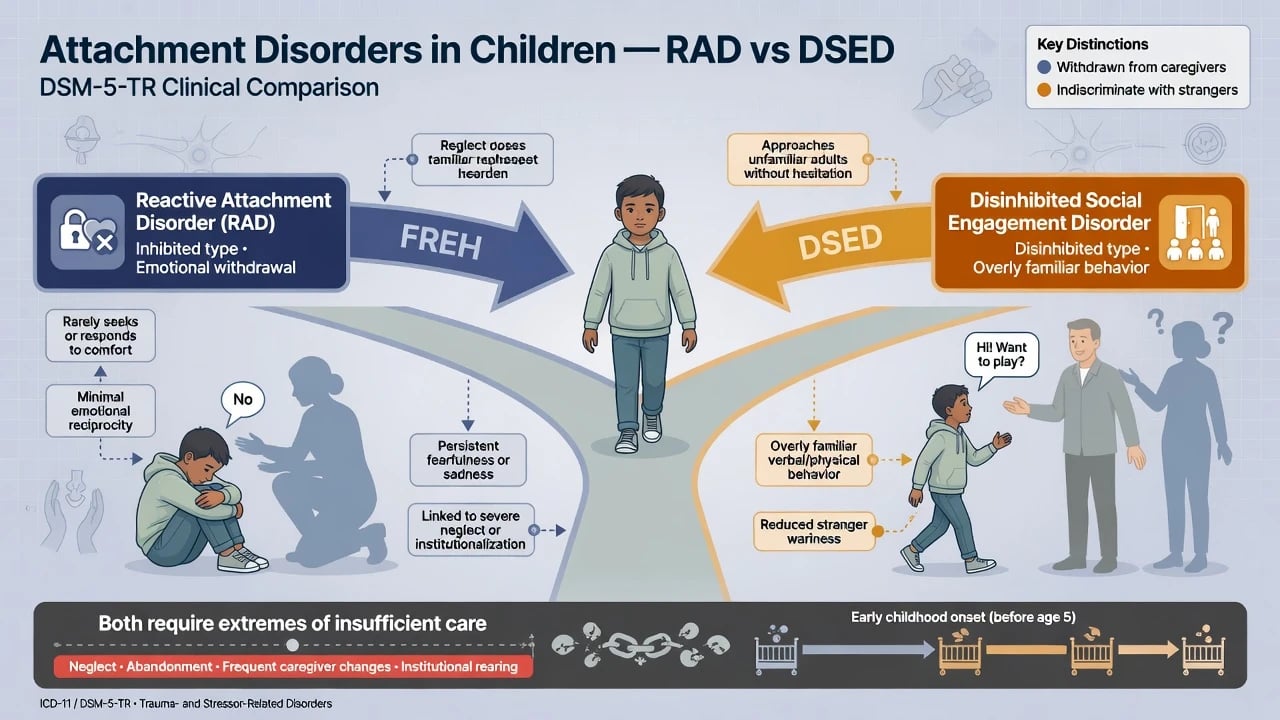
DSM-5-TR — RAD (exam skeleton)
A consistent pattern of inhibited, emotionally withdrawn behaviour toward adult caregivers, manifested by both minimal comfort-seeking when distressed and minimal response to comfort when distressed. Persistent social and emotional disturbance includes at least two of: minimal social and emotional responsiveness to others; limited positive affect; episodes of unexplained irritability, sadness or fearfulness that are evident even during nonthreatening interactions with adult caregivers. The child has experienced a pattern of extremes of insufficient care (social neglect/deprivation; repeated changes of primary caregivers; or rearing in unusual settings that severely limit opportunities to form selective attachments) presumed responsible for the disturbance. Criteria are not met for autism spectrum disorder. Disturbance is evident before age 5 years, and the child has a developmental age of at least 9 months. Specifiers may note persistent course and severity when used.[1][3]
DSM-5-TR — DSED (exam skeleton)
A pattern of behaviour in which a child actively approaches and interacts with unfamiliar adults, with at least two of: reduced or absent reticence in approaching/interacting with unfamiliar adults; overly familiar verbal or physical behaviour (not culturally sanctioned and inappropriate); diminished or absent checking back with adult caregiver after venturing away, even in unfamiliar settings; willingness to go off with an unfamiliar adult with minimal or no hesitation. Behaviours are not limited to impulsivity (as in ADHD) but include socially disinhibited behaviour. The child has experienced extremes of insufficient care as above, presumed responsible. Developmental age at least 9 months. Specifiers for persistent course and current severity may apply.[1][3][12]
ICD-11. Reactive attachment disorder and disinhibited social engagement disorder remain related categories with the same clinical logic: rare disorders after severe early adversity of caregiving, not synonyms for insecure style. State which manual you apply when thresholds are examined.[1]
Historical note. Older DSM-IV language framed inhibited and disinhibited types under a single RAD heading. DSM-5/DSM-5-TR and contemporary AACAP teaching treat them as separate disorders that share aetiology but differ in presentation and course — a classic exam trap if a stem uses outdated single-disorder wording.[1][2][3]
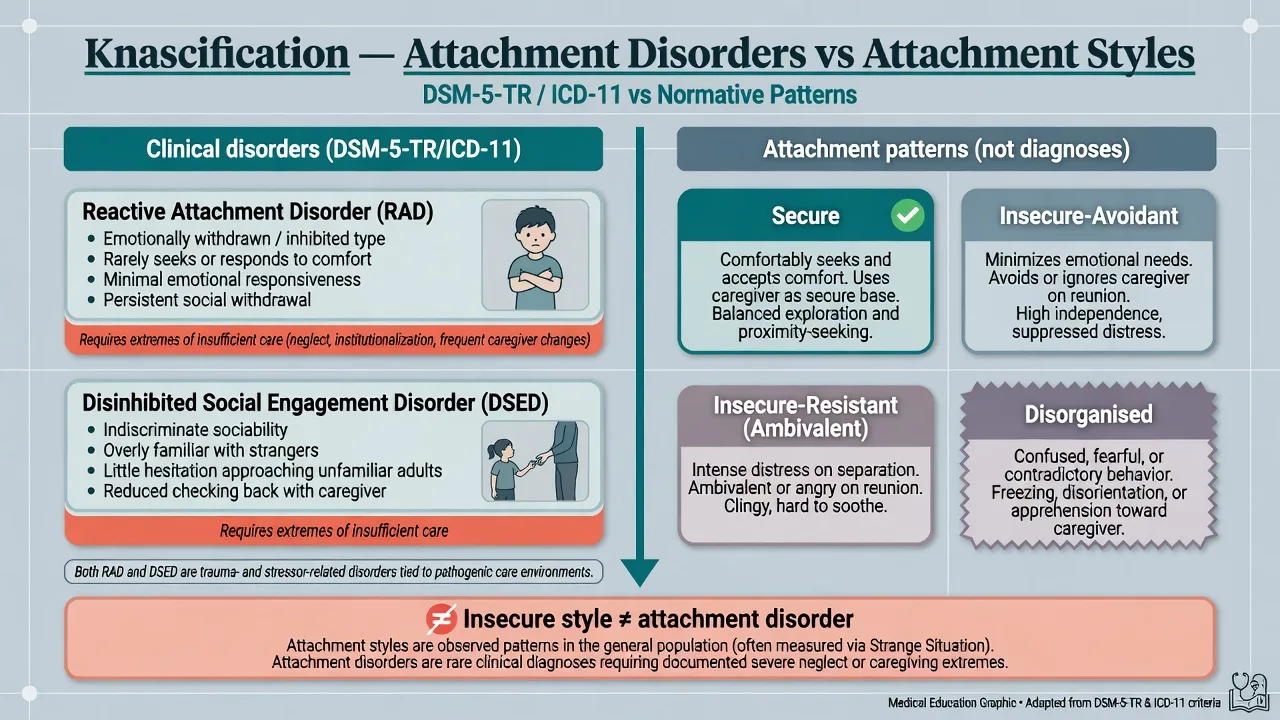
RAD
- Emotionally withdrawn/inhibited
- Does not seek or accept comfort
- Limited positive affect with caregivers
- Often improves with good care
DSED
- Overly familiar with strangers
- Little checking back / wariness
- May leave with unfamiliar adults
- Often more persistent after care improves
Insecure style
- Avoidant/resistant patterns
- Common dimensional variation
- Not a clinical disorder alone
- No insufficient-care requirement
Disorganised pattern
- Contradictory strategies under stress
- Linked to frightened/frightening care
- Research classification (SSP)
- Not automatically RAD/DSED
Epidemiology and risk
Numbers and patterns candidates should own
RAD and DSED are uncommon in general population samples and become clinically important in children with histories of institutional rearing, chronic severe neglect, or highly unstable caregiving. The English and Romanian Adoptees (ERA) programme showed that profound early institutional privation produces heterogeneous outcomes — including attachment disorder behaviours — rather than a single uniform syndrome.[7][8]
The Bucharest Early Intervention Project (BEIP) randomised institutionalised young children to high-quality foster care versus care as usual and demonstrated causal benefits of earlier psychosocial enrichment for cognition and attachment-related recovery pathways — foundational exam evidence that environment is the treatment target.[5][6][16]
Middle-childhood data in UK adopted samples support validity of disinhibited attachment disorder concepts beyond preschool years, with developmental origins linked to early adversity rather than current adoptive parenting failure alone.[15]
Pathophysiology and developmental mechanisms
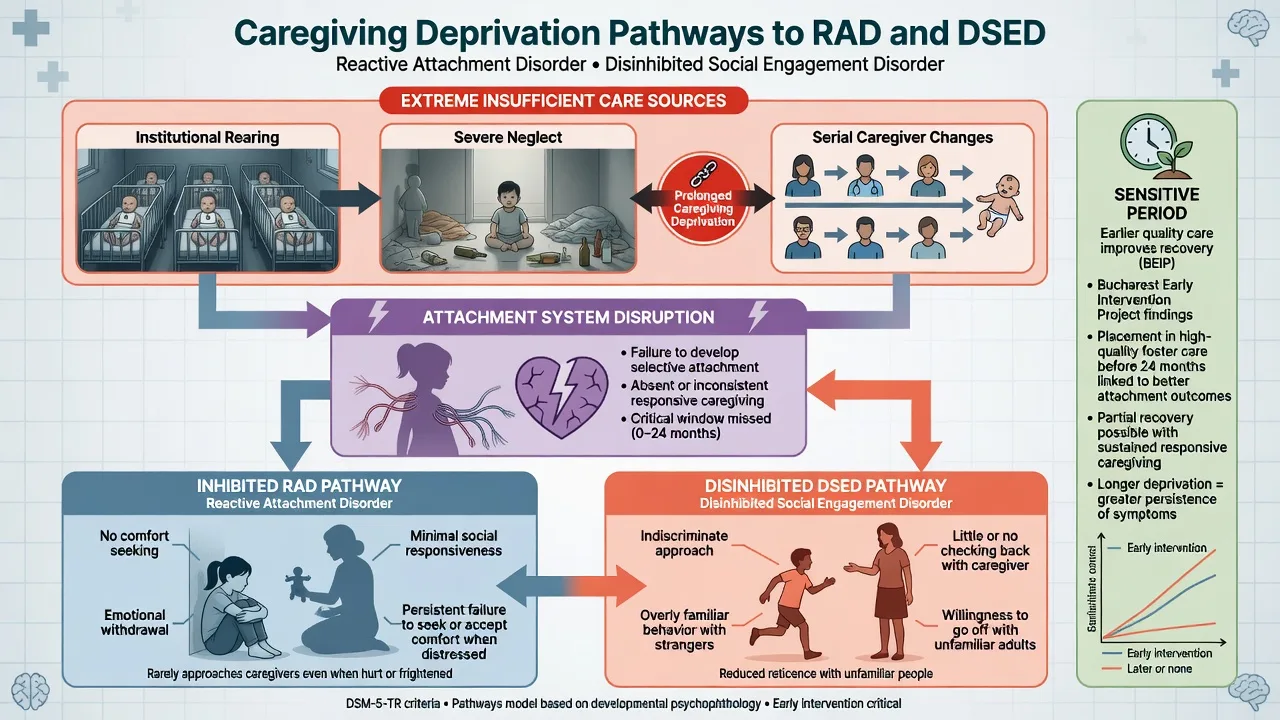
Attachment is a species-typical biobehavioural system organising proximity-seeking under threat and use of a caregiver as a secure base. Under extremes of insufficient care, children may fail to organise selective attachment (RAD) or may show indiscriminate social approach without appropriate reticence (DSED/indiscriminate friendliness).[1][9][10]
Institutional care research shows indiscriminate behaviour is strongly associated with severe early deprivation and can be observed even when some attachment forms with a new carer — one reason DSED is separated from RAD conceptually.[9][12] Following early institutional deprivation, child–parent attachment quality is measurable but often atypical; recovery is possible yet incomplete for some social phenotypes.[11]
Mediation. In BEIP-related analyses, improvements in caregiving and attachment security help explain reductions in psychopathology after placement into better care — supporting interventions that target the caregiving relationship, not only child symptom suppression.[13][5]
Sensitive periods. Earlier placement into high-quality foster care is associated with better recovery trajectories across cognitive and socioemotional domains in multilevel BEIP analyses — examiners expect "timing of intervention matters" without claiming infinite plasticity or hopelessness after late placement.[6][16]
Clinical presentation
RAD. Minimal seeking of comfort when hurt, frightened or ill; little response when comfort is offered; restricted positive affect with caregivers; unexplained irritability, sadness or fearfulness even in non-threatening caregiver interactions. The child may appear emotionally shut down rather than "clingy."[1][3]
DSED. Reduced stranger wariness; overly familiar talk or touch; little checking back in unfamiliar settings; willingness to leave with an unfamiliar adult. Carers and teachers often describe the child as "too friendly" or lacking social boundaries; this is not healthy sociability.[1][12][15]
Collateral is essential. Nursery/school, previous carers, and adoption/foster records often reveal the phenotype more clearly than a single clinic session. Observe the child with the familiar caregiver and with a stranger when safe and appropriate.[1]
Differential diagnosis
ASD
- Pervasive social-communication differences
- RRBs and sensory features
- Present without requiring insufficient care
- May co-occur — assess both carefully
ADHD
- Multi-domain impulsivity/inattention
- Social disinhibition is not specifically stranger-boundary failure
- Often comorbid after deprivation
- Treat ADHD on its own merits
PTSD / trauma
- Re-experiencing, avoidance, hyperarousal
- May coexist with attachment disorder
- Trauma work does not replace caregiving stability
- Do not collapse all adversity into RAD
ID / language delay
- Limited social skills from cognition/language
- Does not equal RAD without care history
- Need developmental assessment
- Adaptive support still required
Also keep depression, social anxiety, Williams syndrome–type genetic social phenotypes (rare), and cultural norms for stranger interaction on the board. The decisive triad for attachment disorder is insufficient-care history + specific social phenotype + multi-source observation, not behavioural difficulty in a looked-after child alone.[1][3][8]
Assessment
Structure as care history + multi-setting observation + criteria map + comorbidity + risk + carer capacity + safeguarding.[1][2]
- Document extremes of insufficient care: institutional periods, neglect, number/duration of placements, caregiver unavailability.
- Map RAD and DSED criteria with concrete examples across home, clinic and educational settings.
- Confirm developmental age threshold (at least 9 months) and RAD onset before age 5 when applying DSM-5-TR.
- Screen ASD, ADHD, cognition/language, hearing, growth/nutrition, PTSD, mood and sleep.
- Observe caregiver sensitivity, availability, hostility, and frightened/frightening behaviours.
- Risk: absconding with strangers (DSED), ongoing maltreatment, placement breakdown, carer burnout, self-harm in older children.
- Capacity, consent and mandatory reporting — jurisdiction-specific; state principles, do not invent section numbers.[1][4]
Research/clinical interviews for disturbances of attachment inform specialist practice; they support, but do not replace, multi-informant clinical diagnosis.[1][3]
Investigations
There is no diagnostic blood test, gene panel or scan for RAD/DSED.[1]
Investigate for sequelae of neglect and for differential diagnoses as indicated: developmental assessment, hearing/vision, growth and nutritional status, ASD evaluation when social-communication differentials are active, cognitive/language testing, and targeted medical work-up for suspected abuse/neglect injuries. Neuroimaging or EEG only for neurological red flags — not to "prove attachment."[1][6]
Acute safety and safeguarding
For DSED, implement practical supervision to prevent the child leaving with strangers (doors, outings, school transitions). For RAD, prioritise consistent caregiver presence during distress rather than forcing physical closeness against the child's regulatory capacity.[1][4]
Definitive management
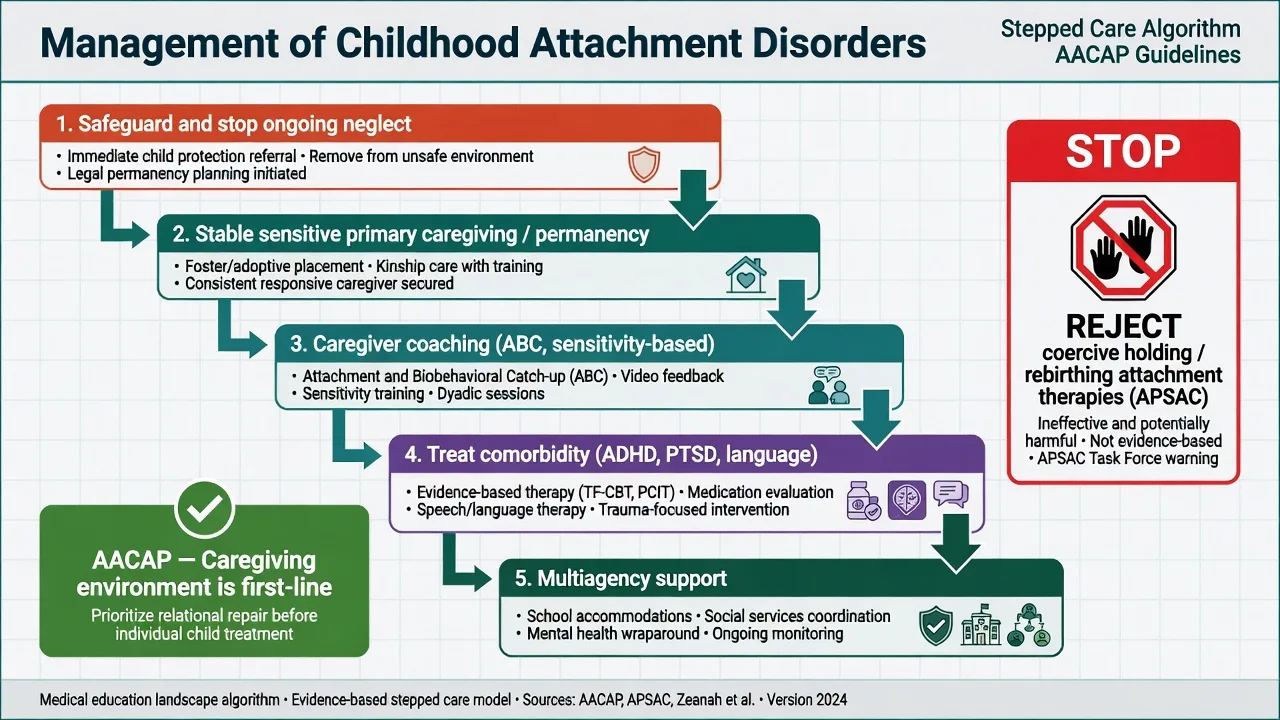
Caregiving environment is first-line
The AACAP practice parameter for RAD and DSED centres treatment on ensuring the child has an emotionally available, stable, sensitive primary caregiver (or a small number of consistent caregivers), with permanency planning that minimises further placement disruption. Symptom-focused child therapies without fixing the caregiving ecology miss the core mechanism.[1][2][5]
Psychoeducation for carers: RAD signs often improve substantially once reliable comfort is available; DSED/indiscriminate behaviour may persist longer and needs explicit boundary coaching and supervision rather than parental self-blame.[1][7][12][15]
Caregiver-focused interventions
Evidence-informed programmes that coach caregiver sensitivity, nurturing and follow-through — including Attachment and Biobehavioral Catch-up (ABC) — have randomised evidence for reducing behaviour problems among internationally adopted children and are exam-nameable models of attachment-informed parent coaching. Infant–parent psychotherapy and other sensitivity-based approaches share the principle of changing the caregiving relationship in vivo.[14][1]
Comorbidity treatment
Treat ADHD, anxiety, PTSD, sleep disturbance, language delay and medical sequelae on their own evidence bases. Pharmacotherapy is not a treatment for attachment disorder itself; avoid antipsychotics or other agents "for attachment." If medication is used, it is for a named comorbid indication with monitoring appropriate to that agent.[1][4]
Explicitly reject coercive attachment therapies
The APSAC task force report is a viva classic: coercive holding, rebirthing, and related forced-regression practices lack evidence, have caused harm (including deaths in widely cited forensic cases discussed in the attachment-therapy literature), and should not be recommended. Prefer conventional, relationship-based, non-coercive interventions and standard child protection practice.[4][1]
Australian and New Zealand CAMHS practice emphasises safeguarding under state/territory child-protection law, placement stability for looked-after children, carer support, and multiagency care. Quote local processes and principles rather than invented national section numbers. Attachment disorder labels must not pathologise culturally normative collective caregiving in Indigenous families.[1]
| Target | Prefer | Avoid |
|---|---|---|
| Core RAD/DSED | Stable sensitive caregiving + carer coaching | Medication "for attachment" |
| Placement instability | Permanency planning, reduce moves | Serial short placements without review |
| DSED social risk | Supervision, stranger-boundary coaching | Assuming "friendly child is fine" |
| Carer distress | Support, psychoeducation, respite | Blaming adoptive/foster carers alone |
| Community "RAD clinics" | Evidence-based non-coercive care | Holding / rebirthing / forced regression |
| Comorbid ADHD/PTSD | Standard indicated treatments | Ignoring comorbidity |
| Framework for exams; individualise and follow local governance.[1][4][14] |
Prognosis and disposition
With stable sensitive care, inhibited RAD features often improve. Disinhibited social engagement is more likely to persist after environmental improvement, though it can attenuate with development, coaching and reduced chaos — set realistic expectations with families.[1][7][12][15]
BEIP demonstrates that moving children from institutional care into high-quality foster care improves attachment-related and cognitive recovery trajectories relative to prolonged institutional care, with stronger benefits when intervention is earlier; comprehensive multilevel analyses continue to support causal effects of the foster-care intervention on recovery from early severe deprivation.[5][6][13][16]
Disposition intensity tracks placement stability, carer support needs, DSED-related absconding risk, and comorbidity. Looked-after children need multiagency review structures rather than single-clinic "attachment labels" without care planning.[1]
Complications and pitfalls
- Labelling any foster/adopted child's behaviour problems as RAD without insufficient-care phenotype criteria.[1][4]
- Missing ASD or ADHD while over-diagnosing attachment disorder.[1][3]
- Missing ongoing maltreatment while discussing "attachment issues" only.[1]
- Blaming adoptive parents who are providing good care for residual DSED from early deprivation.[15][7]
- Referring to coercive holding/rebirthing programmes.[4]
- Prescribing psychotropics as primary treatment for attachment pattern.[1]
- Ignoring permanency and carer support.[1][5]
Special populations
Previously institutionalised and internationally adopted children are the classic high-risk groups in ERA/BEIP teaching. Looked-after children need trauma-informed, permanency-focused care. Indigenous and culturally diverse families require culturally safe assessment — collective caregiving is not automatically "insufficient care." Neurodevelopmental comorbidity is common and must be assessed in parallel. Older children with residual DSED need explicit social-boundary and exploitation-risk planning.[5][7][8][15]
Exam pearls
CARE SAFE plan
References
- [1]Zeanah CH, Chesher T, Boris NW; AACAP Committee on Quality Issues Practice Parameter for the Assessment and Treatment of Children and Adolescents With Reactive Attachment Disorder and Disinhibited Social Engagement Disorder J Am Acad Child Adolesc Psychiatry, 2016.PMID 27806867
- [2]Boris NW, Zeanah CH; Work Group on Quality Issues Practice parameter for the assessment and treatment of children and adolescents with reactive attachment disorder of infancy and early childhood J Am Acad Child Adolesc Psychiatry, 2005.PMID 16239871
- [3]Gleason MM, Fox NA, Drury S, Smyke A, et al. Validity of evidence-derived criteria for reactive attachment disorder: indiscriminately social/disinhibited and emotionally withdrawn/inhibited types J Am Acad Child Adolesc Psychiatry, 2011.PMID 21334562
- [4]Chaffin M, Hanson R, Saunders BE, Nichols T, et al. Report of the APSAC task force on attachment therapy, reactive attachment disorder, and attachment problems Child Maltreat, 2006.PMID 16382093
- [5]Fox NA, Nelson CA 3rd, Zeanah CH The Effects of Psychosocial Deprivation on Attachment: Lessons from the Bucharest Early Intervention Project Psychodyn Psychiatry, 2017.PMID 29244624
- [6]Nelson CA 3rd, Zeanah CH, Fox NA, Marshall PJ, et al. Cognitive recovery in socially deprived young children: the Bucharest Early Intervention Project Science, 2007.PMID 18096809
- [7]O'Connor TG, Rutter M; English and Romanian Adoptees Study Team Attachment disorder behavior following early severe deprivation: extension and longitudinal follow-up J Am Acad Child Adolesc Psychiatry, 2000.PMID 10846304
- [8]Rutter ML, Kreppner JM, O'Connor TG; English and Romanian Adoptees study team Specificity and heterogeneity in children's responses to profound institutional privation Br J Psychiatry, 2001.PMID 11483469
- [9]Zeanah CH, Smyke AT, Dumitrescu A Attachment disturbances in young children. II: Indiscriminate behavior and institutional care J Am Acad Child Adolesc Psychiatry, 2002.PMID 12162634
- [10]Smyke AT, Dumitrescu A, Zeanah CH Attachment disturbances in young children. I: The continuum of caretaking casualty J Am Acad Child Adolesc Psychiatry, 2002.PMID 12162633
- [11]O'Connor TG, Marvin RS, Rutter M, Olrick JT, et al. Child-parent attachment following early institutional deprivation Dev Psychopathol, 2003.PMID 12848433
- [12]Bruce J, Tarullo AR, Gunnar MR Disinhibited social behavior among internationally adopted children Dev Psychopathol, 2009.PMID 19144228
- [13]McGoron L, Gleason MM, Smyke AT, Drury SS, et al. Recovering from early deprivation: attachment mediates effects of caregiving on psychopathology J Am Acad Child Adolesc Psychiatry, 2012.PMID 22721591
- [14]Yarger HA, Lind T, Raby KL, Zajac L, et al. Intervening With Attachment and Biobehavioral Catch-Up to Reduce Behavior Problems Among Children Adopted Internationally: Evidence From a Randomized Controlled Trial Child Maltreat, 2022.PMID 33882710
- [15]Kay C, Green J, Sharma K Disinhibited Attachment Disorder in UK Adopted Children During Middle Childhood: Prevalence, Validity and Possible Developmental Origin J Abnorm Child Psychol, 2016.PMID 26857922
- [16]King LS, Guyon-Harris KL, Valadez EA, Radulescu A, et al. A Comprehensive Multilevel Analysis of the Bucharest Early Intervention Project: Causal Effects on Recovery From Early Severe Deprivation Am J Psychiatry, 2023.PMID 37211832