Psych · Child and adolescent psychiatry — family assessment and therapy
Family assessment and therapy in CAP
Also known as Family therapy in child psychiatry · Systemic family assessment CAP · Parent training CAMHS · PCIT · Family-based treatment · ABFT · Multisystemic therapy · Functional family therapy · MDFT · Family accommodation
Exam-exhaustive fellowship reference on family assessment and therapy in child and adolescent psychiatry — genogram and structural assessment, circular questioning, EE and accommodation, and indication-matched packages (PCIT/PMT, FBT, ABFT, FFT/MST, MDFT). FRANZCP-primary, globally tagged.
On this page & tools
Your progress
Saved locally on this device.
Target exams
Red flags
Definition and scope
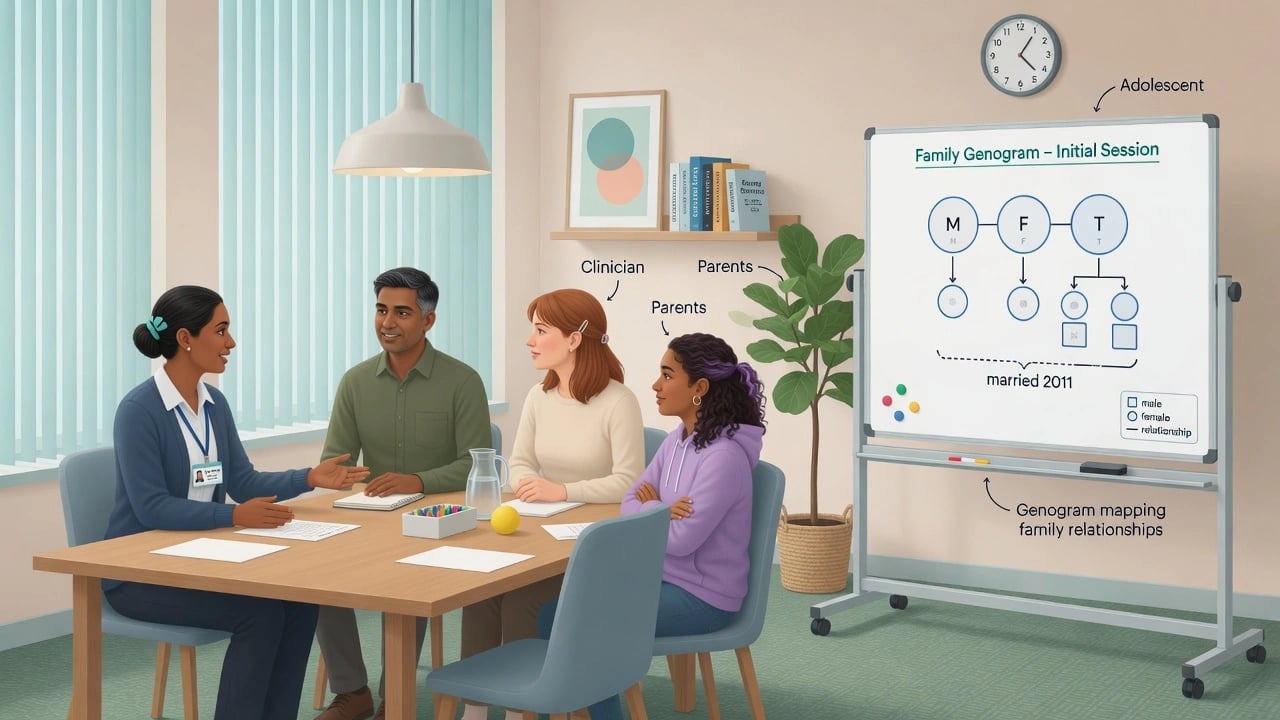
Family assessment in child and adolescent psychiatry (CAP) is the structured appraisal of who is in the system, how they interact, how they explain the problem, and how risk and caregiving operate — using tools such as genogram, structural mapping, circular questioning, and multi-informant history.[1]
Family therapy / family intervention means planned change work with the family as a unit (or with parents as primary agents of change). Related but distinct modalities map onto different CAP indications and ages.[1][6][9]
| Modality | Core idea | Typical CAP use |
|---|---|---|
| Behavioural parent training / PMT | Change contingencies (praise, commands, consequences) | Young ODD/CD, ADHD parenting |
| PCIT | Live coached CDI then PDI parent–child interaction | Ages ~2–7 disruptive behaviour |
| FBT (Maudsley) | Parents lead refeeding then return control | Adolescent anorexia nervosa |
| ABFT | Repair attachment ruptures; promote autonomy | Adolescent depression / suicidal ideation |
| Functional FFT | Engage, motivate, behaviour change, generalise | Youth behavioural problems / delinquency pathways |
| MST | Intensive home-based multi-system ecological work | Serious antisocial / multiproblem youth |
| MDFT | Adolescent, parent, family, and extrafamilial domains | Adolescent substance use and co-problems |
| Family-focused therapy (Miklowitz lineage) | Psychoeducation, communication, problem-solving with mood stabilisation | Bipolar and related youth mood contexts |
| Systemic / structural techniques | Circular questions, boundaries, enactment | Relational stuckness across diagnoses |
Family work may be primary treatment (e.g. FBT, PCIT) or adjunct (e.g. accommodation reduction alongside ERP). Relational Z/V codes do not replace a full diagnostic formulation of the index child.[1][15]
Epidemiology and why families matter
Most CAP presentations live inside families: multi-informant discrepancy is expected; school and home often disagree. Family climate (conflict, criticism, over-involvement) and family accommodation shape course and treatment response across mood, anxiety/OCD, externalising, and eating pathways.[14][15][16]
High expressed emotion (EE) — criticism, hostility, emotional over-involvement — predicts worse psychiatric course in classic meta-analysis; use the construct carefully in CAP as a stress–vulnerability interaction, not as proof that parents "caused" the disorder.[16]
Family accommodation (participation in rituals, excessive reassurance, routine modification) is common in paediatric OCD and anxiety and associates with greater severity and family stress.[14][15]
Caregiver burden, parental mental illness (COPMI contexts), placement instability, and justice involvement concentrate risk and demand multiagency intensity (MST/MDFT logic).[7][13]
Mechanisms examiners expect
Circular causality (not linear blame)
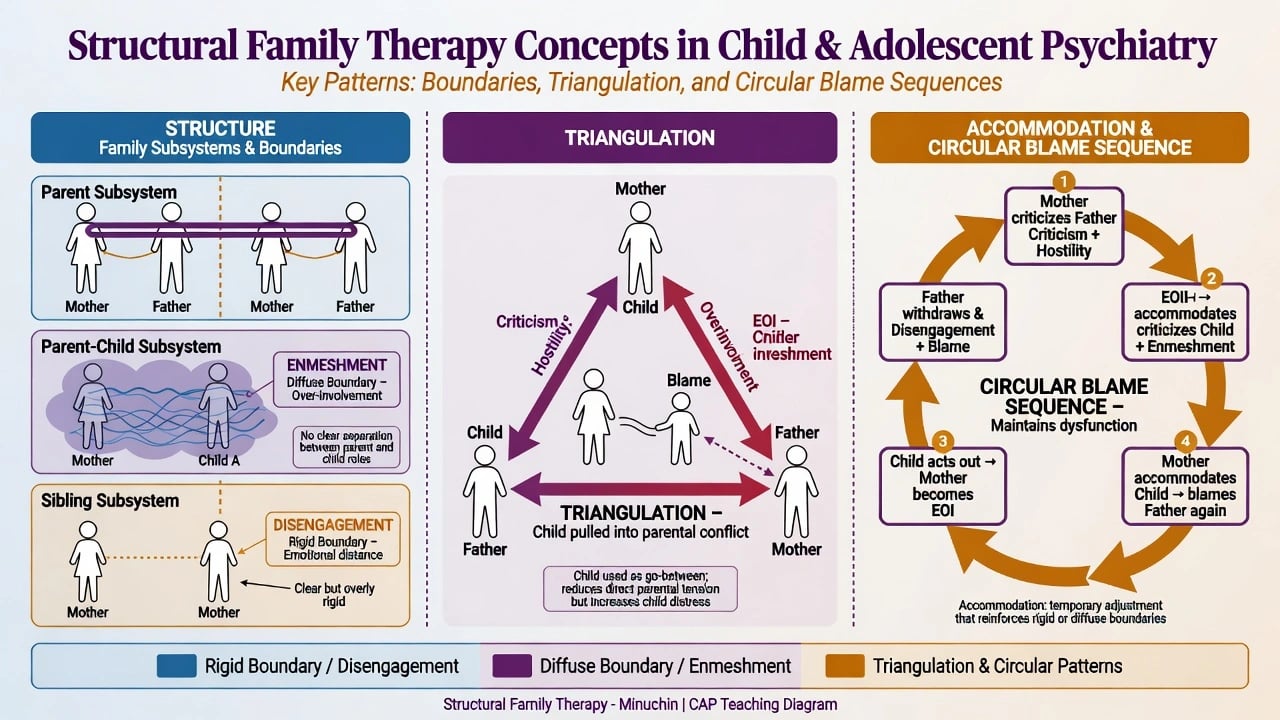
Symptoms and family responses form loops: child defiance → parental escalation → more defiance; adolescent withdrawal → parental EOI → more autonomy struggle. Teaching sentence: families maintain patterns; they do not invent diagnoses from nothing.[1]
Structural concepts
- Boundaries: clear vs diffuse (enmeshment) vs rigid (disengagement).
- Hierarchy: appropriate parental executive function vs inverted hierarchy (child rules).
- Triangulation: child pulled into parental conflict.
- Coalitions: two against one.
- Enactment: invite the pattern into the room and restructure it live.[1]
Coercive family process
Patterson-line teaching for externalising: negative reinforcement cycles (escape from demands, harsh then give-in) maintain aggression and non-compliance — the target of behavioural parent training and PCIT contingency work.[9][11]
Attachment repair and accommodation
ABFT targets ruptured caregiver–adolescent attachment and blocked emotion processing, then autonomy.[4][5] Accommodation short-term reduces anxiety but long-term maintains OCD/anxiety — reduce it deliberately with ERP-aligned plans.[14][15]
EE as interpersonal stress
EE is an interpersonal climate interacting with vulnerability (diathesis–stress), transferable from adult psychosis literature into CAP family teaching without reviving obsolete "schizophrenogenic" blame models.[16]
Clinical presentation in the room
Observable patterns: critical parent; overprotective/enmeshed parent speaking for the child; disengaged parent on phone; scapegoated sibling; adolescent silent with arms folded; separated co-parents replaying court in session. These interaction signatures guide formulation of structure, EE climate, and engagement risks rather than moral scoring of parents.[1][16]
Accommodation behaviours: parents completing rituals, providing endless reassurance, rearranging family life around avoidance.[14][15]
EE proxies (clinic, not full CFI): global criticism, hostility/rejection, EOI self-sacrifice that blocks age-appropriate autonomy, versus warmth and collaborative problem-solving.[16]
Developmental banding matters: preschool tantrum/defiance (PCIT/PMT window) differs from adolescent AN, SI, substance, or justice pathways.[2][4][7][9]
Differential and when not to do conjoint work
| Presentation | Discriminators | Prefer |
|---|---|---|
| Primary child disorder driving family distress | Clear syndrome history, multi-setting symptoms | Treat child + family package as indicated |
| Active IPV / coercive control | Fear, injury, control tactics | Separate interviews; protect; report |
| Cultural collectivism | Normative interdependence without function failure | Cultural safety; do not score as EOI automatically |
| ASD social-communication differences | RRBs, sensory, pervasive social-comm profile | ASD pathway; adapted family coaching |
| ADHD multi-setting impulsivity | Inattention/hyperactivity across settings | ADHD care + parent training, not "bad parents only" |
| Shared fixed false illness beliefs | Delusional intensity, bizarreness | Individual psychosis work; careful family psychoeducation |
| Ongoing CSA / severe neglect | Disclosure, medical signs, multiagency concern | Safeguarding first; therapy model second |
Assessment framework

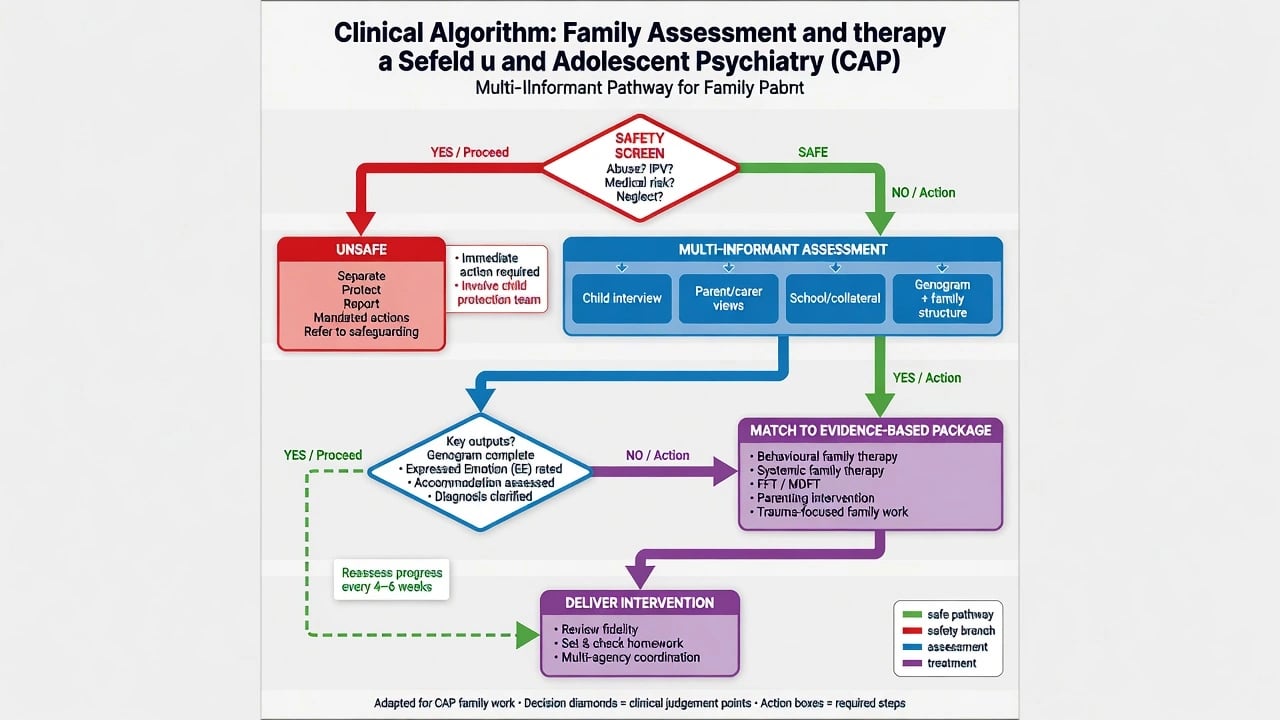
- Safety screen every time: abuse/neglect, IPV, suicide, weapons, absconding, medical risk (especially eating disorders). Separate interviews if free speech is unsafe.[17][18]
- Confidentiality contract (especially with adolescents): what may be shared in joint sessions; what stays private unless risk thresholds met (jurisdiction-specific).
- 3-generation genogram: household, contact hours, losses, mental illness, substances, custody/legal status, chosen family.
- Structural map: hierarchy, boundaries, coalitions, triangulation.
- Circular questions (examples): "When X escalates, who notices first? What does Y do next? What happens if Z tries something different?"
- Multi-informant diagnosis of the child (history, MSE, school, scales as indicated) — family work does not replace diagnosis.
- EE proxies, warmth, problem-solving capacity, carer mental health.
- Accommodation screen in OCD/anxiety (FAS concepts: participation, modification, distress).[14][15]
- Goals and readiness for a named package; barriers (transport, literacy, cultural mistrust, parental depression).
Tools (conceptual familiarity): Family Accommodation Scale concepts; parent-report externalising scales used in PCIT/PMT pathways (e.g. ECBI conceptually); broader behavioural checklists — clinical synthesis over single-questionnaire "family diagnosis."[9][14]
Investigations: none diagnose family dysfunction. Investigate the child medically/psychiatrically as the syndrome requires (organic differentials, baseline metabolic/ECG before psychotropics when used).[1]
Acute priorities vs definitive packages
Acute / emergency: ABC and medical stability; individual suicide/violence risk; least-restrictive legal framework; brief family contact for collateral and safety planning. Do not delay necessary treatment for a perfect genogram.[4][17]
Refuse harmful "attachment therapies": coercive holding, rebirthing, and forced regression are unproven and potentially dangerous — APSAC task force position; redirect to conventional non-coercive care.[18]
Indication-matched definitive care

Young externalising — PCIT and parent training
PCIT meta-analysis supports reduction of children's externalising behaviour; phases typically CDI (child-directed interaction: warmth, labelled praise, PRIDE skills) then PDI (parent-directed interaction: effective commands, consistent consequences) with live coaching.[9] Behavioural parent training more broadly is among the best-supported psychosocial treatments for conduct problems in classic evidence maps (Brestan and Eyberg).[11] Incredible Years-style group parent programmes sit in the same parent-training family of interventions used widely in CAMHS and prevention settings.[11]
Adolescent anorexia — FBT
Lock and colleagues' RCT found family-based treatment superior to adolescent-focused individual therapy on full remission at follow-up; parents are empowered to lead refeeding before control returns to the adolescent.[2] Meta-analytic synthesis supports FBT efficacy for adolescent eating disorders.[3] RANZCP eating disorder guidelines endorse family-based approaches as central for adolescents.[17]
FBT phases (exam skeleton): (1) parent-led refeeding / weight restoration; (2) gradual return of control to adolescent; (3) adolescent developmental issues once medical risk is controlled.[2][17]
Adolescent depression and suicidality — ABFT
ABFT is a manualised attachment-focused model (relational reframe, alliance building, attachment tasks, autonomy promotion). Treatment-development work and a randomised trial support reductions in suicidal ideation and depressive symptoms versus enhanced usual care comparators.[4][5]
Serious antisocial / multiproblem youth — MST and functional FFT
MST is intensive, home-based, ecological (family, school, peers, neighbourhood), with nine core principles and strong implementation research; classic trials supported family preservation alternatives to incarceration pathways for serious juvenile offenders.[7][8] Functional Family Therapy reduces behavioural problems in community settings when therapists adhere to the model — fidelity is an examinable outcome moderator.[10]
Adolescent substance use — MDFT
Multidimensional family therapy showed superior overall improvement versus comparison treatments in a landmark RCT and has an extensive later evidence base for substance use and co-occurring problems across individual, family, and extrafamilial domains.[12][13]
Bipolar / mood — family-focused principles
Family-focused therapy plus pharmacotherapy improves outcomes in bipolar disorder RCTs (Miklowitz lineage); modules of psychoeducation, communication enhancement, and problem-solving transfer to youth mood packages with sleep, early-warning, and medication alliance as family tasks.[6]
OCD and anxiety — reduce accommodation
Assess and reduce family accommodation as part of ERP-aligned care; accommodation is common and linked to severity and family stress.[14][15]
Engagement sequence (any package)
- Alliance with each member (multi-partiality, not taking sides).
- Non-blaming reframe (pattern language: "the cycle has everyone stuck").
- Shared problem list and goals.
- Session structure, between-session tasks, and crisis plan.
- Review fidelity and barriers; step up intensity if multiproblem/high conflict/placement risk.[1][7][10]
Medication: no drug treats "family dysfunction." Treat comorbid ADHD, depression, psychosis, etc. on their own evidence bases with dose, route, and monitoring as those monographs require; family work continues in parallel.[1][6]
Subtypes and high-yield scenarios
- Preschool ODD with coercive cycles → PCIT/PMT first-line psychosocial frame.[9][11]
- Adolescent AN with parental helplessness → FBT; medical monitoring concurrent.[2][17]
- Suicidal adolescent with ruptured caregiver bond → ABFT-style repair plus individual risk management.[4]
- Justice-involved multiproblem youth → MST or high-fidelity functional FFT.[7][10]
- Adolescent cannabis/polysubstance use → MDFT-style ecological family work.[12][13]
- Paediatric OCD with high accommodation → ERP + deliberate accommodation reduction.[14][15]
- Looked-after child → carer coaching, permanency, multiagency; refuse coercive holding programmes.[18]
- High-conflict divorce → structured sessions, written agreements, child protection lens; avoid therapist triangulation.[1]
Pitfalls
| Pitfall | Why it fails | Better move |
|---|---|---|
| Blaming parents as sole cause | Alliance-destroying; often false | Circular formulation + collaboration |
| Pathologising culture as EOI | Culturally unsafe | Explore function and burden |
| Therapist triangulation | Reinforces splits | Multi-partiality, separate caucuses |
| Joint work with IPV | Safety catastrophe | Separate, protect, report |
| "Supportive chat" only | Misses package effect | Named model + homework |
| Ignoring school/peers | Incomplete ecology | MST/MDFT extrafamilial domains |
| Coercive attachment therapies | Harm | Explicit APSAC-aligned refusal |
| Confidentiality blur | Ethical/legal risk | Written sharing contract |
Prognosis and disposition
- FBT: higher full-remission rates than adolescent-focused individual therapy at follow-up in landmark RCT; meta-analysis supports efficacy.[2][3]
- PCIT: meta-analytic externalising benefit; real-world success needs coaching fidelity.[9]
- ABFT: RCT support for reducing suicidal ideation and depressive symptoms vs enhanced usual care comparators.[4]
- MST/FFT: outcomes stronger with model adherence and adequate intensity.[7][10]
- MDFT: RCT and later reviews support substance and broader behaviour gains.[12][13]
- Systemic therapy broadly: multiple RCTs support benefit across selected CAP presentations.[1]
Step up when: multiproblem ecology, high conflict, placement at risk, medical risk in ED, repeated non-response, or fidelity collapse. Disposition always names: who lives where, homework capacity, school liaison, carer mental health, crisis contacts, and review of EE/accommodation climate.[7][15][16]
Special populations
- Looked-after / kinship care: prioritise carer stability and multiagency plans; avoid coercive "attachment" products.[18]
- Indigenous and culturally diverse families: expand who counts as family; use cultural liaison; do not pathologise collective caregiving.[1]
- LGBTQ+ youth: family rejection amplifies suicide risk; pursue repair (ABFT-compatible stance) or alternative supportive adults.[4]
- Neurodevelopmental comorbidity: adapt parent training (visual supports, shorter sessions); treat ADHD/ASD pathways explicitly.[9][11]
- COPMI: dual agenda — parent's illness care and child's developmental needs.[16]
- Refugee families: trauma-informed engagement, interpreters, authority mistrust.[1]
Regional deltas
Exam pearls
FAMILY — CAP family work checklist
Classic stems (indication matching drills):
- Adolescent AN + helpless parents → FBT, not individual therapy first-line frame.[2][17]
- Suicidal adolescent cut off from parent → ABFT principles + risk plan.[4]
- Preschool ODD coercive cycles → PCIT/PMT, not antipsychotic for "attachment."[9][11]
- Justice multiproblem youth → MST ecology or high-fidelity FFT.[7][10]
- Parent wants holding therapy for "RAD" → refuse (APSAC); offer non-coercive care.[18]
- OCD with family doing rituals → reduce accommodation with ERP plan.[14][15]
Bottom line
Fellowship-level CAP family work is safety-first assessment plus indication-matched, non-coercive, evidence-based packages delivered with fidelity — never parent-blame theatre, never unstructured chats when a named model is indicated, and never joint therapy that ignores violence.[1][2][4][7][9][18]
References
- [1]Retzlaff R, von Sydow K, Beher S, et al. The efficacy of systemic therapy for internalizing and other disorders of childhood and adolescence: a systematic review of 38 randomized trials Fam Process, 2013.PMID 24329407
- [2]Lock J, Le Grange D, Agras WS, et al. Randomized clinical trial comparing family-based treatment with adolescent-focused individual therapy for adolescents with anorexia nervosa Arch Gen Psychiatry, 2010.PMID 20921118
- [3]Couturier J, Kimber M, Szatmari P Efficacy of family-based treatment for adolescents with eating disorders: a systematic review and meta-analysis Int J Eat Disord, 2013.PMID 22821753
- [4]Diamond GS, Wintersteen MB, Brown GK, et al. Attachment-based family therapy for adolescents with suicidal ideation: a randomized controlled trial J Am Acad Child Adolesc Psychiatry, 2010.PMID 20215934
- [5]Diamond GS, Reis BF, Diamond GM, et al. Attachment-based family therapy for depressed adolescents: a treatment development study J Am Acad Child Adolesc Psychiatry, 2002.PMID 12364840
- [6]Miklowitz DJ, George EL, Richards JA, et al. A randomized study of family-focused psychoeducation and pharmacotherapy in the outpatient management of bipolar disorder Arch Gen Psychiatry, 2003.PMID 12963672
- [7]Henggeler SW Multisystemic Therapy(®) : Clinical Overview, Outcomes, and Implementation Research Fam Process, 2016.PMID 27370172
- [8]Henggeler SW, Melton GB, Smith LA Family preservation using multisystemic therapy: an effective alternative to incarcerating serious juvenile offenders J Consult Clin Psychol, 1992.PMID 1460157
- [9]Thomas R, Abell B, Webb HJ, et al. Parent-Child Interaction Therapy: A Meta-analysis Pediatrics, 2017.PMID 28860132
- [10]Sexton T, Turner CW The effectiveness of functional family therapy for youth with behavioral problems in a community practice setting J Fam Psychol, 2010.PMID 20545407
- [11]Brestan EV, Eyberg SM Effective psychosocial treatments of conduct-disordered children and adolescents: 29 years, 82 studies, and 5,272 kids J Clin Child Psychol, 1998.PMID 9648035
- [12]Liddle HA, Dakof GA, Parker K, et al. Multidimensional family therapy for adolescent drug abuse: results of a randomized clinical trial Am J Drug Alcohol Abuse, 2001.PMID 11727882
- [13]Liddle HA Multidimensional Family Therapy: Evidence Base for Transdiagnostic Treatment Outcomes, Change Mechanisms, and Implementation in Community Settings Fam Process, 2016.PMID 27565445
- [14]Calvocoressi L, Lewis B, Harris M, et al. Family accommodation in obsessive-compulsive disorder Am J Psychiatry, 1995.PMID 7864273
- [15]Lebowitz ER, Panza KE, Bloch MH Family accommodation in obsessive-compulsive and anxiety disorders: a five-year update Expert Rev Neurother, 2016.PMID 26613396
- [16]Butzlaff RL, Hooley JM Expressed emotion and psychiatric relapse: a meta-analysis Arch Gen Psychiatry, 1998.PMID 9633674
- [17]Hay P, Chinn D, Forbes D, et al. Royal Australian and New Zealand College of Psychiatrists clinical practice guidelines for the treatment of eating disorders Aust N Z J Psychiatry, 2014.PMID 25351912
- [18]Chaffin M, Hanson R, Saunders BE, et al. Report of the APSAC task force on attachment therapy, reactive attachment disorder, and attachment problems Child Maltreat, 2006.PMID 16382093