Psych · Consultation-liaison psychiatry
Abnormal illness behaviour and the sick role
Also known as Abnormal illness behavior · Illness behaviour · Sick role · Illness Behavior Questionnaire · Pilowsky AIB · Somatization behaviour · Health-related help-seeking
Exam-exhaustive fellowship C-L topic on Parsons' sick role, Mechanic's illness behaviour, Pilowsky abnormal illness behaviour (definition, affirming/denying axes, IBQ measurement), mapping to DSM-5-TR SSD/IAD/FND/factitious/malingering, cultural formulation, and non-dualistic stepped care. FRANZCP-primary, globally tagged.
On this page & tools
Your progress
Saved locally on this device.
10 MCQs with explanations
Target exams
Red flags
Overview and definition
Consultation-liaison (C-L) examiners test whether you can hold three nested ideas without collapsing them: the sick role (social contract of being a patient), illness behaviour (how people notice, interpret, and act on symptoms), and abnormal illness behaviour (when that pattern becomes clinically maladaptive relative to findings and explanation).[1][3][4][9]
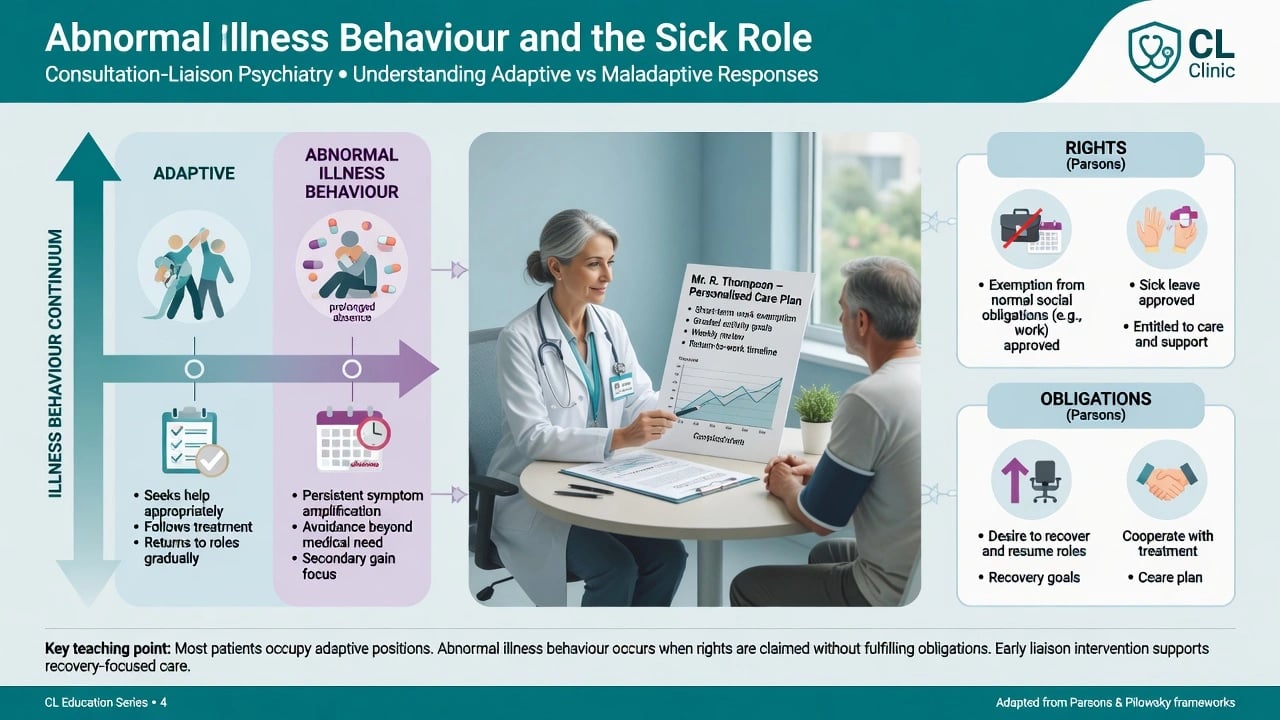
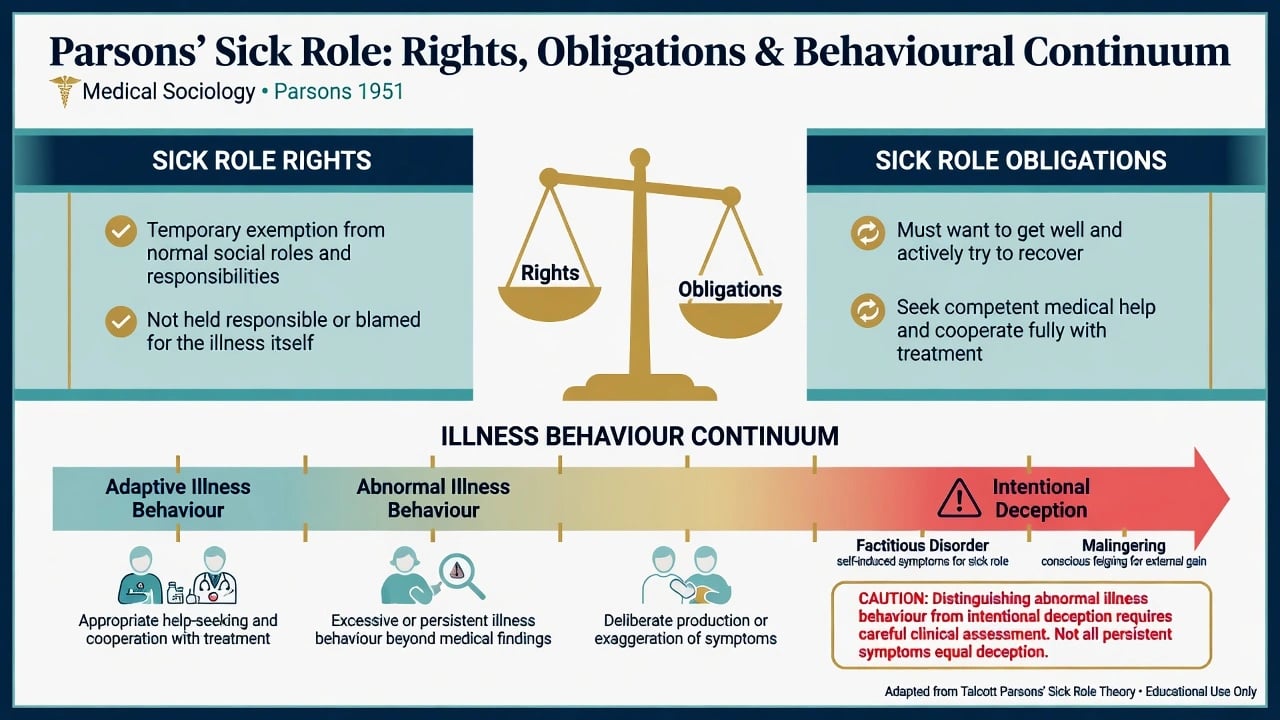
Parsons’ sick role (classic medical sociology teaching, still viva currency) grants two rights — temporary exemption from ordinary social roles, and not being held morally responsible for falling ill — balanced by two obligations — to want to get well, and to seek competent help and cooperate with treatment. Entrenched disability with refusal of recovery work after adequate care is the sociological skeleton of many AIB presentations; conversely, illness-denying patients may refuse the sick role when disease is serious.[4][7]
Mechanic’s illness behaviour is the broader behavioural science term for monitoring bodily sensations, interpreting them, taking remedial actions, and using healthcare systems — shaped by culture, learning, access, and doctor–patient interaction, not by pathology volume alone.[4][9]
Pilowsky’s AIB (1969) defines an inappropriate or maladaptive mode of experiencing, evaluating, or acting in relation to one’s health, judged against available medical information after adequate assessment, and maintained despite explanation. The 1978 classification and later anniversary review refine axes (affirming vs denying; somatic vs psychological focus) and defend AIB as a clinical heuristic linking psychiatry, medicine, and sociology rather than a single syndrome code.[1][2][3]
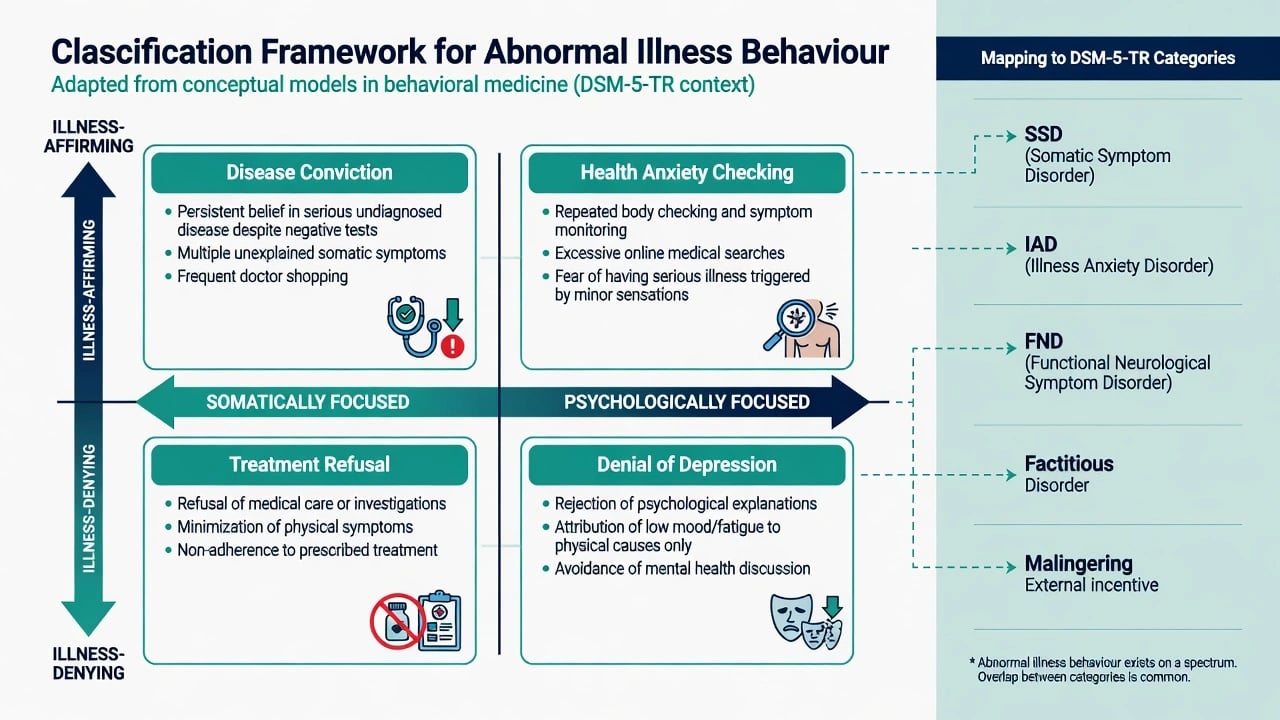
Modern nosology does not replace AIB teaching language overnight: DSM-5-TR somatic symptom disorder abandons “medically unexplained” as the gate and focuses on disproportionate thoughts, feelings, or behaviours about symptoms; illness anxiety, FND, factitious disorder, and malingering cover other poles of the intentionality and symptom-load map. Fellowship answers should translate AIB into current codes when writing diagnoses, while still using Pilowsky’s axes for formulation and team communication.[10][17][18]
Classification map (exam discriminators)
| Construct | Core idea | Intentional production? | Classic trap |
|---|---|---|---|
| Adaptive illness behaviour | Proportionate help-seeking and recovery work | No | Pathologising normal worry about real disease |
| AIB (Pilowsky) | Maladaptive illness-related perception/evaluation/action after adequate assessment | Usually no (unless factitious/malingering end) | Using the label as proof tests were enough forever |
| SSD | Distressing symptoms + disproportionate B-criteria | No | Requiring “unexplained” symptoms (DSM-IV habit) |
| IAD | Minimal symptoms + high health anxiety | No | Missing care-avoidant subtype |
| FND | Involuntary functional neuro signs | No | Equating inconsistency with faking |
| Factitious | Deception for sick role | Yes | Accusing without evidence |
| Malingering | Deception for external incentive | Yes | Using as a discharge weapon |
Illness-affirming AIB includes disease conviction disproportionate to findings, invalidism, insistence on further procedures, and rejection of non-disease explanations. Illness-denying AIB includes minimisation of serious pathology, refusal of indicated treatment, and delayed presentation — equally examinable and often more dangerous medically.[2][3][7]
Sirri, Fava and Sonino argue for a unifying clinimetric concept of illness behaviour that cuts across categorical diagnoses — useful when the stem asks for dimensional formulation rather than a single code.[9] Prior and Bond place AIB beside somatic symptom disorders and critique over-reification of questionnaire cut-points while keeping the construct clinically alive.[10][11]
Epidemiology and service burden
AIB is not a community prevalence diagnosis with a single rate; it is enriched where symptom load, disability, and healthcare use diverge from biomedical findings — primary care high utilisers, specialty clinics, pain services, and C-L wards.[5][10][13] Pain populations historically drove measurement work: Waddell, Pilowsky and Bond emphasised clinical interpretation of illness behaviour in low back pain rather than crude “non-organic” stigma.[5][6]
Dimensional work shows AIB-type response patterns can appear even outside hospital samples — supporting a continuum, not a binary of “genuine patients vs abnormal ones.”[10][11] Cultural epidemiology matters: somatic presentations of distress vary by setting and are not automatically “abnormal” without impairment and context (Kirmayer).[7][8]
Mechanisms — sick role, attention, culture
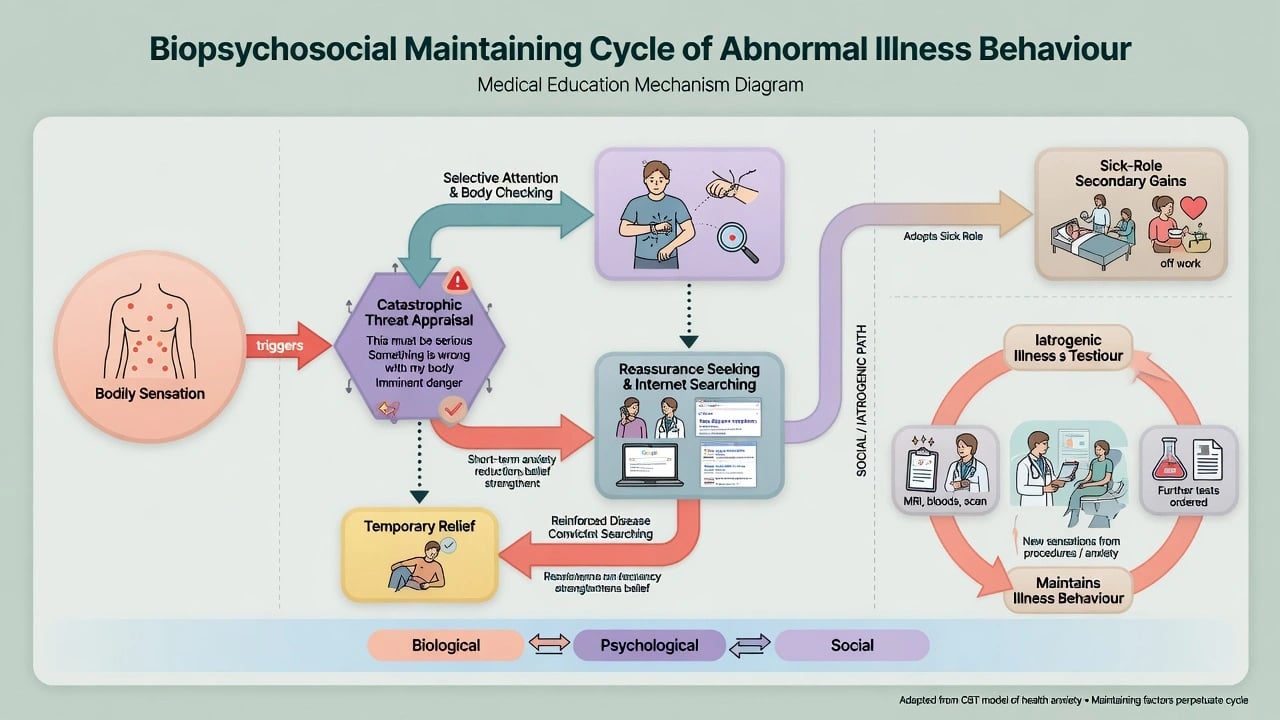
Viva-depth mechanisms without dualism:[4][7][12]
- Social sick-role dynamics — entry and exit from the patient role; secondary gains and family/work reinforcement; failure of reciprocal recovery obligations after rights are claimed.[4][7]
- Somatosensory amplification — tendency to experience normal or minor bodily sensations as intense, noxious, and alarming (Barsky), feeding health anxiety and checking.[12]
- Cognitive-behavioural loops — catastrophic misinterpretation → selective attention → reassurance/internet searching → short-term relief → maintained threat belief (same architecture exploited in health-anxiety CBT trials).[12][14][15]
- Fear-avoidance and disability in pain — distress and behaviour drive disability beyond tissue models (Waddell clinical model).[5][6]
- Iatrogenesis — repeated unfocused tests and conflicting specialist narratives amplify threat; pejorative dismissal drives doctor-shopping.[13][7]
- Cultural pathways — idioms of distress, stigma about psychological labels, and help-seeking norms shape presentation (Kirmayer culture and somatization).[8][7]
Lipowski’s classic somatization framework still helps candidates organise multi-system bodily expression of distress at the medicine–psychiatry border without equating all somatic presentation with intentional deception.[18]
Clinical presentation (C-L stems)
Typical referrals: “negative” medical admission with persistent multi-system complaints and rising disability; chronic back pain with high behavioural distress and surgical pressure; post-reassurance disease conviction; high-utilising multi-specialty patient; refusal of indicated cancer or cardiac treatment framed as stoicism; compensation-linked discrepancy between claimed disability and observed function (raise malingering carefully, never as first default).[5][13][16]
MSE focus: health beliefs (anxious overvalued idea vs delusional certainty), affect, insight into psychological contribution, body checking, substance use, suicide risk, capacity when decisions are contested, and secondary-gain exploration without accusation.[7][16]
Differential diagnosis
Always keep the organic door ajar for red flags or change in pattern. Discriminators that earn marks:[13][16][17]
- Appropriate illness behaviour in real disease — proportionate concern and cooperation.
- SSD / IAD / FND — involuntary distress and behaviour patterns; code when criteria met.
- Major depression / anxiety / panic with somatic prominence.
- Psychotic somatic delusions — different treatment pathway.
- Factitious / malingering — intentional production; incentive type (sick role vs external).[16]
- Cultural idioms — not automatically AIB.[8]
Assessment
- Clarify the consult question — diagnosis support, team frustration, capacity, risk, or disposition?[13]
- Alliance first — “symptoms and suffering are real; the task is to reduce disability and risk.”[13]
- History — timeline, feared disease hierarchy, what explanations have been given, function, family models, prior tests and what would change management if repeated.[7][9]
- Sick-role negotiation — which exemptions are claimed; which recovery obligations are accepted?[4]
- Measures (conceptual exam use) — Illness Behaviour Questionnaire domains and modern measurement agenda (Prior and Bond); health-anxiety items in the Whiteley lineage; PHQ-15 for somatic load when multi-symptom; depression/anxiety screens.[11][10][12]
- Collateral and utilisation — GP, specialists, pharmacy, family within lawful consent.[16]
- Risk and capacity — suicide; delayed disease in care-avoidance; iatrogenic harm; decision-specific capacity for refusal or demand for non-indicated procedures.[16]
Investigations remain hypothesis-driven. Agree re-investigation thresholds and a single medical home so C-L is not hired to “prove psychological” with endless tests.[13]
Acute and emergency issues
Medical red flags, overdose, severe withdrawal, suicidal crisis, and acute organ syndromes outrank formulation. Illness-denying AIB with life-threatening disease may need capacity assessment and jurisdiction-specific least-restrictive pathways — not a lecture on Pilowsky. When intentional self-induction is probable, prioritise safety and non-collusion (Bass and Halligan principles) while still treating real injury.[16][13]
Definitive management
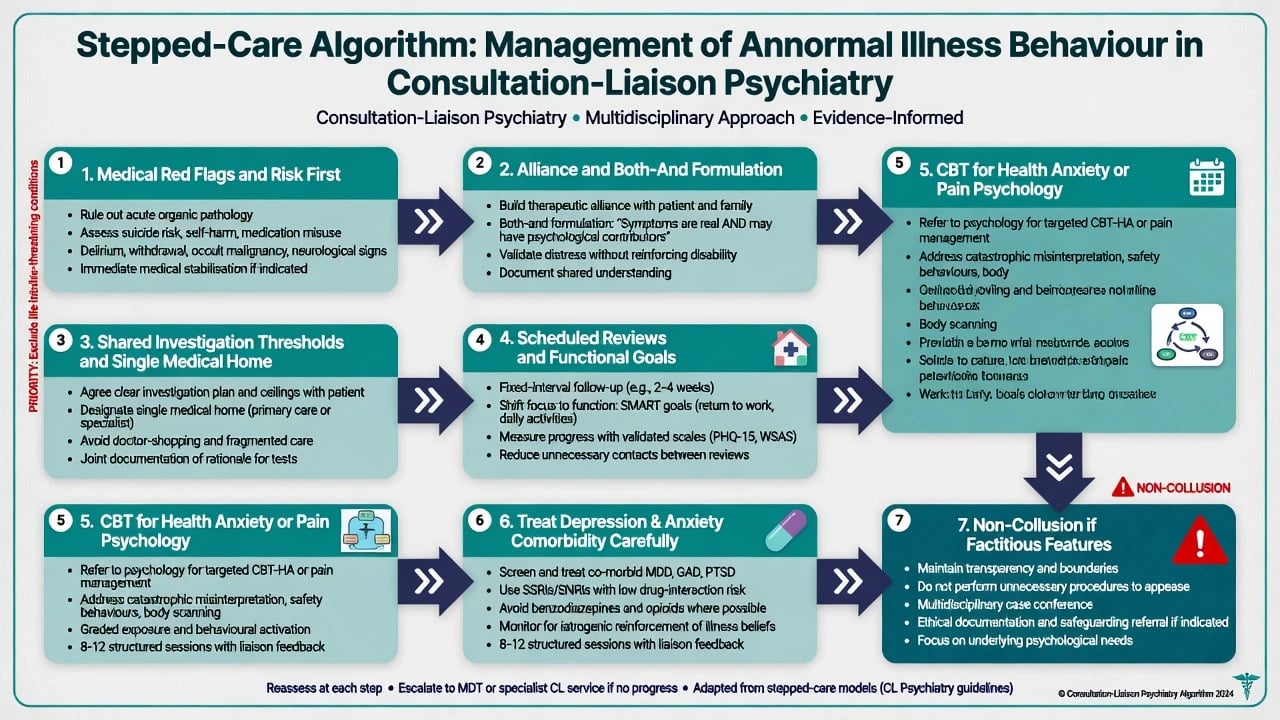
Communication and service model
Henningsen-style principles for functional somatic syndromes translate directly to affirming AIB care: take symptoms seriously; give a positive non-dualistic explanation; avoid unnecessary tests and specialist shopping; use scheduled time-limited reviews; set functional goals (mobility, work, sleep, valued activity) rather than zero symptoms as the only success metric.[13]
Psychological therapies
- CBT for hypochondriasis / health anxiety reduces health anxiety versus control (Barsky and Ahern RCT) — first-line when checking, reassurance, and disease conviction dominate.[14]
- CHAMP (Tyrer et al.): adapted CBT for health anxiety in medical clinics improved outcomes and was cost-effective — high-yield FRANZCP/MRCPsych citation for C-L settings.[15]
- Broader non-pharmacological evidence for somatoform/MUPS shows modest benefits; set realistic expectations and combine with service redesign.[13]
Pharmacotherapy
There is no specific anti-AIB drug. Treat comorbid depression and anxiety with standard antidepressant pathways when indicated (e.g. SSRI strategies studied in hypochondriasis trials such as paroxetine in Greeven’s comparative RCT framework — know that CBT and medication both have evidence signals for health anxiety). Monitor activation, hyponatraemia risk in older adults, sexual side effects, and serotonergic interactions; discuss suicide risk in younger patients as usual.[14][15] Exam-facing spine example when SSRI is chosen for comorbid health anxiety/depression: sertraline 25–50 mg oral daily start (local formulary), review 1–2 weeks for activation/tolerability, titrate toward usual antidepressant range with functional and anxiety targets — cite trial-level health-anxiety evidence rather than inventing an AIB-specific dose licence.[14][15]
Pain and rehabilitation interface
Use Waddell’s biopsychosocial model: distress, illness behaviour, and social factors drive disability; pure surgical or pure psychogenic stories both fail. Rehabilitate function; avoid pejorative “non-organic signs” language without a recovery plan.[5][6]
Intentional production end of spectrum
If evidence supports factitious disorder or malingering, shift to multidisciplinary non-collusion, factual documentation, child protection when relevant, and role-clear reporting — detailed in the dedicated factitious/malingering topic; do not force every AIB case into this pole.[16]
Special populations
Older adults: higher organic base rates — lower threshold to re-open work-up; anticholinergic and hyponatraemia cautions if antidepressants used.[13] Perinatal: health anxiety about fetus/self; collaborative obstetric psychiatry; psychological care first-line where possible.[15] Adolescents: family reinforcement, school avoidance, social media health content.[7] Cultural and Indigenous contexts: use cultural formulation; somatic idioms may be normative pathways of distress, not proof of AIB.[8][7] Occupational/insurance contexts: assess secondary gain carefully without automatic malingering labels; base rates and collateral matter.[16]
Prognosis and disposition
Course is often chronic and fluctuating. Better outcomes track engagement, treated mood/anxiety, reduced multi-doctor shopping, family renegotiation of the sick role, and functional gains. Disposition is usually shared care: GP continuity as medical home, psychology/CBT access, C-L for complex comorbidity or ward crises, clear safety-net for new red flags.[3][13][15]
Regional notes
ANZ (FRANZCP): Pilowsky’s AIB tradition is local intellectual history (including ANZJP anniversary review) — use it fluently in essays, then map to DSM-5-TR codes for documentation. Collaborative C-L and primary-care partnership are the service default. UK (MRCPsych): Expect sick role / illness behaviour theory in Paper A and CASC communication; NICE-aligned stepped psychological care for anxiety/depression and functional symptom pathways. US (ABPN): DSM-5-TR SSD/IAD wording dominates coding; AIB appears more as formulation language. MD/DNB/NEET-SS: Definitions of sick role, AIB, IBQ concept, and differentiation from malingering/factitious are classic viva items.[3][10][17]
Exam pearls
Classic stems
- Multi-specialty high utilizer, normal work-ups, disability rising → AIB-affirming formulation + SSD/IAD criteria check + scheduled GP home + CBT, not another unfocused scan by default.[13][14]
- Refuses indicated chemotherapy calling it “poison” without psychotic process → illness-denying AIB / capacity / motivational and collaborative oncology psychiatry, not automatic factitious label.[2][7]
- Compensation claim with marked observed–claimed discrepancy → consider malingering base rates and validity assessment; still treat genuine needs; document facts.[16]
- Chronic low back pain, fear-avoidance, surgical pressure → Waddell biopsychosocial rehab frame + illness behaviour interpretation without pejorative discharge.[5][6]
Evidence snapshot
Deploy by name: Parsons (sick role teaching), Mechanic (illness behaviour), Pilowsky 1969/1978/1994, Waddell (pain/disability model), Kirmayer (culture and AIB dimensions), Sirri/Fava (unifying illness behaviour), Prior and Bond (IBQ agenda; SSD interface), Barsky (amplification; CBT), Henningsen (FSS management), Tyrer CHAMP, Bass/Halligan (intentional end), Dimsdale (SSD), Lipowski (somatization classic).[1][2][3][4][5][7][13][15][17]
References
- [1]Pilowsky I Abnormal illness behaviour Br J Med Psychol, 1969.PMID 5378602
- [2]Pilowsky I A general classification of abnormal illness behaviours Br J Med Psychol, 1978.PMID 646959
- [3]Pilowsky I Abnormal illness behaviour: a 25th anniversary review Aust N Z J Psychiatry, 1994.PMID 7794200
- [4]Mechanic D Sociological dimensions of illness behavior Soc Sci Med, 1995.PMID 8545675
- [5]Waddell G, Pilowsky I, Bond MR Clinical assessment and interpretation of abnormal illness behaviour in low back pain Pain, 1989.PMID 2530486
- [6]Waddell G 1987 Volvo award in clinical sciences. A new clinical model for the treatment of low-back pain Spine (Phila Pa 1976), 1987.PMID 2961080
- [7]Kirmayer LJ, Looper KJ Abnormal illness behaviour: physiological, psychological and social dimensions of coping with distress Curr Opin Psychiatry, 2006.PMID 16612180
- [8]Kirmayer LJ, Young A Culture and somatization: clinical, epidemiological, and ethnographic perspectives Psychosom Med, 1998.PMID 9710287
- [9]Sirri L, Fava GA, Sonino N The unifying concept of illness behavior Psychother Psychosom, 2013.PMID 23295460
- [10]Prior KN, Bond MJ Somatic symptom disorders and illness behaviour: current perspectives Int Rev Psychiatry, 2013.PMID 23383663
- [11]Prior KN, Bond MJ The measurement of abnormal illness behavior: toward a new research agenda for the Illness Behavior Questionnaire J Psychosom Res, 2008.PMID 18291238
- [12]Barsky AJ, Wyshak G Hypochondriasis and somatosensory amplification Br J Psychiatry, 1990.PMID 2245272
- [13]Henningsen P, Zipfel S, Herzog W Management of functional somatic syndromes Lancet, 2007.PMID 17368156
- [14]Barsky AJ, Ahern DK Cognitive behavior therapy for hypochondriasis: a randomized controlled trial JAMA, 2004.PMID 15039413
- [15]Tyrer P, Cooper S, Salkovskis P, et al. Clinical and cost-effectiveness of cognitive behaviour therapy for health anxiety in medical patients: a multicentre randomised controlled trial Lancet, 2014.PMID 24139977
- [16]Bass C, Halligan P Factitious disorders and malingering: challenges for clinical assessment and management Lancet, 2014.PMID 24612861
- [17]Dimsdale JE, Creed F, Escobar J, et al. Somatic symptom disorder: an important change in DSM J Psychosom Res, 2013.PMID 23972410
- [18]Lipowski ZJ Somatization: the concept and its clinical application Am J Psychiatry, 1988.PMID 3056044