Psych · Consultation-liaison psychiatry
Normal pressure hydrocephalus and reversible dementias
Also known as Idiopathic normal pressure hydrocephalus · iNPH · Hakim–Adams syndrome · Treatable dementia · Potentially reversible dementia · Secondary NPH
Exam-exhaustive fellowship topic on idiopathic and secondary normal pressure hydrocephalus (Hakim–Adams triad, Relkin criteria, DESH, CSF tap test, shunt evidence from SINPHONI/SINPHONI-2/Toma) and the broader reversible-dementia concept (Clarfield, Hejl, Weytingh) — neuropsychiatric phenotype, differentials, work-up, capacity, and CL counselling. FRANZCP-primary, globally tagged.
On this page & tools
Your progress
Saved locally on this device.
Target exams
Red flags
NPH is the classic CL/old-age “treatable dementia” vignette. Examiners test whether you know the Hakim–Adams triad, Relkin probable criteria, DESH imaging phenotype, tap-test pathway, shunt evidence and complications, the apathy-heavy neuropsychiatric profile, and the sober Clarfield lesson that full dementia reversal is rare even when a reversible co-factor is found.[2][3][13][17]
Overview and definition
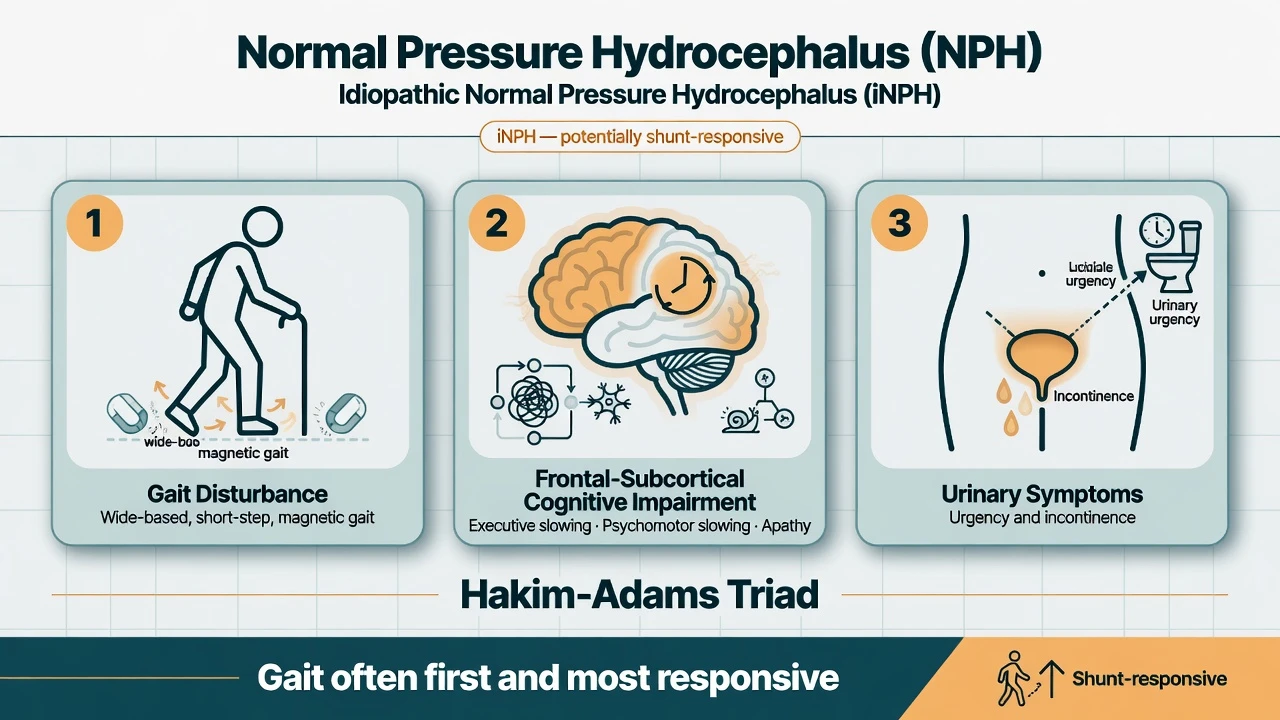
Normal pressure hydrocephalus (NPH) is symptomatic communicating hydrocephalus with CSF opening pressure in the conventionally normal range, classically presenting with progressive gait impairment, cognitive decline, and urinary urgency or incontinence — the Hakim–Adams triad described in 1965.[1][2]
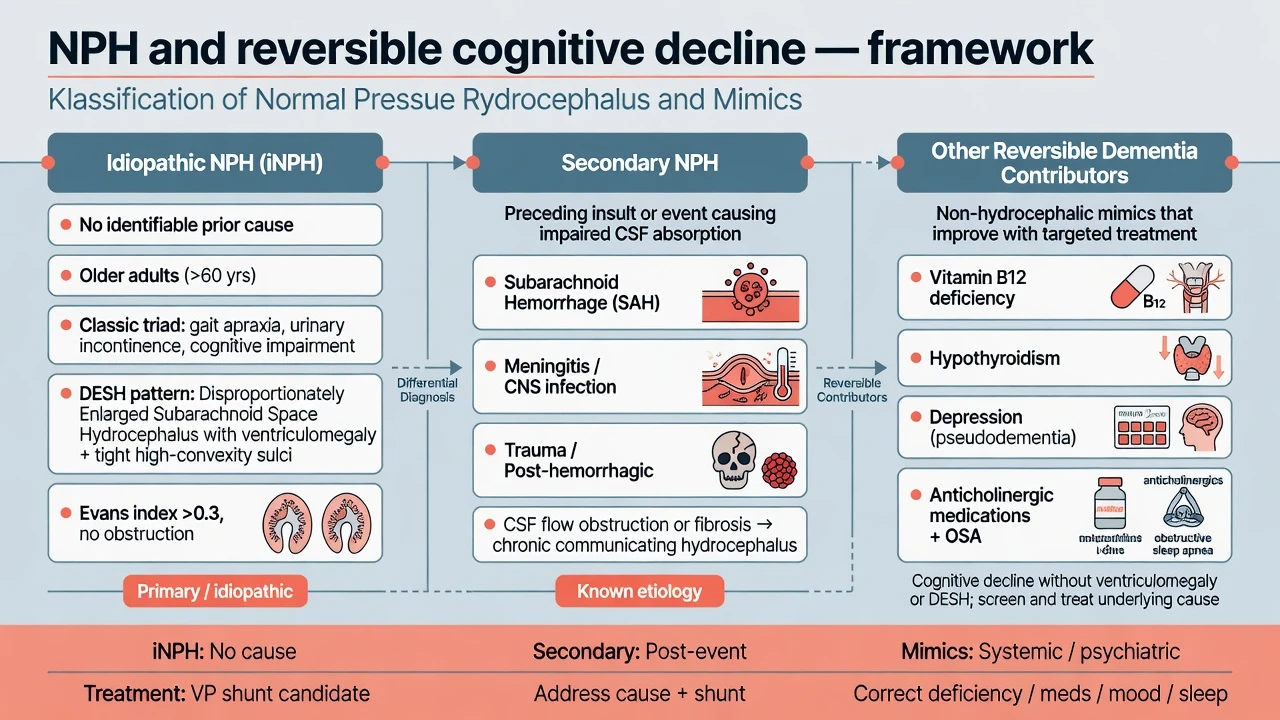
Idiopathic NPH (iNPH) has no identifiable antecedent. Secondary NPH follows prior meningeal irritation or CSF pathway disruption (subarachnoid haemorrhage, meningitis, trauma, some tumours or surgery).[3][10][12]
In DSM-5-TR, cognitive impairment due to NPH is coded as mild or major neurocognitive disorder due to another medical condition, with severity driven by independence — the same independence hinge as other NCD constructs.[21]
Classification
Relkin 2005 clinical categories (iNPH)
The international guideline suite (Relkin diagnostic paper within Marmarou-led guidelines) stratified probable, possible, and unlikely iNPH using history, examination, imaging ventriculomegaly, and CSF pressure in the normal range.[3][4]
Probable iNPH (exam essentials): onset after age 40 (typically much older); insidious progression over at least 3–6 months; gait/balance disturbance mandatory; plus either cognitive or urinary symptoms (or both); ventriculomegaly without obstruction; CSF opening pressure in the normal range; no better alternative explanation.[3][11]
Possible iNPH is more permissive (for example incomplete symptom clusters or less typical imaging) but still requires ventriculomegaly and a compatible clinical picture.[3]
Japanese guidelines and DESH
Japanese Society guidelines (third edition, Nakajima 2021) operationalise MRI-based diagnosis including disproportionately enlarged subarachnoid-space hydrocephalus (DESH) — ventriculomegaly with tight high-convexity sulci and enlarged Sylvian fissures — and define diagnostic certainty partly by response to CSF drainage/shunting.[6][8]
Reversible dementia as a concept
“Reversible dementia” is a teaching phrase, not a single disease. Potentially reversible conditions (depression, B12 deficiency, hypothyroidism, NPH, space-occupying lesions, drugs, etc.) appear in a minority of series; actual full or partial clinical reversal is much rarer.[13][14][15]
Epidemiology and risk
iNPH is predominantly a disorder of older adults, with prevalence estimates rising steeply in the very old and substantial under-recognition when symptoms are ascribed solely to Alzheimer or vascular disease.[10][12]
Clarfield’s meta-analysis (2003) found potentially reversible causes in about 9% of dementia cases across included studies, but only about 0.6% showed partial or full reversal on follow-up — a critical exam statistic that kills naive “10% of dementias reverse” folklore.[13]
Hejl et al. (1000 consecutive memory-clinic patients) found higher rates of potentially reversible primary aetiology (~19%) and concomitant conditions (~23%) among people referred for cognitive symptoms — not all of whom had established dementia — reinforcing systematic work-up even when true cure rates are low.[14]
Weytingh et al. earlier highlighted wide variability in published “reversal” rates depending on case mix and definitions.[15]
Pathophysiology
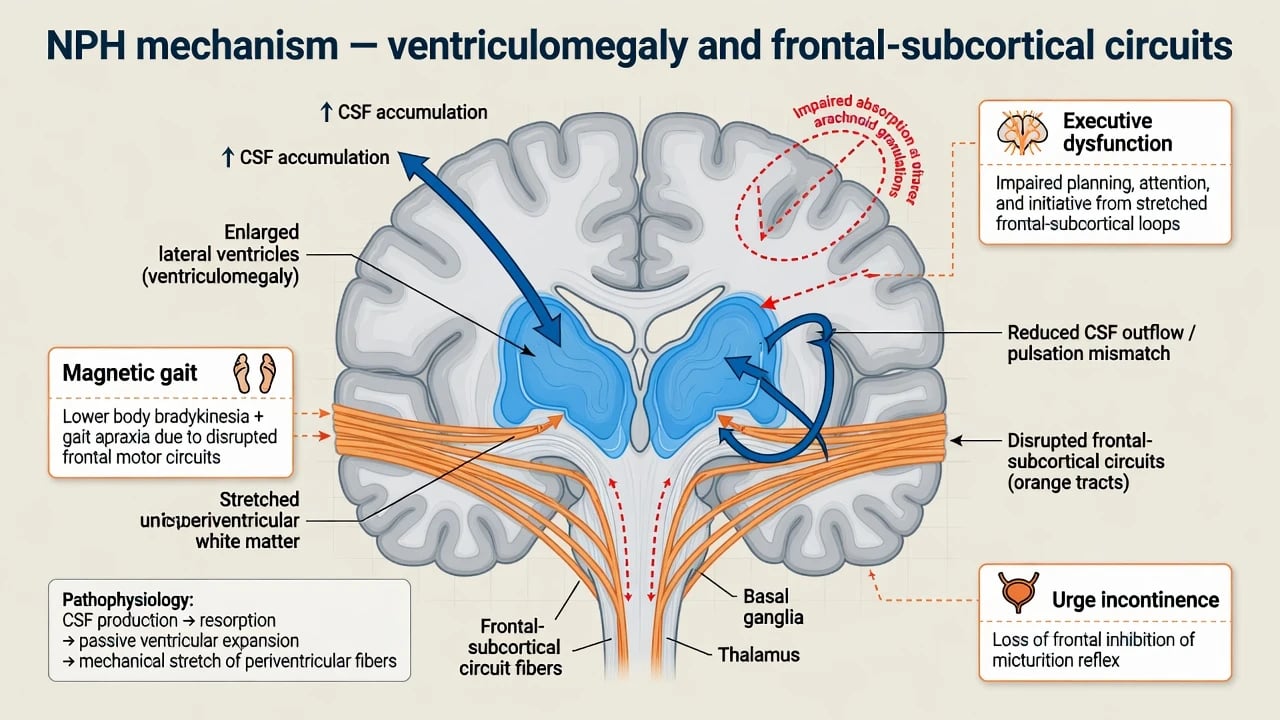
Mechanistic models emphasise impaired CSF dynamics (absorption/resistance) with progressive ventriculomegaly stretching periventricular white-matter tracts and frontal–subcortical circuits — linking magnetic gait, executive dysfunction, and detrusor overactivity/urge incontinence.[2][10][12]
DESH imaging captures the disproportion between ventricular enlargement and high-convexity sulcal effacement, helping separate iNPH-type hydrocephalus from pure atrophy-driven “hydrocephalus ex vacuo,” though mixed pathology is common in the elderly.[6][8]
Secondary NPH reflects post-inflammatory or post-haemorrhagic scarring of CSF resorption pathways.[10]
Clinical presentation
Gait
The signature is a magnetic, apraxic, wide-based, short-step gait with difficulty initiating steps, turning en bloc, and frequent falls. Gait usually appears early and is the domain most likely to improve after CSF diversion.[3][10][12]
Cognition
Expect a frontal–subcortical pattern: bradyphrenia, impaired attention and executive function, reduced processing speed, and retrieval difficulty that may cue better than pure cortical amnesia early on. Frank cortical aphasia or early dense amnesia points away from pure iNPH.[10][12][16]
Urinary symptoms
Urgency often precedes frank incontinence; nocturnal frequency is common.[3][10]
Neuropsychiatric features
Apathy is the most frequent neuropsychiatric symptom on NPI-based assessment in iNPH, followed by anxiety and aggression; depression is also clinically important and may drive CL referral before anyone names NPH.[17] Under-recognition remains common in residential care and general medical settings where symptoms are ascribed solely to “senile dementia.”[18]
Differential diagnosis
| Entity | Discriminators vs NPH |
|---|---|
| Alzheimer disease | Early dense amnesia, cortical features; gait/incontinence late |
| Vascular cognitive impairment | Stepwise course, focal signs, strategic infarcts, severe leukoaraiosis without DESH pattern |
| PSP / atypical parkinsonism | Early postural instability, vertical gaze palsy, axial rigidity |
| DLB | Fluctuation, RBD, recurrent well-formed visual hallucinations |
| Parkinson disease | Rest tremor, clear levodopa-responsive motor syndrome |
| Cervical myelopathy / orthopaedic gait | Upper motor signs, radicular pain, no ventriculomegaly syndrome |
| Depression-related cognitive impairment | Mood primary, effort-related testing pattern; treat and reassess |
| Delirium | Acute, inattention, fluctuation — not a chronic NPH diagnosis setting |
Always co-screen reversible contributors: B12/folate, thyroid, calcium, alcohol, OSA, anticholinergic/sedative burden, depression, subdural haematoma, and tumour when tempo or exam demands it.[13][14][19][22]
Assessment
- History and collateral — tempo of gait vs memory, falls, continence, head injury/SAH/meningitis, vascular risks, mood, sleep, medications.[10][11]
- Gait examination — observe rise, walk, turn, step height, magnetic quality; timed walks if used locally.[10]
- MSE — psychomotor speed, executive bedside tests, free vs cued recall, apathy vs low mood, insight, risk (falls, driving, fire, finance).[17]
- Cognitive screen — MoCA often more sensitive to frontal–executive deficits than MMSE alone; formal neuropsychology when available.[24]
- iNPH scale (Hellström) — structured domains of gait, neuropsychology, balance, and continence for severity and outcome tracking.[16]
- Capacity — decision-specific (understand, appreciate, reason, communicate a choice) for investigations and shunt consent.[23]
Investigations
Bloods: FBC, electrolytes/renal, glucose, B12, folate, TSH, calcium; HIV/syphilis if risk or atypical features.[14][19]
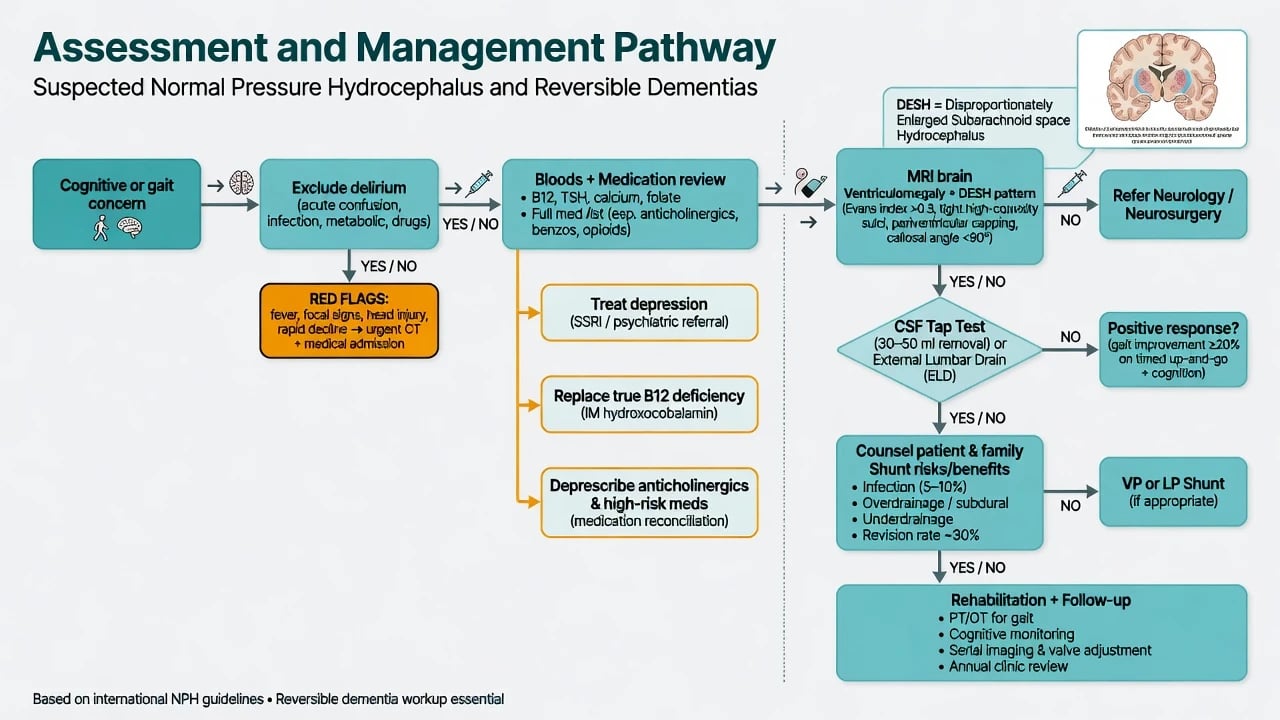
Imaging: MRI preferred (CT if MRI unavailable). Educational targets include ventriculomegaly (Evans index classically cited greater than 0.3 as a rough flag, not NPH-specific), DESH features, and exclusion of mass lesion or significant subdural collection. Discuss patterns educationally — do not invent a patient scan.[6][8][10]
CSF: Opening pressure in the normal range (guideline documents use upper bounds around 20–24 cm H2O depending on source); composition usually unremarkable in iNPH.[3][8]
Prognostic CSF testing: Large-volume CSF tap test with pre/post standardised gait (and cognitive) measures; external lumbar drainage where available may improve predictive performance. Positive response increases likelihood of shunt benefit but is not perfect.[4][10][11]
Management
Acute / safety
Stabilise falls risk, infection, pain, and delirium first. Do not label chronic NPH during an acute confusional episode.[10][22]
Concurrent reversible factors
Treat major depression, replace true B12 deficiency, correct thyroid dysfunction, treat OSA, and deprescribe anticholinergics/sedatives where safe. Cognitive benefit from B12 is most plausible when deficiency is real and decline is not long-established pure AD; Cochrane evidence does not support B12 as a general dementia drug.[13][19][20]
Definitive CSF diversion
Selected patients undergo ventriculoperitoneal (VP) or lumboperitoneal (LP) shunting with programmable valves common in modern practice.[5][7][8]
- SINPHONI supported an MRI-based diagnostic scheme linked to shunt outcomes.[6]
- SINPHONI-2 (Kazui 2015) was an open-label randomised trial supporting LP shunt surgery for iNPH under Japanese guideline protocols.[7]
- Toma et al. systematic review concluded that contemporary shunt series show high rates of improvement with acceptable safety when modern techniques are used — still not risk-free.[9]
- Williams and Malm / Williams and Relkin provide pragmatic neurologist-facing algorithms emphasising organised evaluation before surgery.[10][11]
Counsel honestly: gait is most likely to improve; cognition and continence responses are more variable; concurrent Alzheimer/vascular pathology reduces cognitive gain; complications include infection, overdrainage headache, subdural hygroma/haematoma, obstruction, and revision surgery.[5][9][10]
Non-surgical care
If not a surgical candidate: physiotherapy, falls prevention, continence supports, carer education, treat neuropsychiatric symptoms (apathy/depression), advance care and financial planning, and serial review if the picture evolves toward clearer shunt candidacy.[10][17][22]
Special populations and scenarios
- Oldest-old with multimorbidity: higher surgical risk; still consider if disabling gait and positive prognostic testing after medical optimisation.[10]
- CL “depression/apathy” consults: examine gait and ask about urgency; request imaging review for ventriculomegaly/DESH.[17]
- Secondary NPH (younger adults post-SAH/meningitis): different age spectrum; neurosurgical partnership essential.[10]
- CALD / low education: interpret screens cautiously; track change from baseline.[24]
- Capacity for shunt consent: decision-specific; involve substitute decision-makers under local law when capacity fails.[23]
Prognosis and disposition
Untreated symptomatic iNPH generally progresses. Appropriately selected shunted patients often improve, especially in gait; durability requires follow-up for valve adjustment and complications.[9][10][12] Document driving advice, falls plan, and who will review post-shunt outcomes.
Regional notes
ANZ (FRANZCP). CL psychiatrists often first meet NPH as “depression,” “apathy,” or “failure to thrive.” Pathways run through geriatric medicine, neurology, and neurosurgery; access to ELD and specialised CSF infusion studies is centre-dependent. Guardianship and driving rules are jurisdiction-specific — state principles without inventing section numbers.[10][23]
UK (MRCPsych). Carswell’s contemporary guide is a useful narrative synthesis; CASC stations test explanation of uncertain prognosis and shunt risk without jargon dumps.[12]
US (ABPN). Relkin/Marmarou guideline lineage and Continuum reviews are core citations; programmable valve practice is widespread.[3][4][10]
Japan / East Asia literature. DESH-centred MRI diagnosis and SINPHONI / SINPHONI-2 protocols heavily influence global exam answers on imaging and LP shunts.[6][7][8]
India (MD/DNB, NEET-SS). High rates of treatable metabolic contributors and mixed vascular pathology; never skip B12/thyroid/syphilis where relevant; neurosurgical access varies.[13][14][19]
Exam pearls
NPH TAP
References
- [1]Adams RD, Fisher CM, Hakim S, et al. SYMPTOMATIC OCCULT HYDROCEPHALUS WITH NORMAL CEREBROSPINAL-FLUID PRESSURE. A TREATABLE SYNDROME N Engl J Med, 1965.PMID 14303656
- [2]Hakim S, Adams RD The special clinical problem of symptomatic hydrocephalus with normal cerebrospinal fluid pressure. Observations on cerebrospinal fluid hydrodynamics J Neurol Sci, 1965.PMID 5889177
- [3]Relkin N, Marmarou A, Klinge P, et al. Diagnosing idiopathic normal-pressure hydrocephalus Neurosurgery, 2005.PMID 16160425
- [4]Marmarou A, Bergsneider M, Relkin N, et al. Development of guidelines for idiopathic normal-pressure hydrocephalus: introduction Neurosurgery, 2005.PMID 16160424
- [5]Bergsneider M, Black PM, Klinge P, et al. Surgical management of idiopathic normal-pressure hydrocephalus Neurosurgery, 2005.PMID 16160427
- [6]Hashimoto M, Ishikawa M, Mori E, et al. Diagnosis of idiopathic normal pressure hydrocephalus is supported by MRI-based scheme: a prospective cohort study Cerebrospinal Fluid Res, 2010.PMID 21040519
- [7]Kazui H, Miyajima M, Mori E, et al. Lumboperitoneal shunt surgery for idiopathic normal pressure hydrocephalus (SINPHONI-2): an open-label randomised trial Lancet Neurol, 2015.PMID 25934242
- [8]Nakajima M, Yamada S, Miyajima M, et al. Guidelines for Management of Idiopathic Normal Pressure Hydrocephalus (Third Edition): Endorsed by the Japanese Society of Normal Pressure Hydrocephalus Neurol Med Chir (Tokyo), 2021.PMID 33455998
- [9]Toma AK, Papadopoulos MC, Stapleton S, et al. Systematic review of the outcome of shunt surgery in idiopathic normal-pressure hydrocephalus Acta Neurochir (Wien), 2013.PMID 23975646
- [10]Williams MA, Malm J Diagnosis and Treatment of Idiopathic Normal Pressure Hydrocephalus Continuum (Minneap Minn), 2016.PMID 27042909
- [11]Williams MA, Relkin NR Diagnosis and management of idiopathic normal-pressure hydrocephalus Neurol Clin Pract, 2013.PMID 24175154
- [12]Carswell C Idiopathic normal pressure hydrocephalus: historical context and a contemporary guide Pract Neurol, 2023.PMID 36162853
- [13]Clarfield AM The decreasing prevalence of reversible dementias: an updated meta-analysis Arch Intern Med, 2003.PMID 14557220
- [14]Hejl A, Høgh P, Waldemar G Potentially reversible conditions in 1000 consecutive memory clinic patients J Neurol Neurosurg Psychiatry, 2002.PMID 12235305
- [15]Weytingh MD, Bossuyt PM, van Crevel H Reversible dementia: more than 10% or less than 1%? A quantitative review J Neurol, 1995.PMID 7595679
- [16]Hellström P, Klinge P, Tans J, et al. A new scale for assessment of severity and outcome in iNPH Acta Neurol Scand, 2012.PMID 22587624
- [17]Kito Y, Kazui H, Kubo Y, et al. Neuropsychiatric symptoms in patients with idiopathic normal pressure hydrocephalus Behav Neurol, 2009.PMID 19996513
- [18]Siraj S An overview of normal pressure hydrocephalus and its importance: how much do we really know? J Am Med Dir Assoc, 2011.PMID 21194654
- [19]Moore E, Mander A, Ames D, et al. Cognitive impairment and vitamin B12: a review Int Psychogeriatr, 2012.PMID 22221769
- [20]Malouf R, Areosa Sastre A Vitamin B12 for cognition Cochrane Database Syst Rev, 2003.PMID 12918012
- [21]Sachdev PS, Blacker D, Blazer DG, et al. Classifying neurocognitive disorders: the DSM-5 approach Nat Rev Neurol, 2014.PMID 25266297
- [22]Livingston G, Huntley J, Sommerlad A, et al. Dementia prevention, intervention, and care: 2020 report of the Lancet Commission Lancet, 2020.PMID 32738937
- [23]Appelbaum PS, Grisso T Assessing patients' capacities to consent to treatment N Engl J Med, 1988.PMID 3200278
- [24]Nasreddine ZS, Phillips NA, Bédirian V, et al. The Montreal Cognitive Assessment, MoCA: a brief screening tool for mild cognitive impairment J Am Geriatr Soc, 2005.PMID 15817019