Psych · Consultation-liaison psychiatry
Parkinson disease psychiatry
Also known as Parkinson's disease psychosis · PD psychosis · Impulse control disorders Parkinson · Dopamine dysregulation syndrome · Parkinson disease depression · Neuropsychiatric Parkinson disease · Pimavanserin · Clozapine Parkinson psychosis
Exam-exhaustive fellowship topic on the psychiatry of Parkinson disease: depression and apathy, PD psychosis (Ravina criteria, visual hallucinations), clozapine and pimavanserin, impulse control disorders from dopamine agonists, dopamine dysregulation syndrome, cognitive spectrum, and joint CL–neurology management. FRANZCP-primary, globally tagged.
On this page & tools
Your progress
Saved locally on this device.
Target exams
Red flags
Psychiatrists fail this topic when they prescribe haloperidol for "organic psychosis," when they miss pathological gambling because they never ask collateral, or when they leave PD depression untreated as "understandable." Examiners reward stepwise DRT review, clozapine/pimavanserin literacy, and ICD/DDS discrimination.[4][6][11][15]
Overview and definition
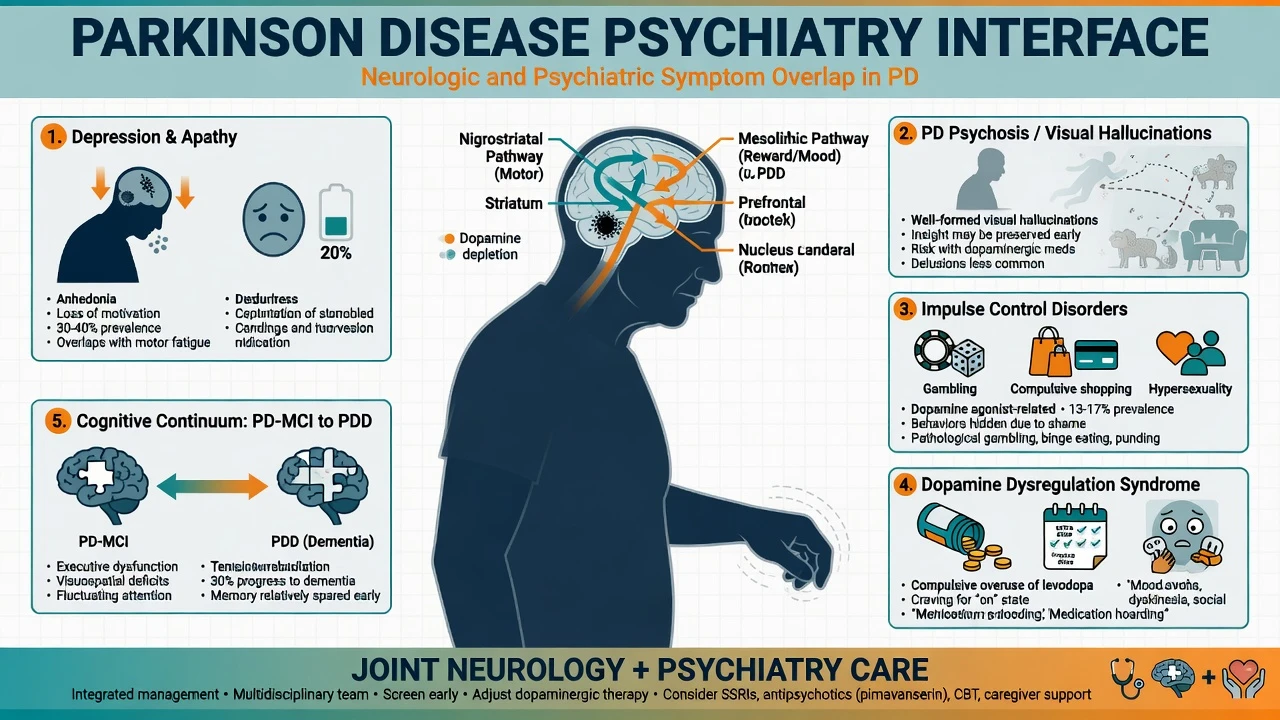
Parkinson disease psychiatry covers the nonmotor neuropsychiatric syndromes of idiopathic PD: affective and apathy syndromes, psychosis spectrum phenomena, impulse control and related behaviours linked to dopamine replacement therapy (DRT), cognitive impairment through to PD dementia (PDD), anxiety, sleep-related phenomena (including REM sleep behaviour disorder as a related marker), and the psychopharmacology of agents that can worsen motor function. In DSM-5-TR language many syndromes map to mental disorder due to another medical condition or medication-induced disorders; the clinical task is mechanism-aware management without sacrificing mobility or safety.[1][11][16]
Epidemiology
Clinically significant depressive symptoms are common; systematic review shows wide study heterogeneity but consistently elevated burden versus age-matched peers, with clinically relevant depression in roughly one-third of patients depending on threshold and setting.[3] Hallucinations, mainly visual, affect a substantial minority and become more frequent with longer disease duration, cognitive impairment, sleep disturbance, and dopaminergic treatment intensity.[2]
Impulse control disorders (ICDs) occurred in 13.6% of patients in a large cross-sectional study of 3090 PD patients, with significantly higher rates among those treated with dopamine agonists than those not on agonists.[4] Case–control data refine risk markers including younger onset, novelty seeking, personal/family substance or gambling history, and agonist exposure.[5] Dopamine dysregulation syndrome (DDS) is less common (order of a few percent in specialist clinics) but high-impact.[13][14]
Classification of key syndromes
PD psychosis (NINDS/NIMH — Ravina)
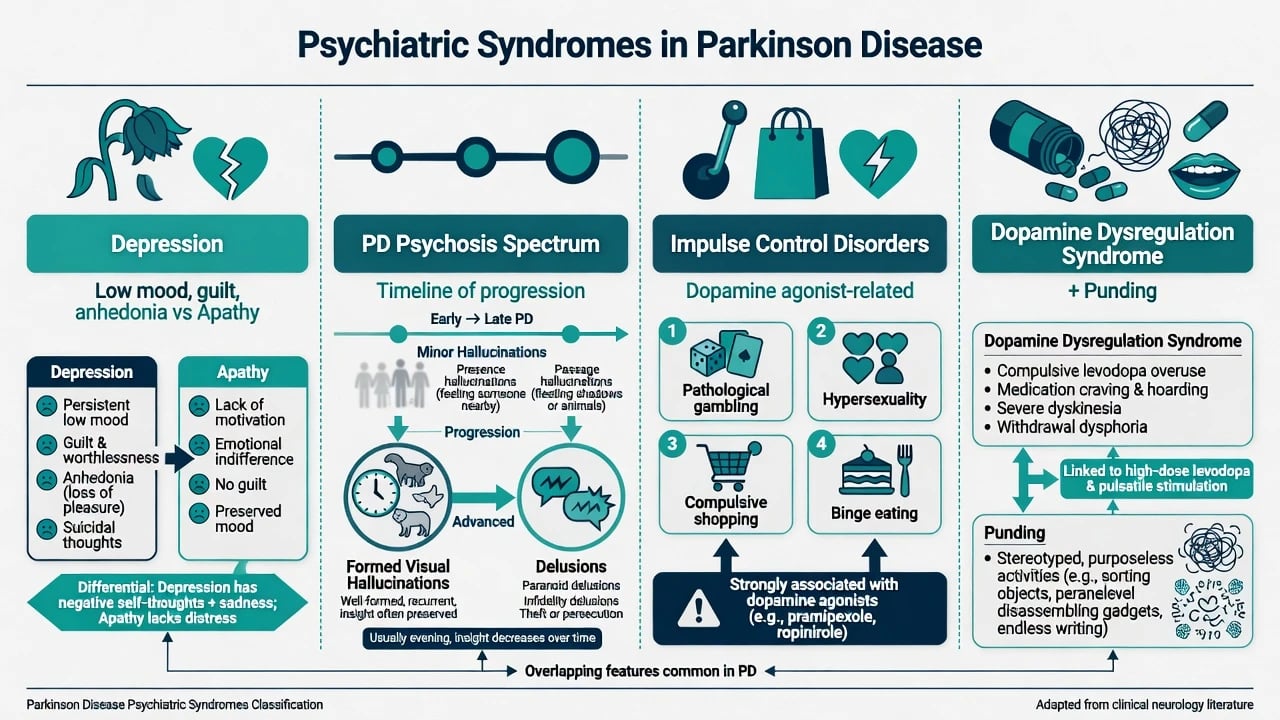
The NINDS/NIMH work group proposed operational criteria for PD-associated psychosis: characteristic symptoms (illusions, false sense of presence, hallucinations, or delusions), recurrent or continuous for at least 1 month, occurring after PD onset, not better accounted for solely by another cause such as delirium, and often with associated features (e.g. insight may be retained early; sleep disturbance common).[1] Phenotype classically starts with minor hallucinations (sense of a person nearby — "presence" — or a fleeting shadow — "passage") and may progress to formed visual hallucinations of people or animals and to paranoid delusions (infidelity is a classic stem).[1][2]
Depression versus apathy
Depression includes dysphoria, guilt, hopelessness, and anhedonia with suicide risk. Apathy is reduced motivation and goal-directed behaviour without the same affective pain; both may coexist and both impair function. Overlap with PD motor features (bradykinesia, hypomimia, sleep change, fatigue) forces careful history rather than symptom-count alone.[3][9]
Impulse control disorders, DDS, and punding
ICDs are behavioural addictions: pathological gambling, hypersexuality, compulsive shopping, and binge eating — strongly associated with dopamine agonists (pramipexole, ropinirole, rotigotine and related agents).[4][5] DDS (originally framed as hedonistic homeostatic dysregulation) is compulsive overuse of DRT beyond motor need, with craving, dysphoria off-drug, and often severe dyskinesias.[13][14] Punding is repetitive, non-goal-directed stereotyped behaviour. Examiners punish conflating ICD with DDS: ICD can occur at prescribed agonist doses without dose-seeking; DDS is about addictive DRT use pattern.[14]
Pathophysiology (viva depth)
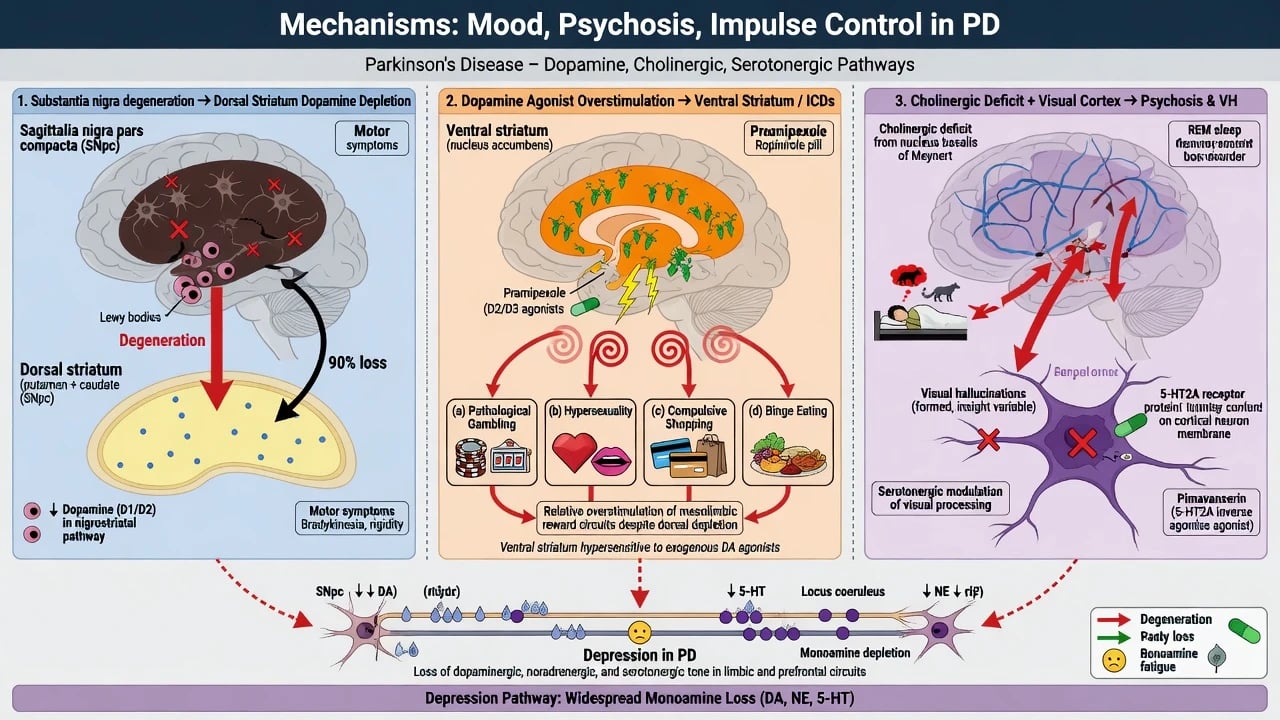
Degeneration of nigrostriatal dopamine systems drives motor PD, while mesocorticolimbic and monoaminergic loss contribute to mood, motivation, and reward dysregulation.[14][16] Psychosis involves a mix of cholinergic deficit, visual network dysfunction, sleep-state intrusion (links with RBD), and relative dopaminergic overstimulation of more intact ventral systems by DRT.[2][11] Agonist-related ICDs map to D2/D3-rich reward circuitry; reducing agonist drive is mechanistically rational first-line behavioural risk management.[4][5] Depression is both neurobiological and psychosocial — not pure "reaction to disability."[3]
Clinical assessment for CL
Structure history around: PD diagnosis and stage; ON/OFF timing of mood or psychosis; full medication list (levodopa, agonists, MAO-B inhibitors, COMT inhibitors, amantadine, anticholinergics, psychotropics); recent dose escalations; cognition and RBD; vision; infection/delirium precipitants; suicide and aggression risk; finances and sexual risk for ICD; caregiver safety; capacity.[1][4][16]
Always take collateral for ICDs — patients frequently minimise gambling or hypersexuality. Screen cognition (e.g. MoCA) when psychosis, functional decline, or caregiver concern appears. MSE language should capture visual phenomena, insight, paranoia, mood versus flat apathy, and fluctuating attention that might signal delirium or DLB-spectrum features.[2][4]
Differential diagnosis
- Delirium — acute, fluctuating attention; infection, metabolic, anticholinergic toxicity, post-operative states.
- Dementia with Lewy bodies (DLB) versus PDD — classic 1-year rule for cognitive–motor timing; shared antipsychotic sensitivity.
- Primary psychotic or bipolar disorders coincidental with PD.
- Charles Bonnet-like pure visual release in severe visual impairment (still review DRT and cognition).
- Medication toxicity — anticholinergics, amantadine, high-dose agonists, steroids.
- ICD vs hypomania; DDS vs anxiety about OFF periods with appropriate dose negotiation.[1][11][14]
Investigations
For new or worsening neuropsychiatric change: delirium panel as indicated (infection screen, electrolytes, glucose, urine); medication reconciliation; visual acuity; cognitive testing; ECG and metabolic baseline before antipsychotics; FBC pathway before and during clozapine; consider cholinesterase inhibitor path when dementia with hallucinations is established. Imaging and broader organic work-up when the presentation is atypical for PD stage or tempo — jointly with neurology.[6][11][12]
Acute management
Psychosis stepwise approach
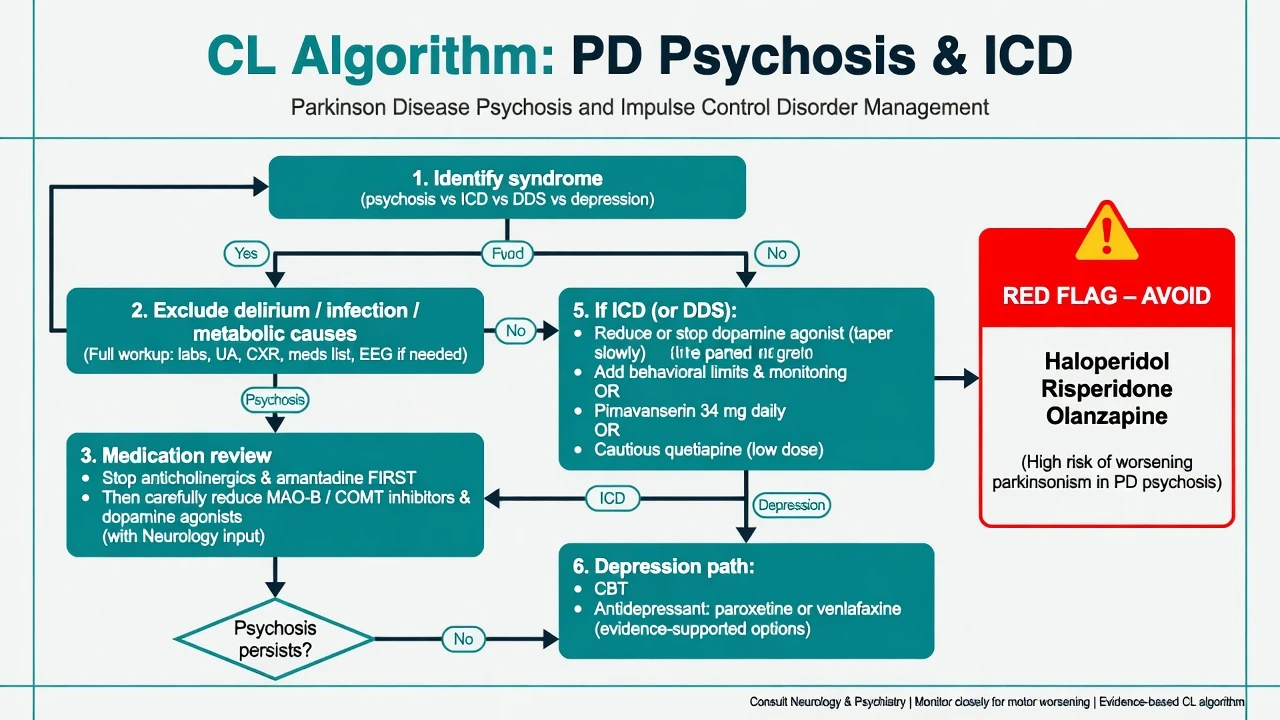
- Exclude and treat delirium/precipitants.
- Review and reduce offending agents with neurology: anticholinergics and amantadine early; then consider reducing MAO-B/COMT or dopamine agonists; last, careful levodopa adjustments if essential — never strip all motor therapy overnight without a plan.[11][16]
- Non-pharmacological measures: lighting, orientation, sleep hygiene, caregiver education that arguing with hallucinations rarely helps.
- If psychosis remains distressing or dangerous, add PD-appropriate antipsychotic (below).[6][8][11]
Agents to avoid
High-potency dopamine D2 antagonists (haloperidol, many typicals) and agents with substantial motor-worsening liability (risperidone, olanzapine in classic stems) are exam traps. Prefer agents with evidence for motor sparing at low dose, and always reassess need.[11][15][16]
Definitive pharmacotherapy of PD psychosis
Clozapine (best traditional evidence)
Two landmark randomised trials established low-dose clozapine for drug-induced psychosis in PD without significant motor worsening when doses remain low. The Parkinson Study Group trial supported benefit at daily doses of 50 mg or less.[6] The French randomised study (Pollak and colleagues) similarly supports efficacy with open follow-up data.[7]
Practical exam dosing (adult PD psychosis, with monitoring): start clozapine 6.25–12.5 mg oral at night, titrate slowly by small increments every few days according to response and tolerability, often remaining well below schizophrenia-range doses (commonly aiming under 25–50 mg/day total). Mandatory full blood count monitoring per local clozapine protocol (agranulocytosis risk), plus vigilance for sedation, orthostatic hypotension, sialorrhoea, constipation/ileus risk, myocarditis rare signals, seizures at higher doses, and metabolic effects. Co-manage with neurology for motor status.[6][7][11]
Pimavanserin
Pimavanserin is a selective 5-HT2A inverse agonist without dopamine D2 antagonism. In the pivotal phase 3 trial, fixed-dose pimavanserin 34 mg oral once daily improved PD psychosis scores versus placebo without worsening motor function in the study population.[8] Availability and subsidy are region-dependent (FDA-approved for PD psychosis in the US; limited or specialist access elsewhere). Discuss QTc and interactions when relevant; still exclude delirium and optimise DRT first.[8][11]
Quetiapine
Quetiapine is widely used off-label at low night doses in practice for PD psychosis because of motor tolerability impressions, but randomised evidence is weaker and more mixed than for clozapine. MDS evidence-based reviews treat clozapine (with monitoring) and pimavanserin as the better-supported pharmacological options for PD psychosis, with quetiapine as a pragmatic alternative when clozapine/pimavanserin are not feasible.[11] Example cautious use: quetiapine 12.5–25 mg oral at night, slow titration, watch sedation and falls — cite practice context, not oversell RCT certainty.[11][16]
Antipsychotic mortality signal
Observational data associate antipsychotic use with increased mortality risk in PD after adjustment for measurable confounders. This is a risk-communication and deprescribing prompt, not a reason to abandon treatment of dangerous psychosis; use lowest effective dose, shortest appropriate duration, and non-drug measures first.[15]
Depression management
Do not leave depression untreated. SAD-PD showed that paroxetine and venlafaxine XR improved depression versus placebo in PD (Class I evidence for efficacy of those agents in the trial).[9] Example starts (adult, after interaction check with MAO-B inhibitors — critical safety point): paroxetine may be started around 10 mg oral daily with slow titration toward trial-range doses under review; venlafaxine XR often started 37.5 mg oral daily then titrated (trial mean doses were higher — individualise). Never combine with nonselective MAOIs; use extreme caution / follow product guidance with selegiline/rasagiline regarding serotonin toxicity risk. Monitor hyponatraemia, activation, suicidality, tremor, and motor change.[9][11]
CBT adapted for PD improved depression versus clinical monitoring in an RCT and is a first-line or adjunctive option, especially when patients prefer psychological care or when drug interactions constrain antidepressants.[10] Exercise, social support, and optimising OFF-period disability are part of comprehensive care.[11]
Impulse control disorders and DDS management
ICD
Primary intervention is reduction or cessation of the dopamine agonist under neurology supervision, with careful replacement of motor cover (often levodopa adjustment) to avoid severe OFF and dopamine agonist withdrawal syndrome (anxiety, pain, drug craving, autonomic features).[4][5][11] Add behavioural limits (financial controls, partner supervision of cards/online access), treat comorbid depression, and document risk. Many ICDs improve after agonist withdrawal, but social damage may persist.[4][5]
DDS
Management centres on supervised DRT rationalisation, limiting access to surplus tablets, treating mood/psychosis comorbidities, and structured follow-up; evidence base is largely observational and mechanistic rather than large RCTs.[13][14] Younger male patients with early-onset PD and high DRT exposure are classic risk profiles for DDS.[13][14]
Cognition and PD dementia
When dementia develops in established PD (PDD), rivastigmine showed moderate cognitive and global benefits versus placebo in a landmark RCT, with gastrointestinal side effects and possible tremor increase — still a core evidence-based option for PDD neuropsychiatric complexity including hallucinations in some patients.[12][11] Distinguish from DLB timing when classification matters for trials or counselling, but antipsychotic sensitivity is shared caution.[12]
Special populations
Young-onset PD: higher ICD/DDS risk on agonists — proactive education at agonist initiation.[4][5] Older adults: falls, orthostasis, delirium, QTc, polypharmacy — slower titration. Cognitive impairment: capacity assessments for finances and care placement; caregiver involvement. Cultural formulations: visual phenomena may be framed spiritually — still apply medical risk assessment while respecting explanatory models.[11][16]
Prognosis and disposition
Psychosis and dementia predict higher care needs and institutionalisation risk; depression drives quality of life and suicide risk independent of pure motor scores.[2][3] Disposition should include neurology/PD clinic, mental health or CL follow-up when psychosis/ICD/depression is active, caregiver education, and clear escalation plans. Driving and occupational decisions follow local legal standards after psychosis, sleep attack risk, or cognitive decline — do not invent rules.[11][16]
Regional notes
ANZ (FRANZCP): Clozapine available with local blood-monitoring programmes; pimavanserin often not routinely funded — answer with clozapine evidence and quetiapine pragmatism. Use jurisdiction-specific Mental Health Act principles if capacity lacking (do not invent section numbers). UK (MRCPsych): NICE PD guidance emphasises specialist PD services and careful antipsychotic choice; CASC communication about hallucinations and agonist risks is high yield. US (ABPN): pimavanserin FDA-approved for PD psychosis; still teach clozapine evidence and black-box antipsychotic mortality awareness in elderly/dementia-related contexts. South Asia (MD/DNB, NEET-SS): agonist ICD education critical where pramipexole is common; clozapine monitoring infrastructure varies — prioritise DRT simplification and safety.[6][8][11]
Exam pearls
PD-PSYCH
Summary
Fellowship-level PD psychiatry is a systems interface: depression is treatable (SAD-PD pharmacotherapy and CBT), psychosis is diagnosable (Ravina spectrum from minor hallucinations to delusions) and manageable with DRT optimisation plus low-dose clozapine or pimavanserin, and ICD/DDS demand proactive agonist/DRT risk management with collateral history. A candidate who refuses haloperidol, quotes low-dose clozapine monitoring, names pimavanserin 34 mg, and stops the dopamine agonist for gambling has mastered the exam spine of this topic.[1][4][6][8][9][11]
References
- [1]Ravina B, Marder K, Fernandez HH, et al. Diagnostic criteria for psychosis in Parkinson's disease: report of an NINDS, NIMH work group Mov Disord, 2007.PMID 17266092
- [2]Fénelon G, Mahieux F, Huon R, Ziégler M Hallucinations in Parkinson's disease: prevalence, phenomenology and risk factors Brain, 2000.PMID 10734005
- [3]Reijnders JS, Ehrt U, Weber WE, Aarsland D, Leentjens AF A systematic review of prevalence studies of depression in Parkinson's disease Mov Disord, 2008.PMID 17987654
- [4]Weintraub D, Koester J, Potenza MN, et al. Impulse control disorders in Parkinson disease: a cross-sectional study of 3090 patients Arch Neurol, 2010.PMID 20457959
- [5]Voon V, Sohr M, Lang AE, et al. Impulse control disorders in Parkinson disease: a multicenter case--control study Ann Neurol, 2011.PMID 21416496
- [6]Parkinson Study Group Low-dose clozapine for the treatment of drug-induced psychosis in Parkinson's disease N Engl J Med, 1999.PMID 10072410
- [7]Pollak P, Tison F, Rascol O, et al. Clozapine in drug induced psychosis in Parkinson's disease: a randomised, placebo controlled study with open follow up J Neurol Neurosurg Psychiatry, 2004.PMID 15090561
- [8]Cummings J, Isaacson S, Mills R, et al. Pimavanserin for patients with Parkinson's disease psychosis: a randomised, placebo-controlled phase 3 trial Lancet, 2014.PMID 24183563
- [9]Richard IH, McDermott MP, Kurlan R, et al. A randomized, double-blind, placebo-controlled trial of antidepressants in Parkinson disease Neurology, 2012.PMID 22496199
- [10]Dobkin RD, Menza M, Allen LA, et al. Cognitive-behavioral therapy for depression in Parkinson's disease: a randomized, controlled trial Am J Psychiatry, 2011.PMID 21676990
- [11]Seppi K, Ray Chaudhuri K, Coelho M, et al. Update on treatments for nonmotor symptoms of Parkinson's disease-an evidence-based medicine review Mov Disord, 2019.PMID 30653247
- [12]Emre M, Aarsland D, Albanese A, et al. Rivastigmine for dementia associated with Parkinson's disease N Engl J Med, 2004.PMID 15590953
- [13]Giovannoni G, O'Sullivan JD, Turner K, Manson AJ, Lees AJ Hedonistic homeostatic dysregulation in patients with Parkinson's disease on dopamine replacement therapies J Neurol Neurosurg Psychiatry, 2000.PMID 10727476
- [14]O'Sullivan SS, Evans AH, Lees AJ Dopamine dysregulation syndrome: an overview of its epidemiology, mechanisms and management CNS Drugs, 2009.PMID 19173374
- [15]Weintraub D, Chiang C, Kim HM, et al. Association of Antipsychotic Use With Mortality Risk in Patients With Parkinson Disease JAMA Neurol, 2016.PMID 26999262
- [16]Connolly BS, Lang AE Pharmacological treatment of Parkinson disease: a review JAMA, 2014.PMID 24756517