Psych · Foundations
Human development across the lifespan
Also known as Lifespan development · Developmental psychology for psychiatry · Piaget Erikson Kohlberg · Cognitive ageing · Gene-environment development · Sensitive periods psychiatry
Exam-exhaustive fellowship reference on human development across the lifespan for psychiatry — Piaget, Erikson, Kohlberg/Gilligan, adult development and successful ageing, ageing cognition, gene–environment interplay, adversity timing and plasticity, resilience, and clinical/exam applications for FRANZCP, MRCPsych, ABPN, and MD/DNB.
On this page & tools
Your progress
Saved locally on this device.
Target exams
Red flags
Psychiatry exams (FRANZCP theory and clinical, MRCPsych Paper A developmental psychology, ABPN lifespan blueprint, MD/DNB viva) still demand fluent stage vocabulary and the ability to update it with plasticity, resilience, and non-deterministic adversity science. Stage ages are approximate teaching tools, not hard cut-offs.[14][15][18]
Definition and classification of developmental frameworks
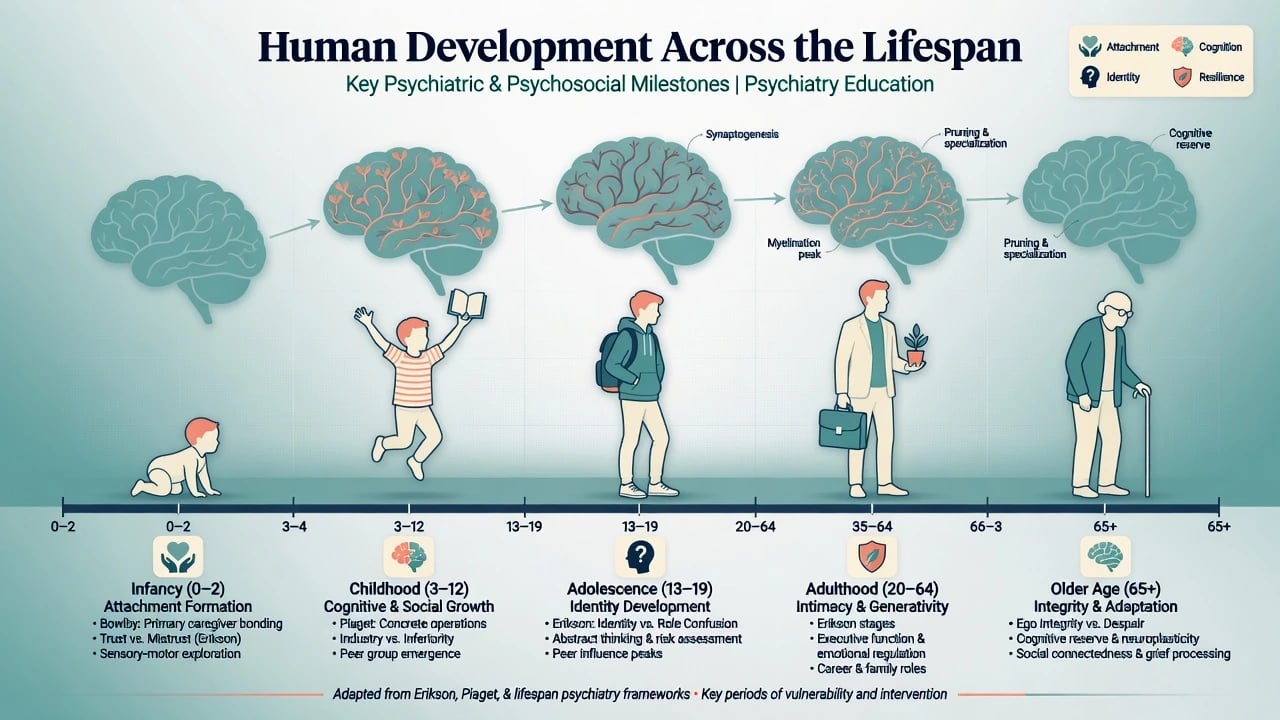
Development is ordered change over time in structure and function. Models differ by domain (cognition, identity, morality), assumed continuity, and cultural scope.[1][6]
| Framework | Core claim | Exam use |
|---|---|---|
| Piaget | Qualitative cognitive stages built by assimilation/accommodation | Child interview style; CBT adaptation; capacity-style reasoning level |
| Erikson | Eight psychosocial crises across the life course | Formulation language from trust to integrity |
| Kohlberg | Moral reasoning stages from punishment avoidance to principled ethics | Forensic/ethics stems; Heinz dilemma logic |
| Marcia | Identity statuses from exploration × commitment | Adolescent/young adult identity assessment |
| Dual systems / social brain | Reward and control systems mature on different timetables | Adolescent risk, substance, peer influence |
| SOC / processing-speed / SLS | Adult and late-life adaptation and intellectual trajectories | Old-age psychiatry and rehabilitation framing |
Continuous vs discontinuous change
Stage theories emphasise qualitative reorganisation (e.g. conservation, formal operations). Dimensional approaches emphasise quantitative growth in speed, knowledge, and executive control. Clinical practice needs both: stages for communication and scaffolding; dimensions for measurement and heterogeneity.[1][2]
Sensitive vs critical periods
A sensitive period is a window when experience has especially strong effects. A critical period is stricter: required experience must occur or typical development is permanently altered. Human socioemotional development is often better described with sensitive-period language, but severe early deprivation can approach critical-period consequences for language, attachment circuitry, and cognition.[14][15]
Epidemiology and clinical stakes
Development is not a disease with prevalence, but age-banded risk is examinable.[5][9]
- First-episode psychosis and many substance-use onsets cluster in late adolescence and early adulthood, overlapping dual-systems immaturity and social-brain change.[3][4][5]
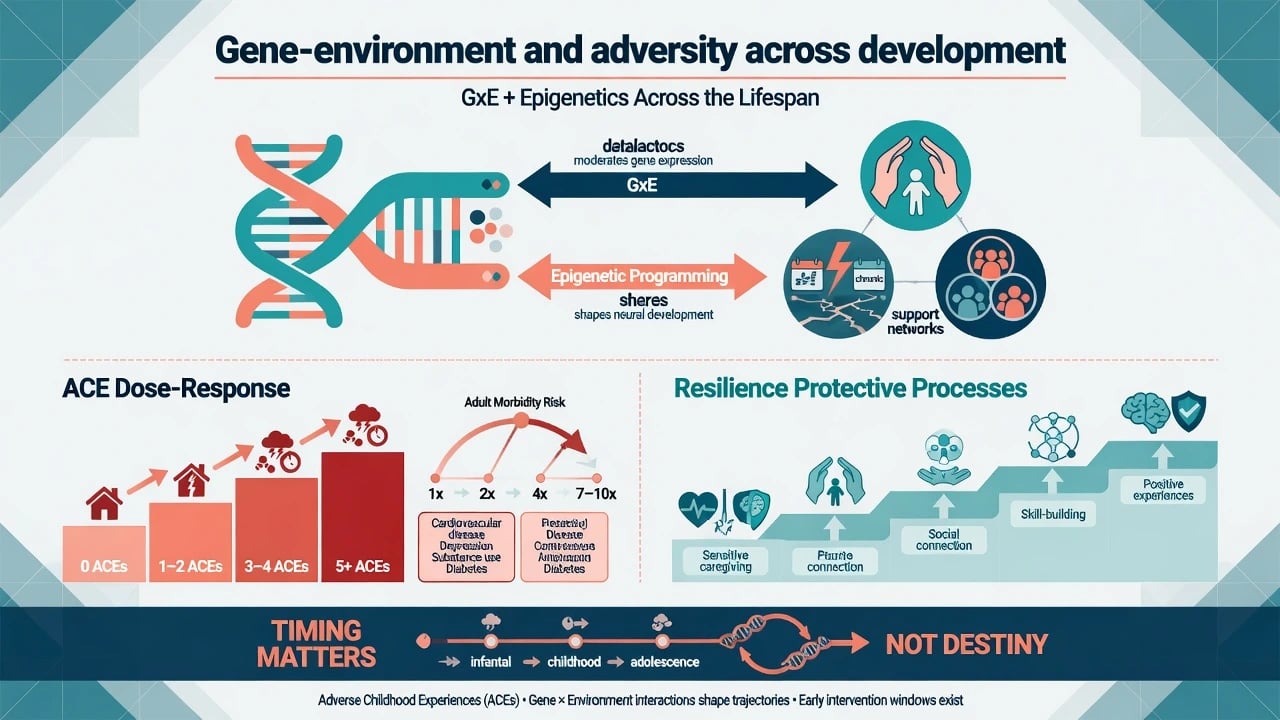
- ACE exposure shows a graded association with adult mental and physical morbidity; higher cumulative ACE counts associate with higher rates of depression and other outcomes in epidemiological cohorts.[9][10]
- Late-life cognitive impairment and dementia risk rise with age; normal ageing trajectories are heterogeneous and modified by education, vascular risk, and activity.[19][20]
- Resilience after maltreatment is real: a substantial minority avoid adult psychiatric disorder despite severe childhood adversity — resilience is inferred from better-than-expected outcome, not from invulnerability.[18]
Mechanisms — brain, mind, gene–environment
Cortical maturation and executive function
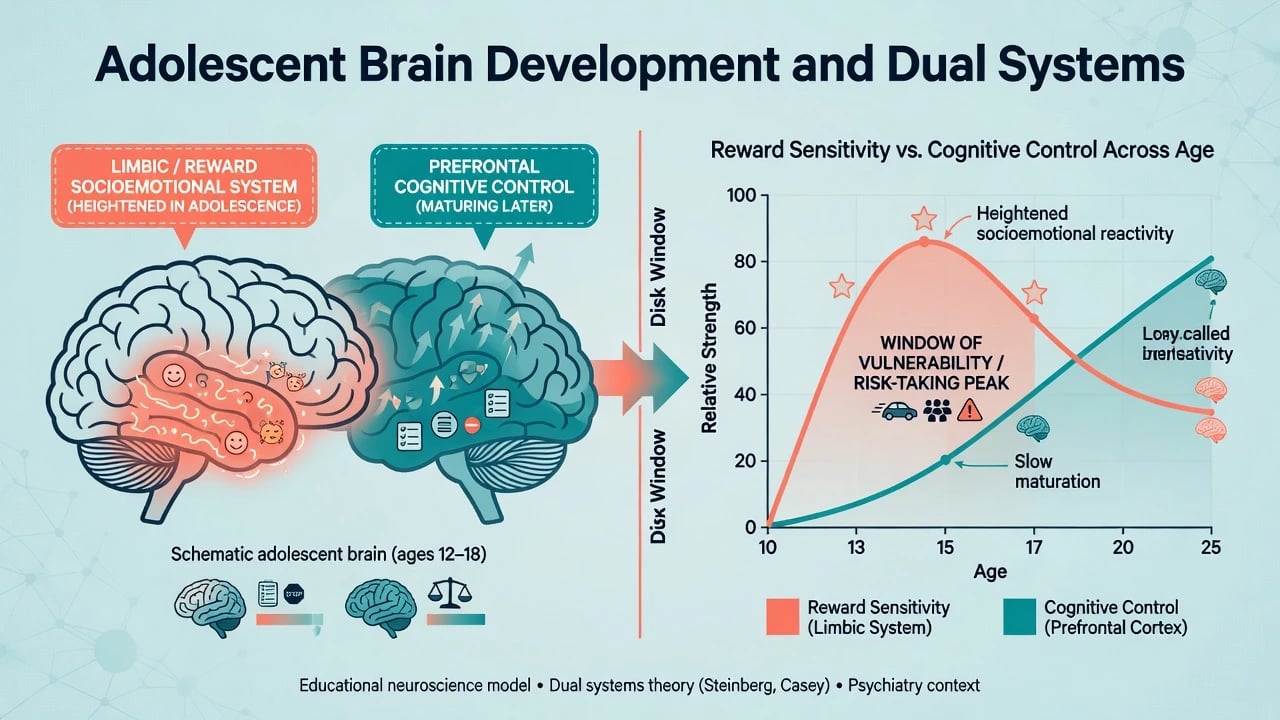
Longitudinal MRI maps show dynamic grey-matter change from childhood into early adulthood, with association cortices and prefrontal systems among the later-maturing regions.[2][3] Executive functions — inhibition, working memory, and cognitive flexibility — develop over a protracted course and support planning, self-regulation, and abstract problem-solving that underwrite later Piagetian formal operations and adult judgement.[1]
Adolescent social brain and dual systems
Adolescence remodels the social brain (networks for mentalising, peer evaluation, and social emotion).[4] Steinberg’s dual systems account: reward-seeking and impulsivity follow different developmental timetables; mid-adolescence combines relatively high reward drive with still-maturing self-control — a vulnerability window for risk-taking, especially with peers and substances.[5]
Gene–environment interplay and epigenetics
Development is neither genetic destiny nor pure environment. Classic animal work on maternal care shows epigenetic programming of stress-reactivity pathways — a mechanism language for how caregiving quality can become biologically embedded.[11]
The Caspi et al. report that 5-HTTLPR short alleles moderated stress-related depression risk became a canonical G×E exam stem.[12] Collaborative meta-analysis later found no evidence of a strong stress × 5-HTTLPR interaction for depression — candidates must know both the classic finding and the replication crisis response.[13]
Adversity timing and neurobiology
Early abuse and neglect associate with enduring structural and functional alterations across stress, reward, and threat systems; effects depend on type, timing, and chronicity of adversity.[17] Severe institutional deprivation illustrates critical/sensitive-period logic: the Bucharest Early Intervention Project (BEIP) randomised foster care versus care as usual and showed greater cognitive recovery with earlier placement into family care.[16]
Adult and late-life mechanisms
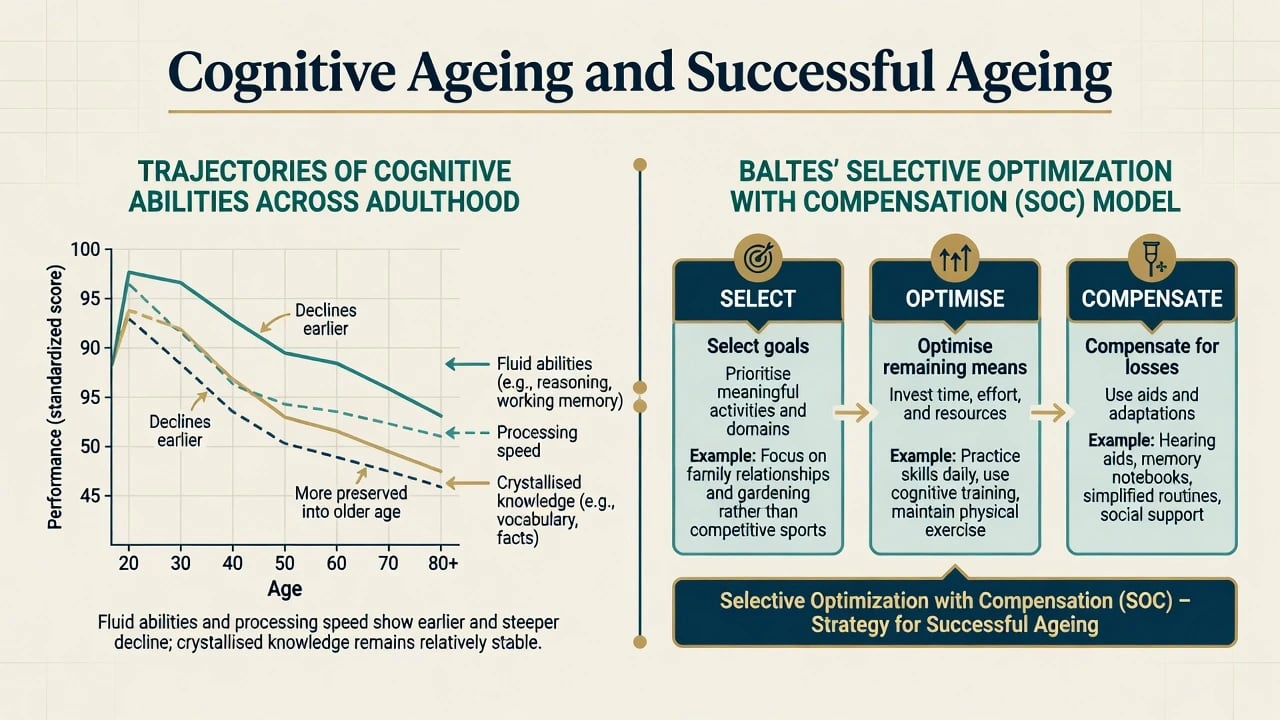
Processing-speed theory proposes that age-related slowing contributes broadly to adult age differences on cognitive tasks.[19] The Seattle Longitudinal Study tradition (Schaie) charts multi-ability intellectual trajectories across adulthood and highlights cohort and individual differences rather than uniform decline.[20] Selective optimisation with compensation (SOC) describes successful ageing strategy: select valued goals, optimise remaining means, compensate losses.[20]
Piaget — cognitive stages (exam core)
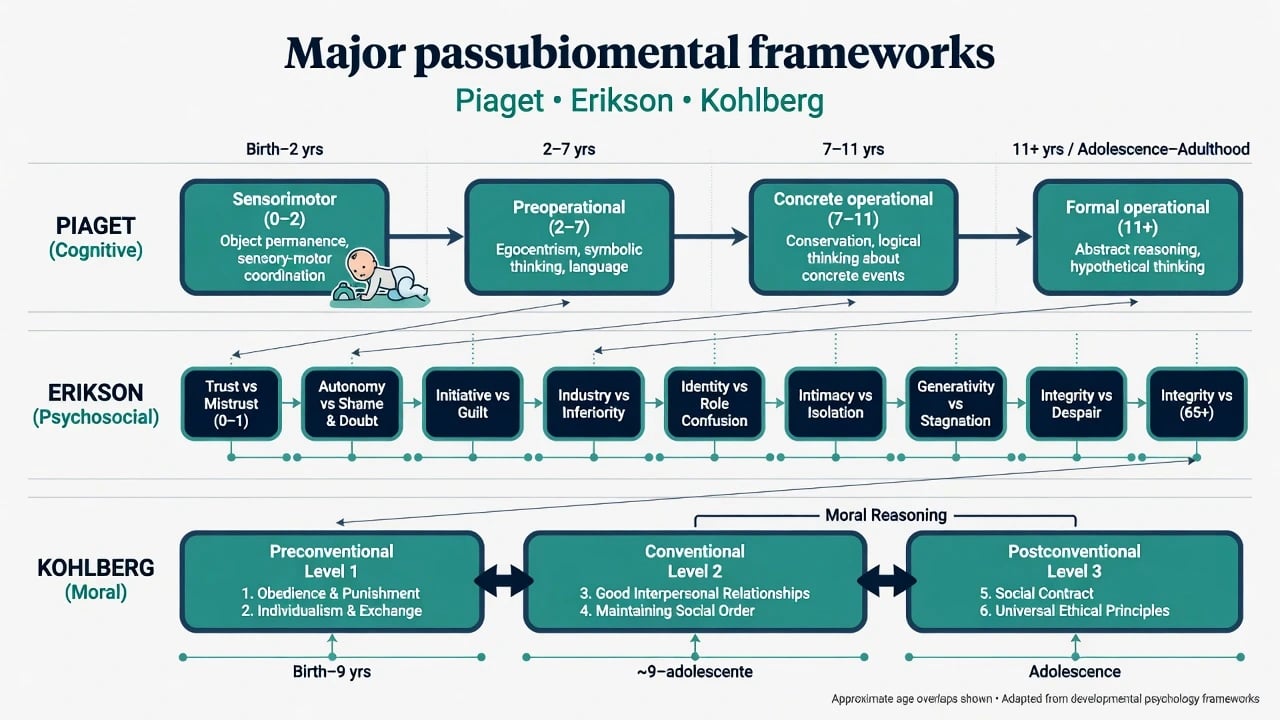
Ages are approximate and culturally moderated.[1]
| Stage | Approx. age | Achievements / traps |
|---|---|---|
| Sensorimotor | 0–2 years | Object permanence; sensory–motor schemes; separation distress links to attachment work |
| Preoperational | 2–7 years | Symbolic thought and language; egocentrism; magical thinking; fails conservation |
| Concrete operational | 7–11 years | Conservation, classification, reversibility; logic about concrete events |
| Formal operational | 11+ years | Hypothetical–deductive reasoning, abstract ethics, scientific thinking — not universal |
Under stress, illness, or low literacy, adults may reason concretely; do not equate failure of formal operations with intellectual disability without broader assessment.[1]
Clinical applications: match explanations and CBT homework to cognitive level; use play and concrete tools with younger children; expect abstract insight work to fail if formal operations are not available.[1]
Erikson — psychosocial crises (exam core)
Erikson’s eight crises organise ego strengths across the lifespan. Know the pairs in order:[6][7]
- Trust vs mistrust (infancy)
- Autonomy vs shame/doubt (toddler)
- Initiative vs guilt (preschool)
- Industry vs inferiority (school age)
- Identity vs role confusion (adolescence)
- Intimacy vs isolation (young adulthood)
- Generativity vs stagnation (middle adulthood)
- Integrity vs despair (late life)
Marcia identity statuses
Marcia operationalised adolescent identity along exploration and commitment:[6]
- Identity achievement — explored then committed
- Moratorium — exploring, not yet committed
- Foreclosure — committed without exploration
- Diffusion — neither exploring nor committed
Meta-analytic work supports developmental movement toward achievement into young adulthood, with substantial individual variation.[6][7]
Kohlberg — moral development and critiques
Kohlberg’s levels (preconventional → conventional → postconventional) describe justice-oriented moral reasoning, classically probed with dilemmas such as Heinz.[8]
- Preconventional: punishment avoidance; instrumental exchange
- Conventional: good-person approval; law-and-order
- Postconventional: social contract; universal ethical principles
Gilligan’s critique emphasises a care orientation (responsibility, relationships, contextual harm) historically undervalued in justice-stage scoring — examinable as a sex-difference/feminist developmental challenge, not as “women are stuck at stage 3.”[8]
Clinical use: moral reasoning level informs — but does not decide — forensic, capacity-adjacent, and adolescent behavioural formulations. Antisocial personality and callous-unemotional traits are not reducible to “low Kohlberg stage” alone.[8]
Adult development and ageing cognition
Beyond adolescence
Adult development is not a plateau. Midlife tasks include generativity (care for next generation, meaningful work), dual-career and caregiving loads, and identity revision after losses. Late life emphasises integrity (coherent life narrative) versus despair.[20]
Cognitive ageing patterns
- Fluid abilities and processing speed are more vulnerable earlier in adult ageing.[19][20]
- Crystallised knowledge (vocabulary, expertise) is often better preserved.
- Longitudinal multi-ability studies show heterogeneous trajectories, not inevitable global collapse.[20]
Successful ageing: SOC
Select valued goals → optimise remaining skills/resources → compensate (aids, simplified routines, social supports). SOC is a rehabilitation and psychotherapy framing for late-life functional work, not a drug protocol.[20]
Clinical presentation — developmental patterns in the interview
Child and adolescent
- Preoperational: concrete language, magical explanations, egocentric perspective-taking limits.
- Concrete operational: rule-focused, factual; benefit from structured CBT.
- Adolescent: identity themes, peer salience, risk under arousal; social-brain sensitivity to evaluation.[4][5]
Adult and older adult
- Midlife: role strain, generativity failure, caregiver burden as precipitants.
- Older adult: grief, retirement, integrity themes; slowed processing with relatively intact knowledge may be normal ageing rather than dementia — still investigate red flags.[19][20]
Differential diagnosis using developmental reasoning
| Presentation | Prefer development | Prefer pathology / other |
|---|---|---|
| Identity flux age 16–22 | Moratorium | Persistent identity disturbance + affective instability → consider personality pathology longitudinally |
| Risk-taking with peers | Dual-systems window | Escalating antisocial pattern, substance use disorder, mania |
| Concrete reasoning in adult | Stress, education, culture | Intellectual disability, severe thought disorder, delirium |
| Cognitive slowing late life | Processing-speed ageing | MCI / major NCD, depression, medications, medical illness |
| Moral rule-breaking youth | Immature conventional reasoning + context | Callous-unemotional traits, psychosis, conduct disorder |
Always include organic differentials for regression, new cognitive change, or atypical age of onset.[15][19]
Assessment — what to do at the bedside
- Developmental history: pregnancy/birth, milestones, schooling, friendships, trauma/ACE chronology (timing and chronicity), identity/sexual development, occupation, losses.[9][15]
- Adversity timing: not only ACE total — when, how long, who was present/absent as caregiver.[15][17]
- Age-band MSE: observation/play; adolescent privacy + collateral; older-adult sensory and cognitive screens as adjuncts.[1][19]
- Identity probes (Marcia): exploration and commitment in occupation, values, relationships.[6]
- Executive and social cognition sampling when relevant (planning, inhibition, mentalising).[1][4]
- Formulation: BPS × 4P with explicit developmental stage match/mismatch.[18]
DEVELOP for developmental assessment
Investigations
- Developmental red flags (regression, seizures, focal neurology, delirium, hearing/vision loss) → medical work-up first.[15]
- Neuroimaging is not used to “confirm Piaget stage.”[2]
- Late-life: cognitive screens and targeted batteries to separate normal ageing from disease pathways.[19]
- Genetic testing is phenotype-driven, not for exam-factoid G×E storytelling.[12][13]
Acute safety and developmental windows
High-risk developmental contexts:[5]
- Adolescent suicide, self-harm, and impulsive risk under peer/substance/affect load.[5]
- Early psychosis age band overlapping identity and social-brain change.[3][4]
- Older adults with depression, cognitive change, and self-neglect.[19][20]
Capacity and legal frameworks are jurisdiction-specific. Developmental maturity informs clinical judgement about decision-making support; it does not replace statutory capacity tests, and candidates must not invent section numbers.[5][1]
Definitive management — developmentally matched care
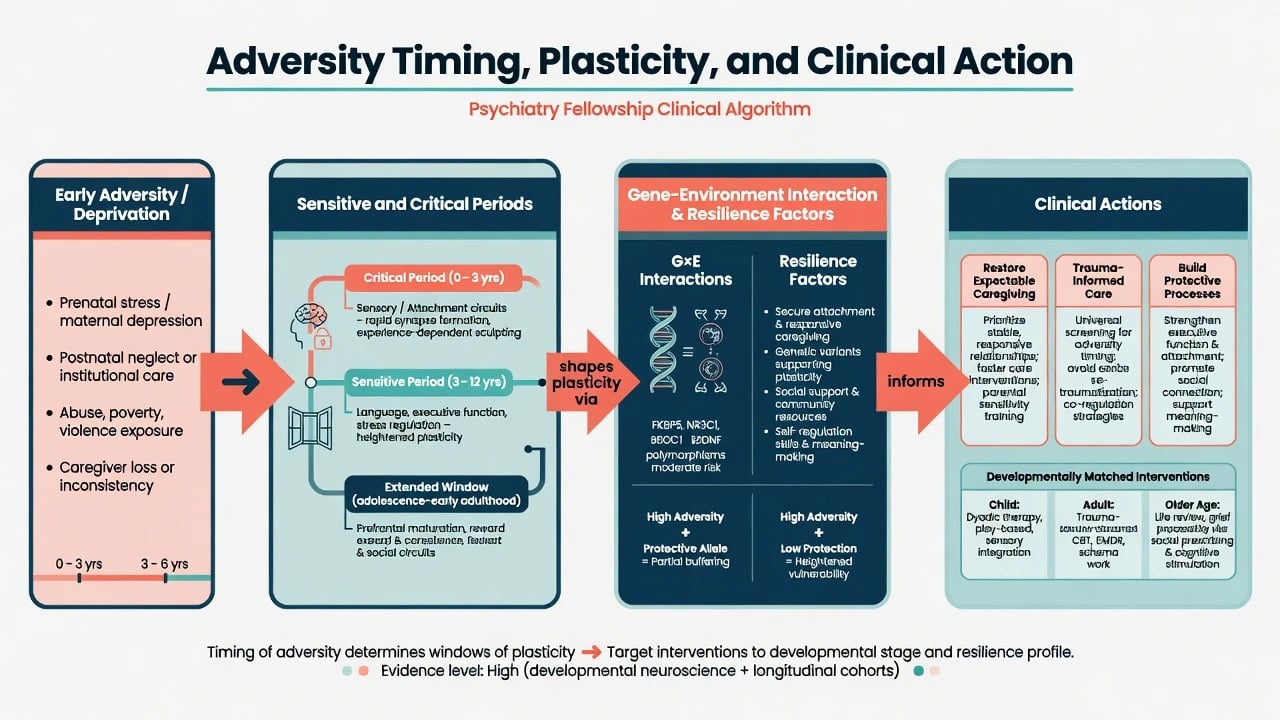
Principles: restore expectable care, build protective processes, match modality to stage, avoid ACE fatalism, and use multiagency interfaces.[16][18]
- Restore expectable caregiving early after deprivation — BEIP supports earlier family-based care for cognitive recovery after institutionalisation.[16]
- Build protective processes (secure relationships, self-regulation skills, meaning, social capital) — resilience is dynamic, not a trait chip.[18]
- Match modality to cognitive/emotional stage: play/parent work in early childhood; concrete CBT in school age; motivational and identity-supportive work in adolescence; role and generativity work in midlife; SOC-informed rehab and grief/integrity work in late life.[1][20]
- Trauma-informed care without deterministic ACE fatalism.[9][17]
- Multiagency interfaces: education, child protection, aged care, transition-age youth gaps.[18]
Regional guidance consistently emphasises developmentally appropriate, family-inclusive, rights-based assessment and intervention, with stepped care and local safeguarding pathways. Apply principles; cite local statutes accurately rather than inventing cross-jurisdiction section numbers.[18][16]
Special populations and scenarios
- Neurodevelopmental disorders: chronological vs developmental age mismatch in communication and consent scaffolding.[1]
- Cultural and Indigenous contexts: avoid Eurocentric stage imperialism; explore local developmental norms and meaning.[18]
- Migration/refugee: interrupted schooling, trauma timing, language.[15][17]
- LGBTQ+ identity development: minority stress across stages; support exploration without pathologising.[6][7]
- Forensic youth: maturity and moral reasoning are dimensional inputs to risk formulation, not sole determinants of culpability.[5][8]
- Intellectual disability dual diagnosis: baseline developmental function before inferring new psychosis or dementia.[1][19]
Complications and examiner pitfalls
- Rigid age tables without cultural/individual variation.[14]
- ACE score as diagnosis or destiny.[9][18]
- Uncritical 5-HTTLPR G×E as settled science.[12][13]
- Missing delirium/medical causes of “developmental” regression.[15][19]
- Confusing cultural display rules with affect pathology.[18]
- Kohlberg without Gilligan/care critique when the stem invites it.[8]
- Assuming formal operations are universal.[1]
- Premature personality-disorder labels during normative moratorium.[7]
Prognosis and disposition
Plasticity persists across life, but early restoration of caregiving after severe deprivation improves cognitive recovery odds.[16] Resilience remains possible after maltreatment and is context-dependent over time.[18] Cognitive ageing is modifiable in trajectory by vascular risk, education, activity, and comorbidity management.[19][20] Disposition must match developmental service need (CAMHS vs adult vs old-age; watch transition-age gaps).
Evidence anchors and exam pearls
Landmark anchors to name in viva: Gogtay cortical mapping; Giedd adolescent MRI; Blakemore social brain; Steinberg dual systems; Diamond executive functions; Felitti ACE; Weaver maternal-care epigenetics; Caspi 5-HTTLPR classic + Culverhouse meta-caution; Knudsen sensitive periods; Nelson critical periods/expectable environment; BEIP; Teicher maltreatment neurobiology; Rutter resilience; Salthouse processing speed; Schaie adult intellectual course.[1][2][3][4][5][9][11][12][13][14][15][16][17][18][19][20]
High-yield memory lines
- Piaget: object permanence → egocentrism → conservation → formal operations.[1]
- Erikson: trust → … → identity → intimacy → generativity → integrity vs despair.[6]
- Kohlberg: preconventional / conventional / postconventional (+ Gilligan care critique).[8]
- Marcia: exploration × commitment → four statuses.[6][7]
- Dual systems: reward ahead of control in mid-adolescence.[5]
- Ageing: speed/fluid more vulnerable; crystallised more preserved; use SOC.[19][20]
- Adversity: timing + expectable environment + protective processes; BEIP earlier is better for cognition after institutional care.[15][16][18]
Summary for the candidate
Read development as a clinical operating system: classic stages for vocabulary and scaffolding; neuroscience for mechanisms of risk windows; ACE/GxE/epigenetics for how environment becomes biology without fatalism; resilience and SOC for hope and plan. A candidate who only memorizes ages will fail MEQs that ask why now and what to do next. A candidate who integrates stage, timing, and protective processes will sound like a consultant.[1][5][9][18][20]
References
- [1]Diamond A Executive functions Annu Rev Psychol, 2013.PMID 23020641
- [2]Gogtay N, Giedd JN, Lusk L, et al. Dynamic mapping of human cortical development during childhood through early adulthood Proc Natl Acad Sci U S A, 2004.PMID 15148381
- [3]Giedd JN Structural magnetic resonance imaging of the adolescent brain Ann N Y Acad Sci, 2004.PMID 15251877
- [4]Blakemore SJ The social brain in adolescence Nat Rev Neurosci, 2008.PMID 18354399
- [5]Steinberg L A dual systems model of adolescent risk-taking Dev Psychobiol, 2010.PMID 20213754
- [6]Marcia JE Development and validation of ego-identity status J Pers Soc Psychol, 1966.PMID 5939604
- [7]Kroger J, Martinussen M, Marcia JE Identity status change during adolescence and young adulthood: a meta-analysis J Adolesc, 2010.PMID 20004962
- [8]Muuss RE Carol Gilligan's theory of sex differences in the development of moral reasoning during adolescence Adolescence, 1988.PMID 3381683
- [9]Felitti VJ, Anda RF, Nordenberg D, et al. Relationship of childhood abuse and household dysfunction to many of the leading causes of death in adults. The Adverse Childhood Experiences (ACE) Study Am J Prev Med, 1998.PMID 9635069
- [10]Chapman DP, Whitfield CL, Felitti VJ, et al. Adverse childhood experiences and the risk of depressive disorders in adulthood J Affect Disord, 2004.PMID 15488250
- [11]Weaver IC, Cervoni N, Champagne FA, et al. Epigenetic programming by maternal behavior Nat Neurosci, 2004.PMID 15220929
- [12]Caspi A, Sugden K, Moffitt TE, et al. Influence of life stress on depression: moderation by a polymorphism in the 5-HTT gene Science, 2003.PMID 12869766
- [13]Culverhouse RC, Saccone NL, Horton AC, et al. Collaborative meta-analysis finds no evidence of a strong interaction between stress and 5-HTTLPR genotype contributing to the development of depression Mol Psychiatry, 2018.PMID 28373689
- [14]Knudsen EI Sensitive periods in the development of the brain and behavior J Cogn Neurosci, 2004.PMID 15509387
- [15]Nelson CA 3rd, Gabard-Durnam LJ Early Adversity and Critical Periods: Neurodevelopmental Consequences of Violating the Expectable Environment Trends Neurosci, 2020.PMID 32101708
- [16]Nelson CA 3rd, Zeanah CH, Fox NA, et al. Cognitive recovery in socially deprived young children: the Bucharest Early Intervention Project Science, 2007.PMID 18096809
- [17]Teicher MH, Samson JA Annual Research Review: Enduring neurobiological effects of childhood abuse and neglect J Child Psychol Psychiatry, 2016.PMID 26831814
- [18]Rutter M Resilience as a dynamic concept Dev Psychopathol, 2012.PMID 22559117
- [19]Salthouse TA The processing-speed theory of adult age differences in cognition Psychol Rev, 1996.PMID 8759042
- [20]Schaie KW The course of adult intellectual development Am Psychol, 1994.PMID 8203802