Psych · Foundations — neurotransmitters receptors signalling
Neurotransmitters, receptors and signalling
Also known as Monoamine systems · Receptor pharmacology for psychiatrists · Synaptic signalling · GPCR and ionotropic receptors · Psychotropic drug targets
Fellowship-depth map of DA, 5-HT, NA, GABA, glutamate and ACh systems — receptor subtypes, second messengers, adaptive cascades, and drug-class target mapping for FRANZCP, MRCPsych, ABPN and MD/DNB exams.
On this page & tools
Your progress
Saved locally on this device.
Target exams
Red flags
This topic is the exam language layer under antidepressants, antipsychotics, anxiolytics, ketamine pathways and emergency toxidromes. FRANZCP and MRCPsych theory papers expect pathway tables, receptor subtype roles, second-messenger logic, and honest limits of monoamine “imbalance” slogans — not undergraduate cartoons.[1][3][13]
Definition and classification
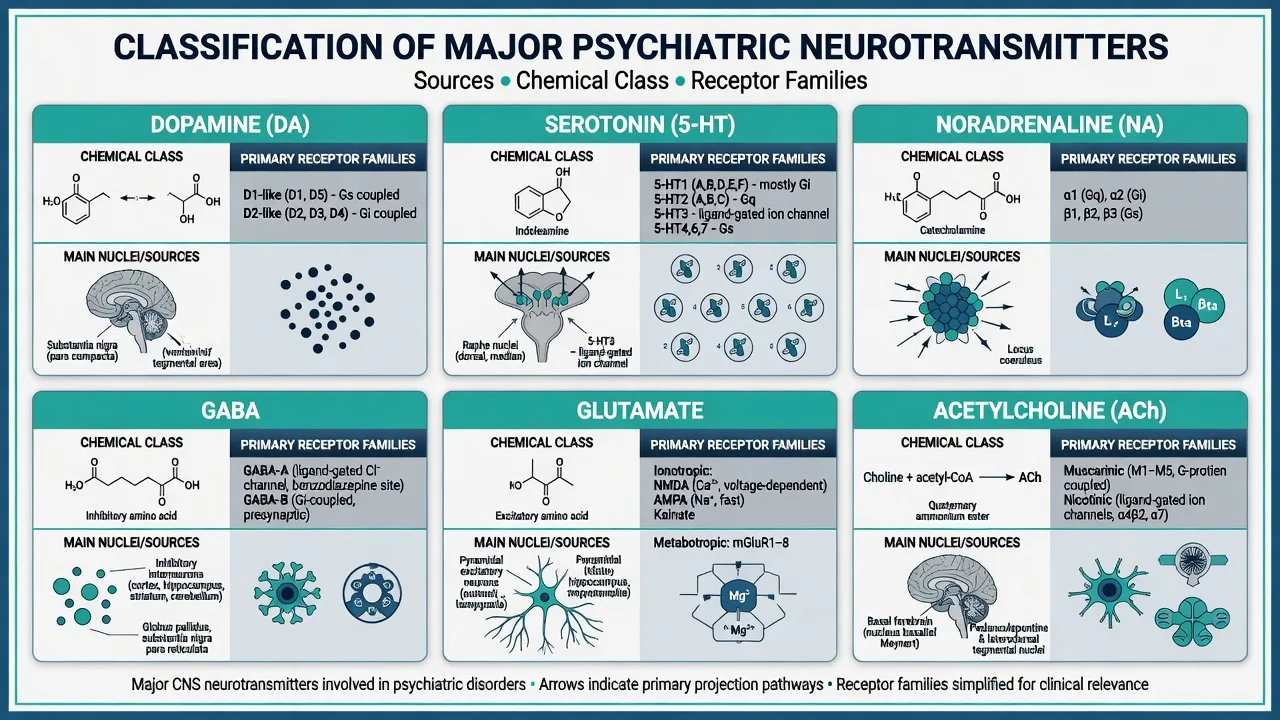
A neurotransmitter is a signalling molecule released from a neuron that acts at specialised receptors to change postsynaptic excitability or intracellular cascades on a short timescale. Neuromodulators (often the same monoamines) set gain across circuits. Hormones act over longer distances and timescales; the boundary is functional, not absolute.[11]
Exam taxonomy of chemistry (synthesis enzymes are viva cues, not lab orders):[10][11]
| Class | Core transmitters | Rate-limiting synthesis cue |
|---|---|---|
| Catecholamines | DA, NA (and adrenaline) | Tyrosine hydroxylase |
| Indolamine | 5-HT | Tryptophan hydroxylase |
| Amino acid | GABA, glutamate | GAD for GABA from glutamate |
| Quaternary amine | ACh | Choline acetyltransferase |
| Peptides | e.g. endogenous opioids | Gene transcription / processing |
| Table content maps to standard psychopharmacology teaching targets.[10][1][19] |
Chemistry table anchors drug-class teaching across monoamines, amino acids and ACh.[10][11]
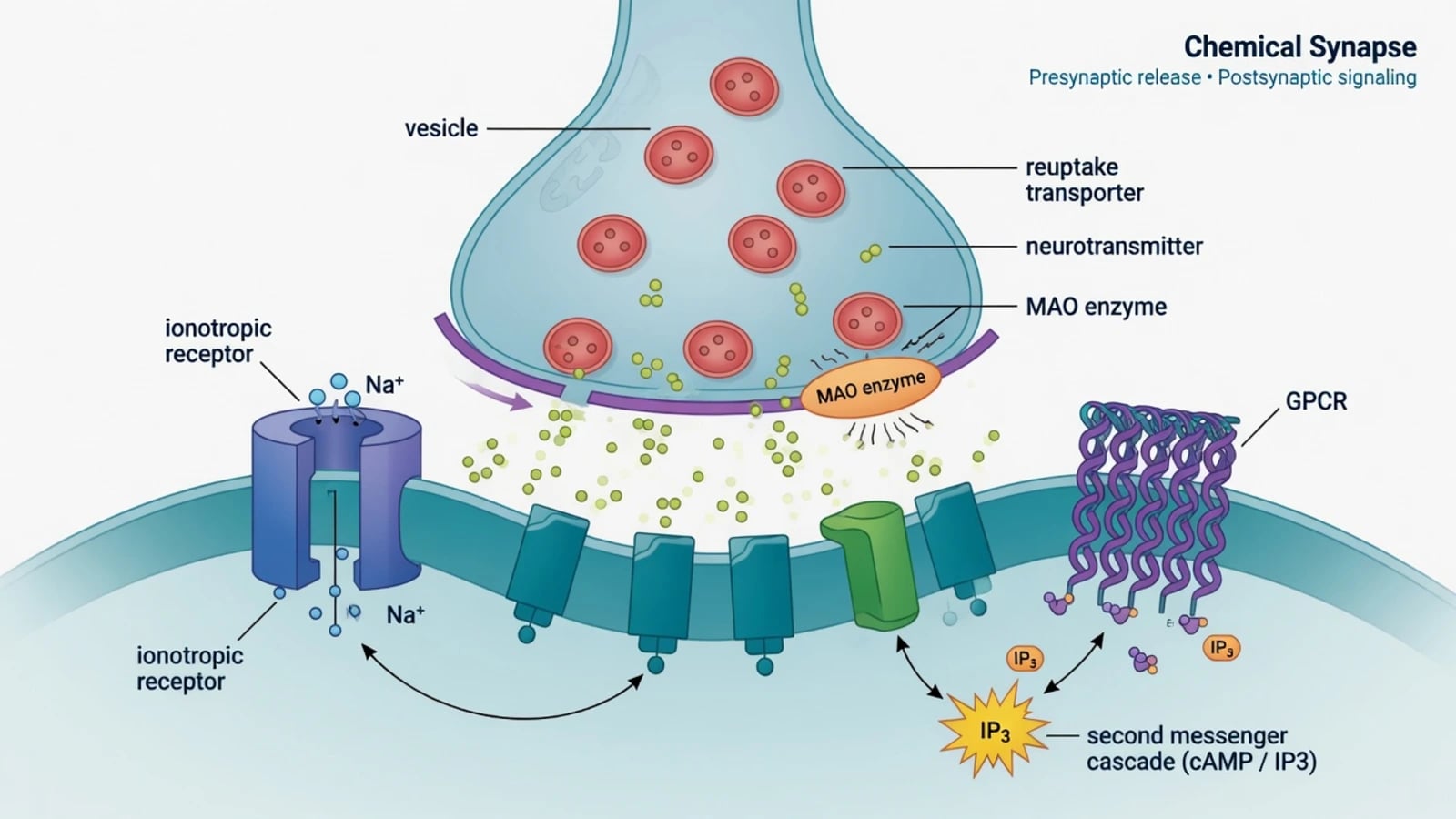
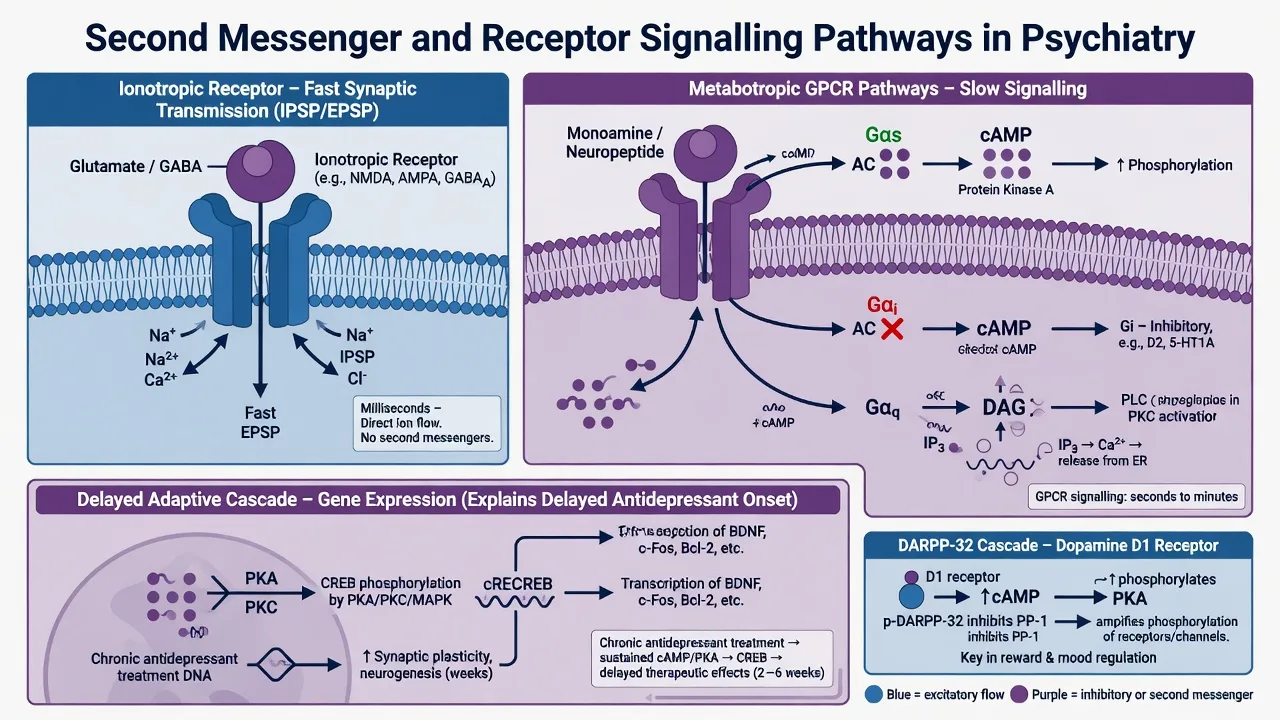
Receptor superclasses examiners want named: 1. Ionotropic (ligand-gated ion channels) — fast; e.g. GABA-A, NMDA, AMPA, nicotinic ACh, 5-HT3. 2. Metabotropic (GPCRs) — slower, amplifiable; most monoamine receptors, mGluRs, muscarinic ACh, GABA-B. 3. Transporters / enzymes as drug targets — SERT, NET, DAT, MAO-A/B, COMT (clinical relevance mainly for MAOI and catecholamine handling). Ionotropic versus metabotropic distinction plus transporter targets is core Paper A/B language.[9][10]
The six systems you must own
Dopamine (DA)
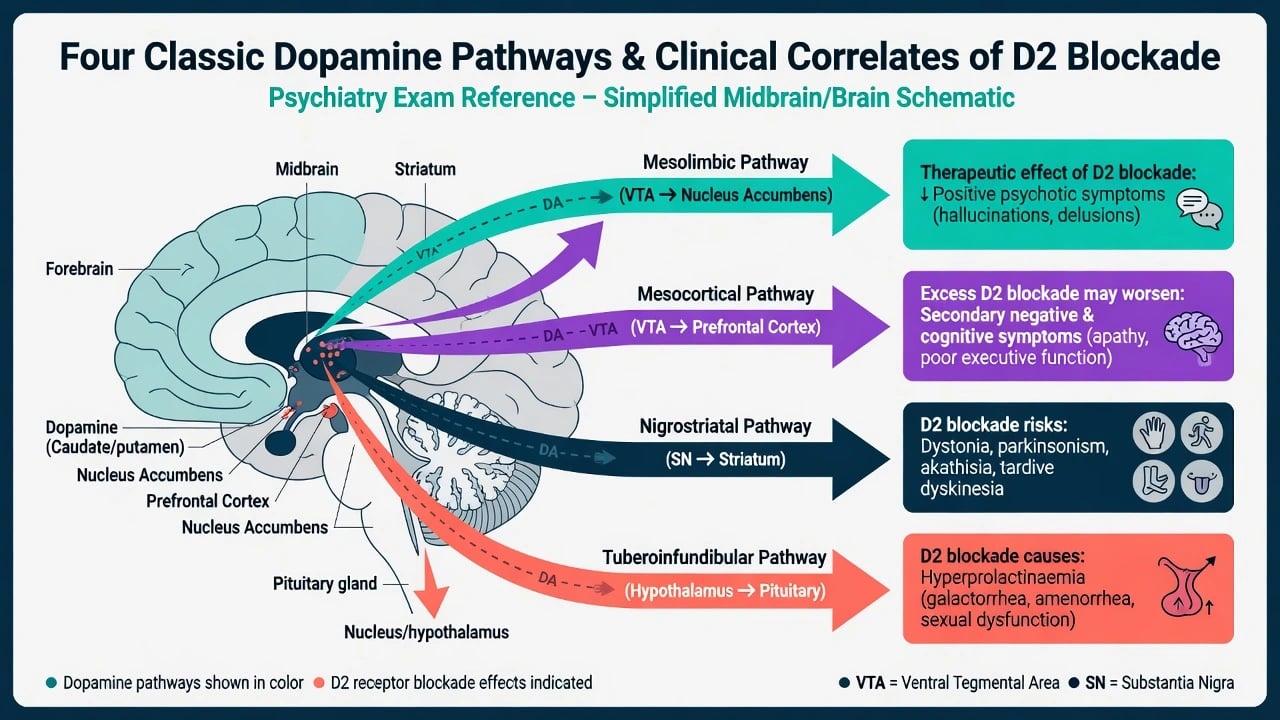
Sources: substantia nigra pars compacta (nigrostriatal), VTA (mesolimbic/mesocortical), hypothalamic tuberoinfundibular neurons.[1][4]
Receptors: D1-like (D1, D5 — typically Gs-linked, raise cAMP) vs D2-like (D2, D3, D4 — typically Gi-linked, lower cAMP). Antipsychotic efficacy and EPS/prolactin maps are still taught primarily through D2 occupancy.[1][12]
Four pathways (viva table) — map efficacy and harm before inventing mechanisms:[1][4]
| Pathway | Excess blockade phenotype |
|---|---|
| Mesolimbic | Therapeutic reduction of positive symptoms |
| Mesocortical | Risk of worsening secondary negative/cognitive symptoms |
| Nigrostriatal | Dystonia, parkinsonism, akathisia, TD risk |
| Tuberoinfundibular | Hyperprolactinaemia |
| Table content maps to standard psychopharmacology teaching targets.[10][1][19] |
Pathway–phenotype mapping is the standard antipsychotic side-effect scaffold.[1][15]
Hypothesis literacy: Carlsson’s pharmacological dopamine hypothesis matured into regionally nuanced models (prefrontal hypo- vs subcortical hyper-dopaminergia) and Howes/Kapur version III — striatal dopamine dysregulation as a final common pathway linking diverse risk factors to psychosis. Type A (hyperdopaminergic) vs type B (normodopaminergic) frames treatment-responsive vs resistant psychosis conversations.[1][5][6][7]
Teaching occupancy construct: roughly 60–80% striatal D2 occupancy is the classic therapeutic window, with EPS rising as occupancy exceeds about 80% — agent and individual variability apply; use as a scaffold, not a lab number you order.[1][15]
Serotonin (5-HT)
Source: raphe nuclei; projects widely (cortex, limbic system, spinal cord).[9][10]
Receptor families (high-yield clinical map) drawn from central 5-HT catalogues:[9][10]
| Receptor | Type | Exam clinical hooks |
|---|---|---|
| 5-HT1A | GPCR (Gi) | Autoreceptor/postsynaptic; anxiolytic/antidepressant cascade teaching; buspirone partial agonist |
| 5-HT2A | GPCR (Gq) | Psychedelic agonist site; many SGA antagonists; sleep/psychosis teaching |
| 5-HT2C | GPCR | Appetite/metabolic signalling; weight gain contribution of several agents |
| 5-HT3 | Ionotropic | Nausea/vomiting; ondansetron; mirtazapine antagonism |
| 5-HT6/7 | GPCR | Cognition/circadian research hooks — know they exist |
| Table content maps to standard psychopharmacology teaching targets.[10][1][19] |
Subtype hooks explain both therapeutic teaching points and common adverse effects.[9][10]
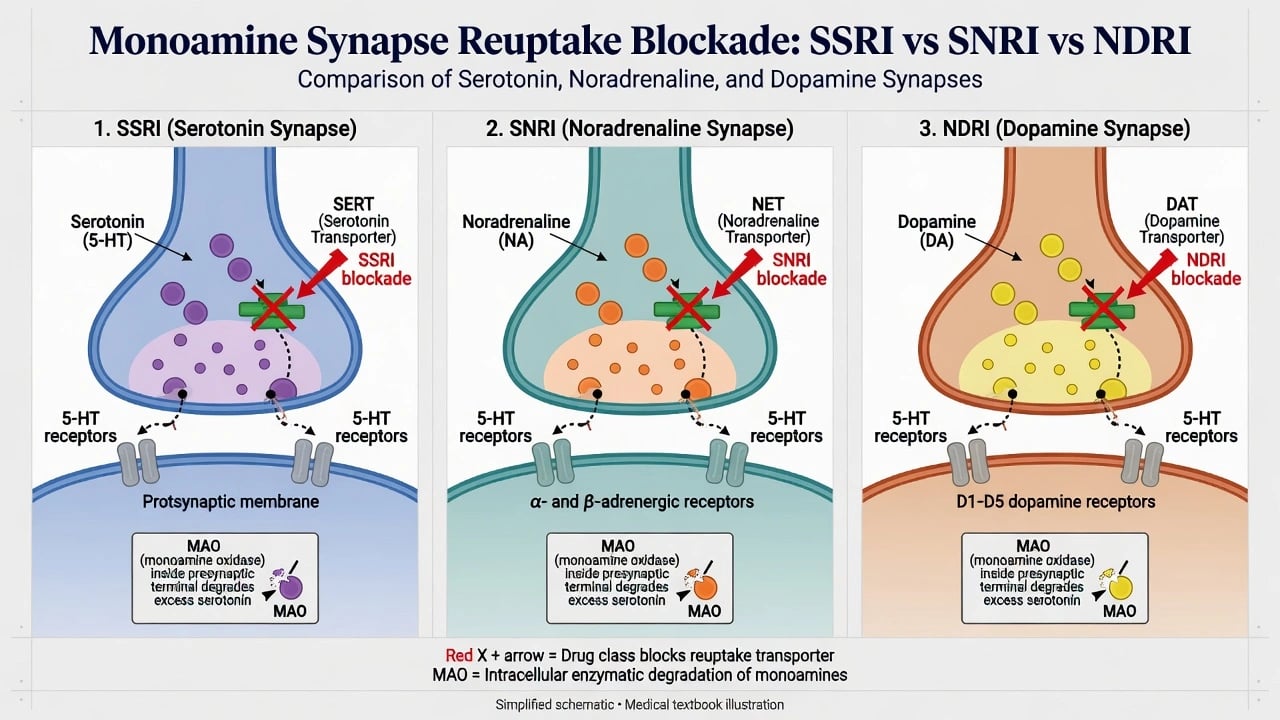
Stahl’s classic teaching: SSRIs raise synaptic 5-HT by blocking SERT, but clinical timing tracks receptor and network adaptation, not same-day monoamine “refilling.” Side-effect profiles also map to receptor stimulation (GI, sexual, sleep, activation).[9][10]
Hypothesis honesty: Schildkraut’s catecholamine hypothesis and later monoamine stories launched modern psychopharmacology, but depression is not proven to be simple low serotonin. Moncrieff’s umbrella review challenges consistent biomarker support for a serotonin-deficiency theory — yet network meta-analysis still shows antidepressants beat placebo with acceptability differences. Exam answer: distinguish pathogenesis slogan from treatment efficacy evidence.[2][3][13][14]
Noradrenaline (NA)
Source: locus coeruleus (and lateral tegmental system). Sets arousal, vigilance, stress responsivity, and autonomic tone.[2][3]
Receptors: alpha-1 (Gq — vasoconstriction, some CNS arousal), alpha-2 (Gi — autoreceptor feedback; clonidine/guanfacine and mirtazapine logic), beta (Gs — peripheral cardiac; central roles more nuanced).[3]
Drug mapping: SNRIs (e.g. venlafaxine, duloxetine) and many TCAs block NET (± SERT). Mirtazapine’s alpha-2 antagonism increases monoamine release while 5-HT2/3 antagonism shapes its side-effect profile. Bupropion’s clinical niche is more DAT/NET than SERT.[10][14]
GABA
GABA is the main fast inhibitory transmitter. GABA-A is a chloride-permeable ionotropic receptor; benzodiazepines and Z-drugs are positive allosteric modulators (PAMs) — they increase GABA efficacy/frequency of channel opening at the BZD site; they are not direct GABA agonists. Barbiturates and ethanol also modulate GABA-A but at distinct sites and with different safety ceilings.[19]
GABA-B is metabotropic (Gi). Baclofen is the clinical GABA-B agonist reference, distinct from BZD site pharmacology.[19]
Exam dependence logic: chronic GABA-A PAM exposure drives tolerance, withdrawal hyperexcitability, and dependence risk — manage as a controlled deprescribing problem, not a simple receptor factoid.[19]
Glutamate
Glutamate is the main fast excitatory transmitter. Ionotropic families: AMPA, kainate, NMDA (requires co-agonist glycine/D-serine and depolarisation to relieve Mg2+ block — coincidence detector language). Metabotropic mGluR groups modulate transmission.[8][16]
Psychosis model: PCP/ketamine NMDA antagonism models aspects of schizophrenia (including cognitive/negative features poorly explained by pure D2 stories) — Javitt and Zukin’s classic formulation remains examinable.[8]
Depression model: ketamine/esketamine rapid antidepressant effects are taught via NMDA-related cascades, AMPA throughput, and synaptic plasticity — not monoamine reuptake.[16]
Acetylcholine (ACh)
Sources: basal forebrain (cortical/hippocampal), brainstem pedunculopontine/laterodorsal tegmental, striatal interneurons.[20]
Receptors: nicotinic (ionotropic) and muscarinic M1–M5 (GPCRs). Anticholinergic burden (M1) explains cognitive dulling, dry mouth, constipation, urinary retention, delirium risk. Cholinesterase inhibitors in dementia increase synaptic ACh.[20]
Modern exam twist: xanomeline-trospium (M1/M4-preferring muscarinic agonist + peripheral anticholinergic) demonstrated antipsychotic efficacy without D2 blockade in phase 3 EMERGENT-2 — proof that the transmitter map is expanding beyond dopamine monopoly narratives.[20]
Second messengers and delayed drug action
GPCRs do not stop at the membrane — three arms appear repeatedly in viva answers: Gs → adenylate cyclase → cAMP → PKA; Gi → inhibit adenylate cyclase; Gq → PLC → IP3/DAG → Ca2+ / PKC. Gs, Gi and Gq cascades are the minimum second-messenger map for monoamine receptors.[11][12]
Downstream phosphoproteins (including DARPP-32 in striatal medium spiny neurons) integrate dopamine and other signals into phosphorylation states that change ion channels, receptors and gene expression.[12]
Hyman and Nestler’s initiation and adaptation paradigm is the viva answer to “why do antidepressants take weeks?”: acute synaptic initiation is necessary but insufficient; clinical response tracks adaptive changes in receptors, intracellular cascades and circuits.[11][10]
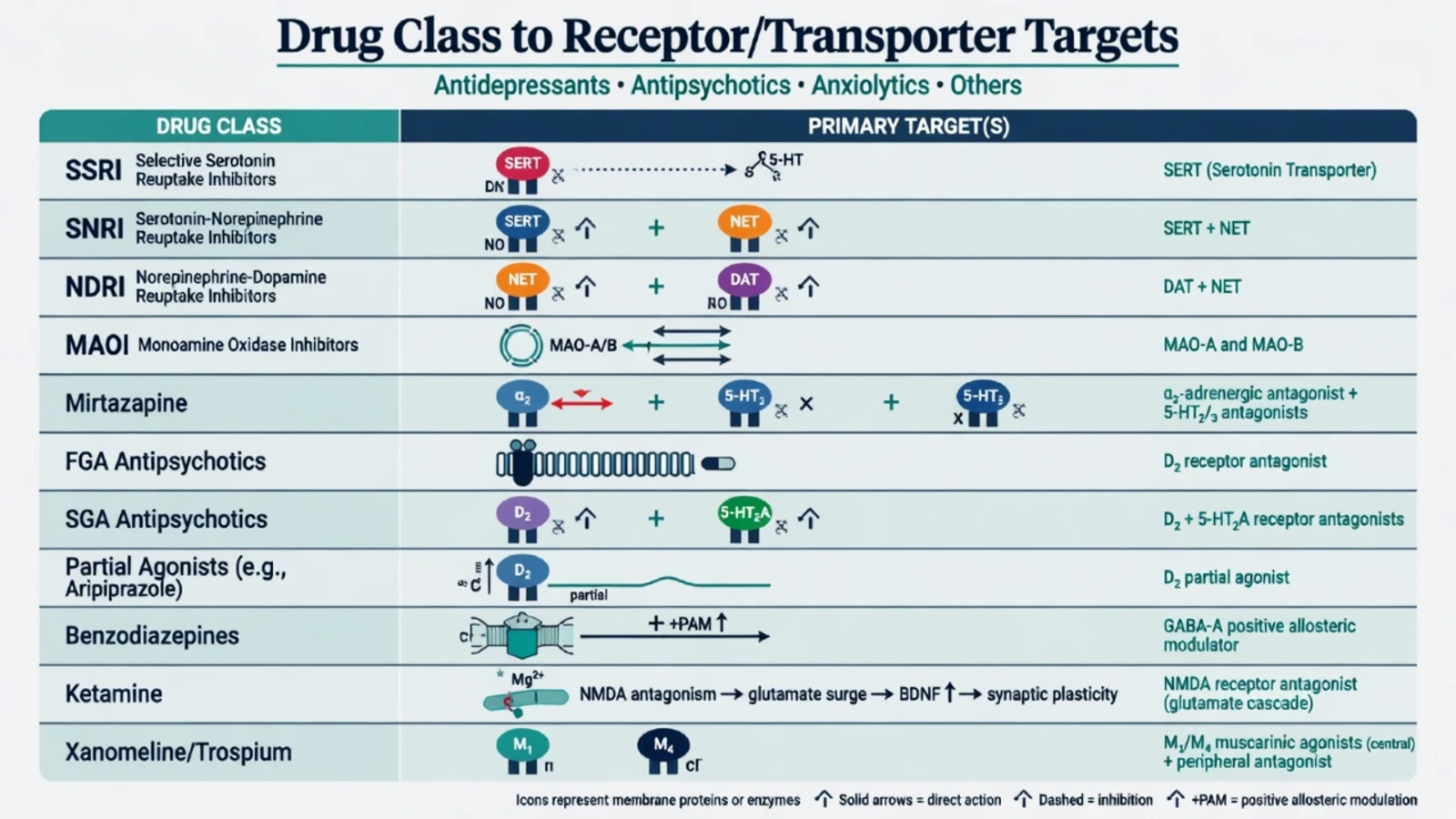
Drug-class mapping (the table examiners want)
| Class | Primary target map | Clinical fingerprint |
|---|---|---|
| SSRI | SERT | Sexual SE, GI, hyponatraemia risk (older adults), discontinuation (short t½ agents) |
| SNRI | SERT + NET | As SSRI ± NA-related effects; venlafaxine discontinuation |
| NDRI (bupropion) | DAT + NET | Sexual-sparing niche; seizure threshold caution |
| NaSSA (mirtazapine) | alpha-2; 5-HT2/3 | Sedation, weight; less sexual SE |
| TCA | SERT/NET + H1/M1/alpha-1 + Na-channel toxicity | Efficacy with toxicity/overdose risk |
| MAOI | MAO-A/B | Dietary tyramine; washouts with serotonergics |
| FGA | High D2 antagonism | EPS, prolactin |
| SGA | D2 ± 5-HT2A multi-receptor | Variable metabolic vs EPS trade-offs |
| Partial agonists | D2 partial agonism | Prolactin-sparing tendency; akathisia watch |
| BZD / Z-drug | GABA-A PAM | Anxiolysis/sedation; dependence/withdrawal |
| Ketamine pathway | NMDA-related cascade | Rapid antidepressant research/clinical niche |
| Muscarinic agonist (xanomeline-trospium) | M1/M4 (± peripheral block) | Non-D2 antipsychotic pathway |
| Table content maps to standard psychopharmacology teaching targets.[10][1][19] |
Class-to-target mapping is the practical spine of psychopharmacology theory exams.[10][14][15][19][20]
Comparative effectiveness still matters after mechanism: Leucht NMA ranks antipsychotic efficacy/tolerability trade-offs; Cipriani NMA ranks antidepressant efficacy/acceptability — mechanism explains how, trials decide whether and which.[14][15][20]
Clinical presentation as receptor fingerprints
When a patient describes sedation, dry mouth, postural dizziness, sexual dysfunction, tremor, galactorrhoea or weight gain, translate to H1, M1, alpha-1, SERT/5-HT, D2 nigrostriatal, D2 tuberoinfundibular, 5-HT2C/H1 metabolic stacks before shrugging “side-effects.” This is MSE-adjacent medication review language expected at fellowship level.[10][15]
Time course teaching links occupancy speed to clinical expectation-setting: minutes–hours for BZD anxiolysis/sedation (GABA-A PAM); days for early activation/akathisia risk on some antidepressants/antipsychotics and acute dystonia; weeks for classic antidepressant response via adaptation; hours–days for ketamine pathway rapid effects (setting-specific). Rapid GABA-A effects, delayed monoamine adaptation and rapid glutamatergic pathways must not be collapsed into one timeline.[11][16][19]
Differential of mechanism toxidromes
| Syndrome | Dominant mechanism language | Discriminators |
|---|---|---|
| Serotonin toxicity | Excess serotonergic tone | Clonus, hyperreflexia, hyperthermia; Hunter criteria |
| NMS | Relative dopamine hypofunction / antagonism | Rigidity, bradyreflexia, slower onset, antipsychotic context |
| Anticholinergic delirium | M1 blockade | Dry, hot, dilated pupils, urinary retention, picking |
| BZD withdrawal | GABA-A PAM removal | Anxiety, insomnia, seizures, perceptual change |
| BZD overdose | GABA-A PAM excess | Sedation, respiratory depression especially with alcohol/opioids |
| Table content maps to standard psychopharmacology teaching targets.[10][1][19] |
Toxidrome discrimination is a mechanism problem first, then a resuscitation sequence.[17][18][19]
Serotonin toxicity is a clinical diagnosis; Dunkley Hunter criteria operationalise decision rules; Boyer and Shannon remain the classic review framing.[17][18]
Assessment without fantasy labs
Routine CSF 5-HIAA or “serotonin blood levels” do not diagnose depression in clinic. Bedside assessment is: full medication/supplement map, alcohol/substance, toxidrome features, cognitive/anticholinergic load, metabolic and cardiac risk predicted by receptor profile, and suicide risk when starting/changing monoaminergic agents.[13][14]
Research PET of striatal dopamine synthesis capacity informs models and treatment-response science — it is not a routine ordering list for a CASC station.[4][5]
Acute management (mechanism → action)
- Serotonin toxicity: stop serotonergic agents; ABC and cooling; benzodiazepines for agitation; critical care for severe cases; recognise Hunter features.[17][18]
- NMS: stop dopamine antagonists; resuscitate; supportive care; specialist treatments as indicated — mechanism language is hypodopaminergic rigidity syndrome, not “more 5-HT.”[15]
- BZD excess: support respiration; flumazenil is not a casual antidote (seizure risk in dependent/epileptic patients).[19]
- Anticholinergic delirium: stop offenders; supportive care; specialist physostigmine pathways only in appropriate settings — M1 burden language guides the search for culprits.[20]
Definitive prescribing still needs doses and monitoring
Mechanism does not replace agent-level prescribing. Examples of exam-safe starts (always individualise; see class monographs for full monitoring) are anchored in comparative efficacy literature and class safety profiles:[14][15][19]
- Sertraline often 50 mg orally daily, titrate; watch sexual SE, hyponatraemia in older adults.[14]
- Venlafaxine XR often 75 mg orally daily, titrate; NET contribution increases at higher doses; discontinuation risk high.[14]
- Aripiprazole often 10 mg orally daily in adults for psychosis-related starts; partial agonist fingerprint (akathisia, relative prolactin-sparing).[15]
- Lorazepam for acute anxiety/agitation pathways commonly 0.5–1 mg orally (or protocolised parenteral in emergencies) with clear short-term intent because of GABA-A PAM dependence risk.[19]
Monitoring packages (metabolic for many SGAs, sodium in older adults on SSRI/SNRI, ECG when risk stacks, clozapine-specific rules) live in class topics — but you should predict which package from receptor maps.[14][15]
Subtypes and scenarios
- Psychosis viva: lead with striatal DA dysregulation + four pathways + occupancy; add glutamate NMDA model for cognitive/negative complexity and non-response framing.[1][8]
- Depression viva: monoamine history → adaptive cascade → efficacy evidence (Cipriani) → serotonin-deficiency critique (Moncrieff) without therapeutic nihilism.[3][13][14]
- Anxiety/insomnia: GABA-A PAM short-term vs antidepressant/psychological first-line logic.[19]
- Cognitive/dementia interface: cholinergic deficit language and anticholinergic avoidance.[20]
- New mechanisms: muscarinic agonists break “must block D2” dogma.[20]
Complications and pitfalls
- Selling “low serotonin” as settled cause of depression — contested and incomplete.[13]
- Equating SSRI onset delay with “waiting for levels to rise.”[11]
- Calling BZDs GABA agonists.[19]
- Assuming all SGAs share one receptor map or universal superiority (effectiveness trials/NMA say otherwise).[15]
- Ignoring transporter polypharmacy (e.g. SSRI + MAOI).[18]
- Forgetting that partial agonists can still cause akathisia.[15]
Prognosis and disposition language
Mechanism explains tools; course of illness and relapse prevention data explain duration. Antidepressant maintenance reduces relapse versus stop in recurrent depression; antipsychotic continuation decisions are effectiveness and recovery goals, not receptor purity contests.[14][15]
Special populations
- Older adults: reduce anticholinergic load; BZD sensitivity (falls, confusion); SSRI/SNRI hyponatraemia; start low go slow still applies.[14][19]
- Youth: safety monitoring and activation/suicide-risk surveillance when starting antidepressants is clinical governance, not pure receptor theory.[14]
- Pregnancy/lactation: do not invent fetal receptor stories; use class-specific risk–benefit evidence (separate pharmacology topic).[14]
- Intellectual disability / medically complex: receptor-stack delirium risk is high — deprescribe before adding.
Evidence and regional guidelines
FRANZCP / MRCPsych theory: pathway tables, receptor subtypes, second messengers, toxidrome discrimination, and critical appraisal of monoamine slogans. ABPN: blueprint psychopharmacology mechanisms. MD/DNB / NEET-SS: classic tables plus newer agents (partial agonists, ketamine pathway, muscarinic agonists). Clinical guidelines (RANZCP mood, CANMAT, NICE, APA) assume this map when they recommend classes; they do not replace landmark trial names.[14][15]
Landmark anchors to name cleanly: Howes/Kapur dopamine III; McCutcheon striatal dopamine; Davis reconceptualisation; Javitt PCP model; Stahl SERT pathways; Barnes/Sharp 5-HT catalogue; Greengard DARPP-32; Hyman–Nestler adaptation; Moncrieff umbrella debate; Cipriani and Leucht NMAs; Krystal ketamine neurobiology; Soyka BZD dependence; Kaul EMERGENT-2 muscarinic antipsychotic efficacy.[1][4][8][11][13][16][20]
Exam pearls
Transmitter six-pack
- Partial agonism ≠ “no side-effects.”
- Ionotropic = ion channel; metabotropic = GPCR cascade.
- Serotonin toxicity ≠ NMS (clonus/hyperreflexia vs lead-pipe bradyreflexia).
- Adaptive cascade explains delayed AD onset.
- Muscarinic agonists prove the map is not D2-only forever.[17][18][20]
Bottom line
Master six transmitters, two receptor superclasses, three G-protein arms, and one adaptation story, then hang every drug class and toxidrome on that skeleton. Mechanism without trials is storytelling; trials without mechanism is memorisation — fellowship answers need both.[1][11][14][15]
References
- [1]Howes OD, Kapur S The dopamine hypothesis of schizophrenia: version III--the final common pathway Schizophr Bull, 2009.PMID 19325164
- [2]Schildkraut JJ The catecholamine hypothesis of affective disorders: a review of supporting evidence Am J Psychiatry, 1965.PMID 5319766
- [3]Hirschfeld RM History and evolution of the monoamine hypothesis of depression J Clin Psychiatry, 2000.PMID 10775017
- [4]McCutcheon RA, Abi-Dargham A, Howes OD Schizophrenia, Dopamine and the Striatum: From Biology to Symptoms Trends Neurosci, 2019.PMID 30621912
- [5]Howes OD, Kapur S A neurobiological hypothesis for the classification of schizophrenia: type A (hyperdopaminergic) and type B (normodopaminergic) Br J Psychiatry, 2014.PMID 24986384
- [6]Davis KL, Kahn RS, Ko G, Davidson M Dopamine in schizophrenia: a review and reconceptualization Am J Psychiatry, 1991.PMID 1681750
- [7]Carlsson A The current status of the dopamine hypothesis of schizophrenia Neuropsychopharmacology, 1988.PMID 3075131
- [8]Javitt DC, Zukin SR Recent advances in the phencyclidine model of schizophrenia Am J Psychiatry, 1991.PMID 1654746
- [9]Barnes NM, Sharp T A review of central 5-HT receptors and their function Neuropharmacology, 1999.PMID 10462127
- [10]Stahl SM Mechanism of action of serotonin selective reuptake inhibitors. Serotonin receptors and pathways mediate therapeutic effects and side effects J Affect Disord, 1998.PMID 10333979
- [11]Hyman SE, Nestler EJ Initiation and adaptation: a paradigm for understanding psychotropic drug action Am J Psychiatry, 1996.PMID 8561194
- [12]Greengard P, Allen PB, Nairn AC Beyond the dopamine receptor: the DARPP-32/protein phosphatase-1 cascade Neuron, 1999.PMID 10433257
- [13]Moncrieff J, Cooper RE, Stockmann T, et al. The serotonin theory of depression: a systematic umbrella review of the evidence Mol Psychiatry, 2023.PMID 35854107
- [14]Cipriani A, Furukawa TA, Salanti G, et al. Comparative efficacy and acceptability of 21 antidepressant drugs for the acute treatment of adults with major depressive disorder: a systematic review and network meta-analysis Lancet, 2018.PMID 29477251
- [15]Leucht S, Cipriani A, Spineli L, et al. Comparative efficacy and tolerability of 15 antipsychotic drugs in schizophrenia: a multiple-treatments meta-analysis Lancet, 2013.PMID 23810019
- [16]Krystal JH, Kavalali ET, Monteggia LM Ketamine and the neurobiology of depression: Toward next-generation rapid-acting antidepressant treatments Proc Natl Acad Sci U S A, 2023.PMID 38011560
- [17]Dunkley EJ, Isbister GK, Sibbritt D, et al. The Hunter Serotonin Toxicity Criteria: simple and accurate diagnostic decision rules for serotonin toxicity QJM, 2003.PMID 12925718
- [18]Boyer EW, Shannon M The serotonin syndrome N Engl J Med, 2005.PMID 15784664
- [19]Soyka M Treatment of Benzodiazepine Dependence N Engl J Med, 2017.PMID 28328330
- [20]Kaul I, Sawchak S, Correll CU, et al. Efficacy and safety of the muscarinic receptor agonist KarXT (xanomeline-trospium) in schizophrenia (EMERGENT-2) in the USA: results from a randomised, double-blind, placebo-controlled, flexible-dose phase 3 trial Lancet, 2024.PMID 38104575