Psych · Foundations — nosology
Psychiatric classification: DSM-5-TR and ICD-11
Also known as DSM-5-TR · ICD-11 mental disorders · Psychiatric nosology · Diagnostic classification psychiatry · Categorical vs dimensional diagnosis · HiTOP · RDoC · CDDR
Exam-exhaustive fellowship reference on psychiatric classification — ICD vs DSM history and governance, categorical vs dimensional models, ICD-11 personality and psychosis reforms, hierarchical taxonomy (HiTOP) and RDoC, reliability validity and clinical utility, dual-system clinical coding, and multi-board exam traps. FRANZCP-primary, globally tagged.
On this page & tools
Your progress
Saved locally on this device.
10 MCQs with explanations
Target exams
Red flags
Fellowship exams test whether you can use nosology as a tool rather than a creed: when DSM and ICD diverge, why kappa can be modest yet a diagnosis still useful, how ICD-11 reworked personality and psychosis, and why a label never substitutes for formulation, risk, or capacity reasoning.[2][7][20]
Overview and definition
A psychiatric diagnosis is a working construct that groups signs, symptoms, course, and impairment into a shareable category. It is not automatically a single disease entity with one biomarker. Good classification maximises communication and decision support while remaining honest about fuzzy boundaries and cultural context.[2][19]
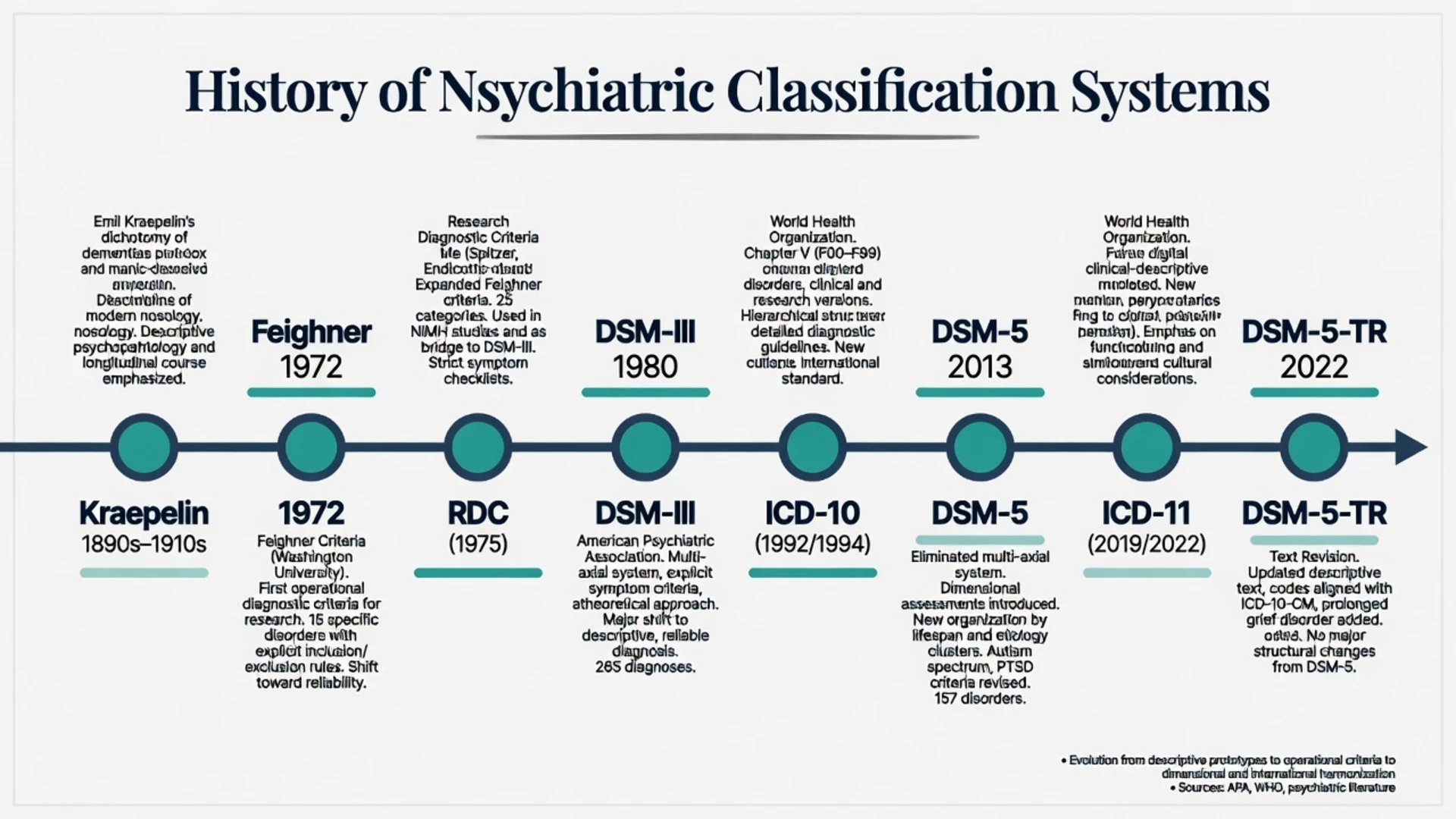
Classical purposes: clinical communication, research sampling, and public health statistics under WHO ICD coding.[2][6] Spitzer and colleagues formalised operational criteria (Research Diagnostic Criteria) to improve reliability before DSM-III made polythetic criteria mainstream clinical practice.[1]
Classification systems — history and architecture
ICD vs DSM governance
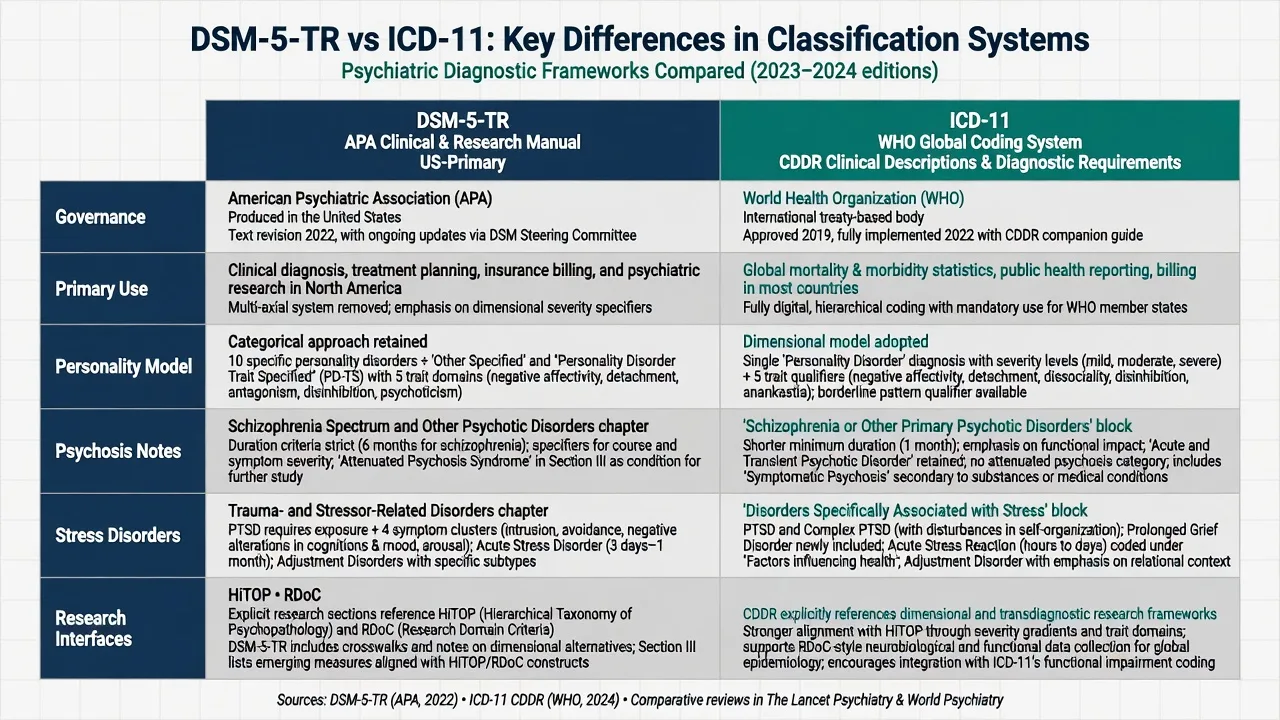
| Feature | ICD-11 | DSM-5-TR |
|---|---|---|
| Owner | WHO | American Psychiatric Association |
| Global role | Universal morbidity/mortality coding | Dominant US clinical/research manual |
| Clinical text | Clinical Descriptions and Diagnostic Requirements (CDDR) | Full criteria text + descriptive text revision |
| Audience | All countries' health systems | Clinicians, insurers, researchers (global influence) |
| Personality | Severity + trait domains (+ optional borderline pattern) | Section II categorical types (+ AMPD Section III) |
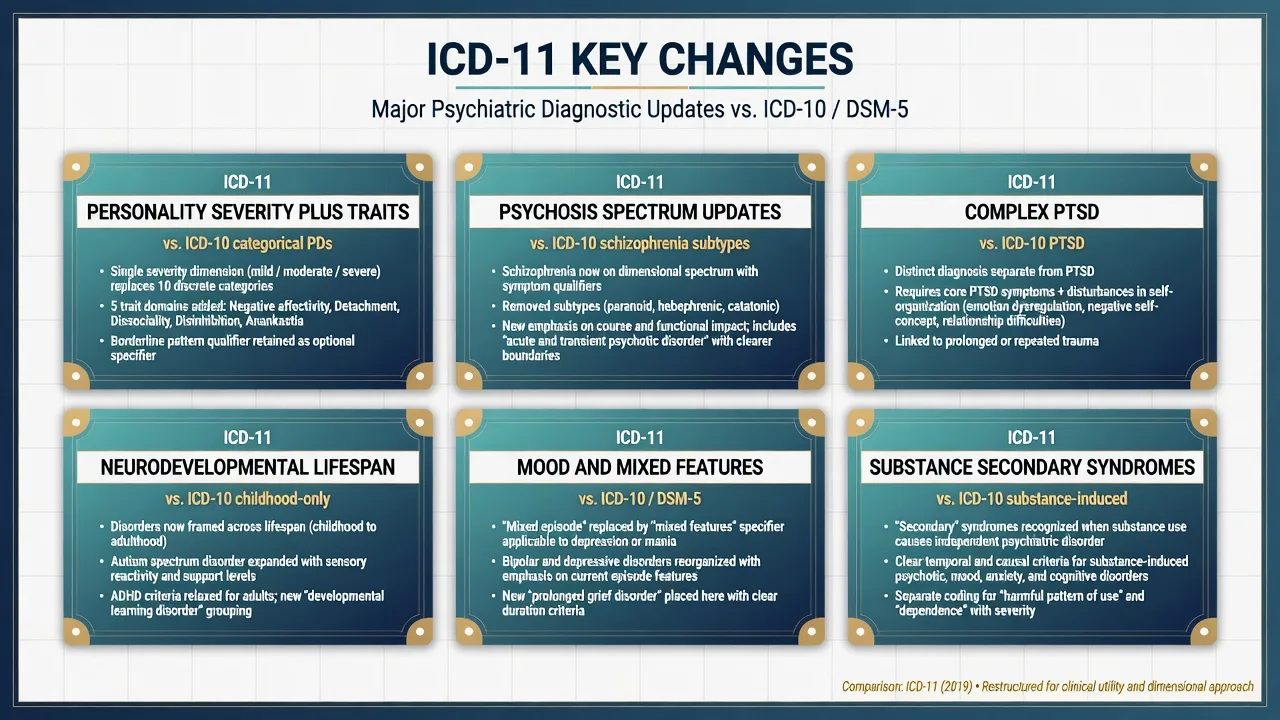
ICD-11 innovations for mental, behavioural, and neurodevelopmental disorders include revised chapter structure, greater attention to clinical utility for global practitioners, and selected new or reconceptualised categories.[6][8] Organisation-level comparison shows substantial concordance with DSM-5 but non-trivial category and requirement differences that matter for coding and exams.[7]
DSM-5-TR specifically
DSM-5-TR is a text revision, not a full structural redesign. Core architecture from DSM-5 remains; text updates, criterion clarifications, coding alignments, and selected diagnostic refinements (including formalisation of prolonged grief disorder in the DSM ecosystem) improve clarity. On viva, do not invent a mythical "DSM-6 lite" redesign.[7]
What "criteria" actually require
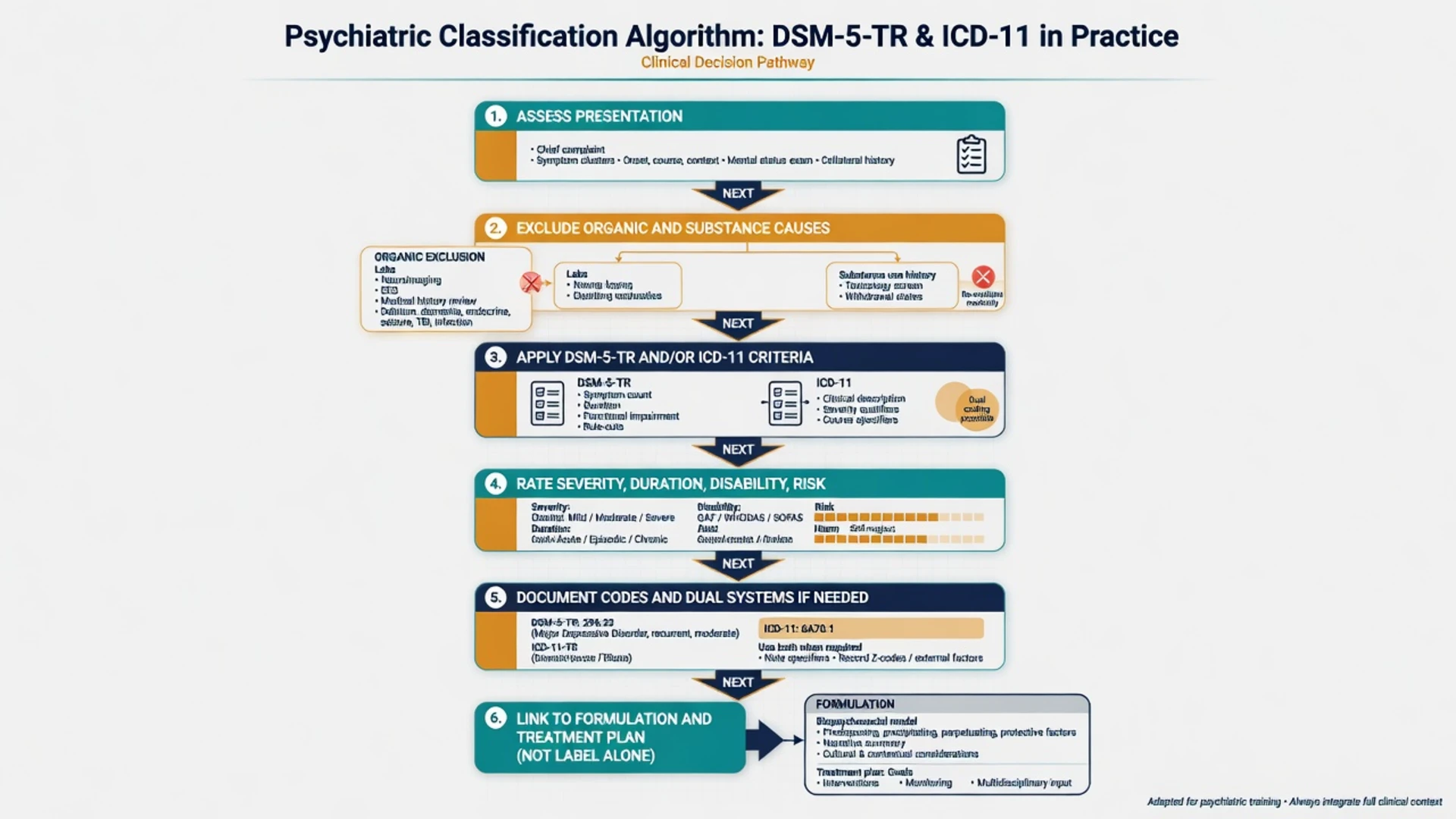
Modern systems typically demand a symptom set (often polythetic), duration/persistence, clinically significant distress or impairment, exclusions (substance, medical, other mental disorder hierarchy where stated), and specifiers (severity, course, features).[7][19] Missing impairment or exclusion reasoning is a classic undergraduate error; fellowship answers always include them.[7][19]
Epidemiology and the politics of thresholds
Classification creates prevalence as much as it measures it. Changing duration, severity, or hierarchical exclusion rules shifts who counts as a case. Field-trial design choices (sampling, test–retest interval, clinician training) also shape reliability estimates used in debates about "overdiagnosis".[3][4]
Comorbidity inflation is often an artifact of splitting overlapping criteria sets (especially personality, anxiety, depression) rather than proof of dozens of independent diseases. Dimensional models treat much of this as shared spectra.[10][11]
Pathophysiology of nosology — constructs, not lesions
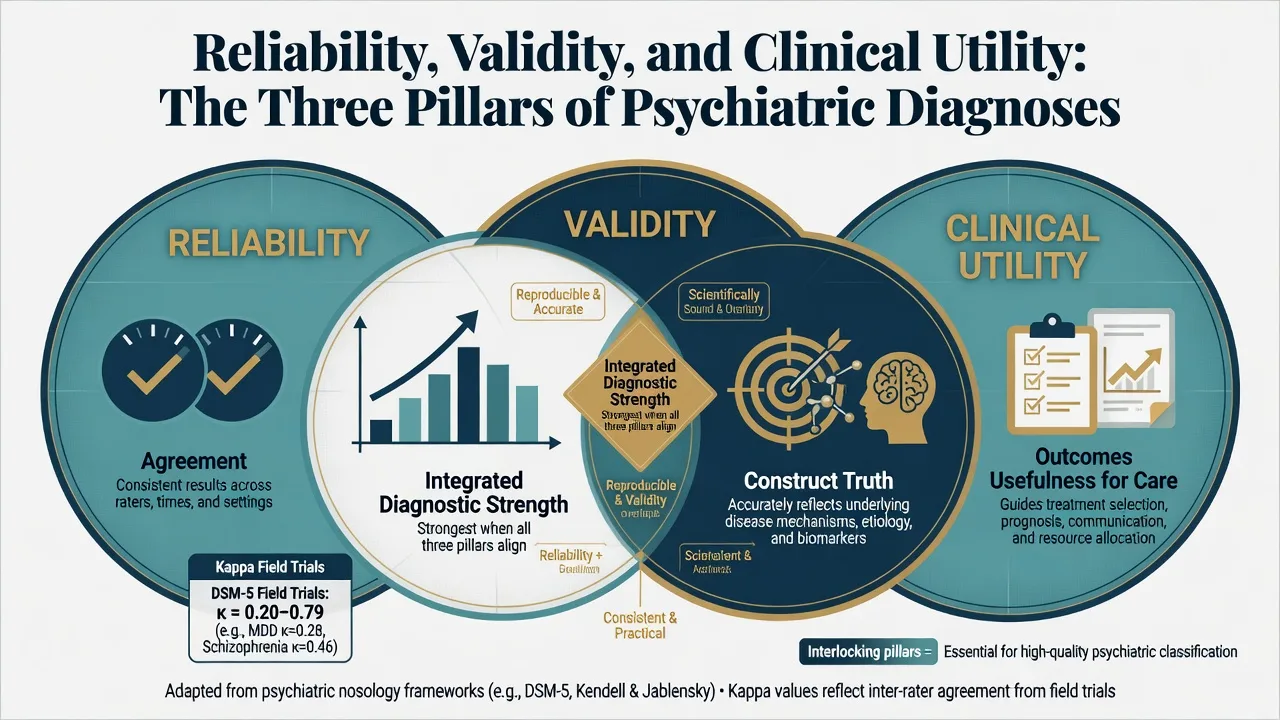
Most psychiatric categories remain syndromal constructs. Validity is multi-method (clinical description, laboratory/biomarker where available, delimitation from other disorders, follow-up course, family/genetic aggregation) rather than a single gold-standard test. Kendell and Jablensky's classic paper separates validity (does the category carve nature at its joints?) from utility (does it help predict, communicate, or treat?). A diagnosis can be useful without being a fully validated natural kind.[2][19]
Categorical vs dimensional
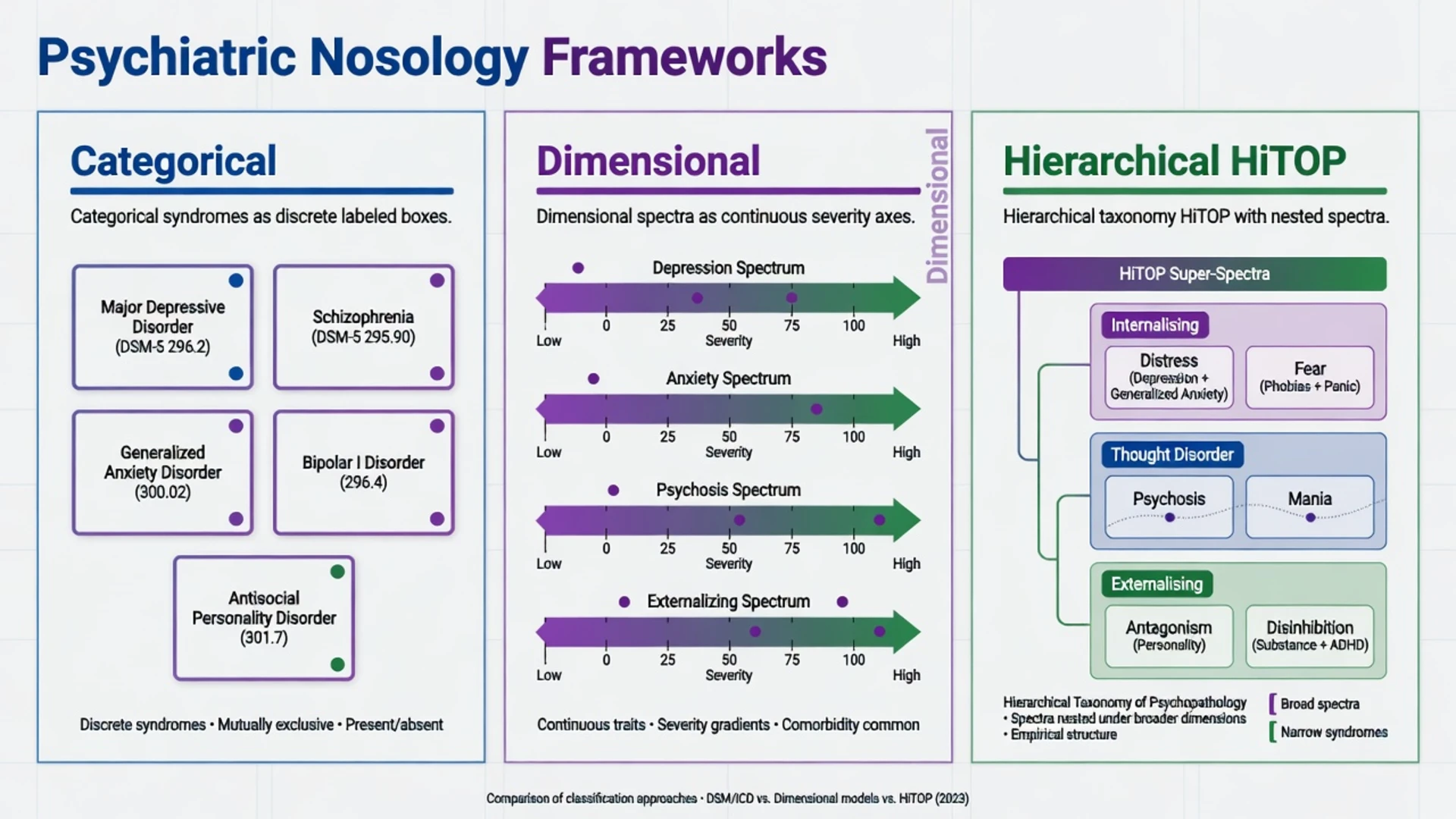
Categorical systems assign present/absent disorders — good for guidelines, trials, and coding, at the cost of arbitrary thresholds, artificial comorbidity, and loss of severity information.[9][10] Dimensional systems rate continuous traits or symptom dimensions — better for severity and research covariance, at the cost of harder administrative coding and less familiar workflows for some clinicians.[9][10] Hybrid practice is already mainstream: severity and course specifiers, cross-cutting symptom measures, and ICD-11 personality severity are dimensional features living inside categorical shells.[5][9][15]
HiTOP — hierarchical taxonomy
The Hierarchical Taxonomy of Psychopathology (HiTOP) organises psychopathology into hierarchical dimensions (for example internalising, thought disorder, disinhibited externalising, antagonistic externalising, detachment) based largely on quantitative covariance of symptoms and traits. It is a scientific taxonomy proposal for research and measurement, increasingly discussed for practice, not a WHO/APA replacement manual.[10][11][12]
RDoC — research domain criteria
NIMH RDoC frames psychopathology as dysfunctions in major neurobehavioural domains (for example negative valence, positive valence, cognitive systems, social processes, arousal/regulatory systems) studied across units of analysis (genes to self-report). RDoC is a research framework aiming toward precision psychiatry; it does not provide ICD billing codes or standard clinical trial eligibility lists.[13][14][9]
ICD-11 / DSM-5-TR
- Clinical syndromes
- Guideline and service entry
- Global coding (ICD)
- Polythetic criteria + impairment
HiTOP
- Empirical symptom hierarchy
- Dimensional spectra
- Explains comorbidity structure
- Research and measurement emphasis
RDoC
- Mechanistic domains
- Units of analysis
- Not a clinical codebook
- Precision-medicine research aim
Clinical presentation of classification work
What examiners want to see in your notes and viva: primary diagnosis with system named when relevant (ICD-11 code; DSM-5-TR label); specifiers that change care; provisional status when data are incomplete; secondary/substance-induced hierarchy; formulation after the label; and risk and capacity as separate lines of reasoning.[7][20] Weak presentation includes laundry lists of comorbidities without hierarchy, personality labels from a single ED visit, or "rule out everything" without a working diagnosis.[20]
Differential — related concepts examiners mix up
| Concept | Is | Is not |
|---|---|---|
| Diagnosis | Syndrome category | Full person explanation |
| Formulation | Causal hypothesis + plan | Optional essay decoration |
| Specifier | Modifies a diagnosis | Separate disease |
| Trait elevation | Dimensional style | Automatic PD diagnosis |
| RDoC domain | Research construct | Service access code |
| Clinical utility | Usefulness for care | Biological validity |
Organic and substance-induced mental syndromes always sit in the differential for acute psychosis, mania, depression, and cognitive change — classification systems encode this with exclusion and secondary categories.[7][17]
Assessment — applying systems at the bedside
Structured tools
Structured interviews (SCID / MINI / CIDI / SCAN) operationalise criteria for research and complex cases; DSM-5 Level 1 cross-cutting measures screen dimensional symptom domains; disability measures (for example WHODAS-style instruments) capture impairment rather than diagnosis alone; and ICD-11 CDDR provides clinical descriptions for global practitioners beyond pure checklists.[5][6] Cross-cutting assessments were developed and reliability-tested as part of the DSM-5 field-trial programme.[5]
Cultural context
Any category must be interpreted against cultural norms, idioms of distress, and explanatory models. Pathologising culturally sanctioned experience is a classification error as well as a clinical one.[9][19]
Investigations — what classification is not
There is no laboratory panel that "proves" major depression or schizophrenia for routine diagnosis. Investigations revise coding when they establish secondary mental syndromes (delirium, autoimmune encephalitis, thyroid disease, substance toxicity). Rating scales quantify severity and track response; they do not replace diagnostic criteria.[2][19]
Management — resuscitation priorities
In the ED or acute ward, prioritise medical stability and organic screen as indicated, immediate suicide/violence/vulnerability risk, legal status and least-restrictive safety, a working diagnosis sufficient to start evidence-based acute care, and deferral of personality disorder labels plus fine-grained dual coding until longitudinal data exist when the acute picture is unstable.[20][7] Classification perfection is not a resuscitation target.[20]
Management — definitive use of nosology
How labels guide care
Labels select guidelines and first-line treatments (RANZCP / NICE / APA keyed to syndromes), structure psychoeducation and prognosis ranges, enable access to programmes and supports, and organise measurement-based care targets.[6][20] Then map interventions onto formulation: treat precipitants, interrupt perpetuating loops, bolster protection — the label alone under-specifies the plan.[20]
Dual-system reality (ANZ and global)
Many ANZ services code ICD for health information while clinicians trained on DSM language. Dual fluency means: think in clinical criteria, document the local coding standard, and note clinically important DSM-ICD divergences in letters when they affect interpretation.[6][7]
RANZCP teaching expects dual fluency. Hospital coding is typically ICD-linked; exams still expect DSM-5-TR criterion knowledge for many syndromes. State/territory Mental Health Acts govern involuntary care — classification does not equal legal threshold.[6][7]
Specific subtypes and high-yield divergences
Personality disorder — the cleanest ICD-11 exam topic
ICD-11 replaces most categorical PD types with general requirements, then severity (mild / moderate / severe) as the principal clinical axis, then trait domain qualifiers (negative affectivity, detachment, dissociality, disinhibition, anankastia), plus an optional borderline pattern specifier.[15][16] DSM-5-TR Section II retains categorical types and clusters; the Alternative Model for Personality Disorders (AMPD) aligns conceptually with severity (Criterion A) plus traits (Criterion B).[15][16]
Schizophrenia and other primary psychotic disorders
ICD-11 revises the psychosis chapter toward a spectrum of primary psychotic disorders with updated duration/course concepts and reduced historical over-weighting of Schneiderian first-rank symptoms as privileged pathognomonic signs. Relationship to DSM-5 schizophrenia spectrum criteria is close but not identical — duration and schizoaffective boundaries remain exam favourites.[17][7]
Disorders specifically associated with stress
ICD-11 structures PTSD with a tighter symptom focus and introduces complex PTSD (PTSD plus pervasive self-organisation disturbances: affect dysregulation, negative self-concept, relational disturbance). Prolonged grief and related categories have evolving cross-system recognition; emerging implementation literature tracks real-world uptake of new ICD-11 categories.[8][6]
Neurodevelopmental and lifespan framing
Both systems increasingly treat autism and ADHD as lifespan conditions with developmental onset requirements. Threshold and specifier language differences still trip candidates who memorise only one manual.[6][7]
Mood disorders
Mixed features, bipolar boundaries, and persistent depressive constructs show residual DSM-ICD wording differences. Always state which system's duration and exclusion rules you are applying in an MEQ.[7][6]
Substance-induced and secondary mental syndromes
Hierarchy matters: if substances or medical disease fully explain the syndrome, primary psychiatric categories may be inappropriate or provisional. This is classification hygiene, not pedantry.[7]
Reliability, validity, utility — the exam trinity
Reliability
Reliability = agreement (test–retest, inter-rater). DSM-5 field trials reported variable kappas across diagnoses; some common disorders showed more modest reliability than hoped, fuelling public controversy. Interpreting kappa requires prevalence awareness and study design literacy.[3][4]
Validity
Validity = whether the construct corresponds to a meaningful natural distinction (predictive, concurrent, construct validity). Most categories have partial validators (course, treatment response, family aggregation) without complete pathophysiological definition.[2][19]
Clinical utility
Clinical utility = whether clinicians can use the category to communicate, choose interventions, and predict needs. ICD field and web-based studies have evaluated diagnostic accuracy and clinician-rated utility of ICD-11 relative to ICD-10 for selected disorders — utility is an empirical claim, not a slogan.[18][6]
Complications and pitfalls
Pitfalls include reification (treating the manual as nature), checklist medicine without culture or impairment, premature PD labels from single crisis contacts, comorbidity scorekeeping without hierarchy, system confusion mixing DSM durations with ICD names, RDoC/HiTOP overclaim as legal or billing systems, forensic over-reach equating diagnosis with responsibility or risk, and stigma laundering via softer names without better care.[1][2][9][20]
Prognosis and disposition
Course specifiers (first episode, multiple episodes, continuous, partial remission) structure prognosis conversations more honestly than the bare diagnosis. Severity grades (for example ICD-11 PD severity) inform intensity of follow-up and risk of self-harm or service use. Administrative miscoding can misroute patients into wrong pathways — quality of coding is a patient-safety issue, not clerical trivia.[15][17]
Special populations
Children and adolescents. Developmental appropriateness and age-of-onset rules matter; adult criteria may misclassify normative developmental phenomena.[6][7] Older adults. Medical comorbidity raises the base rate of secondary syndromes; avoid pure primary labels without organic thought.[7][19] Cultural and Indigenous contexts. Classification without cultural formulation risks false positives and false negatives; dual competence is required.[9][19] Intellectual disability. Diagnostic overshadowing (attributing all behaviour to ID) and under-recognition of treatable mental disorders both occur.[6][19] Forensic settings. Classification informs clinical care plans; it does not answer fitness, responsibility, or dangerousness alone. Statutes are jurisdiction-specific.[2][20]
Evidence, guidelines, and controversies
Landmark anchors for viva include the operational criteria and reliability movement (RDC), validity versus utility (Kendell and Jablensky), DSM-5 field trials Parts I–III, ICD-11 innovation and DSM–ICD comparison papers, HiTOP quantitative taxonomy, the RDoC research framework, ICD-11 personality and psychosis chapter reforms, and clinical utility field evaluations.[1][2][3][4][6][7][10][13][15][18]
Self-test: name the framework
Controversies that remain fair game: modest reliability for some DSM-5 diagnoses; whether dimensional systems can be implemented at scale; political and pragmatic compromises in ICD-11 personality reform; and how far new categories (complex PTSD, gaming disorder, and others) should expand the manual.[4][8][15]
Exam pearls
Three properties of a diagnosis
R-V-U
Exam pearls: DSM-5-TR is a text revision — do not invent wholesale new chapters; ICD-11 PD is severity first, traits second, borderline pattern optional; first-rank symptoms are no longer sacred pathognomonic keys in ICD-11 psychosis teaching; HiTOP explains comorbidity hierarchies while RDoC targets mechanisms — neither replaces ICD coding; always state system, criteria met, exclusions, specifiers, then formulation; multi-board trap — ABPN stems are often DSM-worded while MRCPsych/ANZ practice is ICD-coded, so answer in the language of the stem and note dual systems when asked.[6][7][15][17][9][20]
References
- [1]Spitzer RL, Endicott J, Robins E Research diagnostic criteria: rationale and reliability Arch Gen Psychiatry, 1978.PMID 655775
- [2]Kendell R, Jablensky A Distinguishing between the validity and utility of psychiatric diagnoses Am J Psychiatry, 2003.PMID 12505793
- [3]Clarke DE, Narrow WE, Regier DA, et al. DSM-5 field trials in the United States and Canada, Part I: study design, sampling strategy, implementation, and analytic approaches Am J Psychiatry, 2013.PMID 23111546
- [4]Regier DA, Narrow WE, Clarke DE, et al. DSM-5 field trials in the United States and Canada, Part II: test-retest reliability of selected categorical diagnoses Am J Psychiatry, 2013.PMID 23111466
- [5]Narrow WE, Clarke DE, Kuramoto SJ, et al. DSM-5 field trials in the United States and Canada, Part III: development and reliability testing of a cross-cutting symptom assessment for DSM-5 Am J Psychiatry, 2013.PMID 23111499
- [6]Reed GM, First MB, Kogan CS, et al. Innovations and changes in the ICD-11 classification of mental, behavioural and neurodevelopmental disorders World Psychiatry, 2019.PMID 30600616
- [7]First MB, Gaebel W, Maj M, et al. An organization- and category-level comparison of diagnostic requirements for mental disorders in ICD-11 and DSM-5 World Psychiatry, 2021.PMID 33432742
- [8]Reed GM, First MB, Billieux J, et al. Emerging experience with selected new categories in the ICD-11: complex PTSD, prolonged grief disorder, gaming disorder, and compulsive sexual behaviour disorder World Psychiatry, 2022.PMID 35524599
- [9]Clark LA, Cuthbert B, Lewis-Fernández R, et al. Three Approaches to Understanding and Classifying Mental Disorder: ICD-11, DSM-5, and the National Institute of Mental Health's Research Domain Criteria (RDoC) Psychol Sci Public Interest, 2017.PMID 29211974
- [10]Kotov R, Krueger RF, Watson D, et al. The Hierarchical Taxonomy of Psychopathology (HiTOP): A dimensional alternative to traditional nosologies J Abnorm Psychol, 2017.PMID 28333488
- [11]Kotov R, Krueger RF, Watson D A paradigm shift in psychiatric classification: the Hierarchical Taxonomy Of Psychopathology (HiTOP) World Psychiatry, 2018.PMID 29352543
- [12]Kotov R, Cicero DC, Conway CC, et al. The Hierarchical Taxonomy of Psychopathology (HiTOP) in psychiatric practice and research Psychol Med, 2022.PMID 35650658
- [13]Insel TR The NIMH Research Domain Criteria (RDoC) Project: precision medicine for psychiatry Am J Psychiatry, 2014.PMID 24687194
- [14]Cuthbert BN, Insel TR Toward the future of psychiatric diagnosis: the seven pillars of RDoC BMC Med, 2013.PMID 23672542
- [15]Tyrer P, Mulder R, Kim YR, et al. The Development of the ICD-11 Classification of Personality Disorders: An Amalgam of Science, Pragmatism, and Politics Annu Rev Clin Psychol, 2019.PMID 30601688
- [16]Bach B, First MB Application of the ICD-11 classification of personality disorders BMC Psychiatry, 2018.PMID 30373564
- [17]Gaebel W, Kerst A, Stricker J Classification and Diagnosis of Schizophrenia or Other Primary Psychotic Disorders: Changes from ICD-10 to ICD-11 and Implementation in Clinical Practice Psychiatr Danub, 2020.PMID 33370728
- [18]Gaebel W, Stricker J, Riesbeck M, et al. Accuracy of diagnostic classification and clinical utility assessment of ICD-11 compared to ICD-10 in 10 mental disorders: findings from a web-based field study Eur Arch Psychiatry Clin Neurosci, 2020.PMID 31654119
- [19]Stein DJ, Palk AC, Kendler KS What is a mental disorder? An exemplar-focused approach Psychol Med, 2021.PMID 33843505
- [20]Macneil CA, Hasty MK, Conus P, et al. Is diagnosis enough to guide interventions in mental health? Using case formulation in clinical practice BMC Med, 2012.PMID 23016556