Psych · general-adult
Other specified feeding or eating disorders (OSFED)
Also known as OSFED · EDNOS · Atypical anorexia nervosa · Purging disorder · Night eating syndrome · UFED · Subthreshold bulimia · Other specified feeding or eating disorder
Exam-exhaustive fellowship reference on OSFED — DSM-5-TR named examples (atypical AN, BN/BED of low frequency/limited duration, purging disorder, night eating syndrome), UFED distinction, medical risk despite non-low BMI, CBT-E/transdiagnostic care, RANZCP/NICE/APA framing. FRANZCP-primary, globally tagged.
On this page & tools
Your progress
Saved locally on this device.
10 MCQs with explanations
Target exams
Red flags
Other specified feeding or eating disorder (OSFED) is a high-yield residual-nosology topic for FRANZCP MEQ and clinical reasoning, MRCPsych theory and CASC explanation stations, and ABPN blueprint items. Examiners test whether candidates recognise named examples, refuse the trap that residual equals mild, screen medical risk in atypical AN and purging disorder, and apply transdiagnostic CBT-E rather than waiting for full diagnostic thresholds.[1][2][9]
Overview and definition
Historically, most treatment-seeking eating-disorder patients fell into EDNOS under DSM-IV. Meta-analytic work showed EDNOS was not a trivial leftover — symptom severity and impairment often approached full-threshold AN and BN, which is why DSM-5 reorganised residual categories and elevated BED to a full diagnosis while retaining OSFED for specified incomplete presentations.[9][2]
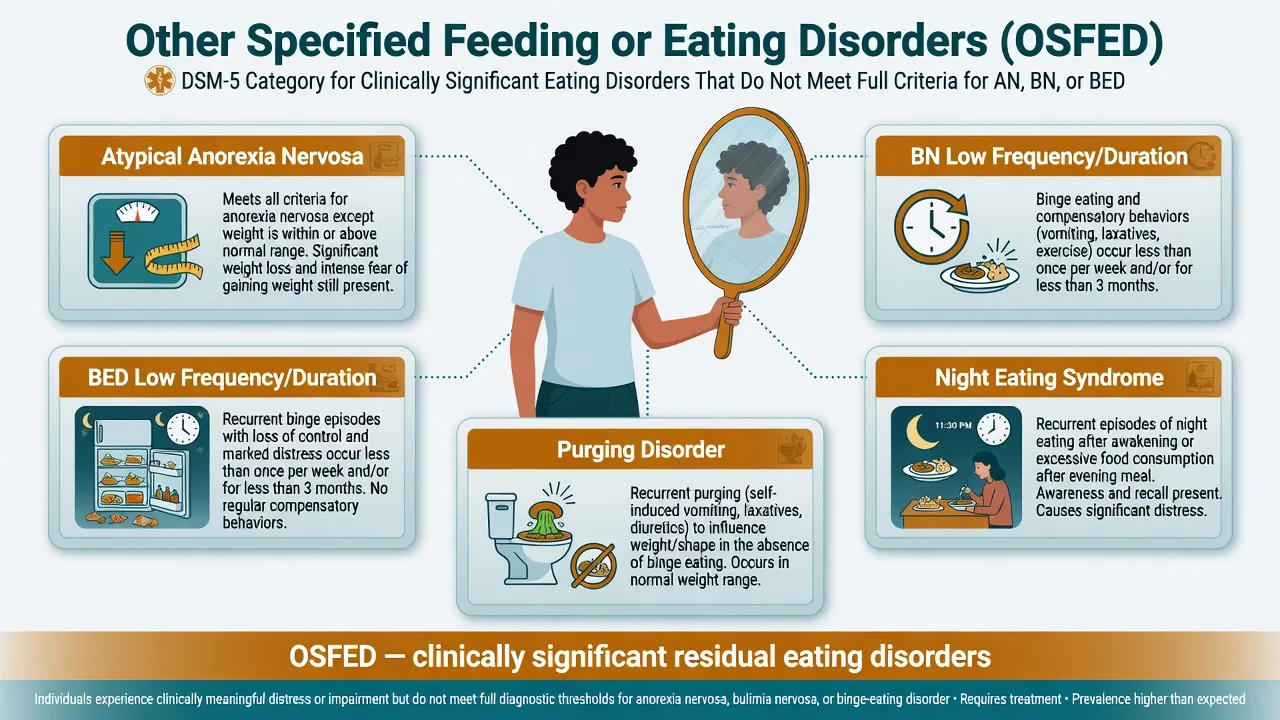
OSFED (DSM-5-TR structure to reproduce). Feeding or eating behaviours that cause clinically significant distress or impairment but do not meet full criteria for any specific feeding or eating disorder, and the clinician chooses to communicate the specific reason the presentation is residual. Named examples examiners expect are listed below.[1][2]
- Atypical anorexia nervosa — all criteria for AN are met except that, despite significant weight loss, the individual’s weight is within or above the normal range.[1][3]
- Bulimia nervosa (of low frequency and/or limited duration) — BN criteria met except binge eating and inappropriate compensatory behaviours occur, on average, less than once a week and/or for less than three months.[1][2]
- Binge-eating disorder (of low frequency and/or limited duration) — BED criteria met except binge eating occurs, on average, less than once a week and/or for less than three months.[1][2]
- Purging disorder — recurrent purging behaviour to influence weight or shape (e.g. self-induced vomiting, laxative/diuretic/other medication misuse) in the absence of binge eating, and the behaviour does not occur exclusively during AN.[5][6][1]
- Night eating syndrome (NES) — recurrent episodes of night eating, as manifested by eating after awakening from sleep or by excessive food consumption after the evening meal; awareness and recall of the eating; the behaviour causes significant distress or impairment and is not better explained by other factors (e.g. social norms, medication, another mental/medical disorder).[7][1][2]
UFED (unspecified feeding or eating disorder) is used when residual symptoms cause clinical significance but the clinician does not specify why criteria for a more specific disorder are not met (e.g. emergency settings with incomplete information). OSFED and UFED are not interchangeable exam terms.[1][11]
ICD-11. Residual feeding and eating disorder categories exist with closely related clinical ideas (including atypical AN framing). In viva, name which manual you are applying when residual language is examined.[1][2]
Classification and severity
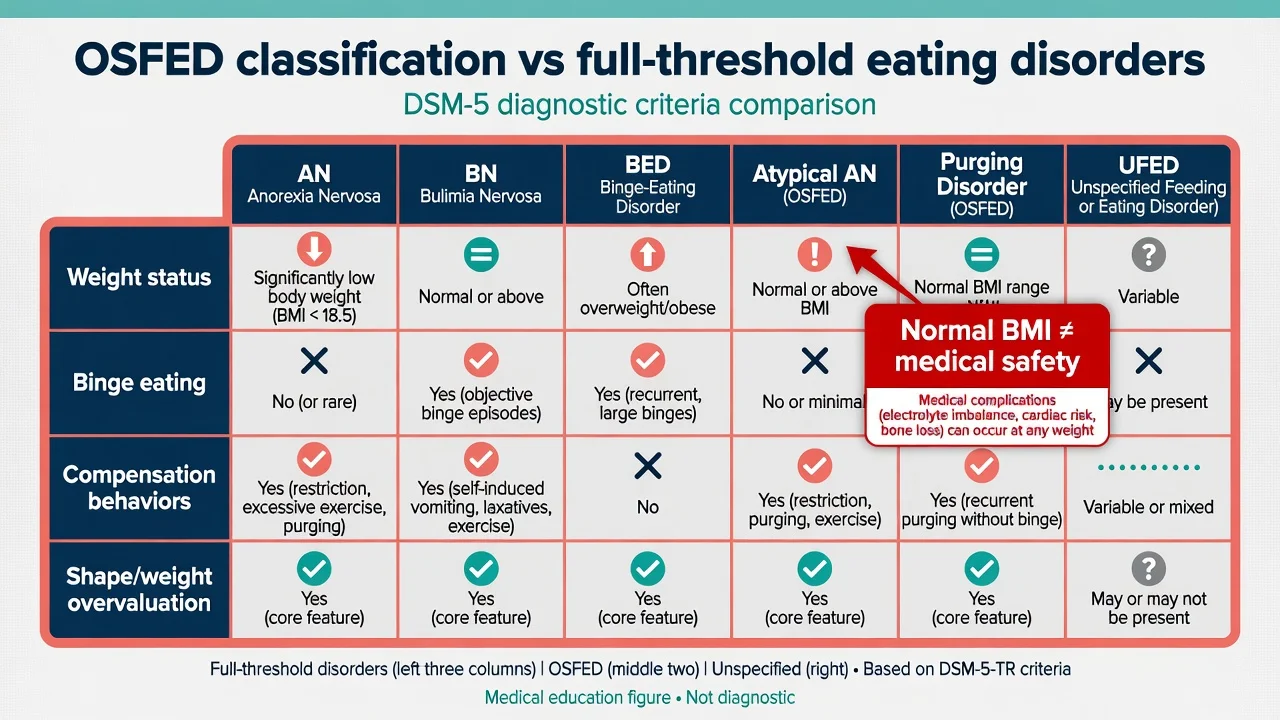
| Presentation | Weight | Binge | Compensation / other | Core residual reason |
|---|---|---|---|---|
| AN (full) | Significantly low | ± | ± | Meets full AN |
| Atypical AN (OSFED) | Normal or high after loss | ± | Restriction ± purge | Weight not significantly low |
| BN (full) | Not significantly low | Yes | Regular | Full frequency/duration |
| BN low frequency/duration (OSFED) | Not significantly low | Yes | Yes | Frequency and/or duration incomplete |
| BED (full) | Any | Yes | No regular | Full frequency/duration |
| BED low frequency/duration (OSFED) | Any | Yes | No regular | Frequency and/or duration incomplete |
| Purging disorder (OSFED) | Not AN range | No objective binge | Recurrent purge | Purge without binge |
| NES (OSFED) | Variable | Night pattern | Not classic BN cycle | Evening/night eating pattern |
| UFED | Variable | Variable | Variable | Unspecified residual |
| Always map residual examples against full-threshold discriminators rather than treating OSFED as a single homogeneous syndrome.[1][2][6][7] |
Severity in OSFED is clinical, not a single DSM severity band shared across all examples. Rate impairment, medical risk, suicide risk, weight-loss velocity (especially atypical AN), purge frequency, and functional disability — not the residual label alone.[1][3][4]
Atypical AN
- AN psychopathology + significant weight loss
- Weight still normal/high
- Medical risk can equal AN
- Do not call 'healthy weight dieting'
Purging disorder
- Recurrent purge, no objective binge
- Shape/weight influence typical
- Electrolyte and dental risk real
- Not 'almost BN — ignore'
Subthreshold BN/BED
- Same behaviours, lower frequency/duration
- May be early illness or partial remission
- Still impairing — treat
- Reassess as thresholds crossed
Night eating syndrome
- Evening hyperphagia and/or nocturnal ingestions
- Awareness retained (vs SRED)
- Distress/impairment required
- Often sleep and metabolic comorbidity
Epidemiology and risk factors
Headline epidemiology (exam framing)
Australian adolescent epidemiology shows other specified and unspecified eating disorders are not rare and carry clinical significance alongside full-threshold diagnoses.[10] Community sampling among women likewise finds OSFED and UFED presentations that merit clinical attention rather than dismissal as subclinical noise.[11]
Risk and maintaining factors mirror full-threshold eating disorders: dieting and thin-ideal internalisation, body dissatisfaction, perfectionism, adverse experiences, familial aggregation, elite sport/performance pressures, and prior higher weight with subsequent large loss (especially atypical AN).[2][1]
Mortality and suicide. Meta-analysis of mortality across eating disorders shows elevated standardised mortality ratios, highest in AN but not confined to it; residual and non-AN eating disorders also contribute excess risk.[12] Crow and colleagues reported increased mortality in BN and other eating disorders, reinforcing that incomplete criteria do not equal low risk of death.[13] Suicide risk assessment is mandatory at every meaningful contact, independent of residual label.[12][13][1]
Pathophysiology
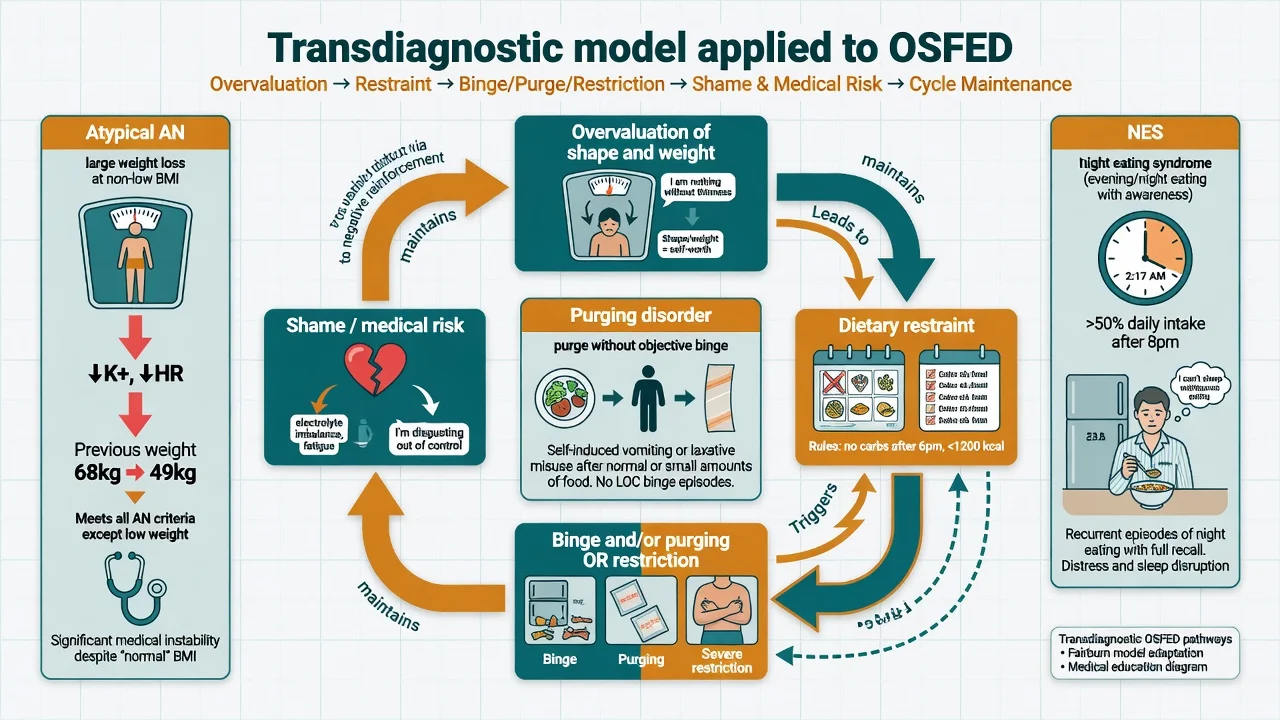
Transdiagnostic cognitive-behavioural model. Overvaluation of shape and weight drives dietary restraint and food rules; restraint and affect precipitates bingeing and/or compensatory behaviour; shame and medical symptoms maintain secrecy and further control. Residual presentations are often the same maintaining system with incomplete frequency, duration, or weight thresholds — which is why CBT-E is conceptually natural across OSFED.[8][2]
Atypical AN physiology. Significant calorie deficit and large or rapid weight loss produce starvation physiology (bradycardia, orthostasis, electrolyte and bone risk, cognitive rigidity about food) even when absolute BMI remains in a “normal” or overweight range. Whitelaw and colleagues showed that extent and recency of weight loss predict complications and can matter as much as or more than the degree of underweight alone — a core exam pearl for atypical AN.[3][4][16]
Purging disorder. Keel’s programme of work supports purging disorder as a clinically meaningful entity distinct from BN on subjective and physiological responses to a test meal, not merely “BN missing a binge criterion.” Purging still drives hypokalaemia, acid–base disturbance, and dental/salivary complications.[5][6][14]
Night eating syndrome. Research diagnostic criteria emphasise evening hyperphagia (classically at least about 25 percent of intake after the evening meal) and/or nocturnal ingestions (often at least twice weekly), retained awareness, distress or impairment, and a minimum duration (commonly three months in research criteria). Frame NES as a circadian–appetite dysregulation pattern with psychological distress — not casual late snacking.[7]
Clinical presentation
Atypical anorexia nervosa. Intense fear of weight gain or persistent behaviour preventing regain, body image disturbance or lack of recognition of seriousness, and significant weight loss from a higher premorbid weight, yet current weight is not in the significantly low AN range. Patients may present with marked restriction, compulsive exercise, purging, amenorrhoea history, and medical instability while family and clinicians still see a “normal” body size.[3][4][16]
BN/BED of low frequency or limited duration. Phenomenology matches BN or BED but weekly frequency or three-month duration is incomplete — early illness, partial remission, or fluctuating course. Functional impairment and medical risk can still be substantial.[1][2]
Purging disorder. Recurrent self-induced vomiting, laxatives, diuretics, or other purgatives to influence weight/shape without objective binge episodes. Dental erosion, parotid enlargement, Russell sign, reflux, and electrolyte disturbance may be the first clues.[5][6][14]
Night eating syndrome. Evening hyperphagia, nocturnal awakenings to eat with awareness, morning anorexia, insomnia, guilt, and often weight or metabolic concerns. Distinguish from sleep-related eating disorder, in which awareness of the eating episode is impaired or absent.[7]
MSE language examiners reward. Quantify weight trajectory (highest adult weight, amount lost, months of loss); operationalise binge fidelity; list every compensation method; document night-eating pattern; overvaluation of shape/weight; mood and suicide risk; insight and minimisation (“I’m not underweight so it isn’t anorexia”).[1][2]
Differential diagnosis
| Pair | Discriminator |
|---|---|
| AN vs atypical AN | Significantly low weight present → AN; significant loss but weight not low → atypical AN (OSFED) |
| BN vs purging disorder | Objective binge present → BN pathway; purge without binge → purging disorder |
| BN vs BN low frequency | Frequency/duration thresholds |
| BED vs BED low frequency | Frequency/duration thresholds |
| Atypical AN vs ARFID | Shape/weight overvaluation and weight-phobia structure present in atypical AN; ARFID avoidance is not driven by body image |
| NES vs SRED | Awareness of night eating retained in NES |
| OSFED vs UFED | Clinician specifies residual reason (OSFED) vs unspecified (UFED) |
| Organic mimics | Hyperthyroidism, IBD, coeliac, malignancy, diabetes, Addison, TB, stimulant use — exclude when red flags |
| These discriminators keep residual coding precise and prevent both over-diagnosis of full-threshold labels and under-treatment of impairing partial presentations.[1][2][5][7] |
Always reassess over time: diagnostic crossover between AN and BN is well described, and residual presentations often migrate into or out of full-threshold diagnoses as weight and behaviours evolve.[15][1][2]
Clinical and bedside assessment
History structure. Onset and course; highest/lowest weights; rate and absolute amount of weight loss; intake and food rules; binge definition (amount + loss of control); purge methods and frequency; exercise; NES pattern (evening proportion, nocturnal ingestions, awareness); body image; menses; substances; trauma; prior therapy fidelity; suicide and self-harm; functional impairment; carer accommodation.[1][3][16]
Physical exam. BMI and trend; heart rate, blood pressure including orthostatics, temperature; hydration; dentition; parotids; Russell sign; oedema; self-harm scars; signs of malnutrition that can appear even without classic underweight appearance.[3][14][16]
Risk. Suicide risk is elevated across the eating-disorder spectrum. Medical risk in OSFED is driven by weight-loss velocity, purging intensity, vitals, electrolytes, and ECG — not by residual status.[3][4][12][13]
Measurement-based care. Track weekly binge/purge counts, night-eating episodes, weight trajectory, and distress. Use EDE/EDE-Q concepts where services support them; consistency beats unused scales.[1][8]
Investigations
Baseline whenever restriction is significant, purging occurs, or vitals worry you. Urea and electrolytes including potassium, sodium, magnesium, phosphate; glucose; full blood count; liver function; ECG; pregnancy test when relevant. Abnormal electrolytes or ECG change trigger a medical pathway.[14][16][1]
Atypical AN. Apply restrictive eating-disorder medical principles (SAHM position framing): do not under-investigate because BMI is “normal.” Refeeding risk follows depletion and carbohydrate reintroduction physiology, not BMI band alone.[16][3][4]
Neuroimaging is not routine without neurological red flags.[1]
Management — acute risk and resuscitation
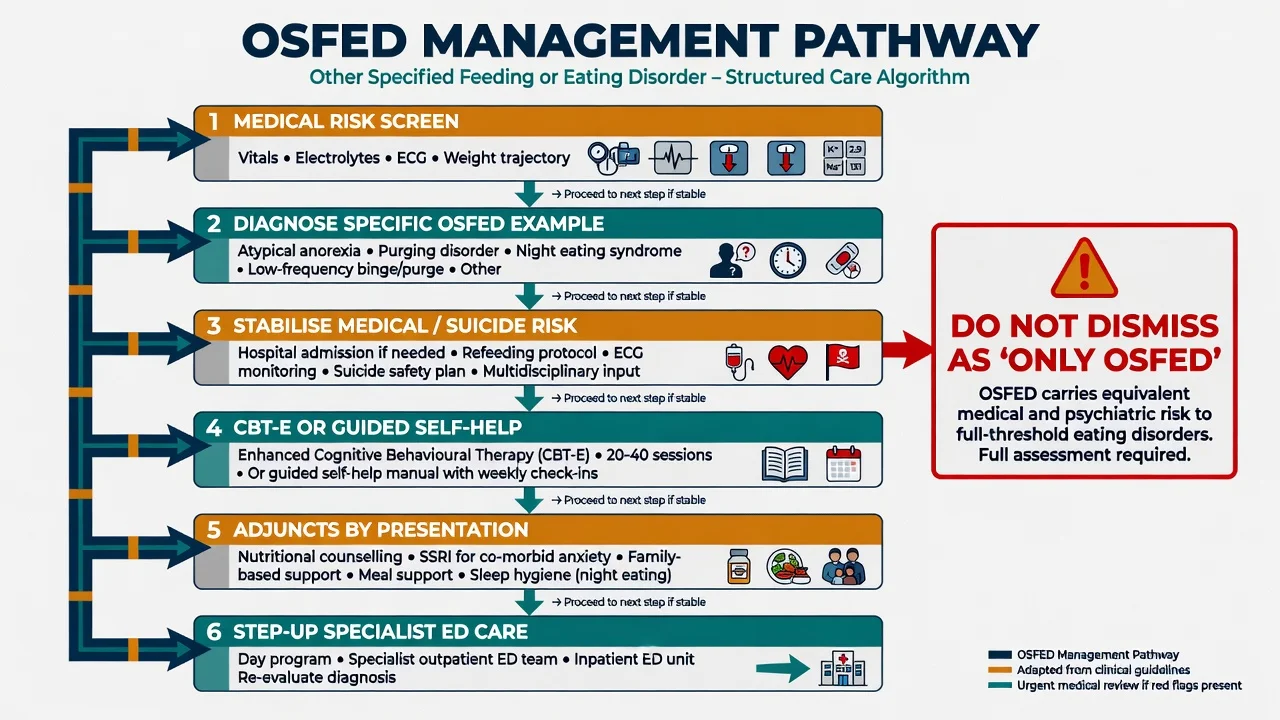
Medical priorities. Correct electrolytes under medical protocols; ECG monitoring when indicated; careful refeeding with phosphate/potassium/magnesium surveillance after restriction; manage volume depletion; dental and medical review for purging complications.[14][16][4]
Psychiatric priorities. Structured suicide risk assessment, means restriction, safety planning, and appropriate setting intensity. Do not minimise because the patient “does not look anorexic.”[12][13][1]
Legal frameworks. Capacity is decision-specific. Compulsory medical or psychiatric care uses jurisdiction-specific mental health and guardianship statutes — state principles and local Act names without inventing foreign section numbers.[1]
Management — definitive and stepwise
Psychological treatments (first line)
CBT-E (enhanced cognitive behaviour therapy) is the leading evidence-based psychological treatment for many non-underweight eating-disorder presentations. Fairburn and colleagues demonstrated efficacy of a transdiagnostic CBT protocol with durable follow-up gains in patients who were not severely underweight — residual and mixed presentations are conceptually in scope because maintaining mechanisms are shared.[8][1][2]
Core CBT-E targets for OSFED: formulation of the individual cycle; regularised eating; self-monitoring; reduction of dietary rules; shape/weight overvaluation work; purge cessation; night-eating pattern restructuring for NES; relapse prevention.[8]
Guided self-help CBT is a valid stepped first step for milder residual BN/BED-pattern presentations when services support structured manuals plus brief guidance — not unstructured supportive chat labelled as therapy.[1][8]
Atypical AN psychological care. Restore nutrition toward an individualised healthy weight trajectory (often guided by premorbid growth or adult healthy range, medical stability, and return of physiological function), reduce restriction and exercise compulsion, and involve family in adolescents. Case-series evidence supports family-based treatment elements for adolescent atypical AN; medical monitoring intensity should match restrictive ED practice.[3][16][1]
Purging disorder. Target purging and overvaluation directly with CBT methods; do not delay care until objective binges appear to “complete” BN.[5][6][8]
NES. Behavioural regulation of meal timing, sleep hygiene, and CBT elements addressing evening/night eating with retained awareness; treat comorbid insomnia and mood disorders. Avoid overclaiming a single drug of choice — evidence is thinner than for BN pharmacotherapy.[7][1]
Pharmacotherapy (adjunctive, presentation-guided)
There is no OSFED-specific first-line drug. Use diagnosis-pattern logic with transparent uncertainty, anchored to full-threshold evidence where the residual picture matches BN-like severity.[1][2][8]
For BN-pattern residual illness severe enough to warrant medication, specialist practice may titrate fluoxetine toward the classic collaborative-trial BN dose of 60 mg oral daily (often start lower and titrate), with monitoring for sexual and gastrointestinal effects, activation, drug interactions, and suicidality when depression coexists — this is extrapolated specialist judgment for residual BN-like presentations, not an automatic licence for every OSFED subtype.[1][8]
| Pattern | Adjunct teaching (adult, specialist judgment) | Key cautions |
|---|---|---|
| BN-like residual with regular purge/binge severity | Consider fluoxetine toward 60 mg oral daily when medication is indicated | Sexual/GI effects; suicidality with depression; not a CBT substitute |
| BED-like residual | Psychological care first; stimulant BED drugs only where licensed for full BED and regionally available — do not assume for residual labels | Cardiovascular, misuse, formulary limits |
| Atypical AN | No routine weight-gain pill; specialist olanzapine adjunct is an AN-pathway discussion, not automatic OSFED default | Metabolic monitoring; not first-line alone |
| Active BN/AN-pattern with seizure risk drugs | Do not use bupropion in active BN or AN (and treat purging/restrictive high-risk states with the same caution) | Seizure risk |
| Doses individualise for age, interactions, pregnancy, and hepatic function; check local product information.[1][2][8] |
Multidisciplinary care and intensity
Dietetics for structured regular eating and refeeding plans; GP for frequent medical monitoring; dental review after purging; specialist eating-disorder services for non-response, high medical risk, or complex comorbidity; day programmes or admission for instability or failed outpatient care.[1][16]
Specific subtypes and scenarios
Atypical AN after higher premorbid weight. Large absolute kilogram loss can produce severe medical instability despite BMI still reading “normal” or “overweight.” Exam stems often hide bradycardia or hypophosphataemia behind a normal BMI number.[3][4]
Early or partial BN/BED. Low frequency/duration OSFED may be the first presentation; treat and reclassify if full thresholds are later met.[1][15]
Chronic purging disorder. Predictive validity work supports ongoing clinical attention; medical complications of purging accumulate over time.[6][14]
NES with obesity. Address night-eating pattern and cardiometabolic health together; pure calorie restriction without pattern work often fails.[7]
Diagnostic crossover. Eddy and colleagues documented substantial AN–BN crossover over longitudinal follow-up — residual labels are snapshots. Reassess diagnosis as weight and behaviours change rather than freezing an early OSFED code forever.[15]
Complications and pitfalls
Medical complications. From purging: hypokalaemia, metabolic alkalosis, arrhythmia risk, dental enamel erosion, parotid hypertrophy, Mallory–Weiss risk, dehydration, pseudo-Bartter physiology after purgative cessation.[14] From restriction/rapid loss in atypical AN: bradycardia, hypotension, hypothermia, orthostasis, refeeding hypophosphataemia, bone and endocrine effects, cognitive rigidity.[3][4][16]
Classic pitfalls.
- Calling atypical AN “not anorexia” and under-monitoring medical risk.[3][4]
- Waiting for full BN criteria before treating purging disorder.[5][6]
- Equating residual diagnosis with mild illness or good prognosis automatically.[9][12]
- Confusing NES with sleep-related eating disorder or with ordinary evening snacking without distress criteria.[7]
- Using UFED without assessment when a named OSFED example fits.[11]
- Ignoring suicide risk because the patient is not underweight.[12][13]
Prognosis and disposition
Without treatment, residual eating disorders often run a chronic-waxing course. Thomas and colleagues’ EDNOS meta-analysis supports that residual presentations can approach full-threshold severity — prognosis is driven by symptoms, medical risk, and engagement, not by the residual name alone.[9][2]
Disposition map. Medically stable, engaged, mild–moderate → outpatient CBT-E or guided self-help with GP monitoring. Significant restriction with abnormal vitals/labs or high suicide risk → medical and/or psychiatric escalation. Non-response → specialist ED intensity, fidelity check of therapy, comorbidity review. Always safety-net electrolyte, cardiac, and suicidal red flags.[1][3][16]
Special populations
Adolescents. Atypical AN is a high-yield youth presentation; family involvement, school function, and growth trajectory matter; medical admission decisions follow instability and weight-loss dynamics, not BMI alone.[3][16][10]
Pregnancy and lactation. Active purging or severe restriction threatens maternal–fetal physiology; prioritise medical stability and perinatal mental health collaboration; medication only with specialist risk–benefit discussion.[1][2]
Males and athletes. Under-recognised atypical AN and purging; muscularity ideals may replace classic thin-ideal language — still map weight loss, compensation, and medical risk.[2]
Older adults. Lower physiological reserve for electrolytes and refeeding; late presentations need organic differentials for weight and appetite change.[1]
Cultural context (ANZ). Assess body ideals and food practices without stigma; culturally safe care for Aboriginal and Torres Strait Islander and Māori patients is part of competent assessment.[1]
Evidence, guidelines, and regional differences
Landmark anchors for viva: Sawyer atypical AN morbidity; Whitelaw weight-loss predictors of complications; Keel purging disorder physiology and reviews; Allison NES research criteria; Fairburn CBT-E transdiagnostic trial; Thomas EDNOS meta-analysis; Mitchison Australian adolescent OSFED/UFED prevalence; Mustelin community OSFED/UFED; Arcelus and Crow mortality; Forney purging complications; Eddy diagnostic crossover; SAHM restrictive ED medical management; Treasure Lancet overview; RANZCP Hay guidelines.[1][2][3][4][5][7][8][9][12]
Exam pearls
OSFED named examples (A-B-B-P-N)
References
- [1]Hay P, Chinn D, Forbes D, Madden S, et al. Royal Australian and New Zealand College of Psychiatrists clinical practice guidelines for the treatment of eating disorders Aust N Z J Psychiatry, 2014.PMID 25351912
- [2]Treasure J, Duarte TA, Schmidt U Eating disorders Lancet, 2020.PMID 32171414
- [3]Sawyer SM, Whitelaw M, Le Grange D, Yeo M, Hughes EK Physical and Psychological Morbidity in Adolescents With Atypical Anorexia Nervosa Pediatrics, 2016.PMID 27025958
- [4]Whitelaw M, Lee KJ, Gilbertson H, Sawyer SM Predictors of Complications in Anorexia Nervosa and Atypical Anorexia Nervosa: Degree of Underweight or Extent and Recency of Weight Loss? J Adolesc Health, 2018.PMID 30454732
- [5]Keel PK, Wolfe BE, Liddle RA, De Young KP, Jimerson DC Clinical features and physiological response to a test meal in purging disorder and bulimia nervosa Arch Gen Psychiatry, 2007.PMID 17768271
- [6]Keel PK Purging disorder: recent advances and future challenges Curr Opin Psychiatry, 2019.PMID 31306252
- [7]Allison KC, Lundgren JD, O'Reardon JP, Geliebter A, et al. Proposed diagnostic criteria for night eating syndrome Int J Eat Disord, 2010.PMID 19378289
- [8]Fairburn CG, Cooper Z, Doll HA, O'Connor ME, et al. Transdiagnostic cognitive-behavioral therapy for patients with eating disorders: a two-site trial with 60-week follow-up Am J Psychiatry, 2009.PMID 19074978
- [9]Thomas JJ, Vartanian LR, Brownell KD The relationship between eating disorder not otherwise specified (EDNOS) and officially recognized eating disorders: meta-analysis and implications for DSM Psychol Bull, 2009.PMID 19379023
- [10]Mitchison D, Mond J, Bussey K, Griffiths S, et al. DSM-5 full syndrome, other specified, and unspecified eating disorders in Australian adolescents: prevalence and clinical significance Psychol Med, 2020.PMID 31043181
- [11]Mustelin L, Lehtokari VL, Keski-Rahkonen A Other specified and unspecified feeding or eating disorders among women in the community Int J Eat Disord, 2016.PMID 27442991
- [12]Arcelus J, Mitchell AJ, Wales J, Nielsen S Mortality rates in patients with anorexia nervosa and other eating disorders. A meta-analysis of 36 studies Arch Gen Psychiatry, 2011.PMID 21727255
- [13]Crow SJ, Peterson CB, Swanson SA, Raymond NC, et al. Increased mortality in bulimia nervosa and other eating disorders Am J Psychiatry, 2009.PMID 19833789
- [14]Forney KJ, Buchman-Schmitt JM, Keel PK, Frank GK The medical complications associated with purging Int J Eat Disord, 2016.PMID 26876429
- [15]Eddy KT, Dorer DJ, Franko DL, Tahilani K, et al. Diagnostic crossover in anorexia nervosa and bulimia nervosa: implications for DSM-V Am J Psychiatry, 2008.PMID 18198267
- [16]Society for Adolescent Health and Medicine, Golden NH, Katzman DK, et al. Position Paper of the Society for Adolescent Health and Medicine: medical management of restrictive eating disorders in adolescents and young adults J Adolesc Health, 2015.PMID 25530605