Psych · General adult psychiatry — mood disorders / women's mental health
Premenstrual dysphoric disorder
Also known as PMDD · Premenstrual dysphoric disorder · Late luteal phase dysphoric disorder · Severe premenstrual syndrome · Premenstrual syndrome severe
Exam-exhaustive fellowship reference on premenstrual dysphoric disorder — DSM-5-TR/ICD-11 criteria, prospective diary diagnosis, PMS vs PMDD vs premenstrual exacerbation, allopregnanolone/GABA hormone-sensitivity model, SSRI continuous and luteal-phase dosing, drospirenone/EE contraception, CBT, GnRH with add-back, surgical pathways, suicide risk, and guideline deltas. FRANZCP-primary, globally tagged.
On this page & tools
Your progress
Saved locally on this device.
10 MCQs with explanations
Target exams
Red flags
PMDD is a high-yield women's mental health leaf. Examiners test whether you invent "low progesterone" stories, skip the two-cycle diary, confuse PMDD with premenstrual exacerbation (PME), or prescribe luteal-only SSRIs while missing continuous major depression. FRANZCP MEQs want named doses and dosing schedules. MRCPsych loves DSM core symptoms and mechanisms. CASC stations often involve explaining intermittent SSRI use or COC options to a woman who has been told for years that she is "just hormonal."[1][2][14][19]
Definition and classification
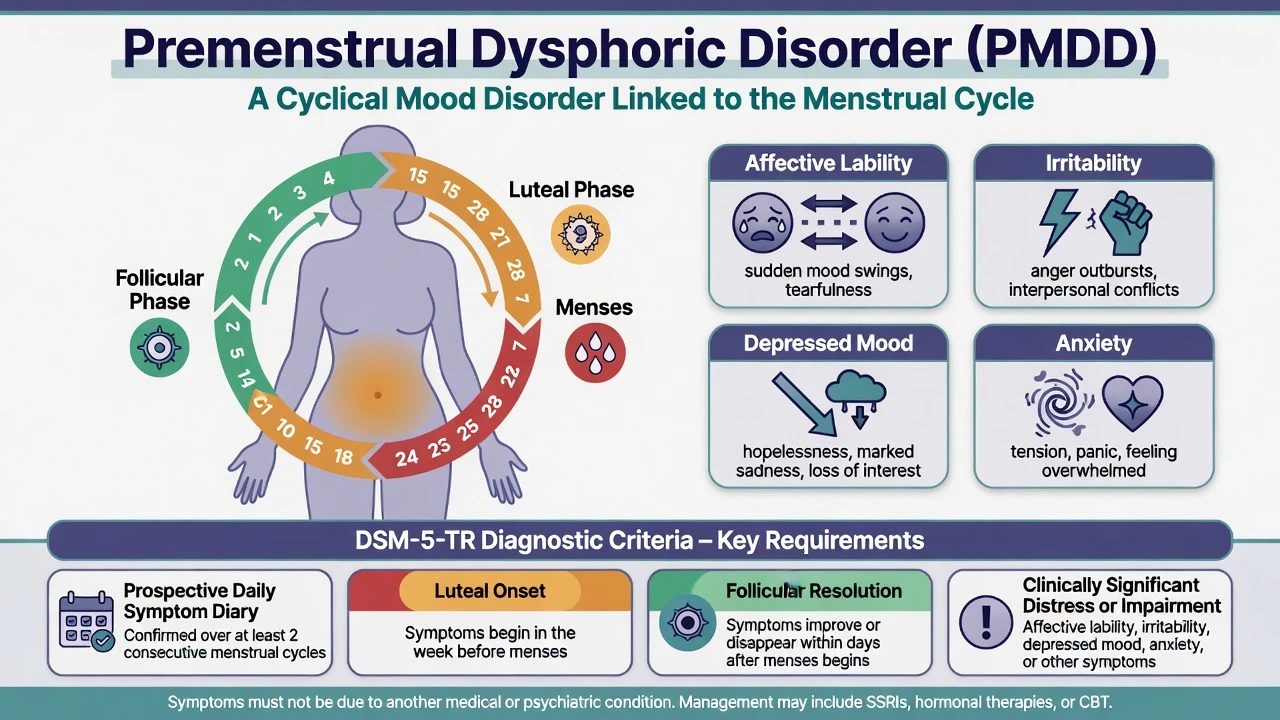
DSM-5-TR places PMDD among depressive disorders. In the majority of menstrual cycles, at least five symptoms must be present in the final week before the onset of menses, start to improve within a few days after the onset of menses, and become minimal or absent in the week post-menses. At least one of four core affective symptoms is required: (1) marked affective lability; (2) marked irritability, anger, or increased interpersonal conflicts; (3) marked depressed mood, feelings of hopelessness, or self-deprecating thoughts; (4) marked anxiety, tension, or feeling on edge. Additional symptoms completing the count of five include decreased interest, concentration difficulty, lethargy, appetite change, sleep change, sense of being overwhelmed or out of control, and physical symptoms (breast tenderness/swelling, joint or muscle pain, bloating, weight gain). Symptoms must cause clinically significant distress or interference with work, school, social activities, or relationships, and must not be merely an exacerbation of another disorder (though another disorder may co-occur). Symptoms are not attributable to substances or another medical condition. A provisional diagnosis may be made from clinical history; the full diagnosis is confirmed by prospective daily ratings during at least two symptomatic cycles.[2][14]
Historical note. Late luteal phase dysphoric disorder sat in DSM-IV appendices; the evidence review led by Epperson and colleagues supported promotion of PMDD into the main manual for DSM-5, with prevalence estimates of roughly 2–5% of premenopausal women under research-grade criteria (method-dependent).[2]
ICD-11. Use the premenstrual dysphoric disorder construct aligned with severe cyclic luteal symptoms and impairment; state which manual you are applying when examiners ask about nomenclature.[1][2]
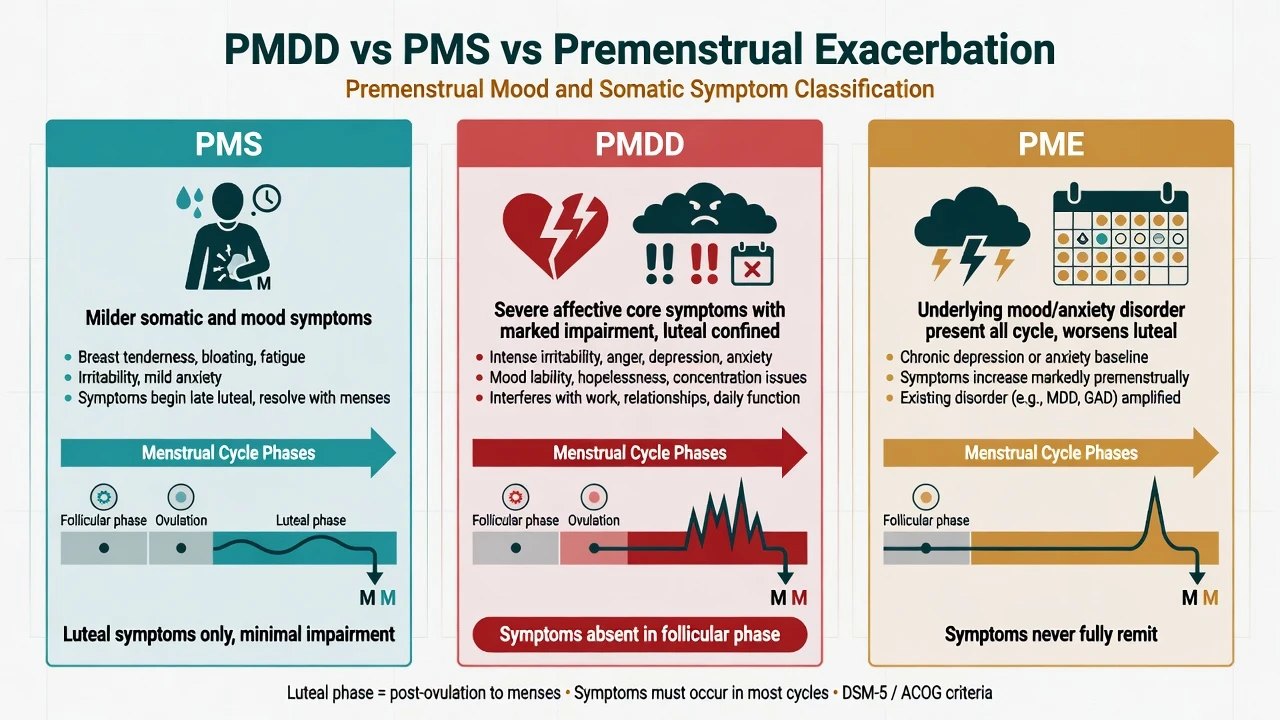
PMS
- Common milder premenstrual somatic/mood symptoms
- Impairment modest or absent
- Does not meet full PMDD symptom/impairment thresholds
- Lifestyle measures often sufficient
PMDD
- Severe core affective symptoms + total five symptoms
- Marked distress or functional impairment
- Luteal confined; follicular minimal/absent
- SSRI/COC/CBT/GnRH pathways
PME
- Baseline MDD, bipolar, GAD, PTSD, etc. present mid-cycle
- Symptoms worsen premenstrually but do not fully remit
- Treat the primary disorder continuously
- Do not label pure PMDD
Dysmenorrhoea / pelvic disease
- Pain-dominant menstrual disorder
- Endometriosis, adenomyosis in differential
- Gynaecology assessment when indicated
- May coexist with PMDD
Epidemiology and risk
Numbers candidates should own
Prospective confirmation lowers prevalence relative to retrospective self-label. Comorbidity with mood, anxiety, trauma-related, and substance-use disorders is common and must be formulated separately from pure cyclic illness. Family history of PMS/PMDD and personal history of mood disorder raise risk. Trauma exposure associates with more severe premenstrual affective symptoms in some samples — screen trauma without assuming causality for every case.[1][14][19]
Pathophysiology
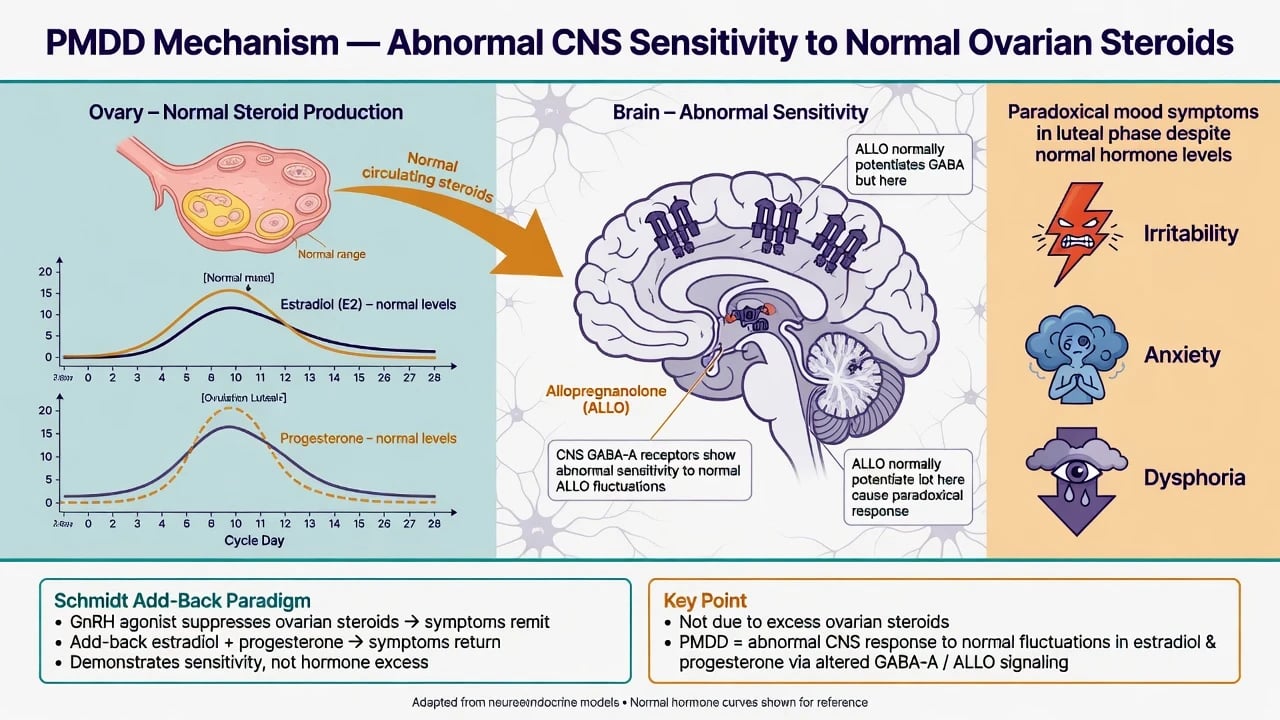
Not a hormone deficiency. Peripheral oestradiol and progesterone concentrations in women with PMDD are typically indistinguishable from asymptomatic controls. Pathophysiology is best framed as abnormal CNS sensitivity to normal cyclic changes in ovarian steroids and their neuroactive metabolites.[1][12][13]
Schmidt add-back paradigm (landmark). Ovarian suppression with a GnRH agonist remits symptoms in many women with severe premenstrual syndrome/PMDD. Add-back of oestradiol or progesterone re-triggers symptoms in susceptible women but not in controls, demonstrating that the same physiologic hormone exposure is pathoplastic only in PMDD.[12]
Allopregnanolone (ALLO) and GABA-A. ALLO, a progesterone metabolite, is a positive allosteric modulator of GABA-A receptors. In PMDD, dynamic ALLO fluctuations across the luteal phase are thought to produce dysregulated or paradoxical GABAergic responses, manifesting as irritability, anxiety, and dysphoria. This model links reproductive hormones to rapid-onset affective symptoms and helps explain why serotonergic drugs can work within days in PMDD (neurosteroid–serotonin interactions) rather than with classic MDD latency alone.[13][15]
Psychological maintaining factors. Catastrophic appraisals of premenstrual change, interpersonal conflict spirals, sleep disruption, and avoidance maintain impairment and are CBT targets.[18]
Clinical presentation
Core luteal phenotype. Marked irritability and anger (often the most relationship-destroying feature), affective lability with tearfulness, tension/anxiety, and depressed or hopeless mood dominate. Patients describe feeling "not themselves," overwhelmed, or out of control for several days to two weeks before menses, with striking relief after bleeding starts.[1][2][19]
Associated features. Concentration failure, lethargy, food cravings or binge eating, hypersomnia or insomnia, breast tenderness, bloating, headaches, and joint/muscle pain. Functional impact includes work errors, absenteeism, cancelled social plans, and partner/parenting conflict timed to the late luteal phase.[1][19]
MSE contrast. During the symptomatic window: irritable or labile affect, negative cognitive content, possible passive or active suicidal ideation, preserved reality testing. Mid-follicular MSE often normalises substantially in pure PMDD — if it does not, rethink PME or dual diagnosis.[2][14]
Differential diagnosis
Key discriminators, not laundry lists: PME of MDD/GAD/PTSD/bipolar/BPD — residual symptoms in the week after menses; continuous treatment of the primary disorder is mandatory; bipolar spectrum — irritability may be premenstrual depression or mixed features, so screen elevated periods before SSRI monotherapy framing; medical — thyroid disease, anaemia, perimenopausal irregular cycles, endometriosis/chronic pelvic pain with gynaecology co-management when pelvic pathology is likely; substance and medication — alcohol bingeing luteally, and hormonal contraceptives that cause mood adverse effects (stop–trial when suspected).[1][2][10][20]
Assessment
Chart cycle day of onset and offset across multiple months; percentage of cycles affected; severity and impairment domains; contraception and pregnancy plans; trauma and mood history; substance use. Obtain collateral — partners often describe a "Jekyll and Hyde" monthly pattern more clearly than retrospective self-report.[1][2]
Prospective diary. Daily Record of Severity of Problems (DRSP) is the classic research/clinical daily rating tool. The Premenstrual Symptoms Screening Tool (PSST) is useful for screening and severity banding but does not replace prospective confirmation for a definitive exam-standard diagnosis. Instruct two full cycles of daily ratings whenever safe and feasible; start treatment for severe impairment while diary runs if risk or suffering is high, labelling the diagnosis provisional.[2][14]
Risk. Explicitly assess suicide and harm-to-others ideation during the current luteal phase, prior luteal crises, access to means, and dependants. Build a cycle-phase safety plan (who to call in late luteal week; leave of absence options; medication adherence).[14][19][20]
Investigations
Order a pregnancy test when relevant before teratogenic plans. Check TSH and FBC if fatigue, weight change, or systemic symptoms suggest comorbidity. Do not order oestradiol or progesterone "to confirm PMDD" — normal levels neither rule in nor rule out the diagnosis. Image or refer gynaecology when history suggests structural pelvic disease. The diagnostic investigation that matters most is the completed prospective diary.[1][2][12]
Acute risk management
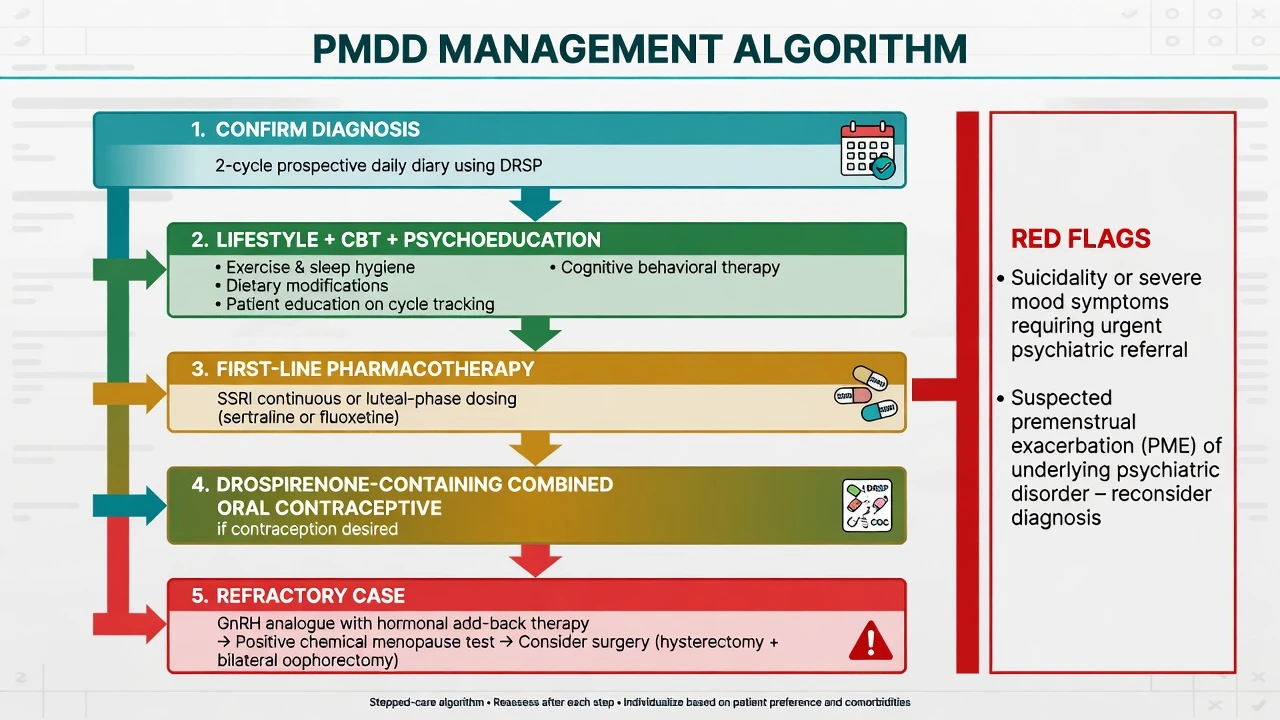
If the presentation is an acute major depressive episode that fails to remit mid-follicular, manage as MDD/PME, not as intermittent PMDD alone.[20]
Definitive management
Psychoeducation and lifestyle
Explain the hormone-sensitivity model in plain language (normal levels, abnormal brain response). Encourage prospective tracking, sleep regularity, aerobic exercise, and reduction of alcohol excess in the luteal phase. Lifestyle alone is rarely adequate for full PMDD but supports every other modality.[1][14][19]
SSRIs — first-line pharmacotherapy
SSRIs are the best-evidenced first-line medications for PMDD. Landmark RCTs established fluoxetine and sertraline; Cochrane synthesis confirms class efficacy for PMS/PMDD, with continuous dosing probably somewhat more effective than luteal-phase-only dosing in meta-analysis, though both strategies reduce symptoms.[3][4][5][7][8]
Exam-ready regimens (adult, oral). Continuous: fluoxetine 20 mg orally once daily, or sertraline 50 mg orally once daily (titrate toward 50–150 mg as tolerated) every day — prefer if irregular cycles, PME overlap, comorbid anxiety/MDD, or simplicity. Luteal-phase: same agents/doses from ovulation or about day 14 until menses starts — enabled by rapid SSRI benefit in PMDD; counsel missed-window risk. Symptom-onset: sertraline from first symptom day through early menses when recognition is reliable. Monitor sexual dysfunction, nausea, headache, sleep change, hyponatraemia risk in older adults, bleeding risk with NSAIDs, and early activation or suicidality after initiation — especially in younger adults. Paroxetine is effective but has higher discontinuation risk and pregnancy planning concerns; avoid as first pick if conception is possible. Citalopram/escitalopram are alternatives with QTc ceilings as for general SSRI practice.[3][4][5][6][8][15]
Rapid response pearl. Unlike classic MDD (weeks), many women with PMDD report improvement within days of SSRI exposure — a mechanistic and practical rationale for intermittent dosing in carefully selected patients.[15][6]
Combined oral contraceptives
For women who also desire contraception, a drospirenone 3 mg / ethinyl estradiol 20 microg regimen in a 24 active / 4 inactive day schedule has RCT evidence for PMDD symptom reduction and is the COC formulation with the strongest dedicated PMDD trial signal. Cochrane reviews of drospirenone-containing OCs support benefit for premenstrual symptoms with common adverse effects (nausea, breast pain, irregular bleeding) and the usual VTE counselling. Long-term efficacy beyond the first few cycles is less well characterised in pivotal designs — set expectations accordingly.[9][10][11]
Screen contraindications: migraine with aura, prior VTE, thrombophilia, smoking age 35+, uncontrolled hypertension, liver disease, and pregnancy. Not all combined pills are interchangeable for PMDD exam answers — name drospirenone/EE 24/4 when asked for the evidence-linked agent.[9][10]
Psychological therapy
CBT and internet-based CBT protocols targeting cycle-linked appraisals, emotion regulation, and stress management reduce PMDD burden in randomised work and suit women who prefer non-drug care, are pregnant-planning, or need skills alongside medication.[18]
Refractory pathways — GnRH and surgery
GnRH agonists suppress ovarian steroid cyclicity ("chemical menopause") and improve severe PMS/PMDD in meta-analytic data, but induce hypoestrogenic adverse effects. Use add-back oestrogen with appropriate progestogen cover to protect bone and reduce vasomotor symptoms; choice of add-back regimen can influence mood and requires specialist collaboration.[16][17]
A positive chemical menopause test (symptoms remit when ovaries are suppressed) supports that symptoms are ovary-driven before considering definitive bilateral oophorectomy (often with hysterectomy) — a last-resort pathway with irreversible surgical menopause, HRT planning, and fertility loss. Never leap to surgery on retrospective history alone.[12][16][17]
Other agents
Calcium, vitamin B6, and herbal products have mixed or lower-quality evidence; do not displace SSRI/COC/CBT for full PMDD. Anxiolytic PRN benzodiazepines are not disease-modifying and risk dependence. For pure physical-dominant PMS without full PMDD, gynaecology pathways (e.g. other hormonal options) may dominate.[1][14][19]
RANZCP mood disorder guidance emphasises formulation-driven, measurement-based care and suicide risk assessment for affective presentations. PMDD sits at the women's mental health / mood interface: use DSM/ICD criteria, prospective confirmation, and SSRI first-line practice consistent with international trial evidence, shared with GP and gynaecology for COC and GnRH pathways. Map care to Australian/New Zealand contraception and PBS/Pharmac access realities without inventing local product exclusivity.[20]
Subtypes and scenarios
Pure PMDD with full follicular remission — intermittent SSRI or continuous SSRI both defensible. PMDD + PME — continuous SSRI/SNRI treating baseline disorder plus cycle-aware safety planning. Adolescent onset — family psychoeducation, school impairment plans, careful consent. Perimenopause — irregular cycles blur luteal timing; may need continuous treatment and gynaecology input. Pregnancy desire — stop COC/GnRH; PMDD symptoms typically abate without cycles; reassess postpartum when cycles return.[1][14][20]
Complications and pitfalls
Mislabeling PME as PMDD; skipping the diary; treating "low progesterone" with unmonitored supplements; ignoring luteal suicidality; COC in contraindicated patients; unopposed long-term GnRH; surgical cascade without chemical menopause confirmation; missing bipolarity before antidepressant framing.[2][12][16][20]
Prognosis and disposition
Without treatment, monthly recurrence continues until menopause. Many women respond well to SSRIs or evidence-linked COCs; partial response needs dose/schedule adjustment or combination with CBT. Share care with primary care for stable responders; escalate to secondary psychiatry and gynaecology for high risk, refractoriness, dual diagnosis, or surgical consideration.[8][14][19]
Special populations
Youth, pregnancy planning, lactation after cycles return, and culturally diverse presentations require adapted consent, access support, and avoidance of minimising menstrual mental health as "normal woman problems."[14][19][20]
Evidence and guidelines
Named anchors: Steiner fluoxetine NEJM; Yonkers sertraline JAMA; Freeman continuous vs intermittent; Yonkers symptom-onset; Cochrane SSRI 2013/2024; Yonkers drospirenone/EE; Cochrane drospirenone OC; Schmidt add-back NEJM; Hantsoo/Epperson ALLO and epidemiology; Weise iCBT; Wyatt GnRH meta-analysis; Segebladh add-back; RANZCP mood 2020/21 framing.[3][4][5][6][8][9][12][13][18][20]
Exam pearls
[2] [8] [12] [15] [16]PMDD CARE
References
- [1]Yonkers KA, O'Brien PM, Eriksson E Premenstrual syndrome Lancet, 2008.PMID 18395582
- [2]Epperson CN, Steiner M, Hartlage SA, et al. Premenstrual dysphoric disorder: evidence for a new category for DSM-5 Am J Psychiatry, 2012.PMID 22764360
- [3]Steiner M, Steinberg S, Stewart D, et al. Fluoxetine in the treatment of premenstrual dysphoria. Canadian Fluoxetine/Premenstrual Dysphoria Collaborative Study Group N Engl J Med, 1995.PMID 7739706
- [4]Yonkers KA, Halbreich U, Freeman E, et al. Symptomatic improvement of premenstrual dysphoric disorder with sertraline treatment. A randomized controlled trial. Sertraline Premenstrual Dysphoric Collaborative Study Group JAMA, 1997.PMID 9307345
- [5]Freeman EW, Rickels K, Sondheimer SJ, et al. Continuous or intermittent dosing with sertraline for patients with severe premenstrual syndrome or premenstrual dysphoric disorder Am J Psychiatry, 2004.PMID 14754784
- [6]Yonkers KA, Kornstein SG, Gueorguieva R, et al. Symptom-Onset Dosing of Sertraline for the Treatment of Premenstrual Dysphoric Disorder: A Randomized Clinical Trial JAMA Psychiatry, 2015.PMID 26351969
- [7]Marjoribanks J, Brown J, O'Brien PM, Wyatt K Selective serotonin reuptake inhibitors for premenstrual syndrome Cochrane Database Syst Rev, 2013.PMID 23744611
- [8]Jespersen C, Lauritsen MP, Frokjaer VG, Schroll JB Selective serotonin reuptake inhibitors for premenstrual syndrome and premenstrual dysphoric disorder Cochrane Database Syst Rev, 2024.PMID 39140320
- [9]Yonkers KA, Brown C, Pearlstein TB, et al. Efficacy of a new low-dose oral contraceptive with drospirenone in premenstrual dysphoric disorder Obstet Gynecol, 2005.PMID 16135578
- [10]Lopez LM, Kaptein AA, Helmerhorst FM Oral contraceptives containing drospirenone for premenstrual syndrome Cochrane Database Syst Rev, 2012.PMID 22336820
- [11]Ma S, Song SJ, et al. Oral contraceptives containing drospirenone for premenstrual syndrome Cochrane Database Syst Rev, 2023.PMID 37365881
- [12]Schmidt PJ, Nieman LK, Danaceau MA, et al. Differential behavioral effects of gonadal steroids in women with and in those without premenstrual syndrome N Engl J Med, 1998.PMID 9435325
- [13]Hantsoo L, Epperson CN Allopregnanolone in premenstrual dysphoric disorder (PMDD): Evidence for dysregulated sensitivity to GABA-A receptor modulating neuroactive steroids across the menstrual cycle Neurobiol Stress, 2020.PMID 32435664
- [14]Hantsoo L, Epperson CN Premenstrual Dysphoric Disorder: Epidemiology and Treatment Curr Psychiatry Rep, 2015.PMID 26377947
- [15]Steinberg EM, Cardoso GMP, Martinez PE, et al. Rapid response to fluoxetine in women with premenstrual dysphoric disorder Depress Anxiety, 2012.PMID 22565858
- [16]Wyatt KM, Dimmock PW, Ismail KM, et al. The effectiveness of GnRHa with and without 'add-back' therapy in treating premenstrual syndrome: a meta analysis BJOG, 2004.PMID 15198787
- [17]Segebladh B, Borgström A, Nyberg S, et al. Evaluation of different add-back estradiol and progesterone treatments to gonadotropin-releasing hormone agonist treatment in patients with premenstrual dysphoric disorder Am J Obstet Gynecol, 2009.PMID 19398092
- [18]Weise C, Kaiser G, Janda C, et al. Internet-Based Cognitive-Behavioural Intervention for Women with Premenstrual Dysphoric Disorder: A Randomized Controlled Trial Psychother Psychosom, 2019.PMID 30783069
- [19]Pearlstein T, Steiner M Premenstrual dysphoric disorder: burden of illness and treatment update J Psychiatry Neurosci, 2008.PMID 18592027
- [20]Malhi GS, Bell E, Bassett D, et al. The 2020 Royal Australian and New Zealand College of Psychiatrists clinical practice guidelines for mood disorders Aust N Z J Psychiatry, 2021.PMID 33353391