Psych · Old age psychiatry — grief and loss
Bereavement in later life
Also known as Late-life grief · Widowhood · Spousal bereavement in older adults · Prolonged grief disorder older adults · Complicated grief elderly · Bereavement-related depression late life
Exam-exhaustive fellowship reference on bereavement in later life — adaptive grief versus prolonged grief disorder (DSM-5-TR/ICD-11), widowhood morbidity and mortality, suicide lethality in older bereaved men, dual-process mechanisms, Complicated Grief Treatment evidence in elderly persons, selective pharmacotherapy for comorbid major depression, cultural care, and residential aged care scenarios. FRANZCP-primary, globally tagged.
On this page & tools
Your progress
Saved locally on this device.
10 MCQs with explanations
Target exams
Red flags
Bereavement in later life is an old-age psychiatry core skill: protect adaptive mourning from medicalisation, still detect PGD and comorbid MDD, manage practical secondary losses and isolation, and treat suicide risk with geriatric lethality in mind. Examiners reward candidates who name duration clocks, CGT evidence, and the widowhood health pathway — not stage-of-grief dogma.[1][8][10][13]
Overview and definition
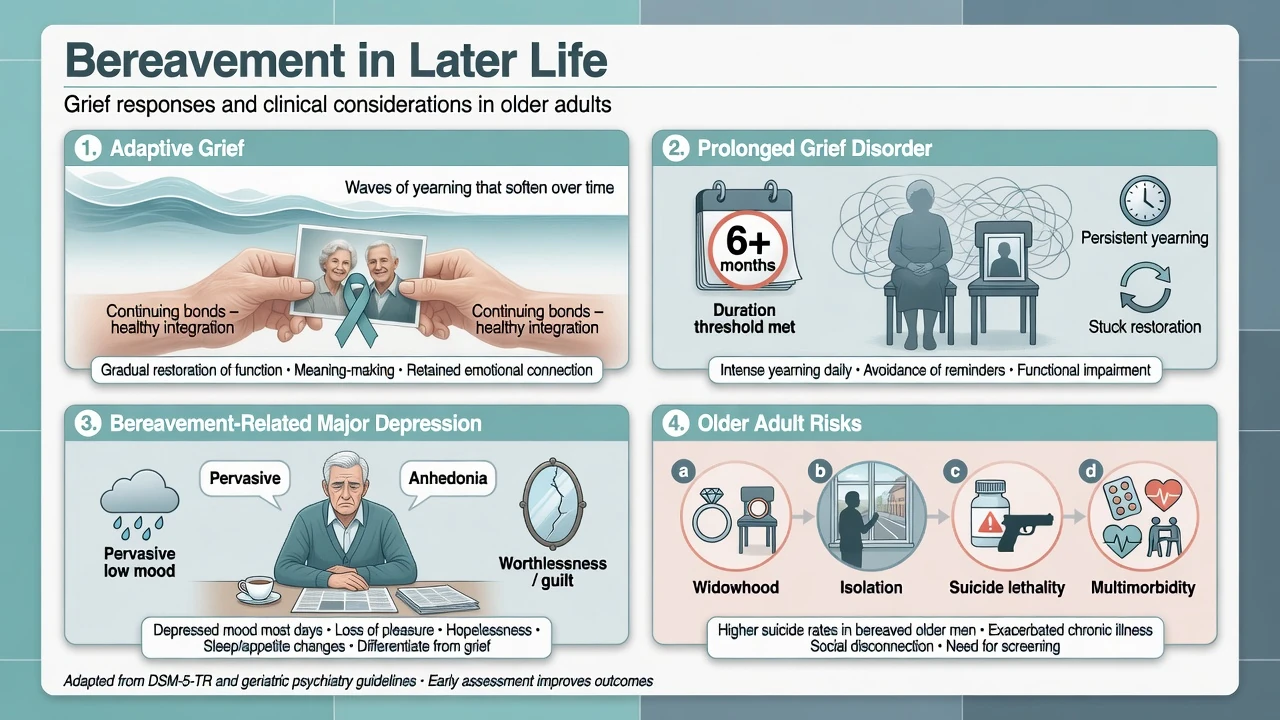
Bereavement is the objective state of having lost someone close through death. Grief is the multidimensional response (emotional, cognitive, behavioural, somatic, social, spiritual). Mourning is the culturally patterned expression of grief through ritual, family roles, and community practice.[4][10]
In later life the modal losses are spouse or long-term partner, siblings, adult children, and peers. Secondary losses follow: empty house, lost driver, lost meal-provider, lost social broker, income change, and sometimes forced residential aged care transition.[7][8]
Adaptive grief is intense and often oscillating; it typically softens enough to permit progressive restoration of daily life even when love and continuing bonds endure. Adaptive grief is not a DSM/ICD mental disorder.[4][10][13]
Prolonged grief disorder (PGD) is a freestanding diagnosis for a minority whose grief remains intense, persistent beyond duration and cultural norms, and functionally impairing, with yearning or preoccupation as the core. Historical labels still appear in stems: complicated grief (CG), persistent complex bereavement disorder (PCBD).[4][13]
Classification and diagnostic criteria
DSM-5-TR PGD (adults — exam anchor)
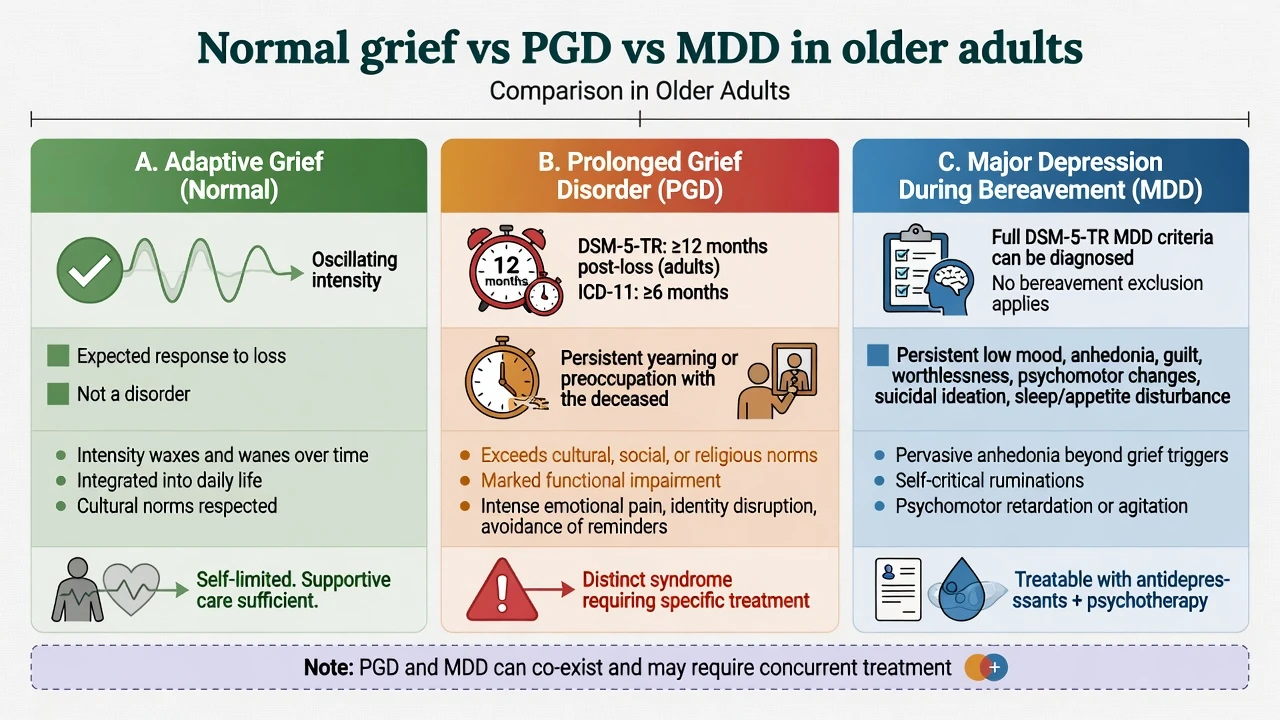
- Death of a close person at least 12 months ago (adults).
- Persistent grief with intense yearning/longing and/or preoccupation with the deceased, most days for at least the past month to a clinically significant degree.
- At least three additional symptoms (examples: identity disruption, disbelief, avoidance of reminders, intense emotional pain, difficulty reintegrating, numbness, meaninglessness, intense loneliness) most days for at least the past month.
- Clinically significant distress or impairment.
- Duration and severity clearly exceed expected social, cultural, or religious norms.
- Not better explained by another mental disorder, substances, or another medical condition.[4][13]
ICD-11 PGD (exam delta)
ICD-11 emphasises persistent longing or preoccupation with intense emotional pain, persisting for an atypically long period (more than 6 months) after the loss, exceeding cultural norms, with impairment. Name which system you are using — do not invent a hybrid "9-month" rule.[4][13]
Two classification moves candidates confuse
- DSM-5 removed the bereavement exclusion for major depressive episode — full MDD can be diagnosed during bereavement when criteria are met.[11][12]
- DSM-5-TR formalised PGD as its own diagnosis — this is not the same as converting all grief into depression.[4][13]
Adaptive late-life grief
- Expected after death
- Waves that typically soften
- Continuing bonds may be healthy
- Not a mental disorder
DSM-5-TR PGD
- ≥12 months after death (adults)
- Yearning or preoccupation ≥1 month
- ≥3 additional symptoms
- Impairment + exceeds cultural norms
ICD-11 PGD
- ≥6 months after loss
- Longing or preoccupation
- Intense emotional pain
- Exceeds norms + impairment
MDD in bereavement
- Full episode criteria can be met
- No bereavement exclusion (DSM-5+)
- Pervasive low mood/anhedonia
- May co-occur with PGD
Epidemiology and risk factors
Late-life bereavement numbers candidates should own
Among bereaved adults, a systematic review and meta-analysis estimated pooled PGD prevalence in the order of about one in ten, with substantial heterogeneity by criteria and culture.[5] Older-adult community data characterise complicated grief as a clinically important minority problem with identifiable correlates, not a universal fate of ageing.[6]
Widowhood elevates risk of mood and anxiety disorders compared with non-widowed peers.[7] Bereavement has broad health outcomes beyond psychiatric diagnosis — behavioural self-neglect, medical morbidity pathways, and mortality risk are part of the clinical frame.[8] Population analyses of the widowhood effect show excess mortality patterns that vary with causes of death of both spouses — quote as excess risk, not a single universal hazard ratio for every stem.[9]
Late-life amplifiers: dependent marriage, social network shrinkage, sensory impairment, multimorbidity, cognitive decline, prior depression, sudden or suicide death, multiple sequential losses, residential aged care transition, and blocked rituals.[6][7][8]
Pathophysiology and maintaining mechanisms
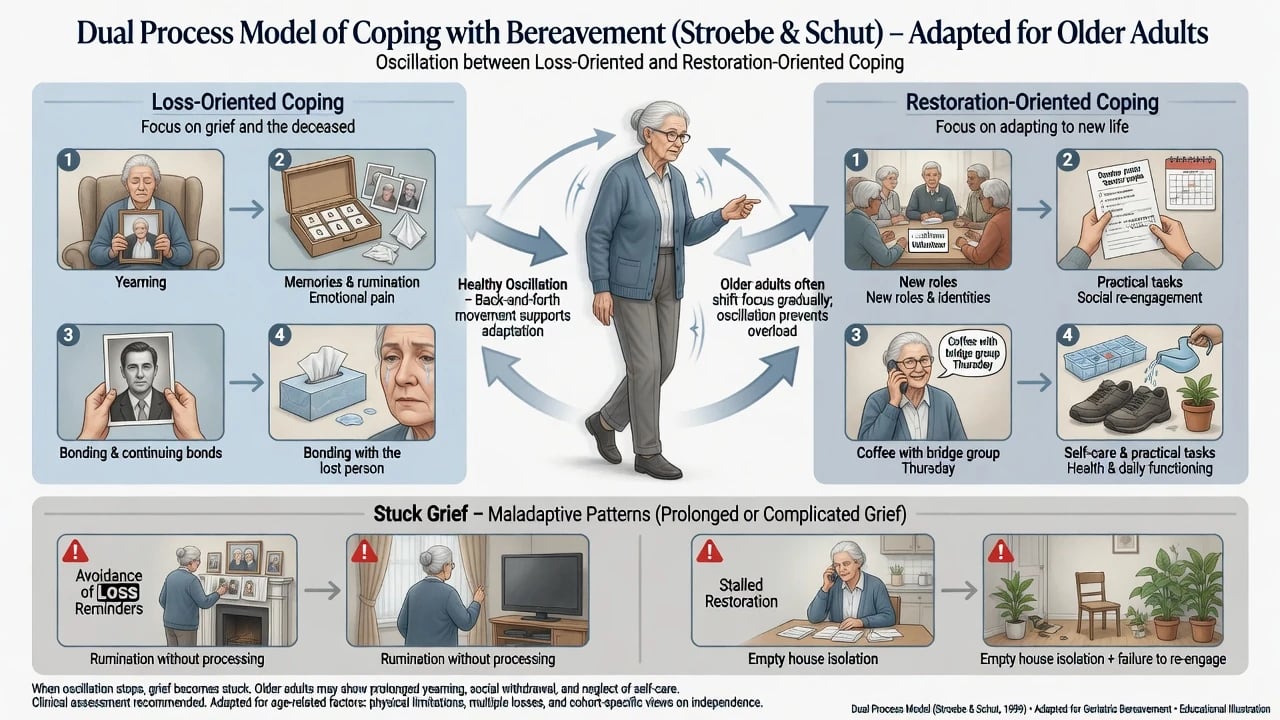
Dual process model (Stroebe and Schut). Adaptive coping oscillates between loss-oriented processes (yearning, crying, bonding memories) and restoration-oriented processes (new roles, practical tasks, distraction, self-care). Pathology is framed as stuck oscillation — excessive avoidance of loss material, relentless rumination without restoration, or inability to re-engage life tasks after partner death.[10]
Attachment and yearning. Separation distress is core to PGD and phenomenologically distinct from the pervasive anhedonia and self-reproach that dominate many major depressive episodes, although both can coexist.[4][13]
Late-life restoration barriers. Loss of the spouse who cooked, drove, managed bills, or initiated social contact turns restoration into a multi-agency problem. Loneliness and empty-house isolation maintain severity and medical risk.[7][8]
Health pathway. Bereavement is associated with adverse physical and behavioural health outcomes; clinicians must treat self-neglect, non-adherence, alcohol, and falls risk as part of grief care, not as "social issues outside psychiatry."[8][9]
Clinical presentation
Adaptive late-life grief. Waves of yearning triggered by the empty chair, anniversaries, and shared music; preserved capacity for moments of pleasure or connection with grandchildren or faith community; gradual reorganisation of routine; cultural mourning engaged.[4][10]
PGD in older adults. Persistent intense yearning or mental preoccupation long after peers have re-engaged; identity freeze ("I was his wife — who am I now?"); disbelief that feels frozen; avoidance of the bedroom, the cemetery, or the hospital corridor; emotional numbness; sense that life is empty; stalled reintegration. Quoteable MSE: "I still set two places; I cannot sleep on his side of the bed; every day I wait for her key in the door."[4][6][13]
Bereavement-related major depression. Pervasive low mood and anhedonia not limited to loss cues; worthlessness and guilt that generalise; marked psychomotor change; early morning waking; anorexia with weight loss; passive or active suicidal ideation. Kendler and colleagues found bereavement-related major depression substantially similar to other stressor-related MDD — do not withhold the diagnosis when criteria are met.[11][12]
Atypical older presentations. Somatic preoccupation, pain amplification, irritability, quiet withdrawal misread as "settled," alcohol or sedative increase, and self-neglect without explicit affective complaint.[7][8]
Differential diagnosis
Key discriminators for fellowship stems are as follows.[4][11][13]
- Adaptive grief vs PGD: system-specific duration, cultural-norm criterion, persistence of yearning cluster, and stalled restoration with impairment.[4][13]
- PGD vs MDD: person-linked yearning and identity disruption vs pervasive low mood/anhedonia, global self-worth collapse, and full symptom count; both may be present.[4][11]
- PGD vs PTSD: separation distress about the person vs trauma clusters about how they died (discovery of body, ICU scenes).[4][13]
- Grief-related sensing of the deceased vs late-life psychosis: form, insight, cultural congruence, other psychotic features, Lewy body visual phenomenology.[4][13]
- Hypoactive delirium / evolving dementia vs grief withdrawal: tempo, attention, arousal, collateral baseline.[8][13]
- Medical and substance mimics when course is atypical.[8][13]
Do not soft-label full MDD as "just grief" — diagnose and treat fully while still addressing grief mechanisms if present.[11][12]
Clinical and bedside assessment
Structure a bereavement-focused geriatric assessment with mandatory risk and function review.[4][7][13]
- Loss map — who died, relationship quality, circumstances (natural/sudden/suicide), date, rituals completed or blocked, secondary losses.[4][13]
- Timeline — apply DSM-5-TR (≥12 months adult) or ICD-11 (≥6 months) deliberately.[4][13]
- PGD inventory — yearning, preoccupation, identity, disbelief, avoidance, reintegration failure, numbness, meaninglessness, loneliness.[4][13]
- Full syndrome screen — MDD, anxiety, PTSD, substances, psychosis, cognitive impairment.[11][13]
- Suicide risk — passive death wish, reunion wish, intent, plan, means (medicines, firearms, heights), prior attempts, alcohol, living alone, protective factors.[7][8]
- Function — ADLs/IADLs, nutrition, mobility, finances, capacity for self-care, elder abuse screen.[7][8]
- Cultural formulation — expected mourning period, family hierarchy, spiritual continuing bonds.[4][13]
Scales. Inventory of Complicated Grief / PG-13 lineage and modern PGD instruments measure severity; GDS and PHQ-9 monitor depression comorbidity but do not diagnose PGD.[4][6]
Investigations
There is no laboratory or imaging test for grief or PGD. Investigate to exclude medical contributors and to baseline pharmacotherapy when treating comorbid depression: FBC, U&E (especially sodium), TSH, B12/folate, glucose as indicated; ECG when cardiac risk or QT-relevant agents; cognitive screen when self-neglect or dementia concern is present. Neuroimaging only for neurological red flags.[8][13]
Management — acute risk and crisis
Priorities: physical safety; substance intoxication; safeguarding a newly alone vulnerable adult; decide home-with-plan versus crisis team versus inpatient care. Short-term hypnotics for severe acute insomnia are occasional bridges only (for example temazepam 10 mg orally at night for a few nights in a carefully selected older adult without high falls/delirium risk, or a local non-benzodiazepine alternative) with a documented exit plan — never convert grief into chronic sedative dependence.[8][13]
Do not pathologise the first weeks to months after an expected death when functioning and cultural fit remain acceptable; offer support, practical help, and review triggers.[4][10]
Management — definitive stepped care
Step 0 — Safety and practical needs
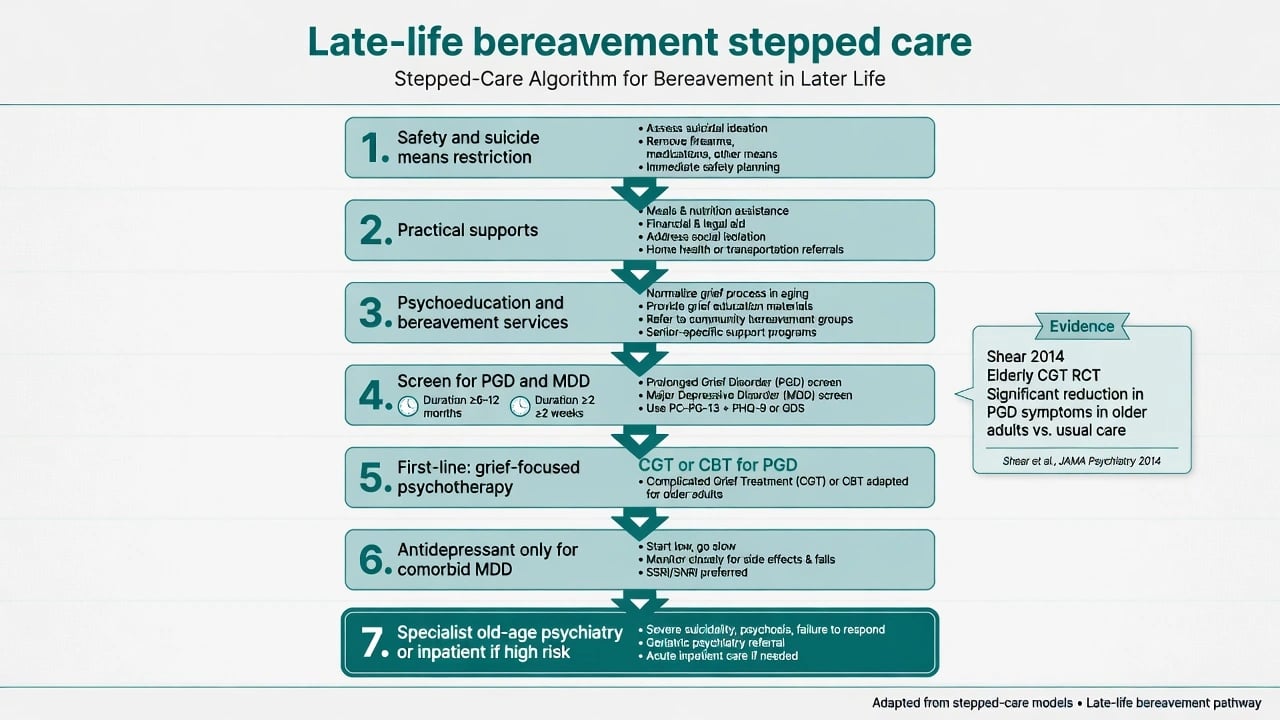
Risk management, meals, hydration, medication adherence, finances after death, transport, and housing. Practical help is clinical care.[8][10]
Step 1 — Psychoeducation and supportive bereavement care
Explain oscillation of grief, continuing bonds, and when to seek help. Community bereavement services, peer support, faith communities, and culturally congruent rituals are appropriate for adaptive grief. Avoid forced "closure" rhetoric that shames ongoing love.[10][13]
Step 2 — Grief-focused psychotherapy (first-line for PGD / complicated grief)
Complicated Grief Treatment (CGT) is the landmark named package. The original randomised trial showed CGT superior to interpersonal psychotherapy for complicated grief.[2] A full-scale RCT in elderly persons found CGT produced substantially higher CG response rates than grief-focused IPT (about 70.5% versus 32.0% responders in the published trial).[1] The optimising trial examined CGT with or without citalopram and remains the key modern reference for combined treatment questions — therapy is central; antidepressant addition targets co-occurring depression rather than replacing grief work.[3]
Name CGT ingredients in MEQs: grief psychoeducation; aspirational goals for a meaningful life after loss; revisiting the story of the death; reconnecting with the deceased in adaptive ways (for example imaginal conversation); graded work on avoided situations; behavioural activation toward restoration; careful work on guilt, anger, and self-blame.[1][2][3]
Network meta-analysis of psychotherapies for adult PGD supports psychological treatment efficacy as a class — quote direction of effect and name specific packages when possible.[14]
Step 3 — Pharmacotherapy (selective)
Antidepressants are not first-line monotherapy for pure PGD when grief-focused therapy is available and indicated.[1][3][14]
Treat comorbid major depression or severe anxiety with standard late-life regimens in parallel with grief-focused therapy when possible. Example older-adult regimen for comorbid MDD: sertraline 25 mg orally each morning for 4–7 days, then 50 mg daily if tolerated, with early review for activation, hyponatraemia risk, falls, and gastrointestinal effects; titrate toward 50–100 mg as indicated with measurement-based PHQ-9/GDS plus a grief severity scale. Prefer start-low-go-slow and go — under-dosing creates pseudo-treatment resistance. Avoid routine long-term benzodiazepines. Avoid antipsychotics for ordinary grief without psychotic indications.[3][11][12]
Step 4 — Specialist escalation
Escalate for high suicide risk, severe self-neglect, diagnostic uncertainty (bipolar, psychosis, delirium, dementia), failed adequate grief-focused therapy, heavy substance comorbidity, or complex guardianship/residential care interface.[1][8][13]
ANZ practice maps onto GP shared care, public and private psychology for CGT/CBT-informed work, community bereavement services, and old-age psychiatry for risk or comorbidity. Apply cultural safety for Māori, Aboriginal and Torres Strait Islander peoples; partner with community and spiritual supports rather than imposing purely Western timelines. Prescribe within PBS/PHARMAC constraints and geriatric safety rules.[1][13]
Specific subtypes and scenarios
Spousal widowhood after chronic illness. Caregiver exhaustion, anticipatory grief, and relief-guilt mixtures; assess medical self-neglect in the survivor.[7][8]
Widower suicide pathway. High lethality, under-reporting of distress, alcohol, living alone, access to means — proactive outreach after partner death is a systems intervention.[7][8]
Death of an adult child. High PGD risk; identity and meaning collapse; partner discord common.[5][6]
Suicide bereavement. Stigma, guilt, trauma imagery, and family contagion concerns require dual grief-and-trauma formulation.[13]
Residential aged care. Death of a roommate or of a spouse still living in the community; staff may under-recognise grief; avoid sedating "settling" as default.[6][8]
Dementia caregiver after death. Anticipatory grief may have begun years earlier; relief-guilt needs explicit permission; some carers only collapse after the funeral.[8][10]
Bereaved older adult with MCI/dementia. Adapt language, involve supports, watch capacity and self-neglect; do not withhold depression treatment solely because cognition is impaired.[6][11]
Complications and pitfalls
Classic pitfalls: inventing hybrid duration numbers; antidepressants alone without grief-focused therapy for PGD; chronic benzodiazepines; forced "moving on" shaming of continuing bonds; missing suicide risk in quiet older men; ignoring practical secondary losses; soft-labelling full MDD as grief alone.[1][3][11][12]
Prognosis and disposition
Most older adults adapt without meeting PGD criteria. A clinically important minority develop persistent impairing grief or major depression; risk is higher after unnatural death and in those with prior vulnerability, isolation, and dependent marriages.[5][6][7] CGT improves complicated grief outcomes in elderly samples versus grief-focused IPT.[1] Widowhood and bereavement associate with excess morbidity and mortality pathways that justify active medical-psychiatric co-management.[8][9]
Disposition ladder: primary care and bereavement services → specialist psychology/old-age psychiatry for PGD, high risk, or comorbidity → crisis/inpatient care when safety or severe self-neglect requires it. Plan anniversary and birthday proactive review.[1][10][13]
Special populations and cultural care
Cultural formulation is diagnostic, not optional colour. Both DSM-5-TR and ICD-11 require that the reaction exceed expected cultural and religious norms — meaning the clinician must know something about those norms or consult cultural brokers.[4][13]
Indigenous and migrant care in ANZ requires interpreter use, family inclusion as appropriate, and respect for spiritual continuing bonds. LGBTQ+ older adults may experience disenfranchised grief when partners are not recognised. Frail oldest-old need fall-safe pharmacotherapy and goals-of-care framing when depression is treated. Intellectual disability ageing into later life needs concrete language and system support after a carer's death.[7][8][13]
Evidence, guidelines and controversies
Therapy landmarks. Shear 2005 JAMA CGT RCT; Shear 2014 JAMA Psychiatry elderly CGT RCT; Shear 2016 optimising CGT ± citalopram; Hao 2024 network meta-analysis of psychotherapies for adult PGD.[1][2][3][14]
Nosology and prevalence. Prigerson 2009 PGD criteria validation; Simon 2020 commentary supporting a grief-related DSM diagnosis; Lundorff 2017 adult prevalence meta-analysis; Newson 2011 older-adult complicated grief characteristics.[4][5][6][13]
Widowhood and health. Onrust 2006 mood and anxiety in widowhood; Stroebe 2007 Lancet health outcomes; Elwert 2008 widowhood mortality analysis.[7][8][9]
Depression interface. Kendler 2008 comparison of bereavement-related and other stressor-related MDD; Zisook bereavement-exclusion literature.[11][12]
Mechanisms. Dual process model decade review.[10]
Controversies examiners love: 6 versus 12 month duration thresholds; medicalising love and mourning; whether antidepressants help pure PGD; continuing bonds versus older detachment models; how aggressively to outreach widowers after partner death.[1][3][13]
Exam pearls
WIDOWED
Self-test: high-yield traps
- DSM-5-TR adult duration for PGD? At least 12 months after the death.
- ICD-11 duration? More than 6 months (atypically long for the culture).
- Core of PGD? Yearning/longing or preoccupation with the deceased.
- Is normal late-life grief a disorder? No.
- Can MDD be diagnosed while grieving? Yes, if full criteria met.
- First-line for pure PGD? Grief-focused psychotherapy (CGT/CBT), not automatic SSRI.
- Named elderly CGT trial? Shear 2014 JAMA Psychiatry.
- Widowhood risks? Elevated mood/anxiety morbidity and excess mortality pathways; high suicide lethality in older men.[1][4][7][9][11][13]
References
- [1]Shear MK, Wang Y, Skritskaya N, Duan N, Mauro C, Ghesquiere A Treatment of complicated grief in elderly persons: a randomized clinical trial JAMA Psychiatry, 2014.PMID 25250737
- [2]Shear K, Frank E, Houck PR, Reynolds CF 3rd Treatment of complicated grief: a randomized controlled trial JAMA, 2005.PMID 15928281
- [3]Shear MK, Reynolds CF 3rd, Simon NM, Zisook S, et al. Optimizing Treatment of Complicated Grief: A Randomized Clinical Trial JAMA Psychiatry, 2016.PMID 27276373
- [4]Prigerson HG, Horowitz MJ, Jacobs SC, Parkes CM, et al. Prolonged grief disorder: Psychometric validation of criteria proposed for DSM-V and ICD-11 PLoS Med, 2009.PMID 19652695
- [5]Lundorff M, Holmgren H, Zachariae R, Farver-Vestergaard I, et al. Prevalence of prolonged grief disorder in adult bereavement: A systematic review and meta-analysis J Affect Disord, 2017.PMID 28167398
- [6]Newson RS, Boelen PA, Hek K, Hofman A, Tiemeier H The prevalence and characteristics of complicated grief in older adults J Affect Disord, 2011.PMID 21397336
- [7]Onrust SA, Cuijpers P Mood and anxiety disorders in widowhood: a systematic review Aging Ment Health, 2006.PMID 16798624
- [8]Stroebe M, Schut H, Stroebe W Health outcomes of bereavement Lancet, 2007.PMID 18068517
- [9]Elwert F, Christakis NA The effect of widowhood on mortality by the causes of death of both spouses Am J Public Health, 2008.PMID 18511733
- [10]Stroebe M, Schut H The dual process model of coping with bereavement: a decade on Omega (Westport), 2010.PMID 21058610
- [11]Kendler KS, Myers J, Zisook S Does bereavement-related major depression differ from major depression associated with other stressful life events? Am J Psychiatry, 2008.PMID 18708488
- [12]Zisook S, Corruble E, Duan N, Iglewicz A, et al. The bereavement exclusion and DSM-5 Depress Anxiety, 2012.PMID 22495967
- [13]Simon NM, Shear MK, Reynolds CF, Cozza SJ, et al. Commentary on evidence in support of a grief-related condition as a DSM diagnosis Depress Anxiety, 2020.PMID 31916663
- [14]Hao F, Qiu F, Liang Z, Li P Psychotherapies for prolonged grief disorder in adults: A systematic review and network meta-analysis Asian J Psychiatr, 2024.PMID 38970900