Psych · Old age psychiatry — addiction interface
Late-life substance use
Also known as Geriatric substance use · Substance use disorders in older adults · Late-onset alcohol use disorder · Elderly alcohol misuse · Benzodiazepine dependence older adults · Late-life addiction
Exam-exhaustive fellowship reference on late-life substance use — early- vs late-onset trajectories; alcohol, benzodiazepines/Z-drugs, opioids, cannabis and nicotine; age-related PK/PD vulnerability; AUDIT-C/SMAST-G screening; alcohol withdrawal, thiamine and Wernicke risk; BZD deprescribing (EMPOWER, Beers); pharmacotherapy with older-adult cautions; dual diagnosis, suicide and falls. FRANZCP-primary, globally tagged.
On this page & tools
Your progress
Saved locally on this device.
Target exams
Red flags
Fellowship viva language is concrete: early- versus late-onset trajectories, why two standard drinks can harm a frail older adult, CIWA-guided detox with age-adjusted benzodiazepine dosing, parenteral thiamine before glucose in at-risk drinkers, EMPOWER-style BZD deprescribing, Beers PIMs, and means restriction for late-life suicide.[3][6][8][10][15]
Definition and classification
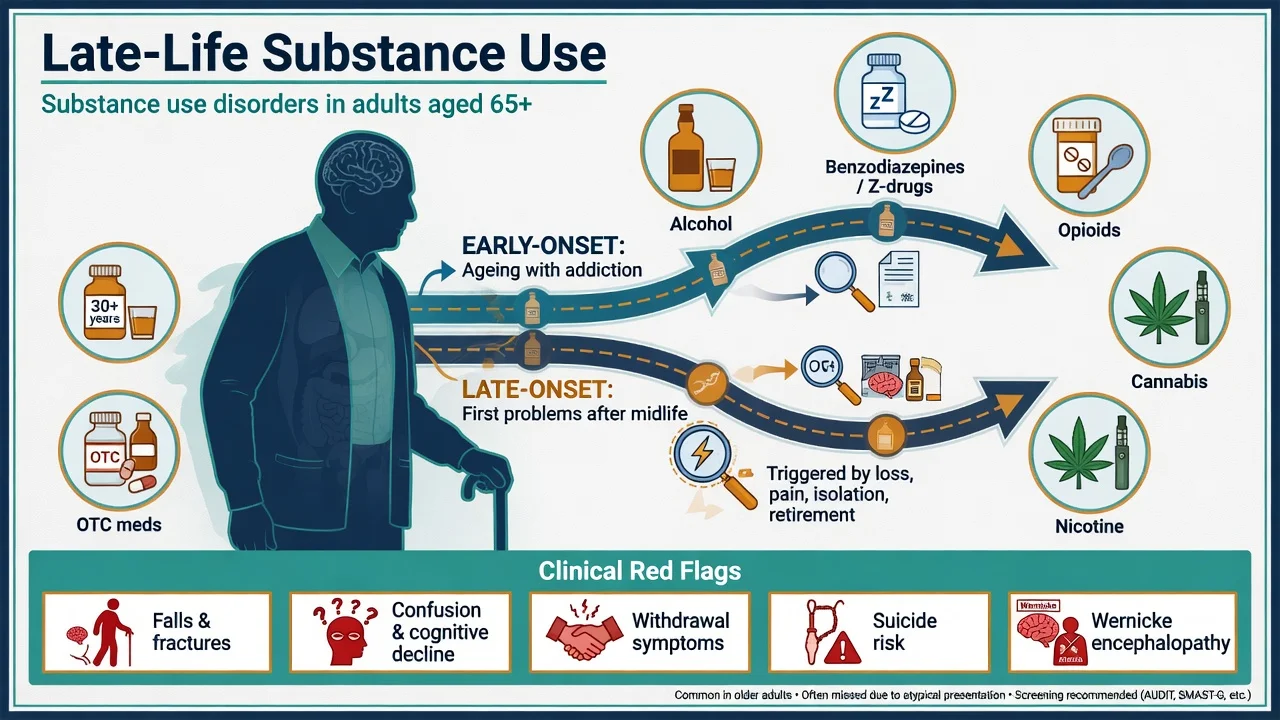
Late-life substance use covers clinically significant substance-related harm in older adults (commonly aged 60 or 65 and older). It includes early-onset illness continuing into old age and late-onset first problems after midlife — a distinction that shapes dual-diagnosis load, medical complication burden and often prognosis talk.[1][2]
DSM-5-TR substance use disorder (SUD) uses 11 criteria across impaired control, social impairment, risky use and pharmacological domains; severity is mild (2–3), moderate (4–5) or severe (6 or more). Apply the same criteria in older adults, but interpret tolerance carefully: age-related sensitivity may reduce the need to escalate dose even when dependence is present.[1]
ICD-11 frames harmful pattern of use and dependence syndrome separately from the DSM continuum — map both in viva without forcing a false one-to-one code swap.[1]
Critical nosology trap: long-term prescribed benzodiazepines often produce physiological dependence (tolerance and withdrawal). That is not automatically recreational SUD, but it still demands a deprescribing plan and never an abrupt stop.[9][14]
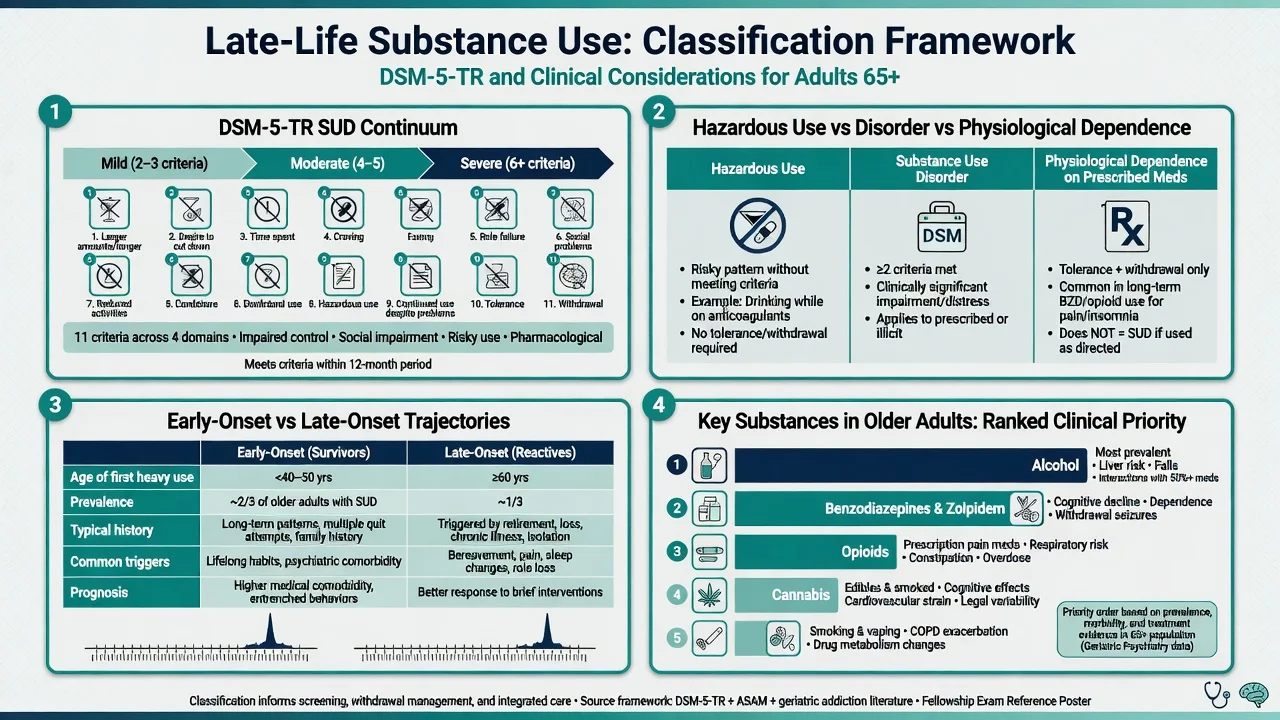
Highest-yield substances in later life: alcohol (most common problem substance), benzodiazepines and Z-drugs, prescription opioids, cannabis, nicotine/tobacco, and OTC analgesics or anticholinergic sedating agents.[1][2][14]
Epidemiology and risk
Absolute SUD rates are lower than in midlife, but detection is poor and consequences are amplified by multimorbidity, polypharmacy and frailty. Alcohol remains the dominant problem substance; benzodiazepine exposure is common in primary care and residential aged care, especially among older women.[1][2][14]
Cohort effects matter: baby-boom generations enter later life with higher lifetime substance exposure than prior cohorts, including rising cannabis and opioid experience.[1][2]
Risk factors for late-onset harm: bereavement, retirement and role loss, social isolation, chronic pain, insomnia, depression and anxiety, sensory impairment, cognitive decline, elder abuse contexts, caregiver stress, and unrestricted access to alcohol or stockpiled medicines.[1][2][15]
Alcohol and sedative use interact with late-life suicide — older adults have high completion-to-attempt ratios; intoxication lowers inhibition and increases access to lethal means.[15]
Pathophysiology and mechanisms
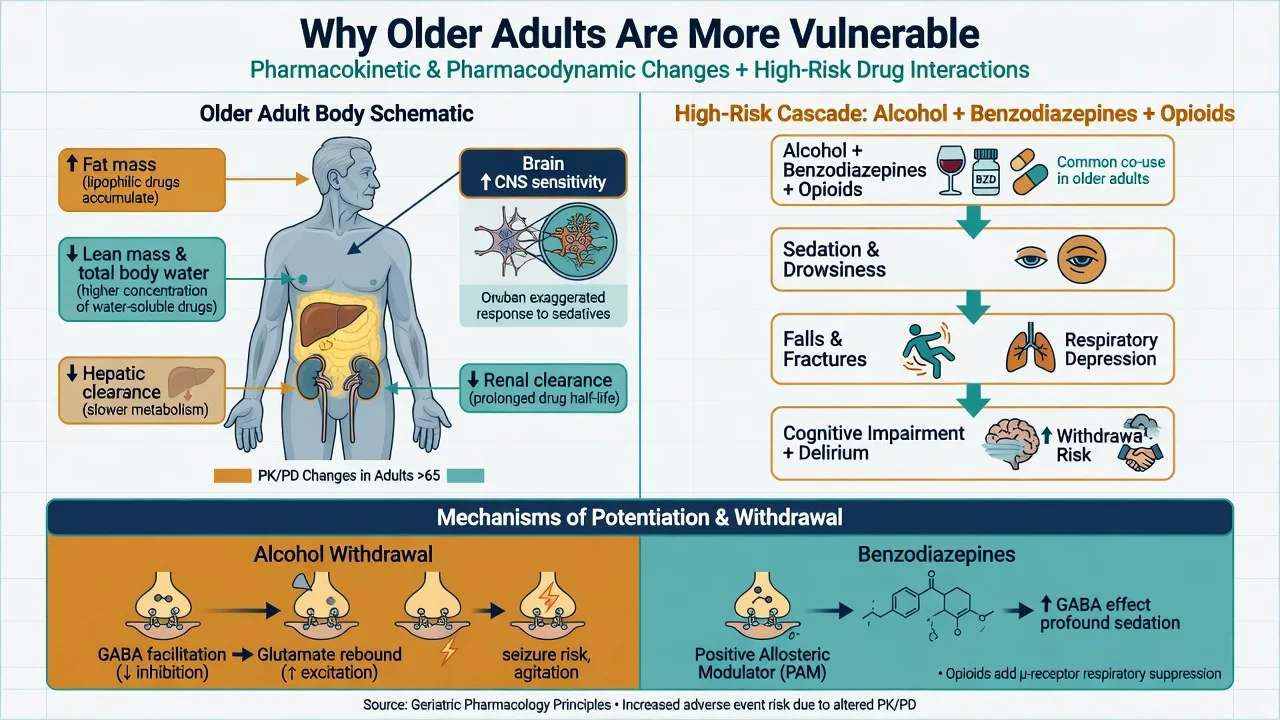
Ageing changes both pharmacokinetics and pharmacodynamics: relatively reduced lean mass and total body water, increased fat stores for lipophilic agents, reduced hepatic and renal clearance, and increased CNS sensitivity to alcohol and sedatives. The clinical translation is simple: the same drink or tablet hits harder and lasts longer.[16]
Alcohol facilitates GABA and suppresses glutamate; abrupt cessation produces glutamatergic rebound with autonomic hyperactivity, seizures and delirium risk. Chronic heavy use depletes thiamine and sets up Wernicke–Korsakoff pathways.[6][7][8]
Benzodiazepines and Z-drugs are GABA-A positive allosteric modulators. Repeated exposure produces tolerance, withdrawal liability (including seizures) and a falls/cognitive burden that meta-analytic and clinical reviews repeatedly flag in older adults.[9][13][14]
Psychosocial drivers are examinable: self-medication of grief, pain and insomnia; drinking as social structure after retirement; isolation maintaining use; and stigma that blocks help-seeking ("I am too old to change").[1][2]
Clinical presentation
Early-onset ageing-with-addiction: long dependence history, prior detoxes, dual diagnosis, medical complications (liver disease, neuropathy, cardiomyopathy), alcohol-related cognitive injury, and entrenched cues.[1][2]
Late-onset: quieter volumes that still cause falls, confusion, unstable hypertension or diabetes, sleep rebound, bereavement-related drinking, and family surprise that "Mum only has a nightcap."[1][2]
MSE anchors. Intoxication: dysarthria, ataxia, disinhibition, nystagmus, reduced alertness. Alcohol withdrawal: tremor, sweats, anxiety, tachycardia/hypertension, perceptual disturbance, delirium. Sedative intoxication: oversedation, fall risk, anterograde memory gaps. Look for depressive or anxious affect that may be substance-induced or dual diagnosis.[5][6]
Medical proxy presentations: recurrent ED falls, "UTI delirium" that is actually withdrawal, poorly controlled BP/AF, malnutrition, GORD, bruises, missed medications, and PRN sedative culture in residential care.[1][14]
Differential diagnosis
Delirium
- Acute fluctuating attention/arousal
- Medical drivers + withdrawal/intoxication
- Treat as emergency first
Dementia / ARBI / Wernicke–Korsakoff
- Persistent cognitive deficit after detox
- Thiamine history critical
- Do not diagnose dementia only while intoxicated
Primary mood/anxiety disorder
- Timeline relative to use
- Symptoms may clear with abstinence
- Often true dual diagnosis
Prescribed physiological dependence
- BZD/opioid as directed for years
- Withdrawal risk still real
- Deprescribe — do not moralise
Discriminators: last-use timing, CIWA trajectory, collateral cognition before the crisis, medication lists from pharmacy, and response after supervised abstinence.[1][5][7]
Assessment
Structure history for onset (early vs late), standard drinks per day/week, binge pattern, last drink, prior seizures/DT, other substances including OTC, multi-prescriber patterns, pain and sleep, bereavement, living alone, driving, falls, firearms and stockpiled meds, and elder abuse risk.[1][2][15]
Screening tools. AUDIT and AUDIT-C are useful; consider lower cut-points for older adults. SMAST-G/MAST-G concepts are geriatric-specific. CAGE alone misses many late-life problem drinkers. Always combine with medication review.[1][2][3]
Collateral from family, GP, pharmacy and aged-care staff is mandatory when under-reporting is likely. Assess capacity for treatment decisions, suicide risk with lethality focus, falls risk, cooking/fire safety and need for supervised detox.[1][15]
Use CIWA-Ar to quantify alcohol withdrawal severity and guide benzodiazepine treatment intensity; adapt monitoring for concurrent sedative dependence and medical frailty.[5][6]
Investigations
Baseline: FBC (MCV), U&E, LFT (GGT, AST/ALT pattern), glucose, TSH, B12/folate, magnesium/phosphate in heavy drinkers, coagulation if liver disease, ECG when cardiac risk or QT-active agents, urine/oral fluid drug screen when it changes management.[1][16]
Image the brain for first seizure, focal neurology, significant head trauma or unexplained rapid cognitive decline. Reassess cognition after detox — do not stamp irreversible dementia during intoxication or withdrawal.[1][7]
Acute and emergency management
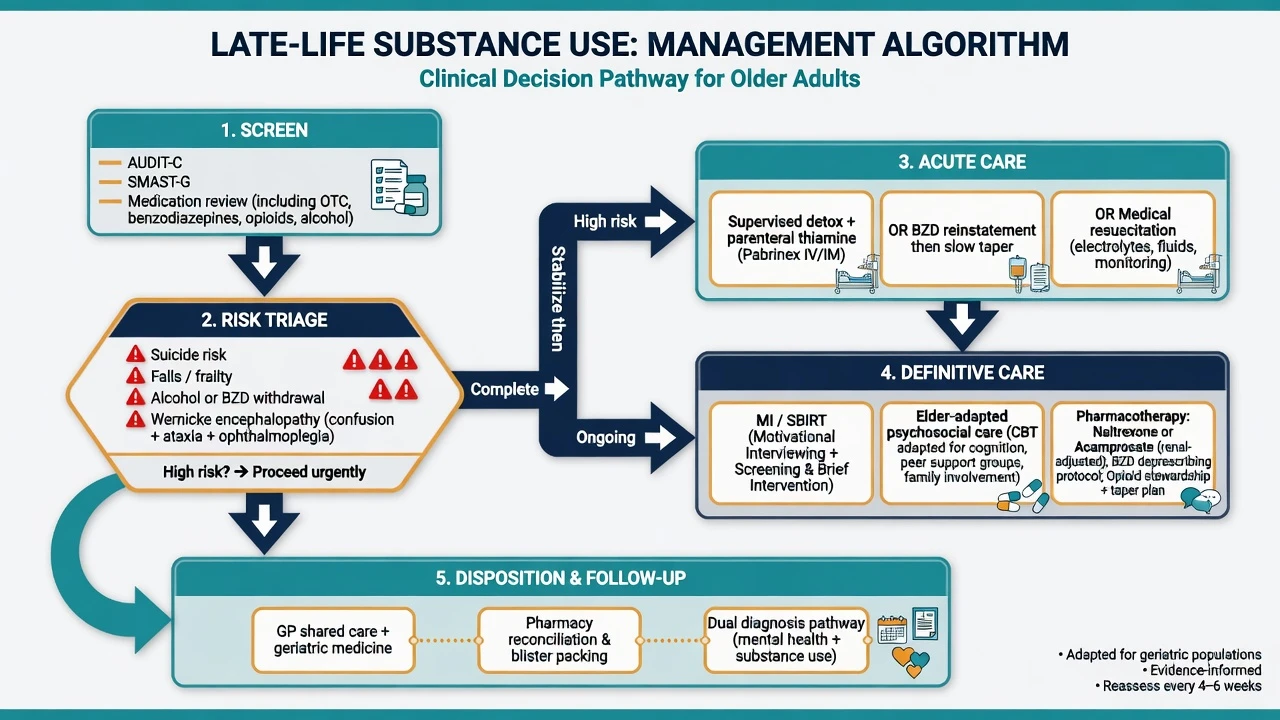
Alcohol withdrawal. Benzodiazepines remain first-line pharmacological treatment (meta-analytic and guideline tradition: Mayo-Smith). Prefer long-acting agents (e.g. diazepam) when hepatic function allows, or shorter-acting agents (e.g. lorazepam, oxazepam) when liver disease, respiratory risk or severe frailty argues against long half-life accumulation — start low, reassess frequently, symptom-triggered where staffing supports reliable CIWA scoring.[5][6]
Illustrative older-adult alcohol withdrawal example (local protocol always overrides): lorazepam 0.5–1 mg orally or IV as needed per CIWA band, or a cautious fixed schedule with daily review, plus vital-sign monitoring, falls precautions and electrolyte replacement. Escalate senior/medical review for rising CIWA, confusion, seizure or haemodynamic instability.[5][6]
Thiamine. For suspected Wernicke or high-risk malnourished heavy drinkers, give high-dose parenteral thiamine (institutional regimens commonly use thiamine 200–500 mg IV three times daily for several days, then step down — follow local protocol) before or with glucose. Caine operational criteria support treating on clinical suspicion rather than waiting for nystagmus plus ophthalmoplegia plus ataxia as a complete set.[7][8]
Benzodiazepine withdrawal emergency. If a chronic user has been stopped abruptly and develops severe anxiety, perceptual change, delirium or seizure risk, reinstate GABA-A cover, stabilise medically, then negotiate a gradual taper rather than another abrupt stop.[9][14]
Polydrug respiratory depression. Support airway, consider naloxone for opioid contribution, avoid flumazenil in chronic BZD users (seizure risk).[9][14]
Suicide and safety. Ask directly; restrict alcohol access, surplus tablets and firearms; intensify care rather than empty safety plans for isolated older adults.[15]
Definitive management
Psychosocial care. Motivational interviewing and SBIRT frameworks transfer well. Primary-care-based intervention can reduce at-risk drinking in older adults (Moore et al., Addiction 2011). Elder-adapted CBT, behavioural activation, grief work, peer support and family involvement improve engagement; ageist nihilism ("too late to treat") is an exam-fail attitude.[1][2][3]
Alcohol pharmacotherapy (older-adult cautions). APA guidance supports naltrexone and acamprosate as evidence-based options for AUD; disulfiram is generally avoided or highly selected in frail multimorbid elderly because of adherence, capacity and cardiovascular risk concerns.[4]
- Naltrexone: typical adult oral dose 50 mg once daily after opioid-free interval and liver assessment; confirm no planned opioid analgesia need; monitor LFTs and adherence. Use only after opioids are fully cleared.[4]
- Acamprosate: typical adult regimen 666 mg orally three times daily (dose-adjust for renal impairment — often 333 mg three times daily when eGFR reduced per product guidance); useful when hepatic disease limits naltrexone. Check renal function first.[4]
- Disulfiram: rarely first-line in late life; requires robust informed consent, capacity, and absolute alcohol avoidance including hidden alcohol in products.[4]
Benzodiazepine and Z-drug deprescribing. AGS Beers Criteria list benzodiazepines and non-benzodiazepine hypnotics as potentially inappropriate in older adults. Glass et al. showed modest sleep benefit against meaningful harm. EMPOWER demonstrated that direct-to-consumer education increases deprescribing success; Canadian BRZA guidance and Soyka's treatment framework support negotiated gradual taper, often via diazepam substitution principles, plus CBT-I/anxiety alternatives — never abrupt cessation after continuous use.[9][10][11][12][13][14]
Illustrative BZD taper principle: convert to a long-acting equivalent where appropriate, then reduce by about 10–25% every 1–2 weeks (slower near the end or in frail patients), with written sleep/anxiety plan and early review for rebound.[9][11]
Opioids. Prefer multimodal non-opioid pain strategies; avoid co-prescribing benzodiazepines; if opioid use disorder is present, specialist opioid agonist pathways still apply with geriatric monitoring. Taper only with a pain and withdrawal plan.[1][12]
Nicotine. Cessation remains beneficial in later life; NRT is usually first-line; varenicline or bupropion need comorbidity screening.[1]
Dual diagnosis. Treat late-life depression, anxiety, PTSD and psychosis in an integrated plan; ongoing alcohol or sedatives create pseudo-treatment resistance. Avoid replacing one long-term sedative with another without an exit strategy.[1][14][15]
Frame answers around old-age psychiatry plus addiction liaison, local detox thresholds, aged-care medication review culture, and least-restrictive mental health law principles. Prefer naming pathways (shared care, pharmacy reconciliation, residential medication advisory) over inventing statute numbers. Align alcohol pharmacotherapy with APA-style evidence while applying Beers-style PIM thinking to sedatives.[1][4][12]
Subtypes and special scenarios
- Bereavement-triggered late-onset alcohol misuse — screen grief versus major depression versus AUD; combine MI with bereavement support.[1][2]
- Chronic primary-care BZD insomnia scripts — EMPOWER education + taper + CBT-I pathway.[10][11][14]
- Alcohol-related brain injury / Wernicke–Korsakoff — thiamine, nutrition, supported accommodation, capacity opinions.[7][8]
- Residential aged care — hidden alcohol, PRN sedative culture, falls committees, deprescribing champions.[12][14]
- Opioid–BZD co-prescription — highest overdose risk stack; prioritise separation of scripts.[12][14]
- Hospital detection — undiagnosed dependence unmasked by nil-by-mouth or missed home sedatives; proactive withdrawal plans.[5][6][9]
Complications and pitfalls
Missed withdrawal labelled as dementia or UTI; abrupt BZD stop; under-use of thiamine; glucose without thiamine in malnourished drinkers; therapeutic nihilism; ignoring suicide means; diagnosing permanent dementia during detox; starting naltrexone on opioids; using disulfiram without support; and moralising prescribed physiological dependence instead of deprescribing safely.[6][8][9][12][15]
Prognosis and disposition
Older adults can achieve meaningful reductions and abstinence. Late-onset cases often respond well to brief intervention and structured follow-up when engaged; early-onset severe dependence with cognitive impairment needs more intensive, longer supports.[1][2][3]
Disposition intensity follows withdrawal risk, suicide risk, cognition, medical comorbidity and home supports: home with package and early review, supervised community detox, medical ward, or psychiatric admission. Name a follow-up owner, pharmacy reconciliation plan and dual-diagnosis pathway before discharge.[1][6]
Exam pearls
OLDER-SUBS (bedside prompt)
Fellowship standard: detect early, treat withdrawal as medicine, deprescribe sedatives with a plan, use age-attuned psychosocial care and carefully selected anti-craving agents, and never leave an isolated older adult with unaddressed alcohol, tablets and suicide risk.[1][3][4][15]
References
- [1]Kuerbis A, Sacco P, Blazer DG, Moore AA Substance abuse among older adults Clin Geriatr Med, 2014.PMID 25037298
- [2]Barry KL, Blow FC Drinking Over the Lifespan: Focus on Older Adults Alcohol Res, 2016.PMID 27159818
- [3]Moore AA, Blow FC, Hoffing M, Welgreen S, Davis JW, Lin JC, et al. Primary care-based intervention to reduce at-risk drinking in older adults: a randomized controlled trial Addiction, 2011.PMID 21143686
- [4]Reus VI, Fochtmann LJ, Bukstein O, et al. The American Psychiatric Association Practice Guideline for the Pharmacological Treatment of Patients With Alcohol Use Disorder Am J Psychiatry, 2018.PMID 29301420
- [5]Sullivan JT, Sykora K, Schneiderman J, et al. Assessment of alcohol withdrawal: the revised clinical institute withdrawal assessment for alcohol scale (CIWA-Ar) Br J Addict, 1989.PMID 2597811
- [6]Mayo-Smith MF Pharmacological management of alcohol withdrawal. A meta-analysis and evidence-based practice guideline. American Society of Addiction Medicine Working Group on Pharmacological Management of Alcohol Withdrawal JAMA, 1997.PMID 9214531
- [7]Caine D, Halliday GM, Kril JJ, et al. Operational criteria for the classification of chronic alcoholics: identification of Wernicke's encephalopathy J Neurol Neurosurg Psychiatry, 1997.PMID 9010400
- [8]Day E, Bentham PW, Callaghan R, et al. Thiamine for prevention and treatment of Wernicke-Korsakoff Syndrome in people who abuse alcohol Cochrane Database Syst Rev, 2013.PMID 23818100
- [9]Soyka M Treatment of Benzodiazepine Dependence N Engl J Med, 2017.PMID 28614686
- [10]Tannenbaum C, Martin P, Tamblyn R, et al. Reduction of inappropriate benzodiazepine prescriptions among older adults through direct patient education: the EMPOWER cluster randomized trial JAMA Intern Med, 2014.PMID 24733354
- [11]Pottie K, Thompson W, Davies S, et al. Deprescribing benzodiazepine receptor agonists: Evidence-based clinical practice guideline Can Fam Physician, 2018.PMID 29760253
- [12]By the 2023 American Geriatrics Society Beers Criteria Update Expert Panel American Geriatrics Society 2023 updated AGS Beers Criteria® for potentially inappropriate medication use in older adults J Am Geriatr Soc, 2023.PMID 37139824
- [13]Glass J, Lanctôt KL, Herrmann N, Sproule BA, Busto UE Sedative hypnotics in older people with insomnia: meta-analysis of risks and benefits BMJ, 2005.PMID 16284208
- [14]Markota M, Rummans TA, Bostwick JM, et al. Benzodiazepine Use in Older Adults: Dangers, Management, and Alternative Therapies Mayo Clin Proc, 2016.PMID 27814838
- [15]Conwell Y, Van Orden K, Caine ED Suicide in older adults Psychiatr Clin North Am, 2011.PMID 21536168
- [16]Mangoni AA, Jackson SHD Age-related changes in pharmacokinetics and pharmacodynamics: basic principles and practical applications Br J Clin Pharmacol, 2004.PMID 14678335