Psych · Old age psychiatry — residential care and systems of care
Residential aged care psychiatry
Also known as Nursing home psychiatry · Long-term care psychiatry · Care home mental health · RACF psychiatry · Aged care facility behavioural management · Institutional geriatric psychiatry
Exam-exhaustive fellowship reference on residential aged care (nursing home / long-term care) psychiatry — epidemiology (Seitz), BPSD assessment, person-centred and staff-training interventions (Fossey, CADRES, WHELD), pain-first care (Husebo), restricted antipsychotics with mortality evidence (Schneider, Gill, Huybrechts), DART-AD/Devanand deprescribing, HTA-SADD and CitAD caveats, chemical restraint and least-restrictive practice, capacity, and liaison disposition. FRANZCP-primary, globally tagged.
On this page & tools
Your progress
Saved locally on this device.
Target exams
Red flags
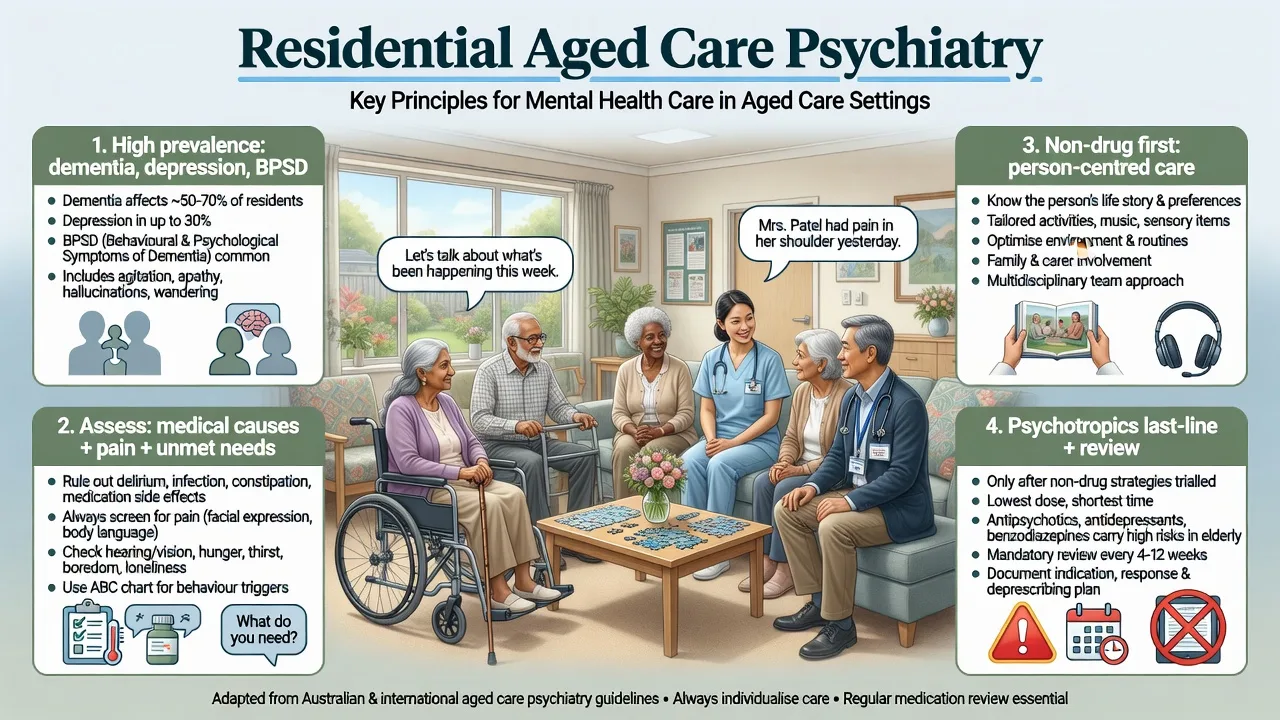
Residential aged care (RAC) — also nursing home / long-term care (LTC) / care home depending on jurisdiction — is where much of late-life severe dementia, frailty, and complex behavioural risk is managed. FRANZCP MEQs and old-age vivas test setting competence: multifactorial assessment, non-drug first, honest harm data, deprescribing, restraint minimisation, capacity, and liaison disposition. MRCPsych CASC stations often place you explaining antipsychotic risk or staff training to a facility manager or family. This leaf complements (and does not replace) the dedicated BPSD, delirium, and prescribing monographs — it owns the RAC interface.[1][4]
Overview and definition
Residential aged care means congregate residential settings that provide 24-hour personal and/or nursing care for older adults with disability, frailty, or dementia. Terminology varies: Australia/New Zealand Residential Aged Care Facility (RACF); UK care home (nursing or residential); North America nursing home / long-term care. Psychiatry's role is not only diagnosis but quality of care — prescribing culture, chemical and physical restraint, staff skill, and least-restrictive risk management.[1][4]
Dominant clinical work is behavioural and psychological symptoms of dementia (BPSD) / neuropsychiatric symptoms (NPS), late-life depression, delirium superimposed on dementia, carried-in severe mental illness, and iatrogenic psychotropic burden.[2][4]
Classification and clinical framework
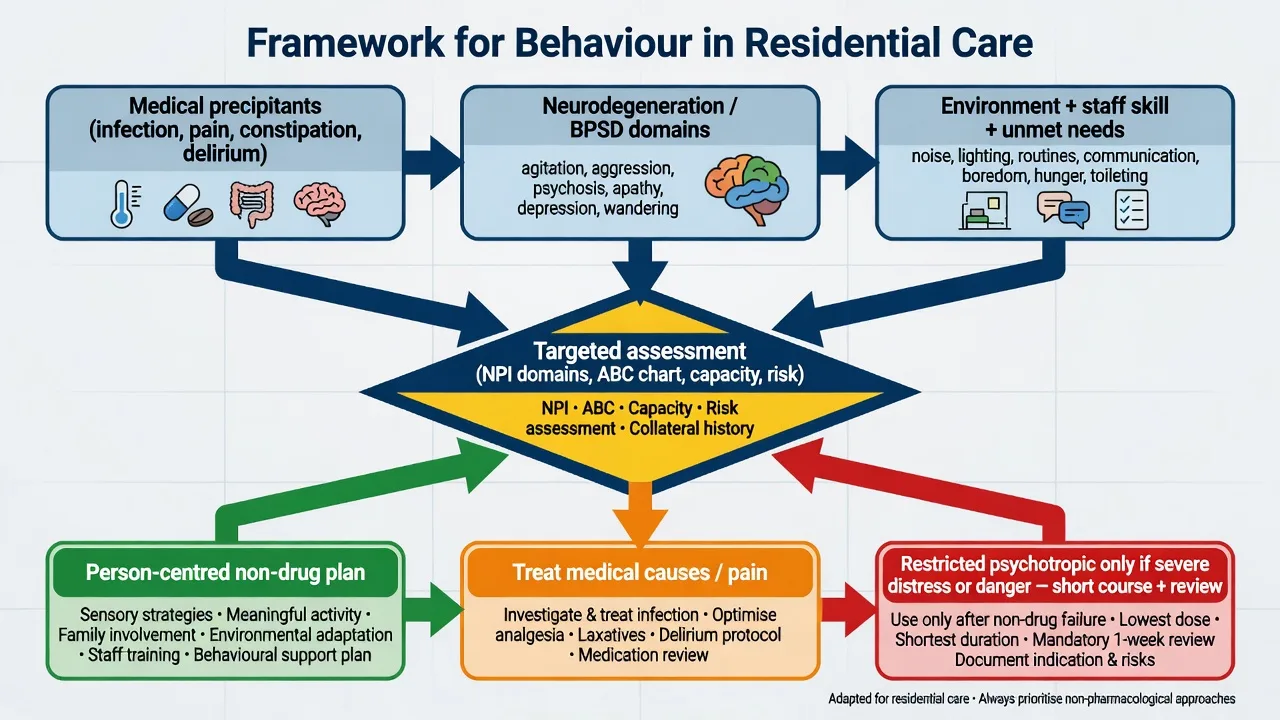
BPSD / NPS domains (operational scaffold)
IPA consensus framed behavioural and psychological signs and symptoms of dementia as a major treatment target beyond cognition.[2] The Neuropsychiatric Inventory (NPI) domains remain the examiner map: delusions, hallucinations, agitation/aggression, depression/dysphoria, anxiety, elation/euphoria, apathy, disinhibition, irritability, aberrant motor behaviour, night-time behaviour, and appetite/eating changes.[3] Facility versions (NPI-NH) use staff informants.
Chemical restraint vs treatment
Chemical restraint (legal-clinical framing) is psychotropic use primarily to control behaviour or restrict freedom rather than to treat a diagnosed condition with a documented therapeutic goal, consent/proxy process, and review. Wandering, calling out, and mild irritability are classic non-indications for antipsychotics. Examiners expect you to name the concept, document indication and review time, and prefer least-restrictive alternatives.[4][5]
Epidemiology and risk
Seitz and colleagues systematically reviewed psychiatric disorders among older adults in long-term care homes: dementia, depression, anxiety, and behavioural symptoms are highly prevalent — far above community rates — making RAC a core old-age psychiatry setting.[1]
Most people with dementia develop neuropsychiatric symptoms over the course of illness; RAC concentrates the severe tail. Risk amplifiers include dementia severity and subtype (e.g. frontotemporal disinhibition; Lewy body hallucinations and neuroleptic sensitivity), male sex for physical aggression in some series, sensory impairment, pain, infection, constipation, polypharmacy, understaffing, environmental over- or under-stimulation, and staff skill gaps.[4]
Antipsychotic exposure has been historically high. Meta-analysis of randomised trials showed increased mortality with atypical antipsychotics in dementia (Schneider et al.).[5] Population data confirm mortality associations with antipsychotic use in older adults with dementia (Gill et al.), differential mortality among specific agents in nursing-home residents (Huybrechts et al.), and short-term serious events (Rochon et al.).[6][7][8]
Pathophysiology and drivers
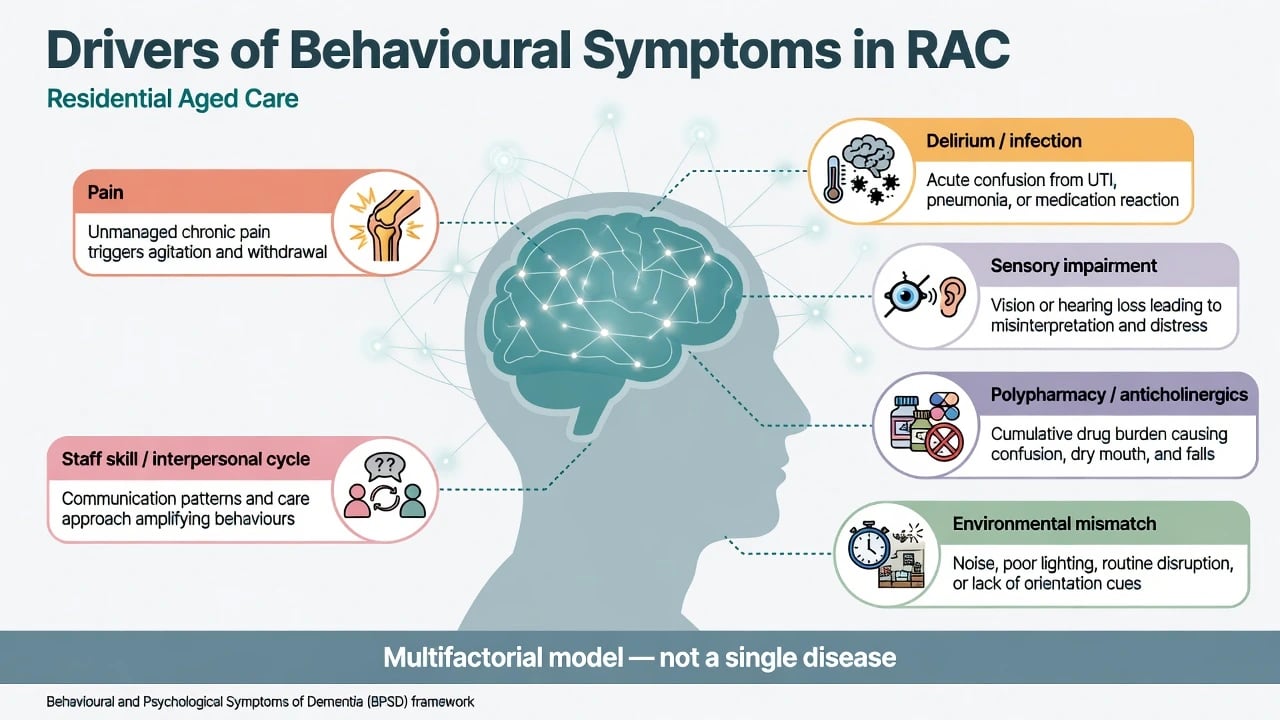
The practical model is multifactorial: neurodegeneration (cholinergic and monoaminergic circuit failure) interacts with unmet needs (pain, boredom, fear, toileting), acute medical precipitants (delirium cascade), sensory loss, environmental mismatch, and interpersonal cycles with staff and co-residents.[4]
Pain is a high-yield modifiable driver: a cluster randomised trial in nursing-home residents with dementia showed that a systematic pain treatment protocol reduced behavioural disturbance.[12] Delirium superimposes acute fluctuating inattention and is easily mislabelled as "progression of dementia" or "settled" hypoactivity.
Clinical presentation
Common RAC behavioural syndromes: verbal and physical agitation/aggression; psychosis (theft, misidentification, visual hallucinations); depression with withdrawal; apathy; sleep–wake disruption and sundowning; wandering and exit-seeking; sexual disinhibition; refusal of care; calling out.[2][3][4]
MSE adaptation. Many residents cannot give a reliable history. Use direct observation, structured staff interview (NPI-style), family collateral, and facility progress notes. Record target behaviours with frequency, severity, triggers, and risk (falls, resident-to-resident aggression, staff injury, absconding, choking, sexual vulnerability).[3][4]
Hypoactive "good resident." Quiet, low intake, more sleep — treat as possible hypoactive delirium or depression until assessed, not as success of sedation.[4]
Differential diagnosis — discriminators
- Hours–days onset
- Fluctuating inattention
- Altered awareness
- Medical precipitant
- Often reversible if cause treated
- Days–weeks pattern in dementia
- Attention relatively more stable than delirium
- Domain-specific (e.g. theft delusion)
- Environment/unmet need drivers
- Responds to person-centred care
- Weeks–months
- Anhedonia, guilt, diurnal mood
- May retain clearer sensorium
- Suicide/self-neglect risk
- HTA-SADD limits drug expectation in dementia
Also exclude: untreated pain; constipation/retention; infection; hypoxia; drug toxicity or withdrawal; primary late-onset psychosis with clearer sensorium; elder abuse or staff conflict masquerading as "behaviour"; carried-in bipolar or schizophrenia with incomplete medication history.[4][12]
Assessment
- Safety first — resident-to-resident violence, weapons/sharp objects, fire risk, absconding, falls after sedation.
- ABC medical screen for any acute change: vitals, glucose, oxygen saturation, pain assessment (including nonverbal scales), bladder scan, bowels, skin, infection sources.
- Medication reconciliation — antipsychotics, benzodiazepines, opioids, anticholinergics, anticholinesterase inhibitors, new starts/stops.
- Behavioural ABC charting and NPI/NPI-NH or CMAI-style symptom definition.[3][4]
- Capacity for each decision (placement, psychotropic consent, hospital transfer); identify substitute decision-maker under local law.
- Legal/least-restrictive review of any restraint or emergency medication.
Investigations
| Tier | Content | Notes |
|---|---|---|
| Immediate | Vitals, glucose, SpO2, pain assessment | All acute behavioural change |
| Core | FBC, U&E, CRP, glucose, ECG before new psychotropic | Directed by clinical clues |
| Common directed | Urinalysis/culture, CXR | Infection common in RAC |
| Cognitive/mood tools | NPI-NH, Cornell Scale for Depression in Dementia, 4AT/CAM if delirium | Staff-informed scales often essential |
| Advanced | CT/MRI, EEG | Focal signs, trauma, seizure, atypical rapid decline only |
Do not delay non-drug care and cause treatment while awaiting exhaustive imaging. Normal investigations do not license antipsychotic use for mild distress.[4][5]
Acute management
Severe aggression ladder: environmental safety and remove others at risk → calm communication, one voice, reduce stimulation → offer food/toilet/pain relief → 1:1 observation → emergency services if weapons or uncontrollable violence → short-term medication only if imminent danger after non-drug measures, with documentation of indication, dose, route, and review time. Avoid IM polypharmacy and avoid combining IM olanzapine with parenteral benzodiazepines.[4]
Definitive management
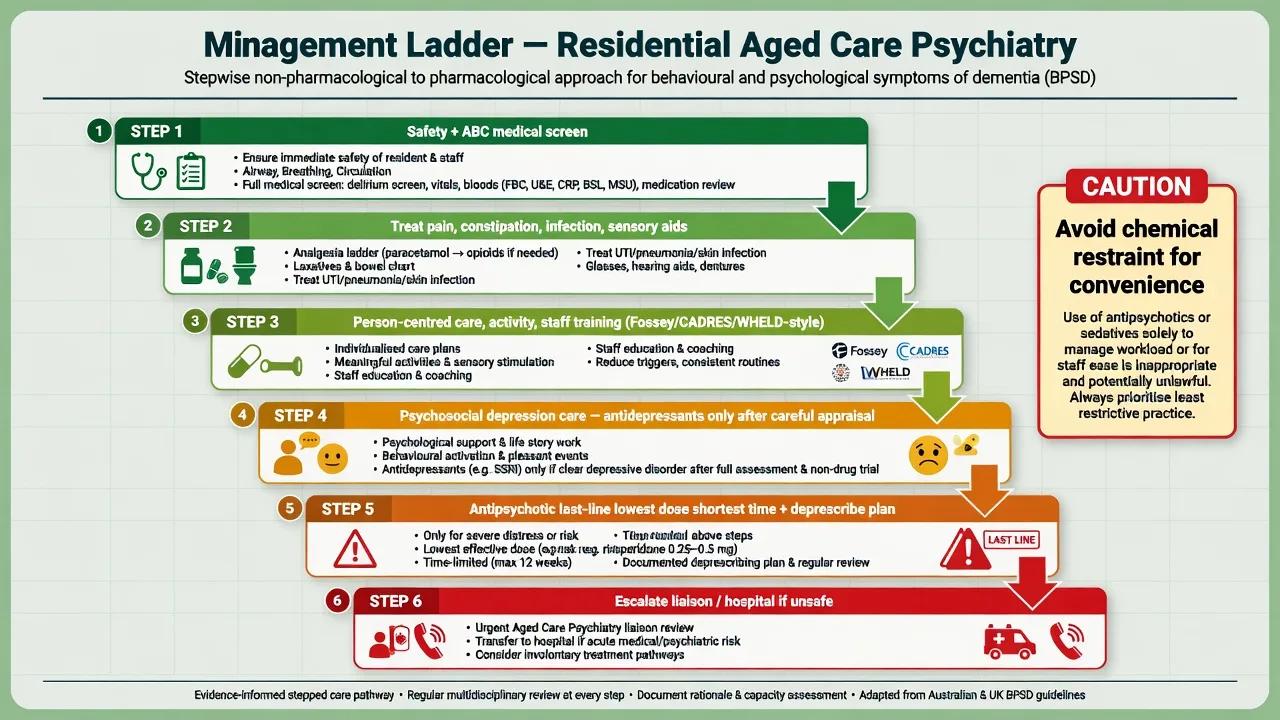
1. Non-pharmacological care is first-line (and evidence-based)
Enhanced psychosocial care / staff training can reduce antipsychotic use in nursing homes with severe dementia without worsening agitation — Fossey and colleagues demonstrated this in a cluster randomised trial.[9]
Person-centred care and related organisational approaches improve outcomes: CADRES (Australia) compared person-centred care and dementia-care mapping with usual care in a cluster-randomised design.[10] WHELD (person-centred care training plus person-centred activities) improved quality of life and reduced agitation and antipsychotic use signals in nursing-home residents with dementia in a large cluster RCT.[11]
Practical package examiners expect: know the person (biography, preferences, cultural identity); structured meaningful activity; sensory aids; consistent staffing where possible; pain and comfort protocols; reduce noise/overcrowding; toileting schedules; music/reminiscence when individualised; carer/staff coaching rather than blame.[4][9][11][12]
2. Treat pain and medical drivers
Implement a stepwise pain protocol when behavioural disturbance is present and pain is possible — Husebo's nursing-home trial is the named evidence examiners want.[12] Fix constipation, retention, dehydration, infection, and sensory deprivation in parallel.
3. Depression in RAC / dementia
Do not assume every low mood needs an antidepressant. HTA-SADD found that sertraline or mirtazapine were not superior to placebo on the primary depression outcome in dementia, with more adverse events on active drug — prioritise psychosocial approaches and reassess diagnosis (apathy, pain, grief, delirium).[15] When major depression is clear and severe (especially without advanced dementia), antidepressants may still be considered with geriatric dosing and monitoring — state uncertainty honestly in viva.
4. Antipsychotics — last-line, brief, monitored
Indications (narrow): severe aggression or psychosis causing serious distress or danger after non-drug measures and medical optimisation, with informed consent or proxy authorisation and a review/deprescribing plan from day one.[4][5]
Harms to name: increased death risk in dementia RCTs (Schneider meta-analysis); observational mortality (Gill); nursing-home agent-specific mortality differences (Huybrechts); short-term serious events including hospitalisation (Rochon); stroke, falls, sedation, EPS, QTc prolongation, metabolic effects.[5][6][7][8]
Illustrative cautious starting ranges if a drug is still required (check product information, ECG/QTc, EPS risk, renal function, frailty; start at the bottom of the range): risperidone 0.25–0.5 mg oral once daily (or divided); quetiapine 12.5–25 mg oral; olanzapine 2.5 mg oral — with daily review initially, falls monitoring, and clear target symptoms (safety/distress, not "stop wandering"). Avoid typical high-potency agents and any antipsychotic if probable Lewy body / Parkinson disease dementia unless specialist-led extreme necessity.[4][5]
Deprescribing evidence: DART-AD showed that continuing neuroleptics is not clearly advantageous for many patients and long-term follow-up raised mortality concerns with continued treatment; plan structured withdrawal when stable, while recognising some individuals relapse (Devanand-style risperidone discontinuation risk in Alzheimer disease psychosis/agitation cohorts informs counselling).[13][14]
5. Citalopram for agitation (CitAD) — not a free pass
CitAD found citalopram can reduce agitation in Alzheimer disease relative to placebo, but with cognitive adverse effects and QTc prolongation concerns — older-adult dose limits and ECG monitoring apply; this is not first-line RAC chemical management of mild irritability.[16]
ANZ practice aligns with Aged Care Quality Standards, restrictive-practice regulation (chemical and physical restraint reporting and consent frameworks — use local statutory language), RANZCP old-age principles, and specialist behavioural support models (e.g. DBMAS/SBRT-style liaison). PBS authority rules may constrain dementia antipsychotic indications — state jurisdiction, do not invent section numbers.[4][10]
Subtypes and scenarios
| Scenario | Priorities |
|---|---|
| New admission relocation stress | Reassurance, familiar objects, family presence, avoid immediate psychotropics |
| Severe aggression high-dependency unit | Medical screen, staffing ratios, specialist liaison, least-restrictive security |
| Young-onset dementia in RAC | Age-appropriate activity, family strain, longer disease course planning |
| Suspected DLB | Avoid typical antipsychotics; careful specialist prescribing only |
| End-of-life distress | Palliate pain/dyspnoea; limited symptom-targeted medication; avoid therapeutic nihilism and over-sedation |
| Carried-in schizophrenia/bipolar | Continuity of psychotropics with geriatric dose review; do not stop suddenly |
Complications and pitfalls
- Antipsychotics for wandering, calling out, or night staffing convenience.
- Missing delirium and pain.
- DLB neuroleptic sensitivity.
- Dual antipsychotics and long-term benzodiazepines.
- Physical restraint without review.
- Hospital transfer as first response when facility optimisation incomplete.
- Failure to deprescribe after crisis resolves.[5][8][13]
Prognosis and disposition
Many behavioural crises improve with medical treatment, pain control, environmental redesign, and staff coaching.[9][11][12] Prognosis for the underlying dementia remains progressive. Excess mortality and hospitalisation risk from antipsychotics must enter family discussions.[5][6][8]
Disposition ladder: optimise in place → RAC liaison/old-age CMHT/DBMAS-style support → acute hospital medical or psychogeriatric admission if medical instability, unmanageable risk, or need for intensive investigation. Disposition is least-restrictive and proportionate — not "send to psych for behaviour" by default.[4]
Special populations
Cultural safety (Indigenous, migrant, language discordance): use interpreters, family cultural brokers, and familiar food/rituals. Rural RAC may rely on telepsychiatry and GP shared care. Trauma-experienced and LGBTQ+ residents need privacy, identity affirmation, and avoidance of re-traumatising restraint. Intellectual disability ageing into RAC needs dual-trained or collaborative ID psychiatry input.[1][4]
Evidence and guidelines (viva packing list)
| Landmark | Message |
|---|---|
| Seitz 2010 | High psychiatric morbidity in LTC |
| Fossey 2006 | Staff psychosocial care ↓ antipsychotics |
| CADRES 2009 | Person-centred care / DCM cluster RCT |
| WHELD 2018 | QoL, agitation, antipsychotic outcomes |
| Husebo 2011 | Pain protocol ↓ behavioural disturbance |
| Schneider 2005 | Atypical AP ↑ death in dementia RCTs |
| Gill 2007 / Huybrechts 2012 / Rochon 2008 | Real-world mortality and serious events |
| DART-AD 2008/2009 | Withdrawal/continuation and long-term mortality signal |
| HTA-SADD 2011 | Sertraline/mirtazapine not superior for depression in dementia primary endpoint |
| CitAD 2014 | Citalopram may help agitation; QTc/cognitive costs |
Exam pearls
- Non-drug and staff skill first — name Fossey, CADRES, WHELD.
- Pain protocol before psychotropics for many "behaviours" (Husebo).
- Mortality black-box / Schneider + Gill/Huybrechts for nursing homes.
- HTA-SADD blocks automatic SSRI for every dementia depression label.
- Deprescribe plan on day one (DART-AD logic).
- Chemical restraint is a legal-clinical concept — document purpose.
- Acute change = delirium until proven otherwise.
- Assess in place when safe; hospital is not a behavioural default.[4][5][9][12][15]
References
- [1]Seitz D, Purandare N, Conn D Prevalence of psychiatric disorders among older adults in long-term care homes: a systematic review Int Psychogeriatr, 2010.PMID 20522279
- [2]Finkel SI, Costa e Silva J, Cohen G, Miller S, Sartorius N Behavioral and psychological signs and symptoms of dementia: a consensus statement on current knowledge and implications for research and treatment Int Psychogeriatr, 1996.PMID 9154615
- [3]Cummings JL, Mega M, Gray K, Rosenberg-Thompson S, Carusi DA, Gornbein J The Neuropsychiatric Inventory: comprehensive assessment of psychopathology in dementia Neurology, 1994.PMID 7991117
- [4]Kales HC, Gitlin LN, Lyketsos CG Assessment and management of behavioral and psychological symptoms of dementia BMJ, 2015.PMID 25731881
- [5]Schneider LS, Dagerman KS, Insel P Risk of death with atypical antipsychotic drug treatment for dementia: meta-analysis of randomized placebo-controlled trials JAMA, 2005.PMID 16234500
- [6]Gill SS, Bronskill SE, Normand SL, Anderson GM, Sykora K, Lam K, et al. Antipsychotic drug use and mortality in older adults with dementia Ann Intern Med, 2007.PMID 17548409
- [7]Huybrechts KF, Gerhard T, Crystal S, Olfson M, Avorn J, Levin R, et al. Differential risk of death in older residents in nursing homes prescribed specific antipsychotic drugs: population based cohort study BMJ, 2012.PMID 22362541
- [8]Rochon PA, Normand SL, Gomes T, Gill SS, Anderson GM, Melo M, et al. Antipsychotic therapy and short-term serious events in older adults with dementia Arch Intern Med, 2008.PMID 18504337
- [9]Fossey J, Ballard C, Juszczak E, James I, Alder N, Jacoby R, et al. Effect of enhanced psychosocial care on antipsychotic use in nursing home residents with severe dementia: cluster randomised trial BMJ, 2006.PMID 16543297
- [10]Chenoweth L, King MT, Jeon YH, Brodaty H, Stein-Parbury J, Norman R, et al. Caring for Aged Dementia Care Resident Study (CADRES) of person-centred care, dementia-care mapping, and usual care in dementia: a cluster-randomised trial Lancet Neurol, 2009.PMID 19282246
- [11]Ballard C, Corbett A, Orrell M, Williams G, Moniz-Cook E, Romeo R, et al. Impact of person-centred care training and person-centred activities on quality of life, agitation, and antipsychotic use in people with dementia living in nursing homes: A cluster-randomised controlled trial PLoS Med, 2018.PMID 29408901
- [12]Husebo BS, Ballard C, Sandvik R, Nilsen OB, Aarsland D Efficacy of treating pain to reduce behavioural disturbances in residents of nursing homes with dementia: cluster randomised clinical trial BMJ, 2011.PMID 21765198
- [13]Ballard C, Lana MM, Theodoulou M, Douglas S, McShane R, Jacoby R, et al. A randomised, blinded, placebo-controlled trial in dementia patients continuing or stopping neuroleptics (the DART-AD trial) PLoS Med, 2008.PMID 18384230
- [14]Ballard C, Hanney ML, Theodoulou M, Douglas S, McShane R, Kossakowski K, et al. The dementia antipsychotic withdrawal trial (DART-AD): long-term follow-up of a randomised placebo-controlled trial Lancet Neurol, 2009.PMID 19138567
- [15]Banerjee S, Hellier J, Dewey M, Romeo R, Ballard C, Baldwin R, et al. Sertraline or mirtazapine for depression in dementia (HTA-SADD): a randomised, multicentre, double-blind, placebo-controlled trial Lancet, 2011.PMID 21764118
- [16]Porsteinsson AP, Drye LT, Pollock BG, Devanand DP, Frangakis C, Ismail Z, et al. Effect of citalopram on agitation in Alzheimer disease: the CitAD randomized clinical trial JAMA, 2014.PMID 24549548