Psych · Professional — motivational interviewing
Motivational interviewing
Also known as MI · Motivational enhancement therapy · MET · Change talk · OARS · Brief motivational intervention · Ambivalence counselling
Exam-exhaustive fellowship reference on motivational interviewing — spirit (PACE), OARS, four processes, change vs sustain talk (DARN-CAT), righting reflex, stages of change interface, MET, substance-use and medical behaviour-change evidence (MATCH, UKATT, COMBINE, Cochrane), dual diagnosis, cultural adaptation, training and fidelity. FRANZCP-primary, globally tagged.
On this page & tools
Your progress
Saved locally on this device.
10 MCQs with explanations
Target exams
Red flags
Overview and definition
MI was developed by Miller and Rollnick for problem drinking and generalised across behaviour change. Fellowship candidates must define it as a style and method, not a single session manual and not synonymous with the transtheoretical (stages of change) model.[1][2][4]
Miller and Rose integrated relational components (empathy, MI spirit) and technical components (evoking and reinforcing change talk) into a causal theory of how MI works.[1] Miller and Rollnick also published an explicit corrective list of what MI is not — not a trick to make people change, not the stages-of-change model itself, not a panacea, and not OARS technique without spirit.[2]
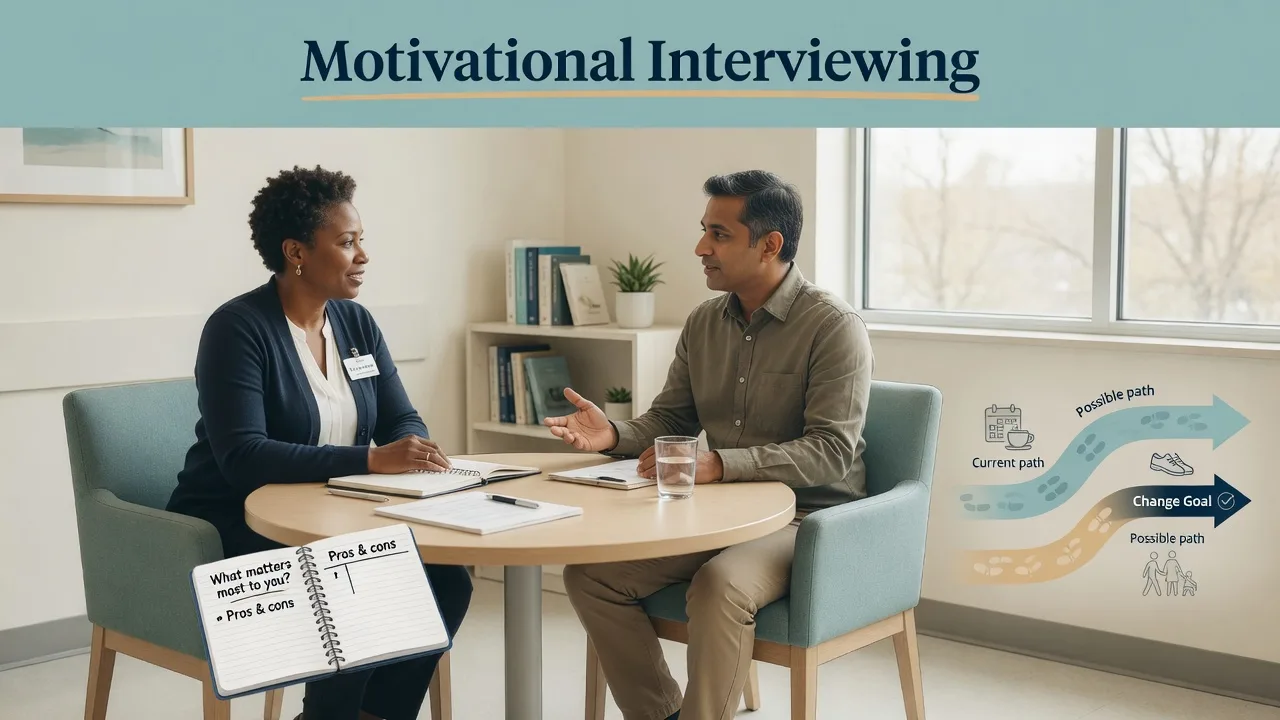
Four processes
Contemporary MI is organised as four processes that are sequential in logic but recursive in practice.[1][2]
| Process | Clinical task |
|---|---|
| Engaging | Therapeutic alliance; "Can we work together?" |
| Focusing | Agenda mapping; shared target behaviour |
| Evoking | Draw out change talk; resolve ambivalence |
| Planning | When ready: concrete commitment and steps |
Jumping to planning before engagement or evocation is a common CASC failure.[1][2]
Spirit — PACE (definition and classification)
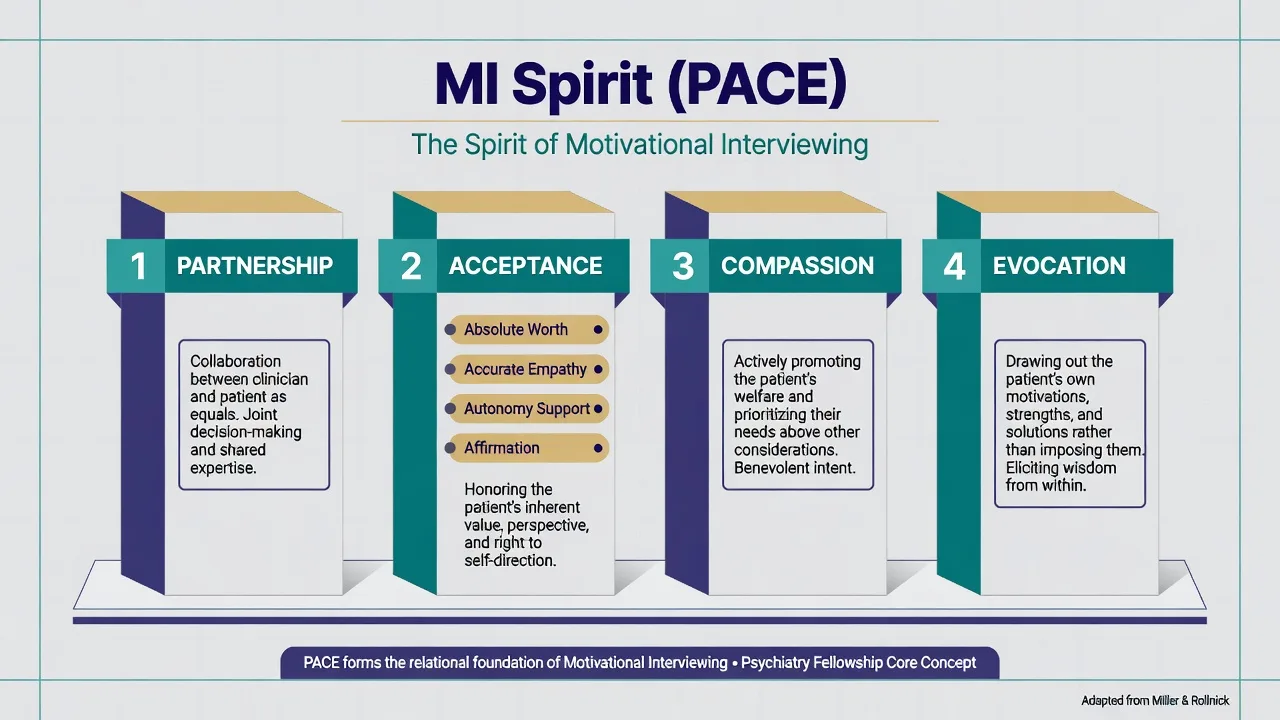
| Pillar | Meaning for the psychiatrist |
|---|---|
| Partnership | Expertise is shared; the patient is the expert on their life |
| Acceptance | Absolute worth, accurate empathy, autonomy support, affirmation |
| Compassion | Priority is the patient's welfare, not clinician agenda performance |
| Evocation | Motivation is drawn out, not installed |
Acceptance is not agreement with harmful behaviour. Accurate empathy and autonomy support can coexist with clear risk communication and, when needed, legal limits on liberty.[1][2]
[1] [2]OARS microskills
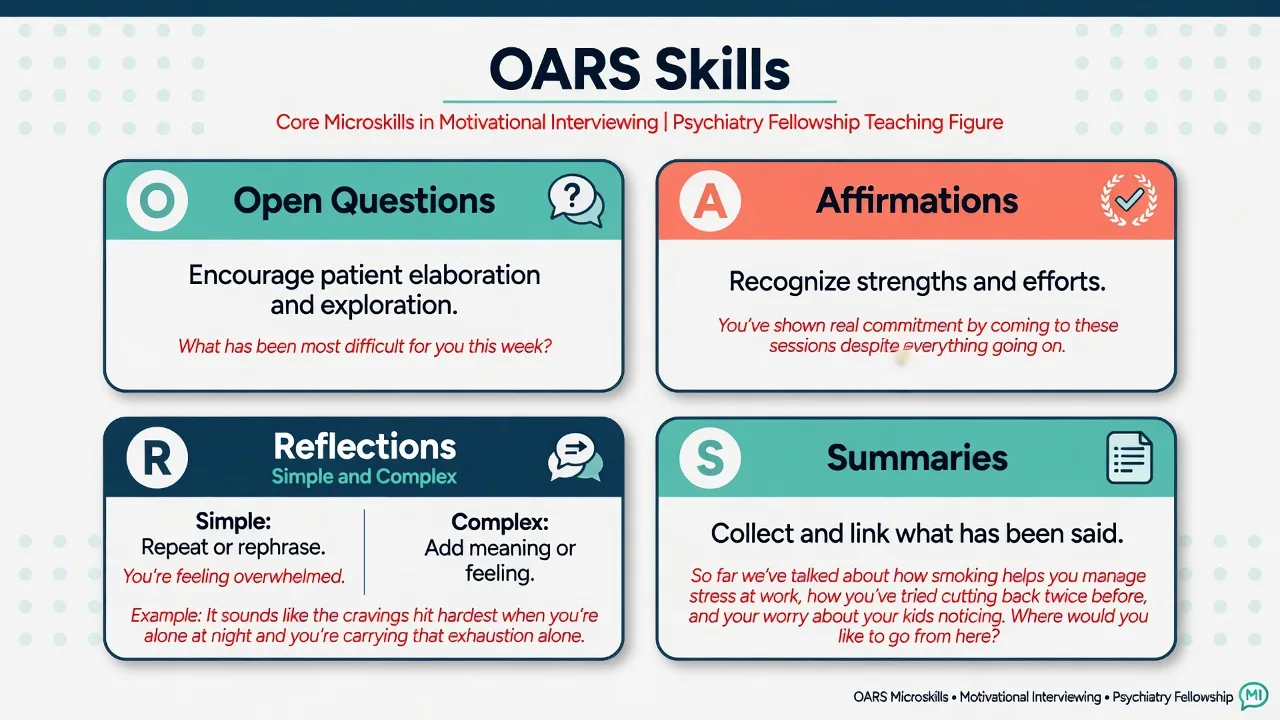
- Open questions invite elaboration ("What concerns you most about your drinking?") rather than yes/no traps.
- Affirmations notice strengths and efforts (not empty praise).
- Reflections — simple (rephrase) and complex (add meaning/emotion/continuation). Aim for more reflections than questions.
- Summaries collect themes, especially change talk, and often end with an open question ("Where does that leave you?").
OARS
Supporting tools used within MI spirit include importance and confidence rulers (0–10), agenda mapping, looking forward/back, values exploration, and Elicit–Provide–Elicit for information (ask permission and prior knowledge → brief information → check meaning).[1][4][9]
Mechanisms — ambivalence, change talk, righting reflex
Ambivalence is simultaneous motivation to change and to stay the same. Confrontational "fixing" activates reactance: the patient defends the status quo (sustain talk) and the relationship frays (discord).[1][10]
Change talk: DARN-CAT
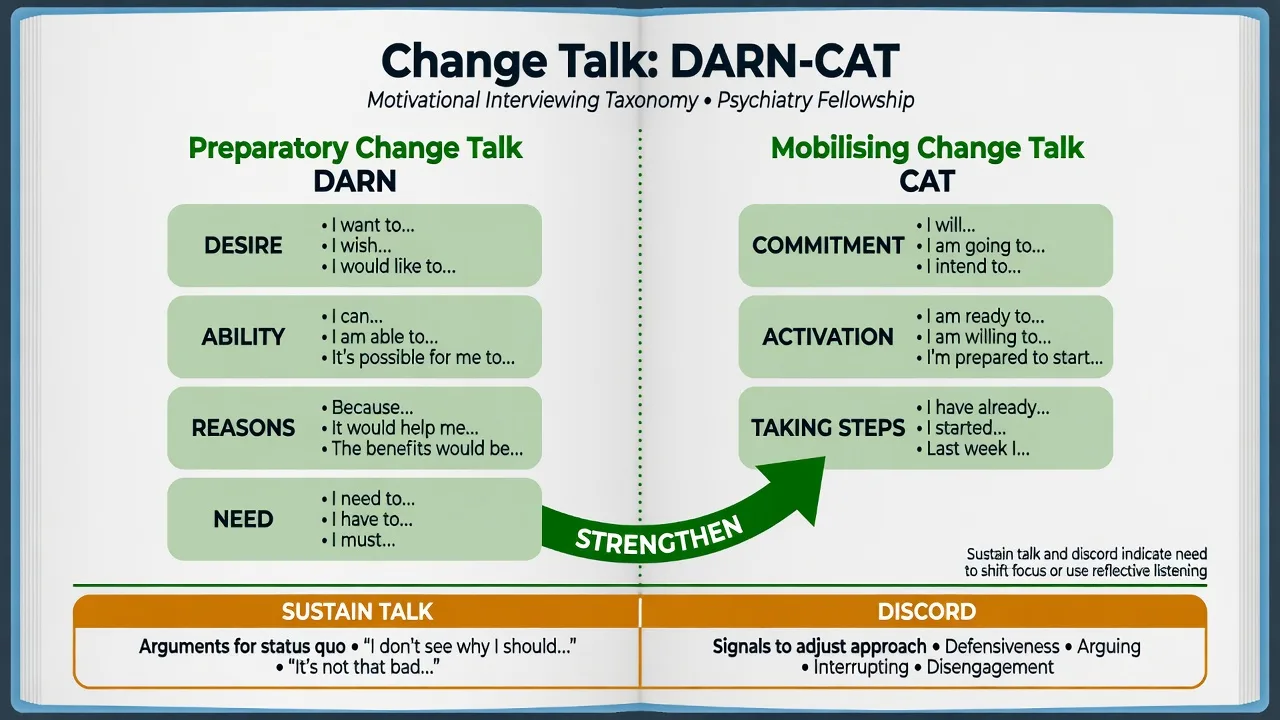
| Type | Elements | Examples |
|---|---|---|
| Preparatory (DARN) | Desire, Ability, Reasons, Need | "I want to cut down"; "I could try weekends dry"; "Because of my LFTs"; "I need to for my licence" |
| Mobilising (CAT) | Commitment, Activation, Taking steps | "I will stop after two"; "I'm ready to book AOD"; "I already poured the vodka out" |
Amrhein and colleagues showed that the strength of commitment language during MI predicted drug-use outcomes — a foundational finding for the technical hypothesis.[6] Magill and colleagues meta-analytically supported paths from MI-consistent clinician behaviour to change talk and outcomes (technical model), alongside relational ingredients (empathy/alliance).[7][8] Clinicians can deliberately "chase" and evoke change talk rather than hoping it appears.[9]
Righting reflex
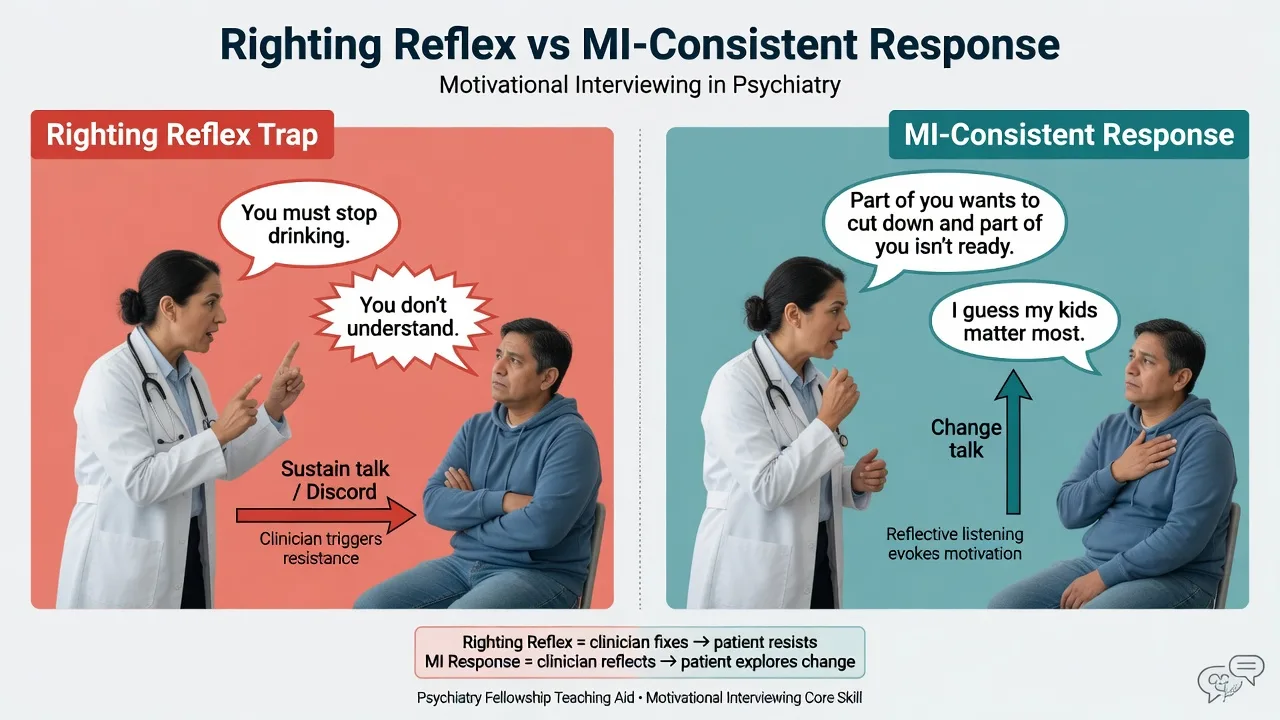
When sustain talk or discord rises: reflect, emphasise autonomy, reframe, and return to the patient's values — do not escalate advice volume.[1][2][10]
[1] [2] [10]Stages of change versus MI
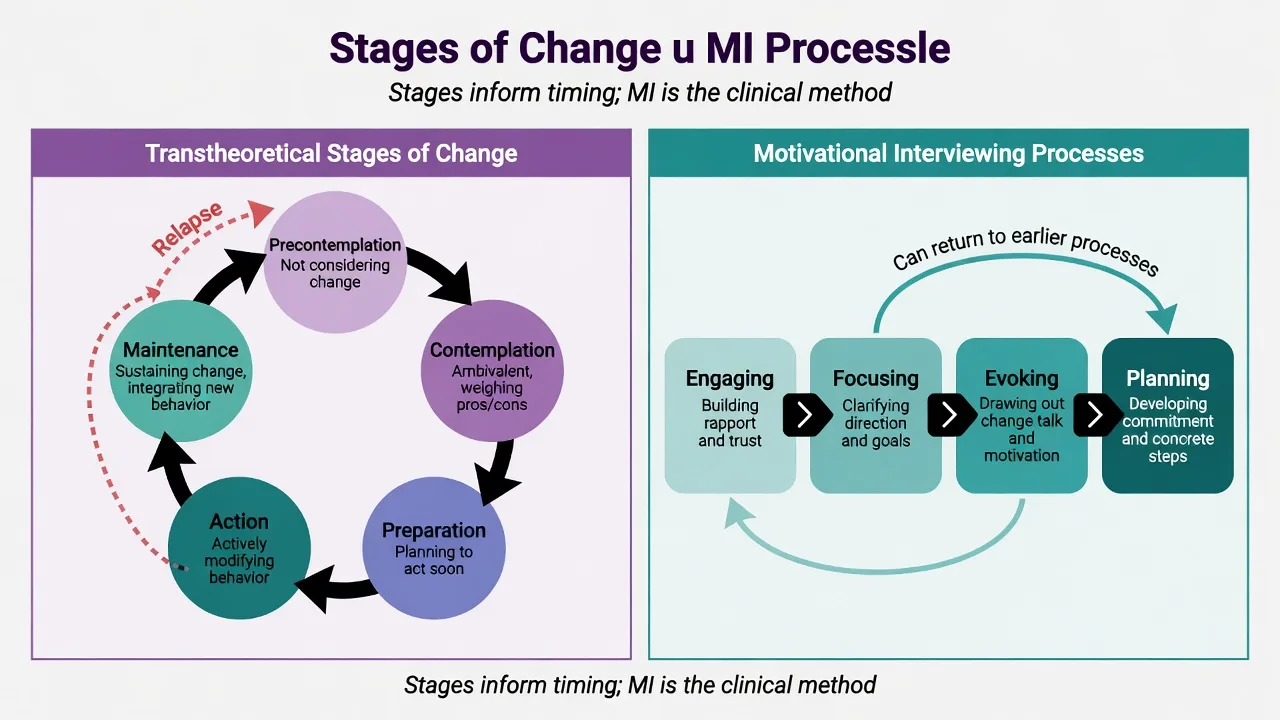
The transtheoretical model describes stages (precontemplation → contemplation → preparation → action → maintenance, with possible relapse loops).[19] MI is not the same construct: stages help you choose focus (build importance vs build confidence vs plan), while MI supplies the conversational method.[2][19] Stage-matched psychotherapy outcomes literature supports readiness as clinically relevant without equating stage assessment with MI skill.[19]
Practical ruler use: Low importance → explore values, concerns, and discrepancy with goals. Low confidence → past successes, menu of options, barrier problem-solving. Both high → move toward planning and specific next steps.[1][4]
Differential: related but non-identical approaches
- Ambivalence focus
- Evokes patient reasons
- Spirit + OARS
- Across settings
- Brief structured
- Personalised feedback
- Often 1–4 sessions
- MATCH/UKATT arm
- Directive information
- Often FRAMES elements
- Less evocation
- Screening pathways
- Skills and thoughts
- Best once committed
- Homework focus
- Complements MI
Motivational enhancement therapy (MET) is a manualised, usually brief package that blends MI style with structured assessment feedback (for example AUDIT scores, liver tests, drinking norms). Project MATCH used MET as a four-session condition.[11][12]
Assessment in practice
Structure a bedside MI-informed assessment:[1][9]
- Specific target — what behaviour, in what context, by when?
- Readiness — importance and confidence rulers; stage language.
- Change vs sustain talk inventory in the interview sample.
- Capacity and cognition — MI requires enough verbal and decision-specific capacity; stabilise intoxication, delirium, or acute mania first.
- Parallel risk assessment — suicide, violence, child protection, driving, and medical emergencies are never "deferred" for pure MI purity.
- Objective feedback data for MET-style work (AUDIT/AUDIT-C, breath alcohol, UDS, BMI, HbA1c, clozapine level, LFTs) delivered via Elicit–Provide–Elicit.
Fidelity in research and supervision is often coded with instruments such as MITI (Motivational Interviewing Treatment Integrity); fellowship candidates should know that fidelity matters even if they never code a tape in clinic.[1][9][10]
Acute limits — when not to "just do MI"
[1] [14] [16]MI also does not replace opioid agonist therapy, nicotine replacement/varenicline/bupropion pathways, or other indicated pharmacotherapies; it may improve engagement with them.[14][16]
Definitive technique and session structure
Core sequence (exam-ready)
- Engage and ask permission to discuss the target.
- Agenda map if multiple issues compete.
- Explore typical day / good things and less-good things about the behaviour (without early decisional balance if already committed).
- Evoking: open questions for DARN; selective reflection of change talk; summaries that amplify change talk.
- Importance/confidence rulers with follow-up ("Why a 6 not a 3?").
- Develop discrepancy with values (family, work, recovery goals) without shaming.
- When mobilising language appears, move to planning: menu of options, SMART next step, if–then coping, follow-up.
Responding to change talk (EARS)
Elaborate, Affirm, Reflect, Summarise — strengthen the change side of ambivalence rather than immediately giving a treatment brochure dump.[1][9]
Training
Meta-analytic and training literature show that durable MI skill needs practice with feedback/coaching, not workshop attendance alone.[4][17]
Clinical scenarios (subtypes)
| Scenario | MI focus | Pair with |
|---|---|---|
| Hazardous drinking / AUD | Cut-down or abstinence goal choice; MET feedback | Pharmacotherapy, withdrawal plan, UKATT/MATCH-informed psychosocial care |
| Dual diagnosis | Engagement, shared goals, medication adherence | Integrated psychiatric + AOD care |
| Smoking | Importance/confidence; prior quit attempts | NRT/varenicline etc. as indicated |
| Depot / clozapine ambivalence | Autonomy + illness values; side-effect trade-offs | Psychoeducation, shared decision, capacity assessment |
| Antipsychotic weight gain | Lifestyle change readiness | Metabolic monitoring, dietetics, medication review |
| Mandated/forensic | Autonomy within legal limits; avoid fake choice | Risk management, legal clarity |
Cultural adaptations of MI can improve fit and engagement; a systematic review supports attention to cultural adaptation rather than one-size scripts.[20]
Evidence and guidelines (exam depth)
Landmark substance-use trials
- Project MATCH: large US multi-site trial comparing MET, CBT, and twelve-step facilitation; overall, matching hypotheses were largely not supported, and MET produced outcomes broadly comparable to longer therapies for many drinking endpoints, with three-year follow-up data published.[11][12]
- UKATT: UK randomised trial found social behaviour and network therapy and MET both effective for alcohol problems in NHS settings.[13]
- COMBINE: combined pharmacotherapies (including naltrexone) and behavioural intervention (CBI with motivational elements) for alcohol dependence — supports integrated medication and behavioural packages rather than pure talking-therapy exceptionalism.[14]
Meta-analyses and Cochrane
- Burke et al. (2003) and Hettema et al. (2005) established efficacy signals across domains with moderate effects and variability.[3][4]
- Rubak et al. (2005) supported MI in broad clinical contexts.[5]
- Lundahl et al. (2013) meta-analysed MI in medical care settings.[17]
- Frost et al. (2018) overview of reviews for adult behaviour change in health and social care found promise with methodological caveats.[18]
- Cochrane reviews of MI for substance use (Smedslund 2011; updated Schwenker 2023) support cautious claims: benefits vs no intervention are clearer short-term; advantages over other active treatments are smaller or uncertain — perfect for balanced viva answers.[15][16]
Process evidence
Technical and process meta-analyses link MI-consistent clinician behaviours and change talk to outcomes, while highlighting relational pathways — use this when asked "how does MI work?" rather than inventing neural myths.[7][8][10]
Regional practice framing
NICE-style alcohol guidance and RANZCP/APA substance-use pathways typically place motivational and brief interventions within stepped care alongside withdrawal management, relapse-prevention psychology, and pharmacotherapy. State principles in exams; do not invent clause numbers.[13][14][16]
Special populations
- Youth: maximise autonomy support; negotiate carer involvement transparently.
- Older adults: screen cognition; simplify targets; address polypharmacy and alcohol–fall risk.
- Pregnancy: non-stigmatising MI for alcohol/drug use with clear fetal-risk information via Elicit–Provide–Elicit.
- Psychosis: adapted MI for engagement and adherence when thought form allows; not a substitute for antipsychotic treatment of acute psychosis.
- Intellectual disability: plain language, longer sessions, carer collaboration.
- Cultural diversity: adapt examples, metaphors, and family involvement; use professional interpreters; avoid assuming Western individualist framing of "autonomy".[20]
Complications and pitfalls
| Pitfall | Correction |
|---|---|
| Righting reflex | Reflect ambivalence; emphasise autonomy |
| Premature planning | Return to engaging/evoking |
| Decisional balance when already committed | Strengthen commitment; plan |
| Vague target ("be healthier") | Specify behaviour |
| Collusion mistaken for empathy | Accurate empathy + clear concern |
| Workshop-only "certification" | Practice, supervision, feedback |
| MI instead of OAT/NRT/etc. | Integrate with indicated treatments |
| Ignoring risk | Parallel safety assessment |
Prognosis and disposition
Expect modest average effects, larger for some targets and better-trained clinicians, and attenuation over time without ongoing support.[3][16][18] Disposition: brief MI/MET in primary care or outpatient psychiatry; step up to structured SUD treatment, CBT, contingency management, family/network approaches, or intensive community packages when severity, risk, or non-response demand it.[13][14]
Exam pearls
High-yield examiner lines
- Define MI in one sentence including ambivalence and patient's own motivation.
- Name PACE spirit and OARS.
- Contrast change talk vs sustain talk; list DARN-CAT.
- Explain righting reflex with a micro-example.
- Separate stages of change from MI method.
- Quote MATCH (MET comparable), UKATT, COMBINE, and Cochrane caution.
- State MI is adjunctive for opioid dependence when OAT indicated.
- CASC: permission → open question → complex reflection → summary of change talk → ruler → one negotiated next step.
References
- [1]Miller WR, Rose GS Toward a theory of motivational interviewing Am Psychol, 2009.PMID 19739882
- [2]Miller WR, Rollnick S Ten things that motivational interviewing is not Behav Cogn Psychother, 2009.PMID 19364414
- [3]Burke BL, Arkowitz H, Menchola M The efficacy of motivational interviewing: a meta-analysis of controlled clinical trials J Consult Clin Psychol, 2003.PMID 14516234
- [4]Hettema J, Steele J, Miller WR Motivational interviewing Annu Rev Clin Psychol, 2005.PMID 17716083
- [5]Rubak S, Sandbaek A, Lauritzen T, Christensen B Motivational interviewing: a systematic review and meta-analysis Br J Gen Pract, 2005.PMID 15826439
- [6]Amrhein PC, Miller WR, Yahne CE, Palmer M, Fulcher L Client commitment language during motivational interviewing predicts drug use outcomes J Consult Clin Psychol, 2003.PMID 14516235
- [7]Magill M, Gaume J, Apodaca TR, et al. The technical hypothesis of motivational interviewing: a meta-analysis of MI's key causal model J Consult Clin Psychol, 2014.PMID 24841862
- [8]Magill M, Apodaca TR, Borsari B, et al. A meta-analysis of motivational interviewing process: Technical, relational, and conditional process models of change J Consult Clin Psychol, 2018.PMID 29265832
- [9]Glynn LH, Moyers TB Chasing change talk: the clinician's role in evoking client language about change J Subst Abuse Treat, 2010.PMID 20418049
- [10]Apodaca TR, Longabaugh R Mechanisms of change in motivational interviewing: a review and preliminary evaluation of the evidence Addiction, 2009.PMID 19413785
- [11]Project MATCH Research Group Matching Alcoholism Treatments to Client Heterogeneity: Project MATCH posttreatment drinking outcomes J Stud Alcohol, 1997.PMID 8979210
- [12]Project MATCH Research Group Matching alcoholism treatments to client heterogeneity: Project MATCH three-year drinking outcomes Alcohol Clin Exp Res, 1998.PMID 9756046
- [13]UKATT Research Team Effectiveness of treatment for alcohol problems: findings of the randomised UK alcohol treatment trial (UKATT) BMJ, 2005.PMID 16150764
- [14]Anton RF, O'Malley SS, Ciraulo DA, et al. Combined pharmacotherapies and behavioral interventions for alcohol dependence: the COMBINE study: a randomized controlled trial JAMA, 2006.PMID 16670409
- [15]Smedslund G, Berg RC, Hammerstrøm KT, et al. Motivational interviewing for substance abuse Cochrane Database Syst Rev, 2011.PMID 21563163
- [16]Schwenker R, Dietrich CE, Hirpa S, et al. Motivational interviewing for substance use reduction Cochrane Database Syst Rev, 2023.PMID 38084817
- [17]Lundahl B, Moleni T, Burke BL, et al. Motivational interviewing in medical care settings: a systematic review and meta-analysis of randomized controlled trials Patient Educ Couns, 2013.PMID 24001658
- [18]Frost H, Campbell P, Maxwell M, et al. Effectiveness of Motivational Interviewing on adult behaviour change in health and social care settings: A systematic review of reviews PLoS One, 2018.PMID 30335780
- [19]Prochaska JO, DiClemente CC, Norcross JC In search of how people change. Applications to addictive behaviors Am Psychol, 1992.PMID 1329589
- [20]Self KJ, Borsari B, Ladd BO, et al. Cultural adaptations of motivational interviewing: A systematic review Psychol Serv, 2023.PMID 35130010