Psych · Professional — psychological therapies
Psychodynamic and supportive psychotherapy
Also known as Psychodynamic psychotherapy · Psychoanalytic psychotherapy · Supportive psychotherapy · Brief supportive psychotherapy · Supportive-expressive therapy · Expressive-supportive continuum · Transference-focused psychotherapy · Mentalization-based treatment · Panic-focused psychodynamic psychotherapy
Exam-exhaustive fellowship reference on psychodynamic and supportive psychotherapy — principles, expressive–supportive continuum, transference and countertransference, techniques, indications, landmark evidence (Shedler, LTPP, STPP, TFP, MBT, PFPP, Winston/Pinsker/Markowitz), boundaries, and CASC/viva application. FRANZCP-primary, globally tagged.
On this page & tools
Your progress
Saved locally on this device.
Target exams
Red flags
Overview and definition
Psychotherapy competence is examined across FRANZCP, MRCPsych, ABPN, and MD/DNB pathways because most psychiatric care is relational as well as pharmacological. Two modalities every registrar must own are psychodynamic (insight-oriented, pattern-focused) and supportive (ego-strengthening, function-focused). They are not enemies; they are poles of technique.[1][14][20]
Psychodynamic psychotherapy descends from psychoanalysis but is usually less frequent (often once or twice weekly), more focused, and more interactive than classical analysis. Core assumptions: much mental life is outside awareness; early relationships shape current expectations; defences manage anxiety and conflict; the therapy relationship reactivates old patterns that can be observed and reworked.[1][12]
Supportive psychotherapy aims to strengthen adaptive defences and functioning, reduce regression, improve reality testing and self-esteem, and help the patient manage current stressors. It uses empathy, praise, advice, psychoeducation, limit-setting, and environmental intervention as legitimate techniques — not as accidental soft skills.[14][15][17]
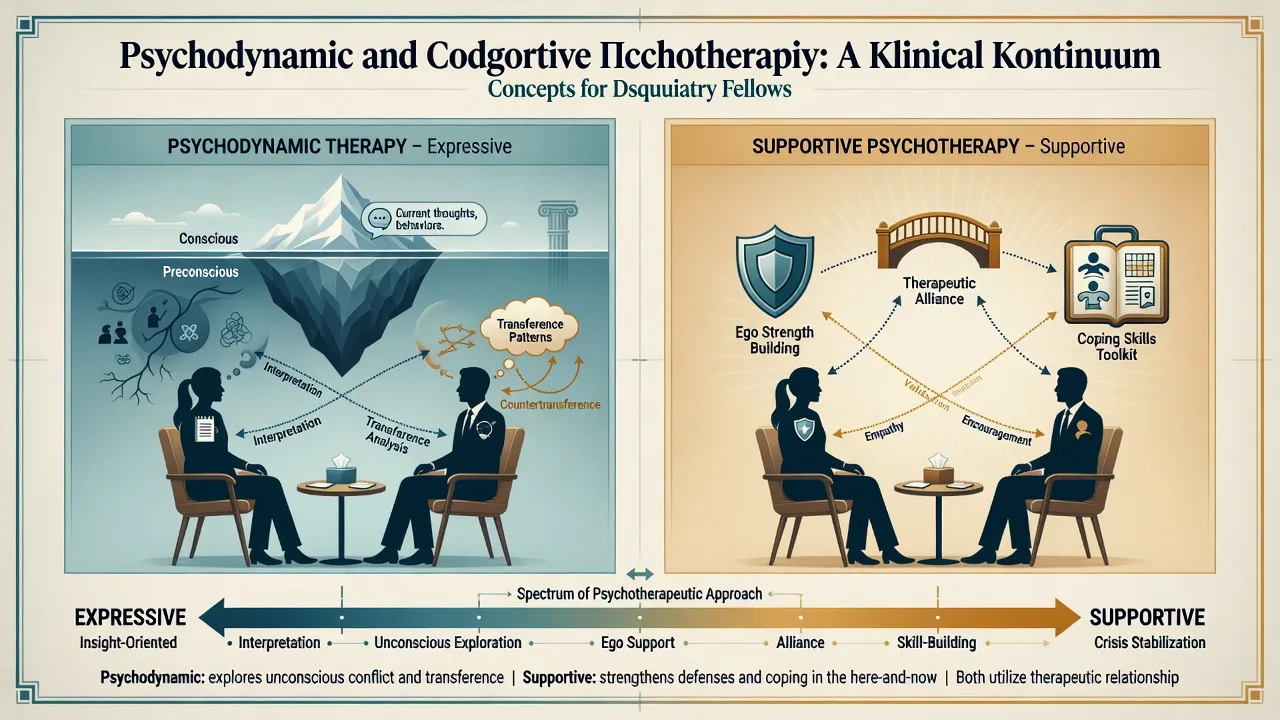
Classification — continuum, not a binary
Expressive–supportive continuum
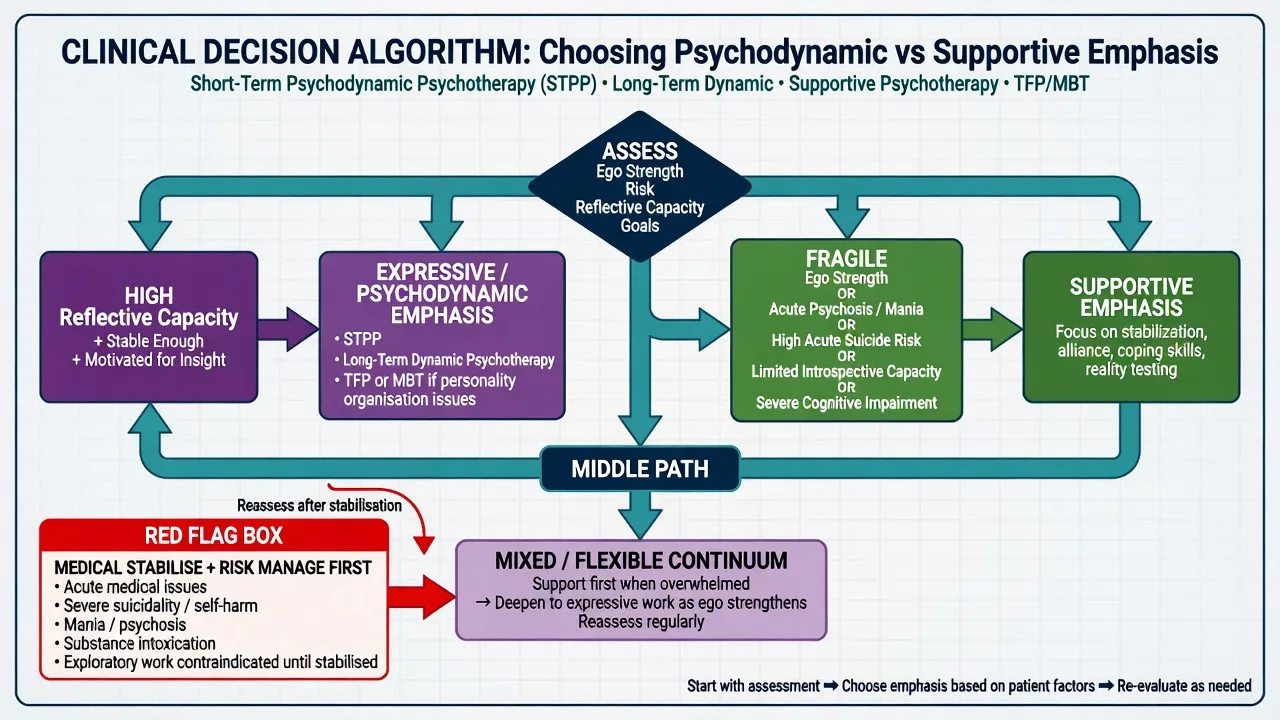
Interventions range from exploratory (clarification, confrontation of inconsistencies, interpretation of defence and transference) to supportive (validation, advice, praise, reality testing, environmental help). The same patient may need more support after a crisis and more exploration when stabilised. Manualised modern forms occupy different points: brief supportive psychotherapy (BSP), supportive-expressive (SE), short-term psychodynamic psychotherapy (STPP), long-term psychodynamic psychotherapy (LTPP), transference-focused psychotherapy (TFP), mentalization-based treatment (MBT), and panic-focused psychodynamic psychotherapy (PFPP).[1][14][17]
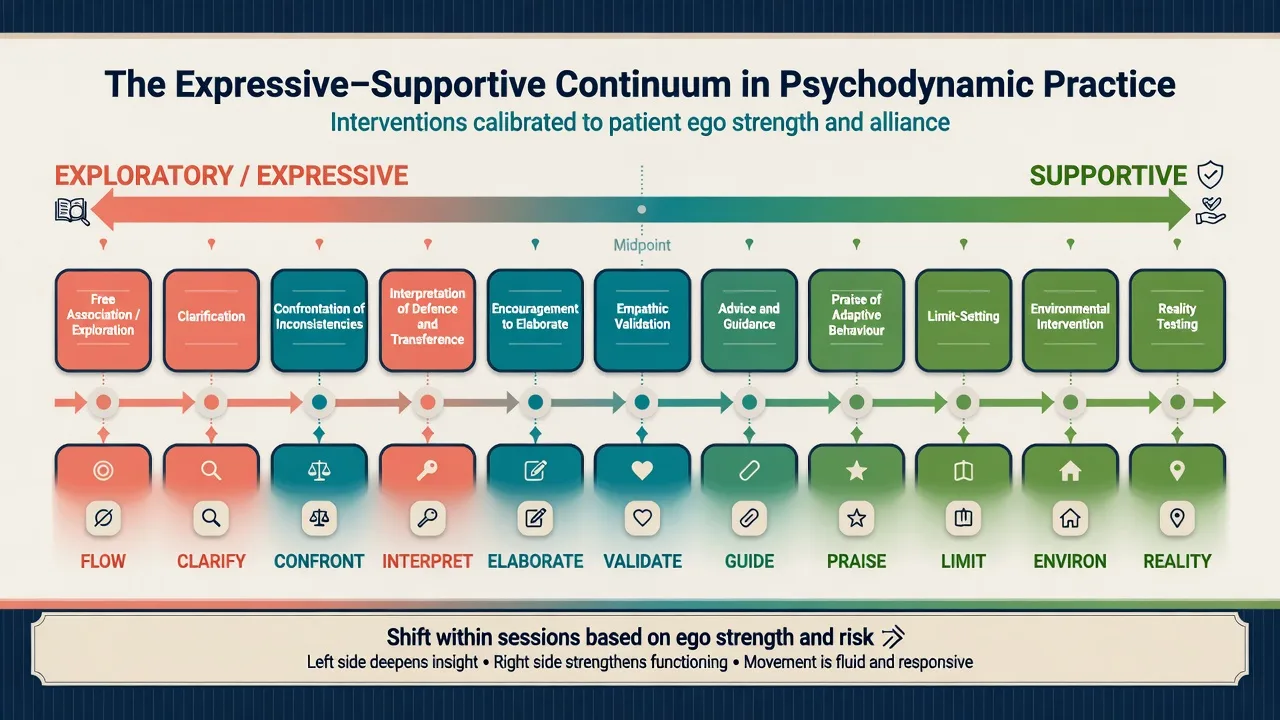
Psychoanalysis vs psychodynamic vs supportive
| Feature | Classical psychoanalysis | Psychodynamic psychotherapy | Supportive psychotherapy |
|---|---|---|---|
| Frequency | High (often 3–5×/week) | Usually 1–2×/week | Flexible; may be brief contacts |
| Stance | More neutral; free association | Active, focused | Actively supportive |
| Primary aim | Structural change via analysis of transference neurosis | Insight + pattern change in focal conflicts | Ego strength, coping, function |
| Transference use | Central technique | Selective, timed | Not systematically interpreted |
| Typical duration | Years | Months to years | Brief or long maintenance |
- Interpretation of defence and conflict
- Transference as data and technique
- Tolerance of affect and silence
- Focus on repeating interpersonal patterns
- Needs adequate ego strength
- Strengthen adaptive defences
- Advice, praise, problem-solving
- Reality testing and structure
- Containment over uncovering
- Often first-line when fragile
- Shift within a session
- Support first if overwhelmed
- Deepen when stable
- Review goals regularly
- Supervise complex work
Epidemiology and training context
Psychodynamic treatments are among the most studied psychotherapies; Shedler's synthesis argued effect sizes are comparable to other evidence-based psychotherapies and may show ongoing gains after termination for some patients.[1] In routine psychiatric practice and residency medication clinics, supportive techniques are the dominant psychotherapy skill set and deserve explicit training rather than being treated as residual "support".[17][20]
Under-provision of structured psychotherapy, long waits, and medication-only pathways are system realities. Examiners still expect the candidate to choose modality wisely and explain it, even when access is imperfect.[5][20]
Risk is elevated when intense transference is managed without supervision or frame (boundary erosion), or when exploratory work is forced onto patients with acute psychosis, mania, delirium, or overwhelming suicidality.[12][18]
Mechanisms and theoretical core
Psychodynamic mechanisms of change
- Making unconscious patterns more available to reflection (not mere intellectual insight).
- Defence modification — rigid or primitive defences become more flexible.
- Object-relations restructuring — internalised relationship templates become less extreme.
- Attachment and mentalization — increased reflective function (RF) and more secure attachment representations (shown in TFP research).[8]
- Working through — repeating and reprocessing conflict in new relational conditions.
Common factors (alliance, empathy, expectations, therapist skill) operate across modalities; dynamic therapies add specific attention to relationship process and developmental patterning.[1][13]
Supportive mechanisms
Supportive therapy reduces demoralisation, bolsters self-esteem, models problem-solving, strengthens reality testing, encourages adaptive defences (e.g. sublimation, humour, anticipation rather than splitting or projective identification), and mobilises external supports.[14][15] Brief supportive psychotherapy has been refined as both an active comparator and a clinical intervention with a coherent technique manual.[17]
Clinical presentation of process phenomena
Transference
Transference is the displacement of feelings, wishes, and expectations from important past figures onto the therapist (or other current figures). Classic forms: idealising, devaluing, erotic, dependent, hostile/paranoid, maternal/paternal. Transference is ubiquitous; interpreting it is a technical choice, not an automatic requirement every session.[12][13]
Countertransference
Countertransference (CT) is the therapist's total emotional response to the patient. Contemporary models treat CT as both data (about the patient's interpersonal world and induced roles) and risk (if acted out). Gabbard's contemporary model emphasises that CT is inevitable and useful when recognised, contained, and supervised — not purged as a failure of neutrality.[12][13]
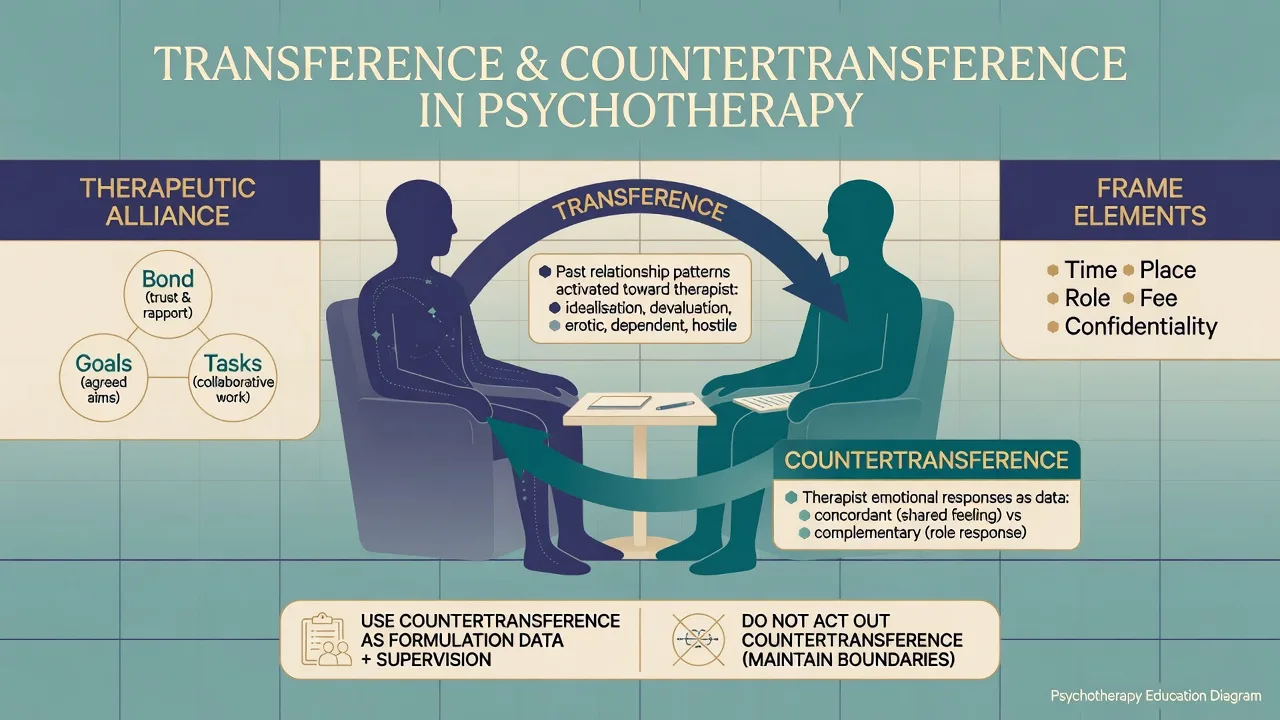
Alliance and frame
Alliance = bond + agreed goals + agreed tasks. Frame = role, time, place, fee/leave, confidentiality limits, contact rules. Boundary theory (Gutheil and Gabbard) distinguishes discussable crossings from exploitative violations; sexual contact with current patients is never a mere crossing.[18]
Differential — modality selection
Do not confuse supportive skill with collusion, or dynamic work with unfocused storytelling.[14][15]
- Supportive therapy with unstructured chatting or pure case management (supportive therapy has technique, goals, and review).
- Psychodynamic work with endless undirected storytelling without formulation or focus.
- Interpretation with intellectualised jargon that increases shame without change.
- Support with collusion that avoids necessary limit-setting on risk or destructive behaviour.[14][15]
Vs other therapies: CBT targets cognitions and behaviours with structured homework; IPT targets interpersonal problem areas; DBT targets emotion dysregulation with skills and team consultation; MI targets ambivalence about change. Dynamic and supportive approaches can integrate elements but keep a coherent frame.[1]
Assessment for therapy suitability
Suitability and assessability
Assess: psychological mindedness; frustration tolerance; impulse control; capacity for alliance; motivation and goals; external supports; substance use; organic contributors; suicide/violence risk; cognitive capacity; cultural explanatory model; prior therapy experience (including boundary trauma).[14][18]
Dynamic formulation (brief): core conflictual relationship pattern (wish–response of other–response of self), dominant defences, attachment style, object-relations level (neurotic vs borderline personality organisation for TFP selection).[6][8]
Contracting
Agree frequency, likely duration or review points, goals, cancellation policy, after-hours rules, how risk will be managed, and when medication will be co-managed. Informed consent includes that therapy can stir strong feelings and that boundaries protect the work.[18]
Investigations and monitoring
Therapy is clinical reasoning, not a laboratory test — but medical work-up revises the plan when delirium, thyroid disease, substance intoxication/withdrawal, or autoimmune encephalitis is possible. Serial symptom scales and functional goals track outcome; alliance rupture–repair is process monitoring. Complex personality work requires supervision, not isolation.[6][13]
Acute priorities (when not to explore)
If risk escalates mid-therapy: reassess suicide/violence risk, temporarily increase support, involve crisis services as needed, hold or simplify the focus, document, and supervise. Do not abandon the patient because the work became intense.[13][18]
Definitive techniques
Expressive (psychodynamic) techniques
- Clarification — organise the patient's material without adding new meaning.
- Confrontation (technical sense) — gently point out contradictions, omissions, or patterns the patient overlooks.
- Interpretation — link present affect/behaviour to defence, unconscious conflict, or transference meaning, timed to readiness.
- Working through — repeated reprocessing of the same conflict in new contexts.
- Transference interpretation — selective; not every feeling about the therapist needs a deep interpretation on first appearance.[1][12]
Supportive techniques
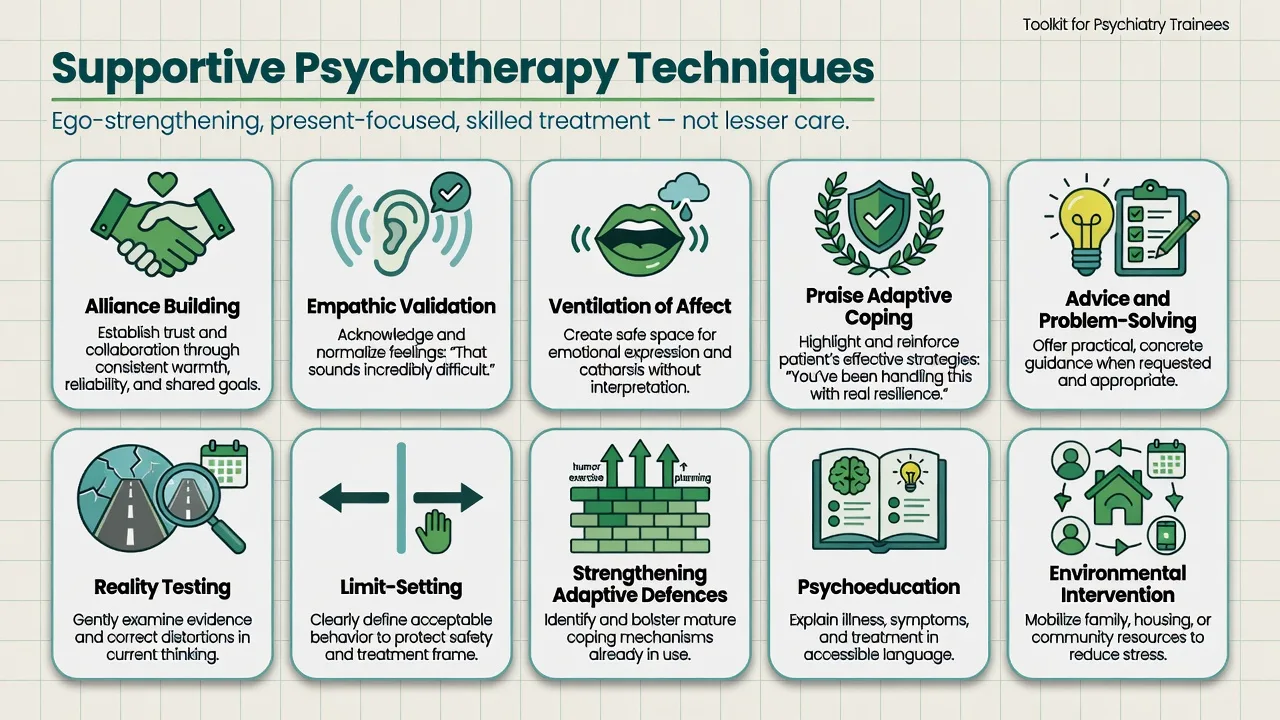
Core supportive interventions: alliance building; empathic validation; affect ventilation within tolerance; praise of adaptive coping; advice and collaborative problem-solving; psychoeducation; reality testing; strengthening adaptive defences; limit-setting without humiliation; environmental intervention (mobilising family, benefits, housing supports via appropriate pathways).[14][15][17]
Interpersonal change can occur even in brief supportive work when alliance and adaptive interpersonal behaviour are actively fostered.[16][19] Comparative work has shown that supportive and dynamic therapies can both help; alliance quality matters across models.[16]
Combined treatment and the "medication visit"
Supportive psychotherapy skills are central in combined pharmacotherapy visits. Dotson and Markowitz argue residency training should prioritise supportive technique rather than treating it as secondary to pure exploratory models.[17][20]
Indications and clinical scenarios
| Clinical scenario | Typical emphasis | Notes |
|---|---|---|
| MDD with adequate ego, motivation for insight | STPP / dynamic | Strong STPP depression evidence base; may combine with antidepressant.[4][5] |
| Complex/chronic multi-morbidity | LTPP or long supportive | LTPP meta-analyses in complex disorders.[2][3] |
| Borderline personality organisation | TFP, MBT (or DBT) | Manualised specialist treatments; not unsupervised "support only" forever.[6][7][9] |
| Panic disorder | PFPP or CBT | PFPP RCT evidence vs applied relaxation comparison design.[11] |
| Acute psychosis / severe mania | Supportive + meds | Contain, reality test, reduce stimulation; delay deep interpretation.[14] |
| CL / medical illness / limited energy | Supportive | Ego support, problem-solving, liaison with medical teams.[15] |
| Adolescent social anxiety | Dynamic or CBT | Multicentre adolescent SAD RCT of CBT and psychodynamic therapy.[21] |
| Cognitive impairment / ID | Supportive, concrete | Simplify language; involve carers; modified mentalization elements if useful.[14] |
Personality pathology packages examiners expect by name
- TFP (Clarkin/Kernberg tradition): structured object-relations treatment targeting identity diffusion and primitive defences via systematic transference work; Clarkin multiwave study compared TFP, DBT, and dynamic supportive; Doering RCT vs community psychotherapy; Levy showed attachment and RF change favouring TFP.[6][7][8]
- MBT (Bateman and Fonagy): enhances mentalizing capacity; partial-hospitalisation RCT and 8-year follow-up showing durable gains vs TAU.[9][10]
Complications and pitfalls
- Boundary slippery slope: specialness, extended sessions, personal texts, dual relationships, secrecy — correct early; sexual misconduct is a violation.[18]
- Acting out CT: rescue, retaliation, flirtation, over-disclosure serving therapist needs.[12][13]
- Over-interpretation of reality-based complaints (housing, racism, medical illness).
- Supportive collusion: never challenging avoidance or risk-taking.
- Ignoring biology: missing organic disease, substance use, or needed medication.
- Interminable therapy without review of goals or indication.
- Isolated complex work without supervision or team.
Prognosis and disposition
Shedler synthesised evidence that psychodynamic psychotherapy produces meaningful, often lasting benefits; some datasets show continued improvement after therapy ends.[1] LTPP meta-analyses (Leichsenring and Rabung) support benefit in complex mental disorders, with an updated meta-analysis reinforcing that conclusion.[2][3] Individual-participant-data meta-analysis supports STPP for depression with attention to moderators.[4] MBT shows long-term follow-up benefit; TFP shows structural change markers (attachment, RF).[8][10]
Disposition: continue outpatient contract; step up to specialist manualised treatment or day programmes for severe personality pathology; admit for acute risk; step down when goals met with a planned termination that addresses grief, gains, and relapse prevention. Post-termination sexual/romantic contact remains ethically high-risk; frame does not end casually.[18]
Special populations
- Youth: developmental frame; family involvement; evidence that psychodynamic and CBT can both help adolescent social anxiety in trial conditions.[21]
- Older adults: supportive often preferred when cognitive load or frailty limits exploratory work; still individualise.
- Perinatal: do not abandon therapy; supportive and focused dynamic work can coexist with perinatal risk management (see perinatal topics for meds).
- Cultural care: cultural formulation first; dynamic metaphors (Oedipus, "insight") are Western-loaded — co-construct meaning; avoid pathologising cultural norms as resistance.
- Indigenous mental health: relationship, community, and historical trauma context may outweigh individualist insight models; adapt respectfully (see cultural formulation topic).
- Forensic dual roles: do not blend treating therapist and forensic assessor without clear consent and role separation.
Evidence and guidelines
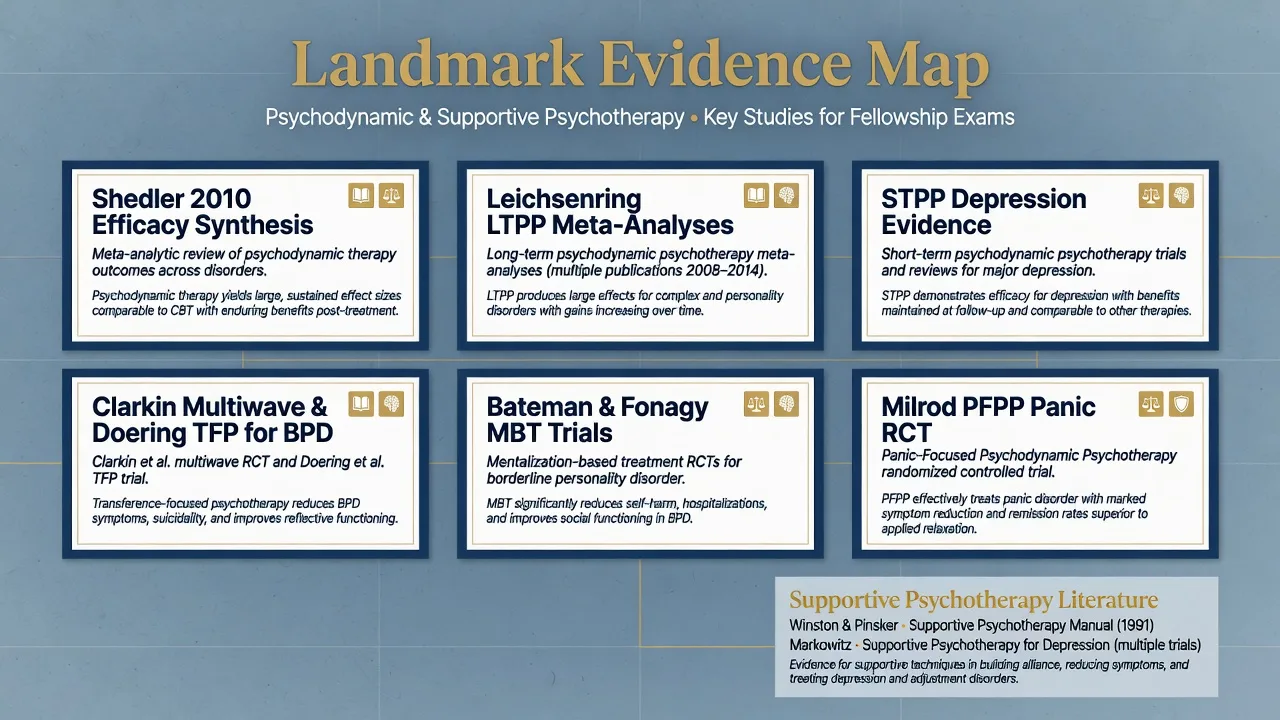
Key anchors to recite (name programmes correctly in viva):[1][2]
- Shedler 2010 — efficacy of psychodynamic psychotherapy synthesis.[1]
- Leichsenring and Rabung 2008 JAMA; 2011 BJP update — LTPP for complex disorders.[2][3]
- Wienicke 2023 IPD meta-analysis; Town/Abbass/Driessen 2017 — STPP for adult MDD evidence and recommendations.[4][5]
- Clarkin 2007 multiwave; Doering 2010 TFP RCT; Levy 2006 — TFP and structural change.[6][7][8]
- Bateman and Fonagy 1999 and 2008 — MBT efficacy and long-term follow-up.[9][10]
- Milrod 2007 — PFPP for panic disorder RCT.[11]
- Winston/Pinsker/Hellerstein/Markowitz/Rosenthal — supportive therapy definition, choice, outcomes, residency priority.[14][15][16][17][19][20]
- Gabbard CT; Gutheil–Gabbard boundaries — process safety literature.[12][13][18]
Regional deltas above align with training expectations and stepped-care principles rather than invented statute or guideline section numbers.[1][6][18]
Exam pearls
SUPPORT for supportive therapy
FRAME for psychodynamic safety
Classic viva traps
- Calling supportive therapy "just listening" without technique names.
- Interpreting during acute psychosis.
- Claiming psychodynamic therapy has no evidence (Shedler; LTPP; STPP; TFP; MBT; PFPP refute this).
- Acting on erotic CT as "human connection" rather than clinical material requiring frame and supervision.[1][13][18]
CASC one-liners for patients
"There are two related approaches. One focuses more on understanding repeating patterns in relationships and feelings that sit outside full awareness. The other focuses more on strengthening how you cope day to day, solving current problems, and building on what already works. We often blend them depending on what you need and how stable things feel. The relationship with me is part of the work, and clear boundaries keep that safe."[1][14][18]
References
- [1]Shedler J The efficacy of psychodynamic psychotherapy Am Psychol, 2010.PMID 20141265
- [2]Leichsenring F, Rabung S Effectiveness of long-term psychodynamic psychotherapy: a meta-analysis JAMA, 2008.PMID 18827212
- [3]Leichsenring F, Rabung S Long-term psychodynamic psychotherapy in complex mental disorders: update of a meta-analysis Br J Psychiatry, 2011.PMID 21719877
- [4]Wienicke FJ, Beutel ME, Zwerenz R, et al. Efficacy and moderators of short-term psychodynamic psychotherapy for depression: A systematic review and meta-analysis of individual participant data Clin Psychol Rev, 2023.PMID 36958077
- [5]Town JM, Abbass A, Driessen E, et al. Updating the Evidence and Recommendations for Short-Term Psychodynamic Psychotherapy in the Treatment of Major Depressive Disorder in Adults Can J Psychiatry, 2017.PMID 28055257
- [6]Clarkin JF, Levy KN, Lenzenweger MF, et al. Evaluating three treatments for borderline personality disorder: a multiwave study Am J Psychiatry, 2007.PMID 17541052
- [7]Doering S, Hörz S, Rentrop M, et al. Transference-focused psychotherapy v. treatment by community psychotherapists for borderline personality disorder: randomised controlled trial Br J Psychiatry, 2010.PMID 20435966
- [8]Levy KN, Meehan KB, Kelly KM, et al. Change in attachment patterns and reflective function in a randomized control trial of transference-focused psychotherapy for borderline personality disorder J Consult Clin Psychol, 2006.PMID 17154733
- [9]Bateman A, Fonagy P Effectiveness of partial hospitalization in the treatment of borderline personality disorder: a randomized controlled trial Am J Psychiatry, 1999.PMID 10518167
- [10]Bateman A, Fonagy P 8-year follow-up of patients treated for borderline personality disorder: mentalization-based treatment versus treatment as usual Am J Psychiatry, 2008.PMID 18347003
- [11]Milrod B, Leon AC, Busch F, et al. A randomized controlled clinical trial of psychoanalytic psychotherapy for panic disorder Am J Psychiatry, 2007.PMID 17267789
- [12]Gabbard GO A contemporary psychoanalytic model of countertransference J Clin Psychol, 2001.PMID 11449380
- [13]Gabbard GO The role of countertransference in contemporary psychiatric treatment World Psychiatry, 2020.PMID 32394567
- [14]Winston A, Pinsker H, McCullough L A review of supportive psychotherapy Hosp Community Psychiatry, 1986.PMID 3781499
- [15]Hellerstein DJ, Pinsker H, Rosenthal RN, et al. Supportive therapy as the treatment model of choice J Psychother Pract Res, 1994.PMID 22700197
- [16]Hellerstein DJ, Rosenthal RN, Pinsker H, et al. A randomized prospective study comparing supportive and dynamic therapies. Outcome and alliance J Psychother Pract Res, 1998.PMID 9752637
- [17]Markowitz JC Supportive Evidence: Brief Supportive Psychotherapy as Active Control and Clinical Intervention Am J Psychother, 2022.PMID 35232221
- [18]Gutheil TG, Gabbard GO The concept of boundaries in clinical practice: theoretical and risk-management dimensions Am J Psychiatry, 1993.PMID 8422069
- [19]Rosenthal RN, Muran JC, Pinsker H, et al. Interpersonal change in brief supportive psychotherapy J Psychother Pract Res, 1999.PMID 9888107
- [20]Dotson S, Markowitz JC Planting the Tree Right-Side Up: Supportive Psychotherapy as a Priority in Residency Training Acad Psychiatry, 2025.PMID 40921918
- [21]Salzer S, Stefini A, Kronmüller KT, et al. Cognitive-Behavioral and Psychodynamic Therapy in Adolescents with Social Anxiety Disorder: A Multicenter Randomized Controlled Trial Psychother Psychosom, 2018.PMID 29895001