Psych · psychotherapy
Behavioural activation
Also known as Behavioral activation · BA · Activity scheduling · BATD · Behavioural activation treatment for depression · TRAP TRAC
Exam-exhaustive fellowship reference on behavioural activation for depression — functional model (Ferster, Lewinsohn), Jacobson dismantling, contemporary BA and BATD protocols, TRAP/TRAC technique, Dimidjian/Dobson RCTs, COBRA non-inferiority, meta-analyses and Cochrane, non-specialist delivery, combination with antidepressants, CASC/MEQ skills. FRANZCP-primary, globally tagged.
On this page & tools
Your progress
Saved locally on this device.
10 MCQs with explanations
Target exams
Red flags
Overview and definition
BA is not "telling the patient to exercise" and not unstructured busyness. Fellowship candidates must define it as a behavioural treatment package grounded in functional analysis of depression: reduced adjustive behaviour, loss of positive reinforcement, and high rates of avoidance that are short-term relieving but long-term depressogenic.[8][14][15]
Contemporary BA (Martell/Dimidjian lineage) and brief BATD/BATD-R (Lejuez/Hopko lineage) share the activation goal but differ in session count, values-domain structure, and how explicitly matching-law ideas are framed.[10][11][14][15]

Definition and classification (examiner dimension 1)
| Construct | Exam definition |
|---|---|
| BA (broad) | Structured psychotherapy increasing reinforcement-rich, values-consistent activity and reducing avoidance that maintains depression |
| Activity scheduling | Core technique (monitor → plan → review); alone is thinner than full BA |
| Full contemporary BA | Functional analysis, TRAP/TRAC, graded tasks, values, problem-solving, relapse prevention |
| BATD / BATD-R | Brief, manualised activation packages emphasising life areas, contracts, and graduated goals |
| CT / full CBT | Adds systematic cognitive restructuring and schema work; BA can be a component or standalone |
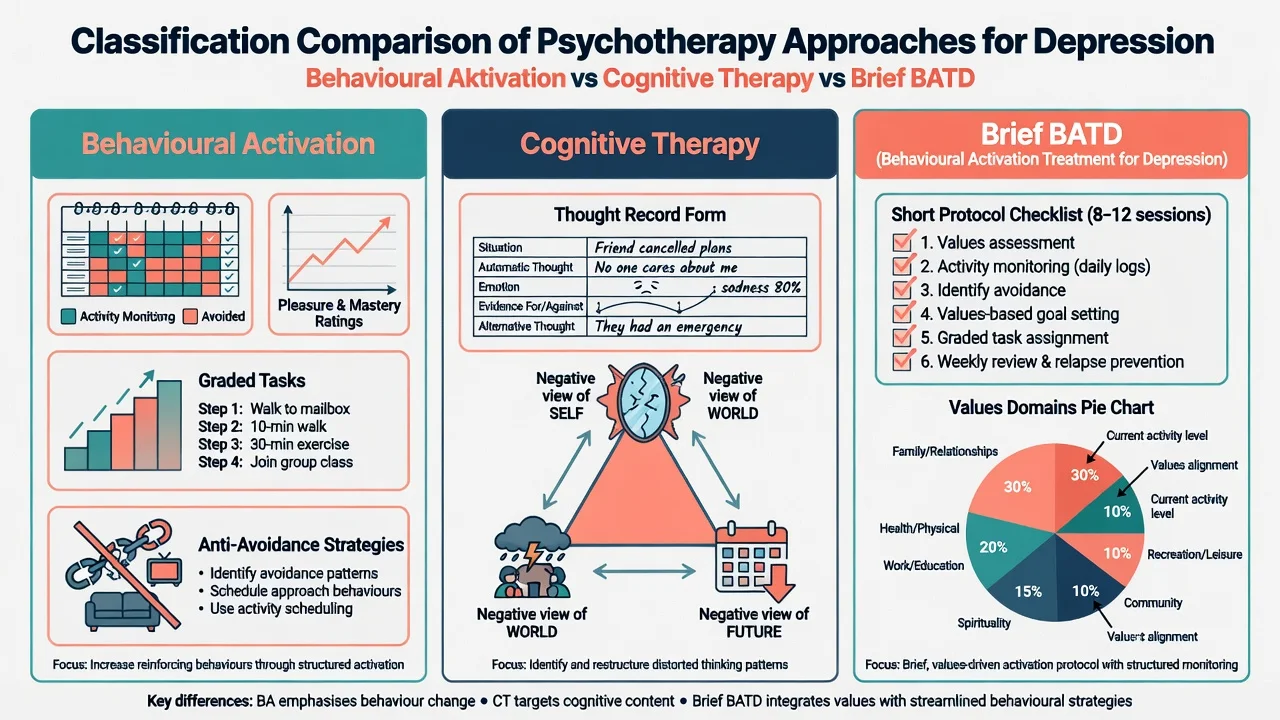
Jacobson and colleagues' component analysis showed that a behavioural activation condition performed as well as full cognitive therapy packages for depression, catalysing BA as a standalone treatment rather than a mere CBT warm-up.[3][4][14]
Epidemiology and service context (dimension 2)
Depression is common; access to high-intensity CBT is limited. BA's relative simplicity supports training of non-specialist and junior mental health workers, with phase II and large-trial support for effectiveness and cost advantages when fidelity is maintained.[5][6][13]
Risk interface during BA: starting activation can temporarily increase fatigue, anxiety, or contact with avoided affect. Safety planning and ongoing suicide risk review remain part of care — BA does not suspend duty of care.[12][14]
Mechanisms and pathophysiology (dimension 3)
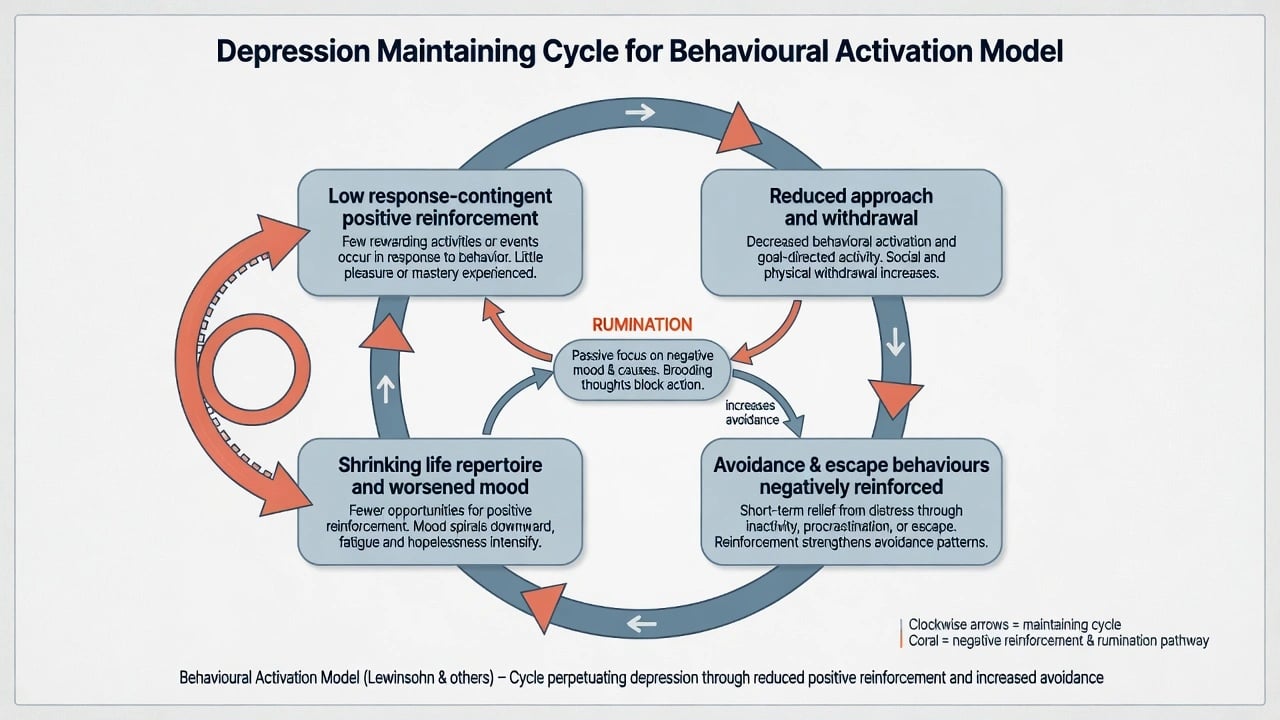
Ferster framed depression as reduced frequency of adjustive behaviour plus high rates of escape/avoidance maintained by negative reinforcement.[8] Lewinsohn-line models emphasise loss of response-contingent positive reinforcement (RCPR). Kanter and colleagues' component review synthesises monitoring, scheduling, contingency management, skills training, and targeting avoidance as the empirical BA toolkit.[14][15]
Outside-in principle: behaviour and context are changed first; mood and cognitions often shift secondarily. This is the conceptual contrast with "wait until I feel motivated" and with pure cognitive-first sequencing when retardation blocks complex thought records.[14][15]
[8] [14] [15]Clinical presentation and what good BA looks like (dimension 4)
Typical BA-relevant presentation: anhedonia, social withdrawal, collapsed routines, "I will start when I have energy," secondary guilt about inactivity, and avoidance of roles (work, parenting, exercise, hobbies). MSE may show psychomotor slowing, reduced reactivity, and poverty of future plans.[14]
Good BA documentation includes: shared formulation, activity logs with mastery/pleasure ratings, graded homework, measure trends (for example PHQ-9), and explicit anti-avoidance work — not "supportive discussion" alone.[15]
Differential diagnosis of the approach (dimension 5)
- Activation + anti-avoidance
- Functional analysis
- Values-based tasks
- Outside-in
- Adds cognitive restructuring
- Thought records/experiments
- Often includes BA component
- Longer cognitive skill set
- Role transitions/disputes
- Grief, deficits focus
- Interpersonal inventory
- Not primarily diary activation
- Alliance and coping
- Less structured homework
- Weaker depression-specific effect size literature
- Not equivalent to BA
Differentiate depressive withdrawal from apathy of neurodegenerative disease, primary negative symptoms, sedation from medication, and medical fatigue. Formulation decides whether BA goals, medical review, or both lead.[14]
Assessment (dimension 6)
- Diagnosis and bipolar screen — confirm depressive syndrome; ask for prior hypomania/mania before ramping activation.
- Risk — suicide, self-neglect, dependents, driving, substance use.
- Medical/substance contribution — when indicated (not "lab for BA candidacy").
- Activity–mood monitoring — 1–2 weeks of diary (hourly or blocks): activity, mood 0–10, mastery/pleasure.
- Values and life areas — relationships, work/education, recreation, health, meaning (especially in BATD-style work).
- Functional analysis — what is avoided, what is negatively reinforced, what short-term relief costs long-term.
- Measures — PHQ-9 or BDI-II serially; optional activation scales.
TRAP and TRAC
| Acronym | Elements | Clinical use |
|---|---|---|
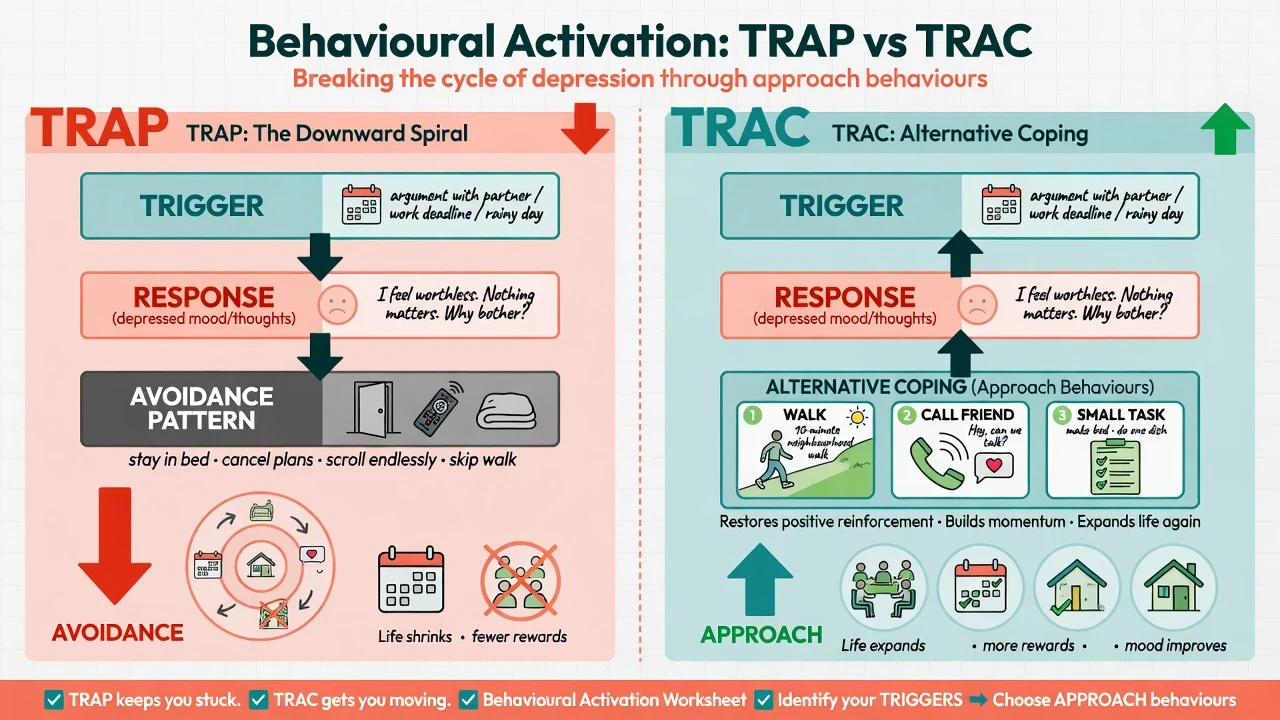
| TRAP | Trigger → Response (mood/thoughts) → Avoidance Pattern | Name the maintaining loop |
| TRAC | Trigger → Response → Alternative Coping (approach behaviour) | Plan the competing response |
Investigations (dimension 7)
There is no biomarker that selects BA. Investigate as for depression generally when organic differentials, medications, or substance use are plausible. If antidepressants are co-prescribed, apply usual baseline metabolic/ECG rules for the agent chosen — those are pharmacology safety steps, not BA prerequisites.[12][14]
Serial symptom measures and diary review are the "investigations" of the BA formulation hypothesis: if activation rises but mood never moves, revisit diagnosis, secondary gain, trauma, substance use, or medical factors.[15]
Acute and emergency limits (dimension 8)
[12] [14]Definitive management (dimension 9)
Core sequence
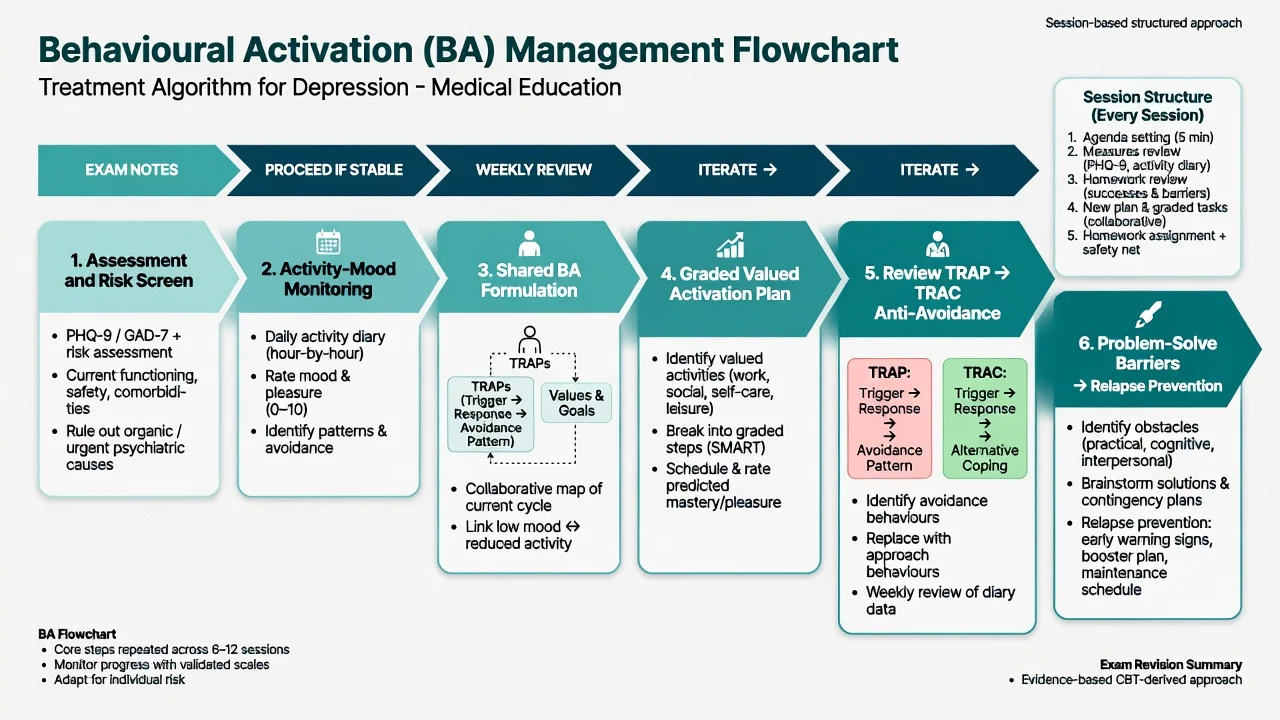
- Engage, psychoeducate (outside-in model), set collaborative goals.
- Collect activity–mood data.
- Build shared BA formulation (reinforcement loss + avoidance).
- Schedule graded, specific, scheduled activities tied to values — start small enough to succeed.
- Review homework every session; shape progress; troubleshoot barriers.
- Explicitly replace TRAP with TRAC.
- Add problem-solving for practical obstacles; social skills only if functionally indicated.
- Relapse prevention: early signs of withdrawal/avoidance, maintain routine skeleton, booster plan.
Session structure (CASC-friendly)
Bridge from last session → agenda → measure → homework review (what happened, what was learned) → new activation plan → summary and commitment.[15]
Combining with medication
For moderate–severe MDD, antidepressants and BA may be combined by preference, severity, prior response, or access limits. Dimidjian's trial positioned BA competitively with paroxetine and CT in acute treatment; combination decisions remain clinical, not ideological.[1][12] When using an SSRI (example pattern, not a universal script): start low, titrate to a therapeutic range, review response at 2–4 weeks, monitor activation/agitation early and sexual/GI effects — always with local formulary and product information, and always with a nearby clinical rationale rather than rote dosing.[1]
Stepped care
Guided self-help BA → group BA → individual BA → full CBT/CT or specialist protocols if non-response, strong cognitive maintaining factors, trauma focus needed, or complex comorbidity.[5][12][13]
ACTIVATE
Subtypes and clinical scenarios (dimension 10)
| Scenario | BA emphasis |
|---|---|
| Moderate outpatient MDD | Full course monitoring + graded activation |
| More severe depression | Small steps; may prioritise BA over complex CT early; consider meds |
| Chronic/persistent depression | Routine rebuilding; values; longer course |
| Comorbid anxiety | Balance activation with exposure principles; do not only comfort-avoid |
| Perinatal | Energy-sensitive grading; infant-care and support values |
| Late-life | Medical pacing; grief/role loss; simplify diary |
| Primary care / non-specialist | Manualised BA with supervision (Ekers; COBRA model) |
| Inpatient brief stay | Micro-routines; hand off detailed BA to community |
Complications and pitfalls (dimension 11)
| Pitfall | Correction |
|---|---|
| Supportive chat without homework | Re-install agenda and activation plans |
| Huge early goals | Grade down to guaranteed small wins |
| Pleasant-events list only | Add functional anti-avoidance and values |
| Therapist-chosen activities | Co-define culturally meaningful values |
| Ignoring mania risk | Bipolar screen; watch reduced sleep/overactivity |
| "BA failed" after 2 sessions | Check fidelity, dose, barriers, diagnosis |
Prognosis and disposition (dimension 12)
Dimidjian and colleagues found BA efficacious in acute major depression relative to CT and antidepressant medication arms in a landmark RCT; severity analyses are often examined in vivas (BA performing strongly in more severe depression in that sample).[1] Dobson and colleagues' follow-up of responders found enduring benefits of BA and CT after treatment, with advantages relative to patients withdrawn from medication — a classic relapse-prevention talking point.[2]
COBRA demonstrated clinical non-inferiority of BA versus CBT for depression, with BA deliverable by junior mental health workers after less intensive training and favourable cost outcomes.[5] Meta-analyses (Ekers, Cuijpers) support BA effectiveness versus controls and comparable performance to other active treatments in many comparisons; Cochrane (Uphoff) supports cautious positive conclusions with certainty limits typical of psychotherapy trials.[6][7][9][12]
Step up when non-response follows adequate dose and fidelity, risk escalates, or formulation demands trauma-focused, interpersonal, or more cognitive work. Step down to self-management with a written activation plan when stable.[5][12]
Special populations (dimension 13)
- Youth: caregiver scaffolding, school re-entry tasks, simplified language.
- Older adults: medical comorbidity, pacing, bereavement-sensitive values; BA remains appropriate.
- Pregnancy/lactation: prioritise accessible psychological care including BA/CBT when acceptable; co-decide medication if severe.
- Intellectual disability: concrete goals, visual schedules, carer involvement.
- Cultural diversity: co-define valued activities; avoid imposing Eurocentric leisure lists; use interpreters.
- Long-term physical illness: energy conservation and paced activation; evidence base exists but heterogeneity warrants modest claims.
Mazzucchelli and colleagues also meta-analysed BA-related interventions for well-being, supporting broader behavioural engagement effects beyond symptom scores alone — useful when examiners ask about secondary outcomes.[16]
Evidence and guidelines (dimension 14)
Must-name landmarks
- Jacobson 1996 / Gortner 1998: component analysis and longer-term follow-up supporting activation components.[3][4]
- Dimidjian 2006 / Dobson 2008: acute efficacy and relapse prevention framing.[1][2]
- COBRA (Richards 2016): non-inferiority and workforce/cost implications.[5]
- Ekers metas and non-specialist RCT: effectiveness and deliverability.[6][7][13]
- Cuijpers 2007; Uphoff Cochrane 2020: synthesis layer for balanced claims.[9][12]
- Kanter 2010; Dimidjian 2011; Lejuez BATD manuals: what BA is and how brief packages are built.[10][11][14][15]
Regional framing
Exam pearls (dimension 15)
[1] [2] [3] [5] [13]CASC micro-skills
- Collaborative agenda; avoid lecturing.
- Co-create a tiny next-step activity with day/time.
- Review barriers without shaming non-adherence.
- Name TRAP once in plain language; invite TRAC alternative.
- Close with written plan and measure next time.
Summary table for rapid revision
| Domain | Anchor |
|---|---|
| Model | Low RCPR + avoidance (Ferster/Lewinsohn lineage) |
| Technique core | Monitor → grade activate → TRAC → problem-solve |
| Not the same as | Pep talk, pure exercise Rx, full CT |
| Landmark acute | Dimidjian 2006 |
| Landmark relapse | Dobson 2008 |
| Landmark service | COBRA 2016; Ekers non-specialist |
| Synthesis | Ekers/Cuijpers metas; Uphoff Cochrane |
| Safety | Risk care continues; bipolar screen; grade goals |
References
- [1]Dimidjian S, Hollon SD, Dobson KS, et al. Randomized trial of behavioral activation, cognitive therapy, and antidepressant medication in the acute treatment of adults with major depression J Consult Clin Psychol, 2006.PMID 16881773
- [2]Dobson KS, Hollon SD, Dimidjian S, et al. Randomized trial of behavioral activation, cognitive therapy, and antidepressant medication in the prevention of relapse and recurrence in major depression J Consult Clin Psychol, 2008.PMID 18540740
- [3]Jacobson NS, Dobson KS, Truax PA, et al. A component analysis of cognitive-behavioral treatment for depression J Consult Clin Psychol, 1996.PMID 8871414
- [4]Gortner ET, Gollan JK, Dobson KS, Jacobson NS Cognitive-behavioral treatment for depression: relapse prevention J Consult Clin Psychol, 1998.PMID 9583341
- [5]Richards DA, Ekers D, McMillan D, et al. Cost and Outcome of Behavioural Activation versus Cognitive Behavioural Therapy for Depression (COBRA): a randomised, controlled, non-inferiority trial Lancet, 2016.PMID 27461440
- [6]Ekers D, Webster L, Van Straten A, Cuijpers P, Richards D, Gilbody S Behavioural activation for depression; an update of meta-analysis of effectiveness and sub group analysis PLoS One, 2014.PMID 24936656
- [7]Ekers D, Richards D, Gilbody S A meta-analysis of randomized trials of behavioural treatment of depression Psychol Med, 2008.PMID 17903337
- [8]Ferster CB A functional anlysis of depression Am Psychol, 1973.PMID 4753644
- [9]Cuijpers P, van Straten A, Warmerdam L Behavioral activation treatments of depression: a meta-analysis Clin Psychol Rev, 2007.PMID 17184887
- [10]Lejuez CW, Hopko DR, Hopko SD A brief behavioral activation treatment for depression. Treatment manual Behav Modif, 2001.PMID 11317637
- [11]Lejuez CW, Hopko DR, Acierno R, Daughters SB, Pagoto SL Ten year revision of the brief behavioral activation treatment for depression: revised treatment manual Behav Modif, 2011.PMID 21324944
- [12]Uphoff E, Ekers D, Robertson L, et al. Behavioural activation therapy for depression in adults Cochrane Database Syst Rev, 2020.PMID 32628293
- [13]Ekers D, Richards D, McMillan D, Bland JM, Gilbody S Behavioural activation delivered by the non-specialist: phase II randomised controlled trial Br J Psychiatry, 2011.PMID 21200079
- [14]Dimidjian S, Barrera M Jr, Martell C, Muñoz RF, Lewinsohn PM The origins and current status of behavioral activation treatments for depression Annu Rev Clin Psychol, 2011.PMID 21275642
- [15]Kanter JW, Manos RC, Bowe WM, Baruch DE, Busch AM, Rusch LC What is behavioral activation? A review of the empirical literature Clin Psychol Rev, 2010.PMID 20677369
- [16]Mazzucchelli TG, Kane RT, Rees CS Behavioral activation interventions for well-being: A meta-analysis J Posit Psychol, 2010.PMID 20539837