Psych · Psychotherapy
Schema therapy
Also known as Schema-focused therapy · Schema focused therapy · SFT · Young schema therapy · Group schema therapy · GST · Mode therapy
Exam-exhaustive fellowship reference on schema therapy (ST/SFT): early maladaptive schemas, schema domains, coping styles, schema modes, limited reparenting and experiential techniques, landmark Giesen-Bloo SFT vs TFP and Bamelis mixed-PD trials, group and implementation evidence, comparators (DBT, MBT, TFP, GPM), and stepped care. FRANZCP-primary, globally tagged.
On this page & tools
Your progress
Saved locally on this device.
10 MCQs with explanations
Target exams
Red flags
Fellowship exams test whether you can define EMS and modes, name coping styles, describe limited reparenting without boundary myths, cite Giesen-Bloo / Bamelis / group ST evidence, and choose ST versus DBT/MBT/TFP/GPM by mechanism, access, and fit.[1][5][7][14]
Definition and classification
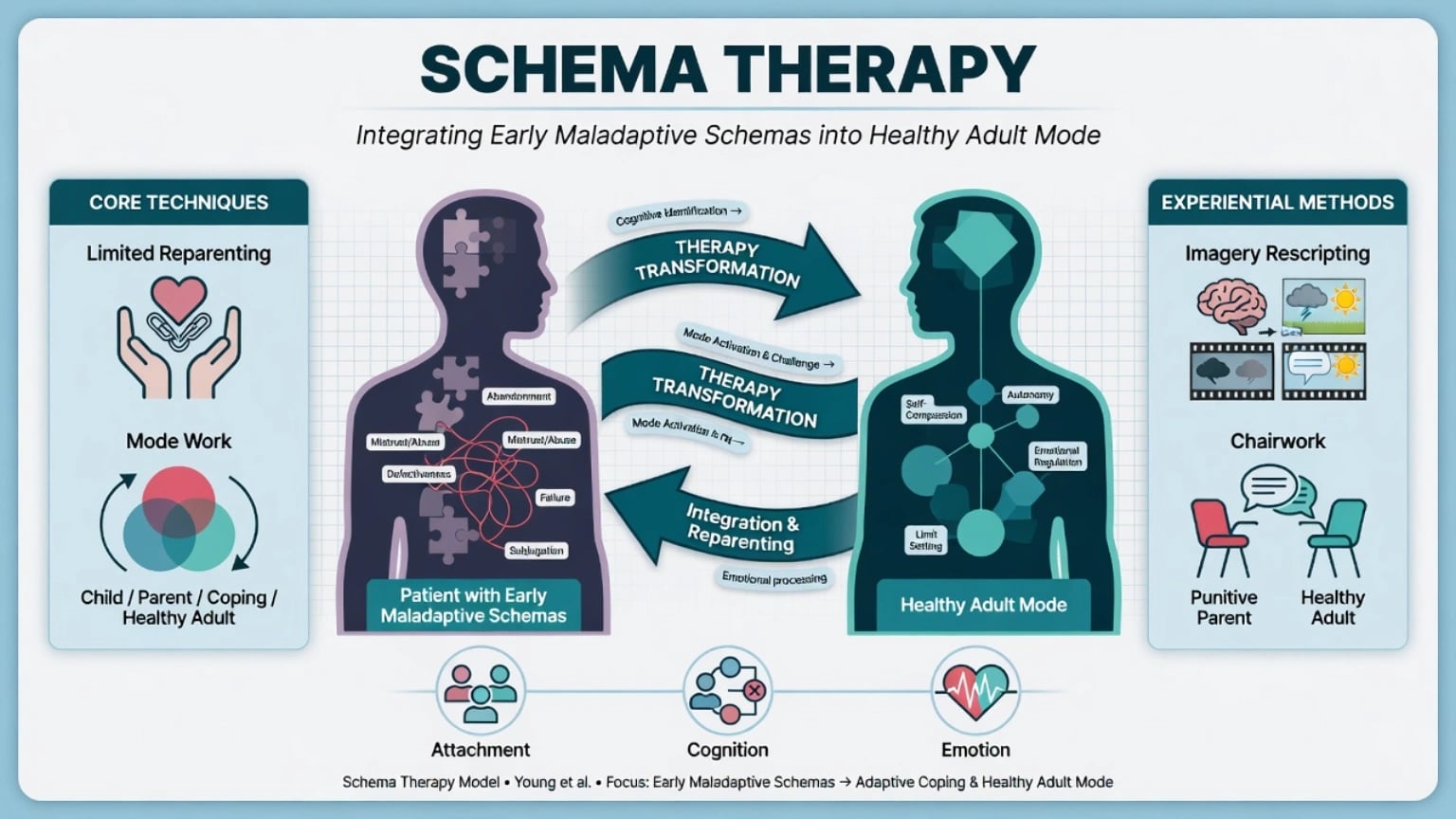
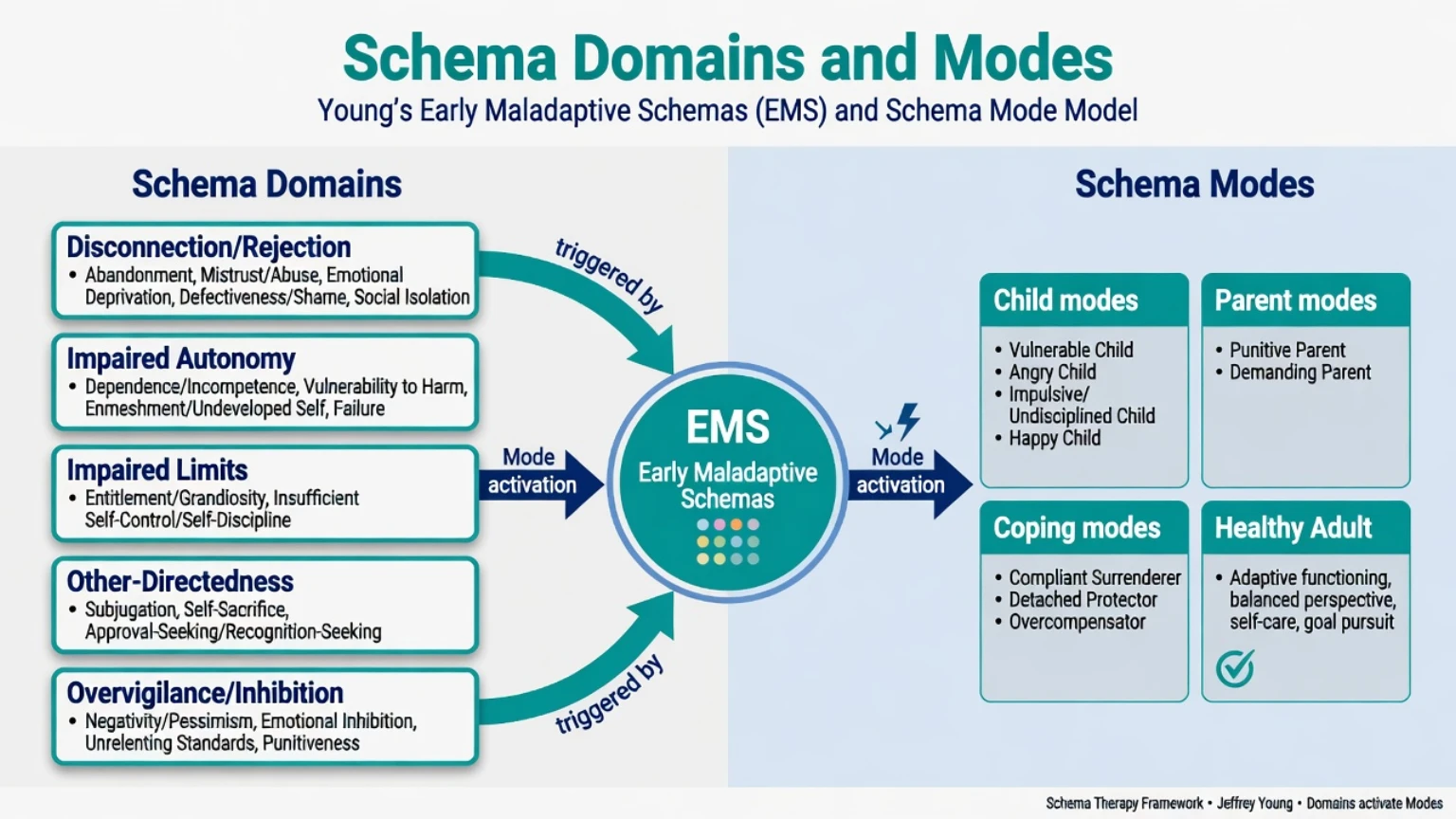
Early maladaptive schemas (EMS) are broad, enduring, self-defeating cognitive-emotional themes regarding self and others, usually formed when core childhood needs (secure attachment, autonomy, realistic limits, self-expression, spontaneity) are chronically unmet, then elaborated across life. EMS are organised under schema domains (classic Young set examiners expect): disconnection/rejection, impaired autonomy/performance, impaired limits, other-directedness, and overvigilance/inhibition.[1][5]
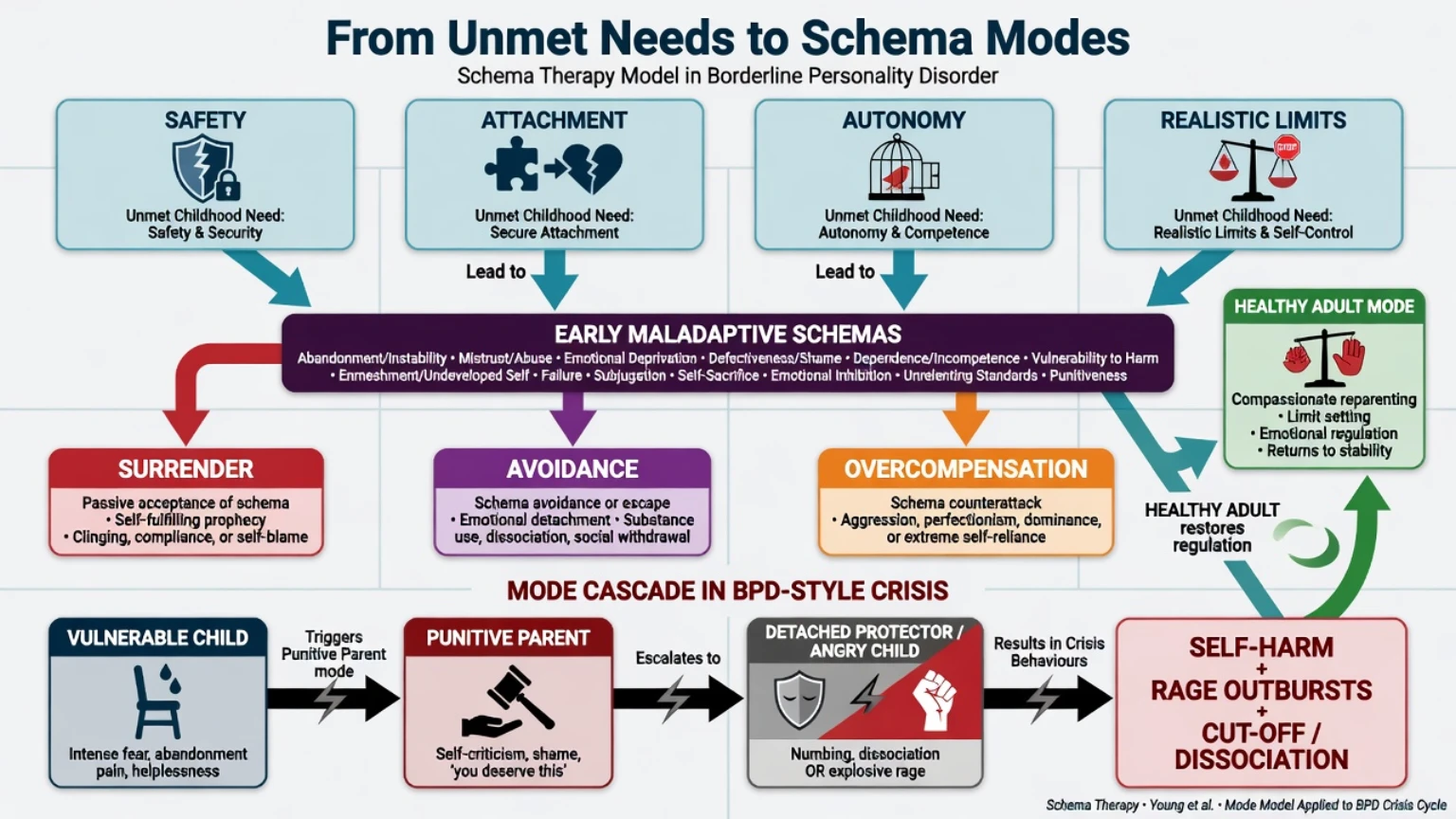
Coping styles describe how people live with EMS: schema surrender (live as if the schema is true), schema avoidance (block activation — substances, detachment, no-shows), and schema overcompensation (fight the schema with opposite extremes — perfectionism, aggression, hyper-independence).[5][6]
Schema modes are the here-and-now emotional-cognitive-behavioural states that dominate at a moment. Exam categories include child modes (vulnerable, angry, impulsive/undisciplined, happy child), parent modes (punitive, demanding), coping modes (detached protector, compliant surrenderer, overcompensator), and healthy adult (balanced perspective, self-care, limit-setting).[5][6]
| Mode family | Examples examiners want | Clinical feel |
|---|---|---|
| Child modes | Vulnerable, angry, impulsive/undisciplined, happy child | Raw affect, need, rage, chaos |
| Parent modes | Punitive parent, demanding parent | Internal attack, shame, impossible standards |
| Coping modes | Detached protector, compliant surrenderer, overcompensator | Numbing, people-pleasing, counterattack |
| Healthy adult | Balanced perspective, self-care, limit-setting | Therapy goal state |
Schema therapy is not “CBT with extra worksheets.” It is a structured programme using cognitive, experiential, and behavioural channels to weaken EMS, reduce maladaptive modes, and strengthen the healthy adult, with the therapeutic relationship offering limited reparenting — meeting needs within ethical professional boundaries, not parenting the patient in life.[1][10]
| Format | Core idea | Exam anchor |
|---|---|---|
| Individual outpatient ST/SFT | Long-course mode and schema work | Giesen-Bloo 2006 vs TFP |
| Group ST (GST) | Group as living mode laboratory | Farrell 2009 add-on; Arntz 2022 multicentre |
| Combined individual + group | Parallel individual depth + group practice | Arntz 2022 combined arm |
| Mixed PD ST | Beyond BPD-only samples | Bamelis 2014 multicentre RCT |
| Implementation variants | Real-world delivery ± after-hours therapist phone | Nadort 2009 |
Mechanism: unmet needs, EMS, modes
Unmet developmental needs scaffold EMS. Under interpersonal threat, rejection, or shame, EMS activate and the person shifts into modes that may cascade in BPD-style crises: vulnerable child pain → punitive parent self-attack → detached protector or angry child → self-harm, rage, cut-off, or frantic contact. Coping styles maintain EMS by preventing corrective emotional experience.[5][6]
Change is multi-channel: limited reparenting (therapist responds to vulnerable child needs — validation, protection, appropriate limits — within the professional frame); empathic confrontation (warm, firm challenge of maladaptive modes); cognitive techniques (test EMS content; build healthy adult counterscripts); experiential techniques (imagery rescripting of early scenes; chairwork mode dialogues); and behavioural pattern-breaking (homework that violates surrender, avoidance, or overcompensation habits).[1][10]
Qualitative work with BPD patients receiving ST highlights the felt importance of group and individual balance, mode language that makes sense of chaos, and the relational stance — useful for CASC plain-language explanations without overclaiming mechanism certainty.[10]
Clinical presentation and assessment
Typical referrals. (1) BPD pattern: abandonment sensitivity, identity instability, self-harm after rejection, chronic emptiness, mode flipping in session. (2) Cluster C / mixed PD: lifelong defectiveness, avoidance of intimacy, unrelenting standards, subjugation — the Bamelis-type population where short CBT failed to shift characterological drivers.[1][7]
Bedside assessment. Map dominant EMS and modes from history and in-session behaviour; assess suicide/self-harm, violence, substances, safeguarding; screen trauma load and dissociation; check capacity for longer-term work and group if offered; clarify practical barriers. Research tools (Young Schema Questionnaire lineage; Schema Mode Inventory variants) support formulation but do not replace clinical judgment.[5][6]
Contract and frame. Duration/intensity (landmark BPD individual ST was multi-year in classic trials; group add-ons may be shorter), crisis pathway, contact rules, and what limited reparenting is not (friendship, dual relationships, secret after-hours dual life). Nadort’s implementation RCT is the examinable pearl that therapist telephone availability outside office hours was not required for ST benefit in that Dutch public-care context — local policy still governs crisis services.[4]
Investigations do not diagnose EMS. Track self-harm frequency, hospital days, validated BPD/PD severity measures, functioning, and (in research) schema/mode scores.[1][7][13]
Acute care and definitive management
Acute / resuscitation of the frame
Medical stabilisation and standard risk assessment outrank mode vocabulary after overdose, serious self-injury, or imminent suicide risk. Once safe, name modes gently (for example, “part of you felt small and abandoned, another part attacked you, then a shut-down part took over”) without blaming. Do not launch deep trauma rescripting mid-crisis; strengthen healthy adult and safety first.[4][9][11]
Definitive pathway
| Presentation | Prefer |
|---|---|
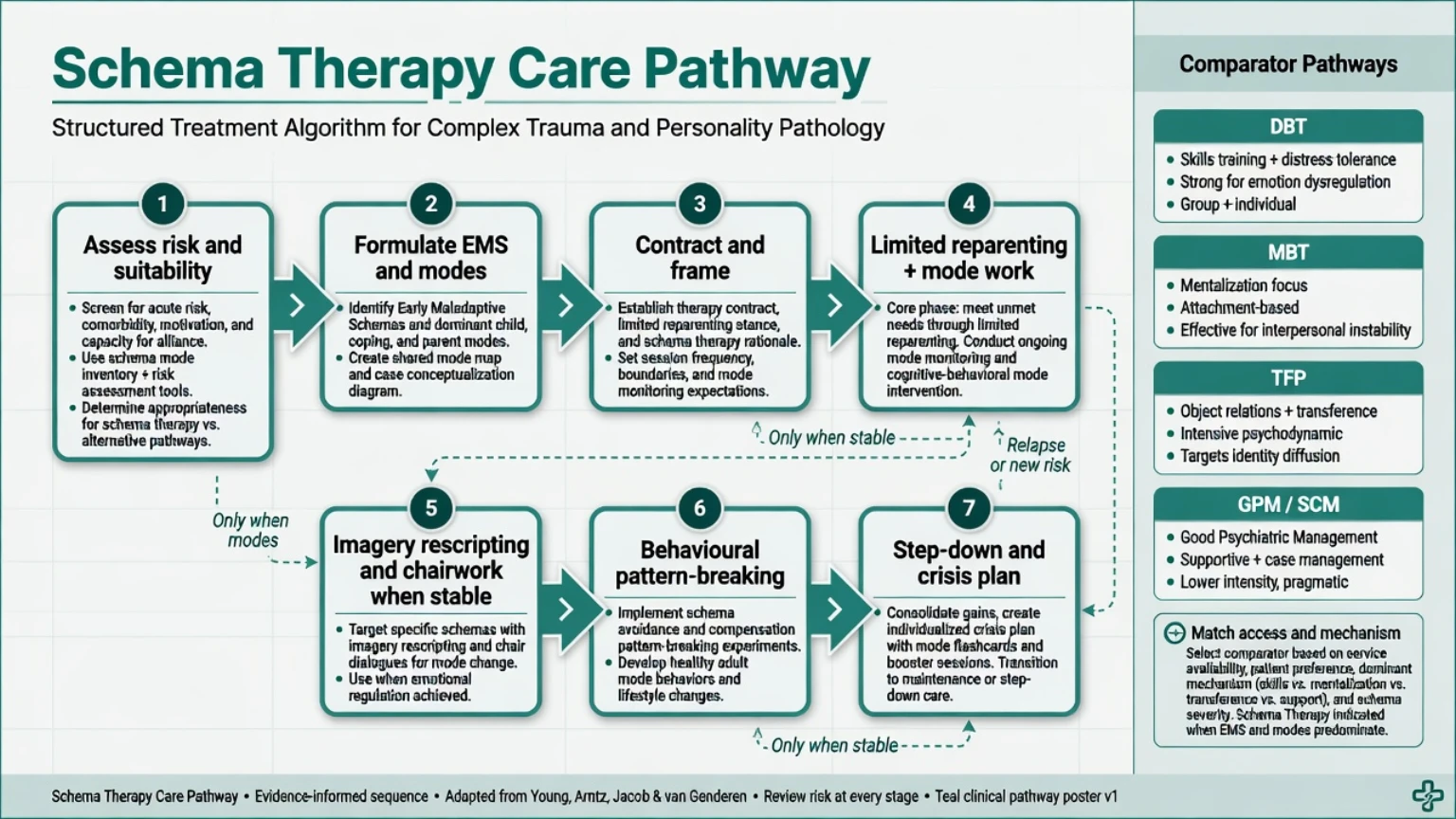
| BPD with mode-driven self-harm; capacity for long specialised work | Individual ST or combined individual+group ST if available |
| BPD; group resource available | Group ST (alone or combined) per local model (Farrell/Arntz lineage) |
| Mixed PD / Cluster C-dominant lifelong patterns | ST with Bamelis-style evidence framing |
| Preference/match for skills-heavy Stage 1 focus | DBT or skills-informed structured care |
| Mentalising failures under attachment arousal as lead problem | MBT if available |
| Specialist ST unavailable | Structured generalist care (GPM/SCM-style) + honest waitlist; do not fake brand fidelity |
| Acute risk dominates | Stabilise, restrict means, safety plan; therapy structure secondary until safe |
Medication: no drug cures EMS or replaces ST. Treat comorbid depression, anxiety, ADHD, substance use, sleep, and medical sequelae with clear review dates; avoid polypharmacy as pseudo-personality treatment.[9][11]
Comparators and differentials
- EMS + modes + limited reparenting
- Imagery rescripting and chairwork
- Individual, group, or combined formats
- Emotion regulation and behavioural control
- Skills modules, chain analysis, dialectics
- Four modes of delivery in standard model
- Restore mentalising under attachment arousal
- Not-knowing stance; pre-mentalising modes
- Classic individual + group dual format
Also distinguish TFP (object-relations interpretation of identity diffusion and transference; Giesen-Bloo comparator) and GPM/SCM (structured generalist psychiatric management when specialised brands are scarce).[1][14]
Assmann and colleagues directly compared DBT and ST for BPD — both are evidence-supported specialised options; choice should reflect clinical match, availability, and preference rather than brand loyalty.[14]
Landmark evidence
BPD core trials
- Giesen-Bloo 2006: multicentre outpatient RCT — schema-focused therapy superior to TFP on recovery indicators for BPD over a long treatment course; foundational specialised ST paper.[1]
- van Asselt 2008: cost-effectiveness analysis from the same programme favoured SFT over TFP from a societal perspective in that Dutch trial context.[2]
- Farrell 2009: adding an eight-month group SFT programme to individual TAU psychotherapy improved BPD outcomes versus individual TAU alone in a small RCT — group format teaching point.[3]
- Nadort 2009: successful implementation of outpatient ST in regular mental healthcare; crisis support by the therapist outside office hours did not show added benefit for primary outcomes in that trial — examinable service-design pearl (does not abolish standard emergency pathways).[4]
- Arntz 2022: multicentre RCT of predominantly group ST and combined individual+group ST versus optimal treatment-as-usual for BPD — know specialised group/combined programmes as contemporary evidence, not only 2006 individual SFT.[13]
- Assmann 2024: RCT comparing DBT and ST for BPD — both specialised therapies in the evidence set; use for “which specialised therapy?” stems.[14]
Beyond BPD-only samples and synthesis
- Bamelis 2011: empirical support for extended schema mode conceptualizations across specific personality disorders.[5]
- Renner 2013: short-term group schema CBT for young adults with PD features — associations with change in distress, schemas, modes, and coping.[6]
- Bamelis 2014: multicentre RCT — ST superior to clarification-oriented psychotherapy and treatment-as-usual for recovery from personality disorders in a mixed PD sample (includes substantial Cluster C pathology) — the named trial beyond BPD-only evidence.[7]
- Bamelis 2015: economic evaluation supported ST in that multicentre programme of research.[8]
- Meta-analyses (2017–2022): specialised psychotherapies for BPD show overall efficacy versus control conditions, with heterogeneity and comparator-quality caveats — ST sits among specialised options in this landscape.[9][11][12]
- Tan 2018: patient-experience qualitative data on ST delivery and implementation lessons (for example, value of individual sessions alongside group).[10]
Pitfalls, special populations, prognosis
Special populations. Adolescents: adapt developmental language and family work; do not transplant multi-year adult protocols uncritically.[6] Older adults: emerging case-series support for late-life personality features with medical/cognitive adaptations. Cultural care: schemas about duty, shame, and family must be formulated with cultural humility — do not pathologise collectivist values as “enmeshment” automatically.[5][7] Forensic mode work for aggression exists as a specialised literature — do not promise generic outpatient ST as a violence cure. Perinatal: safety, bonding, sleep, and joint perinatal planning first; time trauma work carefully.[9] Neurodivergence: distinguish lifelong social-communication differences from mode shifts; adapt experiential techniques and pace.[5]
Prognosis and disposition. Specialised ST programmes improve recovery indicators and reduce BPD severity relative to less structured comparators in landmark trials; mixed-PD ST has multicentre support. Individual response varies. Plan step-down, residual healthy-adult practice, crisis planning, and honest waitlist discussion. Engagement, alliance, substance use, and therapist fidelity influence outcome.[1][7][9][13]
Regional practice notes
ANZ (FRANZCP). Full long-course ST and dual-format group programmes are unevenly available in public services. Examiners expect stepped-care reasoning: offer ST when available and indicated; otherwise structured generalist care, DBT/MBT if available, clear crisis plans, treat comorbidities, and avoid therapeutic nihilism. Align with RANZCP themes that personality disorder is valid and treatable with structured psychological therapy. Do not invent mental health act section numbers.[4][7][9]
UK (MRCPsych). NICE-aligned teaching emphasises structured psychological treatments for BPD; ST is a named specialised option in many services alongside DBT/MBT. CASC stations test plain-language explanation of schemas/modes and collaborative contracting without jargon piles.[9][11][13]
US (ABPN). APA-aligned evidence supports specialised psychotherapies for BPD (ST among several). Know individual versus group formats and generalist structured alternatives when specialty clinics are scarce.[1][13][14]
Exam pearls
ST literacy triad
Coping styles: surrender / avoidance / overcompensation. Mode families: child / parent / coping / healthy adult. Quote Giesen-Bloo 2006 for SFT vs TFP and Bamelis 2014 for mixed PD. Nadort: after-hours therapist phone not essential in that implementation trial. Limited reparenting ≠ boundary violation. ST is not generic CBT and not DBT skills group. Specialised therapy beats unstructured TAU; brand loyalty is not the answer — match mechanism, access, and preference (Assmann DBT vs ST).[1][4][7][14]
References
See frontmatter PMIDs (title/year verified). Landmark anchors: Giesen-Bloo 2006; van Asselt 2008; Farrell 2009; Nadort 2009; Bamelis modes 2011; Renner 2013; Bamelis 2014/2015; Cristea 2017; Tan 2018; Storebø Cochrane 2020; Stoffers-Winterling 2022; Arntz 2022 group/combined ST; Assmann 2024 DBT vs ST.[1][7][13]
References
- [1]Giesen-Bloo J, van Dyck R, Spinhoven P, et al. Outpatient psychotherapy for borderline personality disorder: randomized trial of schema-focused therapy vs transference-focused psychotherapy Arch Gen Psychiatry, 2006.PMID 16754838
- [2]van Asselt AD, Dirksen CD, Arntz A, et al. Out-patient psychotherapy for borderline personality disorder: cost-effectiveness of schema-focused therapy v. transference-focused psychotherapy Br J Psychiatry, 2008.PMID 18515897
- [3]Farrell JM, Shaw IA, Webber MA A schema-focused approach to group psychotherapy for outpatients with borderline personality disorder: a randomized controlled trial J Behav Ther Exp Psychiatry, 2009.PMID 19176222
- [4]Nadort M, Arntz A, Smit JH, et al. Implementation of outpatient schema therapy for borderline personality disorder with versus without crisis support by the therapist outside office hours: A randomized trial Behav Res Ther, 2009.PMID 19698939
- [5]Bamelis LL, Renner F, Heidkamp D, Arntz A Extended Schema Mode conceptualizations for specific personality disorders: an empirical study J Pers Disord, 2011.PMID 21309622
- [6]Renner F, van Goor M, Huibers M, Arntz A, et al. Short-term group schema cognitive-behavioral therapy for young adults with personality disorders and personality disorder features: associations with changes in symptomatic distress, schemas, schema modes and coping styles Behav Res Ther, 2013.PMID 23778056
- [7]Bamelis LL, Evers SM, Spinhoven P, Arntz A Results of a multicenter randomized controlled trial of the clinical effectiveness of schema therapy for personality disorders Am J Psychiatry, 2014.PMID 24322378
- [8]Bamelis LL, Arntz A, Wetzelaer P, et al. Economic evaluation of schema therapy and clarification-oriented psychotherapy for personality disorders: a multicenter, randomized controlled trial J Clin Psychiatry, 2015.PMID 26579561
- [9]Cristea IA, Gentili C, Cotet CD, et al. Efficacy of Psychotherapies for Borderline Personality Disorder: A Systematic Review and Meta-analysis JAMA Psychiatry, 2017.PMID 28249086
- [10]Tan YM, Lee CW, Averbeck LE, et al. Schema therapy for borderline personality disorder: A qualitative study of patients' perceptions PLoS One, 2018.PMID 30462650
- [11]Storebø OJ, Stoffers-Winterling JM, Völlm BA, et al. Psychological therapies for people with borderline personality disorder Cochrane Database Syst Rev, 2020.PMID 32368793
- [12]Stoffers-Winterling JM, Storebø OJ, Kongerslev MT, et al. Psychotherapies for borderline personality disorder: a focused systematic review and meta-analysis Br J Psychiatry, 2022.PMID 35088687
- [13]Arntz A, Jacob GA, Lee CW, et al. Effectiveness of Predominantly Group Schema Therapy and Combined Individual and Group Schema Therapy for Borderline Personality Disorder: A Randomized Clinical Trial JAMA Psychiatry, 2022.PMID 35234828
- [14]Assmann N, Schaich A, Arntz A, et al. The Effectiveness of Dialectical Behavior Therapy Compared to Schema Therapy for Borderline Personality Disorder: A Randomized Clinical Trial Psychother Psychosom, 2024.PMID 38986457