Psych · Public and community psychiatry — carers and family-inclusive practice
Carers and family-inclusive practice
Also known as Family-inclusive practice · Carer-inclusive care · Family psychoeducation · Expressed emotion · Behavioural family therapy · Multifamily groups · Family-focused therapy · Carer burden · Triangle of Care · Informal caregivers mental health
Exam-exhaustive fellowship reference on carers and family-inclusive practice in psychiatry: expressed emotion and relapse, family psychoeducation, behavioural and multifamily models, FFT for bipolar, carer burden assessment, confidentiality versus partnership, early psychosis family work, implementation barriers, and RANZCP/NICE/APA regional frames. FRANZCP-primary, globally tagged.
On this page & tools
Your progress
Saved locally on this device.
1 MCQ with explanations
Target exams
Red flags
Most people with severe mental illness live in relational systems. Fellowship examiners expect you to define carers and family-inclusive practice, explain expressed emotion without blaming families, deliver structured family psychoeducation components, navigate confidentiality, measure carer burden, and cite landmark evidence (Vaughn/Leff, Butzlaff/Hooley, Falloon, McFarlane, Pharoah Cochrane, Miklowitz FFT, Yesufu-Udechuku carer packages).[1][2][3][5]
Overview and definition
An informal carer (family carer, significant other) is a person who provides unpaid practical, emotional, or supervisory support to someone with mental illness — often a parent, partner, adult child, sibling, friend, or culturally recognised kin. Family-inclusive practice means services systematically identify carers, assess their needs, invite participation in care planning where appropriate, offer education and support, and deliver structured family interventions with known active ingredients.[5][15]
| Construct | What it is | What it is not |
|---|---|---|
| Carer-inclusive care | Identify, assess, partner, support carers | Token presence in one ward round |
| Family psychoeducation (FPE) | Structured multi-session education + skills | One discharge leaflet |
| Behavioural family intervention | Communication and problem-solving training | Insight-oriented long-term family therapy by default |
| Multifamily groups | Several families learning together (McFarlane lineage) | Unstructured peer chat without clinical content |
| Family-focused therapy (FFT) | Structured bipolar package (psychoeducation, communication, problem-solving) with pharmacotherapy | Generic supportive counselling only |
Historical contrast for essays: mid-20th-century "schizophrenogenic" family theories are obsolete and harmful. Modern EE research measures a stressful family environment that interacts with vulnerability — families are partners to support, not causes to prosecute.[1][2]
Classification — continuum of inclusion
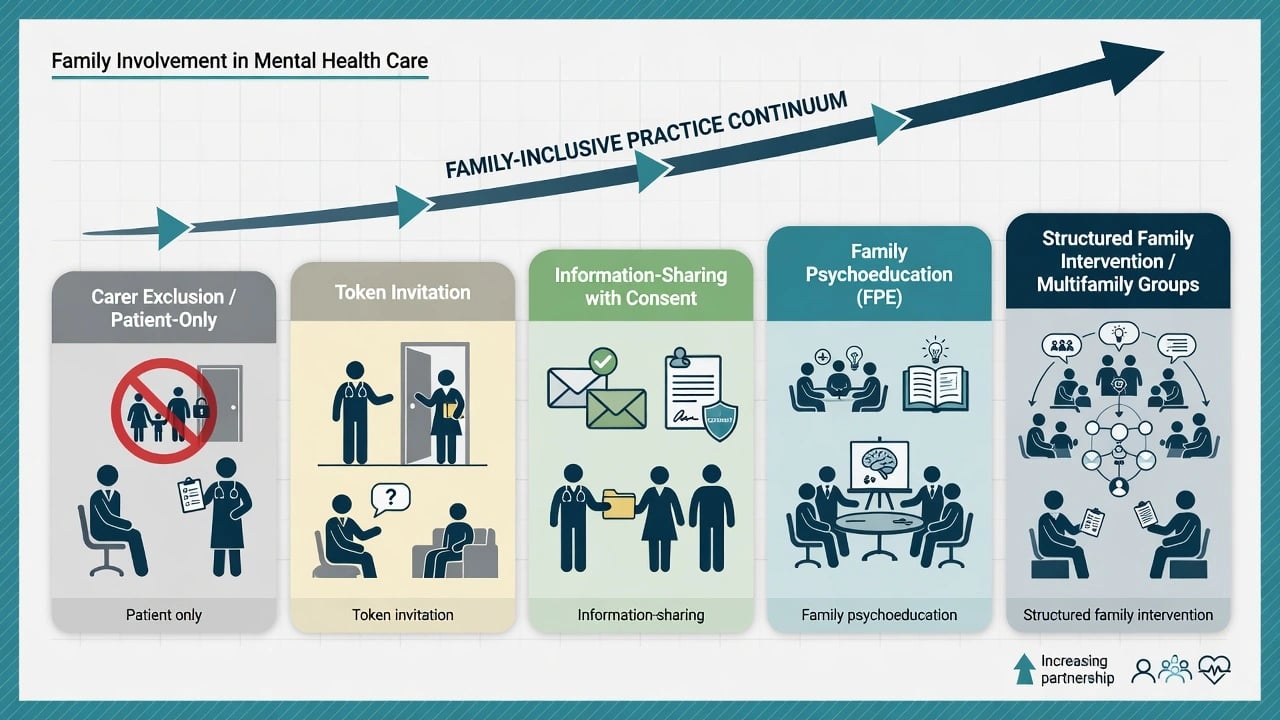
Levels of service behaviour (exam scaffold) range from exclusion and token invitation through consented information-sharing to carer-focused support and full structured family intervention / FPE / FFT / multifamily groups — multi-session, skills-based programmes rather than a single contact.[3][5][6][11]
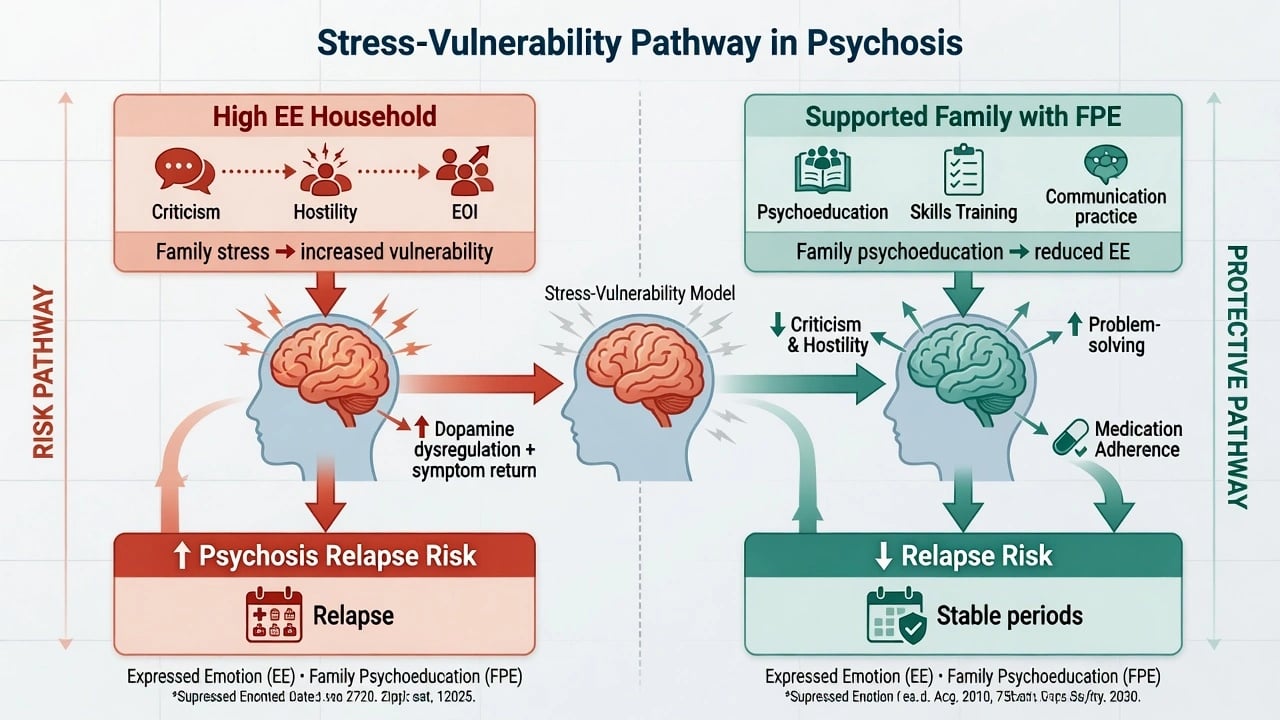
Expressed emotion (EE) is rated on three classic dimensions: criticism, hostility, and emotional over-involvement (EOI). High EE is a robust psychosocial predictor of relapse in schizophrenia and has been studied across other disorders; it is a research and clinical risk marker, not a moral verdict on "bad parents."[1][2]
Epidemiology and risk
Carers and family environment — exam anchors
A substantial share of people with SMI rely on informal care. Carers show elevated rates of psychological distress; unsupported burden threatens sustainability of community care and patient recovery. High-EE households are associated with substantially increased relapse risk relative to low-EE environments in classic literature synthesised by meta-analysis. Under-identification of carers (especially young carers, male carers, and culturally diverse kinship carers) is a service quality failure, not a patient preference default.[1][2][5][6]
Pathophysiology and mechanisms
The mechanism examiners want is stress-vulnerability interaction, not family causation of schizophrenia. Critical comments and hostility amplify interpersonal stress and may undermine adherence and help-seeking; EOI can entangle autonomy and escalate mutual anxiety, particularly after first-episode psychosis. Bidirectional burden means patient symptoms increase carer stress while exhausted carers have less capacity for calm problem-solving. Protective FPE mechanisms include accurate illness models, reduced blame attributions, communication skills, structured problem-solving, early warning sign recognition, and crisis plans — the active ingredients emphasised across McFarlane and related reviews.[1][2][3][6][8][11][15]
Clinical presentation
Carers may present with fatigue, anxiety, depression, grief, anger, hypervigilance to early warning signs, social withdrawal, financial strain, and disrupted work or study. Distinguish objective burden (tasks, hours, disrupted roles) from subjective burden (distress, guilt, resentment).[8] Many carers also report positive meaning when supported.
High-EE behavioural proxies in clinic (not a full Camberwell Family Interview): frequent hostile or critical remarks about the person, global negative judgments, or extreme self-sacrificing overprotection that blocks graded recovery goals.[1][2]
After first-episode psychosis, families often present in crisis: shock, stigma fears, educational/occupational disruption for the young person, and role changes for parents/siblings. Early family intervention is a recognised component of early intervention packages.[9]
Differential: which family modality?
| Offer / prioritise | Prefer alternative / escalate |
|---|---|
| Structured FPE when patient has psychosis/SMI and family contact | Formal systemic family therapy when entrenched multi-generational conflict dominates without acute relapse focus |
| Carer-only support if patient declines joint sessions but carer is distressed | Individual carer psychiatry/GP care if carer has major depression, suicidality, or own SMI |
| FFT-style package in bipolar with family contact | Standalone couple therapy when the primary problem is intimate-partner dynamics without mood-episode focus |
| Safeguarding pathway if violence, coercive control, child risk | Do not force joint sessions when joint work is unsafe |
Assessment
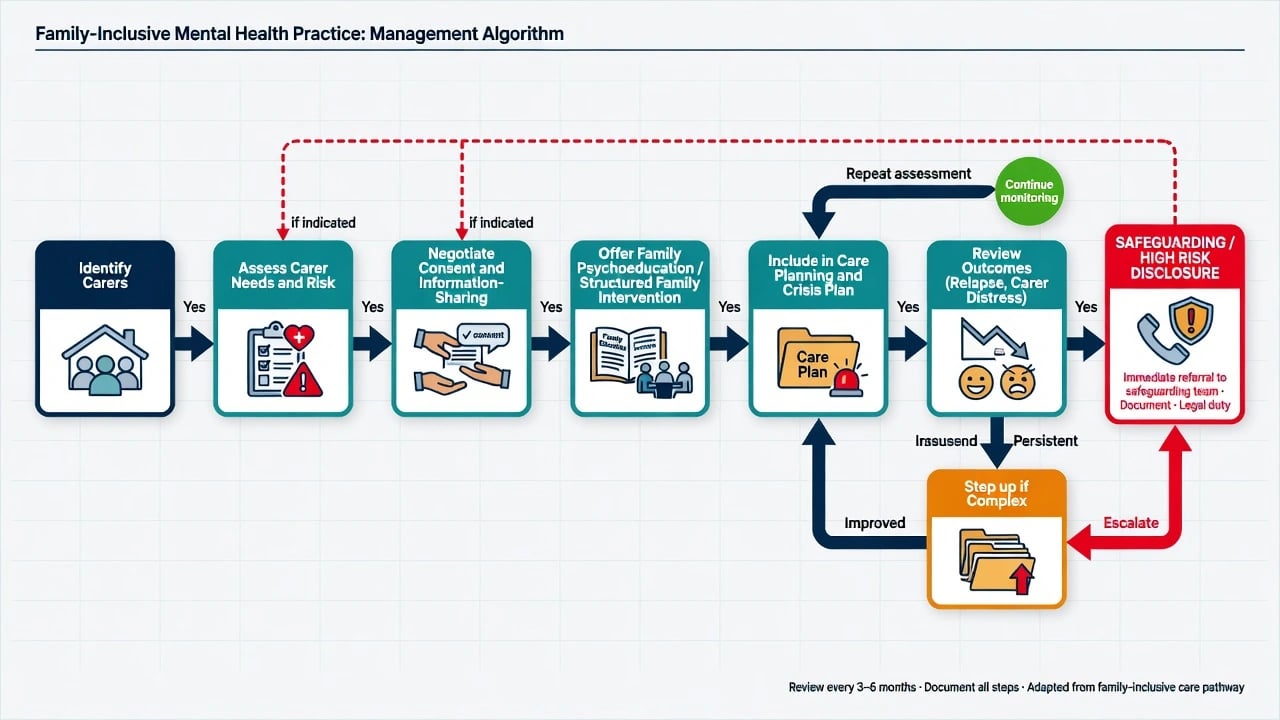
Structure a carer assessment at intake, after admission, and at major pathway transitions: named care network (including chosen family); tasks, hours, overnight supervision, and financial impact; knowledge of illness, early warning signs, medications, and crisis contacts; coping style, criticism/EOI proxies, strengths, and cultural context; carer mental health, substance use, sleep, and suicide risk; patient-to-carer violence, carer burnout, and children in the home; goals and what the patient consents to share.[5][6]
Zarit burden work originated with relatives of impaired older adults and underpins modern caregiver burden measurement language; use validated burden tools as severity/outcome aids, not as standalone diagnoses.[8]
Confidentiality algorithm (exam gold): therapy content and personal disclosures remain confidential unless risk-based disclosure duties apply; general education about illness, services, and carer self-care can often proceed without revealing private session material; seek consent for information-sharing and if refused still support the carer with non-confidential material and document; high risk (suicide, violence, vulnerability) may justify limited disclosure with documentation — never use confidentiality as a total communications blackout when safety requires partnership.[5]
Investigations
There is no blood test for carer status. "Investigate" means: screen carer distress and suicidality when indicated; ensure the patient has appropriate medical/psychiatric work-up; and choose outcome metrics for family programmes (relapse, readmission, adherence, carer distress/quality of life, knowledge). Research EE used the Camberwell Family Interview; routine services use clinical proxies and structured assessments rather than full research EE interviews.[1][2][4][6]
Acute and emergency management

At ED or inpatient discharge: confirm carer contacts, share agreed safety plan elements, ensure medication and follow-up are understood by those supporting the person at home, and offer rapid carer support contact details.[5]
Definitive management
Core FPE / family intervention components (memorise for essays): engagement and alliance with patient and family (blame-free stance); psychoeducation on diagnosis, course, stress-vulnerability, treatments, and prognosis realism; communication training; structured problem-solving for daily stressors; relapse prevention with early warning signs, action plans, and crisis contacts; carer support including respite pathways, peer support, and carer mental health care when needed.[3][4][6][11][13][15]
Dose principle. Landmark programmes and reviews describe multi-session interventions over months, not a one-off chat. Network meta-analysis work suggests multiple family intervention models can reduce relapse when adequately delivered; family psychoeducation alone can be efficacious among models studied.[4][7][10]
Classic models: Falloon behavioural family management showed fewer exacerbations and admissions over longitudinal follow-up; McFarlane multifamily / FPE provides a major literature synthesis for schizophrenia-related psychoses; Pharoah Cochrane concludes family intervention may reduce relapse and hospitalisation; Miklowitz FFT plus pharmacotherapy improves bipolar post-episode course versus less intensive comparators across a multi-trial programme of research.[4][11][12][13][14]
Service system checklist (Triangle of Care–style principles for exams): identify carers on every care pathway; train staff in carer engagement and confidentiality negotiation; embed policies that require carer assessment and invitation to care planning; provide written education and peer pathways; audit carer experience.[5][15]
Subtypes and scenarios
| Scenario | Priority actions |
|---|---|
| First-episode psychosis | Early family engagement; education; FI as part of EIP package evidence |
| Long-term SMI, ageing parent carers | Plan for carer health decline, housing contingency, sibling/successor carers |
| Bipolar disorder | Consider FFT-style psychoeducation + communication + problem-solving with mood stabilisers |
| CAMHS | Parents as developmental context; consent and Gillick/capacity frameworks jurisdiction-specific |
| Dementia / old-age interface | Zarit-type burden assessment; carer depression screening |
| Forensic / compulsory care | Legal rights of nearest relatives/nominated persons vary by statute — state principles, not invented section numbers |
| Rural / telehealth | Remote multifamily or single-family sessions; local GP liaison |
Complications and pitfalls
- Blame culture — EE taught as "your family caused this."[1]
- Confidentiality absolutism blocking all carer partnership.[5] Pitfalls include the leaflet-as-intervention fallacy; ignoring young carers and siblings; missing patient-to-carer violence or carer suicidal risk; implementation gaps when workforce time, skills, and supervision lag despite guideline endorsement; and excluding culturally defined carers who are not nuclear family.[3][5][6][15]
Prognosis and disposition
Meta-analytic and Cochrane evidence supports family intervention for reducing relapse and rehospitalisation risk in schizophrenia-spectrum illness; Pitschel-Walz estimated clinically important relative reductions when relatives are included in treatment.[4][7] Rodolico network meta-analysis found almost all family intervention models efficacious for relapse prevention versus controls in the evidence network studied.[10] Carer-focused interventions improve experience of caring, quality of life, and psychological distress for carers of people with SMI.[6] Early psychosis reviews support family intervention as a component associated with better service-user outcomes within multi-element packages.[9]
Disposition. Integrate family work into routine community care; use specialist family therapists for complex or high-conflict systems; continue carer support even when the patient disengages if ethical and safe; plan booster sessions when relapse risk rises.[3][4][5][10]
Special populations
Young carers and siblings need age-appropriate education and protection of schooling. Ageing parents of adult children with SMI need future-care planning. LGBTQ+ chosen family may be the true carer network. Indigenous and culturally diverse kinship systems require cultural safety and community protocols, not nuclear-family templates alone. Intellectual disability dual diagnosis families often carry lifelong care loads. Perinatal partners are carers of both infant and parent with mental illness. LMIC settings often deliver family-centred care by necessity — apply principles without claiming identical Western RCT infrastructure.[5][6][15]
Evidence and guidelines
| Landmark | Message |
|---|---|
| Vaughn and Leff 1976 | Family/social factors and EE linked to course in schizophrenia vs depression comparison |
| Butzlaff and Hooley 1998 | Meta-analysis: EE robust predictor of psychiatric relapse |
| Falloon 1985 | Family management improves clinical outcomes in schizophrenia longitudinal study |
| Dixon 2001 | Family psychoeducation as evidence-based practice |
| McFarlane 2003 / 2016 | FPE literature and psychoses family intervention reviews |
| Pitschel-Walz 2001 | Meta-analysis: family inclusion reduces relapse/rehospitalisation |
| Pharoah Cochrane 2010 | Family intervention may reduce relapse and hospitalisations |
| Bird 2010 | Early intervention packages include family intervention evidence |
| Miklowitz 2003 / 2016 | FFT for bipolar RCT and multi-decade research synthesis |
| Yesufu-Udechuku 2015 | Carer-focused interventions improve carer outcomes |
| Rodolico 2022 | Network meta-analysis of family interventions for relapse prevention |
| Lucksted 2012 | Implementation and recent FPE developments |
ANZ (RANZCP-facing). Family/carer participation is expected in recovery-oriented community care and psychosis pathways. Offer structured psychoeducation and carer support; document nominated contacts; align with local carer recognition frameworks without inventing legal section numbers.[3][5][15]
UK (NICE / MRCPsych). NICE-facing psychosis/schizophrenia guidance has long endorsed family intervention for people in close contact with families. CASC stations test carer communication, confidentiality negotiation, and psychoeducation skills. Organisational carer-partnership framing (Triangle of Care-style principles) remains useful in exams.[2][4][5]
US (APA / ABPN). Family psychoeducation sits within evidence-based psychosocial treatments for schizophrenia; FFT is a major bipolar psychosocial evidence stream. Systems items often probe implementation barriers.[5][12][14][15]
India / MD-DNB / NEET-SS. Joint family systems are clinical assets when engaged respectfully; apply FPE components and carer burden assessment within district mental health and tertiary settings.[3][6][8]
Exam pearls
[1] [2]- Confidentiality protects private therapy content; it does not forbid all carer contact or general education.[5]
- Name the components: engagement, education, communication, problem-solving, relapse planning, carer support.[3][11]
- Falloon, McFarlane, Pharoah, Miklowitz, Yesufu-Udechuku are high-yield name-checks.[4][6][12][13]
- Zarit anchors burden measurement language.[8]
- Leaflet ≠ FPE. Multi-session structured work is the evidence base.[3][15]
- Do not invent Mental Health Act carer rights numbers unless the stem supplies the jurisdiction and statute.
Related topics
Schizophrenia spectrum and first-episode psychosis pathways; bipolar disorder psychosocial treatments; recovery and rights-based care; community mental health models; suicide risk and safety planning; old-age carer burden in dementia — cross-link after mastering EE, FPE components, confidentiality negotiation, and the landmark evidence table above.[3][5][14]
References
- [1]Butzlaff RL, Hooley JM Expressed emotion and psychiatric relapse: a meta-analysis Arch Gen Psychiatry, 1998.PMID 9633674
- [2]Vaughn CE, Leff JP The influence of family and social factors on the course of psychiatric illness. A comparison of schizophrenic and depressed neurotic patients Br J Psychiatry, 1976.PMID 963348
- [3]McFarlane WR, Dixon L, Lukens E, Lucksted A Family psychoeducation and schizophrenia: a review of the literature J Marital Fam Ther, 2003.PMID 12728780
- [4]Pharoah F, Mari J, Rathbone J, Wong W Family intervention for schizophrenia Cochrane Database Syst Rev, 2010.PMID 21154340
- [5]Dixon L, McFarlane WR, Lefley H, et al. Evidence-based practices for services to families of people with psychiatric disabilities Psychiatr Serv, 2001.PMID 11433107
- [6]Yesufu-Udechuku A, Harrison B, Mayo-Wilson E, et al. Interventions to improve the experience of caring for people with severe mental illness: systematic review and meta-analysis Br J Psychiatry, 2015.PMID 25833867
- [7]Pitschel-Walz G, Leucht S, Bäuml J, Kissling W, Engel RR The effect of family interventions on relapse and rehospitalization in schizophrenia--a meta-analysis Schizophr Bull, 2001.PMID 11215551
- [8]Zarit SH, Reever KE, Bach-Peterson J Relatives of the impaired elderly: correlates of feelings of burden Gerontologist, 1980.PMID 7203086
- [9]Bird V, Premkumar P, Kendall T, Whittington C, Mitchell J, Kuipers E Early intervention services, cognitive-behavioural therapy and family intervention in early psychosis: systematic review Br J Psychiatry, 2010.PMID 21037211
- [10]Rodolico A, Bighelli I, Avanzato C, et al. Family interventions for relapse prevention in schizophrenia: a systematic review and network meta-analysis Lancet Psychiatry, 2022.PMID 35093198
- [11]McFarlane WR Family Interventions for Schizophrenia and the Psychoses: A Review Fam Process, 2016.PMID 27411376
- [12]Miklowitz DJ, George EL, Richards JA, Simoneau TL, Suddath RL A randomized study of family-focused psychoeducation and pharmacotherapy in the outpatient management of bipolar disorder Arch Gen Psychiatry, 2003.PMID 12963672
- [13]Falloon IR, Boyd JL, McGill CW, et al. Family management in the prevention of morbidity of schizophrenia. Clinical outcome of a two-year longitudinal study Arch Gen Psychiatry, 1985.PMID 2864032
- [14]Miklowitz DJ, Chung B Family-Focused Therapy for Bipolar Disorder: Reflections on 30 Years of Research Fam Process, 2016.PMID 27471058
- [15]Lucksted A, McFarlane W, Downing D, Dixon L Recent developments in family psychoeducation as an evidence-based practice J Marital Fam Ther, 2012.PMID 22283383