Psych · Specialty psychiatry — sleep medicine interface
Circadian rhythm sleep-wake disorders
Also known as CRSWD · Delayed sleep-wake phase disorder · DSWPD · DSPD · Advanced sleep-wake phase disorder · Non-24-hour sleep-wake disorder · Free-running disorder · Shift work sleep disorder · Jet lag disorder · Irregular sleep-wake rhythm · Chronotherapy · Melatonin phase shift
Exam-exhaustive fellowship atlas on circadian rhythm sleep-wake disorders — DSM-5-TR/ICSD-3 nosology (DSWPD, ASWPD, non-24, ISWRD, shift work, jet lag), SCN/two-process physiology and PRCs, DLMO/actigraphy assessment, timed light and melatonin, tasimelteon for blind non-24, shift-work countermeasures including modafinil evidence, ADHD/bipolar/adolescence interfaces, and BAP/AASM guideline framing. FRANZCP-primary, globally tagged.
On this page & tools
Your progress
Saved locally on this device.
7 MCQs with explanations
Target exams
Red flags
Circadian disorders are high-yield leaf topics because they sit between psychiatry, occupational medicine, and sleep medicine. FRANZCP MEQs test DSWPD versus insomnia, melatonin timing, and school/work failure framing. MRCPsych CASCs test plain-language phase explanation and collaborative light/melatonin plans. ABPN items test PRC direction, non-24 in blindness, and shift-work pharmacology. A candidate who reads only this leaf should not need the general sleep hub to defend nosology, phase biology, and subtype-specific care.[1][3][11][13]
Overview and definition
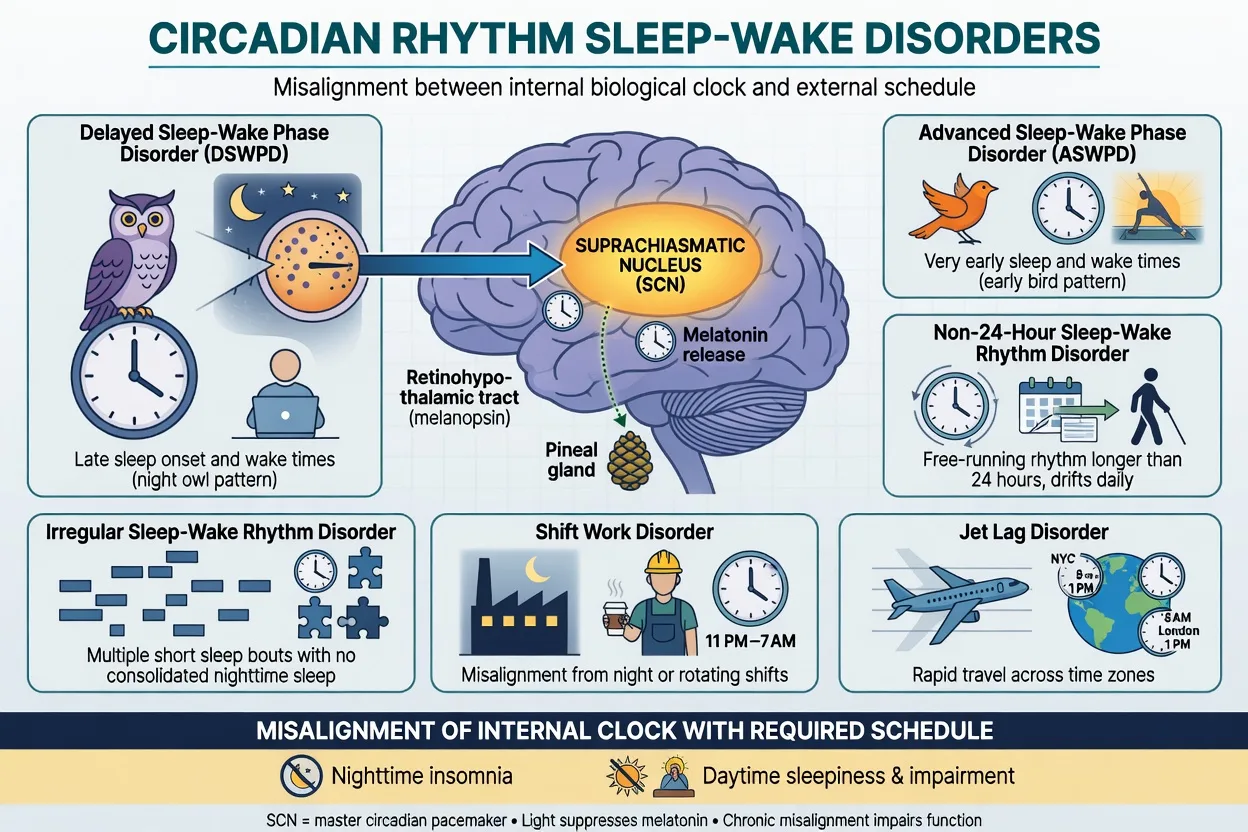
Circadian rhythm sleep-wake disorders (CRSWDs) are a group of sleep disorders in which the primary pathology is misalignment between the endogenous circadian system and the sleep-wake schedule required by social, occupational, or environmental demands. The result is insomnia symptoms at the wrong biological time, excessive sleepiness at the required wake time, or both, with clinically significant distress or impairment.[2][3][13]
Clinical essence. These are timing disorders, not simply “not enough sleep.” In delayed sleep-wake phase disorder (DSWPD), patients often sleep well when allowed a late schedule (holidays, free days) — a key discriminator from insomnia disorder, where sleep fails even with adequate opportunity at the preferred clock time.[3][11]
Classification and nosology
DSWPD
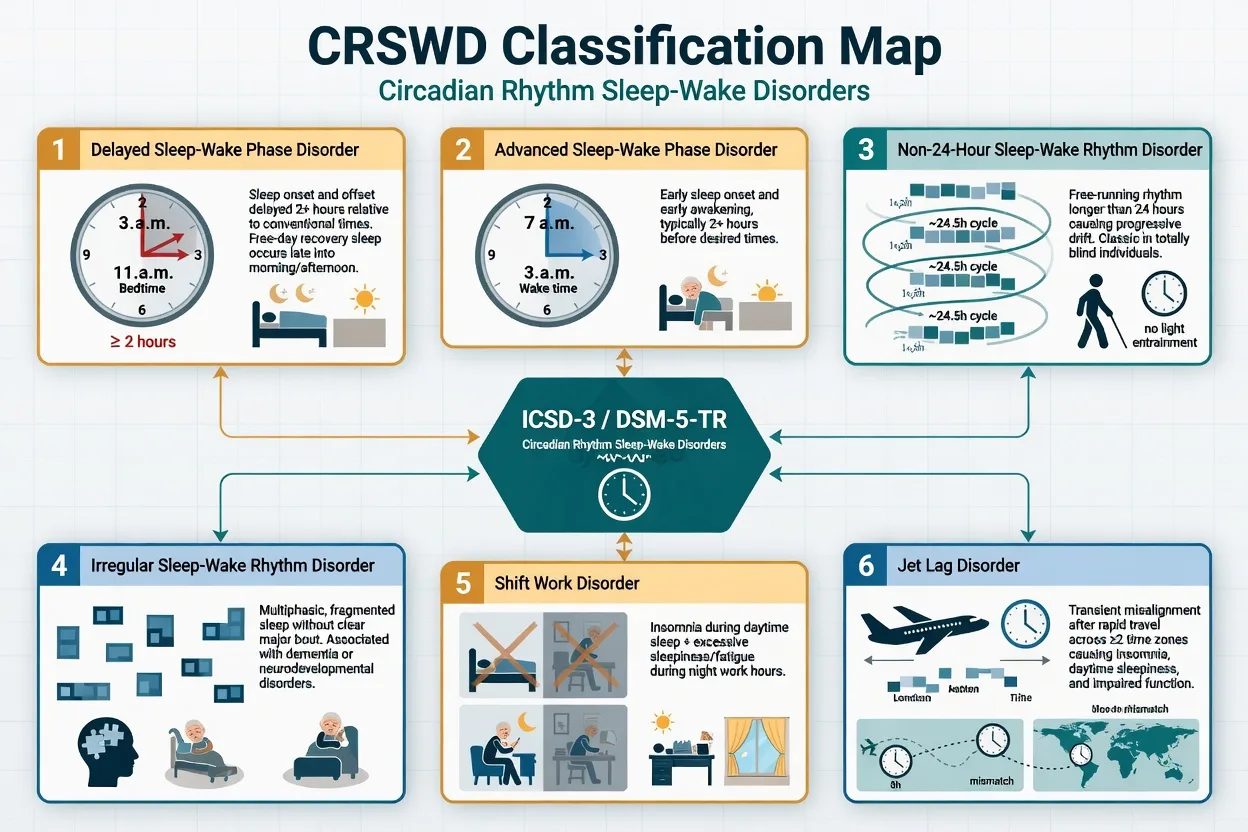
- Late sleep onset/offset
- Sleeps well if free schedule allowed
- Youth/ADHD interface common
- Morning light + evening melatonin
ASWPD
- Early sleep and early awakening
- Older adult enrichment
- Evening social/work clash
- Evening light strategies
Non-24 / ISWRD
- Non-24: free-running drift
- Classic totally blind without light perception
- ISWRD: multiphasic fragmented sleep
- Dementia/neurodevelopmental context
Shift work / jet lag
- Extrinsic schedule mismatch
- SWD: day insomnia + night sleepiness
- Jet lag after rapid time-zone travel
- Occupational safety central
Intrinsic entities emphasised in the AASM 2015 update include ASWPD, DSWPD, non-24-hour sleep-wake rhythm disorder (N24SWD), and irregular sleep-wake rhythm disorder (ISWRD). Extrinsic disorders (shift work, jet lag) share the same circadian physics but different precipitants and organisational levers.[1][2][13]
Epidemiology and risk
Headline epidemiology (exam anchors)
DSWPD is the intrinsic CRSWD most often seen in psychiatric clinics — delayed adolescent physiology, evening light from screens, ADHD comorbidity, and early school start times collide. Shift work disorder is not universal among shift workers: Drake and colleagues estimated that roughly one in ten night and rotating workers meet SWD criteria beyond the symptom burden of day workers, with excess sleepiness, insomnia, and functional harm.[2][3][10]
Non-24 is rare in the general population but common among totally blind people without light perception because photic entrainment fails. ISWRD clusters in neurodegenerative disease and severe neurodevelopmental disability.[1][3]
Pathophysiology and mechanisms
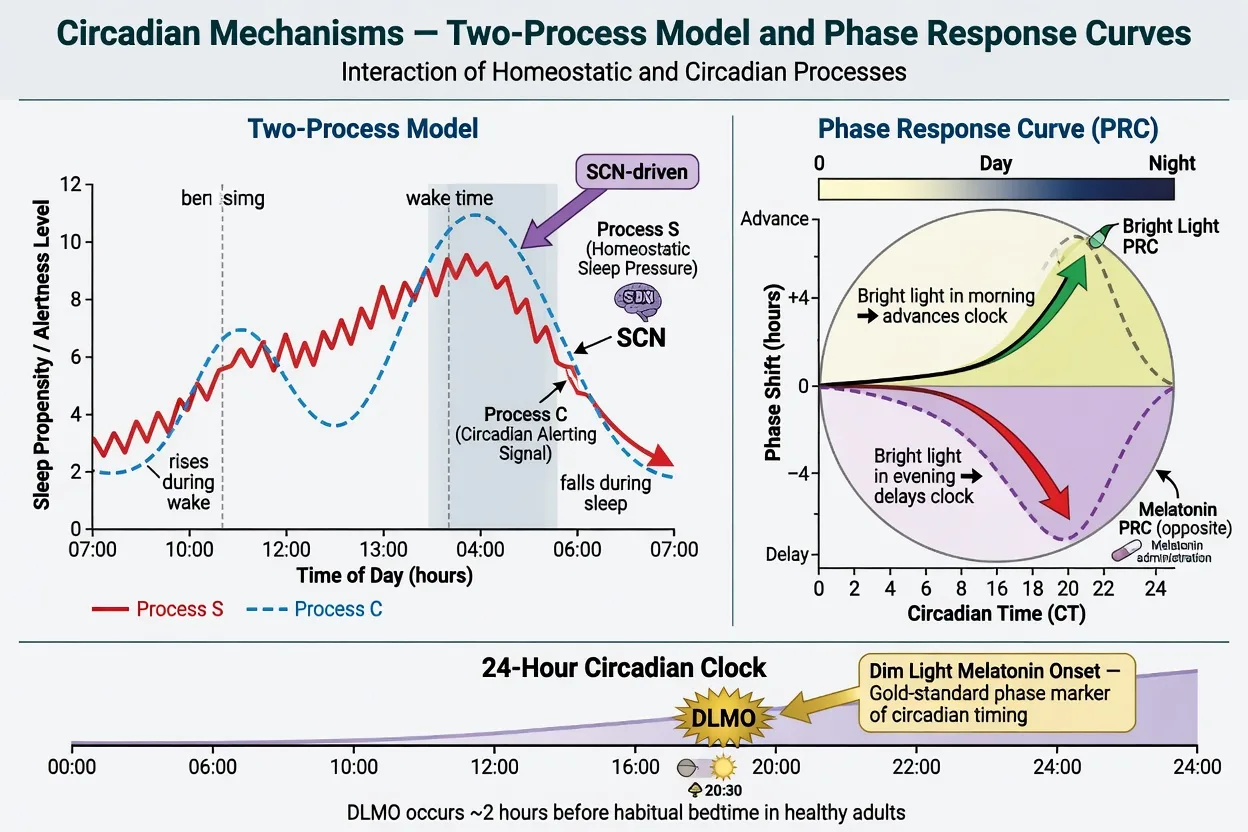
Master clock. The suprachiasmatic nucleus (SCN) is the hypothalamic pacemaker. Intrinsically photosensitive retinal ganglion cells (melanopsin pathway) convey light information that entrains the SCN to the 24-hour day. Melatonin from the pineal gland is a key hormonal output and a phase-shifting signal when given exogenously at the right circadian time.[2][3]
Two-process model (exam gold).
- Process S: homeostatic sleep pressure builds with wake and dissipates with sleep.
- Process C: circadian alerting signal from the SCN. CRSWDs are primarily Process C timing disorders. Insomnia disorder more often reflects hyperarousal and Process S/behavioural perpetuation even when opportunity is correct.[2][11]
Phase response curves (PRC).
- Bright light: morning light tends to advance the clock; evening/night light tends to delay it.
- Melatonin: roughly opposite to light — evening/early night exogenous melatonin tends to advance; morning melatonin can delay. Giving melatonin as a random “nightcap” at the wrong phase can fail clinically or even reinforce delay — timing is the exam answer, not brand name alone.[2][7][11]
Phase markers. Dim light melatonin onset (DLMO) is the research gold-standard phase marker; core body temperature minimum is an alternative in laboratory settings. Clinical practice often estimates phase from free-day mid-sleep and diaries when DLMO is unavailable.[2][4]
Clinical presentation
DSWPD. Habitual sleep onset delayed (often well after midnight into the early morning hours), extreme difficulty waking for required morning obligations, and relatively good sleep quality when the delayed schedule is allowed. Daytime complaints are morning sleepiness and functional failure (school, work), not classic middle-of-night hyperarousal.[3][11]
ASWPD. Early evening sleepiness, early terminal awakening, and difficulty remaining awake for evening social or occupational demands — more often recognised in older adults.[1][3]
N24SWD. Progressive day-to-day drift of the sleep-wake episode; periods of alignment alternate with severe night insomnia and daytime sleepiness as the free-running rhythm moves through the clock. Totally blind adults without light perception are the classic population.[1][8]
ISWRD. No major consolidated nocturnal sleep bout; multiple short sleeps across 24 hours — dementia and intellectual disability contexts dominate.[1][3]
Shift work disorder. Insomnia when attempting sleep during the day opportunity plus excessive sleepiness during night work, not merely preference for day work.[2][10]
Jet lag. Transient after rapid time-zone travel; eastbound travel typically harder (requires phase advance).[2]
Differential diagnosis
| Presentation | Favours | Discriminator |
|---|---|---|
| Late sleep, sleeps well on free delayed schedule | DSWPD | Versus insomnia: opportunity at preferred late time still fails in insomnia |
| Late nights + elevated mood, increased energy, reduced need | Mania/hypomania | Not pure DSWPD — treat mood pathway |
| Loud snoring, apnoeas, high BMI, residual sleepiness | OSA | Can coexist; treat breathing disorder |
| Free-running progressive drift + blindness | Non-24 | Versus extreme DSWPD without continuous drift |
| Multiphasic sleep + cognitive decline | ISWRD / NCD | Not primary insomnia alone |
| Night work insomnia + on-shift sleepiness | Shift work disorder | Versus primary insomnia on day schedule |
Always include substances (stimulants delaying phase; alcohol fragmenting sleep), medication timing, and medical causes of early awakening (pain, nocturia, depression).[3][11]
Assessment
History structure. Preferred versus required sleep-wake times; free-day versus workday mid-sleep; light exposure (morning darkness, evening screens); shift roster; travel; vision; ADHD/mood/psychosis screen; substances; driving and occupational risk; school attendance in youth.[2][4][11]
Tools.
- Sleep diary 1–2 weeks is mandatory exam-answer assessment.
- Actigraphy is endorsed as useful for evaluation and treatment response in CRSWD practice parameters and reviews.[4][2]
- DLMO when available for precision melatonin timing; not always required before pragmatic treatment starts.
- PSG is not first-line for pure CRSWD — reserve for OSA, parasomnia, or hypersomnia differentials.[4][13]
Investigations
Actigraphy and diary form the backbone. Consider ophthalmology when non-24 is suspected outside classic total blindness. Cognitive and medical evaluation for new ISWRD in older adults. ECG/metabolic baseline before wake-promoting agents when used; toxicology when substance-driven reverse phase is plausible.[1][4][8]
Acute / emergency management
- Mania pathway: reduced need for sleep with elevated mood is not DSWPD — stabilise mania, protect sleep, avoid framing as voluntary night-owl lifestyle.[11]
- Severe depression with reverse phase: risk assess suicide and function; schedule correction alone is not a safety plan.
- Stimulant intoxication: medical stabilisation before chronobiology labels.
Definitive management
Core triad (all subtypes)
- Timed light exposure according to desired phase shift direction.
- Strategically timed melatonin (or melatonin receptor agonist where indicated).
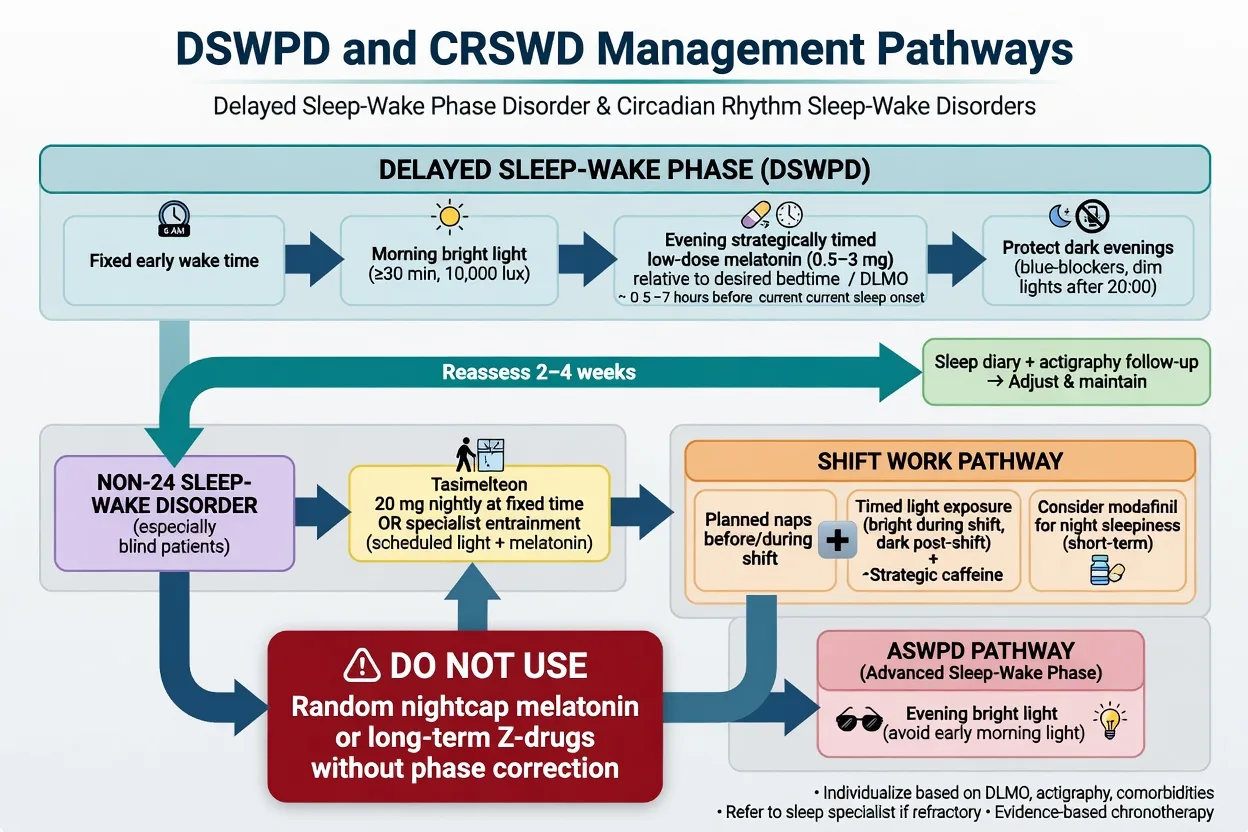
- Prescribed sleep-wake scheduling with fixed wake time, dark evenings when advancing, and behavioural adherence support.[1][2][4][11]
DSWPD (most common psychiatric presentation)
- Morning bright light after the desired wake time (protect regularity).
- Evening melatonin timed as a chronobiotic, not a random hypnotic. Mundey and colleagues showed phase advance depends on timing relative to DLMO — earlier administration relative to DLMO produced larger advances, with melatonin doses of 0.3 mg or 3.0 mg used in that trial framework.[7]
- Sletten and colleagues (DelSoM RCT): melatonin 0.5 mg orally about 1 hour before desired bedtime, combined with behavioural sleep-wake scheduling (attempt sleep at desired bedtime at least 5 nights/week), advanced sleep onset and improved sleep-related impairment versus placebo.[5]
- Meta-analytic synthesis supports exogenous melatonin for advancing rhythm and reducing sleep-onset latency in delayed sleep phase disorder.[6]
- Avoid late evening bright/blue light; fixed morning rise even after poor sleep is often required to consolidate advance.
- Do not default to long-term benzodiazepine/Z-drug nightcaps without phase work — BAP consensus frames circadian disorders as light/melatonin/schedule problems first.[11][12]
ASWPD
Evening bright light and protection from early morning light; carefully timed melatonin if used (direction opposite DSWPD aims). Evidence base is thinner than DSWPD; AASM intrinsic CRSWD guidance is the structure examiners expect.[1][3]
Non-24-hour disorder
In totally blind people, tasimelteon entrained circadian rhythms and maintained entrainment in the SET and RESET phase 3 trials; continued treatment was needed to maintain benefit.[8] Specialty pathways may also use carefully timed melatonin. Access and formulary status vary by region — document specialist involvement.[1][8]
ISWRD
Consolidate light exposure and daytime activity; structured schedules; minimise sedative polypharmacy in dementia; caregiver-led diaries.[1][3]
Shift work disorder
- Organisational: forward-rotating rosters where possible, adequate recovery, nap policy.
- Individual: planned naps, strategic caffeine early in shift, bright light during night work, darkness for day sleep.
- Modafinil 200 mg improved wakefulness measures in shift-work sleep disorder in the Czeisler NEJM RCT — use within local licensing, monitor for residual sleepiness (not a complete normaliser), and never as a substitute for removing someone who is already unsafe to drive/operate machinery.[9][2][10]
- Short-term hypnotics for daytime sleep only with a deprescribing plan and fall/next-duty safety review.[11]
Jet lag
Pre-flight partial adjustment with timed light/melatonin for important travel; eastbound needs advance strategies. Usually self-limited; safety-critical occupations need formal plans.[2]
Subtypes and scenarios
Adolescent DSWPD + school failure. Frame as treatable chronobiology, not laziness. Family-supported fixed rise time, morning light, evening melatonin plan, school liaison (later start or adjusted timetable when available), ADHD assessment if attention symptoms persist after sleep opportunity improves.[3][5][11]
Bipolar spectrum. Irregular sleep-wake timing is a relapse risk; prioritise regularity. Extreme forced phase shifts need mood monitoring.[11]
ANZ FIFO / nursing / emergency rostering. Combine individual countermeasures with occupational health; rural sleep-lab delays should not block starting light/schedule interventions.[2][10]
Complications and pitfalls
- Melatonin at the wrong circadian phase.
- Labelling pure DSWPD as treatment-resistant insomnia and escalating sedatives.
- Missing OSA or substance use.
- Chronotherapy without adherence support → free-running worsening.
- Wake-promoting drugs without occupational risk management.
- Ignoring blindness in cyclic insomnia/sleepiness presentations.[1][7][11]
Prognosis and disposition
DSWPD often persists without active phase intervention but can be highly functional if the environment allows delayed schedules. Maintenance requires ongoing light hygiene and fixed wake anchors after initial advance. Step up to sleep medicine/chronobiology for refractory free-running, non-24, complex shift failure, or diagnostic uncertainty. Safety-net for occupational near-miss, mood decompensation, and progressive functional loss.[1][3][5]
Special populations
Children/adolescents. Developmental phase delay is common; parental supervision of light and melatonin timing; avoid blaming the young person alone.[3][6]
Pregnancy. Prioritise schedule and light; discuss melatonin only with obstetric-aware risk-benefit counselling.[6][11]
Older adults. ASWPD and ISWRD rise; avoid chronic sedatives for “early waking” without circadian framing; falls risk dominates.[1][11]
Intellectual disability / autism. High rates of irregular and delayed patterns; caregiver diaries; minimise polypharmacy.[1][3]
Indigenous and rural ANZ. Mining FIFO and limited specialty access — start behavioural and light interventions while awaiting referral.[2]
Evidence and guidelines
AASM (US): 2015 Auger clinical practice guideline updates intrinsic CRSWD treatment (DSWPD, ASWPD, N24, ISWRD); Sack 2007 Parts I–II and Morgenthaler practice parameters remain foundational teaching documents for shift work, jet lag, and evaluation tools including actigraphy.[1][2][3][4]
BAP (UK): 2010 statement and 2019 update cover insomnia, parasomnias, and circadian rhythm disorders — behavioural/light/melatonin first principles with rational short-term drugs.[11][12]
ANZ practice: Align with timed light/melatonin and schedule design; melatonin regulation differs from US OTC culture (often prescription pathways); tasimelteon access may be limited — specialist sleep referral for non-24. Occupational health partnership is essential for FIFO and night-shift SWD.[2][8][10][11]
Landmark trial names for viva. DelSoM/Sletten melatonin 0.5 mg + scheduling (DSWPD); Mundey phase-dependent melatonin; van Geijlswijk melatonin meta-analysis; Lockley SET/RESET tasimelteon; Czeisler modafinil SWD; Drake SWD epidemiology.[5][6][7][8][9][10]
Exam pearls
- Non-24 + total blindness → tasimelteon / specialist entrainment pathway, not serial Z-drugs.[8]
- Reduced need for sleep + elevated mood = mania until proven otherwise.
- Modafinil evidence is for SWD sleepiness, not a DSWPD cure.[9]
- Actigraphy over routine PSG for CRSWD diagnosis.[4]
- ICSD-3 groups CRSWDs separately from insomnia, breathing, hypersomnolence, parasomnia, and movement disorders — map the leaf correctly.[13]
References
- [1]Auger RR, Burgess HJ, Emens JS, et al. Clinical Practice Guideline for the Treatment of Intrinsic Circadian Rhythm Sleep-Wake Disorders: Advanced Sleep-Wake Phase Disorder (ASWPD), Delayed Sleep-Wake Phase Disorder (DSWPD), Non-24-Hour Sleep-Wake Rhythm Disorder (N24SWD), and Irregular Sleep-Wake Rhythm Disorder (ISWRD). An Update for 2015: An American Academy of Sleep Medicine Clinical Practice Guideline J Clin Sleep Med, 2015.PMID 26414986
- [2]Sack RL, Auckley D, Auger RR, et al. Circadian rhythm sleep disorders: part I, basic principles, shift work and jet lag disorders. An American Academy of Sleep Medicine review Sleep, 2007.PMID 18041480
- [3]Sack RL, Auckley D, Auger RR, et al. Circadian rhythm sleep disorders: part II, advanced sleep phase disorder, delayed sleep phase disorder, free-running disorder, and irregular sleep-wake rhythm. An American Academy of Sleep Medicine review Sleep, 2007.PMID 18041481
- [4]Morgenthaler TI, Lee-Chiong T, Alessi C, et al. Practice parameters for the clinical evaluation and treatment of circadian rhythm sleep disorders. An American Academy of Sleep Medicine report Sleep, 2007.PMID 18041479
- [5]Sletten TL, Magee M, Murray JM, et al. Efficacy of melatonin with behavioural sleep-wake scheduling for delayed sleep-wake phase disorder: A double-blind, randomised clinical trial PLoS Med, 2018.PMID 29912983
- [6]van Geijlswijk IM, Korzilius HP, Smits MG The use of exogenous melatonin in delayed sleep phase disorder: a meta-analysis Sleep, 2010.PMID 21120122
- [7]Mundey K, Benloucif S, Harsanyi K, et al. Phase-dependent treatment of delayed sleep phase syndrome with melatonin Sleep, 2005.PMID 16295212
- [8]Lockley SW, Dressman MA, Licamele L, et al. Tasimelteon for non-24-hour sleep-wake disorder in totally blind people (SET and RESET): two multicentre, randomised, double-masked, placebo-controlled phase 3 trials Lancet, 2015.PMID 26466871
- [9]Czeisler CA, Walsh JK, Roth T, et al. Modafinil for excessive sleepiness associated with shift-work sleep disorder N Engl J Med, 2005.PMID 16079371
- [10]Drake CL, Roehrs T, Richardson G, et al. Shift work sleep disorder: prevalence and consequences beyond that of symptomatic day workers Sleep, 2004.PMID 15683134
- [11]Wilson S, Anderson K, Baldwin D, et al. British Association for Psychopharmacology consensus statement on evidence-based treatment of insomnia, parasomnias and circadian rhythm disorders: An update J Psychopharmacol, 2019.PMID 31271339
- [12]Wilson SJ, Nutt DJ, Alford C, et al. British Association for Psychopharmacology consensus statement on evidence-based treatment of insomnia, parasomnias and circadian rhythm disorders J Psychopharmacol, 2010.PMID 20813762
- [13]Sateia MJ International classification of sleep disorders-third edition: highlights and modifications Chest, 2014.PMID 25367475