Dermatology · Medicine
Hypohidrotic ectodermal dysplasia
Also known as Hypohidrotic ectodermal dysplasia (HED) · Christ–Siemens–Touraine syndrome · XLHED · Anhidrotic ectodermal dysplasia
Hypohidrotic ectodermal dysplasia (HED; Christ–Siemens–Touraine) is a developmental genodermatosis of ectodermal appendages defined by the triad of hypohidrosis/anhidrosis, hypotrichosis, and hypodontia. X-linked HED (XLHED) is caused by loss-of-function mutations in EDA (ectodysplasin-A); autosomal forms involve EDAR or EDARADD in the same NF-κB developmental pathway. Infants risk life-threatening hyperthermia; lifelong care is multidisciplinary (cooling strategies, dental rehabilitation, hair/skin care, genetic counselling). Prenatal/perinatal recombinant ectodysplasin is an emerging causal therapy under trial.
On this page & tools
Your progress
Saved locally on this device.
Exam tags
Red flags
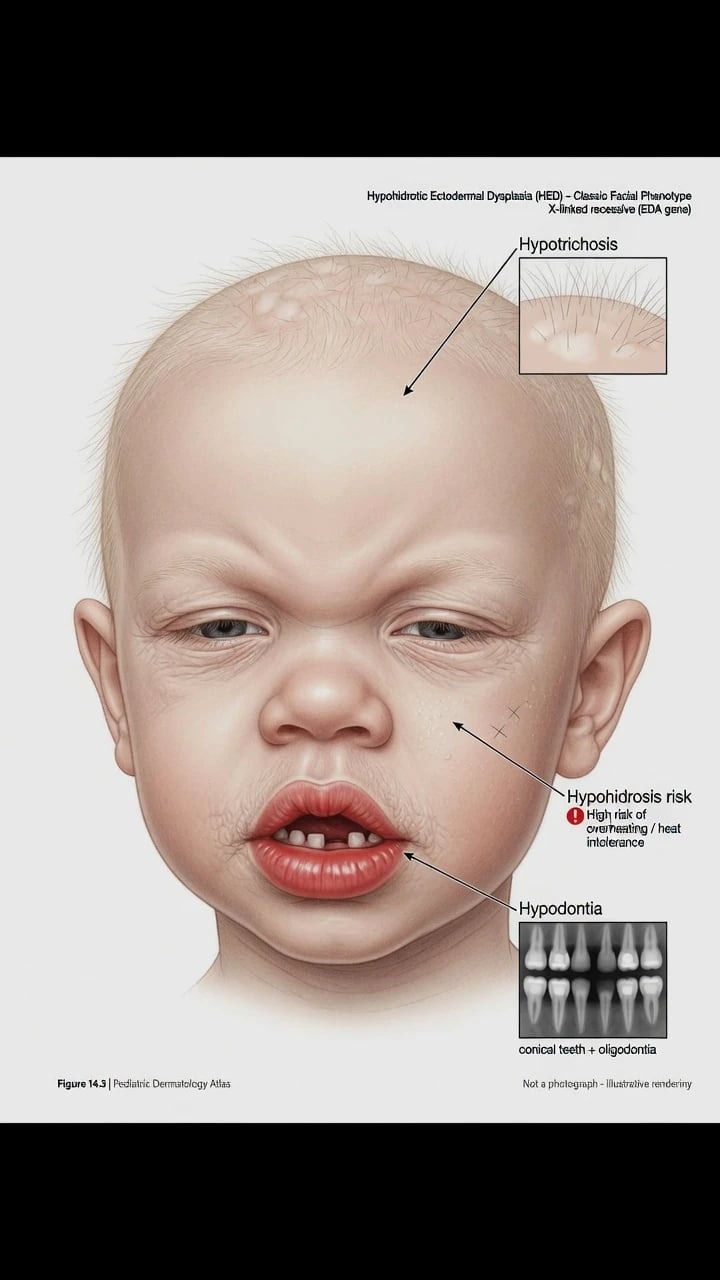
Definition and Classification
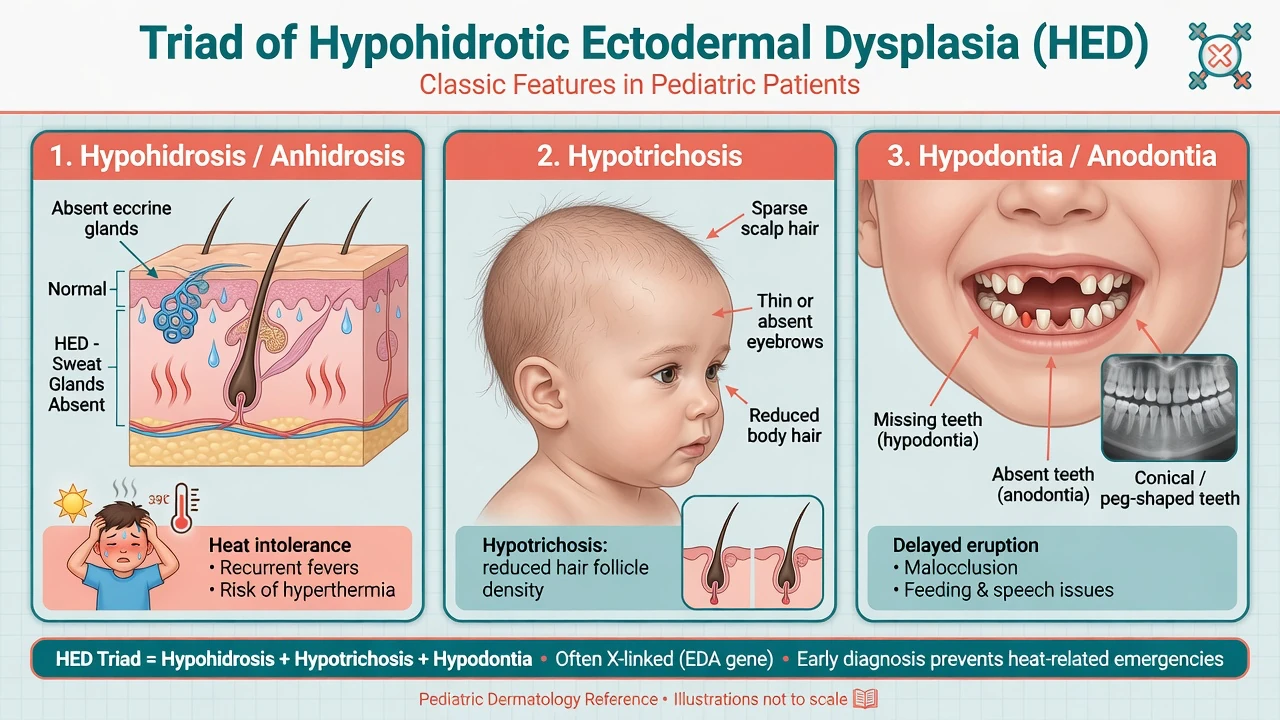
Hypohidrotic ectodermal dysplasia (HED), historically Christ–Siemens–Touraine syndrome and sometimes called anhidrotic ectodermal dysplasia, is a group of genodermatoses in which embryonic development of ectodermal appendages — eccrine sweat glands, hair follicles, and teeth — is impaired. The exam-facing clinical definition is the triad: [1]
- Hypohidrosis / anhidrosis — reduced or absent sweating → heat intolerance
- Hypotrichosis — sparse, fine, often light-coloured hair
- Hypodontia / oligodontia / anodontia — missing and/or conical (peg) teeth [1]
More than a hundred ectodermal dysplasia entities exist; HED is the most frequently tested “hypohidrotic” form. Inheritance and gene: [1]
| Form | Gene | Inheritance | Notes |
|---|---|---|---|
| XLHED | EDA (ectodysplasin-A) | X-linked recessive | ~majority of classic HED; males fully affected |
| Autosomal HED | EDAR or EDARADD | AR (sometimes AD) | Same pathway; phenocopy of XLHED |
| Clouston (hidrotic ED) | GJB6 (connexin-30) | AD | Normal sweating; nail dystrophy + hair — not HED |
Do not confuse HED with hidrotic ectodermal dysplasia (Clouston): sweating is preserved in Clouston, so heat-stroke risk differs fundamentally.[1][2][4]
Epidemiology and Risk Factors
XLHED is rare (order of 1 in 5,000–10,000 births in many estimates for X-linked HED spectrum; exact rates vary by ascertainment). Males with hemizygous EDA mutations show the full phenotype; carrier females may be asymptomatic or show mild patchy hypotrichosis, hypodontia, or reduced sweating because of random X-inactivation (lyonisation).[2][5][6]
Family history may reveal maternal male relatives with similar features; de novo EDA mutations also occur. Consanguinity raises suspicion for autosomal recessive EDAR/EDARADD disease. [1]
Pathophysiology
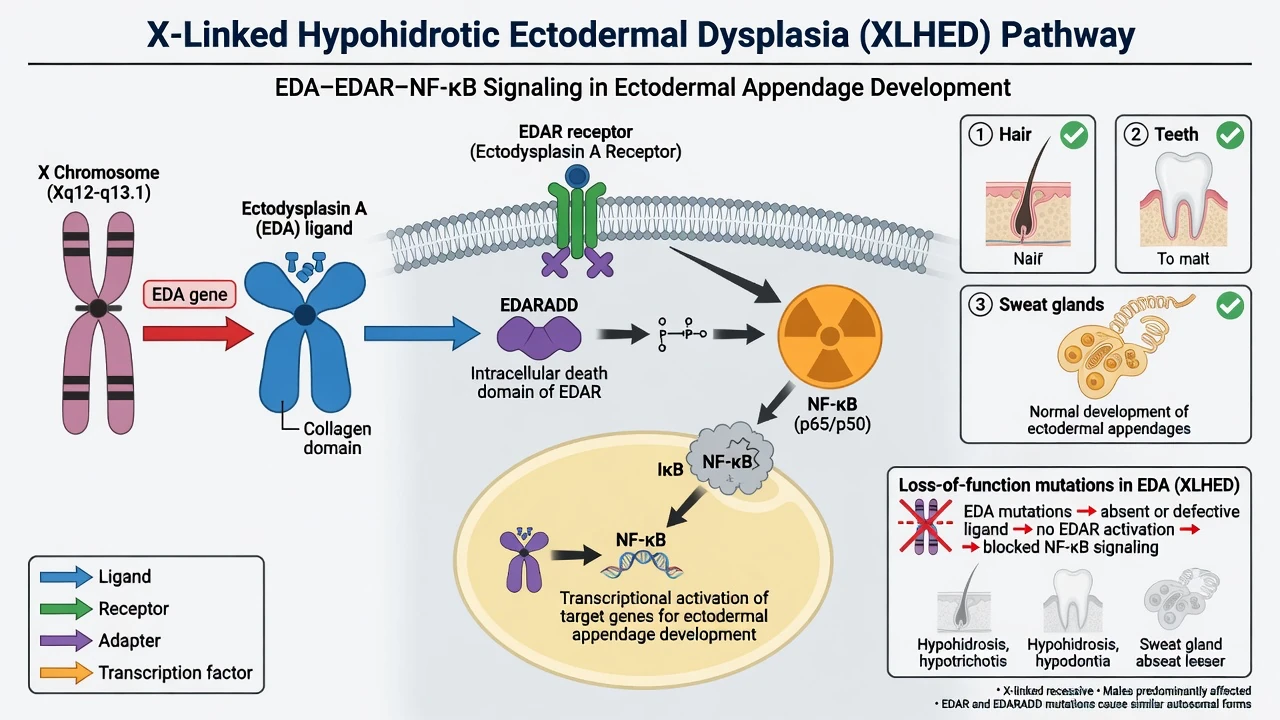
Ectodermal appendage formation requires a ligand–receptor developmental module: [1]
EDA (ligand) → EDAR (receptor) → EDARADD (adapter) → downstream NF-κB transcriptional programmes that induce hair follicles, teeth, and eccrine glands. [1]
Loss-of-function mutations at any step of this cascade produce the HED phenotype. EDA on Xq12–q13.1 encodes ectodysplasin-A; the most common clinical disease is XLHED from EDA mutations. Autosomal mutations in EDAR or EDARADD phenocopy XLHED because they sit on the same path.[3][4]
Absent or reduced eccrine glands abolish evaporative cooling → fever, heat exhaustion, and heat stroke, especially in infancy before the diagnosis is recognised. Failed dental lamina development produces oligodontia and conical crowns. Hair follicle induction failure produces lifelong hypotrichosis.[1][6]
Overlap note for examiners: hypomorphic IKBKG/NEMO mutations can cause ectodermal dysplasia with immunodeficiency (EDA-ID) — ectodermal features plus serious infections — distinct from classic pure HED but in the broader NF-κB developmental/immune network (see incontinentia pigmenti topic for related NEMO biology). [1]
Clinical Presentation
Cutaneous and adnexal
- Hair: sparse scalp hair from birth or early infancy; fine calibre; light colour; sparse eyebrows/eyelashes; body hair reduced. Trichoscopy shows reduced density and hair-shaft thinning.[7]
- Skin: soft, dry, sometimes wrinkled periorbital skin; atopic-like eczema is common; reduced sweating on examination history.
- Nails: often normal or only mildly dystrophic (contrast Clouston).
Craniofacial
Frontal bossing, depressed nasal bridge (saddle nose), maxillary hypoplasia, prominent full lips, and the “aged” periorbital appearance form a recognisable gestalt that examiners expect to name. [1]
Dental
Delayed eruption; conical/peg-shaped teeth; oligodontia or anodontia; need for early prosthetic planning. Dental disease drives feeding difficulty, speech issues, and major psychosocial impact.[6][8]
Systemic
- Thermoregulation failure — recurrent fevers in infancy (often misdiagnosed as infection)
- Dry nasal/respiratory mucosa, thick secretions, recurrent respiratory symptoms
- Occasional lacrimal issues; normal intelligence is typical [1]
Carrier females
Patchy hypotrichosis, mild hypodontia, or regional hypohidrosis may be the only clues — examine mothers of affected boys. [1]
Differential Diagnosis
| Condition | Distinguishing feature |
|---|---|
| Clouston hidrotic ED (GJB6) | Normal sweating; prominent nail dystrophy |
| EDA-ID (NEMO hypomorph) | Severe infections / immune dysfunction |
| Incontinentia pigmenti | Blaschkoid staged eruption; female-predominant; different course |
| Congenital atrichia / vitamin D-resistant rickets overlap entities | Different dental/skeletal pattern; sweating usually spared |
| Alopecia areata | Patchy non-scarring loss later in life; teeth/sweat normal |
| Acquired hypohidrosis | Drugs, neuropathy, Sjögren — not congenital triad |
HED / XLHED
Clouston (hidrotic)
EDA-ID
Clinical Assessment and Investigations
- History: heat intolerance, unexplained infantile fevers, delayed dentition, family males with similar facies.
- Exam: hair density, facial gestalt, dental morphology, skin dryness; plot growth.
- Sweat assessment: clinical history is primary; specialised sweat testing where available.
- Genetics: multigene panel including EDA, EDAR, EDARADD; cascade carrier testing.[2][5]
- Dental imaging (OPG) early; ENT if chronic rhinitis/otitis.
- Immunology only if infection phenotype suggests EDA-ID.
Management
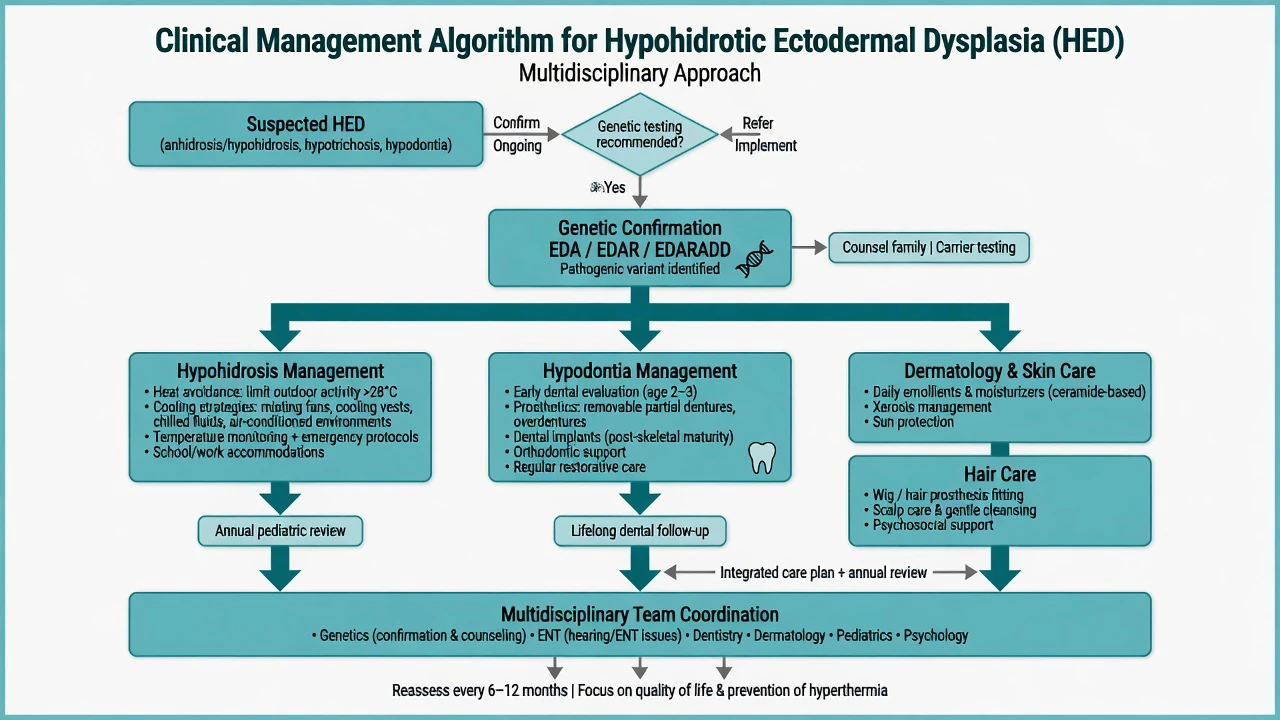
Heat and medical
- Aggressive heat avoidance, cooling vests, misting fans, air-conditioning, chilled fluids
- School/work emergency plans for hyperthermia
- Treat intercurrent fever actively; educate caregivers that “infection work-up alone” without cooling is incomplete [1]
Dental
Early paediatric dental referral; removable prostheses in childhood; implants often after skeletal maturity; orthodontics as needed. Systematic reviews support structured prosthetic rehabilitation pathways.[8]
Dermatologic / hair
Emollients for xerosis; sun protection; wigs/hairpieces; gentle hair care. Trichology findings guide counselling more than disease-modifying drugs.[7]
Genetic counselling
X-linked recurrence risk counselling for carrier mothers (50% of sons affected; 50% of daughters carriers). Offer prenatal/preimplantation options where appropriate.[2]
Emerging causal therapy
Short-term perinatal recombinant ectodysplasin (Fc-EDA) has shown durable improvements in sweat gland and related outcomes in early human experience; intra-amniotic ER004 is under investigation in the EDELIFE phase 2 programme. These are specialist research pathways — not yet routine standard of care everywhere — but fellowship candidates should know the biological rationale (ligand replacement during the developmental window).[9][10]
Complications and Pitfalls
Exam application bank (NEET-PG / INICET)
One-line answer
Hypohidrotic ectodermal dysplasia (HED; Christ–Siemens–Touraine) is a developmental genodermatosis of ectodermal appendages defined by the triad of hypohidrosis/anhidrosis, hypotrichosis, and hypodontia. X-linked HED (XLHED) is caused by loss-of-function mutations in EDA (ectodysplasin-A); autosomal forms involve EDAR or EDARADD in the same NF-κB developmental pathway. Infants risk life-threatening hyperthermia; lifelong care is multidisciplinary (cooling strategies, dental rehabilitation, hair/skin care, genetic counselling). Prenatal/perinatal recombinant ectodysplasin is an emerging causal therapy under trial.
Worked stems (answer without another resource)
Stem 1 — Classic presentation. Map symptoms to mechanism; name the first investigation and first treatment step with dose/route if drug therapy is standard. [1]
Stem 2 — Unstable / complicated. List red flags that force immediate resuscitation, theatre, ICU, antidote, or reperfusion — and what you do in the first 15 minutes. [1]
Stem 3 — Atypical group. Elderly, pregnancy, child, or immunocompromised: how presentation and thresholds change. [1]
Stem 4 — Differential trap. Name the three closest mimics and one discriminator for each. [1]
Stem 5 — Disposition. Who goes home with safety-netting, who is admitted, who needs HDU/ICU/theatre, and what follow-up is mandatory. [1]
Rapid viva checklist
- Definition + classification
- Pathophysiology chain
- Bedside signs / criteria
- Score with exact components (if any)
- Emergency bundle
- Definitive therapy with doses
- Complications of disease and of treatment
- Special populations
- Guideline/trial name if classic
- Three exam traps
Coverage self-check
If you cannot answer any stem above from this page alone, re-read the matching section — the page is intended to be self-sufficient for final-prof and NEET-PG/INICET questions on Hypohidrotic ectodermal dysplasia.
Expanded exam teaching (depth pass)
Clinical reasoning
For Hypohidrotic ectodermal dysplasia, examiners test whether you can prioritise life threats, choose the right first test, and give specific therapy (agent, dose, route, timing). Generic phrases without numbers score poorly.
Mechanism → feature map
Build a short chain: cause → pathophysiologic intermediate → clinical feature → complication. Every major symptom in the classic vignette should sit on that chain.
Investigation strategy
- Bedside/first-line tests that change immediate management
- Confirmatory or staging tests
- What a normal result does not exclude
- When not to delay treatment for imaging (unstable patient)
Management ladder
- Resuscitation / ABC / sepsis or haemorrhage bundle as relevant
- Specific antidote / procedure / antimicrobial / reperfusion / surgery
- Supportive care and monitoring targets
- Definitive long-term therapy and secondary prevention
- Disposition and safety-net advice
Special populations
Always prepare one line each for children, pregnancy, elderly, renal/hepatic impairment, and immunocompromised patients when the topic allows.
Pitfalls that fail candidates
- Treating the number not the patient
- Missing pregnancy status when relevant
- Imaging before stabilisation
- Wrong empiric cover or wrong antidote timing
- Incomplete counselling on recurrence, adherence, or red-flag return
Hypohidrotic ectodermal dysplasia (HED; Christ–Siemens–Touraine) is a developmental genodermatosis of ectodermal appendages defined by the triad of hypohidrosis/anhidrosis, hypotrichosis, and hypodontia. X-linked HED (XLHED) is caused by loss-of-function mutations in EDA (ectodysplasin-A); autosomal forms involve EDAR or EDARADD in the same NF-κB developmental pathway. Infants risk life-threatening hyperthermia; lifelong care is multidisciplinary (cooling strategies, dental rehabilitation, hair/ [1]
Structured revision sheet
Must-know numbers and names
List every score, size threshold, dose, and time window from this topic on a blank page from memory, then check against the sections above.
Three classic MCQ angles
- Most likely diagnosis given a vignette
- Next best step in management
- Most appropriate investigation
Three classic SAQ angles
- Pathophysiology in five steps
- Management algorithm with doses
- Complications and prevention
Clinical station flow
Greet → focused history → targeted exam → investigations → explain diagnosis → emergency care → definitive plan → safety-net / follow-up → answer examiner questions on mechanism and pitfalls.
[1]Pitfalls: missing carrier mothers; labelling as non-accidental dental neglect; promising “hair will grow normally”; confusing with Clouston; overlooking immunodeficiency overlap. [1]
Special Populations and Prognosis
Neonates/infants need thermoregulation teaching before the first summer. Intelligence and lifespan are usually normal with heat precautions and dental care. Psychosocial support for facial and dental difference is essential. Transition to adult dentistry and genetics services should be planned.[2][5]
Evidence and Exam Pearls
[1]HED HHH
Key Takeaways
- HED is a developmental ectodermal appendage disorder — not a progressive inflammatory dermatosis.
- Thermoregulation is the life-critical issue in childhood.
- Dental rehabilitation dominates long-term quality of life.
- Genetics confirms pathway gene and enables family counselling.
- Ligand replacement during fetal/perinatal windows is the emerging causal paradigm.[1][3][9]
Exam anchors
References
- [1]Reyes-Reali J, Mendoza-Ramos MI, Garrido-Guerrero E, et al. Hypohidrotic ectodermal dysplasia: clinical and molecular review Int J Dermatol, 2018.PMID 29855039
- [2]Adam MP, Bick S, Mirzaa GM, et al. Hypohidrotic Ectodermal Dysplasia 1993.PMID 20301291
- [3]Mikkola ML. Molecular aspects of hypohidrotic ectodermal dysplasia Am J Med Genet A, 2009.PMID 19681132
- [4]Trzeciak WH, Koczorowski R. Molecular basis of hypohidrotic ectodermal dysplasia: an update J Appl Genet, 2016.PMID 26294279
- [5]Fete M, Hermann J, Behrens J, et al. X-linked hypohidrotic ectodermal dysplasia (XLHED): clinical and diagnostic insights from an international patient registry Am J Med Genet A, 2014.PMID 24664614
- [6]Anbouba GM, Carmany EP, Natoli JL. The characterization of hypodontia, hypohidrosis, and hypotrichosis associated with X-linked hypohidrotic ectodermal dysplasia: A systematic review Am J Med Genet A, 2020.PMID 31981414
- [7]Peña-Romero AG, Sáez-de-Ocariz M, Toussaint-Caire S, et al. Clinical, trichoscopy, and light microscopic findings in hypohidrotic ectodermal dysplasia: Report of 21 patients and a review of the literature Pediatr Dermatol, 2021.PMID 33085121
- [8]Schnabl D, Grunert I, Schmuth M, et al. Prosthetic rehabilitation of patients with hypohidrotic ectodermal dysplasia: A systematic review J Oral Rehabil, 2018.PMID 29679503
- [9]Schneider H, Schweikl C, Faschingbauer F, et al. A Causal Treatment for X-Linked Hypohidrotic Ectodermal Dysplasia: Long-Term Results of Short-Term Perinatal Ectodysplasin A1 Replacement Int J Mol Sci, 2023.PMID 37108325
- [10]Schneider H, Hadj-Rabia S, Faschingbauer F, et al. Protocol for the Phase 2 EDELIFE Trial Investigating the Efficacy and Safety of Intra-Amniotic ER004 Administration to Male Subjects with X-Linked Hypohidrotic Ectodermal Dysplasia Genes (Basel), 2023.PMID 36672894