Dermatology · Medicine
Ingrown toenail
Also known as Onychocryptosis · Unguis incarnatus · Ingrowing toenail · Embedded toenail
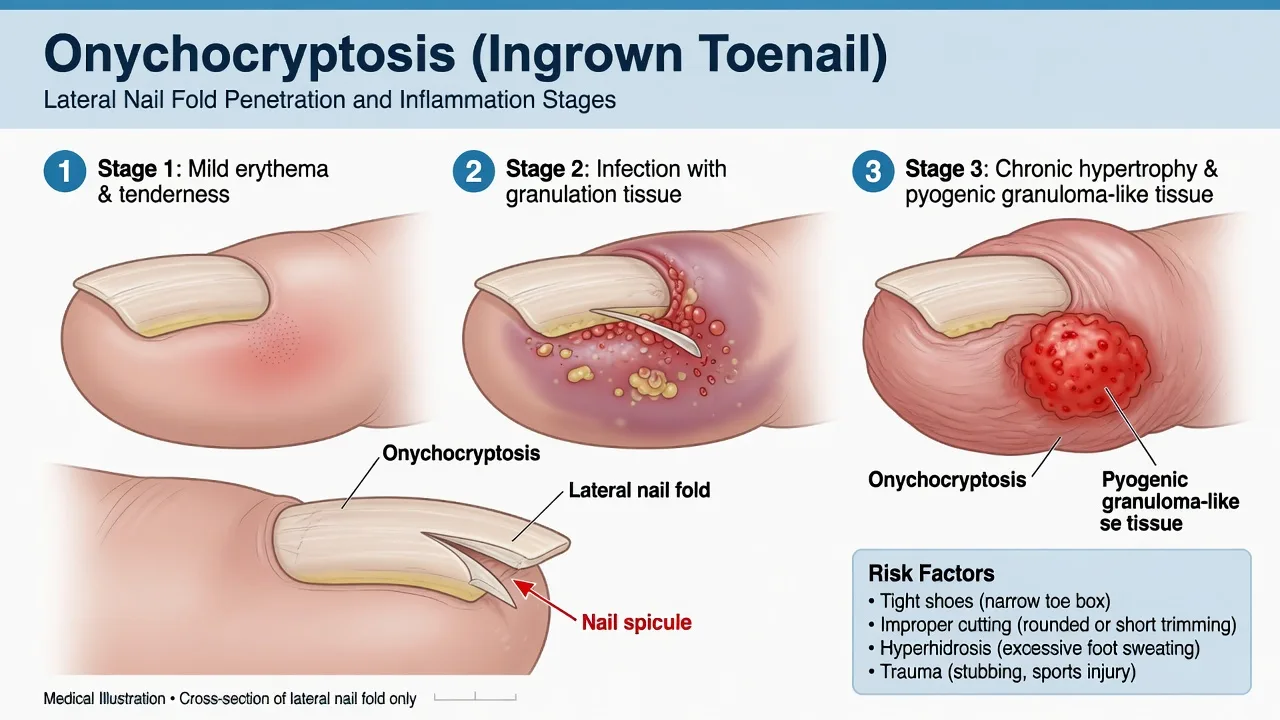
Onychocryptosis (ingrown toenail) is mechanical penetration of the nail plate into the lateral nail fold producing inflammation, secondary infection, and eventually chronic hypertrophy with granulation tissue. High-yield content covers risk factors (tight shoes, improper cutting, hyperhidrosis), three-stage severity, differentials including paronychia and subungual malignancy, stage-based care from conservative packing to partial nail avulsion and phenol chemical matrixectomy, antibiotic indications, and red flags in diabetes/ischaemia.
On this page & tools
Your progress
Saved locally on this device.
Exam tags
Red flags
Overview & Definition
Onychocryptosis (ingrown toenail) occurs when the lateral edge of the nail plate penetrates the soft tissue of the lateral nail fold, acting as a foreign body. The hallux is far most often affected. It is one of the commonest nail-unit presentations in primary care, podiatry, and dermatology procedure clinics.[1][3][6]
Classification
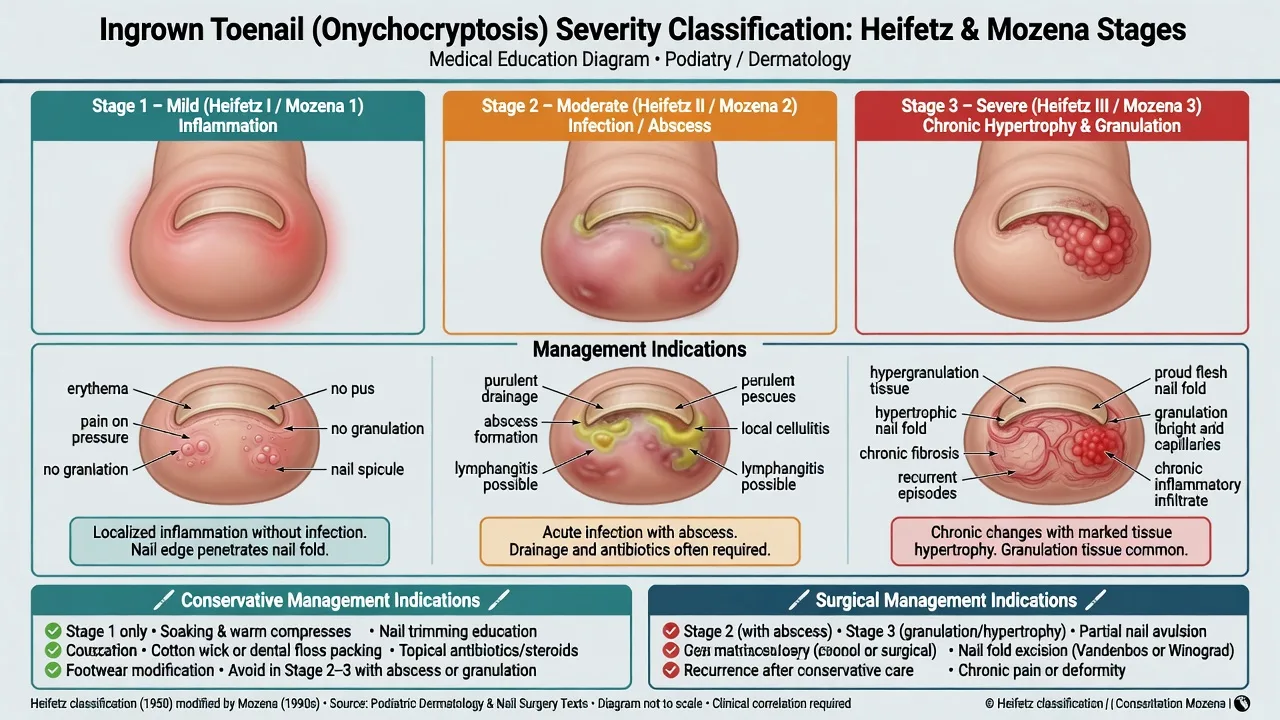
A practical three-stage system (widely taught; related to classic Heifetz-type staging) is exam gold: [1]
- Stage 1 — erythema, oedema, pain on pressure; skin intact.
- Stage 2 — infection, seropurulent discharge, more severe pain.
- Stage 3 — chronic inflammation with hypertrophic nail-fold tissue and often pyogenic granuloma-like granulation.[1][2][3]
Epidemiology & Risk Factors
Peaks in adolescents/young adults and again with age-related nail dystrophy. Risk factors: tight or pointed footwear, improper nail cutting (rounding corners / cutting too short leaving a spicule), hyperhidrosis, trauma, genetic wide nail plate or pincer morphology, obesity, and repetitive sport stress.[1][3] Diabetes and peripheral arterial disease do not cause the spicule but amplify infectious complications.
Pathophysiology
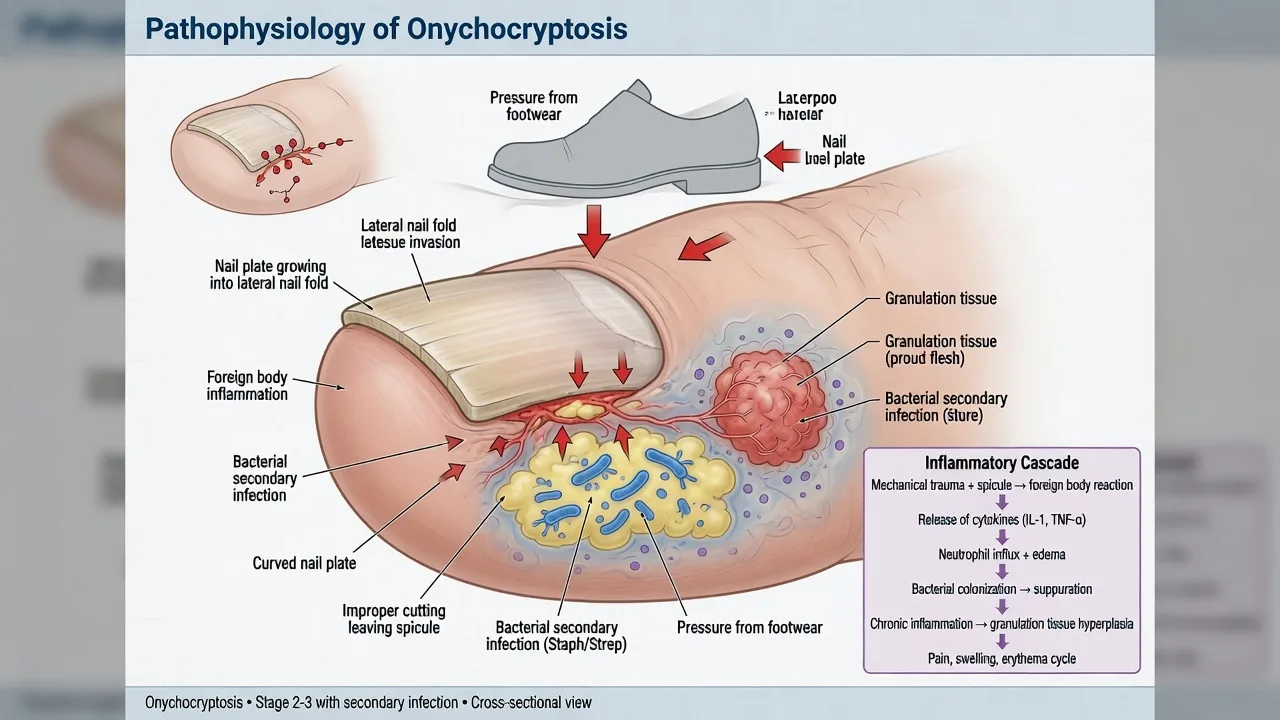
The nail edge (often a sharp spicule from incorrect cutting) penetrates the lateral fold. Local foreign-body inflammation produces pain and swelling; skin breakdown allows secondary bacterial infection (commonly skin flora including staphylococci). Chronicity generates granulation tissue and fold hypertrophy that further embed the nail — a self-perpetuating cycle. Simple avulsion without addressing the lateral matrix often allows the same wide matrix to regrow the same pathological edge, explaining high recurrence.[1][3][5]
Clinical Presentation
Pain on walking and with footwear is the dominant symptom. Examination shows stage-appropriate inflammation of one or both lateral folds of the hallux; a spicule may be visible; granulation tissue may bleed easily in stage 3. Bilateral disease and lesser-toe involvement occur but are less common.[1]
Differential Diagnosis
- Acute paronychia without true nail embedding.
- Cellulitis of the toe / web-space infection.
- Onychomycosis with nail dystrophy (may coexist).
- Subungual exostosis (bony spur — X-ray if atypical).
- Retronychia (proximal embedding).
- Pincer nail.
- Malignancy (SCC, melanoma) masquerading as chronic single-digit granulation — biopsy the odd case.[6]
Clinical & Bedside Assessment
Inspect footwear, gait, and nail-cutting habits. Palpate pulses, check capillary refill, and screen sensation in at-risk feet. Gently separate the fold to identify the spicule and any abscess. Document diabetes status. Image when osteomyelitis or bony spur is plausible.[1][2]
Investigations
Diagnosis is clinical. Swab if you need organism-guided therapy for significant infection; check HbA1c in recurrent or severe disease; X-ray selectively for exostosis/osteomyelitis. Biopsy atypical chronic granulation.[6]
Management — Resuscitation
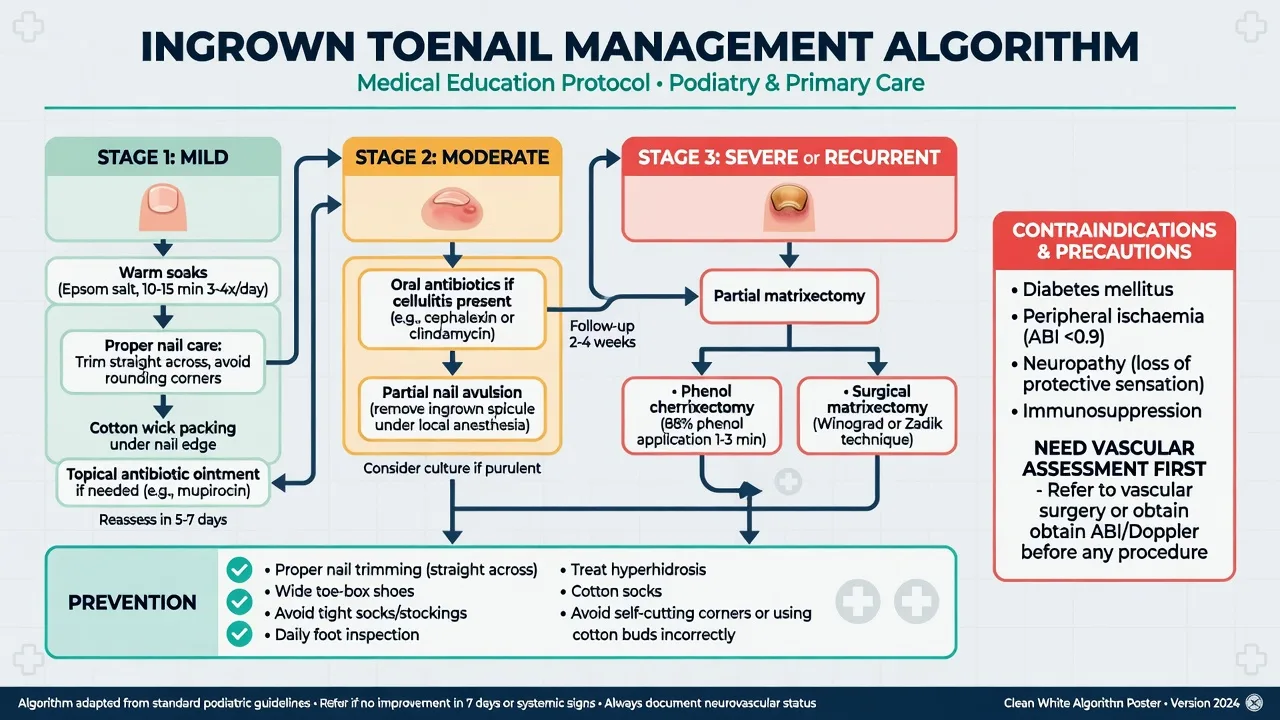
For spreading cellulitis, lymphangitis, or systemic features: rest, elevation, appropriate systemic antibiotics covering skin pathogens per local formulary (e.g. flucloxacillin where MSSA likely and no allergy — dose per local adult guidelines such as 500 mg four times daily orally for uncomplicated cellulitis), and early review. Ischaemic or severely neuropathic feet need urgent multidisciplinary diabetic-foot pathways rather than clinic phenol the same day.[1]
Management — Definitive & Stepwise
Stage 1 — conservative
Warm soaks, elevation, wide footwear, straight-across nail cutting, cotton-wick or gutter splint packing under the lateral edge, and topical care of the fold. Educate to stop digging at corners.[1][2]
Stage 2 — control infection + relieve spicule
If true cellulitis, add antibiotics. Soft-tissue drainage of pus when present. Partial nail avulsion of the offending lateral strip under local anaesthesia (digital block) relieves the foreign body immediately.[1][3]
Stage 3 / recurrent disease — definitive matrix control
Partial matrixectomy of the lateral horn of the matrix reduces recurrence. Chemical ablation with phenol applied carefully to the lateral matrix after partial avulsion is a standard podiatric/dermatologic technique; combination surgical + phenol approaches are widely used and studied.[1][4][5] Protect surrounding skin; irrigate per protocol; counsel on delayed healing and drainage expected after phenol. Alternatives include surgical matrix excision without phenol and other chemical agents (e.g. sodium hydroxide) in some services.
Aftercare
Elevation, wide shoes, daily soaks/dressings as instructed, analgesia, watch for infection, and return precautions. Sports return is staged by pain and wound status.[1]
Specific Subtypes & Scenarios
Paediatrics: prefer maximal conservative care; procedures when recurrent/severe.
Athletes: footwear modification is half the cure.
Diabetes: infection threshold lower; offloading and vascular assessment first.
Anticoagulated patients: coordinate peri-procedure plan. [1]
Complications & Pitfalls
Osteomyelitis, recurrent disease after avulsion alone, phenol burns if misapplied, permanent nail dystrophy, and operating on an ischaemic toe.[3][4] Antibiotics without mechanical relief fail when the spicule remains.
Prognosis & Disposition
Mild disease often settles with education and packing. Recurrence after definitive lateral matrixectomy is substantially lower than after temporary avulsion alone.[5] Refer podiatry/dermatologic surgery/ortho for recurrent stage 3, diagnostic doubt, or high-risk feet.
Special Populations
Children, elderly, diabetic, and vasculopath patients need tailored aggression — not a one-size phenol protocol. Pregnancy: prefer conservative measures; discuss chemical matrixectomy only if benefits clearly outweigh theoretical risks and local policy allows. [1]
Evidence, Guidelines & Regional Differences
American Family Physician reviews provide practical primary-care algorithms for staging and procedures.[1][2] Indian and international dermatology reviews emphasise matrixectomy options and local resource variation.[3] Phenol application technique papers and comparative matrixectomy studies support chemical ablation as a core skill.[4][5]
Exam Pearls
NAIL stage plan
- Mechanical disease first, microbes second.[1]
- Stage 3 granulation is not “just a pyogenic granuloma” to ignore.
- Send or photograph atypical tissue if malignancy possible.[6]
- Diabetes + tight shoes is a classic Indian/tropical clinic vignette.[3]
Exam application bank (NEET-PG / INICET)
One-line answer
Onychocryptosis (ingrown toenail) is mechanical penetration of the nail plate into the lateral nail fold producing inflammation, secondary infection, and eventually chronic hypertrophy with granulation tissue. High-yield content covers risk factors (tight shoes, improper cutting, hyperhidrosis), three-stage severity, differentials including paronychia and subungual malignancy, stage-based care from conservative packing to partial nail avulsion and phenol chemical matrixectomy, antibiotic indications, and red flags in diabetes/ischaemia.
Worked stems (answer without another resource)
Stem 1 — Classic presentation. Map symptoms to mechanism; name the first investigation and first treatment step with dose/route if drug therapy is standard. [1]
Stem 2 — Unstable / complicated. List red flags that force immediate resuscitation, theatre, ICU, antidote, or reperfusion — and what you do in the first 15 minutes. [1]
Stem 3 — Atypical group. Elderly, pregnancy, child, or immunocompromised: how presentation and thresholds change. [1]
Stem 4 — Differential trap. Name the three closest mimics and one discriminator for each. [1]
Stem 5 — Disposition. Who goes home with safety-netting, who is admitted, who needs HDU/ICU/theatre, and what follow-up is mandatory. [1]
Rapid viva checklist
- Definition + classification
- Pathophysiology chain
- Bedside signs / criteria
- Score with exact components (if any)
- Emergency bundle
- Definitive therapy with doses
- Complications of disease and of treatment
- Special populations
- Guideline/trial name if classic
- Three exam traps
Coverage self-check
If you cannot answer any stem above from this page alone, re-read the matching section — the page is intended to be self-sufficient for final-prof and NEET-PG/INICET questions on Ingrown toenail.
Expanded exam teaching (depth pass)
Clinical reasoning
For Ingrown toenail, examiners test whether you can prioritise life threats, choose the right first test, and give specific therapy (agent, dose, route, timing). Generic phrases without numbers score poorly.
Mechanism → feature map
Build a short chain: cause → pathophysiologic intermediate → clinical feature → complication. Every major symptom in the classic vignette should sit on that chain.
Investigation strategy
- Bedside/first-line tests that change immediate management
- Confirmatory or staging tests
- What a normal result does not exclude
- When not to delay treatment for imaging (unstable patient)
Management ladder
- Resuscitation / ABC / sepsis or haemorrhage bundle as relevant
- Specific antidote / procedure / antimicrobial / reperfusion / surgery
- Supportive care and monitoring targets
- Definitive long-term therapy and secondary prevention
- Disposition and safety-net advice
Special populations
Always prepare one line each for children, pregnancy, elderly, renal/hepatic impairment, and immunocompromised patients when the topic allows.
Pitfalls that fail candidates
- Treating the number not the patient
- Missing pregnancy status when relevant
- Imaging before stabilisation
- Wrong empiric cover or wrong antidote timing
- Incomplete counselling on recurrence, adherence, or red-flag return
Onychocryptosis (ingrown toenail) is mechanical penetration of the nail plate into the lateral nail fold producing inflammation, secondary infection, and eventually chronic hypertrophy with granulation tissue. High-yield content covers risk factors (tight shoes, improper cutting, hyperhidrosis), three-stage severity, differentials including paronychia and subungual malignancy, stage-based care from conservative packing to partial nail avulsion and phenol chemical matrixectomy, antibiotic indicat [1]
Structured revision sheet
Must-know numbers and names
List every score, size threshold, dose, and time window from this topic on a blank page from memory, then check against the sections above.
Three classic MCQ angles
- Most likely diagnosis given a vignette
- Next best step in management
- Most appropriate investigation
Three classic SAQ angles
- Pathophysiology in five steps
- Management algorithm with doses
- Complications and prevention
Clinical station flow
Greet → focused history → targeted exam → investigations → explain diagnosis → emergency care → definitive plan → safety-net / follow-up → answer examiner questions on mechanism and pitfalls.
Exam anchors
References
- [1]Mayeaux EJ Jr, Carter C, Murphy TE. Ingrown Toenail Management Am Fam Physician, 2019.PMID 31361106
- [2]Heidelbaugh JJ, Lee H. Management of the ingrown toenail Am Fam Physician, 2009.PMID 19235497
- [3]Khunger N, Kandhari R. Ingrown toenails Indian J Dermatol Venereol Leprol, 2012.PMID 22565427
- [4]Becerro de Bengoa Vallejo R, Losa Iglesias ME, Sanchez Gomez R, Jules KT. Gauze application of phenol for matrixectomy J Am Podiatr Med Assoc, 2008.PMID 18820047
- [5]Isik C, Cakici H, Coscun KA, Ergun C. Comparison of partial matrixectomy and combination treatment (partial matrixectomy + phenol) in ingrown toenail Med Glas (Zenica), 2013.PMID 23348167
- [6]Lee DK, Lipner SR. Optimal diagnosis and management of common nail disorders Ann Med, 2022.PMID 35238267