Dermatology · Medicine
Intralesional therapy
Also known as Intralesional corticosteroid · Intralesional triamcinolone · IL TAC · Intralesional 5-FU · Intralesional injection therapy
Intralesional therapy delivers a drug depot directly into skin lesions. Triamcinolone acetonide (TAC) is the workhorse for keloids, hypertrophic scars, and limited patchy alopecia areata. Concentration is site-adjusted (lower on face and for AA; higher for thick keloid), with serial sessions every 3–6 weeks. Key local risks are atrophy, telangiectasia, and hypopigmentation; rare systemic corticosteroid effects follow large cumulative doses. Other agents include 5-fluorouracil, bleomycin, and Candida antigen for selected indications.
On this page & tools
Your progress
Saved locally on this device.
Exam tags
Red flags
Overview and Definition
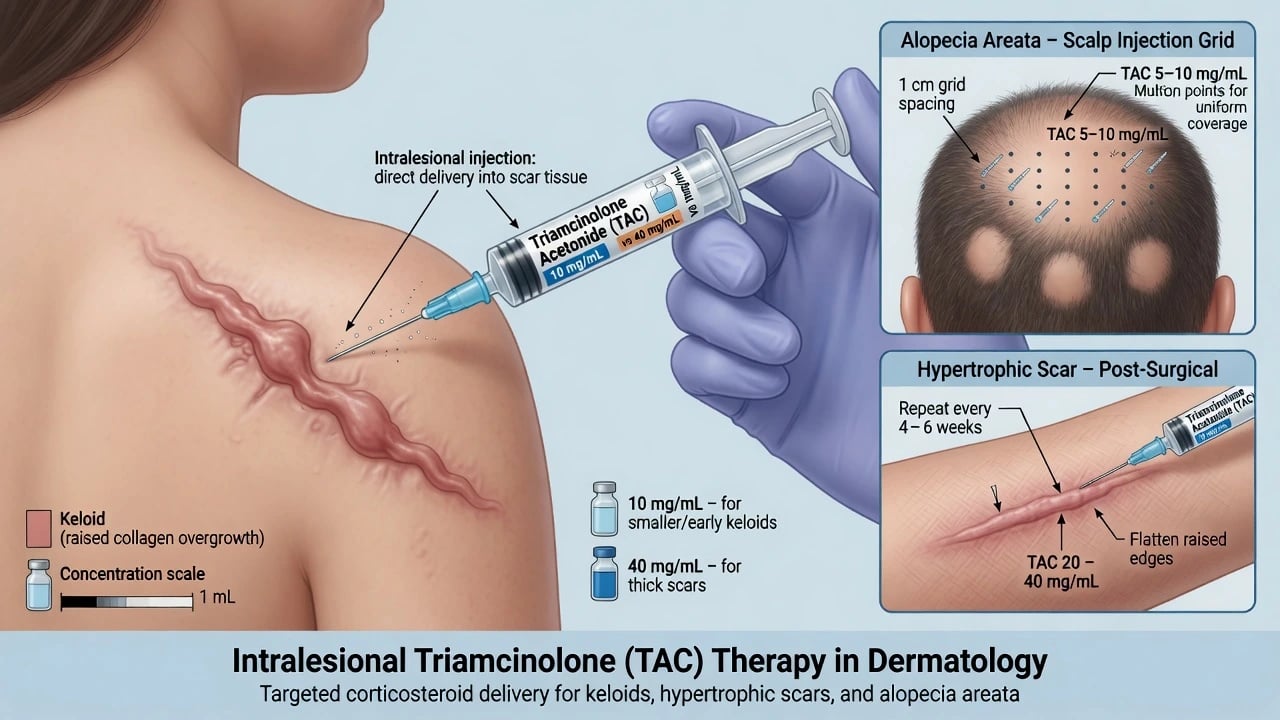
Intralesional (IL) therapy is the direct injection of a medication into diseased skin or scar to achieve a high local concentration with relatively limited systemic exposure compared with oral dosing of the same drug class.[1] In dermatology the dominant agent is triamcinolone acetonide (TAC), a particulate corticosteroid suspension that forms a local depot. Other injectable tools — 5-fluorouracil (5-FU), bleomycin, Candida antigen, and selected others — extend the platform beyond steroids for scars and warts.[3][4]
IL therapy is a procedure, not a casual “steroid shot”: concentration, depth, volume per puncture, total session dose, and interval determine efficacy and the signature complications of dermal atrophy and pigment change. [1]
Classification of Agents
Triamcinolone acetonide
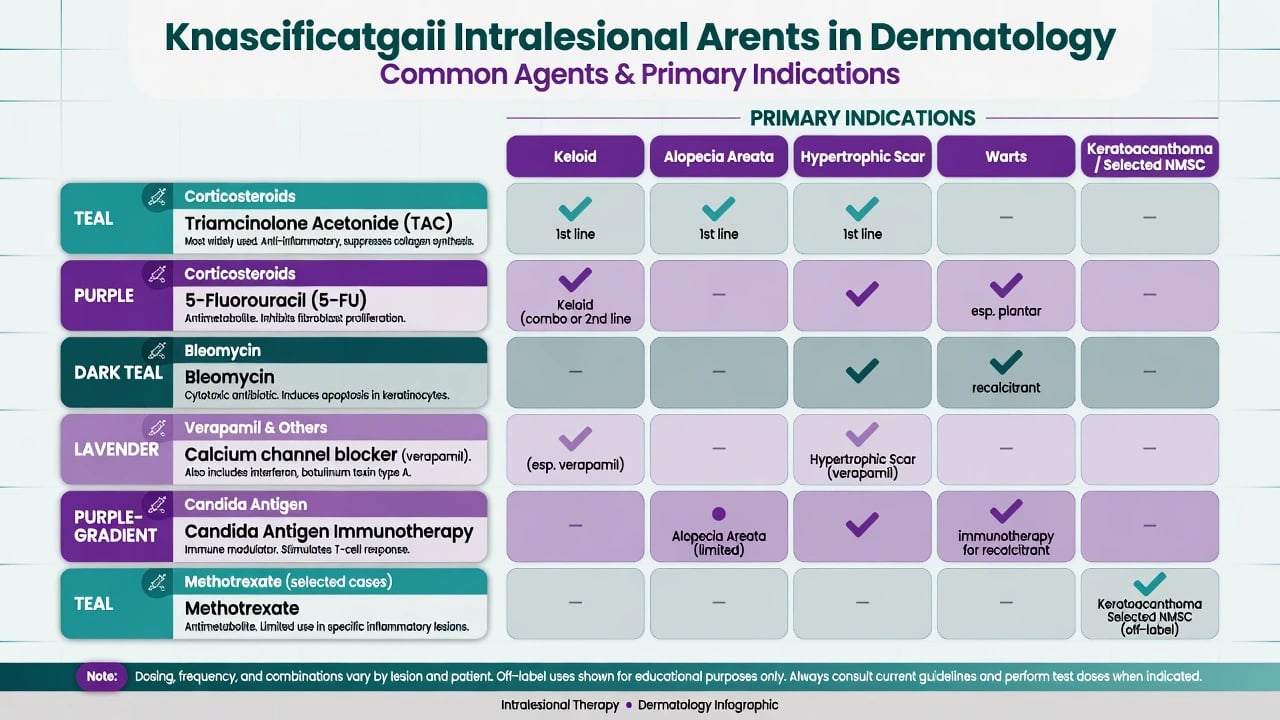
- First-line IL agent for keloid, hypertrophic scar, patchy AA
- Anti-inflammatory; reduces fibroblast activity in scars
- Stock often 10 or 40 mg/mL — dilute to site needs
- Atrophy/telangiectasia if too strong or too superficial
5-Fluorouracil
- Antimetabolite used in keloid protocols
- Often combined with TAC
- Can cause ulceration and pain
- Evidence summarised in systematic reviews
Bleomycin / immunotherapy
- Bleomycin for selected recalcitrant warts/scars in experienced hands
- Candida antigen immunotherapy for warts
- Local necrosis risk with bleomycin
- Not routine first injections for simple keloid
Epidemiology and Practice Context
IL TAC is among the most common procedural prescriptions in dermatology clinics wherever keloids are prevalent and wherever patchy alopecia areata is managed medically before systemic escalation.[6][9] Serial visits every few weeks are the norm; single-injection “cures” of keloid are not a realistic counselling message.[3]
Pathophysiology and Mechanism
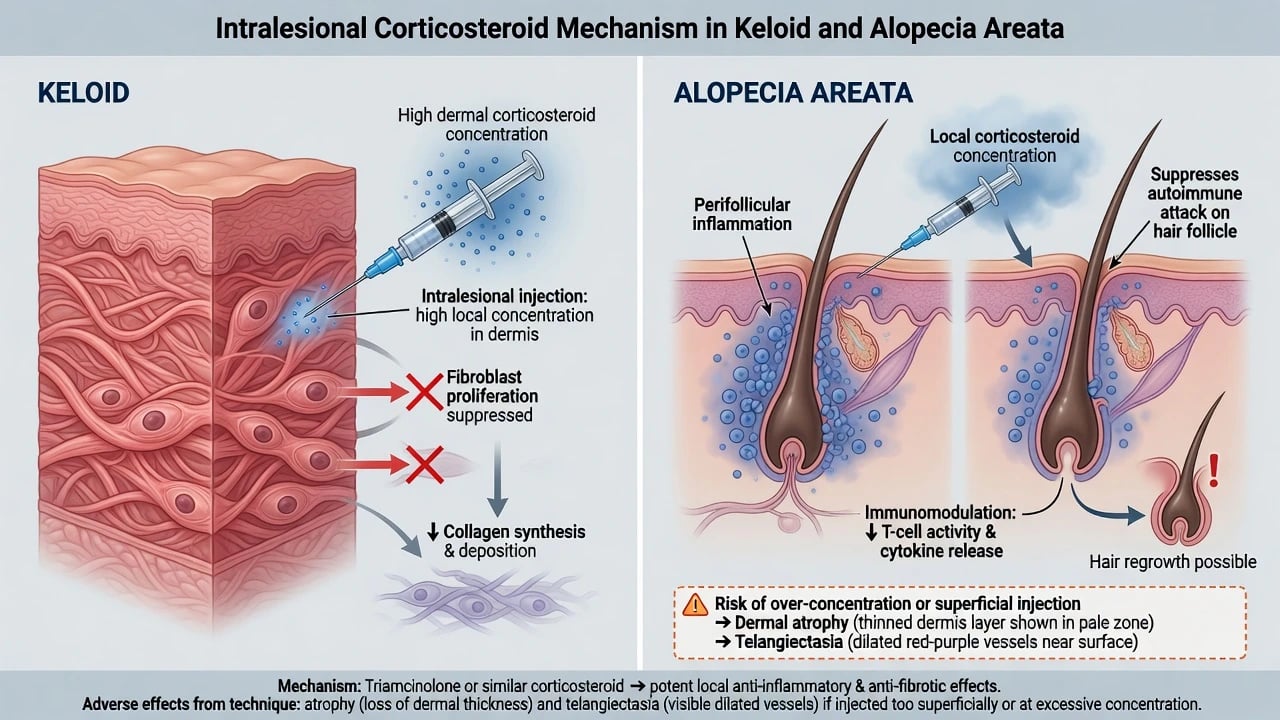
In keloid and hypertrophic scar, corticosteroids reduce inflammation and fibroblast-driven collagen excess, softening and flattening raised tissue over serial sessions.[1][6] In alopecia areata, local immunosuppression around the hair follicle can permit regrowth in limited patchy disease.[7][9] 5-FU inhibits fibroblast proliferation and is used alone or with TAC in recalcitrant keloids.[4][5]
Atrophy follows oversuppression of dermal matrix — more likely with high concentration, large volume, superficial placement, thin skin (face), and short intervals.[1] Rarely, substantial cumulative IL TAC has been associated with systemic glucocorticoid features including Cushingoid presentation — a board-level safety fact, not a curiosity.[2]
Clinical Indications
High-yield steroid indications
- Keloid and hypertrophic scar — first-line injection therapy in multimodal plans.[3][6]
- Limited patchy alopecia areata in cooperative patients.[7][8][9]
- Other classic uses: hypertrophic lichen planus plaques, prurigo nodularis nodules, acne cysts (after drainage), selected granulomatous lesions — always diagnosis-first.[1]
Non-steroid IL uses (selected)
- IL 5-FU ± TAC for stubborn keloids.[4][5]
- Bleomycin or Candida antigen pathways for recalcitrant warts in experienced practice.
- Highly selected off-label oncologic/inflammatory uses exist in specialist hands and are not routine MBBS first-line procedures.
When Not to Inject
| Situation | Prefer instead |
|---|---|
| Active skin infection at site | Treat infection first |
| Extensive AA (large scalp surface) | Systemic / advanced AA pathways per contemporary care |
| Uncertain diagnosis of scar-like tumour | Biopsy |
| Pregnancy + cytotoxic IL agents | Avoid non-essential cytotoxics |
| Thin facial skin needing tiny doses only | Very dilute TAC or alternative modality |
Comparative data exist for IL corticosteroid versus cryotherapy in AA; injection remains a standard office option for limited disease when pain and logistics allow.[8] Network evidence for AA treatments is broad — IL steroid is one node, not the whole algorithm for severe disease.[7]
Bedside Technique
Preparation
- Confirm diagnosis and rule out infection.
- Photograph baseline for scars and AA.
- Explain pain, multiple sessions, atrophy risk, pigment change, and realistic goals.
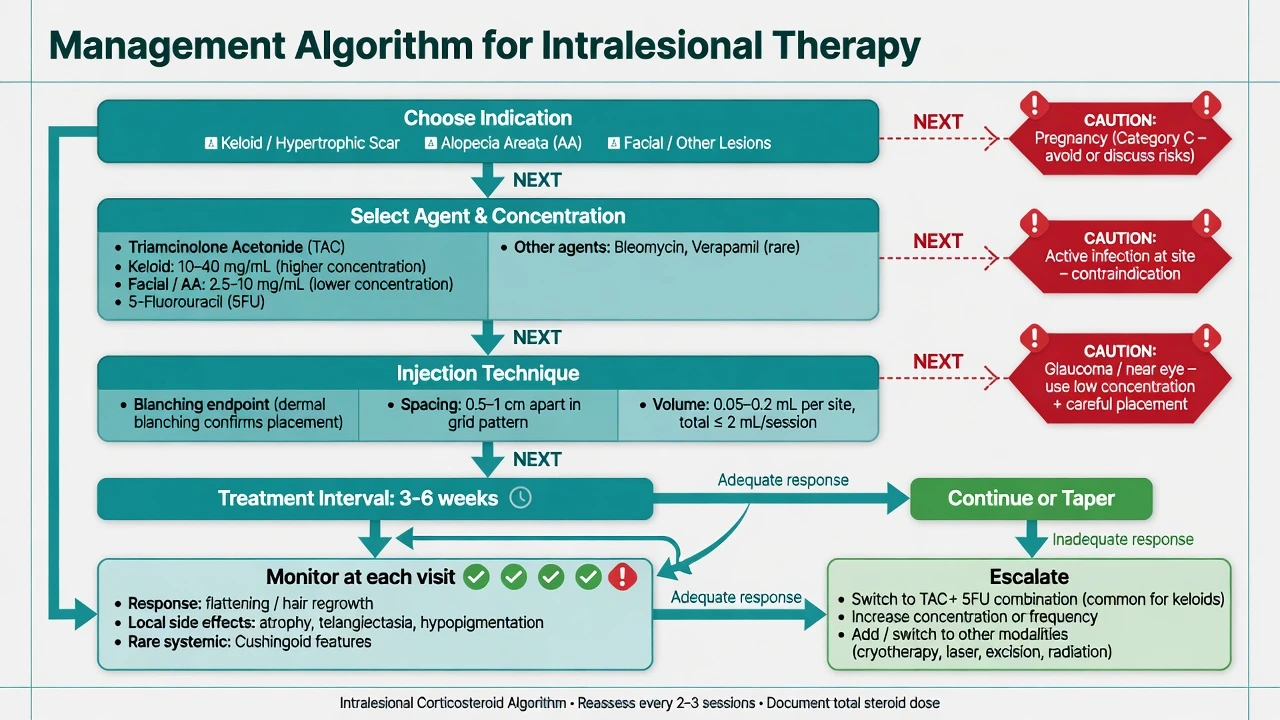
- Choose working concentration by site and thickness (teaching pattern: lower for face/AA; higher for thick truncal keloid).[1]
Injection principles
- Small-gauge needle; enter the lesion mid-dermis/scar substance — not a subcutaneous fat bolus and not a pure epidermal bleb when treating scar bulk.
- Inject small aliquots until blanching of the treated zone (classic endpoint teaching for TAC in scars/AA).
- Space punctures roughly 1 cm apart in a grid for scalp AA patches.[9]
- Cap total session dose; document concentration, volume, and map.
- Interval commonly every 3–6 weeks while response accrues and atrophy is watched.[1][6]
Combination strategies for keloid
Evidence syntheses support multimodal care: IL steroid backbone, consideration of IL 5-FU combinations, silicone/pressure, and planned surgery with postoperative IL steroid for selected lesions.[3][4][5][6]
Complications
Anaphylaxis after IL TAC is rare but reported — clinics need emergency protocols.[10] Systemic steroid toxicity after IL use is uncommon relative to volume of practice but documented enough that cumulative dose discipline matters, especially when treating large keloid burdens.[2]
[1]Exam application bank (NEET-PG / INICET)
One-line answer
Intralesional therapy delivers a drug depot directly into skin lesions. Triamcinolone acetonide (TAC) is the workhorse for keloids, hypertrophic scars, and limited patchy alopecia areata. Concentration is site-adjusted (lower on face and for AA; higher for thick keloid), with serial sessions every 3–6 weeks. Key local risks are atrophy, telangiectasia, and hypopigmentation; rare systemic corticosteroid effects follow large cumulative doses. Other agents include 5-fluorouracil, bleomycin, and Candida antigen for selected indications.
Worked stems (answer without another resource)
Stem 1 — Classic presentation. Map symptoms to mechanism; name the first investigation and first treatment step with dose/route if drug therapy is standard. [1]
Stem 2 — Unstable / complicated. List red flags that force immediate resuscitation, theatre, ICU, antidote, or reperfusion — and what you do in the first 15 minutes. [1]
Stem 3 — Atypical group. Elderly, pregnancy, child, or immunocompromised: how presentation and thresholds change. [1]
Stem 4 — Differential trap. Name the three closest mimics and one discriminator for each. [1]
Stem 5 — Disposition. Who goes home with safety-netting, who is admitted, who needs HDU/ICU/theatre, and what follow-up is mandatory. [1]
Rapid viva checklist
- Definition + classification
- Pathophysiology chain
- Bedside signs / criteria
- Score with exact components (if any)
- Emergency bundle
- Definitive therapy with doses
- Complications of disease and of treatment
- Special populations
- Guideline/trial name if classic
- Three exam traps
Coverage self-check
If you cannot answer any stem above from this page alone, re-read the matching section — the page is intended to be self-sufficient for final-prof and NEET-PG/INICET questions on Intralesional therapy.
Expanded exam teaching (depth pass)
Clinical reasoning
For Intralesional therapy, examiners test whether you can prioritise life threats, choose the right first test, and give specific therapy (agent, dose, route, timing). Generic phrases without numbers score poorly.
Mechanism → feature map
Build a short chain: cause → pathophysiologic intermediate → clinical feature → complication. Every major symptom in the classic vignette should sit on that chain.
Investigation strategy
- Bedside/first-line tests that change immediate management
- Confirmatory or staging tests
- What a normal result does not exclude
- When not to delay treatment for imaging (unstable patient)
Management ladder
- Resuscitation / ABC / sepsis or haemorrhage bundle as relevant
- Specific antidote / procedure / antimicrobial / reperfusion / surgery
- Supportive care and monitoring targets
- Definitive long-term therapy and secondary prevention
- Disposition and safety-net advice
Special populations
Always prepare one line each for children, pregnancy, elderly, renal/hepatic impairment, and immunocompromised patients when the topic allows.
Pitfalls that fail candidates
- Treating the number not the patient
- Missing pregnancy status when relevant
- Imaging before stabilisation
- Wrong empiric cover or wrong antidote timing
- Incomplete counselling on recurrence, adherence, or red-flag return
Intralesional therapy delivers a drug depot directly into skin lesions. Triamcinolone acetonide (TAC) is the workhorse for keloids, hypertrophic scars, and limited patchy alopecia areata. Concentration is site-adjusted (lower on face and for AA; higher for thick keloid), with serial sessions every 3–6 weeks. Key local risks are atrophy, telangiectasia, and hypopigmentation; rare systemic corticosteroid effects follow large cumulative doses. Other agents include 5-fluorouracil, bleomycin, and Can [1]
Structured revision sheet
Must-know numbers and names
List every score, size threshold, dose, and time window from this topic on a blank page from memory, then check against the sections above.
Three classic MCQ angles
- Most likely diagnosis given a vignette
- Next best step in management
- Most appropriate investigation
Three classic SAQ angles
- Pathophysiology in five steps
- Management algorithm with doses
- Complications and prevention
Clinical station flow
Greet → focused history → targeted exam → investigations → explain diagnosis → emergency care → definitive plan → safety-net / follow-up → answer examiner questions on mechanism and pitfalls.
[1]Special Populations
- Children: limit sessions by pain tolerance; topical anaesthetic adjuncts; lower total doses.
- Pregnancy: avoid non-essential cytotoxic IL agents; individualise any steroid use.
- Skin of colour: hypopigmentation and atrophy are highly visible — explicit consent.
- Periocular skin: extra caution regarding local steroid effects; avoid casual high-dose periocular IL injections. [1]
Prognosis and Follow-Up
Keloids usually need serial injections and still may recur without a multimodal plan.[3][6] Patchy AA may show regrowth over months; relapse can occur after cessation.[7][9] Stop and escalate when response plateaus or disease extent outgrows the injection strategy.
Evidence, Guidelines, and Regional Practice
Narrative and systematic sources support IL steroids as foundational scar and limited-AA therapy, with growing 5-FU combination literature for keloids.[1][3][4][5][6] Cochrane-level AA synthesis places IL approaches among many options in a wider efficacy landscape.[7] Head-to-head IL steroid versus cryotherapy data inform technique choice when both are available.[8] Safety literature on rare Cushingoid outcomes and anaphylaxis completes the consent conversation.[2][10]
Exam Pearls
- IL = local depot, high tissue level, serial care.
- TAC concentration follows site — face/AA lower; thick keloid higher.[1]
- Endpoint teaching: blanching; AA grid ~1 cm.
- Atrophy/telangiectasia = too strong, too shallow, too often.
- Know rare systemic steroid effects after large cumulative IL TAC.[2]
- Keloid: consider TAC ± 5-FU multimodal packages.[4][5]
Red Flags
- Injecting infected tissue.
- One-shot promise of permanent keloid cure.
- High-strength TAC on thin face.
- Using only IL steroid for extensive AA when systemic/advanced therapy is indicated.[7][9]
Exam anchors
References
- [1]Richards RN. Update on intralesional steroid: focus on dermatoses J Cutan Med Surg, 2010.PMID 20128986
- [2]Fredman R, Tenenhaus M. Cushing's syndrome after intralesional triamcinolone acetonide: a systematic review of the literature and multinational survey Burns, 2013.PMID 23092701
- [3]Walsh LA, Wu E, Pontes D, et al. Keloid treatments: an evidence-based systematic review of recent advances Syst Rev, 2023.PMID 36918908
- [4]Bijlard E, Steltenpool S, Niessen FB. Intralesional 5-fluorouracil in keloid treatment: a systematic review Acta Derm Venereol, 2015.PMID 25805099
- [5]King A, Guirguis M, Satkunanathan S, et al. Intralesional 5-Fluorouracil for Keloids: A Systematic Review J Cutan Med Surg, 2024.PMID 38807454
- [6]Ekstein SF, Wyles SP, Moran SL, et al. Keloids: a review of therapeutic management Int J Dermatol, 2021.PMID 32905614
- [7]Mateos-Haro M, Novoa-Candia M, Sánchez Vanegas G, et al. Treatments for alopecia areata: a network meta-analysis Cochrane Database Syst Rev, 2023.PMID 37870096
- [8]Liu YC, Chuang KW, Chang HC. Intralesional Corticosteroid Versus Cryotherapy for Alopecia Areata: A Systematic Review and Meta-analysis Acta Derm Venereol, 2025.PMID 40908758
- [9]Dakkak M, Forde KM, Lanney H. Hair Loss: Diagnosis and Treatment Am Fam Physician, 2024.PMID 39283847
- [10]Laisuan W, Wongsa C, Dchapaphapeaktak N, et al. Anaphylaxis following intralesional triamcinolone acetonide (Kenacort) injection Asia Pac Allergy, 2017.PMID 28487843