Dermatology · Medicine
Local anaesthesia in dermatology
Also known as Lidocaine infiltration · Buffered lidocaine · Tumescent anaesthesia · Field block dermatology · LAST dermatologic surgery
Board-level module on local anaesthesia for office dermatologic procedures: amide vs ester classification, lidocaine ± epinephrine pharmacology, infiltration/field/nerve/tumescent techniques, maximum-dose calculation framework, pain-minimising injection (buffer, warm, slow, small needle), digital block epinephrine evidence, paediatric safety, recognition and initial management of local anaesthetic systemic toxicity (LAST), and common failure/allergy pitfalls.
On this page & tools
Your progress
Saved locally on this device.
Exam tags
Red flags
Definition and technique classes
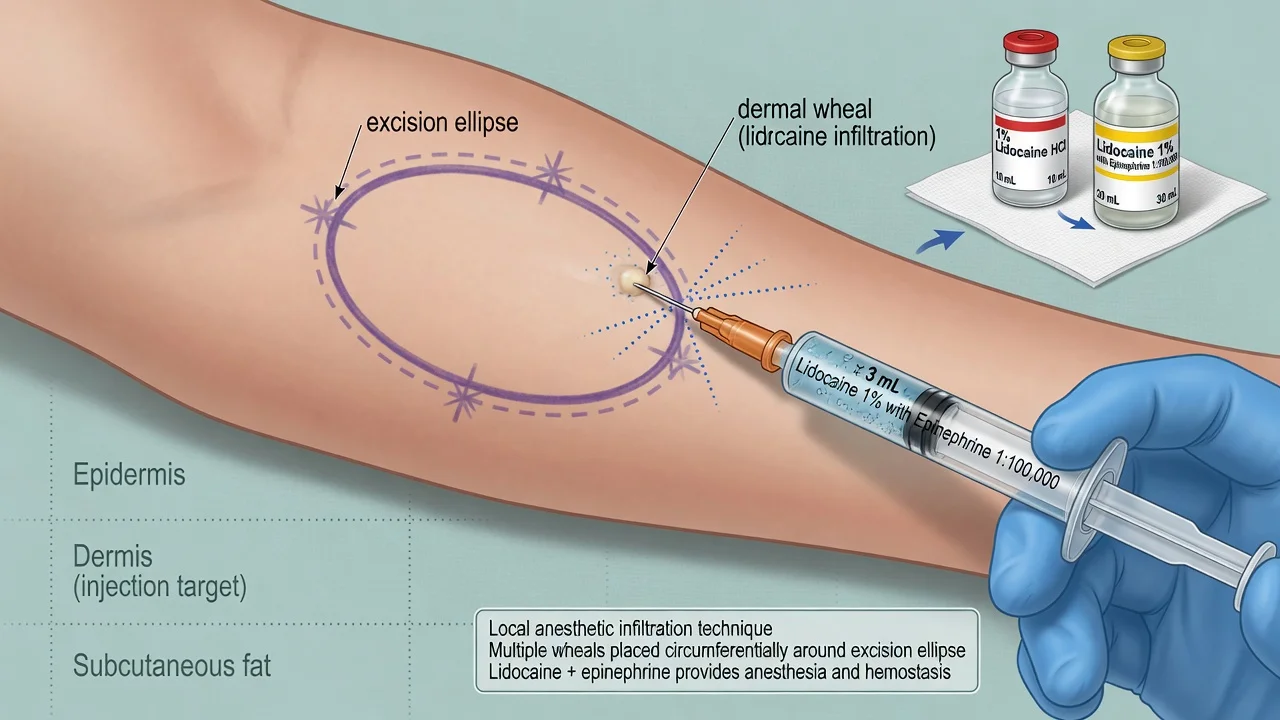
Local anaesthesia (LA) produces reversible sensory (and with depth, motor) block without intended loss of consciousness. In dermatology the workhorses are: [1]
| Technique | Concept | Typical use |
|---|---|---|
| Topical | Cream/ointment on intact or mucosal skin | Superficial procedures, paediatric pre-anaesthesia |
| Infiltration | Direct dermal/subcut wheals in the field | Punch, shave, small ellipse[9][10] |
| Field / ring block | Anaesthetic ring around lesion | Larger lesions, infected centres |
| Nerve block | Named nerve proximal to site | Digits, face (mental, supraorbital, etc.) |
| Tumescent | Large-volume dilute LA ± epinephrine into fat | Liposuction, large field undermining[4][5] |
Classification: amides vs esters
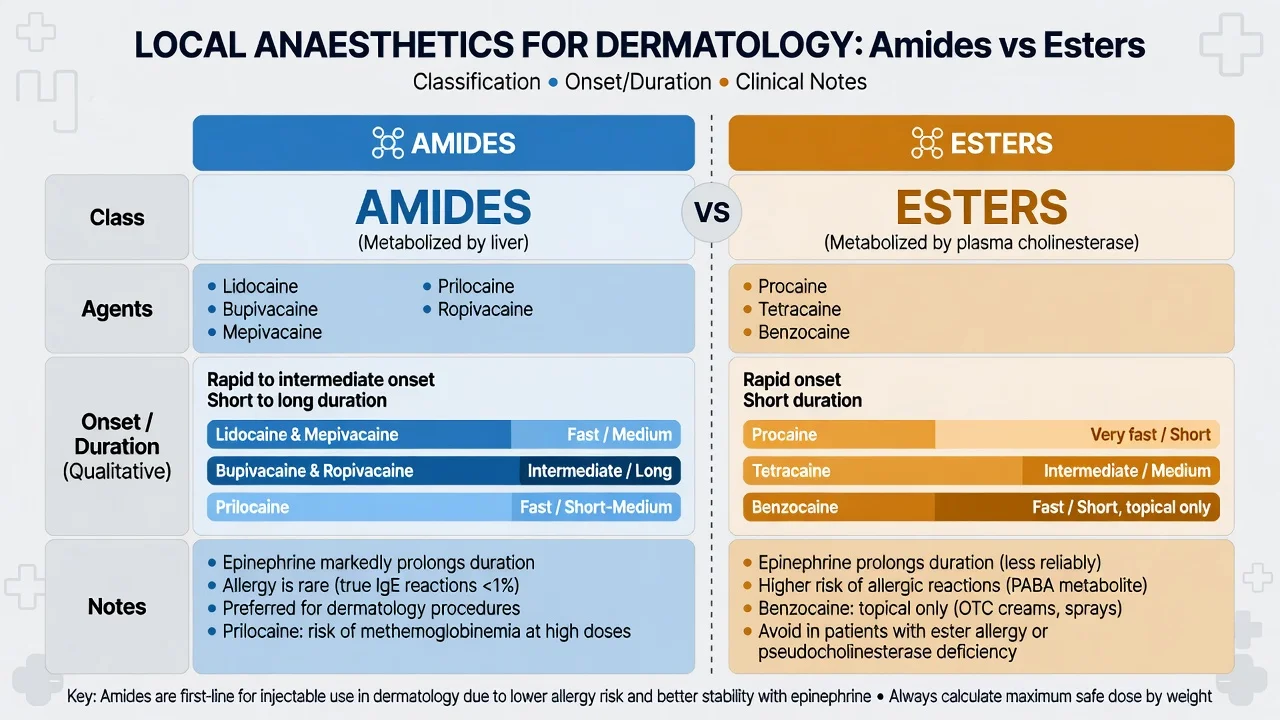
- Amides (two “i”s in the name often: lidocaine, bupivacaine, mepivacaine, prilocaine, ropivacaine): hepatic metabolism; preferred injectables in dermatologic surgery; true allergy uncommon.[8]
- Esters (procaine, tetracaine, benzocaine): plasma cholinesterase metabolism; higher historical allergy via PABA metabolites; benzocaine mainly topical.
Epinephrine (typically 1:100,000–1:200,000 in skin surgery mixes) causes local vasoconstriction → less bleeding, slower systemic uptake, longer duration.[1][9]
Pharmacology that examiners probe
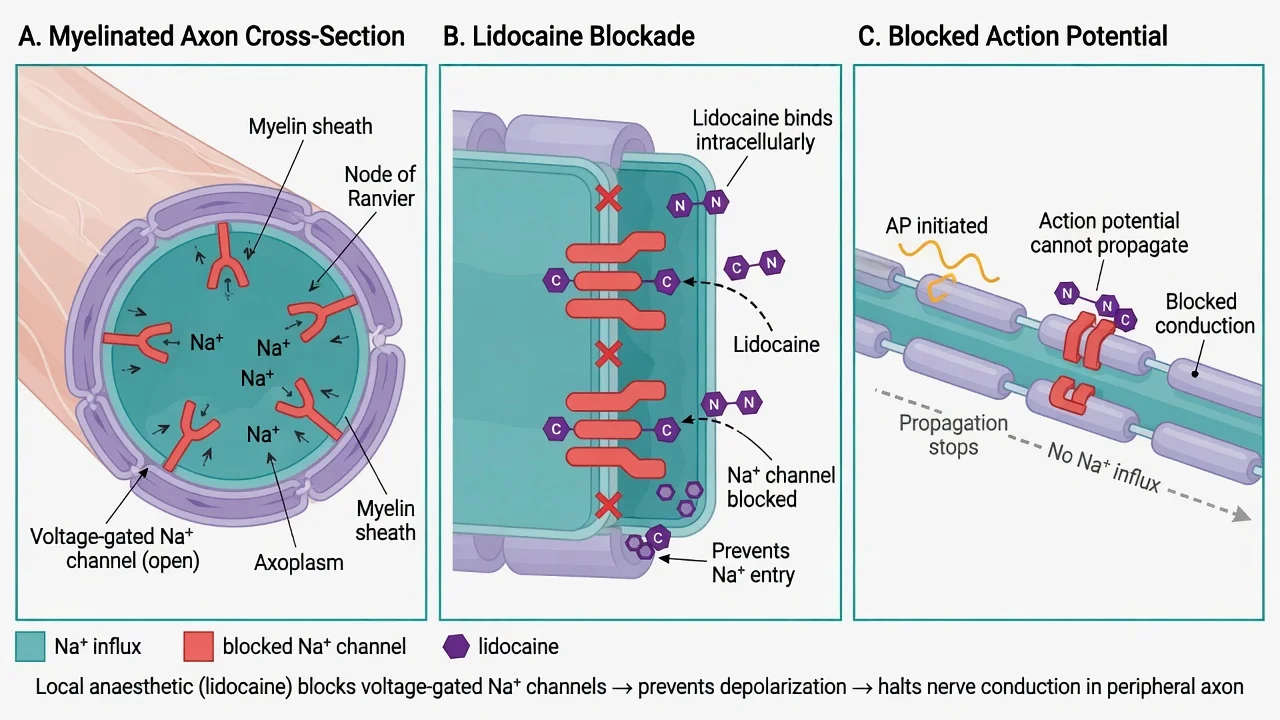
LA molecules cross the axonal membrane in uncharged form and block the intracellular face of voltage-gated Na⁺ channels, preventing depolarisation and propagation of the action potential. Inflamed, acidotic tissue ionises more drug → slower onset and sometimes patchy block — inject around, not only into, abscess walls when possible.[1]
Onset relates to pKa and lipid solubility; duration relates to protein binding and vascularity of the site. Buffering acidic commercial lidocaine toward physiologic pH with sodium bicarbonate reduces injection pain; in-office compounding must respect stability and sterility guidance.[2][1]
Dose calculation (must be automatic)
Conversion: 1% solution = 10 mg/mL.
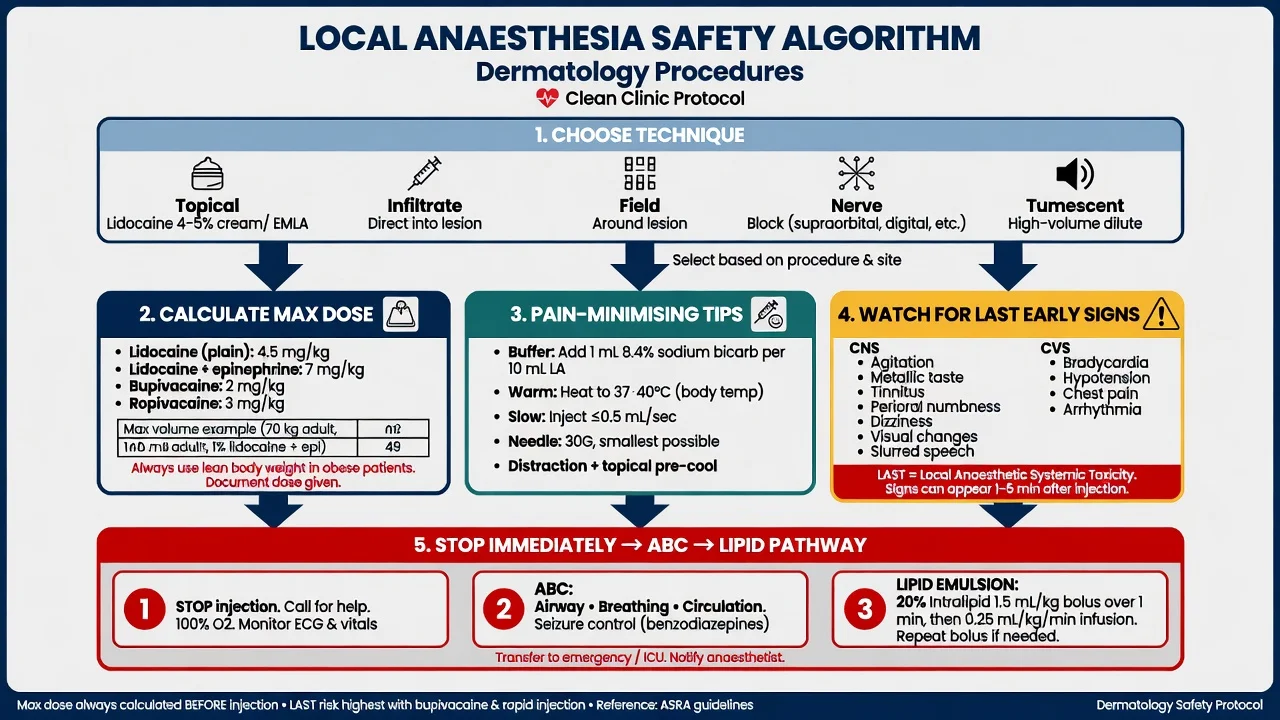
Worked example (exam default): 70 kg adult, lidocaine with epinephrine, classical 7 mg/kg ceiling → 490 mg max → 49 mL of 1% with epinephrine. Plain lidocaine classical ~4.5 mg/kg → ~315 mg → ~31.5 mL of 1%.[3][8]
Use lean body weight thinking in obesity; document cumulative dose across staged procedures. Knowledge surveys show variable clinician fluency — calculate every time.[8]
Tumescent caveat: dilute high-volume lidocaine pharmacokinetics differ; specialised series report mean doses far above classical infiltrative ceilings under controlled tumescent technique — this is not a licence to ignore limits during standard punch/ellipse infiltration.[4][5][3]
Pain-minimising injection
Evidence-aligned comfort measures:[1][2]
- Smallest practical needle (often 30G for wheals).
- Slow injection; warm solution toward body temperature.
- Buffer lidocaine/epinephrine with bicarbonate per compounding guidance.
- Pinch/vibrate/distract; topical anaesthetic or cold before needle in children.[7]
- Subdermal plane where appropriate; raise a wheal then advance through anaesthetised tissue.
- Avoid injecting large volumes that distort fine cosmetic margins before marking is final.
Regional blocks and the epinephrine–digit myth
Digital blocks with dilute epinephrine have substantial safety literature reversing the old absolute ban in non-end-artery-disease digits; still avoid in patients with vascular compromise and use lowest effective concentration.[6] Similar caution narratives apply to penile blocks — know local protocol.
Special populations
- Children: weight-based dosing, behavioural strategies, topical prep; published paediatric dermatologic surgery series support careful LA safety when limits respected.[7]
- Pregnancy: lidocaine is the usual amide of choice when procedure necessary; minimise dose.
- Hepatic disease: reduced amide clearance — lower cumulative dose.
- Prilocaine / benzocaine: methemoglobinaemia risk at high exposure (infants especially for some topical mixtures) — exam classic.
- Beta-blockers / drug interactions: be alert to exaggerated epinephrine responses in selected interactions; take a medication history.
Toxicity: LAST and other adverse effects
Local anaesthetic systemic toxicity (LAST) from intravascular injection or absolute overdose: [1]
- CNS early: metallic taste, perioral paraesthesia, tinnitus, visual change, agitation → seizures.
- CVS: hypertension/tachycardia early → bradycardia, conduction block, cardiovascular collapse (bupivacaine notorious for cardiac binding). [1]
Immediate actions: stop injecting; call for help; airway/oxygen; benzodiazepines for seizures per emergency protocols; intravenous lipid emulsion pathway as per institutional/ASRA-style LAST checklist; ACLS with awareness that some antiarrhythmics are relatively contraindicated. Every procedure room needs a rehearsed plan.[3][8]
Other adverse effects: vasovagal syncope (common), transient tachycardia/palpitations from epinephrine, bruising, prolonged numbness, rare true allergy, wound edge blanching. [1]
Failure of anaesthesia — think systematically
Insufficient volume or concentration; wrong tissue plane; waiting less than a few minutes; highly vascular face; acidotic infection; extreme anxiety; expired/ incorrectly diluted product. True allergy is a diagnosis of careful exclusion after more common mimics.[1][8]
Link to skin surgery
Punch, shave, and elliptical biopsies all depend on adequate field anaesthesia and haemostasis from epinephrine when used.[9][10] Over-infiltration can blur borders of subtle tumours — mark first, then anaesthetise thoughtfully.
Regional practice notes
Exam answers should quote classical infiltrative ceilings and then note that tumescent liposuction anaesthesia is a separate evidence domain.[3][5] UK/ANZ/US office surgery frameworks share the same pharmacology; lipid emulsion access is an institutional safety standard, not optional trivia.
Clinical pearl
Red flags
Exam application bank (NEET-PG / INICET)
One-line answer
Board-level module on local anaesthesia for office dermatologic procedures: amide vs ester classification, lidocaine ± epinephrine pharmacology, infiltration/field/nerve/tumescent techniques, maximum-dose calculation framework, pain-minimising injection (buffer, warm, slow, small needle), digital block epinephrine evidence, paediatric safety, recognition and initial management of local anaesthetic systemic toxicity (LAST), and common failure/allergy pitfalls.
Worked stems (answer without another resource)
Stem 1 — Classic presentation. Map symptoms to mechanism; name the first investigation and first treatment step with dose/route if drug therapy is standard. [1]
Stem 2 — Unstable / complicated. List red flags that force immediate resuscitation, theatre, ICU, antidote, or reperfusion — and what you do in the first 15 minutes. [1]
Stem 3 — Atypical group. Elderly, pregnancy, child, or immunocompromised: how presentation and thresholds change. [1]
Stem 4 — Differential trap. Name the three closest mimics and one discriminator for each. [1]
Stem 5 — Disposition. Who goes home with safety-netting, who is admitted, who needs HDU/ICU/theatre, and what follow-up is mandatory. [1]
Rapid viva checklist
- Definition + classification
- Pathophysiology chain
- Bedside signs / criteria
- Score with exact components (if any)
- Emergency bundle
- Definitive therapy with doses
- Complications of disease and of treatment
- Special populations
- Guideline/trial name if classic
- Three exam traps
Coverage self-check
If you cannot answer any stem above from this page alone, re-read the matching section — the page is intended to be self-sufficient for final-prof and NEET-PG/INICET questions on Local anaesthesia in dermatology.
Expanded exam teaching (depth pass)
Clinical reasoning
For Local anaesthesia in dermatology, examiners test whether you can prioritise life threats, choose the right first test, and give specific therapy (agent, dose, route, timing). Generic phrases without numbers score poorly.
Mechanism → feature map
Build a short chain: cause → pathophysiologic intermediate → clinical feature → complication. Every major symptom in the classic vignette should sit on that chain.
Investigation strategy
- Bedside/first-line tests that change immediate management
- Confirmatory or staging tests
- What a normal result does not exclude
- When not to delay treatment for imaging (unstable patient)
Management ladder
- Resuscitation / ABC / sepsis or haemorrhage bundle as relevant
- Specific antidote / procedure / antimicrobial / reperfusion / surgery
- Supportive care and monitoring targets
- Definitive long-term therapy and secondary prevention
- Disposition and safety-net advice
Special populations
Always prepare one line each for children, pregnancy, elderly, renal/hepatic impairment, and immunocompromised patients when the topic allows.
Pitfalls that fail candidates
- Treating the number not the patient
- Missing pregnancy status when relevant
- Imaging before stabilisation
- Wrong empiric cover or wrong antidote timing
- Incomplete counselling on recurrence, adherence, or red-flag return
Board-level module on local anaesthesia for office dermatologic procedures: amide vs ester classification, lidocaine ± epinephrine pharmacology, infiltration/field/nerve/tumescent techniques, maximum-dose calculation framework, pain-minimising injection (buffer, warm, slow, small needle), digital block epinephrine evidence, paediatric safety, recognition and initial management of local anaesthetic systemic toxicity (LAST), and common failure/allergy pitfalls. [1]
Structured revision sheet
Must-know numbers and names
List every score, size threshold, dose, and time window from this topic on a blank page from memory, then check against the sections above.
Three classic MCQ angles
- Most likely diagnosis given a vignette
- Next best step in management
- Most appropriate investigation
Three classic SAQ angles
- Pathophysiology in five steps
- Management algorithm with doses
- Complications and prevention
Clinical station flow
Greet → focused history → targeted exam → investigations → explain diagnosis → emergency care → definitive plan → safety-net / follow-up → answer examiner questions on mechanism and pitfalls.
Exam anchors
Exam triad
ACT
Define the problem and red flags
Highest-yield test or bedside clue
First-line management and follow-up
References
- [1]Nadir U, Scaburi IR, Cerci FB, et al. How to minimize pain with local anesthesia and improve patient experiences: a review An Bras Dermatol, 2026.PMID 42107926
- [2]Desai SR, Vidimos AT, Elder EJ, et al. In-office compounding of buffered lidocaine and epinephrine - A stability and safety review J Am Acad Dermatol, 2026.PMID 41665574
- [3]Wang A, Grushchak S, Kaul S, et al. Toxicity of Infiltrative Lidocaine in Dermatologic Surgery: Are Current Limits Valid? Dermatol Pract Concept, 2021.PMID 34631267
- [4]Lillis PJ. Tumescent Anesthesia With a Mean Dose of 81 mg/kg of Lidocaine Dermatol Surg, 2023.PMID 37801576
- [5]Klein JA, Jeske DR. Estimated Maximal Safe Dosages of Tumescent Lidocaine Anesth Analg, 2016.PMID 26895001
- [6]Krunic AL, Wang LC, Soltani K, et al. Digital anesthesia with epinephrine: an old myth revisited J Am Acad Dermatol, 2004.PMID 15523354
- [7]Chessa MA, Brunetti T, Robuffo S, et al. Safety of Local Anesthesia in Pediatric Dermatologic Surgery: Our Experience and a Concise Review of the Existing Literature Dermatol Pract Concept, 2026.PMID 42190206
- [8]Walsh AM, Moran B, Walsh SA. Knowledge of local anesthetic use among dermatologists Dermatol Surg, 2012.PMID 22530750
- [9]Pickett H. Shave and punch biopsy for skin lesions Am Fam Physician, 2011.PMID 22046939
- [10]Greenwood JD, Merry SP, Boswell CL. Skin Biopsy Techniques Prim Care, 2022.PMID 35125151