Dermatology · Medicine
Paediatric rashes and exanthems
Also known as Childhood exanthems · Fever and rash · Classic viral exanthems · Measles (first disease) · Rubella (third disease) · Erythema infectiosum (fifth disease) · Roseola infantum (sixth disease) · Scarlet fever · Hand-foot-and-mouth disease
Paediatric rashes and exanthems are fever-associated childhood eruptions spanning the classic numbered viral exanthems (measles, rubella, erythema infectiosum, roseola), bacterial toxin-mediated scarlet fever, enteroviral hand-foot-and-mouth disease, and life-threatening mimics (Kawasaki disease, meningococcaemia, severe drug eruptions). Pattern recognition hinges on prodrome, timing of rash relative to fever, morphology, distribution, enanthem, and host toxicity. Fellowship competence requires separating self-limited viral illness from vaccine-preventable notifiable disease and from emergencies that need IVIG, antibiotics, or intensive care within minutes.
On this page & tools
Your progress
Saved locally on this device.
Exam tags
Red flags
The child with fever and a rash is one of the highest-yield encounters in paediatrics, dermatology, emergency medicine, and public health. Most presentations are self-limited viral exanthems, yet a minority are notifiable vaccine-preventable diseases (measles, rubella) or time-critical emergencies (meningococcaemia, Kawasaki disease, SJS). The safe approach is algorithmic: toxicity first, then pattern match, then host risk (pregnancy contacts, haemolysis, immunocompromise, incomplete immunisation).[1][9][10]
This topic is the clinical approach layer that sits alongside the dedicated viral-exanthems atlas leaf: it emphasises bedside discrimination, dangerous mimics, and disposition rather than exhaustive virology alone. [1]
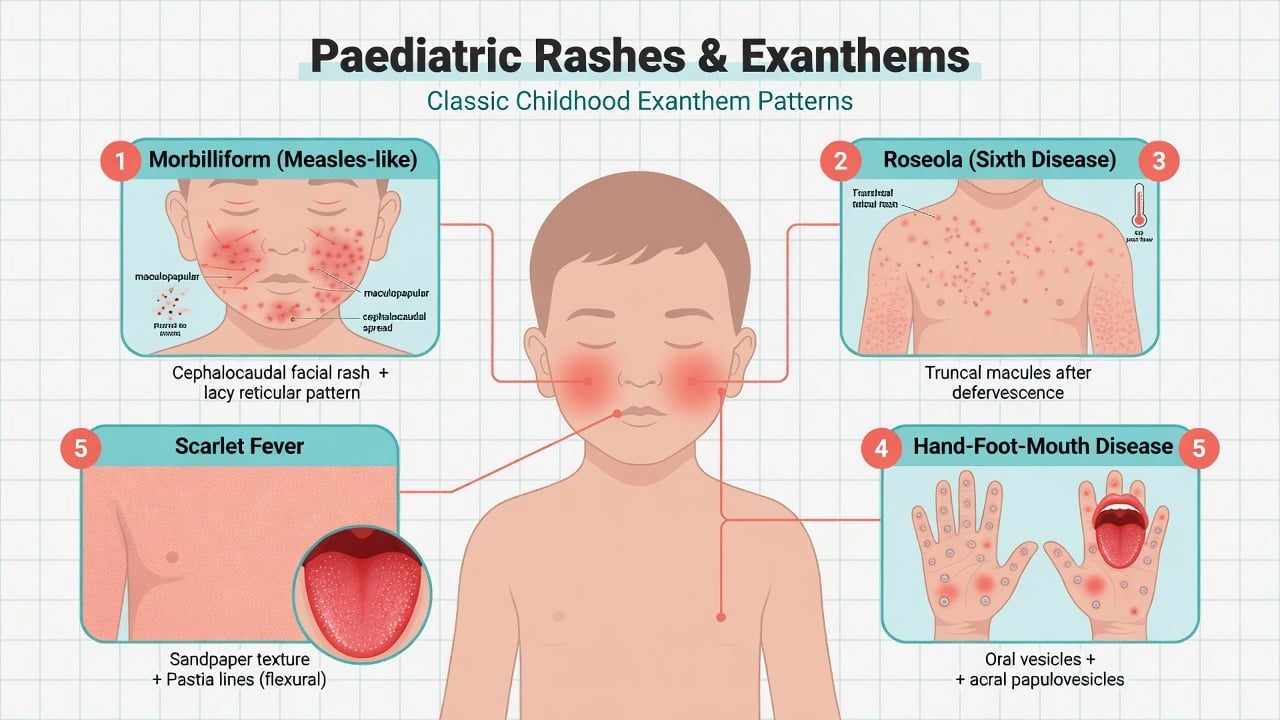
Classification
The historical numbered childhood exanthems still structure exam answers, even though fourth disease is obsolete and second disease maps to scarlet fever rather than a distinct virus. [1]
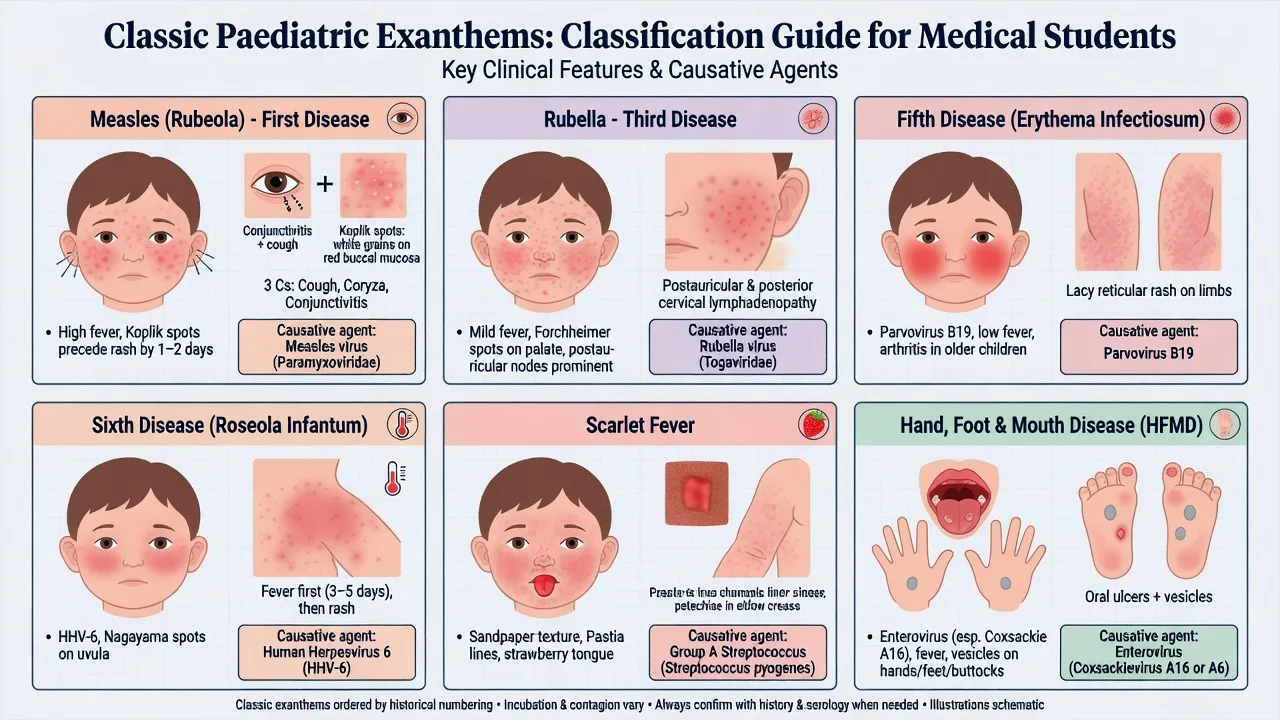
Classic patterns at a glance
Measles (first)
Rubella (third)
Fifth disease
Roseola (sixth)
Scarlet fever
HFMD
Epidemiology and risk factors
Measles and rubella resurgence tracks MMR coverage gaps; measles remains one of the most contagious human viruses, with attack rates above 90 percent in susceptible close contacts.[1][2] Roseola is nearly universal in early childhood via HHV-6B.[4][8] Parvovirus B19 causes seasonal school outbreaks; fifth-disease rash often appears after peak infectiousness.[3][7] HFMD clusters in preschool settings; enterovirus A71 has caused regional neurocardiopulmonary epidemics, especially in Asia-Pacific.[5][6] Kawasaki disease peaks under five years and is more common in East Asian ancestry cohorts.[10]
Pathophysiology
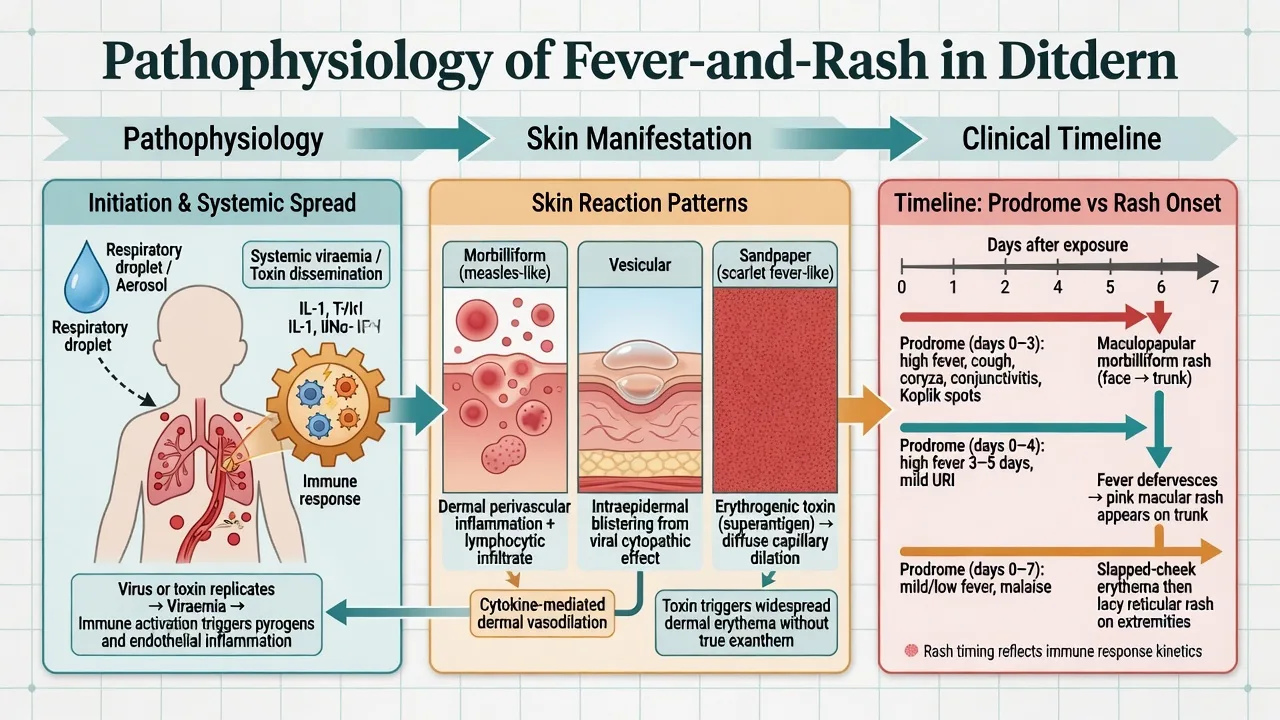
Most viral exanthems reflect viraemia plus immune-mediated dermal inflammation, producing a morbilliform (measles-like) maculopapular eruption. Enteroviruses also cause direct epidermal cytopathic vesiculation in HFMD. Scarlet fever is a delayed hypersensitivity response to group A streptococcal erythrogenic exotoxins. Parvovirus B19 binds the P antigen on erythroid precursors, explaining transient aplastic crisis in haemolytic disorders and fetal anaemia/hydrops.[7][9]
Clinical presentation
Measles and rubella
Measles begins with fever and the three Cs — cough, coryza, conjunctivitis — then Koplik spots (small white lesions on buccal mucosa) and a cephalocaudal morbilliform rash on day three to four.[1] Rubella is milder, with prominent postauricular and occipital lymphadenopathy and a finer pink maculopapular rash; the obstetric stakes are high because of congenital rubella syndrome.[2]
Roseola and fifth disease
Roseola (exanthem subitum) classically presents as three days of high fever in a surprisingly well infant, followed by defervescence and a truncal pink maculopapular rash.[4][8] Erythema infectiosum shows bright malar erythema (slapped cheeks) then a lacy reticular eruption on the limbs; arthropathy is more common in adolescents and adults.[3][7]
Scarlet fever and HFMD
Scarlet fever follows streptococcal pharyngitis with a punctate sandpaper erythema, accentuation in flexures (Pastia lines), circumoral pallor, and a white then red strawberry tongue. HFMD combines painful oral ulcers with vesicles on palms, soles, and sometimes buttocks; nails may show Beau lines or onychomadesis weeks later.[5][6]
Gianotti-Crosti and other papular patterns
Gianotti-Crosti syndrome (papular acrodermatitis of childhood) produces monomorphic papules on face, buttocks, and extensor limbs after viral triggers or vaccination and is usually self-limited.[11]
Differential diagnosis — never miss these
Exam application bank (NEET-PG / INICET)
One-line answer
Paediatric rashes and exanthems are fever-associated childhood eruptions spanning the classic numbered viral exanthems (measles, rubella, erythema infectiosum, roseola), bacterial toxin-mediated scarlet fever, enteroviral hand-foot-and-mouth disease, and life-threatening mimics (Kawasaki disease, meningococcaemia, severe drug eruptions). Pattern recognition hinges on prodrome, timing of rash relative to fever, morphology, distribution, enanthem, and host toxicity. Fellowship competence requires separating self-limited viral illness from vaccine-preventable notifiable disease and from emergencies that need IVIG, antibiotics, or intensive care within minutes.
Worked stems (answer without another resource)
Stem 1 — Classic presentation. Map symptoms to mechanism; name the first investigation and first treatment step with dose/route if drug therapy is standard. [1]
Stem 2 — Unstable / complicated. List red flags that force immediate resuscitation, theatre, ICU, antidote, or reperfusion — and what you do in the first 15 minutes. [1]
Stem 3 — Atypical group. Elderly, pregnancy, child, or immunocompromised: how presentation and thresholds change. [1]
Stem 4 — Differential trap. Name the three closest mimics and one discriminator for each. [1]
Stem 5 — Disposition. Who goes home with safety-netting, who is admitted, who needs HDU/ICU/theatre, and what follow-up is mandatory. [1]
Rapid viva checklist
- Definition + classification
- Pathophysiology chain
- Bedside signs / criteria
- Score with exact components (if any)
- Emergency bundle
- Definitive therapy with doses
- Complications of disease and of treatment
- Special populations
- Guideline/trial name if classic
- Three exam traps
Coverage self-check
If you cannot answer any stem above from this page alone, re-read the matching section — the page is intended to be self-sufficient for final-prof and NEET-PG/INICET questions on Paediatric rashes and exanthems.
Expanded exam teaching (depth pass)
Clinical reasoning
For Paediatric rashes and exanthems, examiners test whether you can prioritise life threats, choose the right first test, and give specific therapy (agent, dose, route, timing). Generic phrases without numbers score poorly.
Mechanism → feature map
Build a short chain: cause → pathophysiologic intermediate → clinical feature → complication. Every major symptom in the classic vignette should sit on that chain.
Investigation strategy
- Bedside/first-line tests that change immediate management
- Confirmatory or staging tests
- What a normal result does not exclude
- When not to delay treatment for imaging (unstable patient)
Management ladder
- Resuscitation / ABC / sepsis or haemorrhage bundle as relevant
- Specific antidote / procedure / antimicrobial / reperfusion / surgery
- Supportive care and monitoring targets
- Definitive long-term therapy and secondary prevention
- Disposition and safety-net advice
Special populations
Always prepare one line each for children, pregnancy, elderly, renal/hepatic impairment, and immunocompromised patients when the topic allows.
Pitfalls that fail candidates
- Treating the number not the patient
- Missing pregnancy status when relevant
- Imaging before stabilisation
- Wrong empiric cover or wrong antidote timing
- Incomplete counselling on recurrence, adherence, or red-flag return
Paediatric rashes and exanthems are fever-associated childhood eruptions spanning the classic numbered viral exanthems (measles, rubella, erythema infectiosum, roseola), bacterial toxin-mediated scarlet fever, enteroviral hand-foot-and-mouth disease, and life-threatening mimics (Kawasaki disease, meningococcaemia, severe drug eruptions). Pattern recognition hinges on prodrome, timing of rash relative to fever, morphology, distribution, enanthem, and host toxicity. Fellowship competence requires [1]
Structured revision sheet
Must-know numbers and names
List every score, size threshold, dose, and time window from this topic on a blank page from memory, then check against the sections above.
Three classic MCQ angles
- Most likely diagnosis given a vignette
- Next best step in management
- Most appropriate investigation
Three classic SAQ angles
- Pathophysiology in five steps
- Management algorithm with doses
- Complications and prevention
Clinical station flow
Greet → focused history → targeted exam → investigations → explain diagnosis → emergency care → definitive plan → safety-net / follow-up → answer examiner questions on mechanism and pitfalls.
Morbilliform eruptions in hospitalised children also include drug reactions, graft-versus-host disease, and early viral syndromes that evolve — serial examination beats a single snapshot.[9]
Bedside assessment
- Airway, breathing, circulation, consciousness — treat shock and purpura immediately.
- Blanching test and full skin including palms, soles, scalp, and genitalia.
- Mucosa — Koplik, strawberry tongue, oral ulcers, conjunctival injection, cracked lips.
- Fever duration, immunisation record, contacts, travel, recent drugs (especially amoxicillin in possible EBV).
- Host risks — pregnancy in household, sickle cell or other haemolysis, immunosuppression, malnutrition. [1]
Investigations
Most well children with classic self-limited exanthems need no blood tests. Investigate when the child is toxic, the pattern is atypical, public-health confirmation is required, or a treatable emergency is possible: [1]
- Measles: IgM or PCR; notify public health; assess complications.[1]
- Rubella: serology when pregnancy is a concern.[2]
- Parvovirus B19: serology/PCR in pregnancy, aplastic crisis, or immunocompromise.[7]
- Scarlet fever: clinical ± throat culture / rapid strep antigen.
- Kawasaki: FBC, CRP/ESR, LFTs, urinalysis, echocardiography; diagnosis remains clinical.[10]
- Meningococcal disease: blood cultures, urgent antibiotics before waiting for labs if suspicion is high.[12]
Management
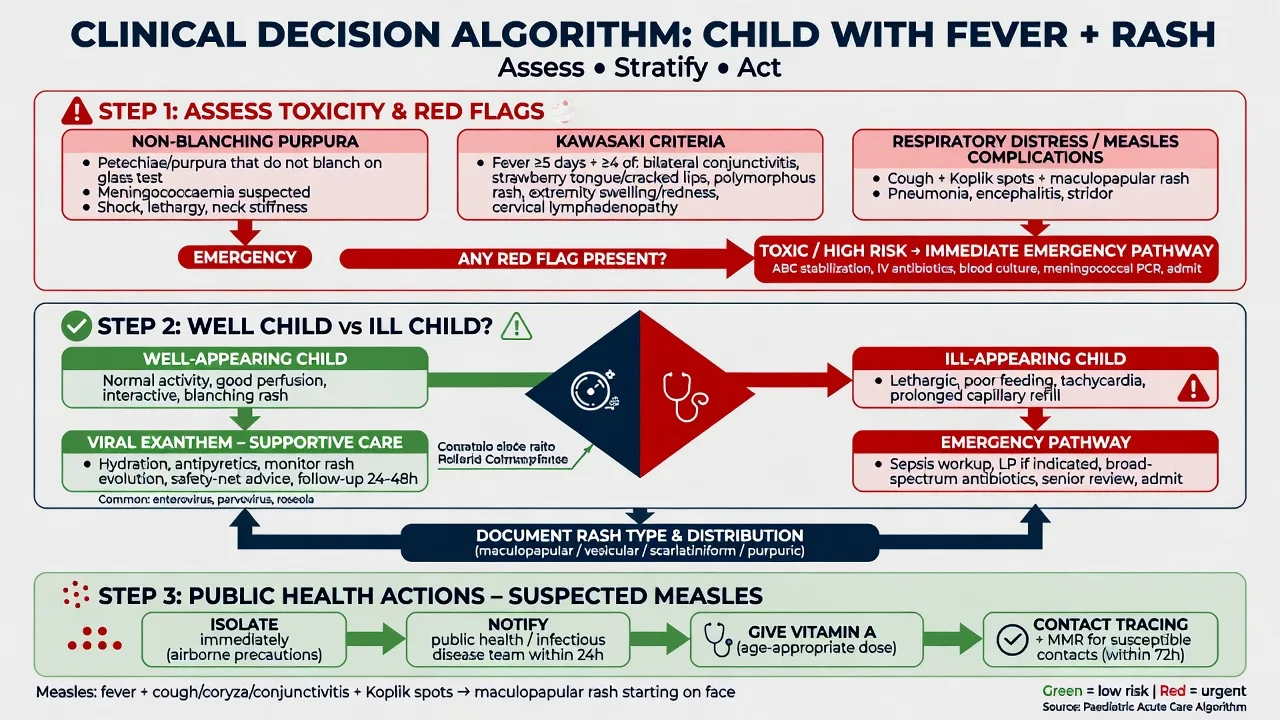
Immediate / emergency
- Meningococcaemia: immediate parenteral antibiotics, fluids, ICU pathway — do not delay for rash taxonomy.[12]
- Kawasaki disease: high-dose aspirin and IVIG ideally within 10 days of fever onset; cardiology follow-up.[10]
- Severe measles: supportive respiratory care, vitamin A dosing per age in endemic or malnourished settings, airborne isolation, notification, contact tracing and PEP (MMR within 72 hours or immunoglobulin when indicated).[1]
Supportive care for self-limited exanthems
Hydration, antipyretics, oral care for HFMD, return precautions for respiratory distress, poor feeding, lethargy, or non-blanching rash. Avoid aspirin in routine viral illness because of Reye-syndrome risk discussions in children. Scarlet fever needs penicillin or amoxicillin (macrolide if true allergy). Counsel families that fifth-disease rash often appears after the main infectious window, but household pregnancy still warrants advice.[3][5][6]
Complications and prognosis
Measles complications include otitis media, pneumonia, encephalitis, and late SSPE; mortality rises with malnutrition and immunodeficiency.[1] Rubella’s catastrophic outcome is congenital infection.[2] B19 causes fetal hydrops and aplastic crisis.[7] Untreated Kawasaki disease risks coronary artery aneurysms.[10] Most roseola and HFMD cases recover fully; EV71 is the exception that needs neuro-red-flag vigilance.[5][8]
Regional notes
India and many low- and middle-income settings still face measles outbreak risk when coverage dips; HFMD seasons are intense in parts of Asia; Kawasaki is diagnosed worldwide but historically described rates are highest in Japan and East Asia. Apply local notification rules and WHO-aligned measles vitamin A practice where appropriate.[1][5][10]
Exam pearls
Fever + rash triage
- Measles = 3 Cs + Koplik + day-3/4 cephalocaudal rash.[1]
- Roseola = fever then rash as fever falls.[4]
- Fifth = slapped cheek then lace.[3]
- Scarlet = sandpaper + Pastia + strawberry tongue.
- HFMD = mouth + hands + feet.[6]
- Never discharge a toxic purpuric child as “viral”.
References
- [1]Hübschen JM, Gouandjika-Vasilache I, Dina J. Measles Lancet, 2022.PMID 35093206
- [2]Winter AK, Moss WJ. Rubella Lancet, 2022.PMID 35367004
- [3]Leung AKC, Lam JM, Barankin B, et al. Erythema Infectiosum: A Narrative Review Curr Pediatr Rev, 2024.PMID 37132144
- [4]Leung AK, Lam JM, Barankin B, et al. Roseola Infantum: An Updated Review Curr Pediatr Rev, 2024.PMID 36411550
- [5]Leung AKC, Lam JM, Barankin B, et al. Hand, Foot, and Mouth Disease: A Narrative Review Recent Adv Inflamm Allergy Drug Discov, 2022.PMID 36284392
- [6]Saguil A, Kane SF, Lauters R, et al. Hand-Foot-and-Mouth Disease: Rapid Evidence Review Am Fam Physician, 2019.PMID 31573162
- [7]Heegaard ED, Brown KE. Human parvovirus B19 Clin Microbiol Rev, 2002.PMID 12097253
- [8]Agut H, Bonnafous P, Gautheret-Dejean A. Laboratory and clinical aspects of human herpesvirus 6 infections Clin Microbiol Rev, 2015.PMID 25762531
- [9]Haber JS, Cipriano SD, Oza VS. Morbilliform Eruptions in the Hospitalized Child Dermatol Clin, 2022.PMID 35366972
- [10]McCrindle BW, Rowley AH, Newburger JW, et al. Diagnosis, Treatment, and Long-Term Management of Kawasaki Disease: A Scientific Statement for Health Professionals From the American Heart Association Circulation, 2017.PMID 28356445
- [11]Leung AKC, Sergi CM, Lam JM, et al. Gianotti-Crosti syndrome (papular acrodermatitis of childhood) in the era of a viral recrudescence and vaccine opposition World J Pediatr, 2019.PMID 31134587
- [12]Rambaud J. [Purpura fulminans in children] Rev Prat, 2021.PMID 34553537